Archive for ‘Chinese firm’

29/04/2020

Exclusive: Amazon turns to Chinese firm on U.S. blacklist to meet thermal camera needs

NEW YORK/SAN FRANCISCO (Reuters) – Amazon.com Inc (AMZN.O) has bought cameras to take temperatures of workers during the coronavirus pandemic from a firm the United States blacklisted over allegations it helped China detain and monitor the Uighurs and other Muslim minorities, three people familiar with the matter told Reuters.

China’s Zhejiang Dahua Technology Co Ltd (002236.SZ) shipped 1,500 cameras to Amazon this month in a deal valued close to $10 million, one of the people said. At least 500 systems from Dahua – the blacklisted firm – are for Amazon’s use in the United States, another person said.

The Amazon procurement, which has not been previously reported, is legal because the rules control U.S. government contract awards and exports to blacklisted firms, but they do not stop sales to the private sector.

However, the United States “considers that transactions of any nature with listed entities carry a ‘red flag’ and recommends that U.S. companies proceed with caution,” according to the Bureau of Industry and Security’s website. Dahua has disputed the designation.

The deal comes as the U.S. Food and Drug Administration warned of a shortage of temperature-reading devices and said it wouldn’t halt certain pandemic uses of thermal cameras that lack the agency’s regulatory approval. Top U.S.-based maker FLIR Systems Inc (FLIR.O) has faced an up to weeks-long order backlog, forcing it to prioritize products for hospitals and other critical facilities.

Amazon declined to confirm its purchase from Dahua, but said its hardware complied with national, state and local law, and its temperature checks were to “support the health and safety of our employees, who continue to provide a critical service in our communities.”

The company added it was implementing thermal imagers from “multiple” manufacturers, which it declined to name. These vendors include Infrared Cameras Inc, which Reuters previously reported, and FLIR, according to employees at Amazon-owned Whole Foods who saw the deployment. FLIR declined to comment on its customers.

Dahua, one of the biggest surveillance camera manufacturers globally, said it does not discuss customer engagements and it adheres to applicable laws. Dahua is committed “to mitigate the spread of the COVID-19” through technology that detects “abnormal elevated skin temperature — with high accuracy,” it said in a statement.

The U.S. Department of Commerce, which maintains the blacklist, declined comment. The FDA said it would use discretion when enforcing regulations during the public health crisis as long as thermal systems lacking compliance posed no “undue risk” and secondary evaluations confirmed fevers.

Dahua’s thermal cameras have been used in hospitals, airports, train stations, government offices and factories during the pandemic. International Business Machines Corp (IBM.N) placed an order for 100 units, and the automaker Chrysler placed an order for 10, one of the sources said. In addition to selling thermal technology, Dahua makes white-label security cameras resold under dozens of other brands such as Honeywell, according to research and reporting firm IPVM.

Honeywell said some but not all its cameras are manufactured by Dahua, and it holds products to its cybersecurity and compliance standards. IBM and Chrysler’s parent Fiat Chrysler Automobiles NV (FCHA.MI) did not comment.

The Trump Administration added Dahua and seven other tech firms last year to the blacklist for acting against U.S. foreign policy interests, saying they were “implicated” in “China’s campaign of repression, mass arbitrary detention, and high-technology surveillance against Uighurs, Kazakhs, and other members of Muslim minority groups.”

More than one million people have been sent to camps in the Xinjiang region as part of China’s campaign to root out terrorism, the United Nations has estimated.

Dahua has said the U.S. decision lacked “any factual basis.” Beijing has denied mistreatment of minorities in Xinjiang and urged the United States to remove the companies from the list.

A provision of U.S. law, which is scheduled to take effect in August, will also bar the federal government from starting or renewing contracts with a company using “any equipment, system, or service” from firms including Dahua “as a substantial or essential component of any system.”

Amazon’s cloud unit is a major contractor with the U.S. intelligence community, and it has been battling Microsoft Corp (MSFT.O) for an up to $10 billion deal with the Pentagon.

Top industry associations have asked Congress for a year-long delay because they say the law would reduce supplies to the government dramatically, and U.S. Secretary of State Mike Pompeo said last week that policies clarifying the implementation of the law were forthcoming.

FACE DETECTION & PRIVACY

The coronavirus has infected staff from dozens of Amazon warehouses, ignited small protests over allegedly unsafe conditions and prompted unions to demand site closures. Temperature checks help Amazon stay operational, and the cameras – a faster, socially distant alternative to forehead thermometers – can speed up lines to enter its buildings. Amazon said the type of temperature reader it uses varies by building.

To see if someone has a fever, Dahua’s camera compares a person’s radiation to a separate infrared calibration device. It uses face detection technology to track subjects walking by and make sure it is looking for heat in the right place.

An additional recording device keeps snapshots of faces the camera has spotted and their temperatures, according to a demonstration of the technology in San Francisco. Optional facial recognition software can fetch images of the same subject across time to determine, for instance, who a virus patient may have been near in a line for temperature checks.

Amazon said it is not using facial recognition on any of its thermal cameras. Civil liberties groups have warned the software could strip people of privacy and lead to arbitrary apprehensions if relied on by police. U.S. authorities have also worried that equipment makers like Dahua could hide a technical “back door” to Chinese government agents seeking intelligence.

In response to questions about the thermal systems, Amazon said in a statement, “None of this equipment has network connectivity, and no personal identifiable information will be visible, collected, or stored.”

Dahua made the decision to market its technology in the United States before the FDA issued the guidance on thermal cameras in the pandemic. Its supply is attracting many U.S. customers not deterred by the blacklist, according to Evan Steiner, who sells surveillance equipment from a range of manufacturers in California through his firm EnterActive Networks LLC.

“You’re seeing a lot of companies doing everything that they possibly can preemptively to prepare for their workforce coming back,” he said.

Source: Reuters
19/11/2019

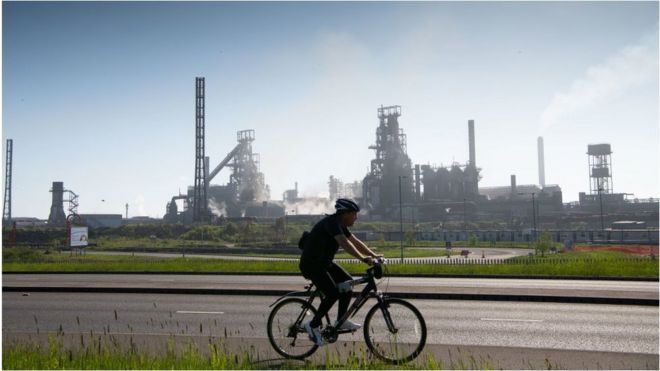
Tata Steel to cut 3,000 jobs in ‘severe’ market

Port TalbotImage copyright GETTY IMAGES
Image caption Port Talbot employs just under half of Tata’s 8,385 UK workforce

Tata Steel plans to cut as many as 3,000 jobs across its European business in another bid to come to terms with a “severe” international steel market.

The company wants to focus on higher-value products, it said, adding there would be no plant closures.

About two thirds of the job cuts will be office-based, it added.

The announcement comes after a merger with German rival Thyssenkrupp was blocked during the summer. Bosses had hoped the deal could reduce costs.

“Today we are highlighting important proposals towards building a financially strong and sustainable European business,” said Henrik Adam, chief executive of Tata Steel in Europe.

“We plan to change how we work together to enable better cooperation and faster decision-making. This will help us become self-sustaining and cash positive in the face of unprecedented severe market conditions, enabling us to lead the way towards a carbon-neutral future.”

The business employs about 20,000 people and is owned by India’s Tata.

Port Talbot steelworks employs just under half of Tata’s 8,385-strong workforce in the UK.

Wales’ economy minister Ken Skates said: “I am seeking an urgent conversation with Tata to establish what this means for workers in Wales and how we can support those affected by this announcement.”

Last week, Chinese firm Jingye agreed to invest £1.2bn in British Steel as it signed a deal to rescue the UK steelmaker.

It also said it would seek to “preserve thousands of jobs in a key foundation industry for the UK” but did not put a number on how many would be saved.

British Steel employs about 4,000 people in Scunthorpe and Teesside.

It has been kept running by the government via the Official Receiver since May when the company went into liquidation.

Source: The BBC

31/03/2019

How a Chinese firm is using artificial intelligence to zero in on liver cancer

  • Genetron Health has developed a technique that detects the disease earlier than other methods
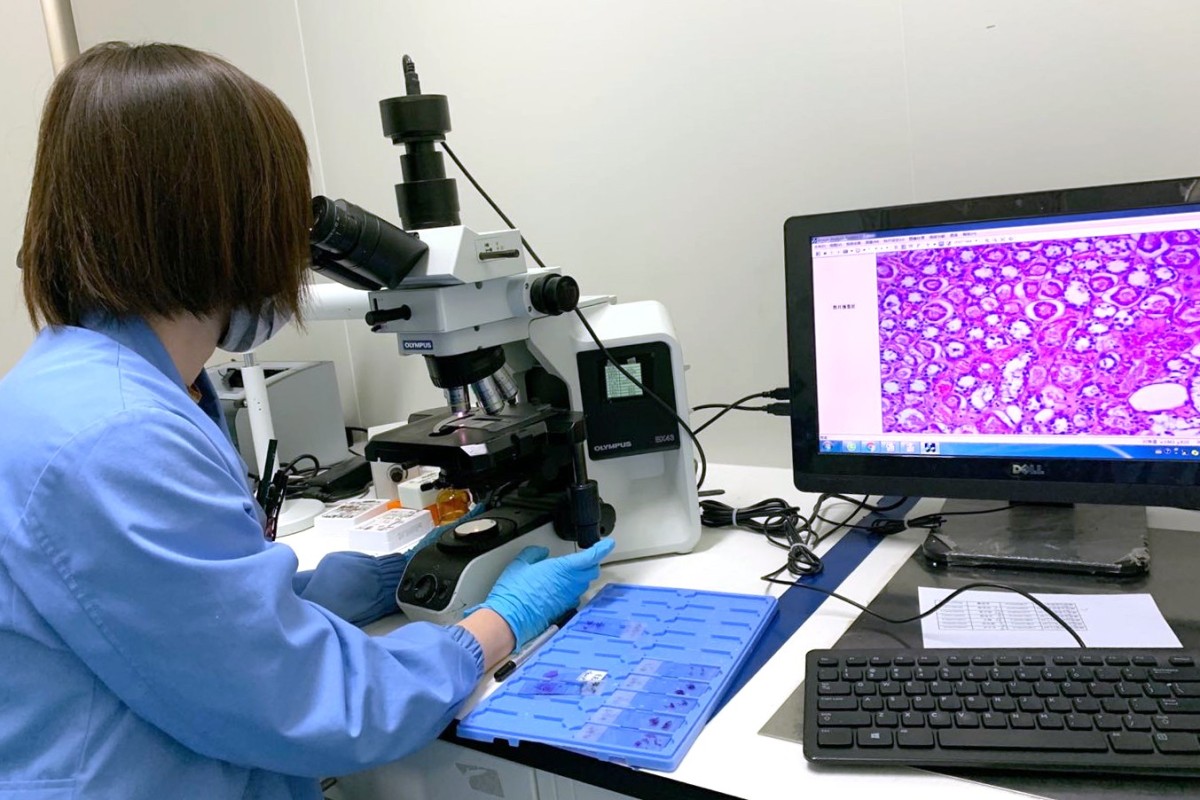
Liver cancer is generally difficult to detect in its early stages. Photo: Handout

A Chinese genomics firm says it has found a way to detect liver cancer linked to hepatitis B months before it can be picked up by other methods.

The conclusion was based on a study by Genetron Health and the Chinese Academy of Medical Sciences Cancer Hospital using a method called HCCscreen, which applies artificial intelligence to look for tumour-related mutations in DNA in blood.

The researchers found that the new method could pick up early signs of the cancer in people who had tested negative based on traditional alpha-fetoprotein (AFP) and ultrasound examinations.

Genetron Health chief executive Wang Sizhen said early detection was important because it significantly increased the chances of survival.
“The study is a breakthrough in genomics technology and it’s likely to help hepatitis B virus carriers, whose risk of liver cancer is much higher,” Wang said.
The researchers first used AI technology to identify biomarkers common in known cases of a type of liver cancer called hepatocellular carcinoma, or HCC.
The team then developed the HCCscreen technique to look for those markers and used it on 331 people with hepatitis B who had tested negative for liver cancer in AFP and ultrasound exams.
Genetron Health chief executive Wang Sizhen says early detection is important because it significantly increases the chances of survival. Photo: SCMP

Twenty-four people tested positive with HCCscreen and were tracked over eight months, with four eventually being diagnosed with early-stage liver cancer.

four patients had surgery to remove the tumours and the other 20 in the positive group had a second HCCscreen test, with mixed results. Wang said all participants in the group of 20 would continue to be monitored.

“This is the first large-scale prospective study on early diagnosis [of liver cancer],” he said.

The results were published in the Proceedings of the National Academy of Sciences earlier this month.

There are about 93 million people with hepatitis B in China and carriers of the virus have a much higher risk of developing liver cancer.

China’s race to test ‘mutation-free’ gene-editing technology on cancer patients

Liver cancer is generally difficult to detect in its early stages, and twice-yearly ultrasounds and AFP tests for the disease are recommended for high-risk groups such as people with hepatitis B virus infections, or cirrhosis – scarring of liver tissue.

But in China, most HCC cases were detected at advanced stage, the authors of the study wrote.

According to the National Cancer Centre, 466,000 people were diagnosed with liver cancer and 422,000 died from the disease in China in 2015.

Wang said the company aimed to commercialise the technology but even then it would take time to ensure it was affordable.

“[High-risk] people need to have regular screening. This is important for public health but the technology must be affordable enough to be widespread,” Wang said. “The ultimate goal of this study is to develop a product that people in China can afford.”

Source: SCMP

26/03/2019

How a Chinese firm fell victim to intellectual property theft

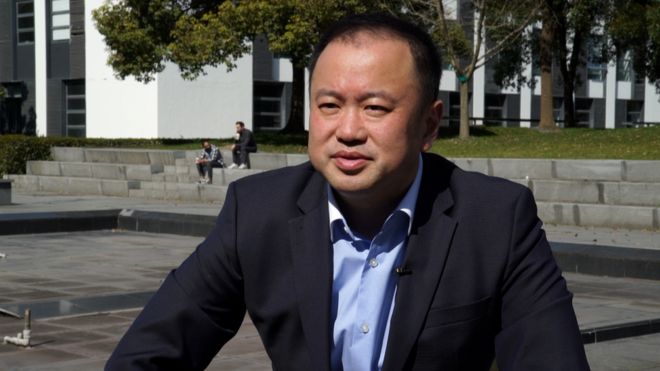
Frank Liu, head of Intco in Shanghai?
Image captionFrank Liu says his company Intco was the victim of intellectual property theft

There was no break in, no hold up. No glass was smashed. But the factory on the outskirts of Shanghai was the scene of a very modern crime. Someone stole a hoard of intellectual property.

“A couple of years ago one of my IT managers copied ten thousand pages of my entire company’s profile,” Frank Liu told me. His company Intco has been around for 25 years.

He told me the stolen download included “our technology information, our customer list, our purchasing and supply information. Everything.”

Intco is a business that makes medical devices, skirting boards and photo frames. I visited its offices at a business park in Shanghai, and a factory that sits either side of a tree-lined road south of the city.

The company recycles polystyrene waste sent to China from all over the world. Then, using heat moulding and imprinting techniques, it turns it into an array of products which end up on the floors of houses in Brazil or Russia, or hanging on walls displaying photos in the US and Britain.

“We actually have the record of how he stole it,” Mr Liu told me. “He just sold it to establish another company, as his investment.”

Mr Liu feels he has no recourse. He told me he went to the police but nothing happened. He said he still intends to pursue it.

His story is increasingly common here, for both local businesses and foreign firms.

Top officials from the US and China will hold their next round of trade talks this week and protecting intellectual property (IP) is a key demand for Washington. They argue American and other foreign companies in China have endured decades of theft and infringement.

Reacting to pressure

China has taken some steps to address the problem. The country only established copyright laws in the 1980s, but things have progressed relatively quickly since then.

China now has specialist IP courts, albeit – like every aspect of the judicial system – subservient to the ruling Communist Party. They are supposed to settle cases within 12 to 18 months.

Their creation was not due solely to outside pressure from foreign firms.

Chinese business figures like Mr Liu have also called for the country’s legal system to better protect the innovators and entrepreneurs who have turned China into much more than the “copycat” economy it was once labelled.

Benjamin Qiu, an IP lawyer with US law firm Loeb & Loeb, told me that the Chinese are now just as litigious as foreign firms.

Foreign firms are just as likely to win a case – a good case, Mr Qiu added – as domestic plaintiffs. In the past few years Lego and New Balance have both won high-profile cases against copycat manufacturers.

There is no doubt that the trade war with the US has sped up the pace of reform in China.

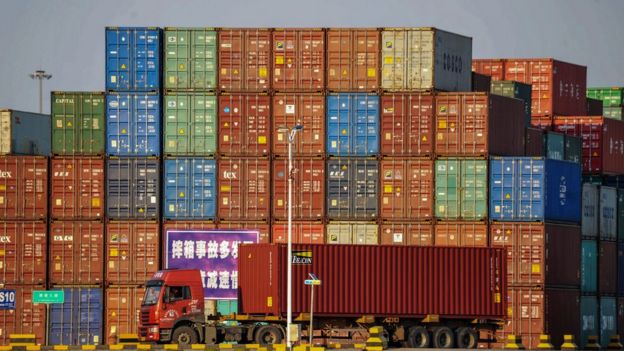
A truck transports a container next to stacked containers at a port in Qingdao in China's eastern Shandong province on October 12, 2018.Image copyrightGETTY IMAGES

President Xi Jinping recently led lawmakers, at their annual gathering in Beijing, in approving new rules for foreign investors.

The Foreign Investment Law states that the transfer of technology from foreign investors to any domestic partner must be voluntary. China has always defended this highly contentious practice by insisting it’s part of an agreed commercial arrangement.

The new law also bars government officials from passing on details of foreign investors IP.

A new era?

Now though comes the hard part – enforcement.

Mr Qiu told me the next step is “detailed regulation coming out after this law, and we want to see actual cases in local courts and also from enforcement agencies.”

If that follows, then he thinks “potentially the foreign IP owners will have more to protect [them] in China.”

Both the EU and American Chambers of Commerce welcomed the new law, but both also criticised what they said was ambiguity in the legislation. The Americans also had concerns that it was rushed through without proper consultation.

Many foreign companies have been stung over the years in China. Most have found the lure of the massive market, or what was once rock bottom labour costs, irresistible.

Some though feel the risk is too high.

A fruit industry executive recently told me his firm wanted to buy new conveyor belts for their farms in China, but the European manufacturers said no. They feared their systems would be copied here, and they’d be wiped out.

Mr Liu can’t do that. He is Chinese and wants to stay in China. But he has taken steps to try to prevent another IP theft.

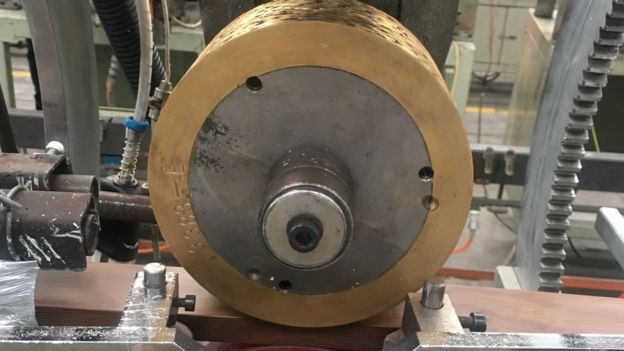
Production line at an Intco factory in Shanghai
Image captionProduction line used to create photo frames at an Intco factory in Shanghai

He is chief executive of the company he founded, but this year he told me he’s changing his title to include head of research and development. Because he can’t trust anyone else with the firms’ commercial secrets.

Protecting original ideas, techniques and information in China – “it’s a human right” he told me.

Source: The BBC

Law of Unintended Consequences

continuously updated blog about China & India

ChiaHou's Book Reviews

continuously updated blog about China & India

What's wrong with the world; and its economy

continuously updated blog about China & India