Chindia Alert: You’ll be Living in their World Very Soon
aims to alert you to the threats and opportunities that China and India present. China and India require serious attention; case of ‘hidden dragon and crouching tiger’.
Without this attention, governments, businesses and, indeed, individuals may find themselves at a great disadvantage sooner rather than later.
The POSTs (front webpages) are mainly 'cuttings' from reliable sources, updated continuously.
The PAGEs (see Tabs, above) attempt to make the information more meaningful by putting some structure to the information we have researched and assembled since 2006.
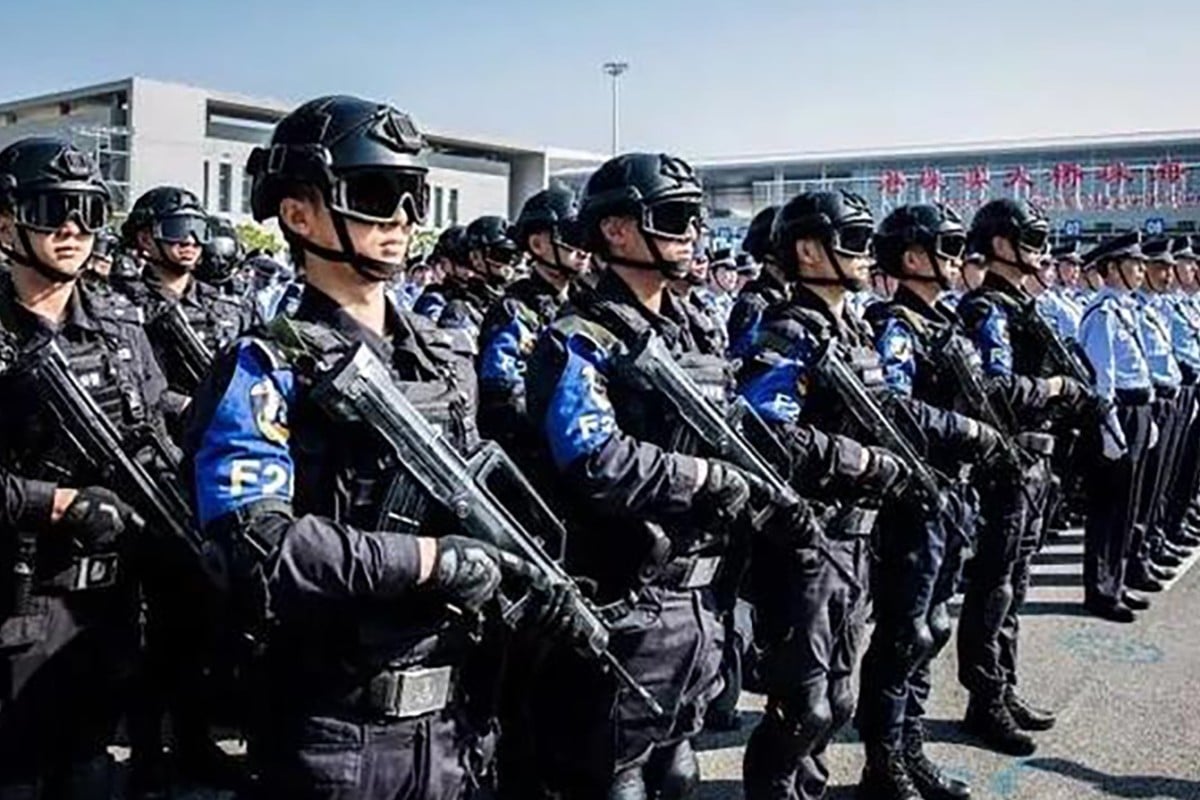
Zhuhai police, at the end of the world’s longest sea bridge, use body armour and tear gas in preparation for Macau’s 20th anniversary celebration
Hong Kong is just an hour’s drive away from Macau using the bridge
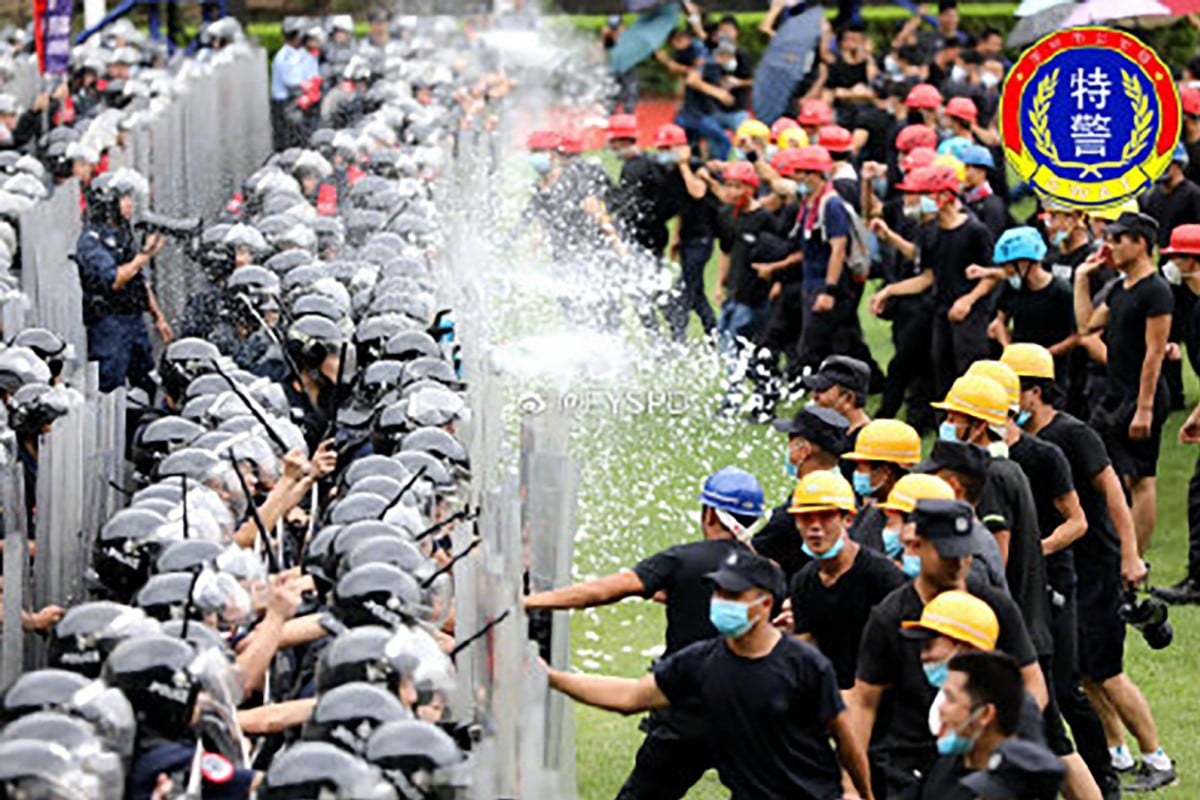
More than 1,000 police officers took part in the anti-terror drill in Zhuhai. Photo: Toutiao
Armed police in the southern Chinese city of Zhuhai held a massive anti-terror drill at its end of the Hong Kong-Zhuhai-Macau Bridge on Friday morning as part of its preparations for the 20th anniversary of the handover of Macau, when President Xi Jinping is expected to visit the city.
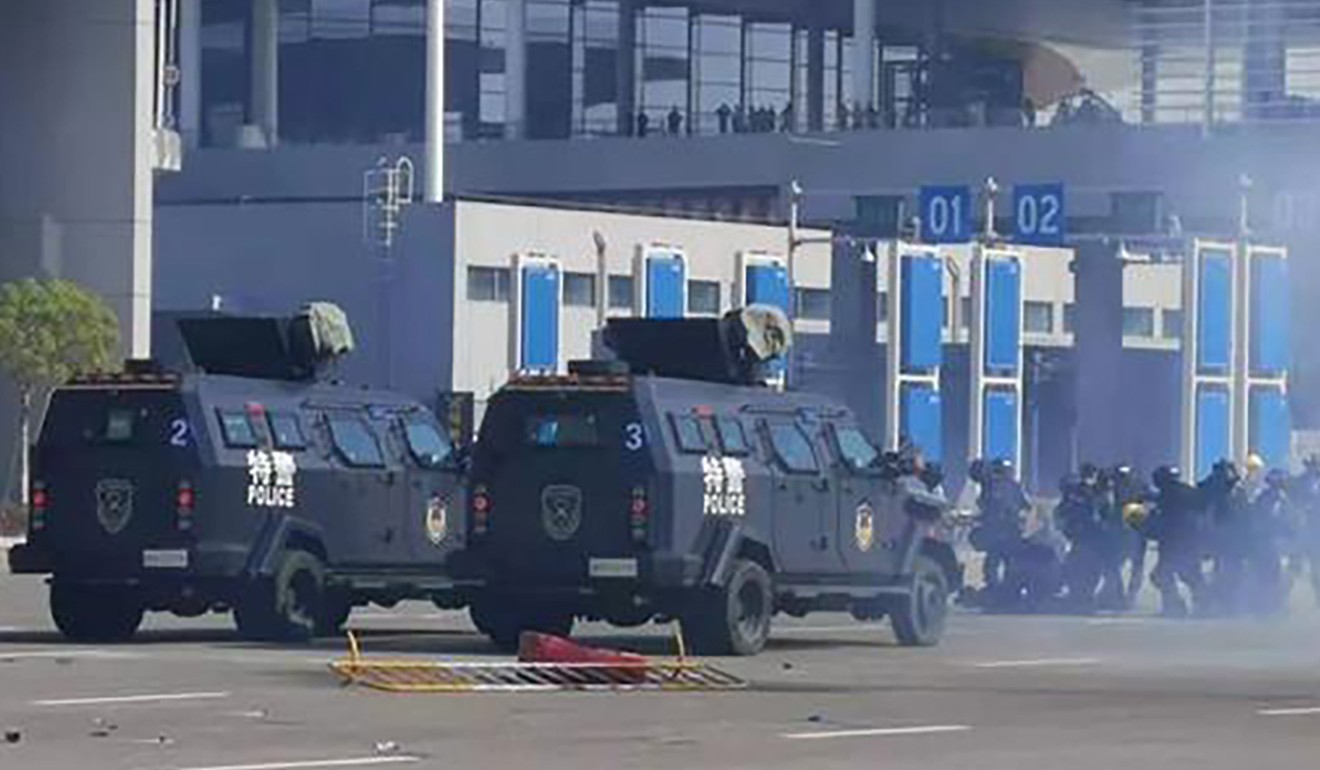
More than 1,000 police officers and 80 vehicles were involved in the exercise, amid
Photos circulated online showed officers in body armour, helmets and shields firing tear gas as they confronted a group of people carrying sticks and wearing black shirts and yellow helmets – attire associated with the protesters in Hong Kong, 60km (37 miles) away from Macau.
The drill was held three weeks before the 20th anniversary of Macau’s return to Chinese administration under the “one country, two systems” policy on December 20.
Police trucks and riot officers during Friday’s exercise at the Zhuhai end of the Hong Kong-Zhuhai-Macau Bridge. Photo: Toutiao
Security is expected to be tightened when Xi visits the city, in response to the violent clashes in Hong Kong over the past six months, which Beijing has repeatedly blamed on radical protesters.
The former Portuguese colony is connected to Hong Kong and its neighbouring city of Zhuhai, Guangdong province, by the world’s longest sea crossing bridge. It takes about an hour to drive from Hong Kong to Macau via the bridge.
Guo Yonghang, Zhuhai party chief, urged the local police to stay loyal to the party. “[Police] should be loyal and fulfil duty and mission to create a peaceful and stable political and social environment for the construction of the Guangdong-Hong Kong-Macau Greater Bay Area and the celebration of the 20th anniversary of Macau’s reunification to the motherland,” he said.
Macau was returned to China two years after Hong Kong and celebrations of its success under one country, two systems could be overshadowed by its neighbour’s anti-government protests which stemmed from opposition to proposed extradition legislation and have escalated into violence on the streets and in university campuses.
In August, two months after more than 2 million people in Hong Kong took to the streets to protest the now-suspended extradition bill, police in Shenzhen held at least three drills featuring anti-riot exercises involving tear gas, armoured vehicles and water cannon.
Television report shows how drivers are willing to pay more than US$20,000 for a sham marriage with someone who has a valid registration
City authorities ration the number of plates that allow people to use their cars in the capital as part of efforts to tackle pollution and congestion
Beijing has started limiting the number of plates issued as part of its efforts to tackle the city’s notorious pollution and congestion. Photo: EPA-EFE
Some desperate Beijing motorists are resorting to sham marriages to get round strict licence plate rules that are designed to limit the number of cars allowed on the city’s congested roads.
A report by state broadcaster CCTV that aired on Sunday night claimed that some drivers were willing to pay the equivalent of tens of thousands of US dollars to marry someone with one of the prized plates, have it transferred into their name and then get divorced.
Specialist agencies charge over 160,000 yuan (US$22,700) to help their clients obtain a licence this way for a petrol-driven car, or over 110,000 yuan for an electric-powered one, according to the report.
The scam is the result of a licence lottery first introduced in 2011 to tackle the Chinese capital’s notorious congestion and pollution.
Chinese driver arrested for doctoring number plate to spell out obscene phrase
Because of the strict limits on the number of Beijing number plates issued, there are now 2,600 applicants for every one issued for petrol-powered vehicles. Those who wanted a licence for an electric car may have to wait until 2028, the report said.
The government has also been steadily lowering the annual quota for new local licences from 240,000 in 2013 to 100,000 last year.
The owners of locally registered cars are also banned from using them on one day a week, which is determined according to the plate number.
Cars that do not have a Beijing licence plate face severe limits on driving in the city. The owners of these cars must apply for a permit that only allows them to use their cars for seven days at a time – and as of this month they are only allowed 12 permits a year.
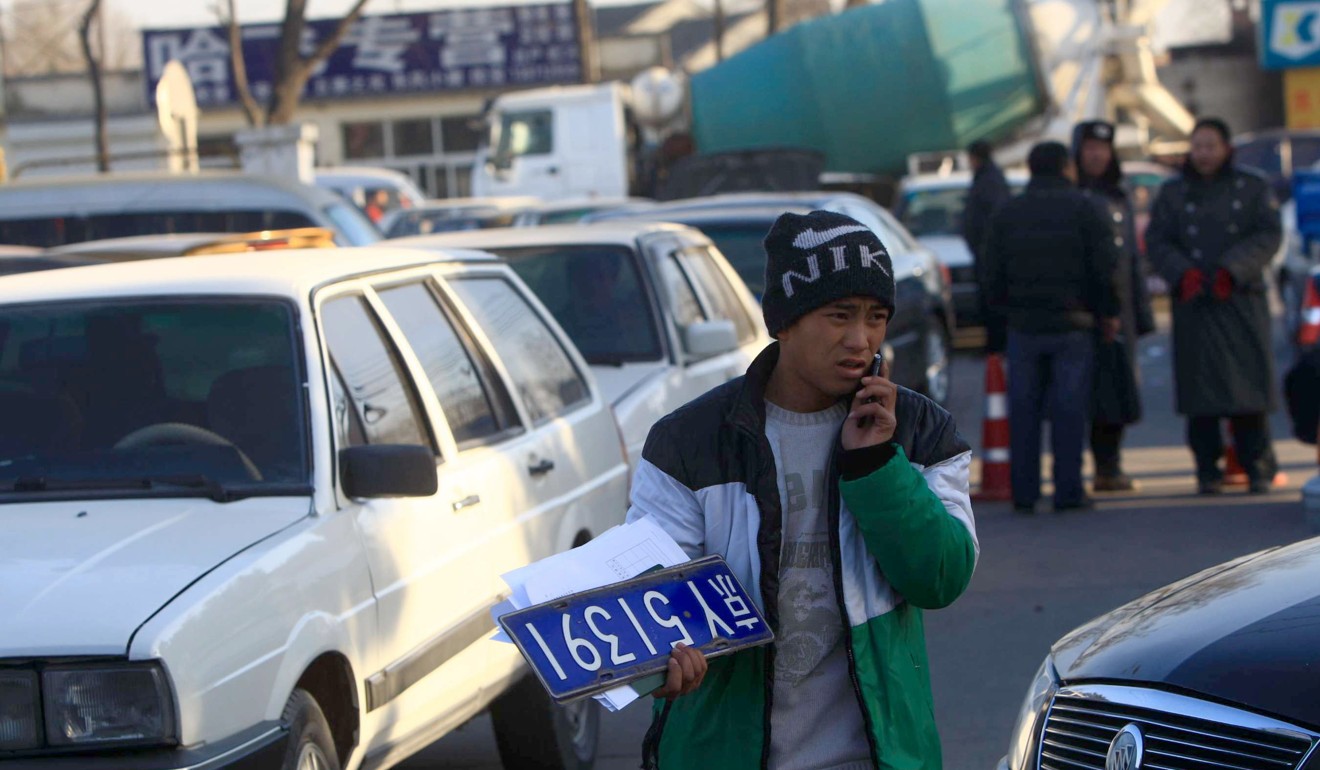
A man carries a number plate at a used car market in Beijing. Photo: AFP
The result is that many drivers have been looking for legal ways to get round the limits – with the sham marriages being one of the most extreme examples.
“We receive at least three or four clients a day asking to get a licence via fake marriages,” a manager at one agency told a CCTV reporter.
A staff worker helps go through all the procedures and if a suitable match is found, the process can be completed within 20 days.
Another loophole some are taking advantage of is to buy a car in the name of someone who has won the licence lottery, according to the agency.
Chinese police do U-turn on traffic crash after online crowd doubt official account
The actual user pays for the car in full, registers it under the licence owner’s name, and pays the latter a sum of money for using the licence – typically 20,000 yuan a year, 49,000 yuan for three years or 69,000 for a five-year deal.
In many cases, the two parties sign an agreement to limit the risk of a protracted dispute, but one judge warned that this was still a risky business.
Wang Lidan, a judge at Haidian District People’s Court in the northwest of the capital, told the programme makers that he knew of one case where a woman had paid a man with a Beijing licence to marry her, only for him to vanish after receiving the money.
Not only did the woman miss out on getting the licence but she faced an extra legal headache in getting a divorce.
Under Chinese law she had to first publish a notice about his disappearance in a newspaper and then wait three months before the divorce could go through the courts.
Record price for Beijing’s cubicle home shows desperation for hukou
Read more
Congestion or consumption? Beijing ponders trade-off on car purchases
Read more
Pollution alarm as tourism contaminates home of China’s hairy crab
Facial recognition technology helped officers narrow down search to building in Nantong, but they were unable to tell which room suspect was in
Police went door-to-door hunting for the smell of hotpot after fugitive was spotted buying ingredients at market
Eating hotpot can be a hot and sweaty business. Photo: Shutterstock
China’s facial recognition technology is now so advanced that it can positively identify 98.1 per cent of human faces and within 0.8 seconds, according to China Daily.
But the latest case of unconventional detective work comes from the eastern province of Jiangsu, where local police used their faces, not their target’s, to locate their man – specifically their noses. Call it olfactory recognition.
Jiangsu police had been looking for a man named Guo Bing, who was suspected of gang crimes, fraud and extortion and had been on the run in the city of Nantong since police there cracked down on gang-related activity in late May, local media reported on Tuesday.
Police used facial recognition to figure out which Nantong building Guo was living in, but they did not know which flat.
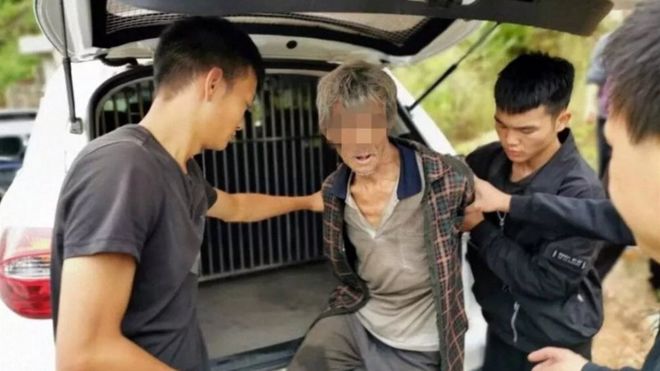
Authorities in Jiangsu province managed to locate a wanted fugitive by tracking the distinctive scent of hot pot after learning he had recently purchased ingredients for the dish.
“It was difficult to tell which room he lives in, because there are too many residents in the same building,” Ge Lei, a local police detective, told the local television station, “and the busy surroundings didn’t allow us to do more.”
So they put in 24-hour camera surveillance and spotted Guo going to a local market on Saturday afternoon and buying ingredients for hotpot.
“We saw him buying vegetables and hotpot soup base at a market one afternoon,” Ge said, “so we guessed he was going to have hotpot that day.”
Police narrowed down the search to the seventh floor of the building, then started sniffing at each door. When they registered the unmistakable aroma of hotpot, they knew they had their man.
Television footage of the bust showed police descending on the surprised and shirtless man – eating hotpot is a messy and sweaty business – and being hauled away.
Suspects rounded up after people complain of being duped into making donations to support non-existent temples
One woman says she handed over US$4,600 after being told that charitable gesture would help her live to be 400
One victim of the alleged scams said she was told she could live for 400 years if she handed over her money. Photo: Thepaper.cn
Police in southeast China have detained 100 people on suspicion of being part of a criminal network that cheated members of the public out of 50 million yuan (US$7 million) by preying on their superstitions and generosity.
Authorities in Ningguo, Anhui province launched an investigation in May after receiving a number of complaints about the activities of several groups posing as fortune-tellers on social media platforms like Weibo, financial news outlet Caijing reported on its website on Tuesday.
One of the groups, which operated on the Twitter-like service under the name “Kanxiang Zen Master”, was run by a local man surnamed Zhang and had 12 million followers, the report said.
Adverts for online fortune-telling services are common in China. Photo: Thepaper.cn
In one alleged scam, members of the group were told they would receive good luck if they made a donation to support a “famous temple”. But when a man who gifted 10,000 yuan via WeChat Pay checked on the address of the recipient, he found it was a residential address in the city of Xuancheng and not a place of worship, the report said.
When police investigated, they found Zhang had links to seven criminal groups in Anhui and neighbouring Jiangsu province, which between them operated about 60 fortune-telling accounts on Weibo, several of which had more than 10 million followers. The Kanxiang Zen Master account has since been removed from the platform.
Six Chinese wanted for internet scam arrested in Vanuatu
A number of the gangs were registered as media companies and operated as semi-professional organisations with formal recruiting procedures and regular conferences to plan their fraudulent activities, the report said, adding that they had been operating for at least two years.
Police in July staged a series of raids to round up the suspects and confiscated associated equipment, including computers, vehicles and mobile phones, the report said.
Authorities in Ningguo have appealed for more victims to come forward.
A separate report by Shanghai-based news outlet Thepaper.cn said that some of the suspects also used e-commerce sites such as Taobao and the messaging service WeChat to promote their fortune-telling services.
Taobao is owned by Alibaba Group, which also owns the South China Morning Post.
In one case, a woman from the city of Changshu in Jiangsu said she made multiple payments – totalling about 33,000 yuan – to a fortune-teller she met on WeChat who said the money would be used to buy incense for use in offerings to the gods.
She said she reported the alleged fraud after starting to doubt the fortune-teller’s claims, including one that said if she made the donations she could live for up to 400 years.
Alibaba, Weibo and Tencent, which owns WeChat, have been contacted for comment.
Security forces shown tackling ‘demonstrators’ wearing black shirts
‘Anti-mob’ tactics prepare forces for the 70th anniversary of the People’s Republic
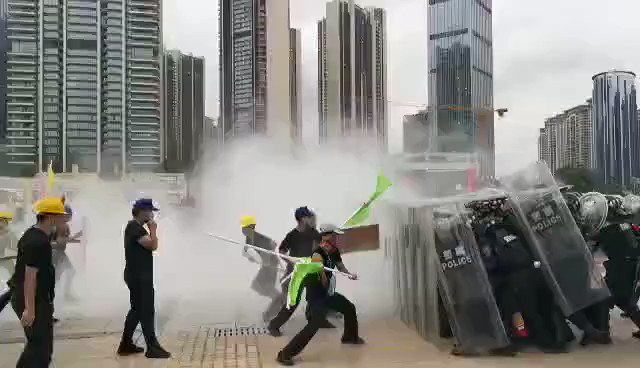
Shenzhen police broadcast live footage of a security exercise involving 12,000 officers rehearsing anti-riot drills. Photo: Weibo
More than 12,000 police officers assembled in Shenzhen in the southern Chinese province of Guangdong on Tuesday for a drill that included anti-riot measures similar to those seen on the streets of Hong Kong.
The drill was part of security preparations for the 70th anniversary of the People’s Republic of China on October 1, Shenzhen police said on the force’s Weibo newsfeed.
“A drill will be held to increase troop morale, practise and prepare for the security of celebrations, [and] maintain national political security and social stability,” police said.
China mobilises 190,000 police officers to prepare for 70th anniversary celebrations
In live videos of the police drills shown on the Yizhibo network, officers in body armour, helmets and shields confronted groups of people in black shirts and red or yellow construction safety helmets – similar to those worn by Hong Kong protesters – who were holding flags, banners, batons and wooden boards.
Global Times
✔@globaltimesnews
Shenzhen #police drill attracted unusual attention as it features scenarios that resemble the ongoing riots in #HongKong. #香港http://bit.ly/2YobnJc (Video: Shenzhen News Radio)
One of the banners read “return my hard-earned money” – a slogan often used by migrant workers in protest against unpaid salaries.
“The practice is complete with mature anti-mob tactics. The police forces can present an anti-mob formation, which is flexible, suitable for different situations, with accurate aim and effective control,” a narrator said during the live broadcast.
As the drill escalated and more “rioters” were deployed, police fired tear gas and smoke covered the training ground.
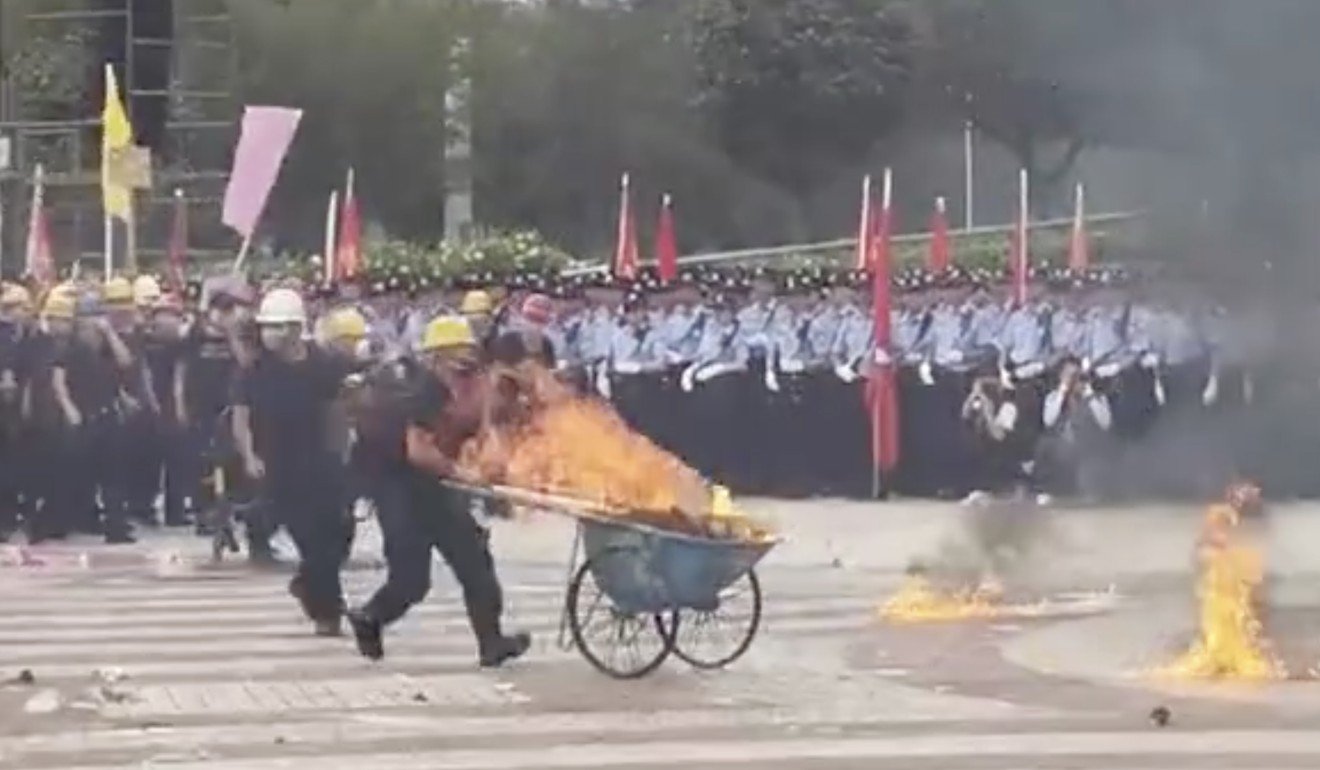
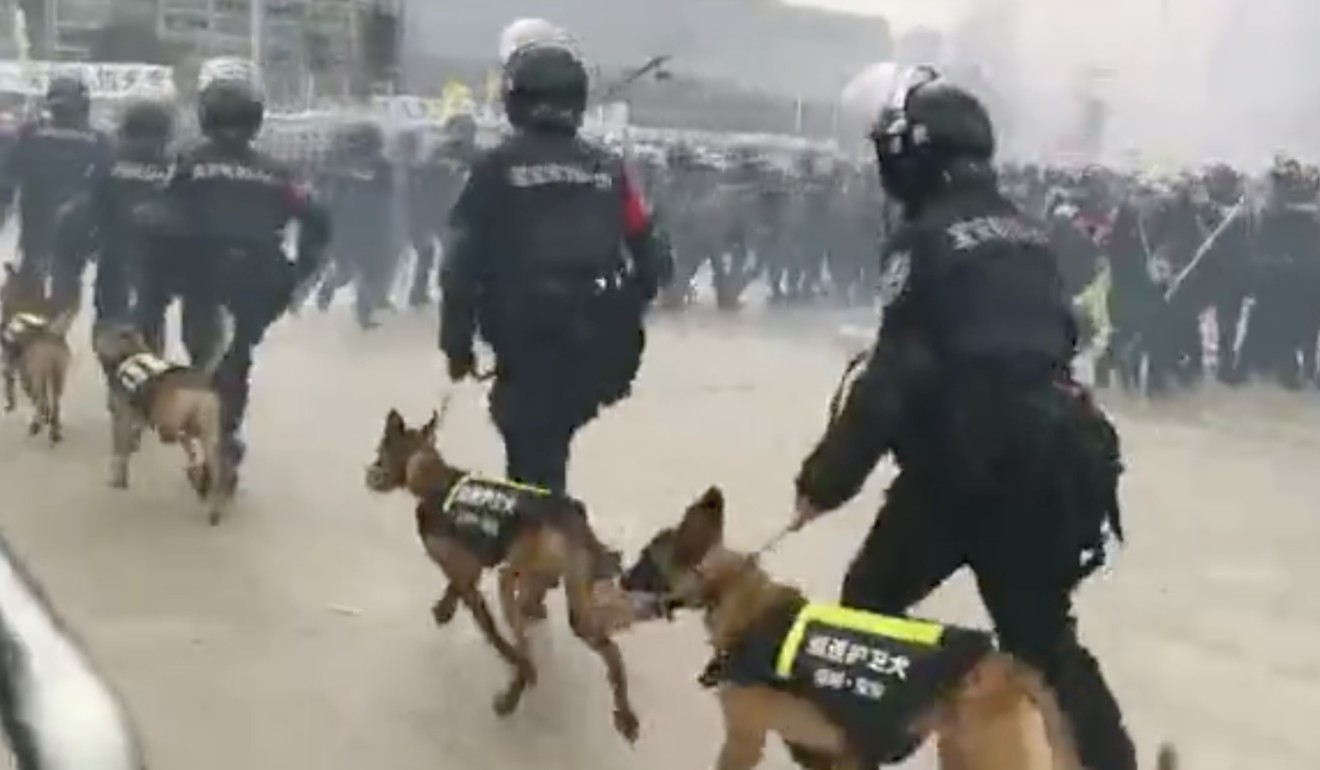
A few minutes later, the rioters fired home-made gas bombs then set bogies alight and drove them at the police lines. The officers changed formations and pressed the rioters, making arrests. Police handlers and their dogs were also on the scene.
A blazing bogie is driven towards police lines during Shenzhen police’s anti-riot exercise. Photo: Weibo
Other drills included anti-smuggling and search-and-rescue exercises involving personnel from the People’s Liberation Army.
The drill was presented as preparation for the 70th anniversary celebrations but it came amid continued violence in the streets of Hong Kong and two incidents of the Chinese national flag being thrown into Victoria Harbour.
Hong Kong has been engulfed in two months of turmoil stemming from opposition to the now-suspended extradition bill.
Police handlers and their dogs were deployed against people dressed like Hong Kong demonstrators. Photo: Weibo
“Is this hinting at Hong Kong?” a commenter on the Shenzhen police Weibo thread asked.
“We are doing drills today, and they can enter into real practice in Hong Kong in the future. We can send thousands of anti-mob squads over and strike hard at the radical traitors, those Hong Kong independence supporters,” another user said.
Since protests escalated in Hong Kong, Beijing has reiterated its “unflagging support” for embattled Hong Kong Chief Executive Carrie Lam Cheng Yuet-ngor and her administration to take lawful action to restore order, and warned that the city was entering “a most dangerous phase” with violence on the streets.
Streaming platform Huahua earned US$2.3 million in profit in five months, according to media report
Final two suspects arrested in Philippines, police say
Chinese police with the last two principal suspects in the Philippines on April 26. Photo: Weibo
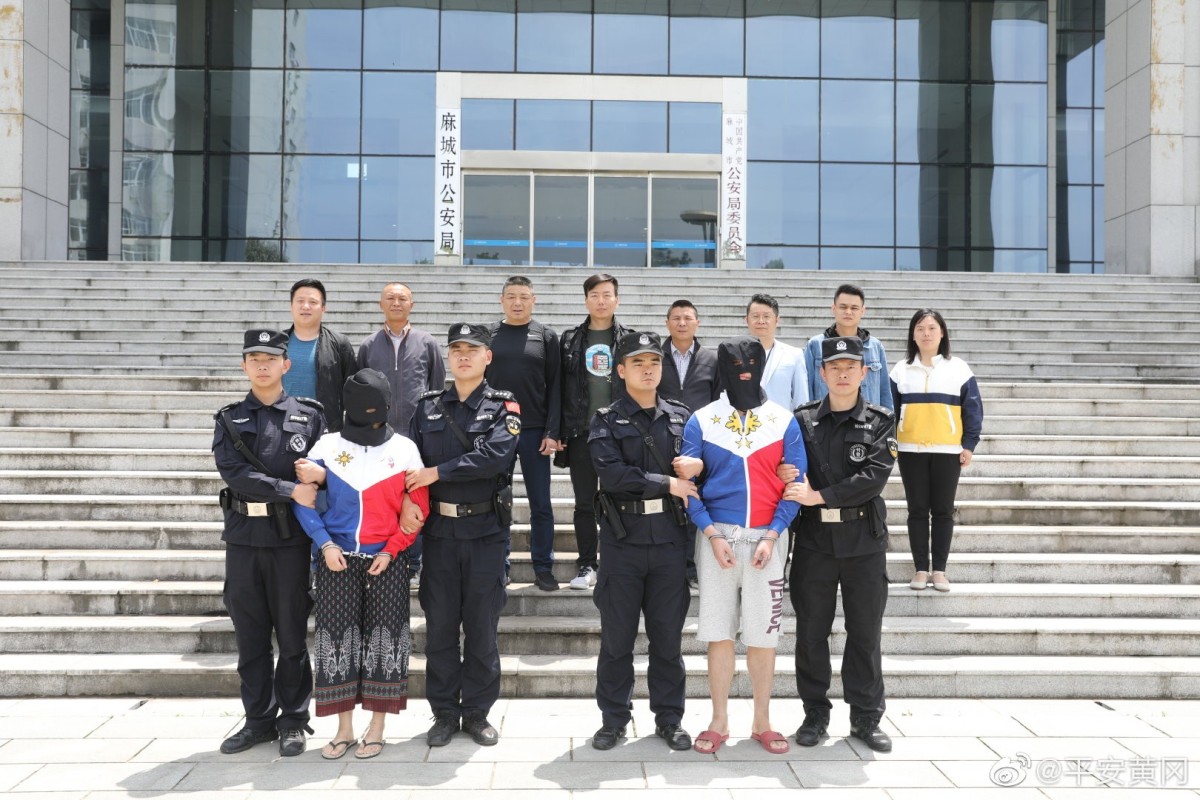
Chinese police have arrested 20 people from a cross-border group accused of operating illegal live streaming platforms to broadcast pornographic content, according to mainland online news outlet The Paper.
After an investigation lasting over a year, police in Macheng in central China’s Hubei province said they arrested the last two main suspects, a man surnamed Hong and a woman surnamed Li, in the Philippines on April 26.
platform, which was initially called Huahua, had more than 900,000 registered users, earning the group 16 million yuan (US$2.3 million) in profit in five months from November 2017, according to the report.
The Chinese government announced in February 2018 it was
against pornographic and illegal publications to foster a healthy online environment.The next month, Macheng police received a tip-off that people were distributing QR codes to download Huahua in chat groups on the popular Chinese messaging app QQ.
On the Huahua platform, live streamers gave erotic performances, with the most popular streamers drawing more than 2,000 viewers at a time and users able to make requests by paying up to almost 2,000 yuan (US$290).
The group had a structure and rules designed to avoid the police’s attention, the report said. Members did not know each other’s identities and each had only one point of contact.
Some recruited streamers, others promoted the app on social platforms to attract traffic, and members in Mongolia laundered money with foreign bank accounts, while the app’s appearance and servers were changed several times, the report said.
After 18 people were arrested by April 2018 across the country, including in Shanghai and Guangdong, the No 1 suspect, the Mongolia-based Hong, fled to South Korea then to the Philippines, where he met Li and they built a similar app, according to the report.
The report said Hong had owned a company in Shanghai focusing on developing video games before turning to pornographic live streaming to make money quickly when the gaming business struggled.
Police in Shenzhen look for clues to accident in driver’s medical records
Motorist complains of ‘sudden attack’ at time of accident
Police in Shenzhen, Guangdong province, are investigating a driver’s medical history after a fatal accident on Thursday. Photo: Weibo
Police in southern China have detained a motorist after three people were killed and seven injured in a car accident on Thursday night.
Officers said a car went out of control and struck pedestrians on a road in Nanshan district in Shenzhen, Guangdong province, at about 7.20pm. The 23-year-old driver, surnamed Liu, was taken into custody.
In a statement online, the Shenzhen public security bureau said blood and urine tests showed the driver was sober and drug-free. They said medicine for epilepsy was found in the vehicle.
Two dead, six injured in Japan after bus drives through pedestrians in Kobe
During questioning, Liu told officers he lost control of car because he had had “a sudden attack”, but did not elaborate.
Police said they were examining Liu’s medical records.
In China, people with epilepsy are not allowed to apply for a driving licence, according to regulations from the Ministry of Public Security.















 CHINDIA ALERT: You'll be living in their world, very soon