31/07/2019
Chinese President Xi Jinping (R) holds talks with visiting Colombian President Ivan Duque Marquez at the Great Hall of the People in Beijing, capital of China, July 31, 2019. (Xinhua/Li Xueren)
BEIJING, July 31 (Xinhua) — Chinese President Xi Jinping and visiting Colombian President Ivan Duque Marquez on Wednesday pledged to promote bilateral relations to a new high.
Source: Xinhua
Posted in Chinese President Xi Jinping, Colombian president, Ivan Duque Marquez, pledge, promote ties, Uncategorized |
Leave a Comment »
29/07/2019
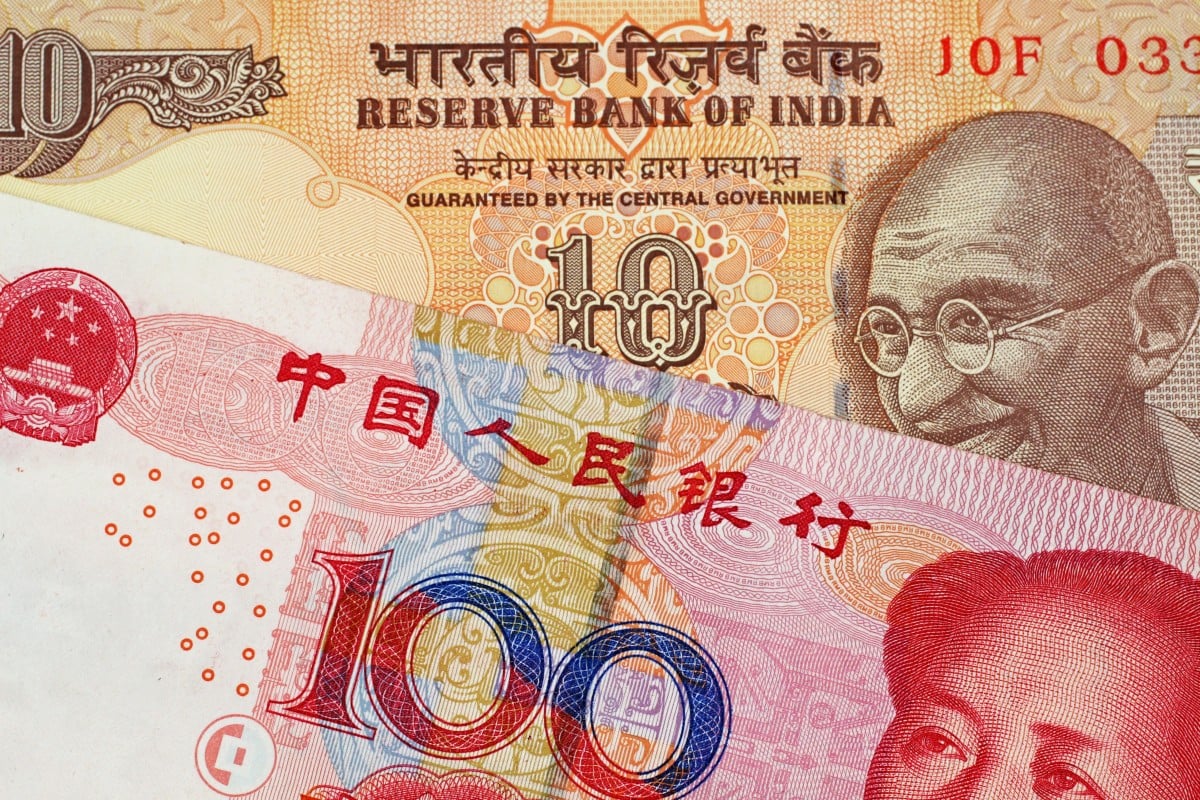
- China last year poured US$2.5 billion into firms in India, which is a healthy breeding ground for up-and-coming tech outfits
- Active cooperation between these investors and entrepreneurs holds a multitude of benefits for both sides, according to industry pundits
Chinese venture capitalists are injecting funds into a variety of cash-hungry Indian businesses. Photo: Shutterstock
C
hinese President Xi Jinping and
look set for another informal summit in October, and a key item on the agenda will be
.
Indian start-ups have become a major target for
, who have been looking to emulate their United States counterparts such as Tiger Global and Sequoia Capital that dominate the sector.
On top of this, a slowdown in start-up deals in China has nudged the country’s investors to look beyond their borders, and
’s affordable labour market and strong economic growth provide a healthy breeding ground for young tech outfits.
Can Bollywood be the bridge that binds India and China?
Led by heavyweights such as Shunwei Capital, Fosun International, Tencent Holdings, Xiaomi and Alibaba Group Holding – which owns the
South China Morning Post –
have been injecting funds into a variety of cash-hungry Indian businesses.
For many of these start-ups, the knowledge and technology of Chinese investors act as the backbone of their business Ntasha B, Venture Gurukool
Beneficiaries have included advertising firm Media.net, e-commerce operator Snapdeal, digital payment provider Paytm, online travel firm MakeMyTrip, messaging platform Hike, health tech start-up Practo and news aggregator Dailyhunt.
“For many of these
, the knowledge and technology of Chinese investors act as the backbone of their business, along with the operational expertise of Indians in the domestic market,” said Ntasha B, co-founder of Venture Gurukool, a mentoring platform for start-ups which works closely with Indian diplomatic missions in China.
Chinese President Xi Jinping and Indian Prime Minister Narendra Modi are set to meet again in October. Photo: Xinhua
She added that Chinese investors usually had a hands-on approach and were a bit inflexible, unlike their American counterparts, who gave some elbow room in hiring local teams.
A senior executive with an Indian start-up, who did not wish to be identified, said it was sometimes straightforward to convince Chinese investors as they could relate to Indian business models and requirements that were dissimilar to those from the Western world.
The world’s second-largest economy invested nearly US$2.5 billion in Indian start-ups last year, a figure that has touched almost US$1 billion so far this year, according to finance research firm Venture Intelligence. The number of such deals jumped from just one in 2013 to 27 last year.
What does Amazon’s China departure mean for its Indian e-commerce battle?
Indian start-ups are estimated to have raised US$3.9 billion from around the globe in the first six months of this year, and the inflow from Chinese behemoths played a key role in pushing them to turn east to source funding.
“What’s more interesting about [Chinese investors’] strategy is that they’re paying more attention to rural India. If you look at the companies they’ve invested in, a fair amount of their businesses target the rural segment,” said Sandeep Murthy, managing partner at venture capital firm Lightbox Ventures, which keeps a close watch on Chinese investments. He said the brisk economic activities in India’s tier two and tier three towns are more attractive to Chinese investors than India’s urban centres.
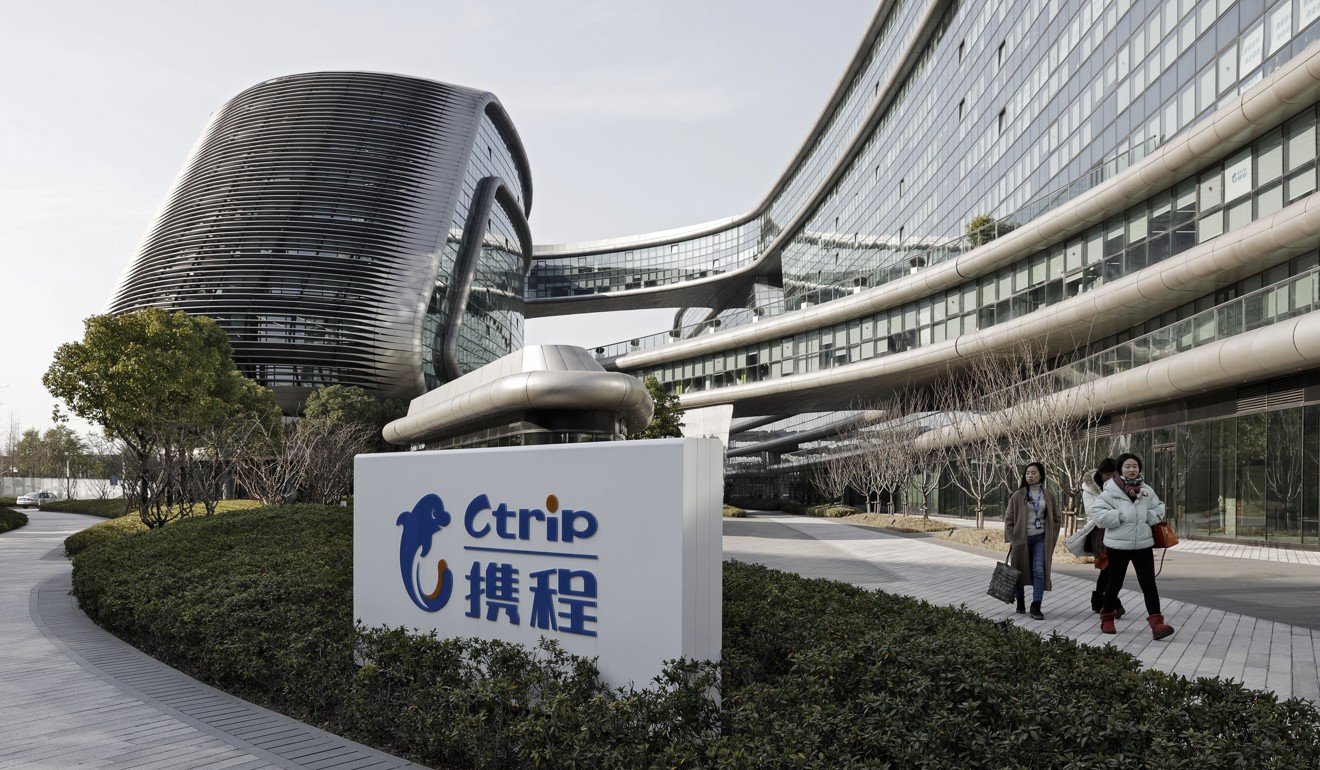
Ctrip, China’s largest online travel agency, is drawn to the size and rapid advancement of the Indian market. Photo: Bloomberg
For Ctrip – China’s largest online travel agency, which in April took a 49 per cent stake in MakeMyTrip – the appeal of India was its whirlwind technological advancement and the disposable income of its massive young population.
“[MakeMyTrip has] achieved fast growth in the online travel market and is becoming well recognised in the Indian market. Their comprehensive products and services, management team and the opportunities in India result in our confidence that they will continue to succeed,” said Wei Yuan Min, a member of Ctrip’s global team. Behind the US and China, India houses the world’s third-largest start-up ecosystem in terms of the number of companies. As for the number of unicorns – start-ups valued at over US$1 billion – India ranks third, offering a vibrant habitat for entrepreneurial ventures. The country is home to 32 such firms, with the addition of nearly half a dozen so far this year and 15 last year.
In India, one man took on Chinese firm ByteDance to shut down TikTok – and he wants to do it again
New Delhi expects there to be 12,000 tech start-ups in the country by next year, up from 7,200 last year. There were 1,200 new tech firms in the sector last year, according to industry body Nasscom.
One of those capitalising on this opportunity is the Beijing-headquartered technology company Xiaomi, which last year promised to pump US$1 billion into 100 Indian start-ups over the next five years. Most of these Indian firms are involved in businesses that are ancillary to Xiaomi’s key operations.
Chinese firm Xiaomi is banking on Indian start-ups to strengthen its own products. Photo: Reuters
“These start-ups help us in building a stronger product offering,” a Xiaomi spokesperson said. “The idea is to invest in start-ups which can further boost the mobile ecosystem in India. They could be into mobile gaming, service providers, value-added services or servicing the mobile industry.”
Xiaomi has been rapidly expanding its businesses in India, selling smartphones, television sets, security cameras, speakers, power banks, and more. India was the first market outside China where Xiaomi introduced its television sets.
Asked which sector would be Xiaomi’s focus for investment in the coming years, the spokesperson said the company was looking to focus on hardware-related start-ups in the ecosystem which could offer “robust solutions” to its Indian requirements.
Amazon, Uber and Google struggled in China, but Indian hotel chain Oyo is succeeding.
Here’s why
While hopes for India’s start-up sector are high, there have been some disappointments. There were reports this month that Alibaba, a major shareholder in Paytm, was unhappy with the Indian firm’s performance, pressuring it to realign its strategies and looking unlikely to provide fresh capital.
Paytm, a digital-payment-system unicorn, launched its own e-commerce Paytm Mall in 2016 when Walmart-backed Flipkart and Amazon were dominating the market.
However, the venture has yet to take off and is burning through cash.
Paytm refused to comment on the matter.
Paytm has attracted investment from Alibaba, but its Paytm Mall venture is struggling. Photo: Bloomberg
Chinese firms’ coordinated effort to enter the Indian start-up scene has made it easy for Indian ventures to access new sources of revenue. For instance, the state-run Industrial and Commercial Bank of China (ICBC), the country’s largest lender, launched an India-specific investment fund for Chinese investors in May last year.
Several Chinese venture capitalists are also providing platforms for entrepreneurs through fellowship schemes. Four Indian ventures – Zefo, Healthy Buddha, NowFloats and Grozip – took part in one such fellowship initiative run by Alibaba last year.
Gold, jewels, ‘Islamic’ finance: how India’s I Monetary Advisory built a US$365 million Ponzi scheme
India has warmly welcomed these initiatives. Amitabh Kant, chief executive of state-backed policy think tank Niti Aayog and a close aide of Modi, has publicly said China should become the topmost investor in its neighbour.
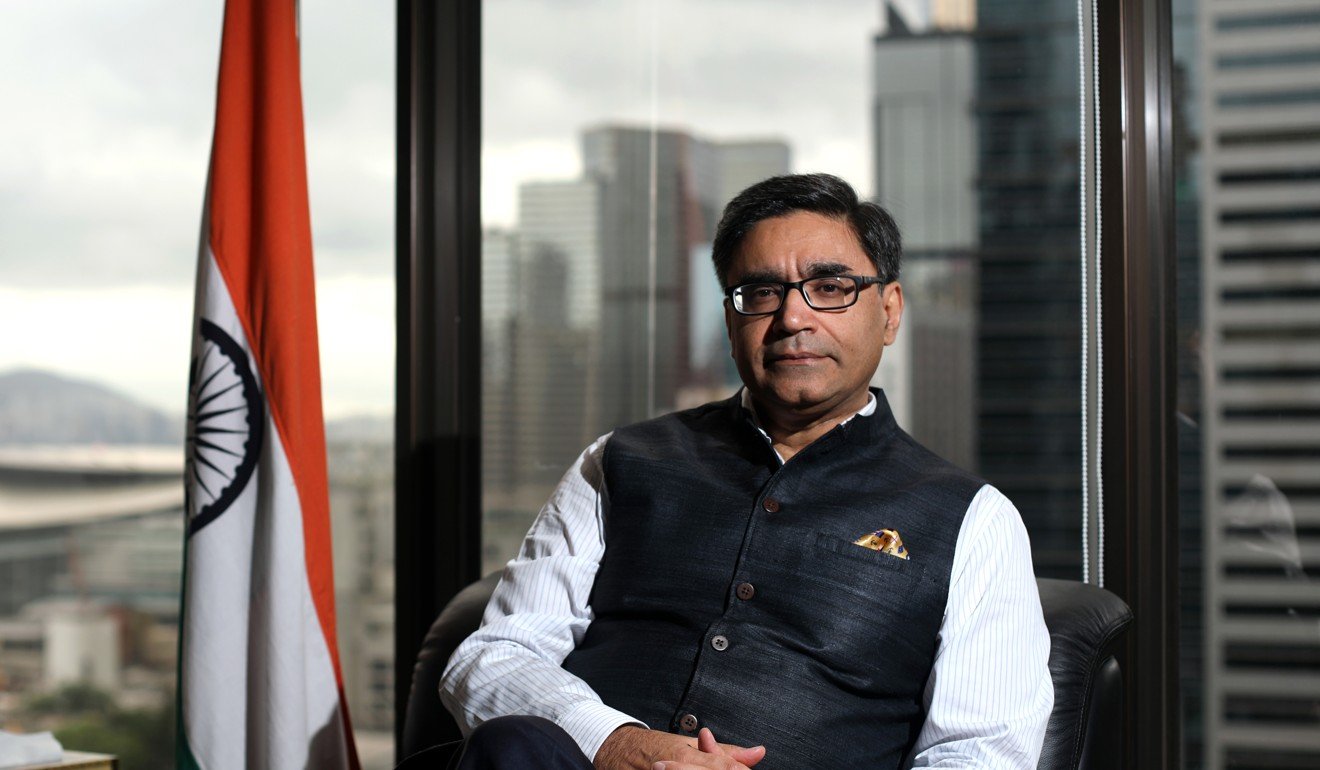
Vikram Misri, India’s ambassador to China, has also been pushing for increased economic cooperation and Chinese investment since he took charge in January, despite expressing concerns over New Delhi’s widening trade deficit with Beijing.
Vikram Misri, India’s ambassador to China, is looking for more economic cooperation between the two countries. Photo: Xiaomei Chen
The increased Chinese investment in Indian ventures has coincided with the Modi administration’s 2015 launch of the Startup India initiative, an umbrella scheme aimed at easing related activities through measures such as tax exemptions and simplified paperwork.
Industry pundits say active cooperation between Chinese investors and Indian entrepreneurs holds a multitude of benefits for both sides.
“The cooperation gives Chinese investors global scale and opportunity to diversify their investments,” said Neil Shah, partner and research director at the technology market research firm Counterpoint.
The cooperation gives Chinese investors global scale and opportunity to diversify their investmentsNeil Shah, Counterpoint
“For Indian start-ups, this gives cross-border learning, guidance from their global investors on dos and don’ts, tactical and long-term strategy, how to create value, run operations efficiently as well as expand beyond India.”
Nilaya Varma, partner and leader of markets enablement at KPMG India, said there was a cultural shift happening in the country where young Indians brimming with ideas wanted to pursue their dreams rather than work for someone else. This brought out the entrepreneurial spirit of this generation, he said.
“The knowledge, concepts, ideas and innovations of the small start-ups in India will have a global appeal. So it makes a lot of sense for Chinese big players to invest here,” he said.
Source: SCMP
Posted in Alibaba Group Holding, Amazon, Beijing, Bollywood, Bytedance, Chinese money, Chinese President Xi Jinping, Counterpoint Research, E-commerce, Flipkart, Fosun International, Google, Grozip, Healthy Buddha, I Monetary Advisory, India’s ambassador to China, Indian Prime Minister Narendra Modi, Indian start-ups, Industrial and Commercial Bank of China (ICBC), KPMG India, MakeMyTrip, Nasscom, New Delhi, NowFloats, online travel agency Ctrip, OYO, Paytm, Paytm Mall, Ponzi, powering, Sequoia Capital, Shunwei Capital, south china morning post, Tencent Holdings Ltd, Tiger Global, TikTok, Travel agency Ctrip, Uber, Uncategorized, unicorn, United States, Vikram Misri, Walmart, Xiaomi, Zefo |
Leave a Comment »
28/07/2019
- Chinese Foreign Minister Wang Yi wraps up tour of Brazil and Chile, as Colombian president heads for Beijing
- Ecuador president tells US Secretary of State Mike Pompeo ‘smaller countries pay when the big ones fight’
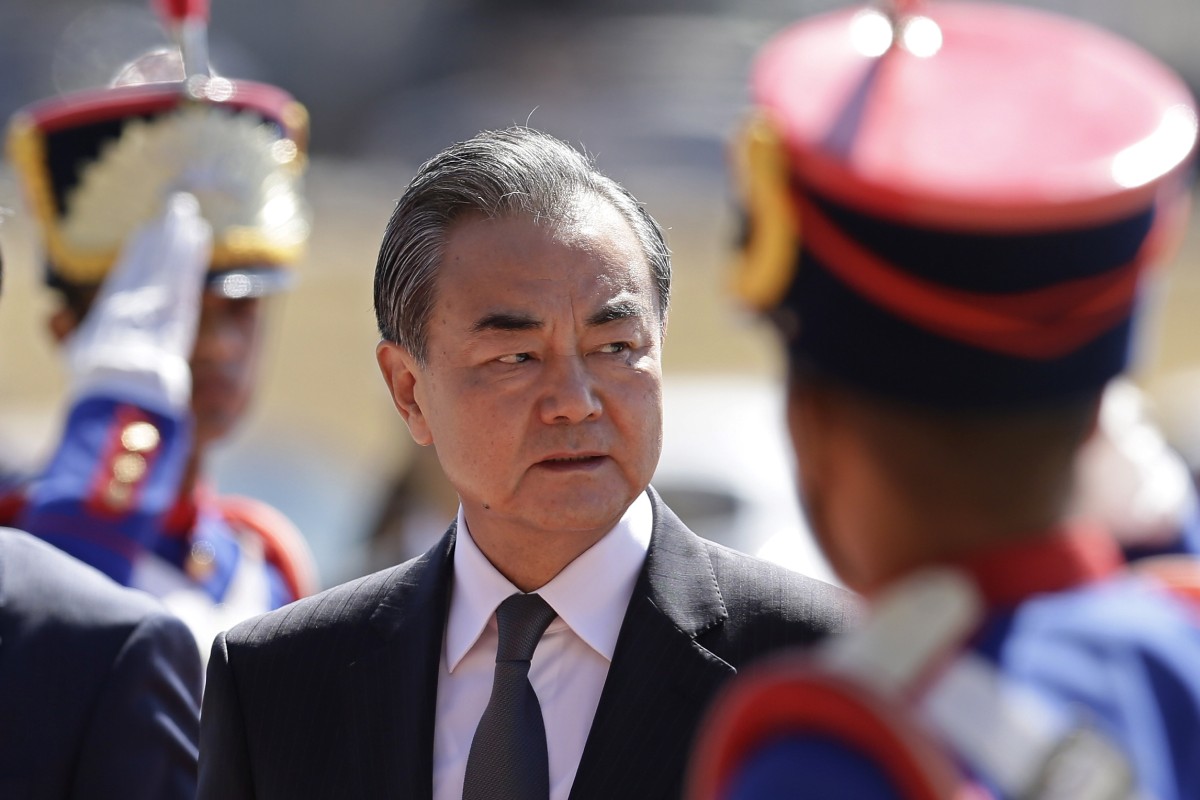
Chinese Foreign Minister Wang Yi is greeted by an honour guard as he arrives at the Itamaraty Palace for a meeting with his Brazilian counterpart Ernesto Araujo on Thursday. Photo: AP
Latin American countries are caught in the middle of a geopolitical tug of war between Beijing and Washington as China boosts its ties in the region in a bid to counterbalance the effects of its trade war with the US.
China’s Foreign Minister Wang Yi wraps up a tour of Latin America on Sunday which began last week in Brazil and ended with an official visit to Chile. He returns to Beijing on the same day Colombia’s President Ivan Duque Marquez arrives for a three-day state visit to China which will include a meeting with Chinese President Xi Jinping.
Wang was in Brazil for the latest summit of foreign ministers from the BRICS countries – an association of emerging countries made up of Brazil, Russia, India, China and South Africa – as well as the third China-Brazil foreign ministers’ comprehensive strategic dialogue with Brazilian Foreign Minister Ernesto Araujo.
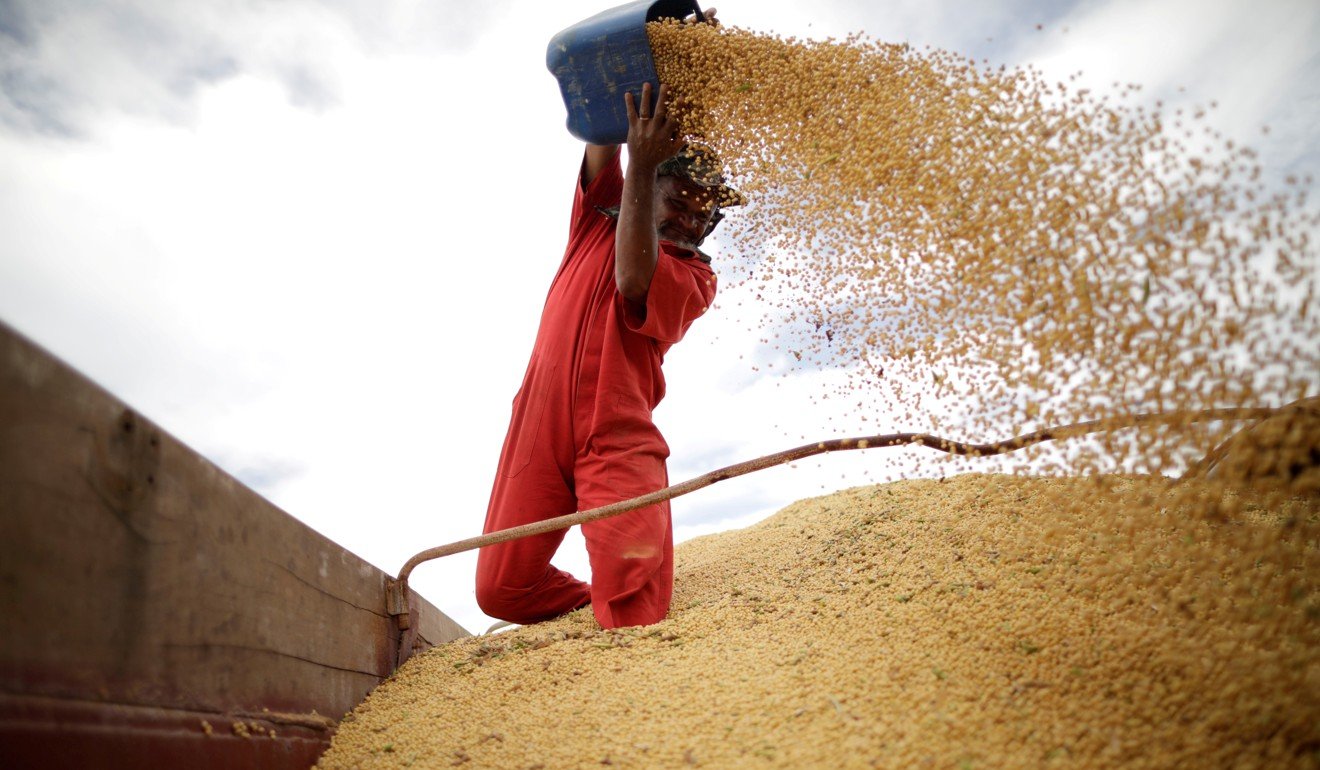
China has overtaken the US as Brazil’s largest trading partner, with Brazilian soybeans – one of the country’s biggest exports – and other agricultural products replacing American imports since the start of the US-China trade war a year ago.
Brazilian soybeans – one of the country’s biggest exports – and other farm products are being sold to China as a result of the trade war. Photo: Reuters
The growing importance of China to Brazil’s economy has created a difficult position for President Jair Bolsonaro, who accused Beijing of trying to buy Brazil during his election campaign, but changed tack on assuming office in January.
In March, Bolsonaro called China his country’s “main partner, politically as well as economically and commercially” and announced plans to travel to Beijing this year, a visit which was confirmed on Tuesday for late October.
China is now Latin America’s second largest trading partner with bilateral trade at US$307.4 billion, growing 18.9 per cent over the previous year, according to China’s ministry of commerce, in a relationship focused on commodity imports, including mining products like copper and energy, as well as soybeans and other agricultural goods.
While the US and China have tentatively agreed to resume talks in Shanghai next week, China and Latin American countries are likely to continue deepening their trade relations as production chains realign as a result of the trade war, according to Gustavo Oliveira, assistant professor of global and international studies at the University of California, Irvine.
“This means Chinese imports of Latin American agricultural and mineral commodities, and Latin American imports of Chinese manufactured products and hi-tech, might contribute to China’s ability to stand its ground against US pressure,” he said.
China in Latin America: partner or predator?
Oliveira said domestic contradictions in most Latin American countries complicated relations with China, as few leaders had the capacity to press or leverage China for much. “Unfortunately, therefore, most in this crop of Latin American leaders are basically placing themselves as junior partners or pawns in the geopolitical tug of war between the US and China.”
US Secretary of State Mike Pompeo put the pressure on Latin American countries over their relationship with China during his four-day tour of the region last weekend, when he visited Argentina, Ecuador, Mexico, and El Salvador.
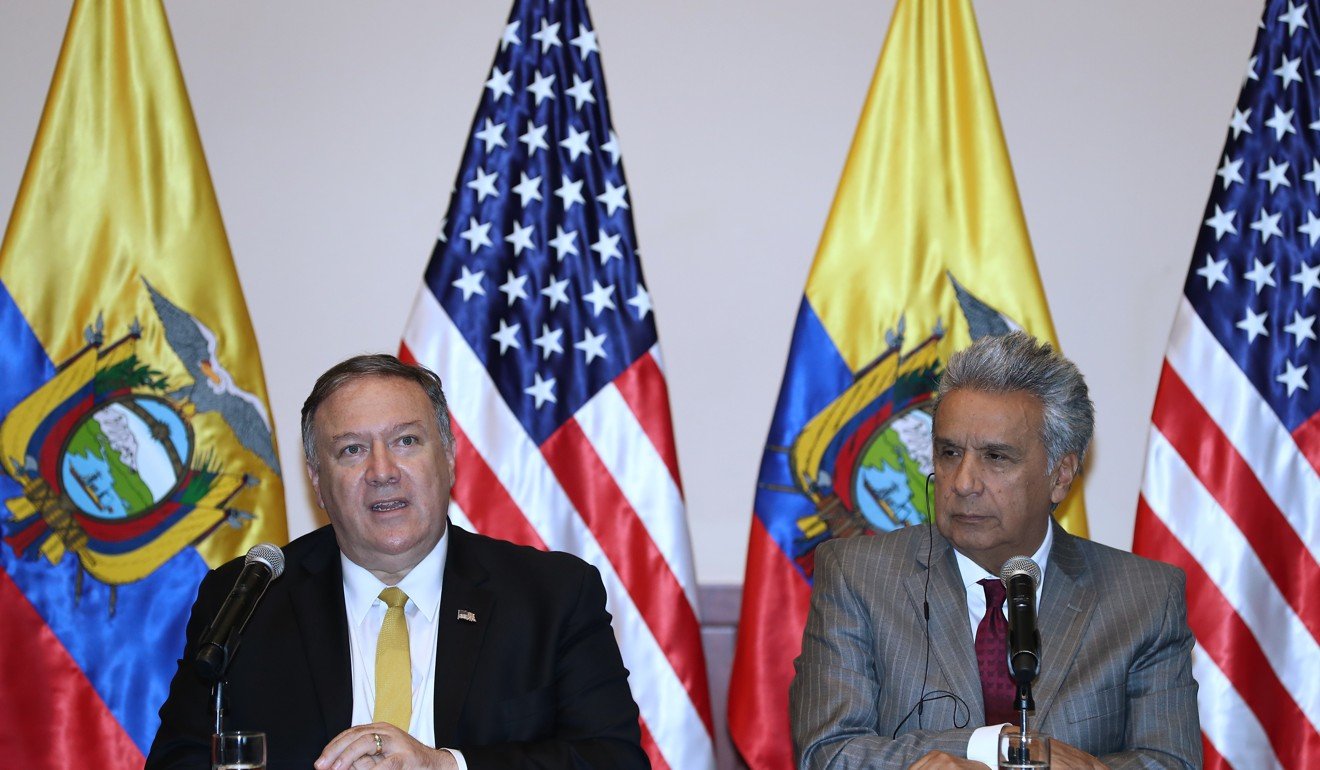
In a joint interview with Pompeo during the visit, Ecuador’s new President Lenin Moreno defended the country’s China ties, and urged Washington and Beijing to resolve their conflicts for the benefit of other nations in the region.
“We hope that the US and China, the greatest powers in the world now, will find agreement easily because, unfortunately, when the big ones are discussing or fighting and have conflicts, the ones that are paying for all of that are the smaller countries,” he said.
“Now, when two elephants fight, the ones who lose are the insects who are of course being crushed by the elephants in the attempt to evade them.”
US Secretary of State Mike Pompeo (left) and Ecuadorian President Lenin Moreno hold a joint press conference during Pompeo’s tour of Latin America on July 20. Photo: EPA-EFE
Pompeo blasted China’s role in the region during a previous tour of South America in April, when he singled out Beijing’s support for President Nicolas Maduro of Venezuela. Maduro is backed by Beijing, Russia and other allies, while the US and many European countries have supported opposition leader Juan Guaido as legitimate president since elections in January.
Speaking from Chile on that tour, Pompeo said Beijing’s calls for non-intervention in Venezuela were “hypocritical” and aimed at protecting Beijing’s investments in the country, as well as debts owed to China by Venezuela.
Pompeo also accused Beijing of “sowing discord” in the region through debt traps. “When China does business in places like Latin America, it often injects corrosive capital into the economic bloodstream, giving life to corruption and eroding good governance,” he said.
Professor Cui Shoujun of Renmin University in Beijing said Washington’s concerns about “debt trap diplomacy” in Latin America reflected concerns that China’s growing involvement in financing infrastructure and development projects would make the region more pro-China.
“China’s interests in Latin America go beyond raw materials extraction,” he said. “The biggest point of tension between the US and China in the region is perhaps that China presents an alternative model for development that is very different from the Western model.”
‘Mr Pompeo, you can stop’: China hits back over Latin America criticism
While the US was drumming up tensions about China across the world, Beijing was not openly retaliating but responding with investment and trade for global partners, said Kevin Gallagher, researcher on China-Latin America ties, and professor at Boston University.
“The US points fingers and makes angry speeches in the region as China cuts investment deals and helps address infrastructure needs,” he said.
“Latin American countries’ governments are rightly keeping their heads down on the broader geopolitical winds, and are getting down to business with their largest trading partner.”
Source: SCMP
Posted in Argentina, Beijing, Boston University, Brazil, Brics countries, Chile, China alert, Chinese foreign minister Wang Yi, Chinese President Xi Jinping, Colombian president, copper, Ecuador, Ecuador president, El Salvador, elephants, energy, Ernesto Araujo, European countries, grows, India alert, influence, insects, Itamaraty Palace, Ivan Duque Marquez, Latin America, Mexico, Mike Pompeo, mining products, President Lenin Moreno, President Nicolas Maduro, Renmin University, Russia, Shanghai, South Africa, soybeans, Trade, tussle, Uncategorized, University of California, Irvine, US, US Secretary of State, Venezuela, Washington |
Leave a Comment »
27/07/2019
BEIJING, July 26 (Xinhua) — Chinese President Xi Jinping on Friday sent a message of condolences to Tunisia’s interim President Mohamed Ennaceur over the passing away of President Beji Caid Essebsi.
Xi, on behalf of the Chinese government and people, and also in his own name, expressed deep condolences over the death of Essebsi, and extended sincere sympathy to Essebsi’s family and the Tunisian people.
Essebsi was an outstanding Tunisian statesman, Xi said, adding that he led the Tunisian people in overcoming various challenges facing the country’s development, and made positive efforts in promoting stability and development in his country.
Essebsi committed himself to furthering the development of China-Tunisia relations, and made positive contributions to promoting the two countries’ friendly cooperation and the two peoples’ friendship, Xi said.
China attaches, said Xi, great importance to the development of China-Tunisia relations, and is willing to join efforts with Tunisia to push forward the two countries’ friendly and cooperative relationship.
On the same day, Chinese Premier Li Keqiang sent a condolence message to Tunisian Prime Minister Youssef Chahed over Essebsi’s death, expressing deep condolences to the Tunisian government and extending sincere sympathy to Essebsi’s family.
Source: Xinhua
Posted in chinese leader, Chinese premier Li Keqiang, Chinese President Xi Jinping, condolences, decease, President Beji Caid Essebsi, President Mohamed Ennaceur, Tunisian president, Uncategorized |
Leave a Comment »
24/07/2019
- Switching first face-to-face gathering since G20 summit from Beijing sends message that ‘trade should be trade, and politics should be politics,’ analyst says
- Trade representative Robert Lighthizer and Treasury Secretary Steven Mnuchin are set to meet counterparts Vice-Premier Liu He and Commerce Minister Zhong Shan
Shanghai is China’s global financial hub, while Beijing is viewed as more of a political centre. Photo: Bloomberg
China’s decision to hold next week’s negotiations with the United States in Shanghai could be a fresh sign that Beijing is revising its strategy as it prepares for a protracted trade war, analysts said.
By choosing global financial hub Shanghai rather than the political centre of Beijing, China is trying to play down the political aspects of the talks and emphasise the commercial elements, analysts suggested.
The meeting will be the first face-to-face gathering of the two countries’ trade negotiators since talks collapsed in May without a deal as the US blamed China for renegading on earlier promises, while China blamed the US for being too demanding.
The trade teams have held two phone conversations in July, although neither Washington or Beijing have confirmed the venue or schedule for the talks next week.
Shen Jianguang, the chief economist at JD Digits and a veteran Chinese economy watcher, said China is changing the location of the talks to send a message that “trade should be trade, and politics should be politics”.
He added that the choice of Shanghai implies that China is trying to focus on the technical issues such as the US relaxation of sales restrictions to
and China’s purchase of US farm products instead of political issues that will be more difficult to resolve.
“The Shanghai talks will only result in a small step,” Shen said.
and Treasury Secretary Steven Mnuchin are expected to lead the US delegation to meet their Chinese counterparts headed by Vice-Premier Liu He and Commerce Minister Zhong Shan, the South China Morning Postreported earlier this week.
The Shanghai talks will only result in a small stepShen Jianguang
Bloomberg and The Wall Street Journal reported on Wednesday that the talks will take place in Shanghai, and a source confirmed the location to the Post. Hua Chunying, China’s foreign ministry spokeswoman, said on Wednesday that she had no information to provide on the location of the talks.
Chang Jian, chief China economist at Barclays, said that the choice of Shanghai is a sign that the initial goal of the talks would be “smaller”, focusing more on specific import and export arrangements rather than wholesale institutional changes in China’s economic model.
“It shows that China is preparing for a protracted trade talks for years to come,” Chang said. “For China, a precondition for a grand deal is that the US has to lift all tariffs, which the US will find very hard to do.”
Aidan Yao, a senior emerging Asia economist at AXA Investment Managers, said the fact that it took almost a month after the ceasefire agreement reached between President Xi Jinping and US counterpart Donald Trump at the G20 summit in Japan for a face-to-face meeting to take place is already a confirmation of “the deep divide” that remains.
“Without a clear strategy to tackle them, I doubt anyone should hold their breath for a breakthrough” despite certain goodwill gestures in recent days, Yao said.
Without a clear strategy to tackle them, I doubt anyone should hold their breath for a breakthroughAidan Yao
The initial arrangements for the meeting came after the US announced that it would offer exemptions to 110 Chinese products, including medical equipment and key electronic components, from import tariffs. China, meanwhile, said that several companies would buy American agricultural products having already applied for exemptions from the tariffs imposed by Beijing.
Liao Qun, the chief economist at China Citic Bank International, said a change of location could pump “fresh air” into the talks.
“Shanghai is the window of China’s reform and opening up and the country’s economic heart,” Liao said. “It could be a positive change”.
Larry Hu, chief China economist of Macquarie Capital, noted that Shanghai has played a unique role in US-China relations.
“The important Shanghai Communiqué was inked in the city,” Hu said, referring to the diplomatic document signed between China and US in 1972 during president Richard Nixon’s visit to China to meet Chinese chairman Mao Zedong.
The document, which is part of the Three Joint Communiqués, paved the way for Beijing and Washington to establish official diplomatic relationships later that decade.
The Three Joint Communiqués are a collection of joint statements made by the governments of the US and China from 1972, 1979 and 1982.
Source: SCMP
Posted in AXA Investment Managers, Barclays, Bloomberg, chairman Mao Zedong, China Citic Bank International, China’s choice, Chinese President Xi Jinping, commercial focus, G20 summit, Japan, Macquarie Capital, Minister of Commerce Zhong Shan, political focus, Richard Nixon, Robert Lighthizer, Shanghai, Steven Mnuchin, The Wall Street Journal, Uncategorized, US President Donald Trump, US trade talks, Vice-Premier Liu He |
Leave a Comment »
14/07/2019
- The Indian prime minister refused to back the Chinese leader’s ambitious global infrastructure vision at a summit last week, but the apparent snub is not getting in the way of amicable ties between Asia’s two biggest economies
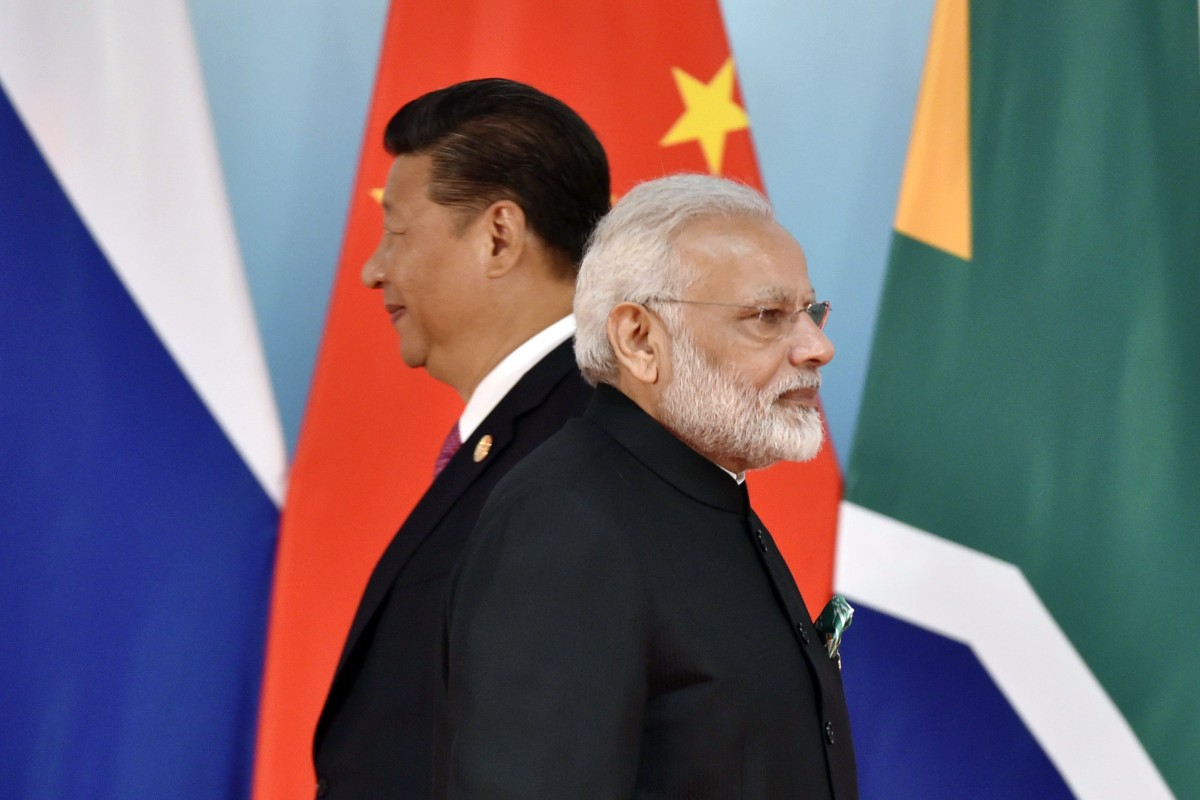
Chinese President Xi Jinping and Indian Prime Minister Narendra Modi at the BRICS Summit at the Xiamen International Conference and Exhibition Center in 2017. Photo: AFP
Their informal summit in Wuhan last year created all the right optics; even their chemistry seemed on point. So, when
and
met last week on the sidelines of the Shanghai Cooperation Organisation (SCO), the bonhomie seemed like it was there to stay.
But a day later, cracks appeared to emerge. India, holding on to its long-stated position, delivered a public snub to China by refusing to endorse its ambitious, trillion-dollar
(BRI) in the SCO summit’s Bishkek declaration.
Now, after equal parts public bonhomie and disagreement over the BRI, where do
finally stand? Somewhere in the middle, by all indications.
With just 10 days before Xi and Modi meet again at the Russia-India-China (RIC) trilateral meeting on the sidelines of the
in Osaka, there have been increasing signs that both countries may now be trialling a fresh approach to diplomacy – one that neither sidesteps contentious issues nor does it allow differences to derail ties.
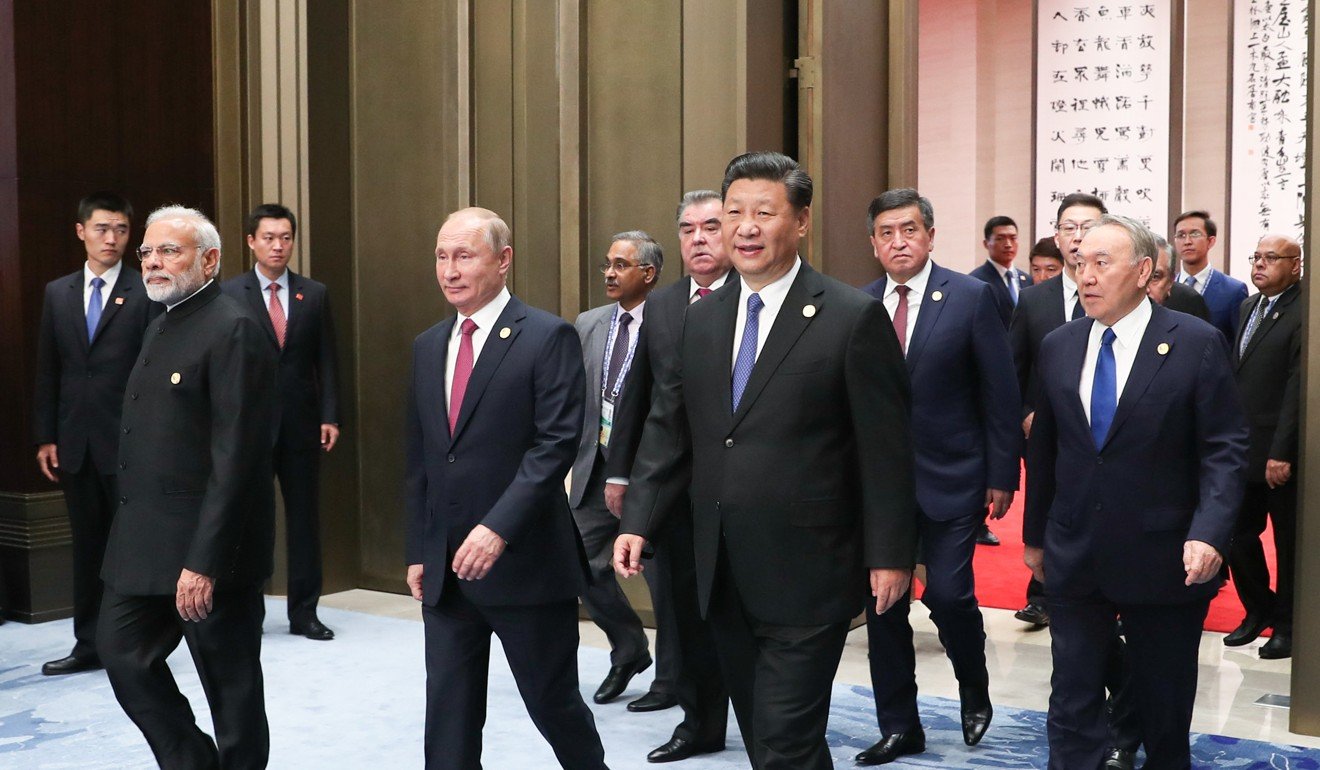
Chinese President Xi Jinping leads other leaders of Shanghai Cooperation Organisation: Russia’s Vladimir Putin and India’s Narendra Modi at the 2018 summit. Photo: Xinhua
Such an approach would delink the thorny issues – like the
and the BRI – from other non-contentious issues of cooperation in other sectors.
But the jury is still out on whether it will pay off, especially given the historical distrust and the baggage that both countries carry.
In the last week alone, there have been at least three flashpoints in the Sino-India relationship.
While the dust was still settling on India’s refusal to sign the Bishkek declaration endorsing the BRI, reports emerged that the
was expected to scrap plans to build jointly with China an ocean observatory overlooking the Indian Ocean. The news came a week after Modi had visited the Maldives capital Male in early June.
For Modi 2.0, India’s US-China balancing act just got trickier
The Maldives’ decision to build the observatory was first mulled in December 2017, raising the Indian establishment’s hackles as it would have given China a presence in the region.
Another irritant between India and China has seemed to be the proposed 16-nation
(RCEP). India has been lukewarm on the free-trade bloc, frustrating the Chinese. Indications have been that China is likely to push for a 13-member bloc at the coming RCEP meeting in Thailand on June 20, excluding India.
BRI and border issues have not managed to overshadow the remaining business between the two countries Narayani Basu
Yet, despite all this, there has been no let down in engagement levels between Modi and Xi. Both leaders are expected to meet at the RIC summit on June 29 to 30, and have at least two more meetings planned this year alone – an informal Xi-Modi summit in India
in October and the BRICS summit on November 13 to 14.
For Narayani Basu, a New Delhi-based author and independent foreign policy analyst with a special focus on China, such sustained engagement between the two countries signals a new level of maturity.
“There has been a fairly successful attempt at delinking historical geopolitical and territorial issues from issues which are economic in nature,” Basu said. “As a result, the BRI and border issues have not managed to overshadow the remaining business between the two countries.”
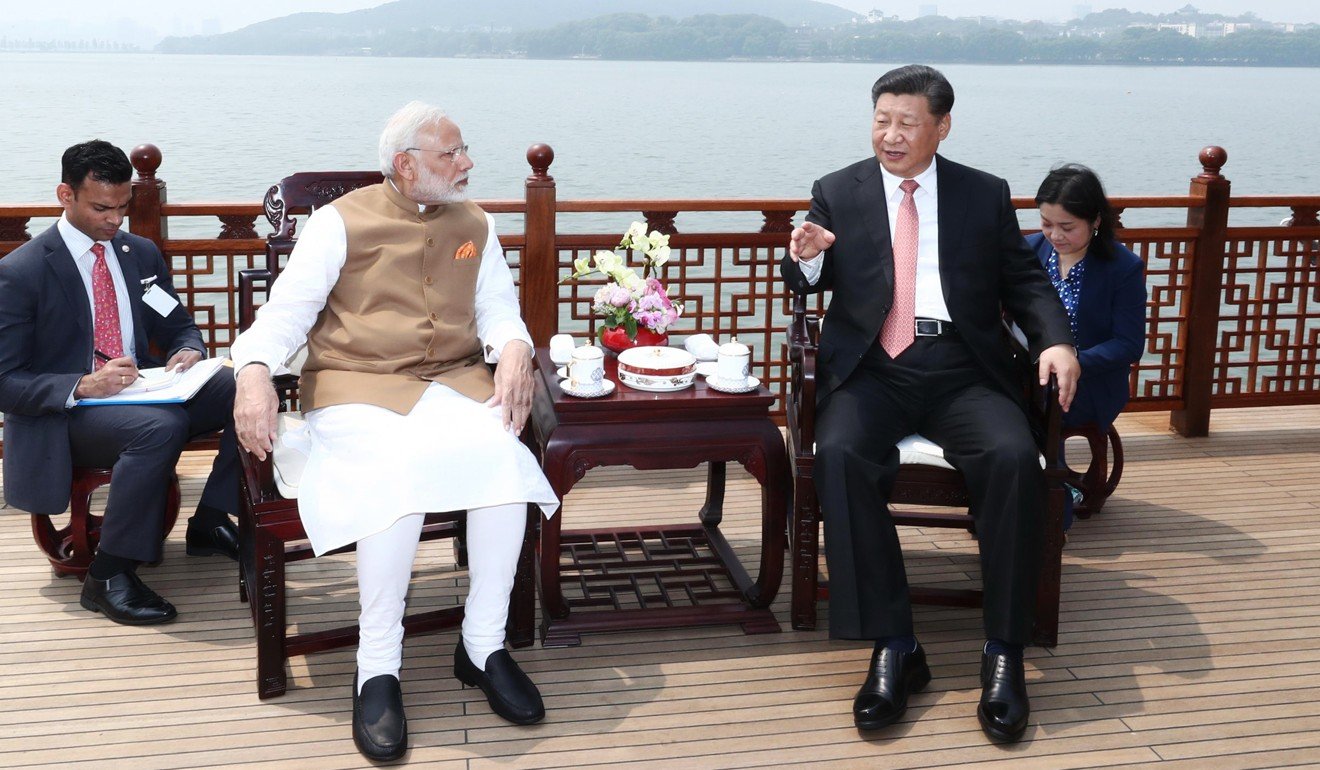
Indian Prime Minister Narendra Modi speaks with Chinese President Xi Jinping in Wuhan. Photo: Xinhua
STRONG LEADERS, STRONGER AGENDAS
The approach might also have to do with where both leaders currently stand.
Modi and his Bharatiya Janata Party (BJP) have freshly emerged from a landslide
. Through the campaign, Modi portrayed a hardline image of himself and his government, especially on issues of national security. Similarly, Xi has emerged as a stronger leader since his reappointment last year – his approach marked by a higher-than-ever emphasis on economic nationalism and connectivity. Modi made a reference to this in his SCO meeting with Xi.
Basu said Sino-India ties were also being guided by the personalities of both leaders – strong, with harder-than-before agendas.
Did Japan and India just launch a counter to belt and road?
“They both came back on agendas based on consolidation of power, protection of sovereignty and nationalism. These are all issues that will not allow either side to blink easily. “So, even as both leaders are looking to move forward, they also do not want to compromise on their core issues – primary among them being territorial sovereignty,” she said.
The message is loud – India’s opposition to the BRI does not mean India will allow adversarial relations to develop between the two Sana Hashmi
In his SCO summit speech, Modi brought up territorial sovereignty as a thinly veiled reference to China’s BRI, saying India only supported connectivity projects that are based on “respect of sovereignty” and “regional integrity”.
Sana Hashmi, an analyst with Perth-based think tank Future Directions International and author of China’s Approach Towards Territorial Disputes: Lessons and Prospects, agreed that India was not letting historical issues get in the way of its relationship with Beijing.
Hashmi noted that India’s main objections to BRI revolved around one component – the China-
Economic Corridor (CPEC), which runs through the disputed region of Kashmir.
“But to make sure this does not affect the relationship, PM Modi and President Xi are meeting numerous times,” Hashmi said. “The message is loud – India’s opposition to the BRI does not mean India will allow adversarial relations to develop between the two.”
A NEED FOR EACH OTHER
Another factor that has likely prompted the new approach between India and China is their need for each other, particularly as both Asian powers navigate bumpy relationships with US under
China is caught in a protracted
and is reeling from the tariffs imposed on Chinese imports to America. India, too, has seen a similar but smaller version of this trade battle play out – things have escalated especially since the Trump administration withdrew its preferential trade treatment towards India. Responding to this, India imposed tariffs on 28 US products over the weekend.
Move over, ‘Made in China’. It’s ‘Made in Bangladesh’ era now
In such a context, a stronger relationship between the two Asian giants might be in mutual interest.
Basu said the scope for the relationship to deliver on, especially economically, is vast.
“Despite the chemistry, India and China’s promises to each other on the economic front haven’t materialised on the ground. Major projects as well as investments in each country are stuck.”
Source: SCMP
Posted in Beijing, Belt and Road (B&R), bonhomie, BRICS summit, China-India ties, China-Pakistan Economic Corridor (CPEC), China’s Approach Towards Territorial Disputes: Lessons and Prospects, Chinese President Xi Jinping, derail, disagreement, Group of 20 (G20) summit, Indian Prime Minister Narendra Modi, Japan, Made in Bangladesh, Made in China, Maldives, Osaka, Regional Comprehensive Economic Partnership (RCEP), Shanghai Cooperation Organisation (SCO), snub, Uncategorized, US President Donald Trump, Vladimir Putin, Xiamen International Conference and Exhibition Center |
Leave a Comment »
14/07/2019
- Indonesian finance minister working on loan structure and criteria
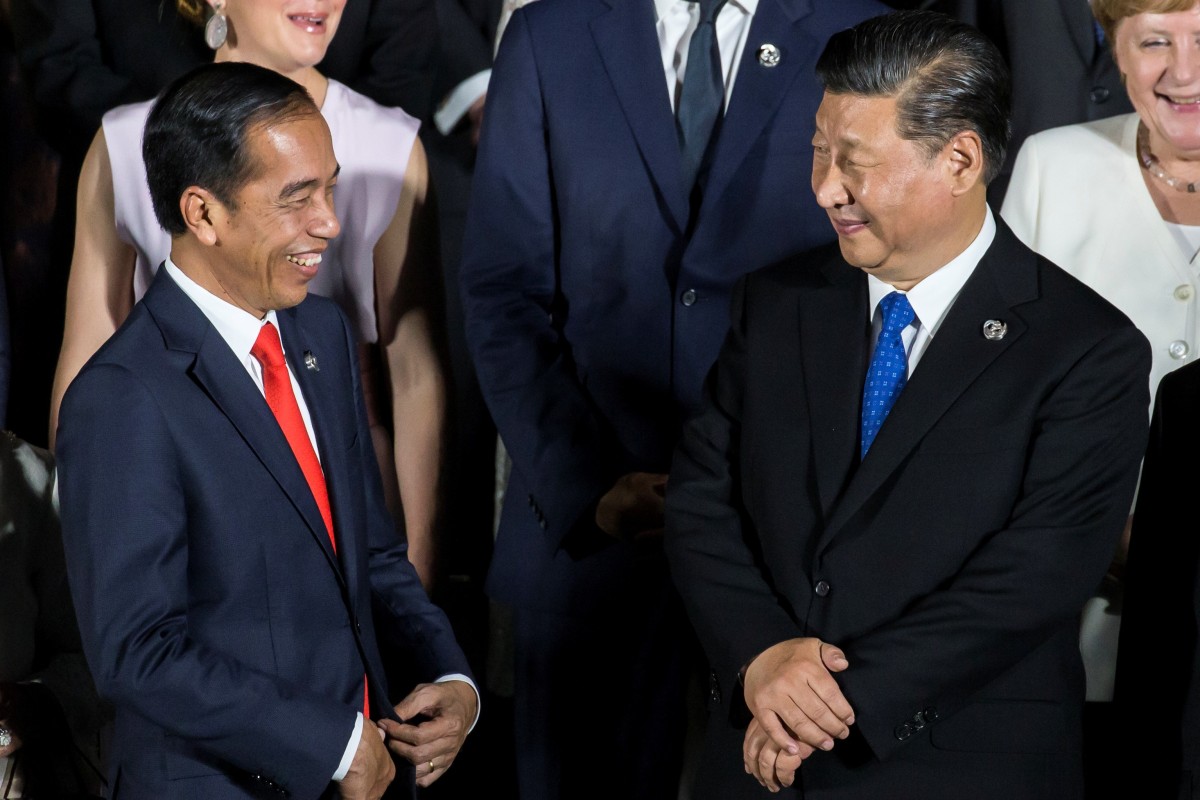
Indonesian President Joko Widodo asked Chinese President Xi Jinping for a special belt and road fund at the G20 summit in Osaka last week. Photo: Reuters
Indonesia has asked China to set up a special fund within its Belt and Road Initiative for investment in Southeast Asia’s biggest economy, after offering China projects worth US$91 billion, Indonesian government officials said on Wednesday.
Indonesia has not been among the biggest beneficiaries of China’s trillion-dollar push to create a modern-day Silk Road.
Indonesia says this is because it has insisted that any loan within the initiative’s framework is done on a business-to-business basis to avoid exposing the government in case of default.
Indonesian President Joko Widodo made the request for a special fund during a meeting with Chinese President Xi Jinping on the sideline of the Group of 20 summit in Japan last week, Indonesia’s Finance Minister Sri Mulyani Indrawati said.
Japan still leads in Southeast Asia infrastructure race, even as China ramps up belt and road investments: report
Indrawati said she had been given the responsibility of coming up with the fund’s structure, including a proposal to China on the size of the fund and the criteria for loans from it.
“I am currently doing a study about its form, its mechanism, the size of it and of course the consequences of its costs,” she said.
Luhut Pandjaitan, coordinating minister for maritime affairs, said separately the fund should provide loans “with low interest in regards to investment in Indonesia, in partnership with Indonesian companies”.
Pandjaitan, who oversees belt and road projects in Indonesia, previously said the Indonesian government had offered China involvement in about 30 projects, worth US$91 billion, during the second Belt and Road Forum in April.
The most high-profile belt and road venture in Indonesia is a US$6 billion high-speed rail project connecting the capital, Jakarta, to the textile hub of Bandung, awarded to a consortium of Chinese and Indonesian state firms in 2015.
China expert lays out trillion yuan nuclear path for belt and road plan
The project has faced land ownership issues.
Another controversial project is a US$1.5 billion hydropower plant, funded by Chinese banks and being built by the Chinese state firm Sinohydro, in the heart of the Batang Toru rainforest on the island of Sumatra, which is home to the endangered Tapanuli orangutans.
Agus Djoko Ismanto, an executive of the power plant developer PT North Sumatra Hydro Energy, on Wednesday denied disrupting the orangutan habitat. He said 11 per cent of the construction had been completed and it was due to begin operation by 2022.
Posted in Batang Toru rainforest, Belt and Road Initiative fund, China alert, Chinese President Xi Jinping, Indonesia, Indonesian President, Japan, Joko Widodo, PT North Sumatra Hydro Energy, Sumatra, Tapanuli orangutans, Uncategorized |
Leave a Comment »
09/07/2019
- Relations between the Asian giants had been strained after a 73-day military stand-off at their disputed border last year
The Chinese People’s Liberation Army in Beijing. Photo: EPA
China and India aim to hold joint army drills in China before the end of this year, China’s Defence Ministry said on Thursday, as the two countries continue a rapid rapprochement.
Relations between the Asian giants were strained last year over a 73-day military face-off in a remote, high-altitude stretch of their disputed Himalayan border.
Chinese ‘tourists’ face 7 years in Indian jail over shahtoosh shawls made from endangered antelope
But the neighbours have over recent months been working on mending ties and Chinese Defence Minister Wei Fenghe met Indian Prime Minister Narendra Modi in New Delhi in August.
Speaking at a regular monthly news briefing, Chinese Defence Ministry spokesman Wu Qian said that the joint exercise was planned for before the end of this year.
China and India are aiming to hold joint army drills this year as part of an ongoing rapprochement. Photo: EPA
The two countries would meet in the southwestern Chinese city of Chengdu next month to discuss the arrangements, he added, without giving other details.
India and China fought a war in 1962 and the unresolved dispute over stretches of their 3,500km (2,200 miles) border has clouded relations ever since.
But the two big Asian economies share similar positions on a host of issues including concern about US tariffs and Chinese President Xi Jinping and Modi agreed in April to improve relations.
Source: SCMP
Posted in Chengdu, China alert, Chinese Defence Minister, Chinese President Xi Jinping, defence ministry, face-of, Himalayan border, India alert, Indian Prime Minister Narendra Modi, Indian Prime Minister Narendra Modi, joint military drills, New Delhi, People’s Liberation Army (PLA), seek thaw, Uncategorized |
Leave a Comment »
09/07/2019
- Chinese president also called for the three nations to uphold multilateralism in talks with Vladimir Putin and Narendra Modi in Osaka
- In a separate meeting with other BRICS leaders, he said Beijing opposed ‘illegal and unilateral sanctions’ and ‘long-arm jurisdiction’
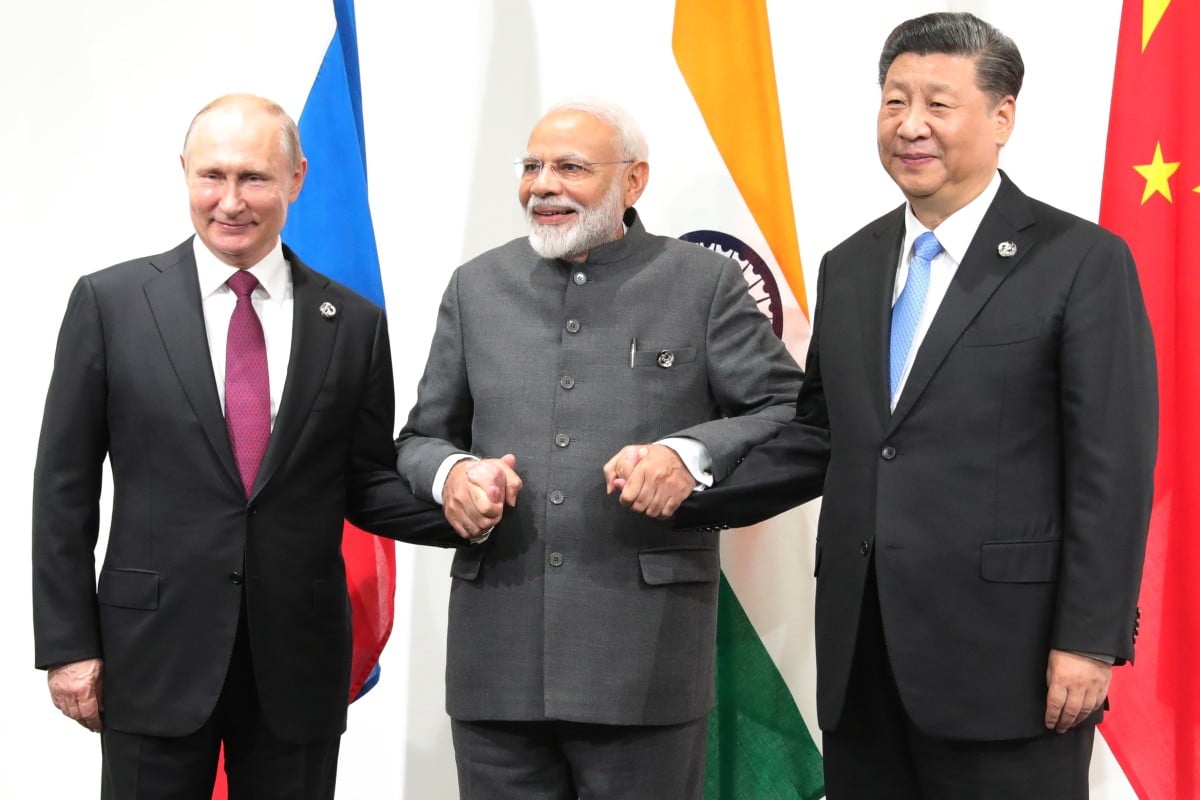
(From left) Russian President Vladimir Putin, Indian Prime Minister Narendra Modi and Chinese leader Xi Jinping meet on the sidelines of the G20 summit in Osaka, Japan, on Friday. Photo: EPA-EFE
Chinese President Xi Jinping on Friday called on the leaders of Russia and India to take “global responsibility” to safeguard the three countries’ interests and uphold multilateralism, as Beijing seeks to rally support amid its protracted trade war with Washington.
Xi made the remarks during a trilateral meeting with Vladimir Putin and Narendra Modi on the sidelines of the annual
summit of world leaders in Osaka, Japan.
The trilateral meeting was part of the Chinese leader’s efforts to marshal international support ahead of his
with US President Donald Trump, seeking to reach a truce on the year-long trade conflict between the world’s two biggest economies.
“The rise of protectionism and unilateralism has severely affected global stability and economic growth, as well as the existing international order which emerging economies and developing countries have relied on,” Xi was quoted as saying by state broadcaster CCTV.
“China, Russia and India should take on global responsibility to safeguard the fundamental and long-term interests of these three countries and the world,” he said.
Xi also called for the nations to promote “a more multipolar world and the democratisation of international relations” – meaning with less reliance on a US-led world order.
During a meeting with leaders of the other BRICS countries – major emerging economies Brazil, Russia, India, China and South Africa – Xi also said Beijing opposed what it saw as “illegal and unilateral sanctions” and “long-arm jurisdiction”.
The efforts to forge closer ties among China, Russia and India come as all three nations are locked in disputes with the United States.
New Delhi, a key strategic ally in Washington’s Indo-Pacific policy to contain China’s rise, has been upset over tariffs imposed on Indian goods by the Trump administration. Meanwhile, geopolitical rivalry and the Kremlin’s alleged meddling in US elections has strained relations between Moscow and Washington.
Beneath the smiles and handshakes, tensions simmer as world leaders meet for G20
Wu Jianghao, director general of the Chinese foreign ministry’s Asian affairs department, said the trilateral meeting laid out a framework for future cooperation.
“The three countries have spoken with one voice on some major global issues, helping stability and injecting positive energy to the current international situation – which is filled with instability and uncertainties,” Wu said at a briefing on Friday.
Wu said that the leaders did not talk about Huawei Technologies or 5G networks, but that the three countries had maintained good communication on telecoms issues and would continue to cooperate.
Washington has banned US companies from selling American technology to Huawei and put pressure on its allies to block the Chinese tech firm over security concerns.
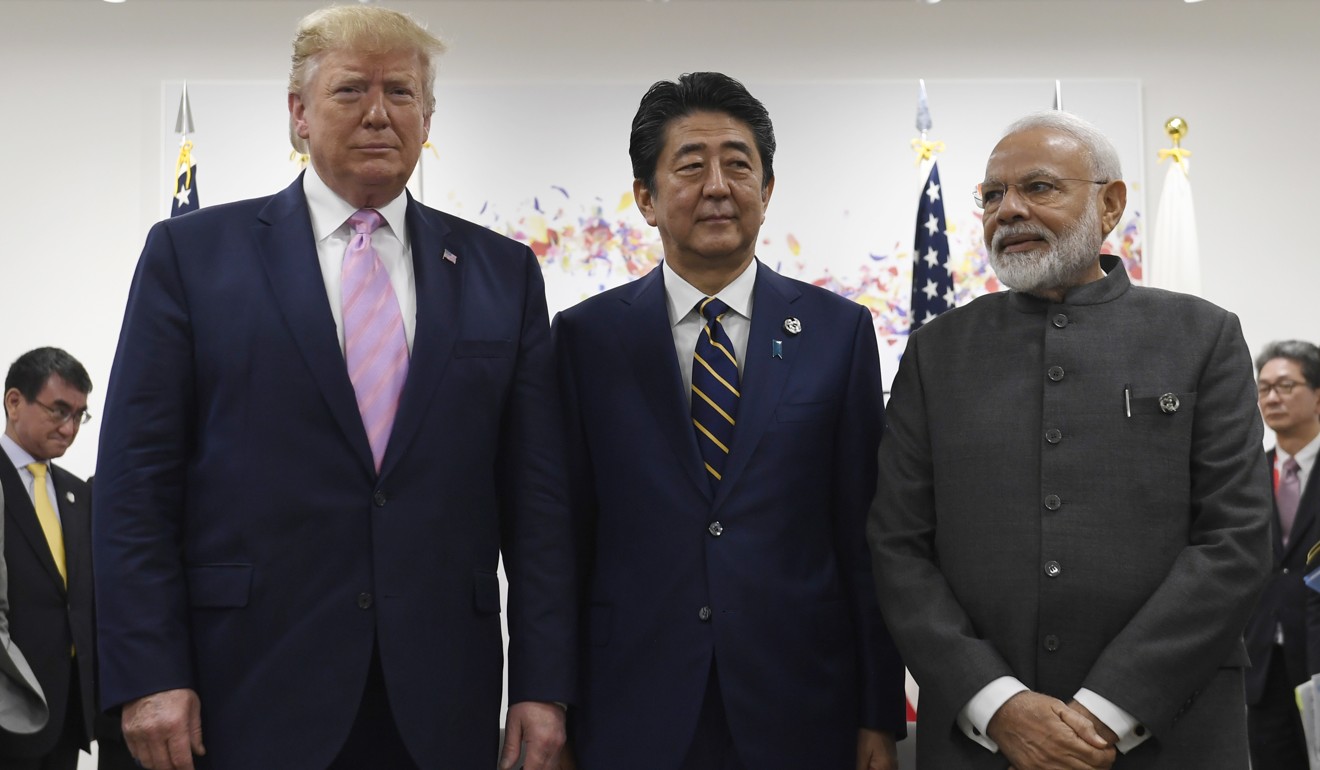
(From left) US President Donald Trump, Japanese Prime Minister Shinzo Abe and Indian Prime Minister Narendra Modi pose for a photo before their meeting. Photo: AP
Meanwhile, the United States is also seeking to build ties with India, with Trump holding trilateral talks with Modi and Japanese Prime Minister Shinzo Abe on Friday.
Indian Foreign Secretary Vijay Gokhale described that trilateral meeting as “very good”, saying it was “short but very productive”.
“The main topic of discussion was the Indo-Pacific, about how the three countries could work together in terms of connectivity, infrastructure and ensuring that peace and stability is maintained, and working together to build upon this new concept so that it would benefit the region as a whole and the three countries,” Gokhale said.
On the Modi-Trump bilateral meeting, he said the two leaders had “a very warm discussion”. They also briefly discussed 5G, with the focus on business cooperation between the two countries to leverage their technology and the potential of the Indian market, according to Gokhale.
He said the discussion of how to develop 5G networks was “in terms of business, not in terms of governments”. “It’s an exciting new area that India and the US can work together [on],” he said.
Source: SCMP
Posted in 5G networks, Beijing, BRICS leaders, China alert, Chinese President Xi Jinping, director general of the Chinese foreign ministry’s Asian affairs department, global responsibility, Huawei, India alert, Indo-Pacific policy, Japanese Prime Minister Shinzo Abe, Narendra Modi, New Delhi, Osaka, President Donald Trump, protect interests, Russia, Uncategorized, Vladimir Putin, Washington |
Leave a Comment »
09/07/2019
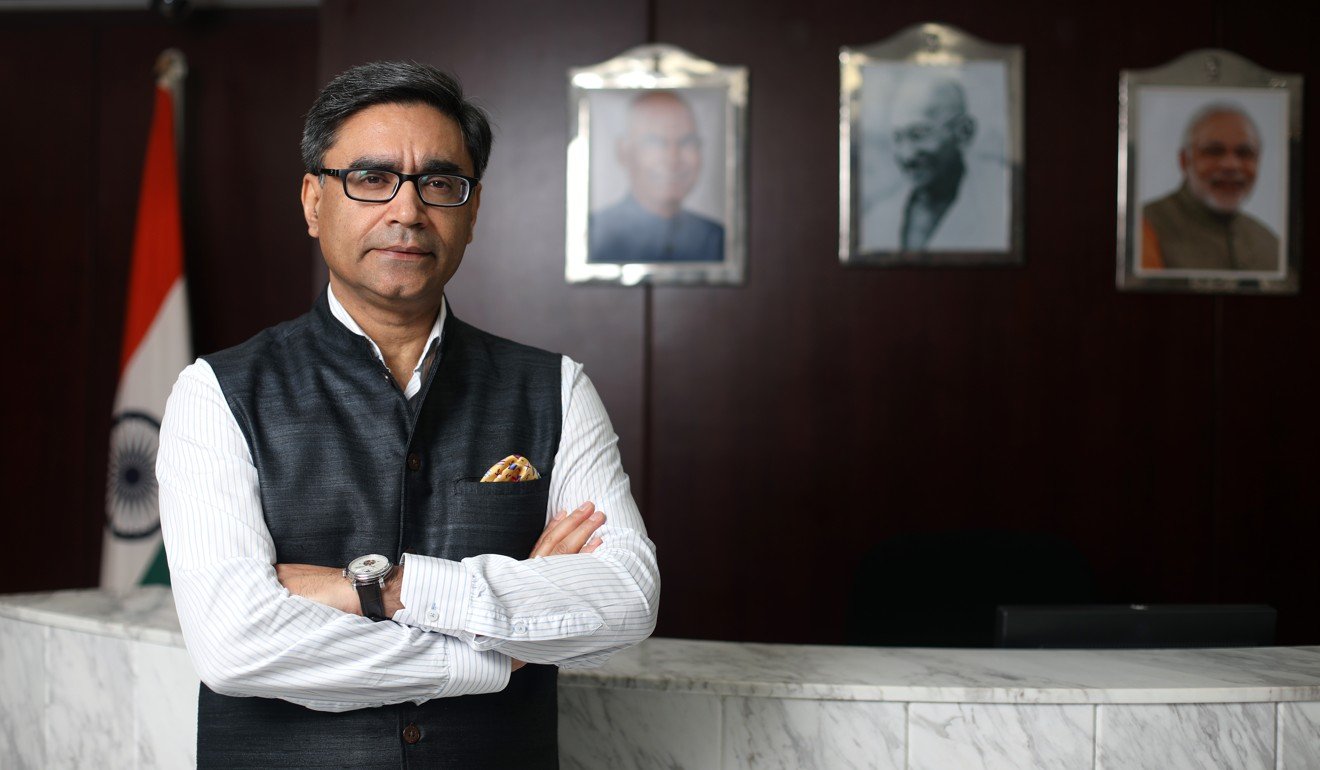
- Ambassador to China Vikram Misri says they will be ‘meeting more and more in common waters’, and more exchanges are needed
- He also says preparations are under way for President Xi Jinping to visit India
The INS Kolkata arrives in Qingdao for PLA Navy 70th anniversary celebrations in April.
The Indian ambassador called for more communication between the two navies. Photo: Reuters
The Chinese and Indian navies should establish communication because they are increasingly operating within close proximity, according to India’s ambassador to China.
While the two nations’ militaries communicated extensively, it was mainly between their land forces, and that should be extended to the navies and air forces, Vikram Misri said.
“We need to talk about the two air forces and the two navies – especially the two navies – because we are operating in the same waters and increasingly in the coming years, we will be meeting more and more in common waters,” Misri said.
“I think it is important for us to develop those levels of understanding and communication,” he said. “There are some [navy and air force] exchanges now, but not as well developed as in the case of the land force.”
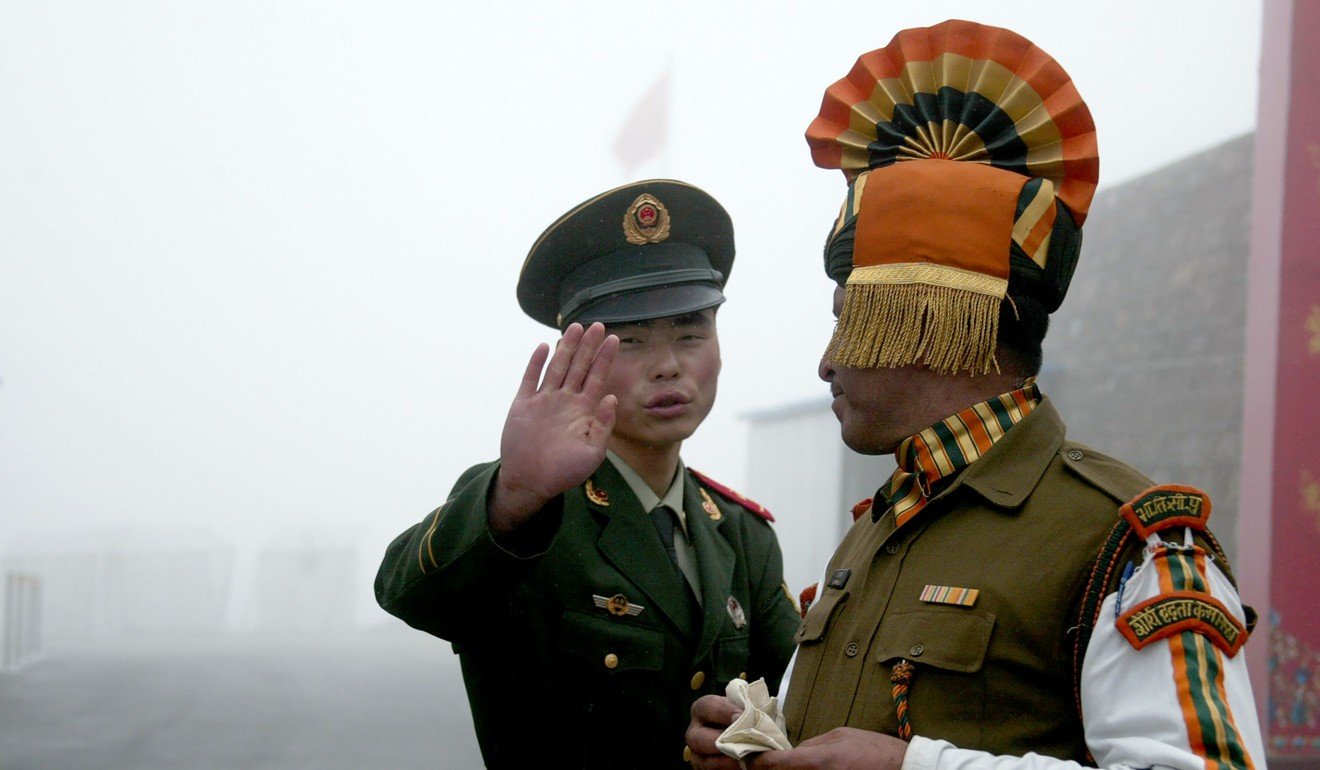
China and India have made efforts to repair their relations since a tense stand-off at the Doklam plateau two years ago, when communications between their forces along the border were seen as inadequate to contain the tension.
China and India have sought to repair relations after a tense stand-off at Doklam. Photo: AFP
Misri said the two nations had made incremental progress, and opened new points where “border personnel can meet and exchange information, or exchange views about any particular situation”.
The ambassador was visiting the Indian consulate in Hong Kong over the weekend, six months after taking up the post and six weeks after Prime Minister Narendra Modi was re-elected.
He said preparations were under way for Chinese President Xi Jinping to visit India, which was expected to happen in the fourth quarter, after they pledged earlier to strengthen cooperation.
Tensions between
have periodically flared along their 4,000km (2,485-mile) border, resulting in a brief war in 1962. Relations have also been strained by China’s ties with Pakistan, and India’s concern over China’s growing presence in the Indian Ocean.
India has also not signed on to China’s global trade and infrastructure strategy, the
, which has projects that run through the disputed Kashmir region.
“Our concerns with regards to this particular initiative are very clear, and we have continued to share them very, very frankly with our Chinese partners,” Misri said. “I think there is understanding on the part of our Chinese partners with regard to this.”
Indian ambassador to China Vikram Misri said New Delhi’s concerns on the Belt and Road Initiative were clear. Photo: Xiaomei Chen
But he said the two nations should not let their differences evolve into disputes, and they should focus on areas where they can cooperate.
One such area was maritime and investment cooperation in the Indo-Pacific region, including infrastructure and disaster response. The US in recent years has focused on the Indo-Pacific region, and has asked its allies to send naval vessels to the area as a counterbalance to Beijing.
“We have made the point that our vision of the Indo-Pacific is not a strategy, which sometimes is a concern on the part of some partners, aimed against any particular country,” Misri said. “It is definitely not a military alliance in any format.
“It is on the other hand a vision that aims at economic and development cooperation with our partners in the Indo-Pacific space,” he said, adding that India was discussing such cooperation with China.
He also said trilateral meetings between China, India and Russia would become more regular after their three leaders met on the sidelines of the
summit in Osaka, Japan last month, when they vowed to uphold multilateralism.
Those meetings would allow the nations to address challenges facing the international trading system and pushback against globalisation, but Misri said they should not be seen as a bid to counter the US, which is also involved in a trade battle with India.
India also had a trilateral meeting with Japan and the United States during the G20 summit.
“The fact that these countries seek us out also shows that they see value in engaging with India, and we have important issues to discuss in each of these settings,” he said. “None of our individual relationships is going to come at the cost of a relationship with any other partner.”
The ambassador said there could be a broader consensus on counterterrorism. Photo: AP
Misri also said there could be a broader consensus between China and India on counterterrorism. The two nations have clashed over Indian efforts to blacklist Masood Azhar, leader of the Pakistan-based terror group Jaish-e-Mohammed (JeM), at the United Nations, which China objected to for years – a move seen in India as being done at the behest of Islamabad.
Azhar was finally listed as a global terrorist by the UN in May, after JeM claimed responsibility for a deadly terror attack on Indian security forces in Pulwama in February, although the listing did not directly reference the attack.
“It could have happened earlier … but I’m glad that it did happen, and we hope to build on that – that should be taken as progress, and we hope to build on that in the coming years,” Misri said.
“Everybody is aware of the context in which the listing happened, and therefore, I don’t think it’s hidden from anybody as to what this was aimed at or who this was aimed at, or what the motivation for the action might have been.”
As for the tensions between India and Pakistan following the terror strike in Indian-controlled Kashmir, Misri said progress would be “largely dependent on Pakistan” and the actions it needed to take to address the “ecosystem of terror that prevails in different parts of that country”.
Source: SCMP
Posted in 70th anniversary, Ambassador Vikram Misri, Belt and Road Initiative (BRI), celebrations, Chinese navy, Chinese President Xi Jinping, communicate, counterterrorism, Doklam plateau, ecosystem of terror, Group of 20 (G20), Hong Kong, Indian ambassador to China, Indian consulate, indian navy, Indian-controlled Kashmir, INS Kolkata, Jaish-e-Mohammed (JeM), Japan, Masood Azhar, Osaka, pla navy, President Xi Jinping, Prime Minister Narendra Modi, Qingdao, Russia, Uncategorized, US, We need to talk |
Leave a Comment »







 CHINDIA ALERT: You'll be living in their world, very soon