25/03/2020
- Large-scale drills conducted across island in what defence ministry describes as test of combat-readiness
- Exercise follows US Navy live-fire exercise last month and a series of incursions by Chinese warplanes in recent weeks
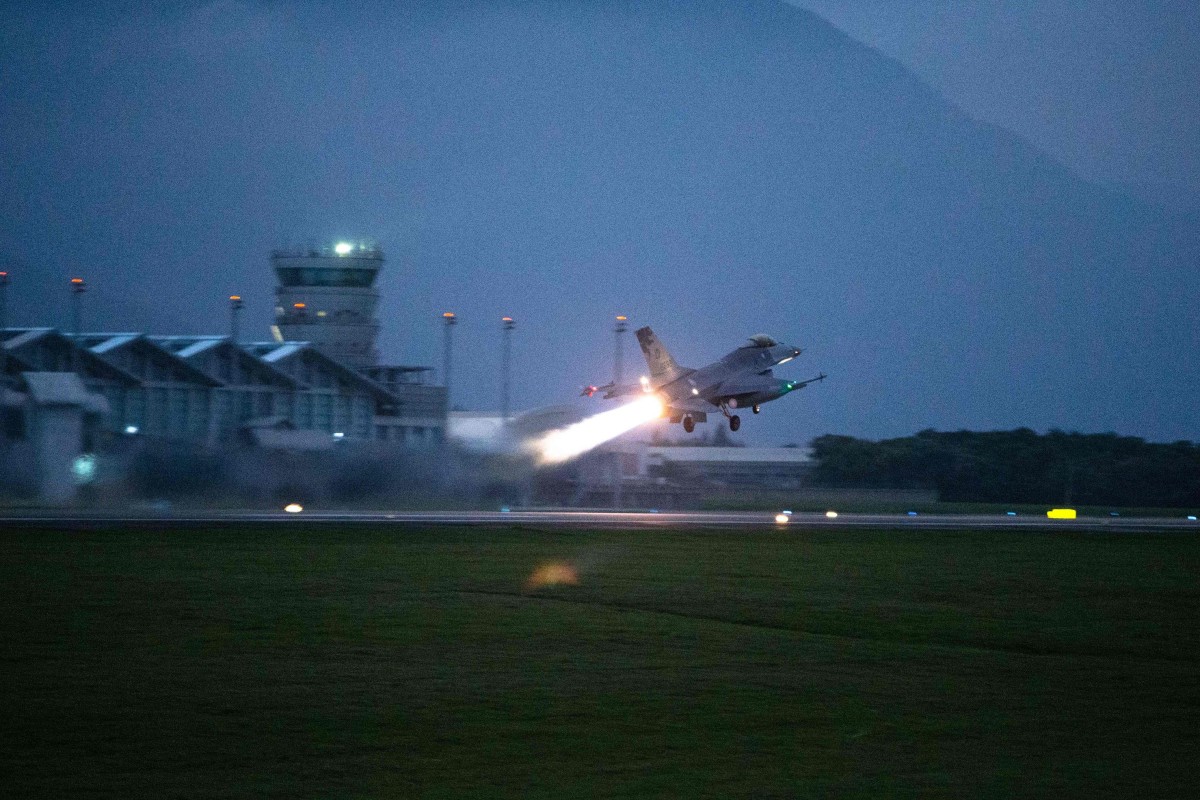
An F-16 fighter takes off from Hualien air base in eastern Taiwan. Photo: Military News Agency/ AFP
Taiwan has staged large-scale military drills throughout the island, including an exercise to repel an invading force, against a backdrop of rising tensions with Beijing.
The exercises, dubbed “Lien Hsiang,” involved the air force, army and the navy and were conducted on Tuesday from various military bases and strongholds in Taiwan, the island’s defence ministry said in a statement.
“The drills were designed to test the combat readiness of our forces and their responses to an all-out invasion by the enemy,” the ministry said, referring to the People’s Liberation Army, which has threatened to attack the self-ruled island.
The exercise follows a live-fire US drill in the region last week.
Taipei says Chinese military aircraft flew night exercise across Taiwan Strait
Eight F-16 fighter jets took off from the air force base in the eastern county of Hualien at dawn on Tuesday, simulating an emergency mission to scramble and intercept enemy warplanes entering the island’s airspace, the defence ministry said.
Elsewhere on the island, F-16 and other fighter jets were spotted taking off from other air force bases in the southwestern county of Chiayi, the northern county of Hsinchu, Ching Chuan Kang in central Taiwan and the southern city of Tainan, according to Taiwanese media.
The exercises also involved operations testing cyberwarfare capabilities, while the air force ground crew simulated an emergency repair of the aircraft runway, the ministry said.
Anti-air units of both the army and the navy also joined the air force in the drills, while various types of naval warships, including Kidd-class destroyers, plus Perry and Kang Ding-class frigates, were deployed near Taiwan’s coast for separated training drills, it added.
The ministry said the training mission, carried out without live ammunition, was also designed to test the military response and make improvements based on the results.
Hundreds of Taiwanese to return from coronavirus centre after Beijing and Taipei reach deal
Beijing considers Taiwan a wayward province that must be returned to the mainland fold, by force if necessary.
Beijing has staged a series of war games close to the island and poached seven of Taiwan’s diplomatic allies to heap pressure on President Tsai Ing-wen, from the independence-leaning Democratic Progressive Party, who was re-elected in January.
The exercises came after recent missions by PLA warplanes which briefly crossed the midpoint of the Taiwan Strait into the Taiwanese side in what analysts saw as testing the response from Taiwan and the US.
Three separate groups of warplanes approached Taiwan on their way to the western Pacific over the Bashi Channel for long-distance training exercises before returning home over the Miyako Strait to the northeast of Taiwan on February 9, 10 and 28.
Coronavirus threat shows ‘unacceptability’ of Beijing isolating Taiwan, US official says
On March 17, another flight of PLA warplanes approached Taiwan in a rare exercise which analysts said was aimed at showing off their night navigation and all-weather capabilities.
Taiwan’s air force scrambled fighter jets to shadow, intercept and disperse the PLA warplanes through radio warnings during each approach by the mainland’s planes, according to the ministry.
Those actions also prompted the US to send two B-52 bombers on southbound flights off Taiwan’s east coast, while a transport plane flew over the Taiwan Strait, the defence ministry said.
On Tuesday, the US Navy’s 7th Fleet also revealed that the US Navy had carried out live-fire missile tests in the Philippine Sea last week, in what analysts said was a message that it was up to the challenge of the Chinese military’s new systems.
DPP legislator Wang Ting-yu asked the Tsai government to take note of developments in the South China Sea, saying the US actions indicated that Washington must have learned “certain information suggesting that the Chinese government is planning certain military activities” or the 7th Fleet would not have made such a bold move.
Posted in 7th Fleet, air force, aircraft runway, army, ‘unacceptability’, B-52 bombers, Bashi Channel, Beijing, Chiayi, Chinese warplanes, Ching Chuan Kang, coronavirus, cyberwarfare capabilities, Democratic Progressive Party, emergency repair, exercise, F-16 fighter, fight off, Hsinchu, Hualien air base, incursions, isolating, Kidd-class destroyers, Kuomintang, Military, Miyako Strait, mock invasion, naval warships, navy, Pacific, Perry and Kang Ding-class frigates, PLA warplanes, President Tsai Ing-wen, stages, Taipei, Taiwan, Taiwan Strait, Taiwanese, threat, Uncategorized, US Navy live-fire exercise, Washington, wayward province |
Leave a Comment »
22/03/2020
- Move will help air force with patrols and combat-readiness near Taiwan and in the East and South China seas, according to observers
- Markings including national flag and service insignia will also be standardised under new guidelines
Chinese military aircraft will get “low observable” coatings and standardised markings. Photo: Xinhua
Chinese military aircraft are to be painted with “low observable” coatings and standardised markings under new guidelines, a move observers say will assist with operations near Taiwan and in the East and South China seas.
The guidelines require markings including the national flag and service insignia to be gradually standardised on both active and future warplanes, the official PLA Daily newspaper said earlier this month.
The move comes two years after the Chinese navy started experimenting with its J-16 strike fighter, using a dark grey low-visibility coating instead of blue-grey, and replacing its service insignia with a new design, according to military magazine Ordnance Industry Science Technology.
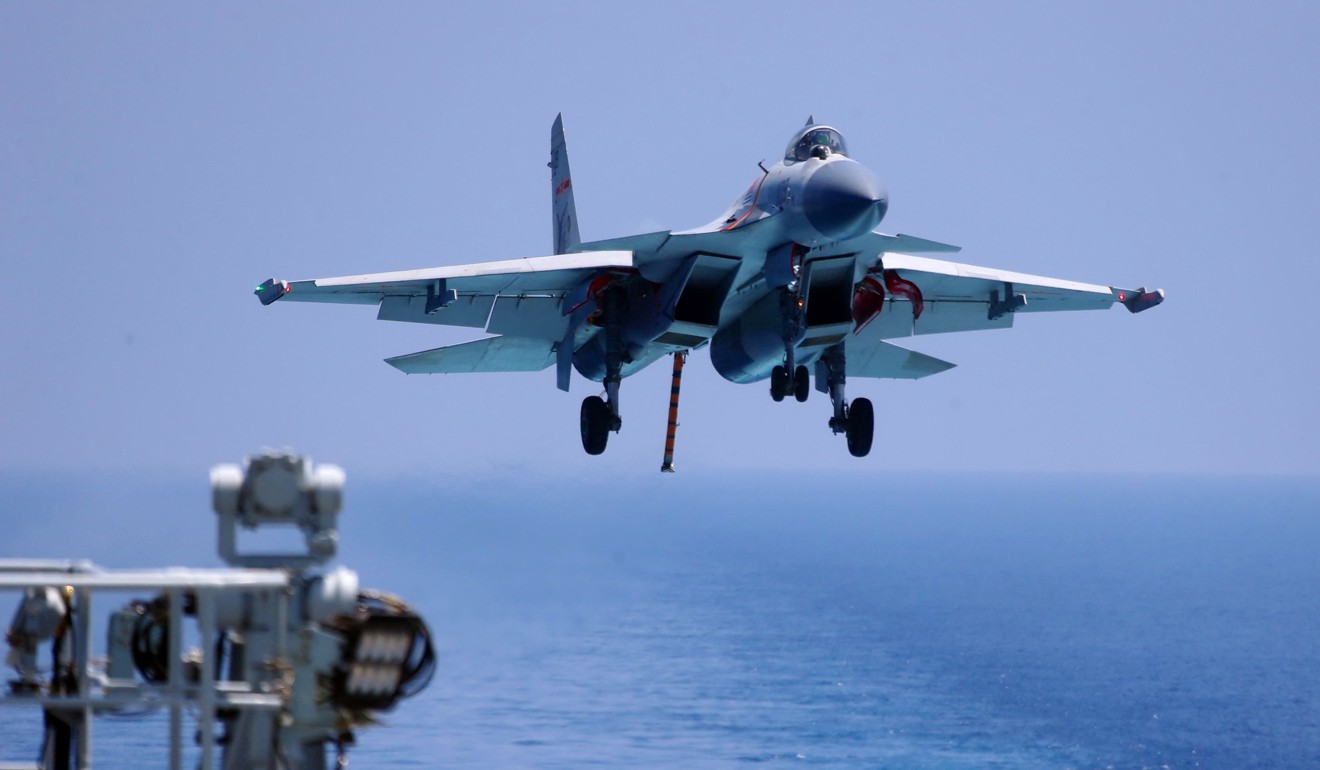
Some of the navy’s only active aircraft carrier-based fighter jets, the J-15s, have also been given new coatings and markings, according to the People’s Liberation Army’s official website.
PLA Daily said the move aimed to give Chinese warplanes a combat advantage as they “will be less likely to be detected by both the naked eye and military radar”. It said the new guidelines would be gradually implemented this year.
Some of the aircraft carrier-based J-15 fighter jets already have the new coatings. Photo: AFP
Macau-based military observer Antony Wong Dong said the move would help the air force improve patrols and combat-readiness as it carried out more drills near the Taiwan Strait and in the East and South China seas.
China’s air force and navy have sent warplanes including Su-35 fighter jets, H-6K strategic bombers and advanced KJ-2000 airborne early warning aircraft to conduct “encirclement” drills around Taiwan since 2018, as Beijing applies pressure on the self-ruled island that it sees as part of its territory. But none of the aircraft seen in photographs of the exercises had low-visibility coatings or standardised markings, as used on the navy’s J-16s and J-15s.
US spy plane pilots use China’s satellite navigation system as backup
“Aircraft used by the PLA Air Force have different coatings and markings because they are still in a transitional period,” Wong said. “Its counterparts like Taiwan have learned from Western countries like the United States to standardise coatings and markings and designs [since the 1990s].”
Beijing insists that Taiwan, which split from the mainland in 1949, remains part of China and they will eventually be reunited – by force if necessary.
The PLA also regularly sends aircraft to monitor freedom of navigation operations by the US Navy in the
South China Sea. Beijing has territorial disputes in the resource-rich waterway with countries including Vietnam, the Philippines, Malaysia and Brunei.
A military insider in Beijing said the US move to send hundreds of its new-generation F-35 stealth fighter jets to South Korea and Japan had also pushed the PLA to upgrade the coatings on its aircraft.
“These coatings are a highly technical area, and China puts a tremendous amount of resources into research on this every year,” said the insider, who requested anonymity due to the sensitivity of the issue. “The coating that’s used on
China’s first stealth fighter jet, the J-20, is more advanced than they used on the Lockheed Martin F-22s, but it’s not yet at the level of the F-35s.”
Hong Kong-based military expert Song Zhongping said military aircraft used to have a bright red national flag and service insignia that made them more detectable on radar systems, or even with the naked eye.
“The red they used is striking, but it’s not in line with the ‘low observable’ requirement for all fighter jets,” said Song, who is a military commentator for Phoenix Television.
“All fighter jets must have stealth and low-visibility capabilities, and the coatings and markings on them are part of how they can do this and meet requirements for combat.”
Source: SCMP
Posted in Beijing, Brunei, Chinese, Chinese navy, Chinese warplanes, coatings, detect, East China Sea, F-35 stealth fighter jets, H-6K strategic bombers, harder, J-16 strike fighter, Japan, KJ-2000 airborne early warning aircraft, Lockheed Martin F-22s,, Malaysia, national flag, Ordnance Industry Science Technology, Philippines, PLA Air Force, PLA Daily, service insignia, South China Sea, South Korea, Su-35 fighter jets,, Taiwan, Taiwan Strait, Uncategorized, United States, Vietnam |
Leave a Comment »
10/02/2020
- Taiwan sends fighters to intercept mainland military aircraft after they cross dividing line in Taiwan Strait
- Incursion comes at end of visit to Washington by vice-president-elect William Lai that angered Beijing
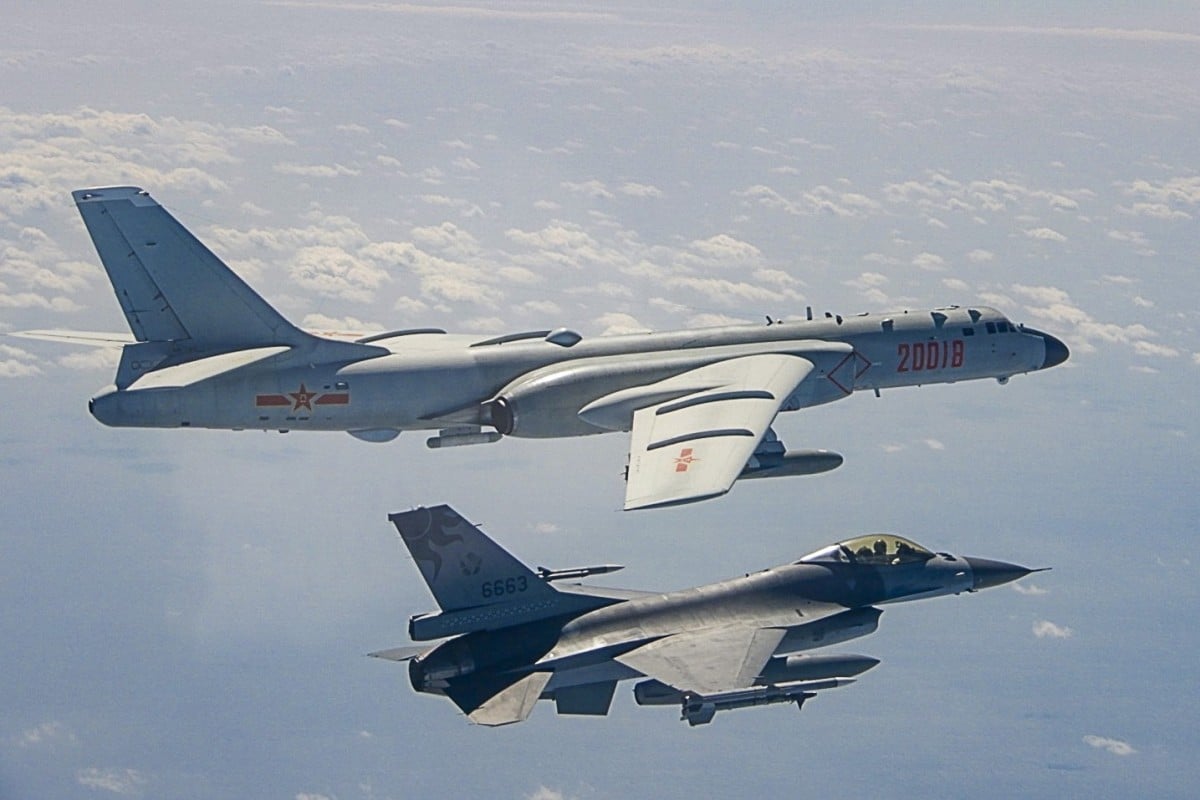
A Taiwanese fighter jet shadows a mainland Chinese bomber over the Taiwan Strait on Monday. Photo: Military News Agency, ROC
Taiwan sent warplanes to intercept a group of mainland Chinese jets that had briefly approached the island on Monday, the second such incident in two days.
The incident came as the island’s vice-president-designate William Lai Ching-te concluded an eight-day visit to the US that had angered Beijing.
The mainland warplanes, including H-6 bombers, briefly crossed the median line in the Taiwan Strait on their way to the western Pacific through the Bashi Channel in the morning for long-haul training exercises, Taiwan’s defence ministry said in a statement on Monday.
“Our air force scrambled fighter jets to shadow, intercept and disperse the communist warplanes through radio broadcasting,” the ministry said, adding the mainland planes later left the area.
The mainland warplanes later returned to their home base after their morning drill, the military said.
It was the second day in a row that the mainland warplanes flew past Taiwan after a group of aircraft, including J-11 fighter jets, KJ-500 early warning aircraft and H-6 bombers, flew over the Bashi Channel on Sunday before returning to their bases via the Miyako Strait northeast of Taiwan, the ministry said.
“The military has full surveillance and control of the communist long-haul training activities and the public can rest assured of our capability to uphold security or our national territory,” it said.
Meanwhile, Lai completed his eight-day “private” visit to Washington, during which he met the National Security Council and other US officials and senators.
Lai, who left for the US last Sunday to attend the National Prayer Breakfast – an annual gathering of political and religious leaders in Washington – was considered the highest-level Taiwanese official to meet with National Security Council officials since the US switched diplomatic recognition to Beijing from Taipei in 1979.
The visit was hailed as a diplomatic breakthrough for the island because until now Washington has been reluctant to allow such exchanges for fear of angering Beijing, which has repeatedly demanded that the US adhere to the “one-China” policy.
Taiwan scrambles jets as mainland Chinese air force flies around island
Beijing views Taiwan as a wayward province that must be brought back to the mainland fold – by force if necessary.
It has suspended official exchanges with Taiwan since Tsai Ing-wen of the independence-leaning Democratic Progressive Party was first elected president in 2016 and refused to accept the one-China principle as the basis for cross-strait exchanges.
Since then, Beijing has staged war games close to the island and poached seven of Taiwan’s allies to heap pressure on the president, who was reelected last month.
A People’s Liberation Army spokesperson said on Sunday the flight was a “necessary action” under “current security situation across the Taiwan Strait”.
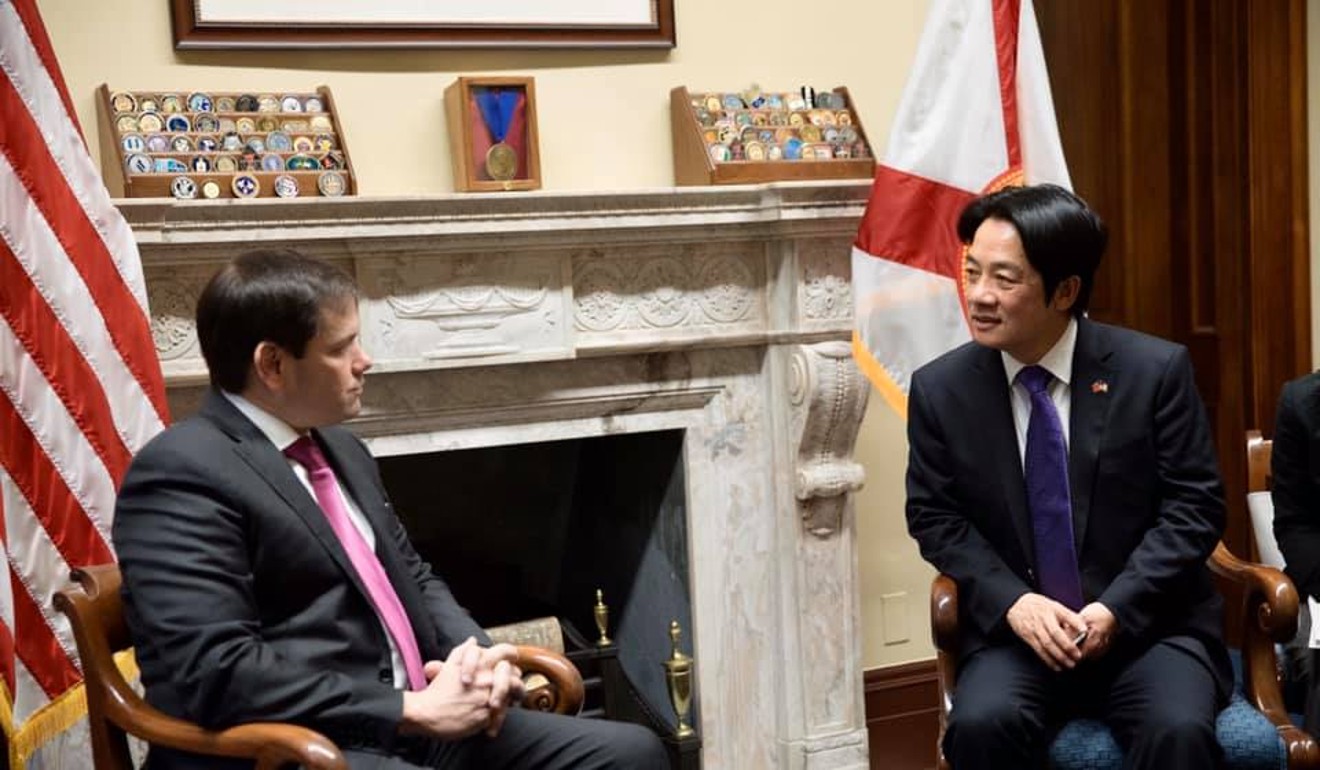
Vice-President-elect William Lai Ching-te met National Security Council officials on his visit to the White House. Photo: Facebook
Observers said Lai’s US visit was made possible due to a new US policy to allow high-level official and military exchanges with Taiwan, which has been included in the US security alliance to counter the mainland’s military expansion in the Indo-Pacific region.
They said Lai is still technically a civilian until he takes office in May, and the US can always use this status to defend its move, although the visit has prompted strong protests from the Chinese foreign ministry.
Observers also said Taiwan’s efforts in seeking to join the World Health Organisation amid the deadly coronavirus outbreak have also riled Beijing, which has repeatedly said the island is a mainland province with no right to join international bodies which require statehood for membership.
Taipei complains to World Health Organisation after coronavirus case is classed as ‘Taiwan, China’
On Monday, Ma Xiaoguang, a spokesman for the mainland’s Taiwan Affairs Office, warned the Tsai government against “playing with fire” by “trying to use its strengthening ties with the US to plot independence”.
“This is a sheer provocation,” Ma said, adding what the People’s Liberation Army did was to protect the national sovereignty and territorial integrity of the mainland and to maintain cross-strait peace.
Song Zhongping, a military commentator for Hong Kong Phoenix Television, said the patrol was aimed at the separatist movement on the island.
“Such a patrol is for war-preparedness … and has become a routine practice and a resolution to effectively attack the pro-independence force,” said Song, a former instructor for the PLA’s Second Artillery, the predecessor of the Rocket Force.
A Beijing-based military source close to the PLA, who requested anonymity, said the warplanes were equipped with missiles, which has become a standard procedure for PLA’s air drills.
Source: SCMP
Posted in angered, Beijing, Chinese warplanes, communist warplanes, cross, diplomatic breakthrough, dividing line, Fighters, H-6 bombers, Hong Kong Phoenix Television, incursion, Indo-Pacific region, intercept, international bodies, island, J-11 fighter jets, KJ-500 early warning aircraft, mainland, membership, military aircraft', missiles, National Prayer Breakfast, National Security Council, one-China policy, Pacific, patrol, People’s Liberation Army, PLA, PLA’s Second Artillery, second, Space, spokesperson, statehood, Surveillance, Taipei, Taiwan, Taiwan Strait, two days, Uncategorized, US, Washington, William Lai Ching-te, World Health Organisation |
Leave a Comment »
12/09/2019
- Military stresses combat readiness and war mentality in production released just weeks before 70th anniversary of the People’s Republic
China’s air force shows a more assertive side in a new propaganda video. Photo: Handout
The Chinese air force has ramped up its combat rhetoric in its latest propaganda video, with pilots warning enemies in English and top brass stressing the need for crisis mode.
The four-minute video was posted on the Ministry of National Defence’s website on Wednesday and begins with two J-20 stealth fighters taking off from an unidentified airbase.
At least three missile-carrying J-11 jets are then shown make low passes and various aerobatics at sea.
After that, a pilot shouts in English: “This is the PLA Air Force speaking. You are about to enter Chinese airspace. Leave immediately. Leave immediately.”
The video also features members of an elite brigade called the “Eagles of Liaoning province”, a frequent winner of PLA Air Force competitions.
PLA Air Force formation ‘a sign of stealth fighter mass production’ in China
Brigade member Bai Long, a J-20 fighter pilot, says the team have a higher calling.
“Winning over enemies is more important than winning competitions,” Bai says.
Also featured is Wang Hai, a 93-year-old combat veteran from the Korean war, who encourages air force personnel to fear nothing during combat.
“You cannot do anything if you are not brave enough. You can’t be a pilot if you fear death,” Wang says.
Wang Yongtong, a brigade commander, is also quoted as saying that the Chinese air force is using war games to strengthen its combat readiness.
“We will meticulously prepare for war and improve our combat capacity to resolutely safeguard national sovereignty, security and interests,” he says.
The video’s release comes just a few weeks before China marks the 70th anniversary of the founding of the People’s Republic with a massive military parade showcasing its military weapons.
It also underlines China’s increasingly assertive efforts to defend its interests.
On Wednesday, China hit out at Canada for sending a warship to traverse the Taiwan Strait.
And in late July, South Korea claimed that two Chinese warplanes entered South Korea’s air defence identification zone, a claimed denied by the Chinese foreign ministry.
And in late January, a Chinese surveillance plane crossed the Sea of Japan and the East China Sea via the Tsushima Strait, prompting the Japanese air self-defense force to scramble fighter jets.
Posted in 70th anniversary, Aerobatics, air defence identification zone, airbase, brigade commander, canada, China alert, Chinese air force, Chinese foreign ministry, Chinese warplanes, deploys, Eagles of Liaoning province, East China Sea, English, fighter jets, founding of the People’s Republic, interests, J-20 stealth fighters, Japanese air self-defense force, Korean War, mass production, massive military parade, military weapons, Ministry of National Defence, national sovereignty, PLA Air Force, safeguard, scramble, Sea of Japan, security, South Korea, stealth fighter, surveillance plane, Taiwan Strait, Tsushima Strait, Uncategorized, veteran, video rallying cry, warship |
Leave a Comment »






 CHINDIA ALERT: You'll be living in their world, very soon