Chindia Alert: You’ll be Living in their World Very Soon
aims to alert you to the threats and opportunities that China and India present. China and India require serious attention; case of ‘hidden dragon and crouching tiger’.
Without this attention, governments, businesses and, indeed, individuals may find themselves at a great disadvantage sooner rather than later.
The POSTs (front webpages) are mainly 'cuttings' from reliable sources, updated continuously.
The PAGEs (see Tabs, above) attempt to make the information more meaningful by putting some structure to the information we have researched and assembled since 2006.
Lufthansa, British Airways, Air Canada among several big name airlines to halt flights, while others reduce services
Travel agents expecting slump in sales amid rising uncertainty over how epidemic will play out
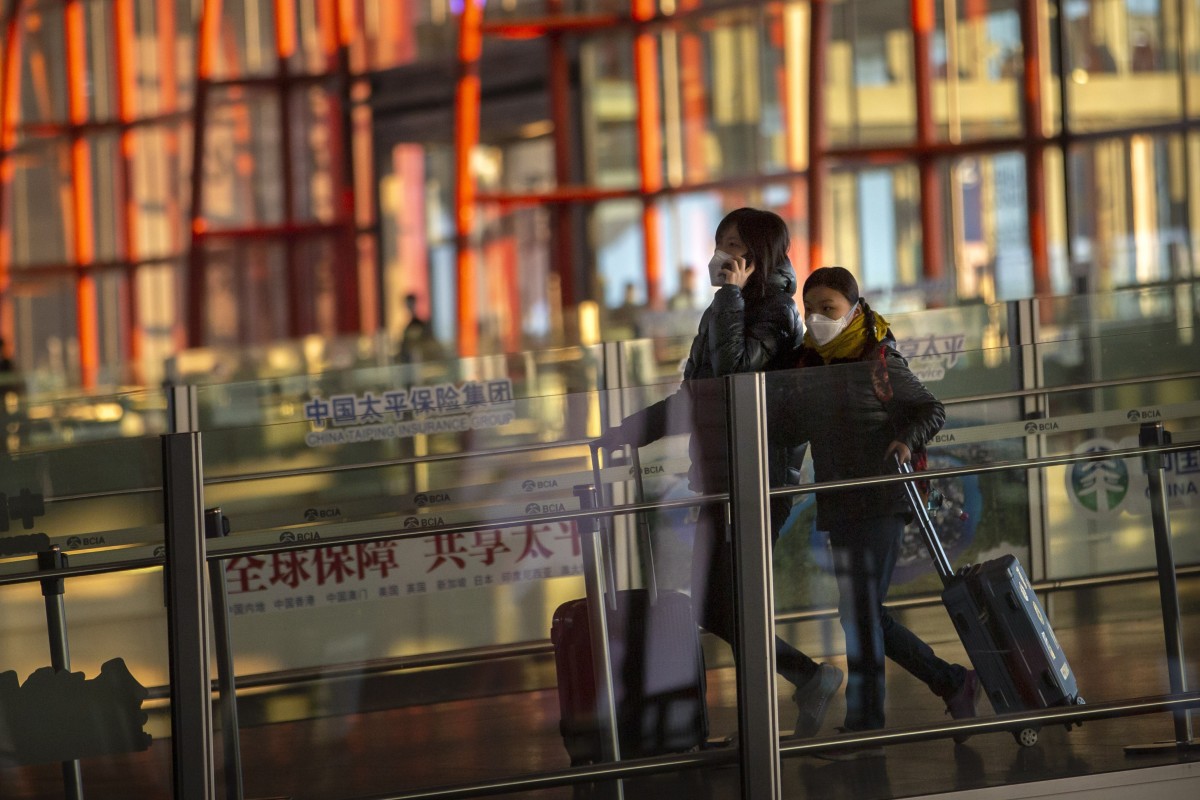
Many airlines have cancelled flights into mainland China because of the coronavirus outbreak. Photo: AP
International air travellers and ticketing agents are in for a turbulent time in the weeks ahead as airlines around the world react to the coronavirus epidemic by cancelling or limiting flights to and from the Chinese mainland.
Lufthansa, British Airways, Air Canada and Indonesia’s Lion Air have
, while United Airlines, American Airlines, IndiGo, Finnair, Delta Air Lines and Jetstar Asia have significantly reduced their services.
“It’s going to be pretty bad for travel agencies. We’ve had a lot of cancellations. Everyone is afraid of coming to China,” said Annabelle Auger from Travel Stone in Beijing.
“Many of our European clients are very worried because of the media coverage they’ve seen. Still, people are willing to wait and see for a few weeks to see how things go,” she said.
For foreigners looking to leave China, Auger said they should contact their embassy to find out about repatriation flights.
“The situation is very unclear, so it’s difficult to give any general recommendations,” she said.
Already this week, the embassies of the United States, Japan, South Korea and Britain have cleared flights to evacuate their nationals from Hubei, the central China province at the heart of the outbreak.
Auger said she and her colleagues had been busy rearranging flights for China-based foreigners who had gone away for the holidays.
“The schools are closed, so families with children abroad are thinking, ‘OK, let’s extend our stay for another week’,” she said.
Politics may have stalled information in coronavirus crisis, scientist says
30 Jan 2020
The Beijing government said on Monday it would extend the Lunar New Year
holiday until Sunday to help stop the spread of the disease, while school breaks have also been extended.
Another travel agent in Beijing, who asked not to be named, said the virus outbreak had yet to have a significant impact on business but concerns were growing.
“We are a bit worried that things may get difficult in the coming months,” she said. “But we trust that the government is doing all it can and will take the appropriate measures to solve the problems.”
Zhu Tao, director of the flight standards department at the Civil Aviation Administration of China (CAAC), said at a press conference in Beijing on Thursday that the relevant authorities were working closely with airlines to help Chinese nationals trapped overseas to get home.
The government had already chartered flights from Japan, Myanmar and South Korea to bring Chinese nationals back to Hubei, he said.
While all flights out of Hubei have been suspended since last week, Zhu said air transport was playing its part in fighting the disease.
As of Wednesday, the CAAC had sent 86 flights carrying 5,129 medical workers and 115,000 items of equipment and other supplies into Wuhan, he said.
Wu Zunyou, the chief epidemiologist at the China Centre for Disease Control and Prevention, said that efforts to prevent the coronavirus spreading outside the country had been successful, as only about 1 per cent of the confirmed infections were outside China.
Despite the flight cancellations, Beijing’s Capital International Airport was operating as normal on Thursday.
Andre Muchanga, a student from Abu Dhabi at the Beijing Institute of Technology, said he made a late decision to fly home.
“I decided to buy my ticket last night,” he said. “At school, our dormitory is almost completely empty. I knocked on a friend’s door last night and found there was no one there, so I decided I better just go home and spend some time with my family.”
He said he decided not to buy a return flight as it he did not know when his classes would resume.
Signs at check-in counters reminded passengers who had travelled to Hubei or had a Hubei address to put themselves in isolation for 14 days.
While flights out of Hubei have been stopped, there was still plenty of inbound traffic.
“The number of domestic inbound travellers seems pretty normal for this time of year,” a man working on an information desk at Capital airport said.
“It’s the sixth day of the Lunar New Year. Lots of people have to return to work.”
An Air China employee, surnamed Hu, said that the airport had stepped up its disinfecting and general cleaning work. Body temperature checks had been installed at all access points and employees had been told to wear masks, he said.
“I don’t mind working during the Lunar New Year holiday,” he said. “I’m not afraid of the virus, I’m here to serve the people.”
Image copyright WEIBO/SCREENSHOTImage caption The female passenger is seen here with her fingers in a V pose, also known as the peace sign
A Chinese pilot has been banned from flying after a photo went viral showing a female passenger in the cockpit.
The photo was taken in January on an Air Guilin flight from Guilin city to Yangzhou city, state media said, but was widely shared this week – causing the airline to take action.
It shows a woman posing in the cockpit with refreshments laid out next to her.
Air Guilin said in a statement the pilot had violated air safety regulations.
‘Thanks to the captain’
The incident took place on 4 January on flight GT1011 from Guilin city to Yangzhou city, according to state media outlet The Global Times.
But it was brought to the airline’s attention on Sunday after screenshots of the alleged passenger’s post started being shared widely on micro-blogging site Weibo.
The post showed the woman making a V sign with her fingers – a popular pose in China – with the photo captioned: “Thanks to the captain. So happy.”
The pilot, who was not named, has been banned from flying for life, though it is unclear if he was fired from all roles by the airline.
Air Guilin said in a statement that he had “violated [regulations] by allowing irrelevant personnel into the cockpit”.
According to the Civil Aviation Administration of China, passengers are not allowed to enter the cockpit without special approval or under “necessary” circumstances.
Other staff members involved in the incident have also been “suspended indefinitely” while further investigations are held.
“Passengers’ safety is always Air Guilin’s priority. We take a zero-tolerance approach against any inappropriate and unprofessional behaviour that might risk the aviation safety,” the Chinese carrier said.
Last year, Chinese carrier Donghai Airlines suspended a pilot for six months and revoked his qualifications as a flight instructor after he allowed his wife to go inside the cockpit.
The airline’s data labs unit is using AI to improve customer service and better handle a flood of complaints
China Eastern Airlines planes are seen on the tarmac at Hongqiao International Airport in Shanghai. Photo: Reuters
In a business that receives around one million complaints a year, the ability to handle large amounts of information is critical.
That is why state-owned China Eastern Airlines is now using artificial intelligence (AI) to improve the customer experience, using the technology’s ability to handle huge amounts of data to tailor its services for individual consumers.
The airline’s data labs unit is even trying to solve problems before they happen by, for example, developing a pilot service that will allow customers to give better instructions and feedback on their in-flight meals.
“Using an analogy, if a good chef happens to leave a restaurant, then he or she takes an abundance of knowledge with them,” said Wang Xuewu, the founder and head of China Eastern Airlines’ data lab, in an interview at the AI summit in Hong Kong this month.
“Through AI, we can better ensure that the tastes and preferences of our customers are kept safe, analysed and applied in the future.”
Beijing thunderstorms return China Eastern’s flight MU5331 twice to Shanghai, taking 17 hours to get back to its origin
The idea for a pilot AI food service at China Eastern comes amid the country’s drive to develop AI technology, dubbed the fourth industrial revolution. In an ambitious three-step blueprint, China wants to catch up with the US in AI technology and applications by 2020, see major breakthroughs by 2025, and become a global leader in the field by 2030.
More broadly, the airline’s data lab now automatically classifies thousands of complaints and offers recommended solutions, to help front line customer relations staff. This shortens the customer response time and helps improve the overall quality of service, said Wang.
A Civil Aviation Administration of China (CAAC) report showed that China Eastern Airlines had 41.6 complaints per million passengers in May. This comes as the airline’s frequent flier members reached 39.6 million in 2019, an increase of 18.8 per cent from the year before, according to the company’s March annual report.
Beijing’s new Zaha Hadid-designed airport to showcase latest facial recognition technology
China’s Quora-like website Zhihu has several questions posted by angry fliers about what is the most effective way to get a satisfactory response from an airline to a complaint.
AI-related technologies have already been deployed at China’s airports. Beijing Capital International Airport launched a facial recognition system for security checks in April 2018 and now around 70 mainland China airports use the system, according to Xinhua reports.
Chief executive Rupert Hogg says staff who ‘support or participate in illegal protests’ would face disciplinary action that ‘may include termination of employment’
Airline’s shares down 4.37 per cent on Monday morning to lowest level in 10 years, despite it complying with orders on Friday from China’s aviation authority
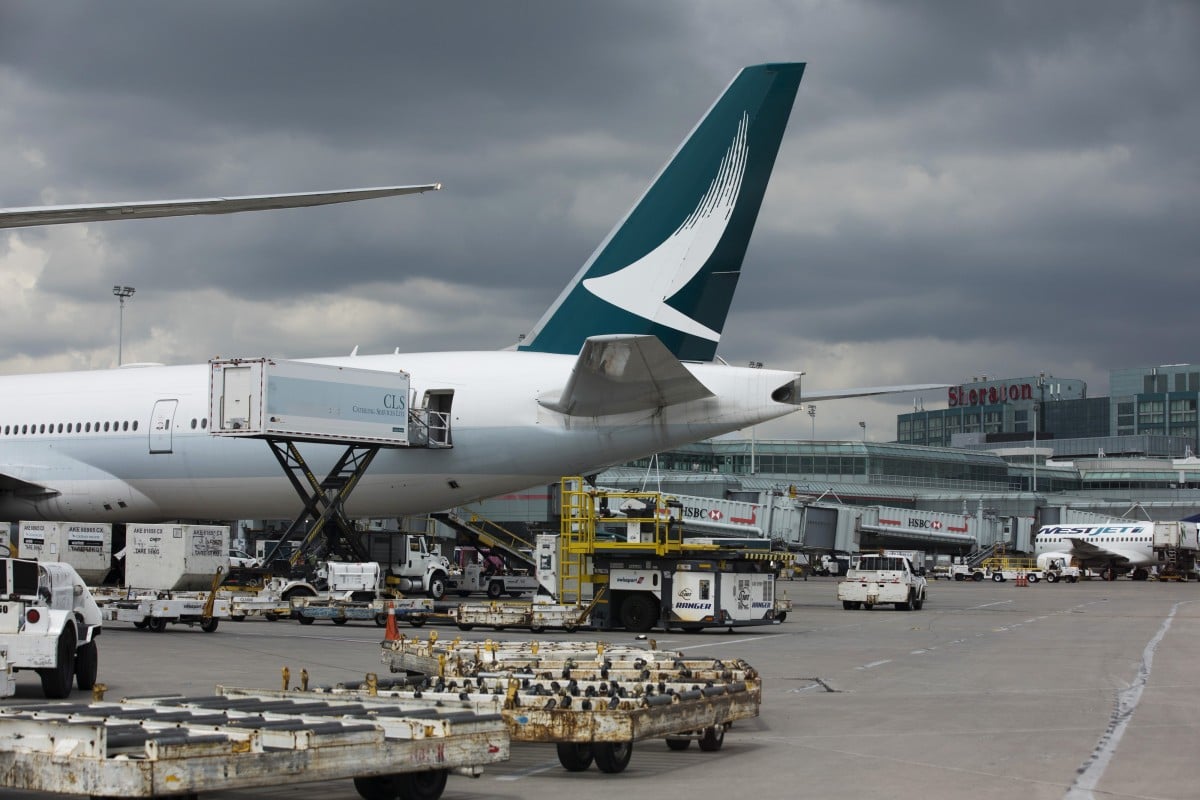
Cathay Pacific moved over the weekend to comply with new orders from China’s aviation authority. Photo: Bloomberg
Cathay Pacific has warned that it would sack staff taking part in illegal protests in Hong Kong, saying it would take a “zero tolerance” approach, as its shares slumped to their lowest level in 10 years in morning trading on Monday.
In a note to staff on Monday, chief executive Rupert Hogg said staff who “support or participate in illegal protests” would face disciplinary action that “could be serious and may include termination of employment”.
His warning indicated an escalation by the company, under pressure to crack down on employees after China’s civil aviation regulator said on Friday that airline staff supporting the Hong Kong protests would be barred from flights going to, from or through mainland China.
“We are all obliged to abide by law at all times,” Hogg said. “Cathay Pacific Group has a zero-tolerance approach to illegal activities. Specifically, in the current context, there will be disciplinary consequences for employees who support or participate in illegal protests. These consequences could be serious and may include termination of employment.”
By noon in Hong Kong, the stock had fallen 4.37 per cent to HK$9.85 (US$1.26), its lowest level since June 2009. Losses dragged the carrier’s parent company Swire Pacific down 5.4 per cent to HK$77.50, making it the worst performer on Hong Kong’s stock market during morning trading.
This was the lowest price since October 2018 for Swire, which owns 45 per cent of the airline. Air China, which owns 22.7 per cent of Cathay, also fell 1.53 per cent in Hong
On Friday, the Civil Aviation Administration of China (CAAC) told Hong Kong’s flagship carrier that any staff members who had taken part in what it called “illegal protests”, “violent actions” and “overly radical activities” would not be allowed to fly to or from the mainland, in a first warning shot at a Hong Kong-based corporate giant.
The CAAC also said that the airline would have to submit identification details of all crew operating all services using mainland China airspace, and that flights with unapproved crew lists would be barred. It gave the airline until Thursday to submit a detailed plan to improve its procedures.
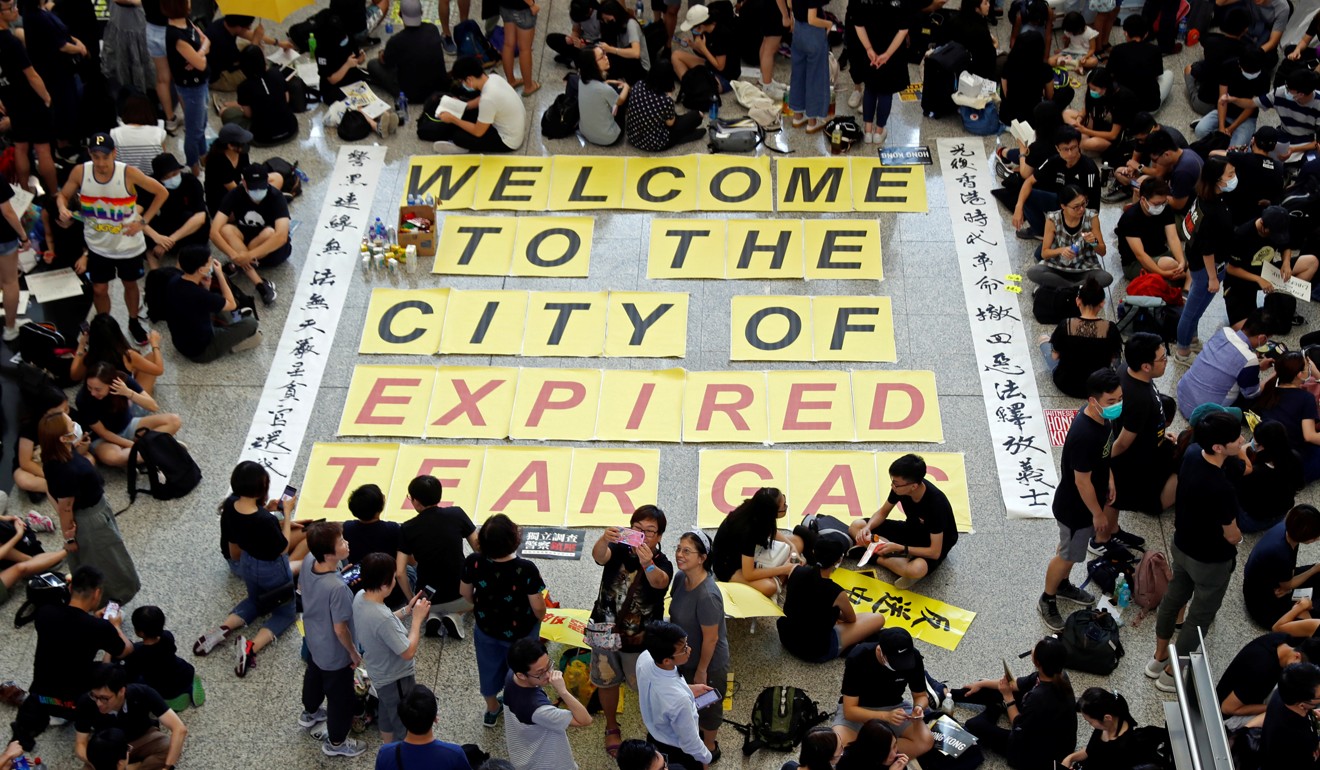
Anti-extradition bill protesters join a sit-in protest at Hong Kong International Airport on Sunday. Photo: Reuters
Cathay Pacific had earlier said it would not stop staff members from taking part in demonstrations.
On Wednesday, Cathay Pacific chairman John Slosar said the company would not rein in staff for openly supporting the protests. “We certainly wouldn’t dream of telling them what they have to think about something,” Slosar said.
But in his second statement in two days in relations to the CAAC’s sanctions, Hogg said the “actions and words” of staff outside of work hours could have a “significant effect on the company”, adding that the actions of a few of Cathay’s 34,000 employees would be seen as a company position.
He also asked staff to not “support or participate” in the illegal protest at the airport, saying the carrier was concerned that the protests could become disorderly and violent.
No flights by Cathay Pacific, nor by its subsidiaries Cathay Dragon or HK Express, were delayed or cancelled on Saturday or Sunday, the company said.
The CAAC’s move was widely seen as a clear warning to Hong Kong’s business community to toe Beijing’s line to pressure ongoing anti-government protests in the city that have been taking place for over two months.
Despite the airline acting over the weekend to comply with the rules, Chinese state media continued to put pressure on the company.
Global Times, a tabloid associated with Communist Party mouthpiece People’s Daily, said on Sunday the airline had still not allayed all concerns despite its adjustments to comply with the ruling.
Carrie Lam’s remarks about Beijing’s sovereignty ‘add fuel to the fire’, analysts warn
“These are only small steps [showing] that Cathay Pacific is heading towards the right direction, and their sincerity will need to be tested over time,” the tabloid said in an opinion article on Sunday.
It said 2,000 company staff joined citywide strikes last Monday, and cited the case of a pilot who was arrested and charged with rioting during a demonstration on July 28.
“Cathay Pacific has touched on this behaviour lightly, which has a huge impact on the trust the industry and the public have towards the company,” the article said.
State broadcaster CCTV published a short video on Weibo on Monday morning of its anchor issuing further warnings to the airline, saying there were reports of staff continuing to join “illegal gatherings” and asking tourists not to go to Hong Kong.
“If this continues, it’s not a matter of whether or not people would still want to come to Hong Kong, but whether they would still want to be on your airline,” Kang Hui said in a one-minute video.
“Let me send a friendly reminder: one would not be in trouble had one not asked for it,” Kang said, in Mandarin and then in English, translating the popular Chinese internet meme phrase “No zuo no die” and claiming some Cathay Pacific staff pretended not to understand Mandarin. Cantonese is the dominant language in Hong Kong.
Elsewhere, the company announced that two of its airport employees
for leaking passenger information about a Hong Kong police soccer team who had been on a flight to mainland China. It has also suspended the pilot who was among 44 people charged with rioting on July 28.
Although the company does not clearly specify its country-by-country performance, China and Hong Kong produced half of all its 2018 revenue – HK$57 billion of a total of HK$111 billion. A fifth of all the carrier’s flight are to and from the mainland.
BEIJING, May 13 (Xinhua) — Beijing Daxing International Airport completed its first test flight of passenger planes as four aircraft landed safely on the runway Monday morning.
China Southern Airlines, China Eastern Airlines, Air China and Xiamen Airlines sent their flagship models A380, A350-900, B747-8 and B787-9, respectively, for the test.
“The test shows that the new airport has now turned its focus from infrastructure construction to operation preparations,” said Wan Xiangdong, chief pilot of Civil Aviation Administration of China.
The test followed the airport’s first flight of verification planes on Jan. 22 this year. The airport is scheduled to take low-visibility flight test in August and go into operation before Sept. 30.
Located 46 km south of downtown Beijing, the new airport is aimed at taking pressure off the overcrowded Beijing Capital International Airport in the northeastern suburbs. It sits at the junction of Beijing’s Daxing District and Langfang, a city of neighboring Hebei Province.
It is expected to handle 45 million passengers annually by 2021 and 72 million by 2025.
Chinese President Xi Jinping, also general secretary of the Communist Party of China Central Committee and chairman of the Central Military Commission, joins deliberation with deputies from Fujian Province at the second session of the 13th National People’s Congress in Beijing, capital of China, March 10, 2019. (Xinhua/Li Xueren)
BEIJING, March 10 (Xinhua) — President Xi Jinping on Sunday afternoon joined deliberation with deputies from Fujian Province at the second session of the 13th National People’s Congress, China’s national legislature.
“[We] should create a favorable development environment for innovation, entrepreneurship and creativity,” said Xi, also general secretary of the Communist Party of China Central Committee and chairman of the Central Military Commission.
China should seek momentum from reform and opening up, unleash to the maximum the whole society’s power for innovation, entrepreneurship and creativity, and keep improving the country’s influence and competitiveness in a world that is undergoing profound changes, Xi said.
Xi stressed creating favorable conditions for the development of small and medium-sized enterprises and young people, and establishing an acceleration mechanism for high-tech companies.
He urged solid implementation of the policies and measures to encourage, guide and support the development of the private sector.
Fujian must leverage the combined strengths of the special economic zone, pilot free trade zone, comprehensive experimental zone and the core zone of the 21st Century Maritime Silk Road, and keep exploring new approaches, Xi said.
Xi called for efforts to explore new ways for integrated development across the Taiwan Strait.
The two sides of the Taiwan Strait should enhance economic and trade cooperation, infrastructure connectivity, energy and resource exchanges, and shared industry standards, he said.
Cross-Strait cooperation and cultural exchanges should be strengthened, he added.
Xi stressed the importance of implementing the people-centered development concept in the work on Taiwan, urging efforts to benefit Taiwan compatriots in the same way as people on the mainland are served.
He encouraged listening to the voice of Taiwan compatriots and research on what other policies and measures can be introduced to bring them benefits.
Xi said that this year marks the 70th anniversary of the founding of New China, and it is necessary to ensure that no one in the country’s old revolutionary base areas falls behind in the process of building a moderately prosperous society in all respects.
He called for adherence to targeted poverty alleviation and efforts to identify the root causes of poverty to enhance the effectiveness of anti-poverty measures.
More efforts should be put into coordinating economic development with ecological protection, Xi said.






 CHINDIA ALERT: You'll be living in their world, very soon