Archive for ‘collision’

20/04/2020

Vietnam accuses Beijing of ‘seriously violating’ sovereignty in South China Sea

  • Move to create administrative units for disputed Paracel and Spratly Islands angers Hanoi
  • China has been engaged in a series of stand-offs with rival claimants recently
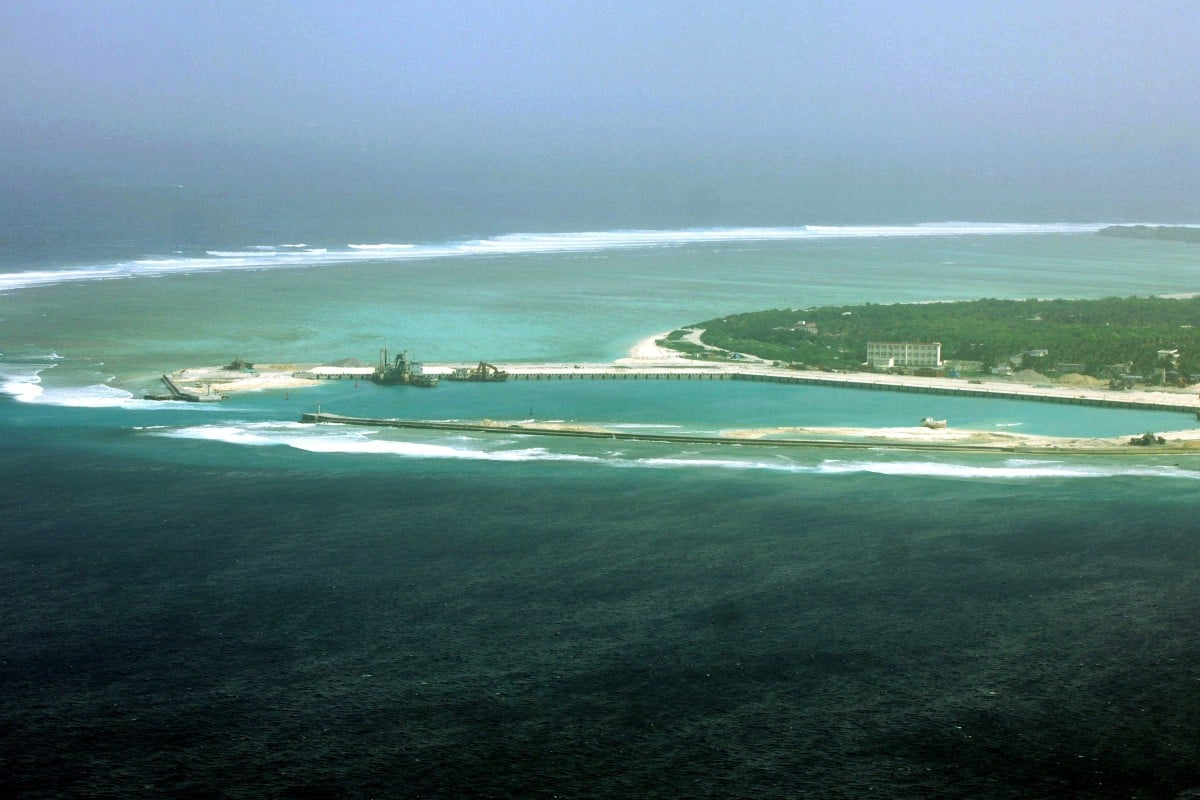
An aerial view of Sanha, a city created to assert China’s claims over the disputed waters. Photo: AFP

China’s latest activities in the South China Sea have triggered a strong protest from rival claimant Vietnam, which said the move “seriously violated” its sovereignty.

The complaint came after China announced on Sunday that it had set up two new administrative districts on the Paracel and Spratly Islands.

The two districts – which China referred to as Xisha and Nansha – will be under the control of Sansha, a city the Chinese government created in 2012 to assert its claims over the South China Sea.

Vietnam’s foreign ministry spokesperson Le Thi Thu Hang issued a statement of protest on Sunday, and said the move would further complicate the situation in the South China Sea.

“These acts are not conducive to the development of the friendly relations between countries and further complicate the situation in the East Sea [Vietnam’s name for the South China Sea], the region and the world,” she said.

“Vietnam demands that China respect Vietnam’s sovereignty and annul its wrongful decisions and not repeat similar activities in the future.”

Under the new plan, the new district of Xisha will be in charge of Paracel Islands, which are also claimed by Vietnam and Taiwan. The Nansha district will manage the Spratly Islands, where there are also multiple competing claims.

Beijing marks out claims in South China Sea by naming geographical features

21 Apr 2020

Chinese Foreign Ministry spokesman Geng Shuang said on Monday that the establishment of the new districts was in line with China’s normal administrative rules.

“China has been resolutely opposing Vietnam’s words and deeds that undermine China’s sovereignty and rights and interests in the South China Sea, and will continue to take necessary measures to firmly safeguard China’s sovereignty and rights and interests.” he said in a press conference

Vietnam is the only claimant which has publicly protested about the move so far. But Zhang Mingliang, an specialist in Southeast Asian politics with Jinan University, said it was likely to have alarmed other members of the Association of Southeast Asian Nations (Asean).

More footage emerges from 2018 near collision of US and China warships in South China Sea
“Setting up such districts will not have much use or actual benefit, and it will cause opposition among the Asean states, many of which have long been suspicious of China’s intentions over the South China Sea,” said Zhang.

“The coronavirus outbreak has already caused some grievances among them towards China, even though they have not been as vocal as the Western countries,” he said.

Richard Heydarian, an academic and former Philippine government adviser, described the move as China taking advantage of a “strategic vacuum” created by the Covid-19 crisis.

South China Sea: Chinese ship Haiyang Dizhi 8 seen near Malaysian waters, security sources say

18 Apr 2020

“On the one hand it’s engaging in face mask diplomacy [providing medical supplies to other countries] … but on the other hand it’s on the offensive,” he said.

“All of them should be seen as part of one package in which China seizes the strategic opportunity of not only its neighbouring countries scrambling to deal with the coronavirus outbreak, but also the US Navy’s suspension of overseas appointments.”

China has recently become involved in a series of stand-off with other claimants in the contested waters.

A Chinese government survey ship reportedly tagged an exploration vessel operated by Malaysia’s state oil company Petronas in the area, and remained off the Malaysian coastline as of late Sunday.

Earlier this month, Vietnam lodged an official protest with China after a Vietnamese fishing boat sunk after a collision in the Paracel Islands.

Source: SCMP

18/02/2020

India’s bird population ‘going down sharply’

Indian peafowlImage copyright GETTY IMAGES
Image caption The population of peafowl, the national bird, has increased significantly

Much of India’s bird population has sharply declined in the past few decades, according to a major study.

The State of India’s Birds report relied on the observations of more than 15,000 birdwatchers who helped assess the status of 867 birds.

It found the greatest decline in the numbers of eagles, vultures, warblers and migrating shorebirds.

But the population of peafowl, the national bird, has increased significantly.

Hunting and habitat loss are the two main reasons behind the decline. “Collision” with electricity lines, according to the study, is a “prime current threat” to birds.

The report, the first comprehensive study of its kind, made two assessments: the drop in bird population over the last 25 years, and over the last five years.

“In the long-term trend assessment, there was appropriate data available only for 261 species, of which 52% had declined [in numbers]. For current trends, there was data only for 146 species, of which [numbers of] nearly 80% were declining,” said MD Madhusudan, co-founder of Nature Conservation Foundation.

It’s based on more than 10 million observations, drawn from sightings and meticulous notes made by professional birdwatchers.

The data was then collated on eBird, a global crowdsourced database that has real-time data on the distribution and abundance of birds.

Presentational grey line
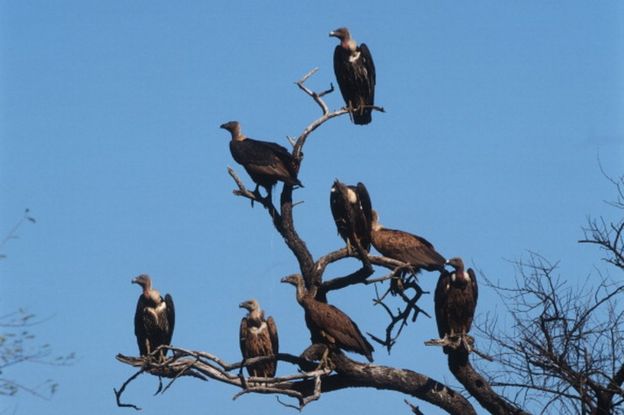
Indian white-rumped vultureImage copyright GETTY IMAGES
Image caption The population of the white-rumped vulture has gone down

Species that have suffered the highest declines

  • White-rumped Vulture
  • Richard’s Pipit
  • Indian Vulture
  • Large-billed Leaf Warbler
  • Pacific Golden Plover
  • Curlew Sandpiper

Species whose numbers have increased

  • Rosy Starling
  • Feral Pigeon
  • Glossy Ibis
  • Plain Prinia
  • Ashy Prinia
  • Indian Peafowl

(Source: State of India’s Birds report)

Presentational grey line

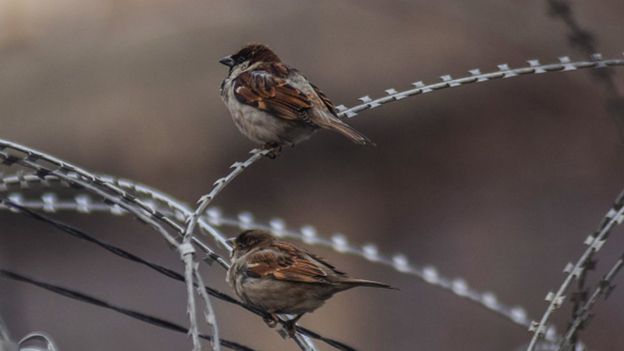
The local sparrow population was found to be roughly stable across the country as a whole, although it has fallen in the major cities.

The population of migratory birds – both long distance and within the subcontinent – also showed a “steep decline”.

The report says that since the 1990s, the numbers of several species of vultures, bustards and other specialist grassland birds have also drastically dropped.

Indian sparrowImage copyright AFP
Image caption The local sparrow population has declined in the major cities

Some species popular in the bird trade, such as the Green Munia, are at “dangerously low” numbers, the report says.

Meanwhile, the Jerdon’s Courser, an endangered bird with “mysterious” breeding habits which was rediscovered in 1986 after a gap of 138 years, has not been seen since 2008.

But there’s some good news as well: the Forest Owlet, another endangered bird that was rediscovered in 1997, is being reported from many more locations.

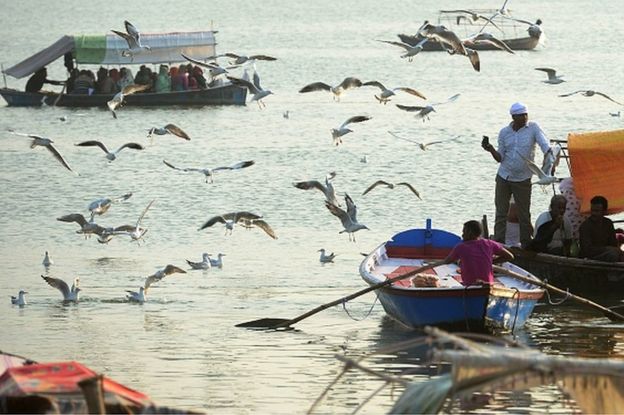
Indian Hindu pilgrims enjoy a boat ride as sea gulls fly at Sangam in Allahabad on October 29, 2018.Image copyright AFP
Image caption The study assessed the status of 867 birds in India

But the study cautions that its research is also a chronicle of “individual species”, and not a report on the “overall health of India’s birds, including those considered common and hence of little conservation concern”.

It says that “abundance trends” are available only for “a handful of bird species” – and mostly for those that tend to be “larger, more obviously threatened and relatively charismatic”.

“For the vast majority of Indian birds, lack of data has hindered a clear understanding of how they are faring. Such an understanding is vital for conservation science, management and policy.”

Source: The BBC

13/11/2019

India train collision: Lucky escape for passengers in Hyderabad

Hundreds of passengers had a lucky escape after two trains collided head-on in the southern Indian city of Hyderabad.

Twelve passengers suffered minor injuries and are being treated at a local hospital.

An inquiry has been ordered into the incident.

India has one of the largest train networks in the world but accidents are fairly common because much of the railway equipment is out of date.

The government has promised to modernise the network but the pace of the change has been slow.

source: The BBC

08/03/2019

IAF’s MiG-21 crashes after bird hit in Rajasthan’s Bikaner, pilot ejects

MiG-21 crash,IAF’s MiG-21,Rajasthan
The plane was on a routine training sortie and hence was unarmed.(Mint/ Representative Image)
A MiG-21 fighter jet of the Indian Air Force crashed in Rajasthan’s Bikaner on Friday. The plane crashed after it reportedly suffered a bird hit.
The plane had taken off from Nal near Bikaner. The pilot is said to have ejected safely.

Bikaner SP Pradeep Mohan Sharma said the MIG aircraft crashed in Shobhasar ki Dhani, 12 km from Bikaner city, news agency PTI reported.

Sharma said police teams have rushed the spot to cordon off the area. No loss of life has been reported.

A statement by the IAF said that the MiG-21 had taken off from the Indian Air Force’s Nal airbase in Rajasthan and that it was on a routine mission.

The IAF statement said, “Today afternoon a MiG-21 aircraft on a routine mission crashed after getting airborne from Nal near Bikaner. Initial inputs indicate the likely cause as bird hit after take off. Pilot of the aircraft ejected safely. A CoI [Court of Inquiry] will investigate the cause of the accident.”

In recent times, the IAF has witnessed a series of crashes involving fighter jets and choppers.

On February 1, a Mirage 2000 fighter jet had crashed during a routine testing flight. Both the pilots in the jet had died after their safety equipment gave way. The pilots were on an “acceptance sortie” of the Mirage 2000 trainer aircraft after it was overhauled by the Bengaluru-based Hindustan Aeronautics Limited (HAL).

Barely a fortnight later, two Surya Kiran Hawks were involved in a collision that led to the death of one pilot. The crash had taken place barely days before the 12 edition of Aero India.

On February 12, a MiG-27 fighter jet had crashed at the Pokhran firing range after taking off from the Jaisalmer air base. The jet was on a training mission. The pilot managed to eject safely from the jet before it crashed.

More recently, on February 27, a Mi17 helicopter of the Indian Air Force had crashed at Budgam in Kashmir. All six IAF personnel on board the chopper were killed. A civilian was also killed in the crash.

The MiG-21 fighter jet has been in the news recently after Wing Commander Abhinandan Varthaman, who was flying a similar aircraft shot down a Pakistani F-16 before crashing in Pakistan.

The MiG-21 is a supersonic jet fighter and interceptor aircraft, designed by the Mikoyan-Gurevich Design Bureau in the erstwhile Soviet Union.

Source: Hindustan Times

09/01/2019

Chinese subway train collision leaves one dead, three injured

  • Chongqing metro rail loop opened two weeks ago and is still in trial operation
  • Train driver died in hospital while two other staff and one passenger treated for injuries
PUBLISHED : Wednesday, 09 January, 2019, 2:39pm
UPDATED : Wednesday, 09 January, 2019, 2:39pm
Martin Choi

<a class="scmp-icon-cross" onclick="popoverClose(this);"></a><h3 class="popover-title"></h3>

” data-original-title=””> 

3SHARE

RELATED TOPICS

Related Articles

The driver of a subway train in southwestern China was killed and three other people were injured when it smashed into protective barrier doors on Tuesday night, less than two weeks after the metro rail line opened.

Station staff on the Chongqing rail transit loop line evacuated 30 passengers and took one passenger, who sustained a slight hand injury, and three injured rail staff, including the driver, to hospital.

The train driver later died in hospital.

The front of the train was damaged and the first compartment offset, but not derailed, when it collided with the protective doors protruding on to the track area between two stations, according to the Chongqing Morning Post.

Chongqing’s railway transit company said three stations along the affected 4km (2.4 miles) route were out of service, while the rest of the metro loop line was still in operation.

The 34km northeastern section of the Chongqing rail line opened on December 28, 2018 and is still under trial operation.

There are 24 stations in the new section, built with an investment of 22.2 billion yuan (US$3.2 billion), with 17 stations currently open, according to local media reports.

The cause of the incident is being investigated.

The protective doors used in Chongqing are a feature of the mountainous city’s rail system and were primarily used in wartime, a staff member of the city’s rail transit department told online news portal Thepaper.cn.

“Protective doors were primarily used during the anti-Japanese war and now to prevent nuclear catastrophes,” the employee said.

During the second world war, hundreds of wartime bomb shelters were built into the sides of mountains in Chongqing to provide protection from Japanese bombardment.

28/12/2018

Mid-air collision of three planes averted in Delhi region after multiple warnings, ATC help

Flights of Dutch carrier KLM, Taiwan’s Eva Air and the US-based National Airlines were involved in the incident, an official said. The incident happened in the Delhi Flight Information Region (FIR).

INDIA Updated: Dec 28, 2018 20:23 IST

In a rare incident, three planes of three foreign airlines, carrying hundreds of passengers, came perilously close in the Delhi flight information region and collisions were averted after multiple auto generated warnings and intervention from ATC, an official said Friday.(Reuters/Representative Image)

In a rare incident, three planes of three foreign airlines, carrying hundreds of passengers, came perilously close in the Delhi flight information region and collisions were averted after multiple auto generated warnings and intervention from ATC, an official said Friday.

The Aircraft Accident Investigation Bureau (AAIB) has started a probe into the incident, which happened on December 23.

Flights of Dutch carrier KLM, Taiwan’s Eva Air and the US-based National Airlines were involved in the incident, the official said.

The incident happened in the Delhi Flight Information Region (FIR).

An FIR refers to a specified airspace where flight information and alerting services are provided. Generally, an FIR can be land and sea territory as well as any international airspace as defined under global norms.

According to the official, at the time of the incident, National Airlines’ flight NCR 840 was on its way to Hong Kong from Bagram in Afghanistan while the KLM Flight KLM 875 was heading to Bangkok from Amsterdam. The Eva Air flight EVA 061 was flying to Vienna from Bangkok, the official said. “First it was NCR 840, which was flying at flight level 310 (31,000 ft) and EVA 061 at flight level 320 (32,000 ft) which breached mandatory separation. The pilots of both the aircraft were alerted by the onboard TCAS warning system,” the official said.

Around the same time, the KLM flight was at 33,000 ft, he added.

Following the TCAS (Traffic Collision Avoidance System) warning, the pilot of NCR 840 sought to climb to 35,000 feet but was told to remain at that current level till the time it gets a go-ahead. “However, when the air traffic controller (ATC) observed it climbing, it was immediately asked to take a left turn. In the meantime, EVA also continued climbing at flight level 330, a level at which KLM was already flying, and at this time, another TCAS warning went off, alerting the pilots to steer the aircraft to a safer distance,” the official said.

As the NCR 840 again descended to flight level 330, it came across the EVA flight , triggering another TCAS alarm, the official said.

Law of Unintended Consequences

continuously updated blog about China & India

ChiaHou's Book Reviews

continuously updated blog about China & India

What's wrong with the world; and its economy

continuously updated blog about China & India