Archive for ‘CONFRONTATION’

31/05/2020

Is Beijing preparing to decouple from the US?

  • China’s leadership has made it clear to its people that the world will become more dangerous and they must be prepared for hard times
  • Beijing’s relatively small stimulus response to Covid-19 suggests it wants to save its economic policy ammunition for a bigger battle China opted not to set a GDP target for 2020. Photo: Xinhua
China opted not to set a GDP target for 2020. Photo: Xinhua
Beijing’s decision not to set an annual GDP target for 2020 – for the first time since 2002 – is a sign it is putting stability ahead of growth as part of its preparations for an escalating conflict with the United States.
Economic development has always been the central theme for Beijing since it established diplomatic relations with the US in 1979. But this year it has given priority to job creation and tackling poverty. The coronavirus outbreak might appear to have been the reason for the shift, but the underlying factor is the tension with the US.
Covid-19 offered a preview of what a decoupling of China and US might look like: aircraft grounded, cargo flows disrupted, value chains broken, goodwill and cooperation lost, blame games started.
Both countries have suffered heavy human and economic losses from the coronavirus, yet that did not inspire them to work together. Instead, hostility and rivalry has thrived, and neither wants to blink first.

The Chinese leadership has made it clear to its people that the world will become more dangerous and they must be prepared for hard times. As such, the government is saving its economic policy ammunition.

While the stimulus plans introduced in the US, Germany, Japan and France exceed 10 per cent of their national GDP and interest rates have been cut to the bone, Beijing stopped at just 1 trillion yuan (US$140 billion) worth of special treasury bonds and 1.6 trillion yuan of additional local government bonds. In total, about 2.6 per cent of GDP.

Interest rates in China – 2.7 per cent on 10-year bonds – are some of the highest among major economies.

China’s 6.6 per cent defence spending boost lowest in three decades

23 May 2020

China’s budget fiscal deficit has increased to 3.6 per cent of GDP for 2020, but the larger deficit is mainly from tax and fee cuts instead of increased fiscal expenses, except for an increased military spending.

Beijing is calling on provincial and local authorities to tighten their belts, which is unusual for a government that has huge assets and can increase spending at any time through quantitative easing.

So why is the government, which is known for intervening in the economy, being so restrained?

It is bracing itself for a perceived period of turbulence and hardship as its relationship with the US turns sour. It is putting jobs and social stability on top of its agenda, instead of growth.

Beijing is refraining from excessive spending, eliminating sources of potential instability, making appeals to the most vulnerable social groups, and saving its power for a bigger test.

Against that backdrop, the National People’s Congress passed the national security legislation on Hong Kong. Beijing knew the bill would anger the US, but did it anyway.

Hong Kong is known as China’s gateway to the international capital market and the largest offshore yuan market, but Beijing is ready to trade losses on the financial and economic front for potential gain on a fortified national security fence.

All this points to the suggestion that Beijing is preparing for the possibility of decoupling from the US, even if it doesn’t necessarily want to.

The threat of a new Cold War is clouding the world. The theme of life for one or two generations of people on both sides of the Pacific may shift from growth and prosperity to struggle and confrontation.

China and the US have yet to collide totally, but that moment is drawing near.

Source: SCMP

30/05/2020

China-India border: Why tensions are rising between the neighbours

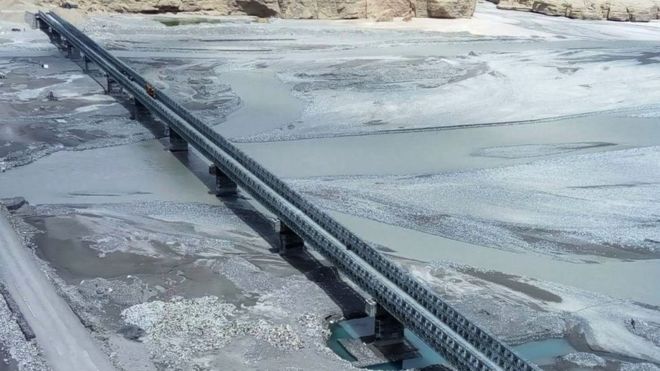
'Col Chewang Rinchen Setu', a bridge built by Border Roads Organisation (BRO) over River Shyok, connecting Durbuk and Daulat Beg Oldie in Eastern LadakhImage copyright PRESS INFORMATION BUREAU
Image caption The area has become a hotspot in part because of a road India has built

The armies of the world’s two most populous nations are locked in a tense face-off high in the Himalayas, which has the potential to escalate as they seek to further their strategic goals.

Officials quoted by the Indian media say thousands of Chinese troops have forced their way into the Galwan valley in Ladakh, in the disputed Kashmir region.

Indian leaders and military strategists have clearly been left stunned.

The reports say that in early May, Chinese forces put up tents, dug trenches and moved heavy equipment several kilometres inside what had been regarded by India as its territory. The move came after India built a road several hundred kilometres long connecting to a high-altitude forward air base which it reactivated in 2008.

The message from China appears clear to observers in Delhi – this is not a routine incursion.

“The situation is serious. The Chinese have come into territory which they themselves accepted as part of India. It has completely changed the status quo,” says Ajai Shukla, an Indian military expert who served as a colonel in the army.

China takes a different view, saying it’s India which has changed facts on the ground.

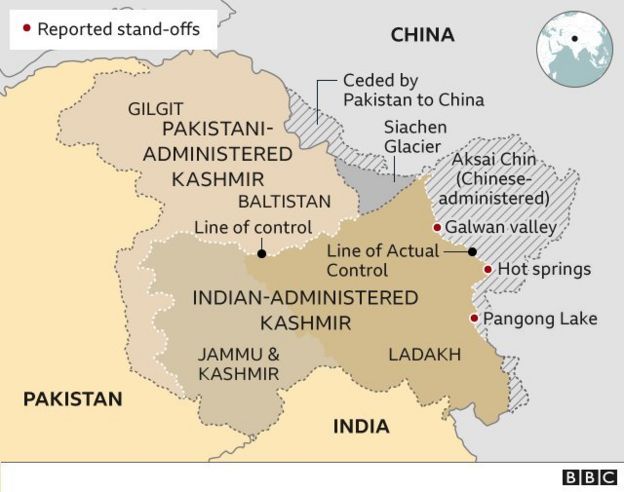
Reports in the Indian media said soldiers from the two sides clashed on at least two occasions in Ladakh. Stand-offs are reported in at least three locations: the Galwan valley; Hot Springs; and Pangong lake to the south.

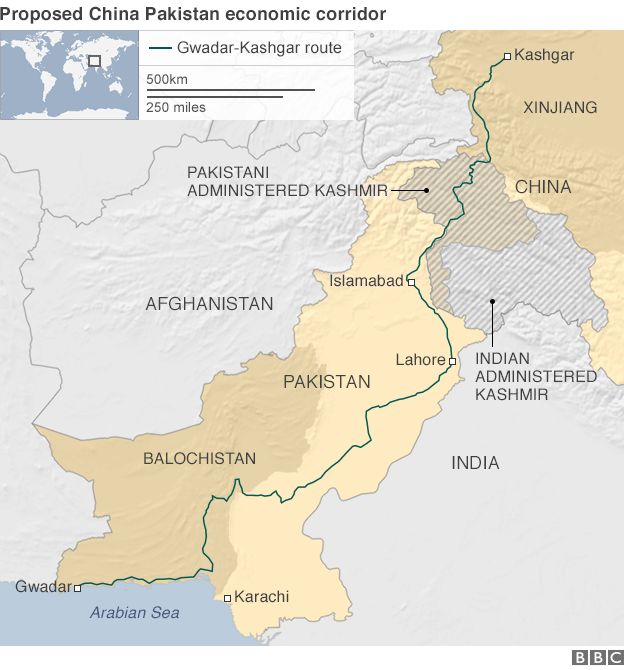
A map showing the disputed area

India and China share a border more than 3,440km (2,100 miles) long and have  overlapping territorial claims. Their border patrols often bump into each other, resulting in occasional scuffles but both sides insist no bullet has been fired in four decades.

Their armies – two of the world’s largest – come face to face at many points. The poorly demarcated Line of Actual Control (LAC) separates the two sides. Rivers, lakes and snowcaps mean the line separating soldiers can shift and they often come close to confrontation.

The current military tension is not limited to Ladakh. Soldiers from the two sides are also eyeball-to-eyeball in Naku La, on the border between China and the north-eastern Indian state of Sikkim. Earlier this month they reportedly came to blows.

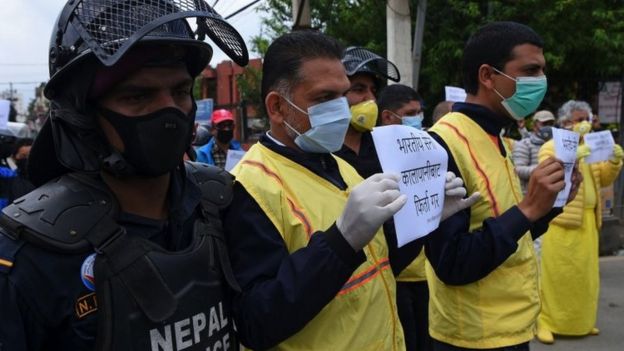
And there’s a row over a new map put out by Nepal, too, which accuses India of encroaching on its territory by building a road connecting with China.

Why are tensions rising now?

There are several reasons – but competing strategic goals lie at the root, and both sides blame each other.

“The traditionally peaceful Galwan River has now become a hotspot because it is where the LAC is closest to the new road India has built along the Shyok River to Daulet Beg Oldi (DBO) – the most remote and vulnerable area along the LAC in Ladakh,” Mr Shukla says.

India’s decision to ramp up infrastructure seems to have infuriated Beijing.

Human rights activists hold placards during a protest against India"s newly inaugurated link road to the Chinese border, near Indian embassy in Kathmandu on May 12, 2020.Image copyright AFP
Image caption There have been protests in Nepal against Indi’s new road link

Chinese state-run media outlet Global Times said categorically: “The Galwan Valley region is Chinese territory, and the local border control situation was very clear.”

“According to the Chinese military, India is the one which has forced its way into the Galwan valley. So, India is changing the status quo along the LAC – that has angered the Chinese,” says Dr Long Xingchun, president of the Chengdu Institute of World Affairs (CIWA), a think tank.

Michael Kugelman, deputy director of the Asia programme at the Wilson Center, another think tank, says this face-off is not routine. He adds China’s “massive deployment of soldiers is a show of strength”.

The road could boost Delhi’s capability to move men and material rapidly in case of a conflict.

Differences have been growing in the past year over other areas of policy too.

When India controversially decided to end Jammu and Kashmir’s limited autonomy in August last year, it also redrew the region’s map.

The new federally-administered Ladakh included Aksai Chin, an area India claims but China controls.

Senior leaders of India’s Hindu-nationalist BJP government have also been talking about recapturing Pakistan-administered Kashmir. A strategic road, the Karakoram highway, passes through this area that connects China with its long-term ally Pakistan. Beijing has invested about $60bn (£48bn) in Pakistan’s infrastructure – the so-called China Pakistan Economic corridor (CPEC) – as part of its Belt and Road Initiative and the highway is key to transporting goods to and from the southern Pakistani port of Gwadar. The port gives China a foothold in the Arabian Sea.

map
In addition, China was unhappy when India initially banned all exports of medical and protective equipment to shore up its stocks soon after the coronavirus pandemic started earlier this year.

How dangerous could this get?

“We routinely see both armies crossing the LAC – it’s fairly common and such incidents are resolved at the local military level. But this time, the build-up is the largest we have ever seen,” says former Indian diplomat P Stobdan, an expert in Ladakh and India-China affairs.

“The stand-off is happening at some strategic areas that are important for India. If Pangong lake is taken, Ladakh can’t be defended. If the Chinese military is allowed to settle in the strategic valley of Shyok, then the Nubra valley and even Siachen can be reached.”

In what seems to be an intelligence failure, India seems to have been caught off guard again. According to Indian media accounts, the country’s soldiers were outnumbered and surrounded when China swiftly diverted men and machines from a military exercise to the border region.

This triggered alarm in Delhi – and India has limited room for manoeuvre. It can either seek to persuade Beijing to withdraw its troops through dialogue or try to remove them by force. Neither is an easy option.

“China is the world’s second-largest military power. Technologically it’s superior to India. Infrastructure on the other side is very advanced. Financially, China can divert its resources to achieve its military goals, whereas the Indian economy has been struggling in recent years, and the coronavirus crisis has worsened the situation,” says Ajai Shukla.

What next?

History holds difficult lessons for India. It suffered a humiliating defeat during the 1962 border conflict with China. India says China occupies 38,000km of its territory. Several rounds of talks in the last three decades have failed to resolve the boundary issues.

China already controls the Aksai Chin area further east of Ladakh and this region, claimed by India, is strategically important for Beijing as it connect its Xinjiang province with western Tibet.

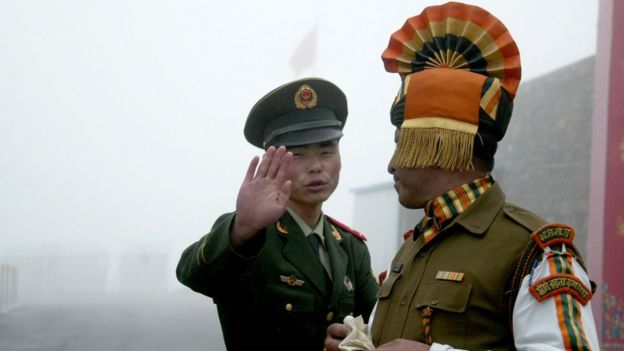
File photo of an Indian and Chinese soldier on the borderImage copyright GETTY IMAGES
Image caption India and China have a long history of border disputes

In 2017 India and China were engaged in a similar stand-off lasting more than two months in Doklam plateau, a tri-junction between India, China and Bhutan.

India objected to China building a road in a region claimed by Bhutan. The Chinese stood firm. Within six months, Indian media reported that Beijing had built a permanent all-weather military complex there.

This time, too, talks are seen as the only way forward – both countries have so much to lose in a military conflict.

“China has no intention to escalate tensions and I think India also doesn’t want a conflict. But the situation depends on both sides. The Indian government should not be guided by the nationalistic media comments,” says Dr Long Xingchun of the CIWA in Chengdu. “Both countries have the ability to solve the dispute through high-level talks.”

Chinese media have given hardly any coverage to the border issue, which is being interpreted as a possible signal that a route to talks will be sought.

Pratyush Rao, associate director for South Asia at Control Risks consultancy, says both sides have “a clear interest in prioritising their economic recovery” and avoiding military escalation.

“It is important to recognise that both sides have a creditable record of maintaining relative peace and stability along their disputed border.”

Source: The BBC

24/05/2020

China and US must find ways to get along and avoid new cold war, says Foreign Minister Wang Yi

  • Countries must respect each others’ systems and be wary of US political forces who want to ‘hijack relations’, Wang tells press conference at ‘two sessions’
  • Beijing is not looking for confrontation and wants to work with Washington to fight coronavirus, minister says
Foreign Minister Wang Yi said China did not want to replace or change the US. Photo: Xinhua

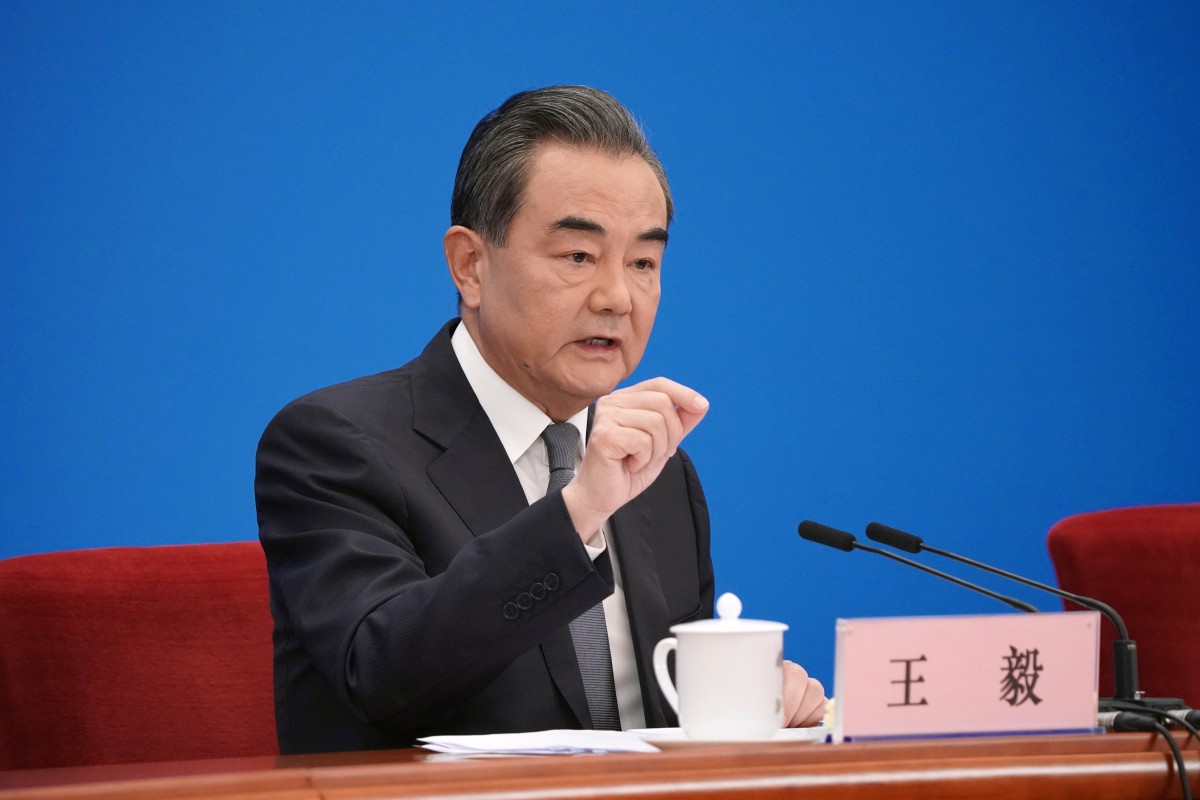
China and the US should try to avoid a new cold war and find new ways to cooperate despite their differences, China’s Foreign Minister Wang Yi said on Sunday.

“We need to be alert to efforts by some political forces in America to hijack China-US relations and who try to push the two countries towards a so-called ‘new cold war’.

“This is a dangerous attempt to turn back the course of history,” Wang told a press conference on the sidelines of the annual parliamentary meetings known as the ‘two sessions’.

Ties between the two countries have further worsened due to escalating tensions over the handling of the Covid-19 pandemic.

Voices calling for decoupling have been on the rise in the US, with some arguing that the two countries are edging towards a new cold war akin to that against the Soviet Union.

Wang called for the two countries to respect each other’s political systems and to find a way to get along despite their differences.

The two nations should step up cooperation on global pandemic control, and coordinate on macro policies to deal with the economic impact.

“China has no intention of changing the United States, much less replacing it. The US should give up the wishful thinking that it can change China.”

“For the benefit of the two peoples, as well as the future and well-being of humankind, China and the US should and must find a way to coexist peacefully despite the differences in system and cultures of the two societies.”

Wang said China will not seek confrontation with the United States, but China is determined to protect its sovereignty, territorial integrity and development.

Source: SCMP
02/04/2020

Chinese air force’s drill ‘aimed at signalling deterrent around Taiwan’

  • 36-hour exercise simulates countering enemy planes during wartime, report says
  • People’s Liberation Army placing increasing emphasis on airborne early-warning and control aircraft, observers say
The Eastern Theatre Command’s latest exercise follows joint air and naval drills near Taiwan in February. Photo: Handout
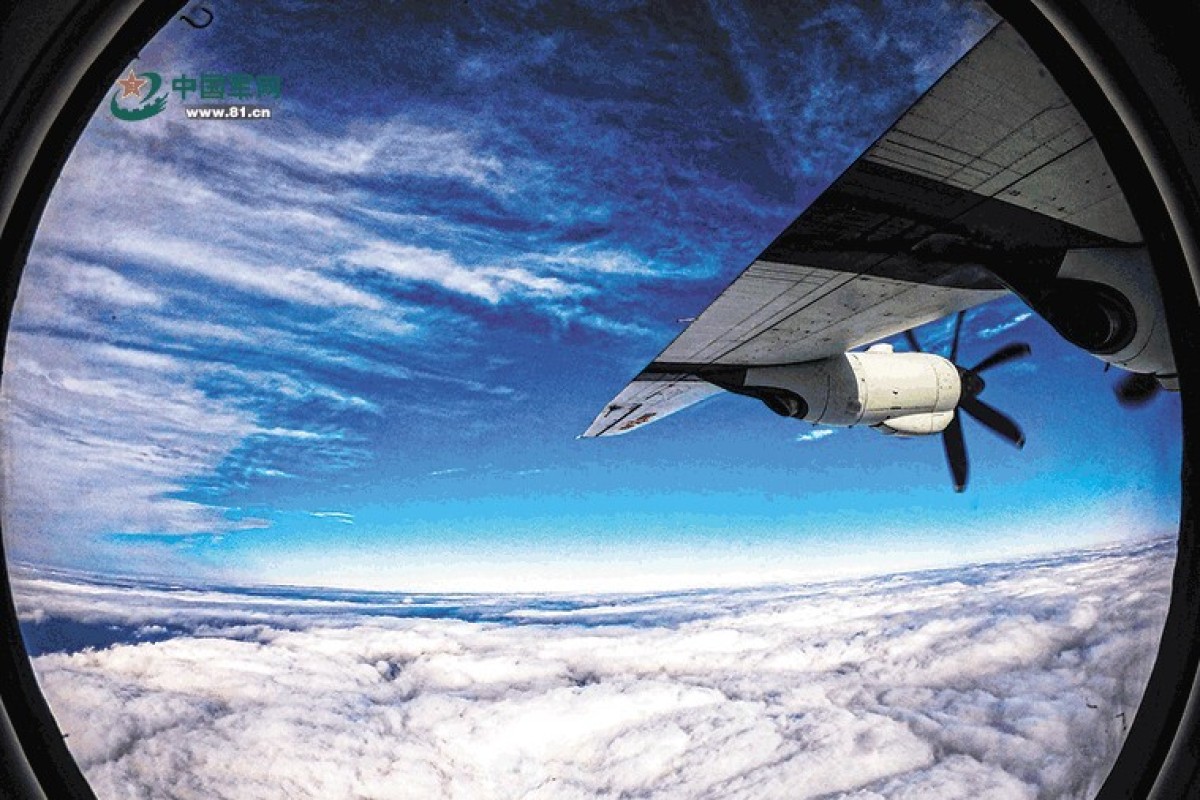
The Chinese military command responsible for patrols around Taiwan stepped up its drills by staging a long-endurance early-warning exercise in March, the official PLA Daily reported on Wednesday.
A warplane conducted tactical acrobatics, which were not specified, immediately after taking off, the report said. The move had not been common during previous drills, and was intended to simulate quickly countering enemy planes during wartime, the report quoted the plane’s captain Liu Yin as saying.
The plane performed reconnaissance, early-warning and surveillance work, tested airborne strikes, and an unspecified number of fighter jets in two groups staged a confrontation in a combat scenario.
The drill lasted for about 36 hours, the report said.
Taiwan shows off its military power after presidential election
Zi Kun, an officer from the division’s training unit, said the drill was a test for both pilots and equipment because it involved planning and coordination to meet actual combat requirements.

The exercise came after the Eastern Theatre Command in early February launched joint drills featuring naval and air forces near Taiwan and a combat-readiness drill in which its warplanes encircled the self-ruled island.

It also came after the United States sent EP-3E Aries electronic warfare and reconnaissance aircraft to fly near Kaohsiung, in southern Taiwan, and Hong Kong in late March.

Beijing may step up drills in South China Sea amid US military tensions

29 Mar 2020

Beijing views the self-governed Taiwan as a renegade province that must be united with mainland China by force if necessary.

Experts said the drill was designed to enhance China’s intelligence-gathering capabilities to better monitor activities at sea and in the air.

Taiwan’s re-elected president Tsai Ing-wen meets US and Japanese envoys to call for closer ties
“The People’s Liberation Army’s Air Force used to rely only on ground-based early-warning radar. Only in the past two decades, it started to acquire airborne early-warning and control aircraft, which could allow the air force to extend their radar coverage beyond the limits of ground-based radars,” said Collin Koh, a research fellow from the S Rajaratnam School of International Studies at Singapore’s Nanyang Technological University.

“The problem with ground-based radars is they are often limited by line of sight and Earth curvature, whereas the airborne early-warning assets can help to address these radar gaps and also have a better ability to pick up low-flying targets and those obscured by terrain,” Koh said.

Taiwan military stages exercise to fight off mock invasion

25 Mar 2020

Zhou Chenming, a Beijing-based military expert, said that China did not have enough early-warning planes to support its expanding military ambitions and needed to maximise its capabilities through various exercises to act as a credible deterrent.

The command’s ongoing drills in recent months would be intended to send signals to the outside world on two fronts, according to Koh.

“The Eastern Theatre Command’s primary area of responsibility would cover Taiwan. And by extension, it also means targeting US forces concentrated not just in the nearby bases in Japan but also further afield beyond the First Island Chain, especially Guam,” he said.

Source: SCMP

01/07/2019

Spotlight: Xi’s trip to Osaka drives multilateralism, G20 cooperation, global economy

JAPAN-OSAKA-XI JINPING-G20 SUMMIT

Chinese President Xi Jinping attends the 14th G20 summit held in Osaka, Japan, June 28, 2019. Xi called on G20 to join hands in forging high-quality global economy while addressing the 14th G20 summit held in the Japanese city of Osaka. (Xinhua/Xie Huanchi)

BEIJING, June 29 (xinhua) — Attending the summit of the Group of 20 (G20) major economies and holding meetings with his counterparts, Chinese President Xi Jinping paid a three-day visit to Osaka, Japan, which has proved a success with expanding consensus on the promotion of multilateralism and providing direction for both the G20 cooperation and global growth.

Chinese State Councilor and Foreign Minister Wang Yi made the remarks while noting that the 14th summit happened at a historic moment when chaos and uncertainties have brought the world to a critical crossroads, and that Xi’s tight diplomatic agenda marked China’s continuous efforts as a reliable and responsible major country to help with broad visions and workable solutions.

Envisioning a new type of international relations and a community with a shared future for mankind, Xi’s efforts were focused on promoting multilateralism, partnerships, mutually beneficial cooperation and joint development, which helped expand consensus, push forward cooperation, and increase confidence in global peace and development.

According to Wang, Xi’s speech at the G20 summit struck an extensive chord and China’s ideas received widespread support. In addition, the world is happy to see that Xi’s meetings with other leaders will help shape healthier major-country relations, that new opportunities will come with the new measures Xi announced for China’s further opening-up, and that Xi and U.S. President Donald Trump agreed that the two countries will restart trade talks.

WIDE CONSENSUS

During his trip to Osaka, by upholding multilateralism, the Chinese president guided the dialogue and discussions towards the direction of cooperation and inclusiveness in order to achieve win-win results.

Xi made four overseas trips since the beginning of June, setting a record for the history of the diplomacy of The People’s Republic of China, Wang said.

Xi put forward a four-point proposal in his speech at the summit, including exploring driving force for growth, improving global governance, removing development bottlenecks, and properly addressing differences.

Those proposals have outlined the direction to tackle the challenges facing the world economy, which is conducive to creating greater space for the global development and a better environment for international cooperation, Wang said.

With joint efforts, the G20 summit in Osaka has voiced support for multilateralism. It has been proven that upholding and practicing multilateralism is not just China’s choice, but a consensus and wish of the majority of countries in the world, Wang said.

Besides, on the sidelines of the G20 summit, Xi also attended a meeting of BRICS nations, China-Africa leaders’ meeting, China-Russia-India leaders’ meeting, and held a series of bilateral meetings.

During the meetings, Xi urged more efforts to promote global governance based on the principle of extensive consultation, joint contribution and shared benefits, safeguard the international system with the UN at the core and the international law as the foundation, preserve the multilateral trade regime with the World Trade Organization at the core and the rules as the foundation, promote multilateralism and free trade, push forward the democratization of international relations, and build an open world economy, Wang said.

Meanwhile, Xi met with Japanese Prime Minister Shinzo Abe with the two sides reaching a 10-point consensus to promote the development of bilateral relations.

When meeting with UN Secretary-General Antonio Guterres, Xi said the more complex and severe the situation is, the more necessary it is to highlight the UN’s authority and role.

Xi also exchanged views and reached new consensus with South Korean President Moon Jae-in on bilateral relations and the Korean Peninsula situation. Xi’s meetings with his French counterpart, Emmanuel Macron, and German Chancellor Angela Merkel will promote the in-depth development of China-Europe relations, Wang said.

Xi also met with Trump, South African President Cyril Ramaphosa, Indonesian President Joko Widodo during his visit.

COOPERATION, NOT CONFRONTATION

As China’s legitimate and lawful rights have been undermined by a series of unilateral and protectionist measures by the United States, China has to adopt necessary counter-measures, Wang said.

During the summit, Xi, at the invitation of his U.S. counterpart, met with President Trump, stating China’s stance on fundamental issues concerning the development of bilateral relations, and conducting candid communication over major challenges facing the two sides, Wang added.

Summing up the experience and illumination in the past the four decades since China and the United States established diplomatic ties, Xi said the two sides both benefit from cooperation and lose in confrontation, and that cooperation and dialogue are better than friction and confrontation.

China and the United States have highly integrated interests and extensive cooperation areas, and they should not fall into so-called traps of conflict and confrontation, Xi said.

On issues involving China’s sovereignty and dignity, China must safeguard its core interests, Xi stressed.

For his part, Trump said he values the good relationship with Xi and that it is of great significance for the two heads of state to maintain close contacts.

The U.S. side attaches importance to its relations with China, and harbors no hostility towards China, Trump said, adding that his country is willing to cooperate with China and that he hopes for better relations between the two countries.

During the meeting, Xi also reiterated the position of the Chinese government on the Taiwan issue, urging the United States to stick to the one-China principle and the three China-U.S. joint communiques.

The U.S. stance has not changed and it continues to pursue the one-China policy, Trump said.

When talking about the China-U.S. trade frictions, Xi emphasized that the essence of the China-U.S. economic and trade cooperation is mutual benefit and win-win, and that the two sides will eventually have to find a mutually acceptable solution to their differences through equal dialogue and consultation. Trump agreed with Xi in this regard.

Trump said the differences in such fields as economy and trade between the two sides should be properly settled, and that the United States will not add new tariffs on imports from China.

The most important consensus reached between the two heads of state is that China and the United States agree to continue to advance a China-U.S. relationship featuring coordination, cooperation and stability, Wang said.

They announced the restart of economic and trade consultations between their countries on the basis of equality and mutual respect. These significant consensuses send positive signals to the international community and global markets, Wang said.

As long as the two sides follow the principles and consensus established by the two heads of state, firmly grasp the correct direction of bilateral ties, expand cooperation based on mutual benefit, manage differences on the basis of mutual respect, and properly settle all problems that exist or will likely happen in bilateral relations, there is hope of a long-term and steady growth of the China-U.S. ties, and of more benefit to the two peoples and the people from other parts of the world, Wang said.

BRIGHT FUTURE OF CHINA

During the G20 summit and meetings with other world leaders, Xi explained China’s development philosophy and cooperation proposals.

According to Wang, Xi stressed that China is confident in pursuing its path, handling its own affairs well, achieving peaceful co-existence and win-win cooperation with all other countries, which has enhanced their understanding and support for China.

Stressing that the Chinese economy is registering a stable performance with good momentum for growth, Xi introduced a clear attitude and the latest measures on opening up the Chinese market, expanding imports, improving business environment as well as advancing free trade arrangements and regional economic integration, Wang said.

The Chinese president said China is breaking new ground in opening-up and pressing ahead with high-quality development.

Meanwhile, during the summit, Xi invited all interested parties to join the Belt and Road Initiative, amplifying the positive effects of the second Belt and Road Forum for International Cooperation.

Xi also advocated international cooperation in innovation so as to benefit more countries and people, Wang said.

According to Wang, all sides are optimistic about China’s development prospects, and believe that the new round of reform and opening-up measures announced by Xi are sincere and substantial, and the high-quality cooperation on building the Belt and Road corresponds with the trend of the times and the aspirations of people in the world.

It has been once again proven that China is a driving force for world economic growth, promoting openness in the world and providing a major market for other countries to explore business opportunities, Wang said.

Source: Xinhua

Law of Unintended Consequences

continuously updated blog about China & India

ChiaHou's Book Reviews

continuously updated blog about China & India

What's wrong with the world; and its economy

continuously updated blog about China & India