Archive for ‘Congo’

31/03/2020

Coronavirus latest: New York begs for help; Indonesia bans foreigners entry; Italy extends lockdown

  • US death toll passes 3,000 as New York’s hospitals are pushed to breaking point
  • Italy extends lockdown as cases exceed 100,000; UN Security Council votes by email for first time
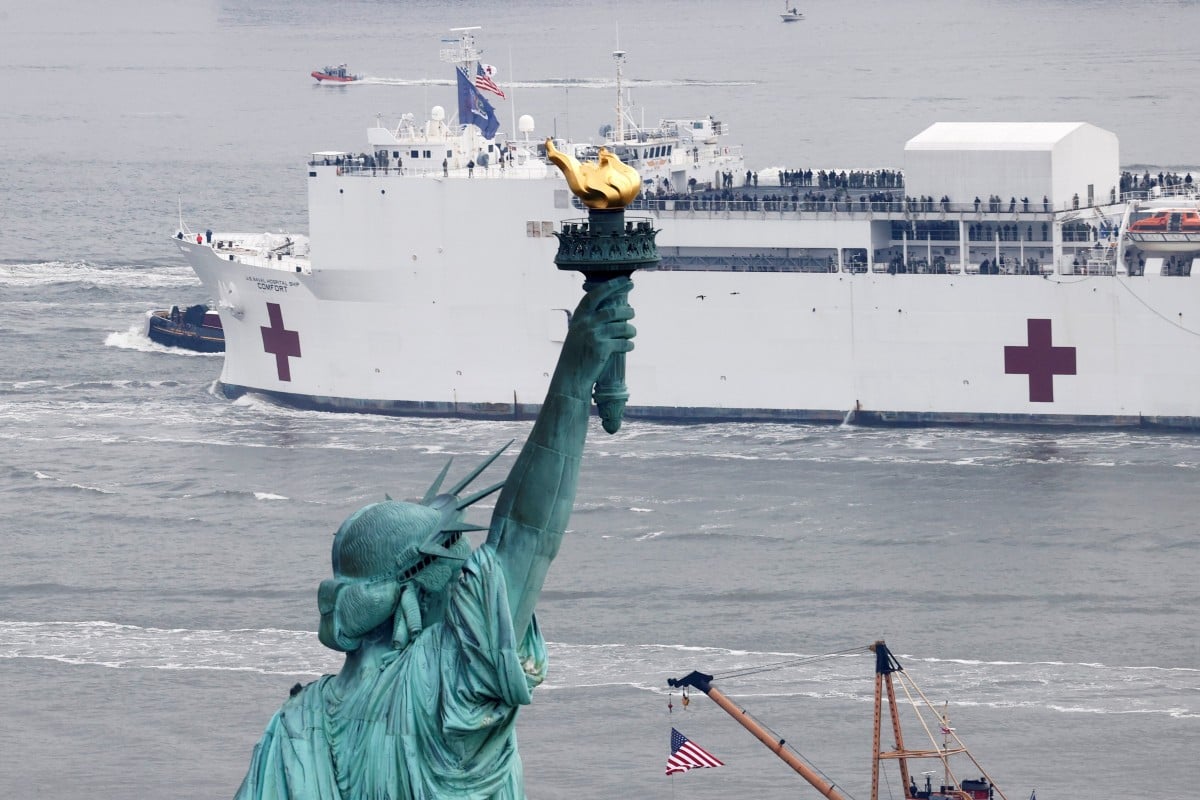
The USNS Comfort passes the Statue of Liberty as it enters New York Harbour on Monday. Photo: Reuters

Harsh lockdowns aimed at halting the march of the coronavirus pandemic extended worldwide Monday as the death toll soared toward 37,000 amid new waves of US outbreaks.

The tough measures that have confined some two-fifths of the globe’s population to their homes were broadened. Moscow and Lagos joined the roll call of cities around the globe with eerily empty streets, while Virginia and Maryland became the latest US states to announce emergency stay-at-home orders, followed quickly by the capital city Washington.

In a symbol of the scale of the challenge facing humanity, a US military medical ship sailed into New York to relieve the pressure on overwhelmed hospitals bracing for the peak of the pandemic.

France reported its highest daily number of deaths since the outbreak began, saying 418 more people had succumbed in hospital.

Spain, which announced another 812 virus deaths in 24 hours, joined the United States and Italy in surpassing the number of cases in China, where the disease was first detected in December.

On Tuesday, mainland China reported a rise in new confirmed coronavirus cases, reversing four days of declines, due to an uptick in infections involving travellers arriving from overseas.

Mainland China had 48 new cases on Monday, the National Health Commission said, up from 31 new infections a day earlier.

All of the 48 cases were imported, bringing the total number of imported cases in China to 771 as of Monday.

There was no reported new case of local infection on Monday, according to the National Health Commission. The total number of infections reported in mainland China stood at 81,518 and the death toll at 3,305. Globally, more than 760,000 have been infected, according to official figures.

Here are the developments:

Hospital ship arrives in New York

New York’s governor issued an urgent appeal for medical volunteers Monday amid a “staggering” number of deaths from the coronavirus, saying: “Please come help us in New York, now.”

The plea from Governor Andrew Cuomo came as the death toll in New York State climbed past 1,200 – with most of the victims in the big city – and authorities warned that the crisis pushing New York’s hospitals to the breaking point is just a preview of what other cities across the US could soon face.

Cuomo said the city needs 1 million additional health care workers.

“We’ve lost over 1,000 New Yorkers,” he said. “To me, we’re beyond staggering already. We’ve reached staggering.”

The governor’s plea came as a 1,000-bed US Navy hospital ship docked in Manhattan on Monday and a field hospital was going up in Central Park for coronavirus patients.

New York City reported 914 deaths from the virus as of 4:30pm local time Monday, a 16 per cent increase from an update six hours earlier. The city, the epicentre of the US outbreak, has 38,087 confirmed cases, up by more than 1,800 from earlier in the day.

Coronavirus field hospital set up in New York’s Central Park as city’s health crisis deepens

Gloom for 24 million people in Asia

The economic fallout from the coronavirus pandemic will prevent almost 24 million people from escaping poverty in East Asia and the Pacific this year, according to the World Bank.

In a report released on Monday, the Washington-based lender also warned of “substantially higher risk” among households that depend on industries particularly vulnerable to the impact of Covid-19. These include tourism in Thailand and the Pacific islands; manufacturing in Vietnam and Cambodia; and among people dependent on “informal labour” in all countries.

The World Bank urged the region to invest in expanding conventional health care and medical equipment factories, as well as taking innovative measures like converting ordinary hospital beds for ICU use and rapidly trining people to work in basic care.

Billionaire blasted for his Instagram-perfect isolation on luxury yacht

31 Mar 2020

Indonesia bans entry of foreigners

Indonesia barred foreign nationals from entering the country as the world’s fourth-most populous country stepped up efforts to contain the spread of the coronavirus pandemic.

The travel ban, to be effective soon, will also cover foreigners transiting through the country, Foreign Minister Retno Marsudi said after a cabinet meeting in Jakarta Tuesday. The curbs will not apply to holders of work permits, diplomats and other official visitors, she said.

The curbs on foreign citizens is the latest in a raft of measures taken by Indonesia to combat the deadly virus that’s sickened more than 1,400 people and killed 122. President Joko Widodo’s administration previously banned flights to and from mainland China and some of the virus-hit regions in Italy, South Korea and Iran. The president on Monday ordered stricter implementation of social distancing and health quarantine amid calls for a lockdown to contain the pandemic.

Indonesia has highest coronavirus mortality rate in Southeast Asia

First US service member dies

The first US military service member has died from the coronavirus, the Pentagon said on Monday, as it reported another sharp hike in the number of infected troops.

The Pentagon said it was a New Jersey Army National Guardsman who had tested positive for Covid-19 and had been hospitalised since March 21. He died on Saturday, it said.

Earlier on Monday, the Pentagon said that 568 troops had tested positive for the coronavirus, up from 280 on Thursday. More than 450 Defence Department civilians, contractors and dependents have also tested positive, it said.

US military has decided to stop providing more granular data about coronavirus infections within its ranks, citing concern that the information might be used by adversaries as the virus spreads.

The new policy, which the Pentagon detailed in a statement on Monday, appears to underscore US military concerns about the potential trajectory of the virus over the coming months – both at home and abroad.

School to resume in South Korea … online

South Korean children will start the new school year on April 9 with only online classes, after repeated delays due to the outbreak of the new coronavirus, the government said Tuesday.

Prime Minister Chung Sye Kyun said that despite the nation’s utmost efforts to contain the virus and lower the risk of infection, there is consensus among teachers and others that it is too early to let children go back to school.

The nation’s elementary schools, and junior and senior high schools were supposed to start the new academic year in early March, but the government has repeatedly postponed it to keep the virus from spreading among children.

The start was last postponed until April 6, but has now been delayed three more days to allow preparations to be made for online classes.

The nation now has 9,786 confirmed cases in total, with 162 deaths.

Italy extends lockdown as cases exceed 100,000

Italy’s government on Monday said it would extend its nationwide lockdown measures
against a coronavirus outbreak, due to end on Friday, at least until the Easter season in April.
The Health Ministry did not give a date for the new end of the lockdown, but said it would be in a law the government would propose. Easter Sunday is April 12 this year. Italy is predominantly Roman Catholic and contains the Vatican, the heart of the church.

Italians have been under lockdown for three weeks, with most shops, bars and restaurants shut and people forbidden from leaving their homes for all but non-essential needs.

Italy, which is the world’s hardest hit country in terms of number of deaths and accounts for more than a third of all global fatalities, saw its total death tally rise to 11,591 since the outbreak emerged in northern regions on February 21.

The death toll has risen by 812 in the last 24 hours, the Civil Protection Agency said, reversing two days of declines, although the number of new cases rose by just 4,050, the lowest increase since March 17, reaching a total of 101,739.

Deadliest day in Italy and Spain shows worst not over yet

28 Mar 2020
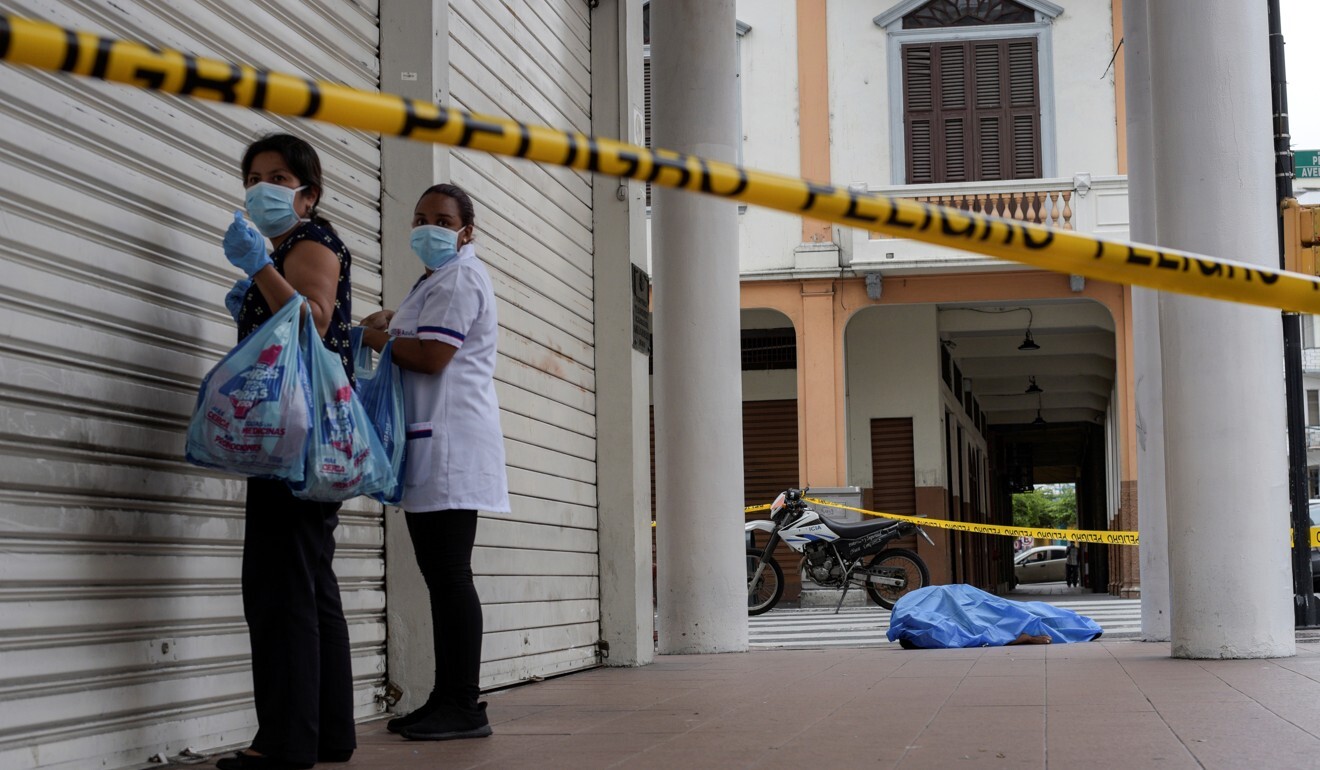
Women stand near the body of a man who died on the sidewalk in Guayaquil, Ecuador. Photo: Reuters

Ecuador struggles to collect the dead

Ecuadorean authorities said they would improve the collection of corpses, as delays related to the rapid spread of the new coronavirus has left families keeping their loved ones’ bodies in their homes for days in some cases.

Residents of Guayaquil, Ecuador’s largest city, have complained they have no way to dispose of relatives’ remains due to strict quarantine and curfew measures designed to prevent spread of the disease. Last week, authorities said they had removed 100 corpses from homes in Guayaquil.

But delays in collecting bodies in the Andean country, which has reported 1,966 cases of the virus and 62 deaths, were evident midday on Monday in downtown Guayaquil, where a man’s dead body lay on a sidewalk under a blue plastic sheet. Police said the man had collapsed while waiting in line to enter a store. Hours later, the body had been removed.

More than 70 per cent of the country’s coronavirus cases, which is among the highest tallies in Latin America, are in the southern province of Guayas, where Guayaquil is located.

Panama to restrict movement by gender

The government of Panama announced strict quarantine measures that separate citizens by gender in an effort to slow the spread of the novel coronavirus.

From Wednesday, men and women will only be able to leave their homes for two hours at a time, and on different days. Until now, quarantine regulations were not based on gender.

Men will be able to go to the supermarket or the pharmacy on Tuesdays, Thursdays and Saturdays, and women will be allowed out on Mondays, Wednesdays and Fridays.

No one will be allowed to go out on Sundays. The new measures will last for 15 days.

Police in Kenya use tear gas to enforce coronavirus curfew

Remote vote first for UN Security Council

The UN Security Council on Monday for the first time approved resolutions remotely after painstaking negotiations among diplomats who are teleworking due to the coronavirus pandemic.

The Security Council unanimously voted by email for four resolutions, including one that extended through April 2021 the expiring mandate of UN experts who are monitoring sanctions on North Korea, diplomats said.

The UN mission in Somalia was also prolonged, until the end of June, and the mission in Darfur until the end of May – two short periods decided due to uncertainty over the spread of the pandemic.

The Council also endorsed a fourth resolution aimed at improving the protection for peacekeepers.

The resolutions are the first approved by the Security Council since it began teleworking on March 12 and comes as Covid-19 rapidly spreads in New York, which has become the epicenter of the disease in the United States.

Congo ex-president dies in France

Former Republic of Congo president Jacques Joaquim Yhombi Opango died in France on Monday of the new coronavirus, his family said. He was 81.

Yhombi Opango, who led Congo-Brazzaville from 1977 until he was toppled in 1979, died at a Paris hospital of Covid-19, his son Jean-Jacques said. He had been ill before he contracted the virus.

Yhombi Opango was an army officer who rose to power after the assassination of president Marien Ngouabi.

Yhombi Opango was ousted by long-time ruler Denis Sassou Nguesso. Accused of taking part in a coup plot against Sassou Nguesso, Yhombi Opango was jailed from 1987 to 1990. He was released a few months before a 1991 national conference that introduced multiparty politics in the central African country.

When civil war broke out in Congo in 1997, Yhombi Opango fled into exile in France. He was finally able to return home in 2007, but then divided his time between France and Congo because of his health problems.

‘When I wake I cry’: France’s nurses face hell on coronavirus front line

31 Mar 2020

EU asks Britain to extend Brexit talks

The European Union expects Britain to seek an extension of its post-Brexit transition period beyond the end of the year, diplomats and officials said on Monday, as negotiations on trade have ground to a halt due to the coronavirus pandemic.

Europe has gone into a deep lockdown in a bid to curb the spread of the disease, with more than 330,000 infections reported on the continent and nearly 21,000 deaths.

In Britain, Prime Minister Boris Johnson and his health minister have both tested positive for the virus and the prime minister’s senior adviser Dominic Cummings – one of the masterminds behind Britain’s departure from the EU earlier this year – was self-isolating with symptoms.

London and the EU have been seeking to agree a new trade pact by the end of the year to kick in from 2021, even though the bloc has long said that such a time frame was extremely short to agree rules on everything from trade to security to fisheries.

The pyramid of Khufu, the largest of the Giza pyramid complex. Photo: Reuters

Great Pyramid in Egypt lights up in solidarity

Egypt’s famed Great Pyramid was emblazoned Monday evening with messages of unity and solidarity with those battling the novel coronavirus the world over.

“Stay safe”, “Stay at home” and “Thank you to those keeping us safe,” flashed in blue and green lights across the towering structure at the Giza plateau, southwest of the capital Cairo.

Egypt has so far registered 656 Covid-19 cases, including 41 deaths. Of the total infected, 150 reportedly recovered.

Egypt has carried out sweeping disinfection operations at archaeological sites, museums and other sites across the country.

In tandem, strict social distancing measures were imposed to reduce the risk of contagion among the country’s 100 million inhabitants.

Tourist and religious sites are shuttered, schools are closed and air traffic halted.
Myanmar braces for ‘big outbreak’ after migrant worker exodus from Thailand
30 Mar 2020

Saudi king to pay for all patients’ treatment

Saudi Arabia will finance treatment for anyone infected with the coronavirus in the country, the health minister said on Monday.

The kingdom has registered eight deaths among 1,453 infections, the highest among the six Gulf Arab states.

Health Minister Tawfiq Al Rabiah said King Salman would cover treatment for citizens and residents diagnosed with the virus, urging people with symptoms to get tested.

“We are all in the same boat,” he told a news conference, adding that Crown Prince Mohammed bin Salman was overseeing containment efforts “night and day”.

Denmark eyes gradual reopening after Easter

Denmark may gradually lift a lockdown after Easter if the numbers of coronavirus cases and deaths remain stable, Prime Minister Mette Frederiksen said on Monday.

The Nordic country, which has reported 77 coronavirus-related deaths, last week extended until after Easter a two-week lockdown to limit physical contact between its citizens that began on March 11.

The number of daily deaths slowed to five on Sunday from eight and 11 on Saturday and Friday respectively. Denmark has reported a total of 2,577 coronavirus infections.

“If we over the next two weeks across Easter keep standing together by staying apart, and if the numbers remain stable for the next two weeks, then the government will begin a gradual, quiet and controlled opening of our society again, at the other side of Easter,” Frederiksen said.

Source: SCMP

24/06/2019

China Focus: African ministers in Beijing to discuss closer cooperation with China

CHINA-BEIJING-WANG YI-CAMEROON-FM-MEETING (CN)

Chinese State Councilor and Foreign Minister Wang Yi (R) meets with Cameroon’s Foreign Minister Lejeune Mbella Mbella in Beijing, capital of China, June 23, 2019. Lejeune Mbella Mbella was here to attend the coordinators’ meeting on the implementation of the Forum on China-Africa Cooperation (FOCAC) Beijing Summit outcomes. (Xinhua/Yin Bogu)

BEIJING, June 23 (Xinhua) — Chinese State Councilor and Foreign Minister Wang Yi held talks or meetings here Sunday with foreign ministers from eight African countries, who are here to attend the upcoming coordinators’ meeting on the implementation of the Forum on China-Africa Cooperation (FOCAC) Beijing Summit outcomes.

The foreign ministers are Sierra Leone’s foreign minister Nabeela Tunis, Gabon’s foreign minister Alain Claude Bilie, Cameroon’s foreign minister Lejeune Mbella Mbella, San Tome and Principe’s foreign minister Elsa Teixeira Pinto, Somali foreign minister Ahmed Isse Awad, Madagascar’s foreign minister Andriantsit Ohaina Franck Michel Niaina, Congo’s foreign minister Jean Claude Gakosso and Senegal’s foreign minister Amadou Ba.

In talks with Tunis, hailing the two countries as “good friends and good brothers”, Wang called on the two sides to continue to firmly support each other on issues concerning each others’ core interests and major concerns, strengthen alignment of the Belt and Road Initiative and the eight major initiatives proposed at the FOCAC Beijing Summit with Sierra Leone’s medium-term national development plan, and beef up cooperation on infrastructure, agriculture and fishery, health care, communication, and capacity building.

Sierra Leone supports Africa and China to deepen partnership and is ready to strengthen communication and coordination with China on implementing the sustainable development goals of the 2030 Agenda, the Paris Agreement on climate change, and reform of the global governance system, Tunis said.

When meeting with Bilie, Wang said 53 countries in Africa have sent high-level delegations to the coordinators’ meeting, including 25 foreign ministers. The move fully reflected the importance that the African side attaches to the China-Africa ties and the unbreakable solidarity and friendship between the two sides.

Wang said the two sides should continue the support to each other on issues involving each other’s core interests, seize opportunities of the 45th anniversary of diplomatic ties between China and Gabon this year to create new progress in ties, and expand cooperation on Belt and Road Initiative and multilateral issues.

Bilie said Gabon is willing to strengthen exchanges of experience with China in governance and seek synergy between its own development strategy with the Belt and Road Initiative.

In meeting with Mbella, Wang said Cameroon is China’s traditional friend and important partner in Africa. Both sides should continue to understand and support each other on issues involving each others core interests and major concerns. China’s financial support for African countries is based on equality and voluntarism and aims to help Africa improve its capacity for independent and sustainable development.

There is no such thing as a “debt trap” between China and Cameroon or between China and Africa, said Wang, adding that China will not seek any political purpose.

Mbella said that Cameroon spoke highly of China’s policy toward Africa and thanked China for its understanding and sincere assistance to Cameroon in alleviating the debt problems.

When meeting with Pinto, Wang said facts have proved that the resumption of diplomatic relations is in full compliance with the interests of the two countries and peoples. The Chinese side appreciates Sao Tome and Principe’s active support for the Belt and Road Initiative and is willing to continue to provide assistance within its capacity to the African country.

Pinto said Sao Tome and Principe will firmly adhere to the one-China principle, strengthen political and diplomatic dialogue with China, actively promote cooperation in infrastructure and enhance non-governmental exchanges.

In the meeting with Awad, Wang said China supports Somalia to restore stability and embark on the path of recovery. China is ready to explore new ways to develop mutually beneficial cooperation with Somalia under the new situation, and conduct cooperation in the areas most needed by Somalia such as agriculture, fisheries and processing industries.

Awad said Somalia expects to strengthen exchanges with China, and promote cooperation in areas such as infrastructure construction.

In the meeting Niaina, Wang expressed the will to promote the alignment with Madagascar’s development strategy, and said China is ready to enhance the cooperation on multilateral issues.

When meeting with Gakosso, Wang hailed bilateral relationship and also reiterated China’s stance to safeguard multilateralism.

In the talks with Amadou Ba, Wang said China would like to work with other international partners in conducting tripartite cooperation in Senegal, on the basis of respecting Senegal’s willingness.

The coordinators’ meeting will be held in Beijing from June 24 to 25. There will be over 80 African ministerial-level officials at the meeting. On the sidelines of the meeting, more than 40 bilateral and multilateral activities will be held to implement the outcomes of the FOCAC Beijing Summit, synergize efforts, consolidate consensus and deliver more benefits to the peoples.

Source: Xinhua

04/06/2019

No time to waste in saving the world’s rivers from drying up – especially in China

  • Brahma Chellaney writes that excessive damming and drastic overuse of water resources are causing the world’s major waterways to run dry
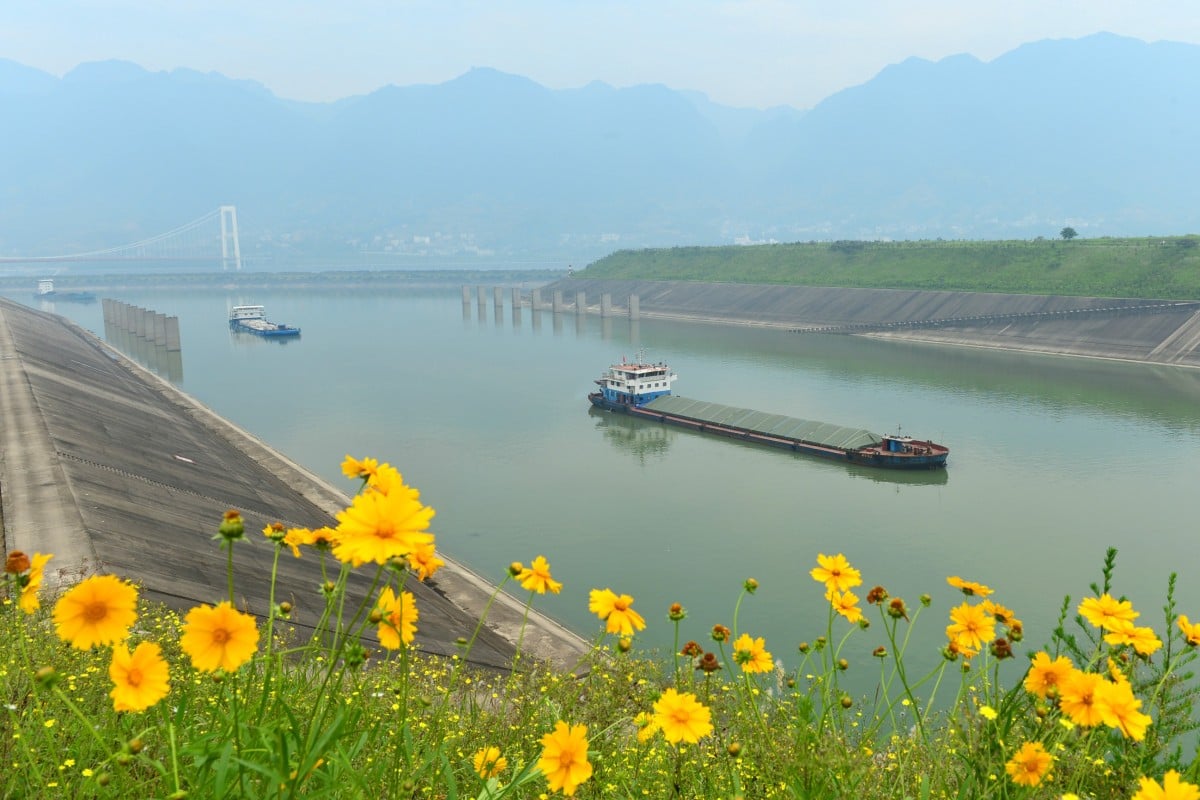
Vessels head for the lock of the Three Gorges Dam in Yichang, in central China's Hubei province. Sediment build-up in the dam’s reservoir stems from silt flow disruption in the Yangtze River, Brahma Chellaney writes. Photo: Xinhua
Vessels head for the lock of the Three Gorges Dam in Yichang, in central China’s Hubei province. Sediment build-up in the dam’s reservoir stems from silt flow disruption in the Yangtze River, Brahma Chellaney writes. Photo: Xinhua
Thanks to excessive damming and drastic overuse of water resources, an increasing number of major rivers across the world are drying up before reaching the sea.
Nowhere is this more evident than in China, where the old saying, “Follow the river and it will eventually lead you to a sea,” is no longer wholly true.
While a number of smaller rivers in China have simply disappeared, the Yellow River – the cradle of the Chinese civilisation – now tends to run dry before reaching the sea.
This has prompted Chinese scientists to embark on a controversial rainmaking project to help increase the Yellow’s flow. By sucking moisture from the air, however, the project could potentially affect monsoon rains elsewhere.
For large sections of the world’s population, major river systems serve as lifelines. The rivers not only supply the most essential of all natural resources – water – but also sustain biodiversity, which in turn supports human beings.
Yet an increasing number of rivers, not just in China, are drying up before reaching the sea.
A major new United Nations study published early this month offers grim conclusions: human actions are irremediably altering rivers and other ecosystems and driving increasing numbers of plant and animal species to extinction.

“Nature across the globe has now been significantly altered,” according to the study’s summary of findings.

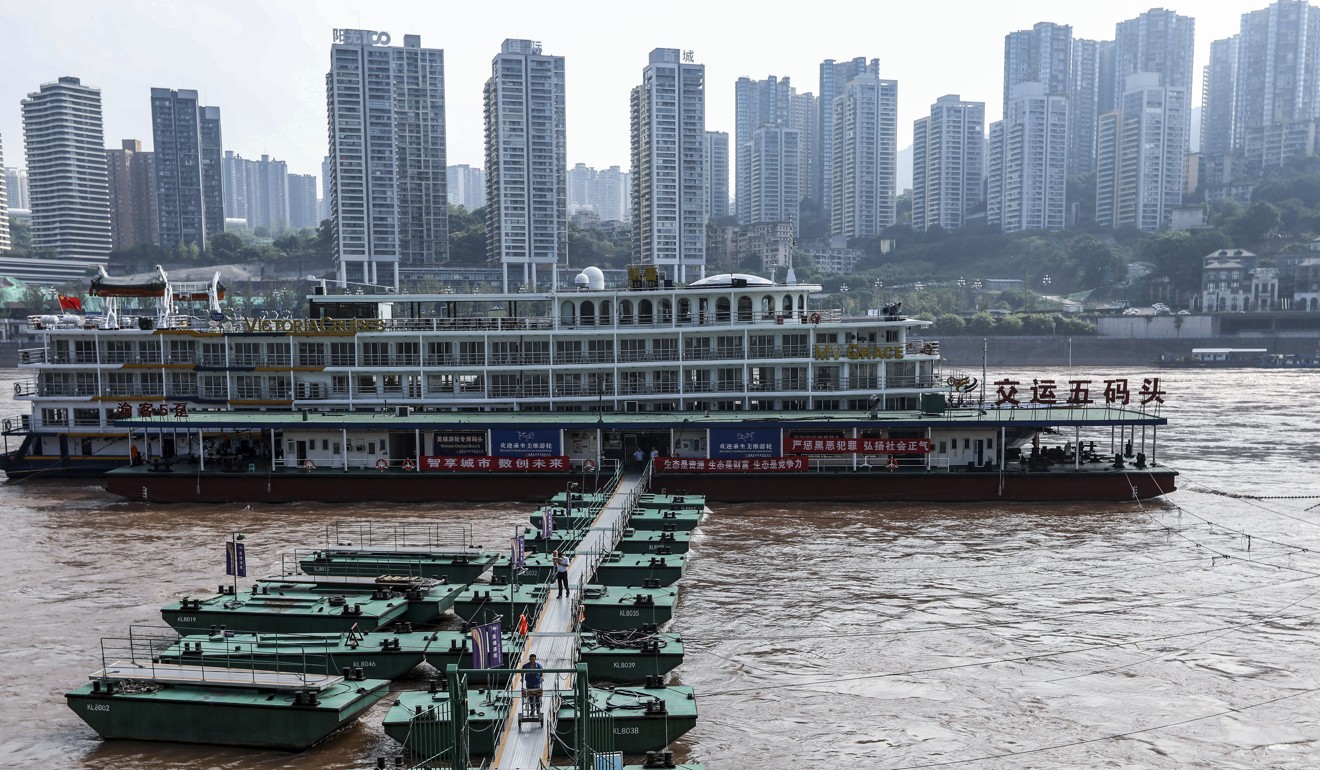
The Yangtze and Jialing rivers come together in the southwestern city of Chongqing. Photo: Simon Song

Water sustains life and livelihoods and enables economic development.

If the world is to avert a thirsty future and contain the risks of greater intrastate and interstate water conflict, it must protect freshwater ecosystems, which harbour the greatest concentration of species.

The Mekong is mighty no more: book charts river’s demise

Yet, according to another study published in Nature this month humans have modified the flows of most long rivers, other than those found in the remote regions of the

Amazon and Congo basins and the Arctic.

Consequently, only a little more than one-third of the world’s 246 long rivers are still free-flowing, meaning they remain free from dams, levees and other man-made water-diversion structures that leave them increasingly fragmented.

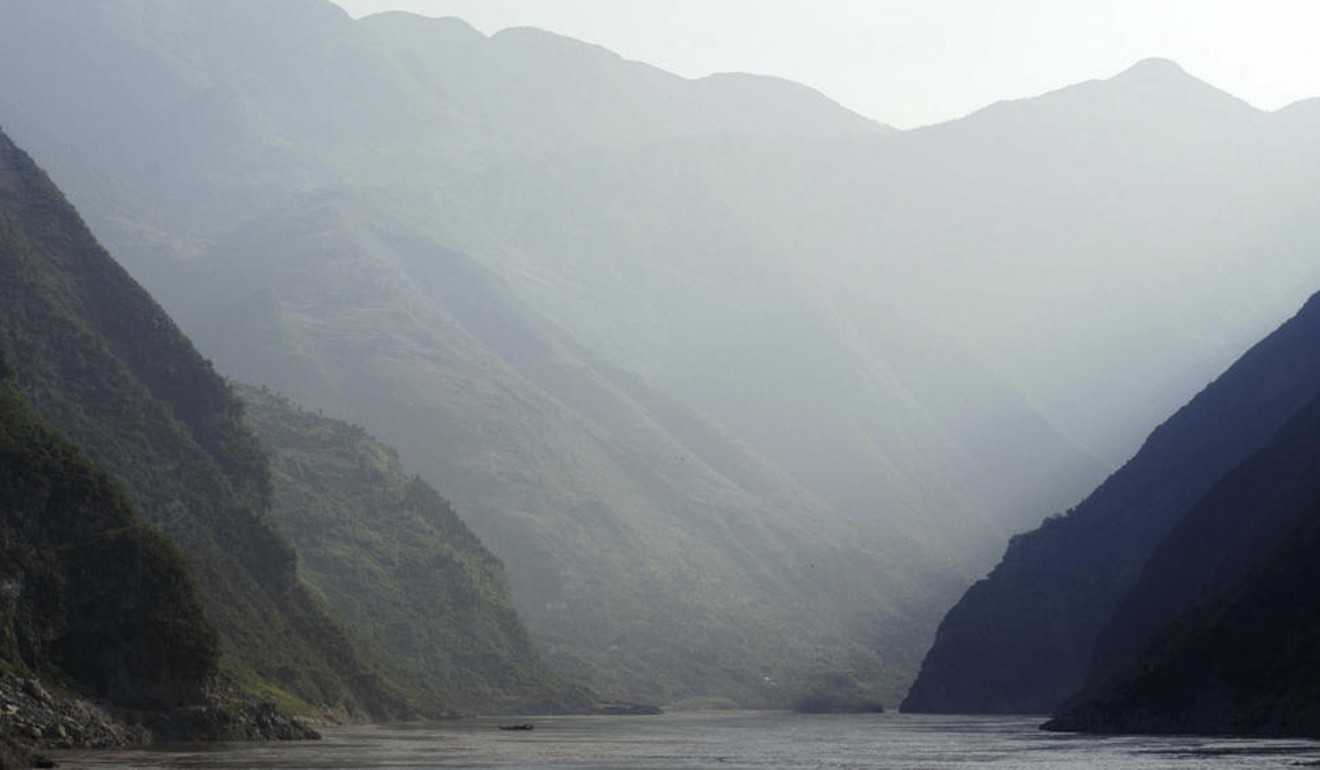
Humans have modified the flows of most long rivers, including the Yangtze, home to some of China’s most spectacular natural scenery. Photo: WWF

Such fragmentation is affecting river hydrology, flow of nutrient-rich sediment from the mountains where rivers originate, riparian vegetation, migration of fish and quality of water.

Take the Colorado River, one of the world’s most diverted and dammed rivers. Broken up by more than 100 dams and thousands of kilometres of diversion canals, the Colorado has not reached the sea since 1998.

Sinking sands along the Mekong River leave Vietnamese homeless

The river, which originates in the Rocky Mountains and is the lifeblood for the southwestern United States, used to empty into the Sea of Cortez in Mexico.

But now, owing to the upstream diversion of 9.3 billion cubic metres (328.4 billion cubic feet) of water annually, the Colorado’s flow into its delta has been reduced to a trickle.

Altering the flow characteristics of rivers poses a serious problem for sustainable development, because they affect the ecosystem services on which both humans and wildlife depend. Photo: AP

Other major rivers that run dry before reaching the sea include the Amu Darya and the Syr Darya, the two lifelines of Central Asia; the Euphrates and the Tigris in the Middle East; and the Rio Grande, which marks the border between Texas and Mexico before heading to the Gulf of Mexico.

The overused Murray in Australia and Indus in Pakistan are at risk of meeting the same fate.

Are China’s Mekong dams washing away Cambodian livelihoods?

More fundamentally, altered flow characteristics of rivers are among the most serious problems for sustainable development, because they seriously affect the ecosystem services on which both humans and wildlife depend.

Free-flowing rivers, while supporting a wealth of biodiversity, allow billions of fish – the main source of protein for the poor – to trek through their waters and breed copiously.

Urgent action is needed to save the world’s rivers, including improving agricultural practices, which account for the bulk of freshwater withdrawals

Free-flowing rivers also deliver nutrient-rich silt crucial to agriculture, fisheries and marine life.

Such high-quality sediment helps to naturally re-fertilise overworked soils in the plains, sustain freshwater species and, after rivers empty into seas or oceans, underpin the aquatic food chain supporting marine life.

China’s hyperactive dam building illustrates the high costs of river fragmentation. No country in history has built more dams than China. In fact, China today boasts more large dams than the rest of the world combined.

China’s chain of dams and reservoirs on each of its long rivers impedes the downstream flow of sediment, thereby denying essential nutrients to agricultural land and aquatic species.

A case in point is China’s Three Gorges Dam – the world’s largest – which has a problematic build-up of sediment in its own massive reservoir because it has disrupted silt flows in the Yangtze River.

Likewise, China’s cascade of eight giant dams on the Mekong, just before the river enters Southeast Asia, is affecting the quality and quantity of flows in the delta, in Vietnam.

Yangtze dams may spell end to sturgeon in a decade
Undeterred, China is building or planning another 20 dams on the Mekong.
How the drying up of rivers affects seas and oceans is apparent from the Aral Sea, which has shrunk 74 per cent in area and 90 per cent in volume, with its salinity growing nine-fold.
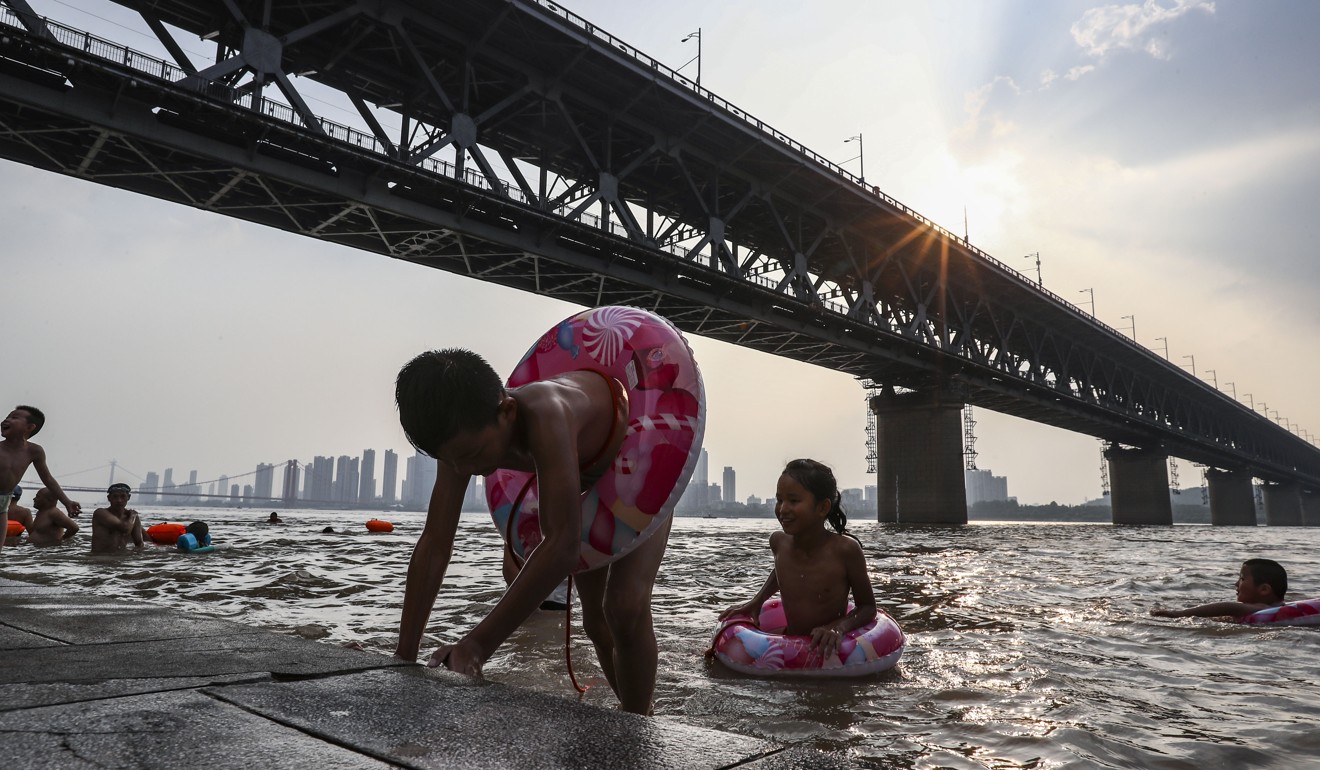
People beat the heat by cooling off in the Yangtze River in Wuhan, in central China’s Hubei province. Photo: Nora Tam

This change is the result of the Aral Sea’s principal water sources, the Amu Darya and Syr Darya, being so overexploited for irrigation that they are drying up before reaching what was once the world’s fourth-largest inland lake.

Compounding the challenges is the increasing pollution of rivers. Aquatic ecosystems have lost half of their biodiversity since the mid-1970s alone.

Chinese court jails nine for dumping toxic waste in Yangtze

Urgent action is needed to save the world’s rivers. This includes action on several fronts, including improving practices in agriculture, which accounts for the bulk of the world’s freshwater withdrawals.

Without embracing integrated water resource management and other sustainable practices, the world risks a parched future.

Source: SCMP

Law of Unintended Consequences

continuously updated blog about China & India

ChiaHou's Book Reviews

continuously updated blog about China & India

What's wrong with the world; and its economy

continuously updated blog about China & India