Chindia Alert: You’ll be Living in their World Very Soon
aims to alert you to the threats and opportunities that China and India present. China and India require serious attention; case of ‘hidden dragon and crouching tiger’.
Without this attention, governments, businesses and, indeed, individuals may find themselves at a great disadvantage sooner rather than later.
The POSTs (front webpages) are mainly 'cuttings' from reliable sources, updated continuously.
The PAGEs (see Tabs, above) attempt to make the information more meaningful by putting some structure to the information we have researched and assembled since 2006.
Combo photo taken on May 3, 2020 shows Cao Xiongbin checking the temperature of his colleague (left) and posing for a photo at the construction site of the Renhuai-Zunyi expressway in Zunyi, southwest China’s Guizhou Province. Cao, 25, from Jingdezhen of Jiangxi Province, has been working as a staff member on the COVID-19 control and prevention since early time this year. Many young workers have stuck to their positions during Labor Day holiday. (Xinhua/Liu Xu)
People work at a construction site of a utility tunnel in Wuhan, central China’s Hubei Province, April 30, 2020. (Xinhua/Xiao Yijiu)
BEIJING, May 1 (Xinhua) — China is getting the world’s largest workforce back to work as the nationwide battle against COVID-19 has secured major strategic achievements.
The unprecedented fight has nurtured new trends in the workplace. For example, more attention is being paid to public health and e-commerce to boost consumption and emerging sectors brought by new applications based on the country’s rapid new infrastructure development of 5G networks and data centers.
In this aerial photo taken on April 29, 2020, representatives of frontline health workers fighting COVID-19 attend a bell-ringing ceremony at the Yellow Crane Tower, or Huanghelou, a landmark in Wuhan, central China’s Hubei Province. (Xinhua/Xiao Yijiu)
ANGELS OF PUBLIC HEALTH
Ye Man, head nurse of gastrointestinal department of Hubei General Hospital East District, one of the five remaining COVID-19 designated hospitals in Wuhan, is taking her first weeklong vacation since January.
The 34-year-old mother of two started to take a week off on Monday, one day after her hospital cleared all remaining confirmed COVID-19 patients. The nine ICU wards in her hospital had been kept occupied over the past several months.
Friday marked International Workers’ Day, and the start of China’s five-day public holiday. Ye said she planned to visit urban parks with her family during the holiday.
At her busiest point, she and her colleagues took care of a ward filled with 40 COVID-19 patients.
“It was a really tough time,” she recalled. She had to wear a protective gown and a mask for nine hours a day and be separated from her family to avoid possible cross-infections.
Wuhan, capital of central China’s Hubei Province and once hard hit by COVID-19, cleared all confirmed cases in hospitals on April 26. Over 42,000 medical workers mobilized nationwide to aid Hubei have contributed to achieving a decisive outcome in the fight to defend Hubei and Wuhan.
In an inspection tour to Wuhan on March 10, President Xi Jinping, also general secretary of the Communist Party of China Central Committee and chairman of the Central Military Commission, lauded medical workers as “the most beautiful angels” and “messengers of light and hope.”
To reward brave and dedicated medics, major tourist sites in Hubei are offering free entry to medical staff over the following two years.
Chinese President Xi Jinping, also general secretary of the Communist Party of China Central Committee and chairman of the Central Military Commission, learns about development of the black fungus industry in Jinmi Village of Xiaoling Township in Zhashui County, Shangluo City, northwest China’s Shaanxi Province, April 20, 2020. (Xinhua/Xie Huanchi)
LIVESTREAMING ANCHORS
“We have a new batch of supplies today. Those who did not get the goods should hurry to buy now,” said Li Xuying, a livestreaming anchorwoman selling agaric mushrooms in Zhashui, a small county deep in the Qinling Mountains in northwest China’s Shaanxi Province.
Li has been prepared for a boom of online shopping in the holiday, because online buyers rushed to her livestreaming website to place orders, after Xi inspected the county and chatted with her in the village of Jinmi during a recent tour to Shaanxi.
“I used to sell goods worth about 50,000 yuan (7,070 U.S. dollars) on average after a six-hour livestreaming session. Now the sales are 10 times that,” she said.
Li was one of the 10 sales staff sent by the local agricultural e-commerce firm to Chinese e-commerce platform Taobao’s headquarters for livestreaming training. She said livestreaming is effective in bridging buyers and farmers, through which viewers can watch planting and harvesting online.
With the number of netizens in China reaching 904 million in March, e-commerce has been one of the popular means of promoting the sale of farm produce and helping farmers shake off poverty. Despite the impact of COVID-19, the country is determined to eradicate absolute poverty by the end of this year.
Workers work at the construction site of a 5G base station at Chongqing Hi-tech Zone in Chongqing, southwest China, April 15, 2020. (Xinhua/Wang Quanchao)
HI-TECH WORKERS IN “NEW INFRASTRUCTURE” BUILDING
As an elasticity calculation engineer of Alibaba Cloud, Zhao Kun and his colleagues always stay on alert for high data flow, for example, brought by the anticipated online shopping spike during the holiday.
“The profession, which may sound obscure, is actually closely connected to everyone’s life, as cloud computing is the infrastructure supporting high-tech applications of artificial intelligence and blockchain,” said Zhao.
The Chinese leadership has underscored expediting “new infrastructure” development to boost industrial and consumption upgrading and catalyze new growth drivers.
Seizing the opportunities of industrial digitization and digital industrialization, China needs to expedite the construction of “new infrastructure” projects such as 5G networks and data centers, and deploy strategic emerging sectors and industries of the future including the digital economy, life health services and new materials, President Xi has said.
During the epidemic, Zhao and his colleagues expanded more than 100,000 cloud servers to ensure the stable operation of “cloud classrooms” and “cloud offices” for millions of people working and studying from home.
In the “new infrastructure” building, people like Zhao contribute to constructing the virtual infrastructure of an ecosystem, which enables e-commerce, e-payment, online teaching and the digital transformation of manufacturing and supply chain management.
In early April, China released a plan on promoting the transformation of enterprises toward digitalization and intelligence by further expanding the application of cloud and data technologies, to nurture new business models of the digital economy.
Chinese Premier Li Keqiang, also a member of the Standing Committee of the Political Bureau of the Communist Party of China (CPC) Central Committee, visits a startup community in Xi’an, capital of northwest China’s Shaanxi Province, Oct. 15, 2019. Li made an inspection tour in the cities of Xi’an and Xianyang in northwest China’s Shaanxi Province from Monday to Tuesday. (Xinhua/Pang Xinglei)
XI’AN, Oct. 15 (Xinhua) — Chinese Premier Li Keqiang has stressed deepening reform and opening-up to facilitate steady economic growth and continuously improve people’s livelihood.
Li, also a member of the Standing Committee of the Political Bureau of the Communist Party of China (CPC) Central Committee, made the remarks during his inspection tour in the cities of Xi’an and Xianyang in northwest China’s Shaanxi Province from Monday to Tuesday.
In his visit to a community in Xi’an, Li stressed that the renovation of old residential communities can improve the livelihood of people, especially those with financial difficulties, and is conducive to boosting effective investment and consumption.
In this regard, Li called for efforts to upgrade community facilities and enhance public services such as elderly care and childcare.
When visiting a restaurant, Li said measures should be taken to guarantee the supply of pork and stabilize vegetable prices to ensure the basic livelihood of those facing difficulties. He also urged the implementation of policies of cutting taxes and fees for private businesses.
The country will make unswerving efforts to open up wider, give equal treatment to both domestic and overseas businesses registered in China, continuously improve the business environment, and intensify the protection of intellectual property rights, said the premier during his visit to Samsung China Semiconductor Co., Ltd.
Commenting on the great development potential of China’s western regions, Li urged greater efforts to create a good business environment, pledging more targeted policy support.
At the construction site of the Yinchuan-Xi’an high-speed railway, the premier underscored the acceleration of key infrastructure projects in west China and encouraged effective investment in spurring development and improving people’s livelihood.
Li, while visiting a startup community, urged efforts to improve the business environment for entrepreneurship and innovation.
Hangzhou subway operator says water seeped into underground construction site
Zhejiang’s capital was scene of subway collapse that claimed 21 workers’ lives in 2008
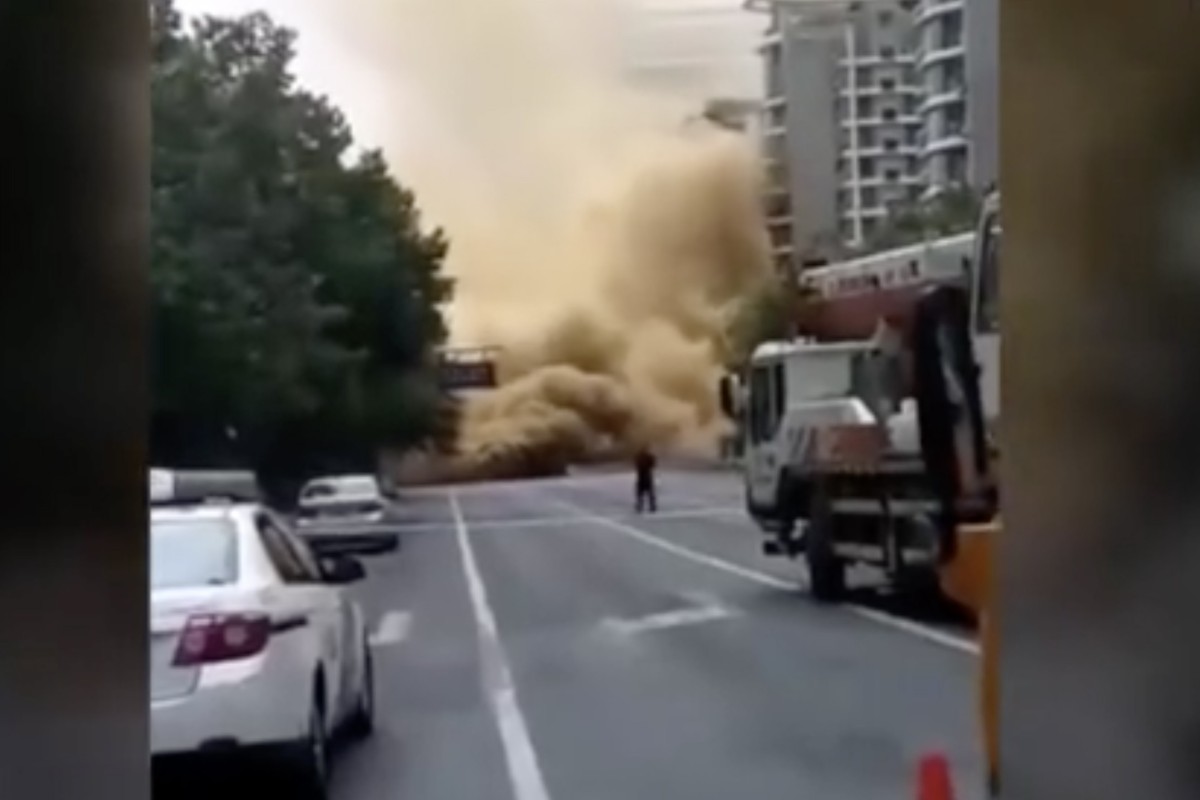
A yellow cloud engulfs buildings after a subway tunnel in Hangzhou, Zhejiang province, collapses. Photo: Pear Video
Homes in a major city in eastern China were evacuated on Wednesday after water seepage at a subway construction site caused a main road to cave in and cut a gas main.
Authorities in Hangzhou, Zhejiang province, said dozens of residents feared for their homes as buildings cracked and swayed from the cave-in.
Videos posted to the Weibo microblogging network showed yellow smoke engulfing the neighbourhood as the road fell below street level. Authorities said Hangzhou’s gas supplier managed to close off the mains.
Hangzhou Metro Group, the city’s subway operator and the company overseeing the network’s expansion from four lines to nine for the 2022 Asian Games, said on Weibo that water seeped into a tunnel that connected two stations in the centre of the city, leading to the collapse.
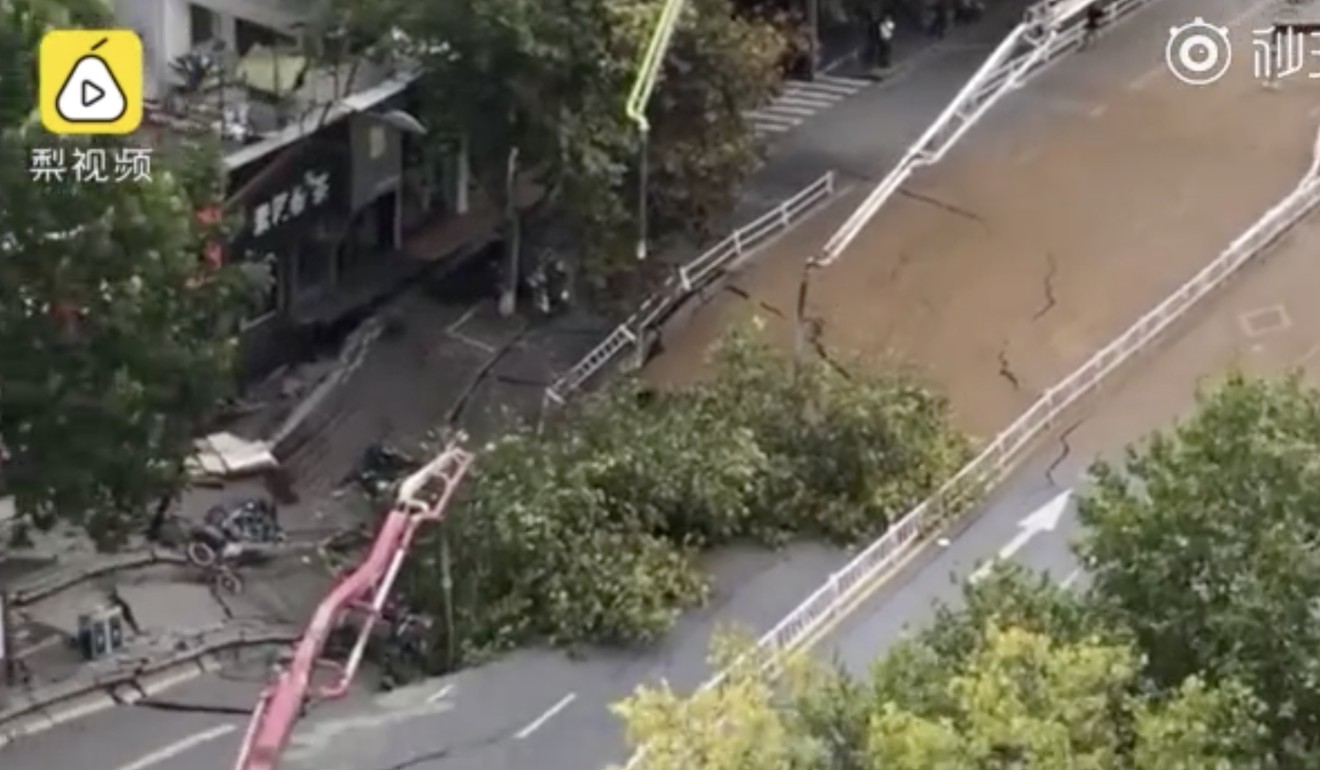
The collapse took down a four-lane road in central Hangzhou. Photo: Pear Video
That caused a hole under the carriageway and took the pavement down with it. Hangzhou Metro said homes around the site were cleared and authorities were monitoring for further danger.
It was not known how many residents were affected, but no casualties were reported.
Most residents were put up in a nearby school until accommodation could be arranged, the City Express newspaper reported, adding that several truckloads of cement were poured into the hole.
Eight Chinese killed as road collapses near subway construction project
The road collapse in central Hangzhou was the latest in a series of subway construction accidents there – some of them deadly – in the past decade as China races to expand its urban rail networks.
In November 2008, 21 workers were killed and 24 were injured when a tunnel Hangzhou’s Line 1 collapsed beneath an eight-lane road and river water rushed in. A court sent eight people to jail for terms of between three and 5½ years for negligence at the site.
Two years later at the same place, a truck driver died and another was injured as a pit collapsed.
In 2016, four construction workers were killed when mud flooded a pit at a station on Line 4.
In 2008, an eight-lane riverside road in Hangzhou fell in on workers building a subway tunnel, killing 21. Photo: AFP
A cave-in similar to Wednesday’s collapse overturned a truck at a construction site near Hangzhou railway station this month, but no one was injured, Hangzhou Metro said.
According to the China Association of Metros, by the end of last year, more than 5,700km (3,540 miles) of urban railway had been built in 35 mainland cities, of which more than a third – 2,100km – was completed since 2015.
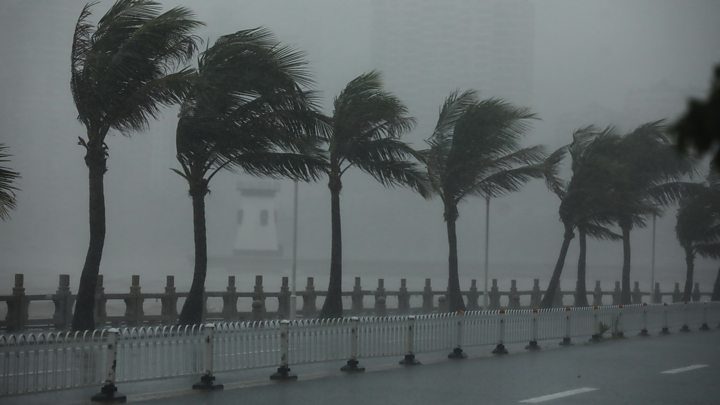
At least 13 people have been killed and more than a million forced from their homes as Typhoon Lekima hit China.
Sixteen people were also missing after a landslide was triggered by the storm, state media reported.
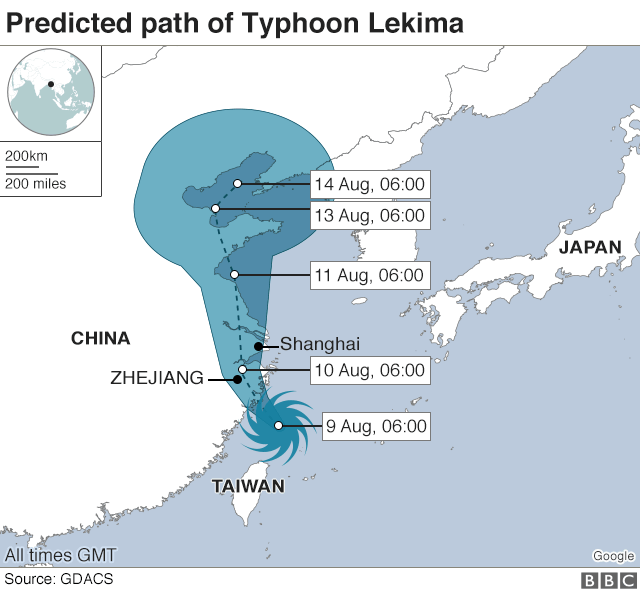
Lekima made landfall in the early hours of Saturday in Wenling, between Taiwan and China’s financial capital Shanghai.
The storm was initially designated a “super typhoon”, but weakened slightly before landfall – when it still had winds of 187km/h (116mph).
The fatal landslide happened when a dam broke in Wenzhou, near where the storm made landfall, state media said.
Lekima is now slowly winding its way north through the Zhejiang province, and is expected to hit Shanghai, which has a population of more than 20 million.
Emergency crews have battled to save stranded motorists from floods. Fallen trees and power cuts are widespread.
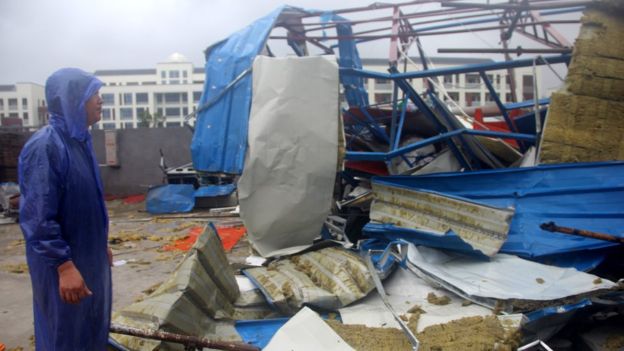
Image copyright EPAImage caption A worker looks for his belongings at a construction site shelter collapsed by the storm
Authorities have cancelled more than a thousand flights and cancelled train services as the city prepares for the storm.
It is expected to weaken further by the time it reaches Shanghai, but will still bring a high risk of dangerous flooding.
The city evacuated some 250,000 residents, with another 800,000 in the Zhejiang province also being taken from their homes.
An estimated 2.7 million homes in the region lost power as power lines toppled in the high winds, Chinese state media said.
It is the ninth typhoon of the year, Xinhua news said – but the strongest storm seen in years. It was initially given China’s highest level of weather warning but was later downgraded to an “orange” level.
Media caption Typhoon Lekima inches towards China
Chinese weather forecasters said the storm was moving north at just 15km/h (9mph).
It earlier passed Taiwan, skirting its northern tip and causing a handful of injuries and some property damage.
Coming just a day after a magnitude six earthquake, experts warned that the combination of earth movement and heavy rain increased the risk of landslides.
Lekima is one of two typhoons in the western Pacific at the moment.
Further east, Typhoon Krosa is spreading heavy rain across the Northern Mariana Islands and Guam. It is moving north-west and could strike Japan some time next week, forecasters said.
Tower falls on car outside the Chengdu worksite, killing motorist
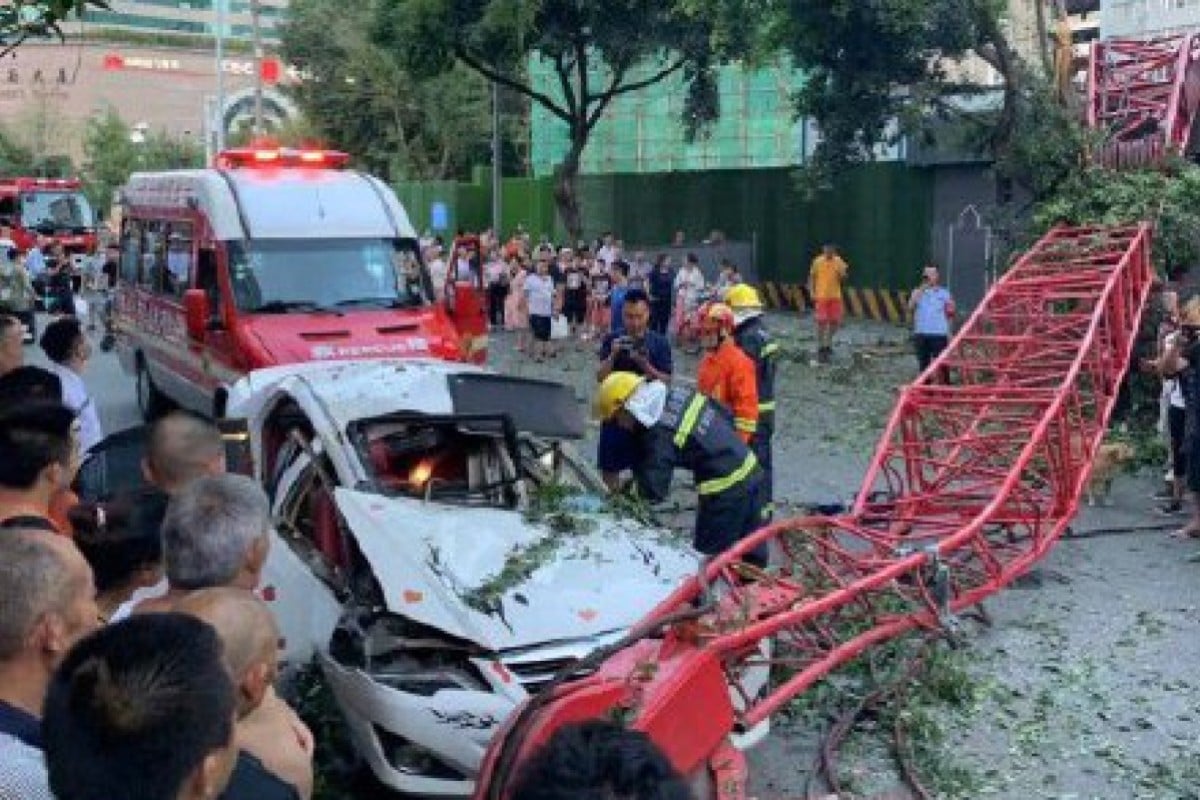
A motorist was killed when a construction crane collapsed in Chengdu on Wednesday. Photo: Weibo
Authorities in southwest China are investigating a crane collapse at a construction site that killed one person and injured another.
The crane collapsed in Chengdu, Sichuan province, at around 7pm on Wednesday, falling onto a car parked near the site and killing the driver, the city’s urban renewal authority said in an online statement. A pedestrian also suffered minor injuries, it said.
Police were investigating the cause of the incident.
A crane accident at a construction site in Southwest China killed one person and injured another on Wednesday. Photo: Weibo
Photos and footage posted online showed emergency workers and others trying to move the crane off of a white car.
Shanghai-based news outlet ThePaper.cn quoted a witness as saying that the crane fell through the construction site wall and a number of trees.
By 10pm, the car had been towed away and the road reopened for use, according to reports.
In January, four people were killed and one was injured when a crane collapsed in Changsha, Hunan province, state news agency Xinhua reported.
Driver who used map app to find construction site sent to crossing for light traffic
Villagers say bridge was used by pedestrians and cars only
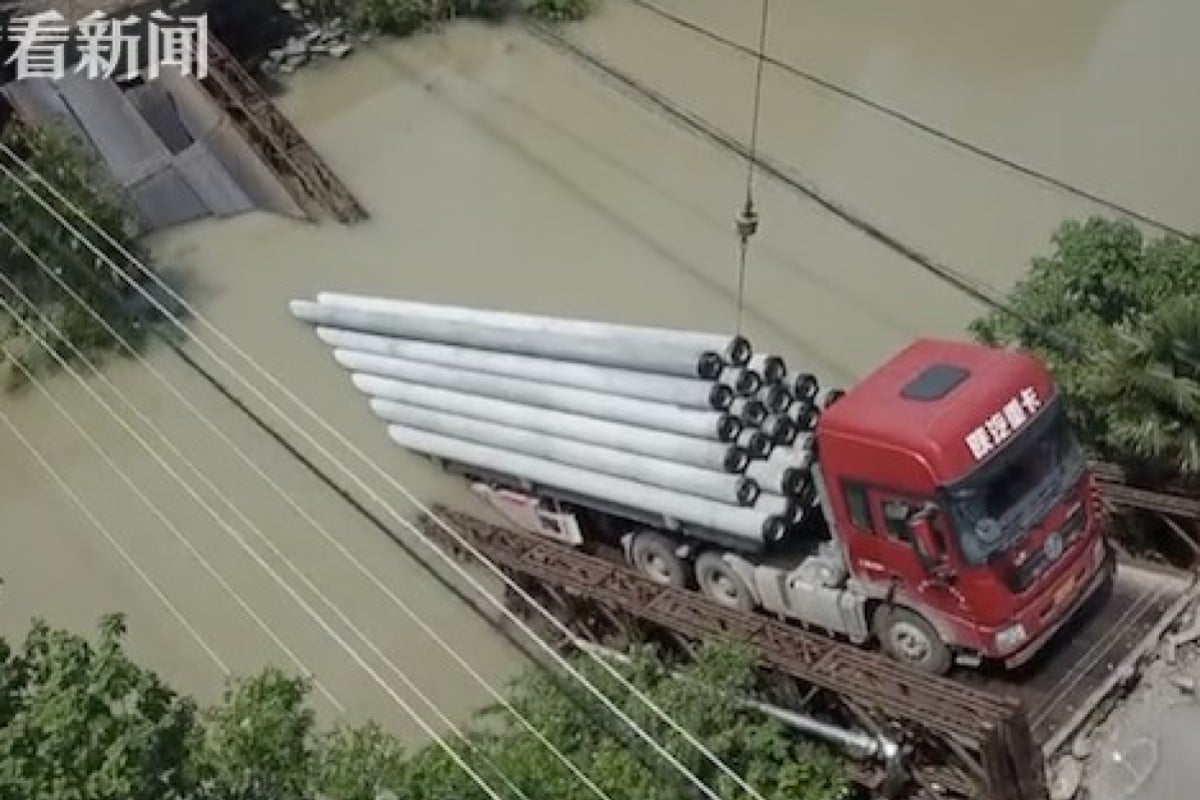
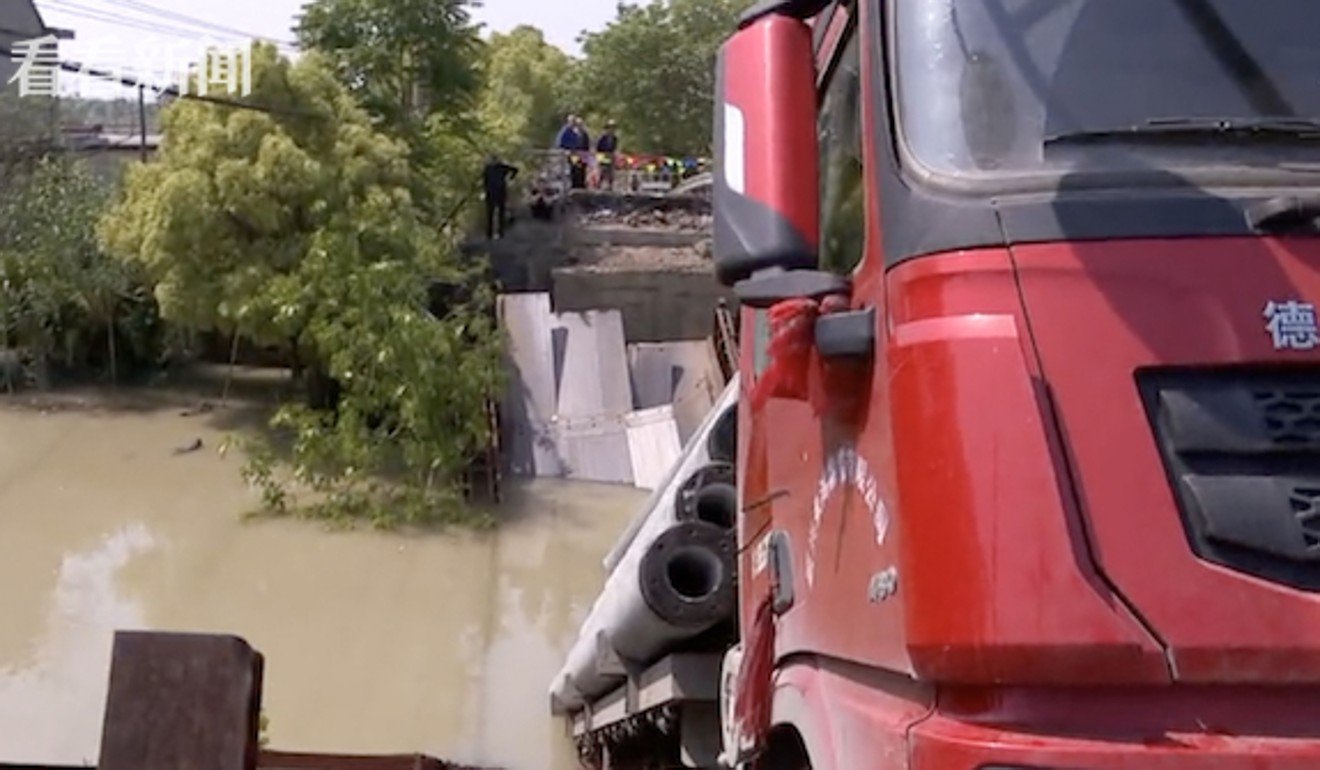
Recovery crews attempt to pull the truck and its load from the river in eastern Zhejiang province. Photo: Weibo
A trucker in eastern Zhejiang province collapsed a steel bridge by crossing it with a load weighing 50 times the bridge’s capacity.
The driver, surnamed Zhang, said he missed the two-tonne load warning sign when he tried to take dozens of concrete pipes to a construction site on Thursday morning, Kankannews.com reported.
He was not familiar with the area and used the bridge suggested by his digital map.
When the laden truck, weighing about 100 tonnes, was halfway across, the structure gave way, pitching the vehicle and its cargo into the water below. The driver managed to escape.
The truck’s load was 50 times the bridge’s breaking capacity. Photo: Weibo
Truck driver left hanging after crane smashes into bridge
Residents of a nearby village said a concrete bridge on the site fell into disrepair and was dismantled. It was replaced with a temporary steel structure a couple of years ago.
The new span was intended only for foot traffic and light vehicles, they said.





 CHINDIA ALERT: You'll be living in their world, very soon