Chindia Alert: You’ll be Living in their World Very Soon
aims to alert you to the threats and opportunities that China and India present. China and India require serious attention; case of ‘hidden dragon and crouching tiger’.
Without this attention, governments, businesses and, indeed, individuals may find themselves at a great disadvantage sooner rather than later.
The POSTs (front webpages) are mainly 'cuttings' from reliable sources, updated continuously.
The PAGEs (see Tabs, above) attempt to make the information more meaningful by putting some structure to the information we have researched and assembled since 2006.
The team is expected to provide technical advice on epidemic prevention and control as well as treatment protocols
The Southeast Asian nation on Tuesday recorded its largest daily increase in coronavirus deaths and infections
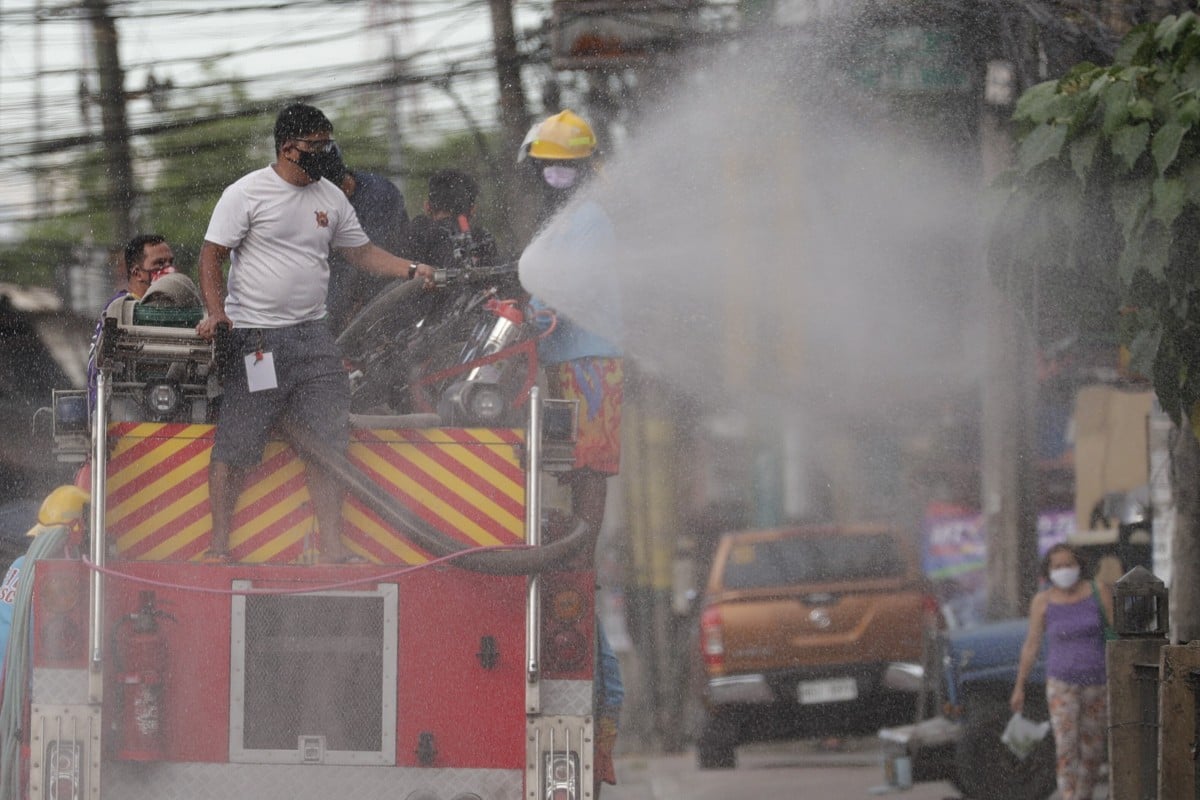
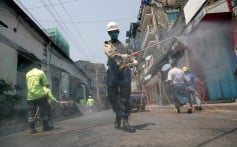
A fireman sprays disinfectant from the back of a fire truck to help curb the spread of the coronavirus during a localised quarantine in Manila. Photo: AP
on Tuesday recorded its largest daily increase in coronavirus deaths and infections, as it awaited the arrival of a Chinese medical team to support its embattled frontline health care workers.
Ten more people died from the Covid-19 disease, bringing the total to 88, while 538 new infections were reported for a total of 2,084.
Among those included in the latest count of positives is former senator Ferdinand “Bongbong” Marcos, whose condition, according to his spokesman Victor Rodriguez, is now “stable” and “improving”.
Health undersecretary Maria Rosario Vergeire said the ministry had opened new labs and run more than 15,000 tests, a five-fold jump from about 3,000 last week. She added that more hospitals were seeking government approval to function as testing centres.
Medical evacuation plane crashes at Manila airport in Philippines, killing eight on board
29 Mar 2020
“We have six more laboratories to conduct tests,” Vergeire said. “We are also conducting contact tracing to find possibly infected persons.”
Philippine hospitals are struggling with a shortage of protective gear, manpower and testing capacity, as are medical facilities around the world. At least 13 doctors have died as of Tuesday and the Philippine Medical Association estimates that over 5 per cent of health workers are currently under quarantine due to Covid-19.
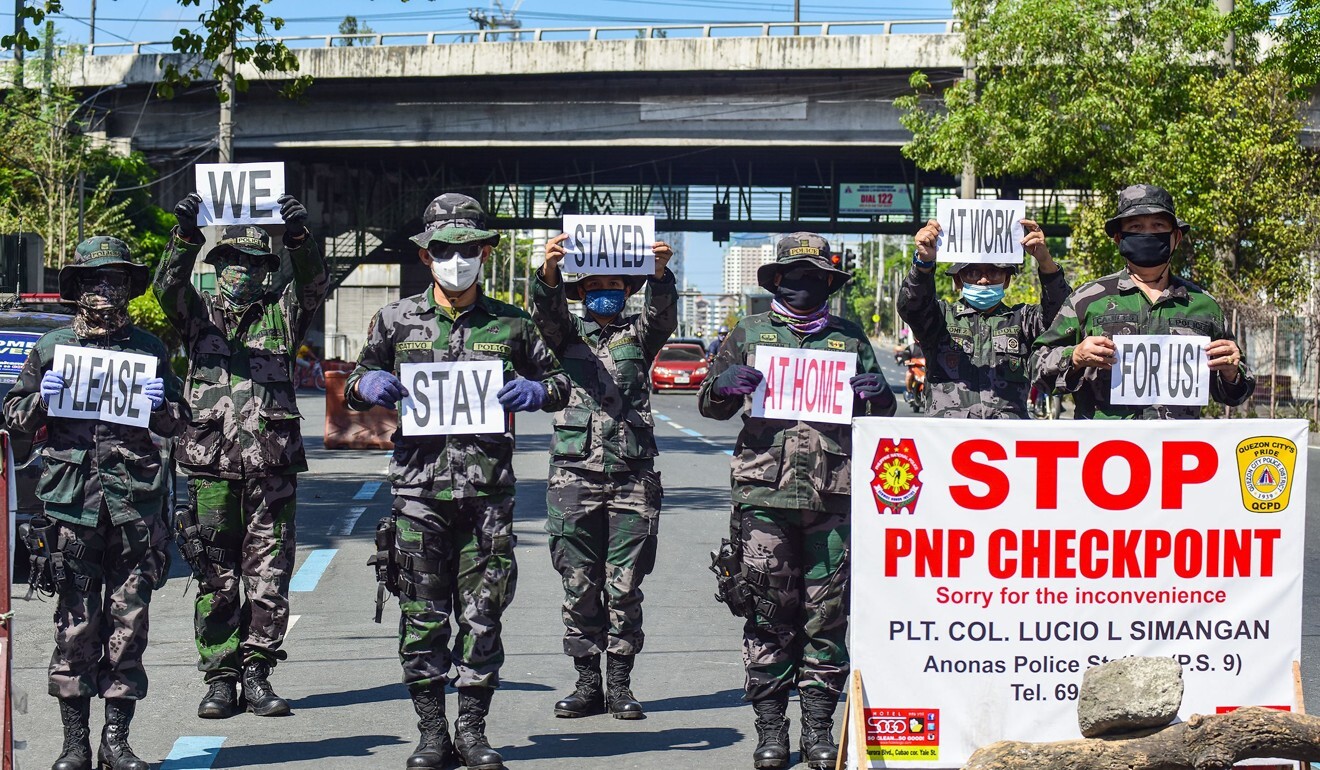
Police personnel in Manila hold up placards reminding people to stay at home. Photo: AFP
The country’s ambassador to China, Chito Sta Romana, confirmed a statement by the Chinese embassy in Manila that Beijing would send an expert team to the Philippines to provide technical advice on epidemic prevention and control as well as treatment protocols.
Sta Romana said the team was made of up of “experienced doctors and public health officials who specialise in infectious diseases”, but could not say when they would arrive.
An infectious disease doctor who spoke on condition of anonymity said the Chinese medical team would only give advice.
Coronavirus: in Philippines, leak shows politicians and relatives received ‘VIP’ testing
25 Mar 2020
“There was an offer to see patients but it was rebuffed because of local laws on practice,” he said, referring to a law that bans foreign doctors from practising medicine in the Southeast Asian nation.
Philippine foreign secretary Teodoro Locsin Jnr on Saturday tweeted that the Department of Health was “blocking their arrival”. His tweet, now deleted, had said “Don’t piss me off. Let them in.”
Health secretary Francisco Duque told local media that Locsin took down his tweet after hearing that the department was preparing hotel accommodation and translators for the expert team.
According to an ethnic Chinese businessman who is a member of a foundation involved in the visit, the team was supposed to have arrived on March 27. It will comprise doctors, nurses and researchers from hospitals and disease prevention agencies in Fujian province who specialise in areas such as infectious diseases, emergency medicine and integrated traditional Chinese and Western medicine.
An estimated 1.2 million ethnic Chinese call the Philippines – which has a population of 107 million people – home, with many tracing their ancestry to Fujian province.
The businessman, who declined to be named, showed This Week in Asia a screenshot of the team’s name list, which included an official from Fujian province’s United Work Front Department, the controversial Communist Party department responsible for promoting its influence around the world.
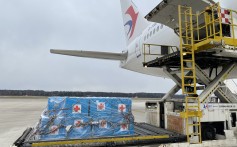
Beijing has dispatched teams of medical experts to countries struggling with a surge in Covid-19 cases, including Iran and Italy, and has also donated testing kits and other medical supplies.
The Philippine health department apologised over the weekend for comments made by undersecretary Vergeire that some of the kits donated by China had yielded only “40 per cent accuracy” and could not be used.
The Chinese embassy in Manila had rejected the suggestions, and shared a mobile text message supposedly from Duque to Ambassador Huang Xilian that thanked the Chinese government for the test kits.
Philippine President Rodrigo Duterte addresses the nation during a live broadcast on March 30. Photo: AP
Vergeire also issued a correction to her earlier statement, and said she was referring to “another brand” of test kits from China that a private foundation was going to donate.
Political risk analyst Ramon Casiple, who chairs the Institute for Political and Electoral Reforms, said at this point in the Philippines’ coronavirus fight “any help is welcome”.
He said he did not expect any negative political backlash towards the Chinese experts, even though on social media Filipinos have continued to blame China for failing to contain the outbreak in Hubei province, where cases first emerged.
Coronavirus: Philippines’ Luzon lockdown hits domestic helper agencies in Singapore
20 Mar 2020
The Philippines has locked down its main island of Luzon – where about a third of the population lives, and where 70 per cent of economic activity takes place – for the past two weeks, resulting in supply chain disruptions and millions of poor families losing any source of income.
’s critics have questioned what he has done with emergency powers granted to him that came bundled with a 275 billion peso (US$5.4 billion) emergency fund. A report showed that Duterte, through the Department of Social Welfare and Development, had managed to deliver emergency food aid to only 4,753 of the 18 million targeted families.
On Tuesday, finance secretary Carlos Dominguez said the government was planning a stimulus package to help companies and the poorest households.
“This planned stimulus package is already being crafted and will be responsive to the uncertainties of the situation,” Dominguez said in a statement, without elaborating. “At this point, nobody knows how bad this pandemic will get or how long it will last.”
Senate defence committee chair Panfilo Lacson warned that some people “are eating corn fungus to stave off hunger” and “if the executive does not act with dispatch, we may have a serious social problem to face”.
Communist Party of the Philippines founding chairman Jose Maria Sison agreed with Lacson but added, “it is therefore just for the broad masses of the people to be outraged and demand collective action against Duterte, his servant generals and the Department of Health because of their incompetence, corruption and stupidity.”
However, Senate President Vicente Sotto urged the public to “cut [Duterte] some slack”.
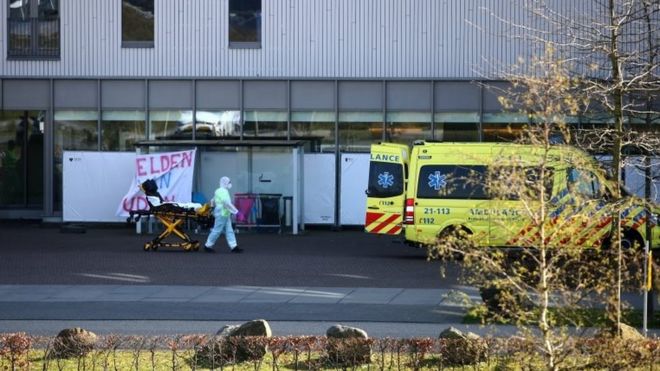
Image copyright GETTY IMAGESImage caption The Netherlands has been among the countries reporting faulty Chinese-made equipment
A number of European governments have rejected Chinese-made equipment designed to combat the coronavirus outbreak.
Thousands of testing kits and medical masks are below standard or defective, according to authorities in Spain, Turkey and the Netherlands.
Europe has reported hundreds of thousands of cases of coronavirus.
More than 10,000 people have died in Italy since the outbreak began.
The virus was first detected in China at the end of 2019. The government implemented strict lockdown measures to bring it under control.
What’s wrong with the equipment?
On Saturday, the Dutch health ministry announced it had recalled 600,000 face masks. The equipment had arrived from a Chinese manufacturer on 21 March, and had already been distributed to front-line medical teams.
Dutch officials said that the masks did not fit and that their filters did not work as intended, even though they had a quality certificate,
“The rest of the shipment was immediately put on hold and has not been distributed,” a statement read. “Now it has been decided not to use any of this shipment.”
Spain’s government encountered similar problems with testing kits ordered from a Chinese company.
It announced it had bought hundreds of thousands of tests to combat the virus, but revealed in the following days that nearly 60,000 could not accurately determine if a patient had the virus.
The Chinese embassy in Spain tweeted that the company behind the kits, Shenzhen Bioeasy Biotechnology, did not have an official license from Chinese medical authorities to sell its products.
It clarified that separate material donated by the Chinese government and technology and retail group Alibaba did not include products from Shenzhen Bioeasy.
Turkey also announced that it had found some testing kits ordered from Chinese companies were not sufficiently accurate, although it said that some 350,000 of the tests worked well.
Allegations of defective equipment come after critics warned China could be using the coronavirus outbreak to further its influence.
“China is aggressively pushing the message that, unlike the US, it is a responsible and reliable partner,” he wrote. “Armed with facts, we need to defend Europe against its detractors.”
What’s the situation in Europe?
On Monday, Spain reported 812 new deaths in the space of 24 hours – bringing its total death toll to 7,340. It now has more than 85,000 infections – surpassing the number of cases reported in China.
Media caption Spanish doctor “scared and exhausted” by pandemic
New measures have also come into force in Spain banning all non-essential workers from going to their jobs. The restrictions will be in place for at least two weeks.
Italy remains the worst affected country worldwide. More than 10,000 people have died from the virus there, and it has recorded nearly 100,000 infections. Only the US has more confirmed cases, although the death toll there is far lower.
US death toll passes 3,000 as New York’s hospitals are pushed to breaking point
Italy extends lockdown as cases exceed 100,000; UN Security Council votes by email for first time
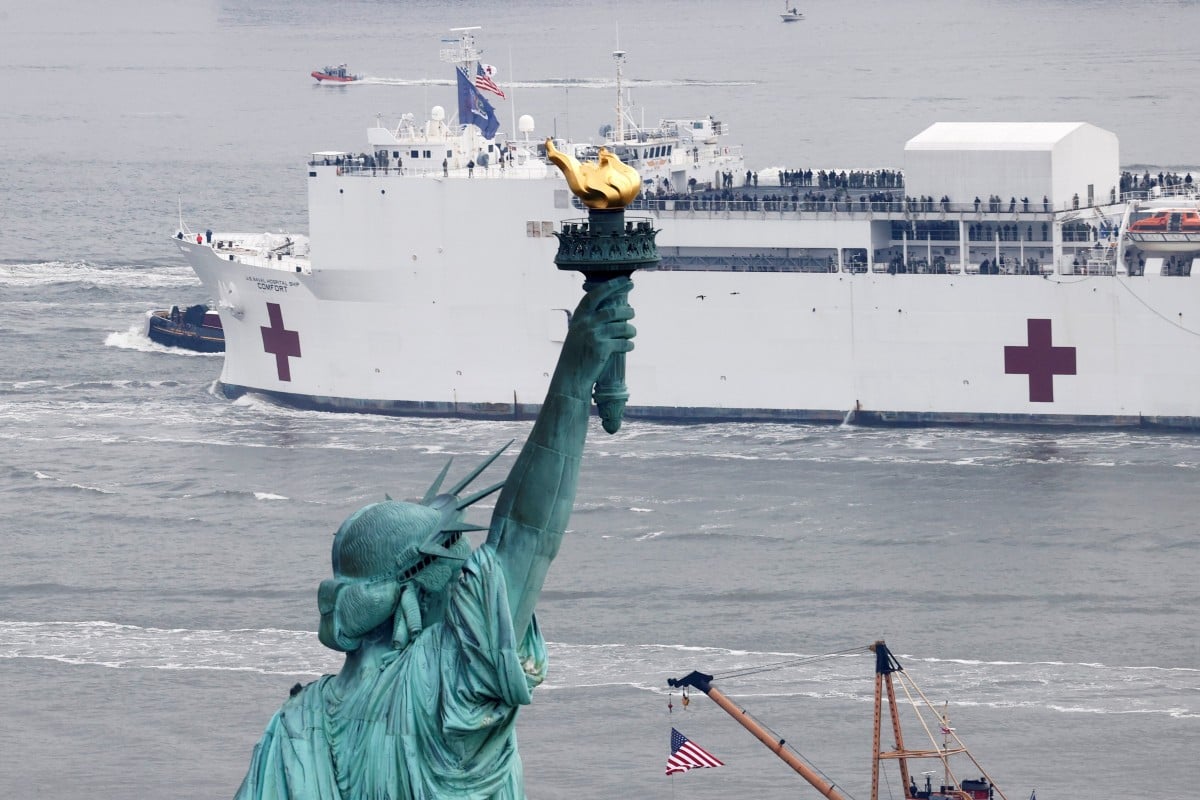
The USNS Comfort passes the Statue of Liberty as it enters New York Harbour on Monday. Photo: Reuters
Harsh lockdowns aimed at halting the march of the coronavirus pandemic extended worldwide Monday as the death toll soared toward 37,000 amid new waves of US outbreaks.
The tough measures that have confined some two-fifths of the globe’s population to their homes were broadened. Moscow and Lagos joined the roll call of cities around the globe with eerily empty streets, while Virginia and Maryland became the latest US states to announce emergency stay-at-home orders, followed quickly by the capital city Washington.
In a symbol of the scale of the challenge facing humanity, a US military medical ship sailed into New York to relieve the pressure on overwhelmed hospitals bracing for the peak of the pandemic.
France reported its highest daily number of deaths since the outbreak began, saying 418 more people had succumbed in hospital.
Spain, which announced another 812 virus deaths in 24 hours, joined the United States and Italy in surpassing the number of cases in China, where the disease was first detected in December.
On Tuesday, mainland China reported a rise in new confirmed coronavirus cases, reversing four days of declines, due to an uptick in infections involving travellers arriving from overseas.
Mainland China had 48 new cases on Monday, the National Health Commission said, up from 31 new infections a day earlier.
All of the 48 cases were imported, bringing the total number of imported cases in China to 771 as of Monday.
There was no reported new case of local infection on Monday, according to the National Health Commission. The total number of infections reported in mainland China stood at 81,518 and the death toll at 3,305. Globally, more than 760,000 have been infected, according to official figures.
Here are the developments:
Hospital ship arrives in New York
New York’s governor issued an urgent appeal for medical volunteers Monday amid a “staggering” number of deaths from the coronavirus, saying: “Please come help us in New York, now.”
The plea from Governor Andrew Cuomo came as the death toll in New York State climbed past 1,200 – with most of the victims in the big city – and authorities warned that the crisis pushing New York’s hospitals to the breaking point is just a preview of what other cities across the US could soon face.
Cuomo said the city needs 1 million additional health care workers.
“We’ve lost over 1,000 New Yorkers,” he said. “To me, we’re beyond staggering already. We’ve reached staggering.”
The governor’s plea came as a 1,000-bed US Navy hospital ship docked in Manhattan on Monday and a field hospital was going up in Central Park for coronavirus patients.
New York City reported 914 deaths from the virus as of 4:30pm local time Monday, a 16 per cent increase from an update six hours earlier. The city, the epicentre of the US outbreak, has 38,087 confirmed cases, up by more than 1,800 from earlier in the day.
Coronavirus field hospital set up in New York’s Central Park as city’s health crisis deepens
Gloom for 24 million people in Asia
The economic fallout from the coronavirus pandemic will prevent almost 24 million people from escaping poverty in East Asia and the Pacific this year, according to the World Bank.
In a report released on Monday, the Washington-based lender also warned of “substantially higher risk” among households that depend on industries particularly vulnerable to the impact of Covid-19. These include tourism in Thailand and the Pacific islands; manufacturing in Vietnam and Cambodia; and among people dependent on “informal labour” in all countries.
The World Bank urged the region to invest in expanding conventional health care and medical equipment factories, as well as taking innovative measures like converting ordinary hospital beds for ICU use and rapidly trining people to work in basic care.
Billionaire blasted for his Instagram-perfect isolation on luxury yacht
31 Mar 2020
Indonesia bans entry of foreigners
Indonesia barred foreign nationals from entering the country as the world’s fourth-most populous country stepped up efforts to contain the spread of the coronavirus pandemic.
The travel ban, to be effective soon, will also cover foreigners transiting through the country, Foreign Minister Retno Marsudi said after a cabinet meeting in Jakarta Tuesday. The curbs will not apply to holders of work permits, diplomats and other official visitors, she said.
The curbs on foreign citizens is the latest in a raft of measures taken by Indonesia to combat the deadly virus that’s sickened more than 1,400 people and killed 122. President Joko Widodo’s administration previously banned flights to and from mainland China and some of the virus-hit regions in Italy, South Korea and Iran. The president on Monday ordered stricter implementation of social distancing and health quarantine amid calls for a lockdown to contain the pandemic.
Indonesia has highest coronavirus mortality rate in Southeast Asia
First US service member dies
The first US military service member has died from the coronavirus, the Pentagon said on Monday, as it reported another sharp hike in the number of infected troops.
The Pentagon said it was a New Jersey Army National Guardsman who had tested positive for Covid-19 and had been hospitalised since March 21. He died on Saturday, it said.
Earlier on Monday, the Pentagon said that 568 troops had tested positive for the coronavirus, up from 280 on Thursday. More than 450 Defence Department civilians, contractors and dependents have also tested positive, it said.
US military has decided to stop providing more granular data about coronavirus infections within its ranks, citing concern that the information might be used by adversaries as the virus spreads.
The new policy, which the Pentagon detailed in a statement on Monday, appears to underscore US military concerns about the potential trajectory of the virus over the coming months – both at home and abroad.
School to resume in South Korea … online
South Korean children will start the new school year on April 9 with only online classes, after repeated delays due to the outbreak of the new coronavirus, the government said Tuesday.
Prime Minister Chung Sye Kyun said that despite the nation’s utmost efforts to contain the virus and lower the risk of infection, there is consensus among teachers and others that it is too early to let children go back to school.
The nation’s elementary schools, and junior and senior high schools were supposed to start the new academic year in early March, but the government has repeatedly postponed it to keep the virus from spreading among children.
The start was last postponed until April 6, but has now been delayed three more days to allow preparations to be made for online classes.
The nation now has 9,786 confirmed cases in total, with 162 deaths.
Italy extends lockdown as cases exceed 100,000
Italy’s government on Monday said it would extend its nationwide lockdown measures
against a coronavirus outbreak, due to end on Friday, at least until the Easter season in April.
The Health Ministry did not give a date for the new end of the lockdown, but said it would be in a law the government would propose. Easter Sunday is April 12 this year. Italy is predominantly Roman Catholic and contains the Vatican, the heart of the church.
Italians have been under lockdown for three weeks, with most shops, bars and restaurants shut and people forbidden from leaving their homes for all but non-essential needs.
Italy, which is the world’s hardest hit country in terms of number of deaths and accounts for more than a third of all global fatalities, saw its total death tally rise to 11,591 since the outbreak emerged in northern regions on February 21.
The death toll has risen by 812 in the last 24 hours, the Civil Protection Agency said, reversing two days of declines, although the number of new cases rose by just 4,050, the lowest increase since March 17, reaching a total of 101,739.
Deadliest day in Italy and Spain shows worst not over yet
28 Mar 2020
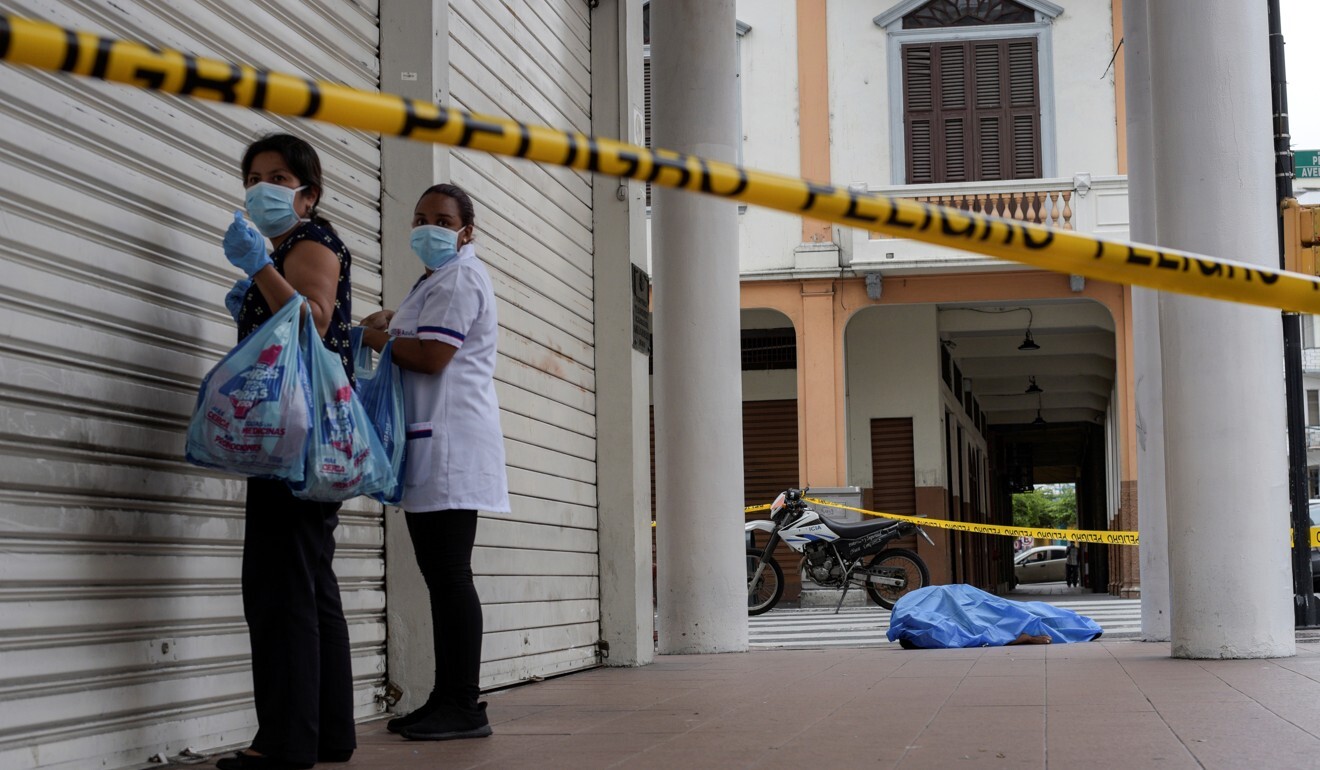
Women stand near the body of a man who died on the sidewalk in Guayaquil, Ecuador. Photo: Reuters
Ecuador struggles to collect the dead
Ecuadorean authorities said they would improve the collection of corpses, as delays related to the rapid spread of the new coronavirus has left families keeping their loved ones’ bodies in their homes for days in some cases.
Residents of Guayaquil, Ecuador’s largest city, have complained they have no way to dispose of relatives’ remains due to strict quarantine and curfew measures designed to prevent spread of the disease. Last week, authorities said they had removed 100 corpses from homes in Guayaquil.
But delays in collecting bodies in the Andean country, which has reported 1,966 cases of the virus and 62 deaths, were evident midday on Monday in downtown Guayaquil, where a man’s dead body lay on a sidewalk under a blue plastic sheet. Police said the man had collapsed while waiting in line to enter a store. Hours later, the body had been removed.
More than 70 per cent of the country’s coronavirus cases, which is among the highest tallies in Latin America, are in the southern province of Guayas, where Guayaquil is located.
Panama to restrict movement by gender
The government of Panama announced strict quarantine measures that separate citizens by gender in an effort to slow the spread of the novel coronavirus.
From Wednesday, men and women will only be able to leave their homes for two hours at a time, and on different days. Until now, quarantine regulations were not based on gender.
Men will be able to go to the supermarket or the pharmacy on Tuesdays, Thursdays and Saturdays, and women will be allowed out on Mondays, Wednesdays and Fridays.
No one will be allowed to go out on Sundays. The new measures will last for 15 days.
Police in Kenya use tear gas to enforce coronavirus curfew
Remote vote first for UN Security Council
The UN Security Council on Monday for the first time approved resolutions remotely after painstaking negotiations among diplomats who are teleworking due to the coronavirus pandemic.
The Security Council unanimously voted by email for four resolutions, including one that extended through April 2021 the expiring mandate of UN experts who are monitoring sanctions on North Korea, diplomats said.
The UN mission in Somalia was also prolonged, until the end of June, and the mission in Darfur until the end of May – two short periods decided due to uncertainty over the spread of the pandemic.
The Council also endorsed a fourth resolution aimed at improving the protection for peacekeepers.
The resolutions are the first approved by the Security Council since it began teleworking on March 12 and comes as Covid-19 rapidly spreads in New York, which has become the epicenter of the disease in the United States.
Congo ex-president dies in France
Former Republic of Congo president Jacques Joaquim Yhombi Opango died in France on Monday of the new coronavirus, his family said. He was 81.
Yhombi Opango, who led Congo-Brazzaville from 1977 until he was toppled in 1979, died at a Paris hospital of Covid-19, his son Jean-Jacques said. He had been ill before he contracted the virus.
Yhombi Opango was an army officer who rose to power after the assassination of president Marien Ngouabi.
Yhombi Opango was ousted by long-time ruler Denis Sassou Nguesso. Accused of taking part in a coup plot against Sassou Nguesso, Yhombi Opango was jailed from 1987 to 1990. He was released a few months before a 1991 national conference that introduced multiparty politics in the central African country.
When civil war broke out in Congo in 1997, Yhombi Opango fled into exile in France. He was finally able to return home in 2007, but then divided his time between France and Congo because of his health problems.
‘When I wake I cry’: France’s nurses face hell on coronavirus front line
31 Mar 2020
EU asks Britain to extend Brexit talks
The European Union expects Britain to seek an extension of its post-Brexit transition period beyond the end of the year, diplomats and officials said on Monday, as negotiations on trade have ground to a halt due to the coronavirus pandemic.
Europe has gone into a deep lockdown in a bid to curb the spread of the disease, with more than 330,000 infections reported on the continent and nearly 21,000 deaths.
In Britain, Prime Minister Boris Johnson and his health minister have both tested positive for the virus and the prime minister’s senior adviser Dominic Cummings – one of the masterminds behind Britain’s departure from the EU earlier this year – was self-isolating with symptoms.
London and the EU have been seeking to agree a new trade pact by the end of the year to kick in from 2021, even though the bloc has long said that such a time frame was extremely short to agree rules on everything from trade to security to fisheries.
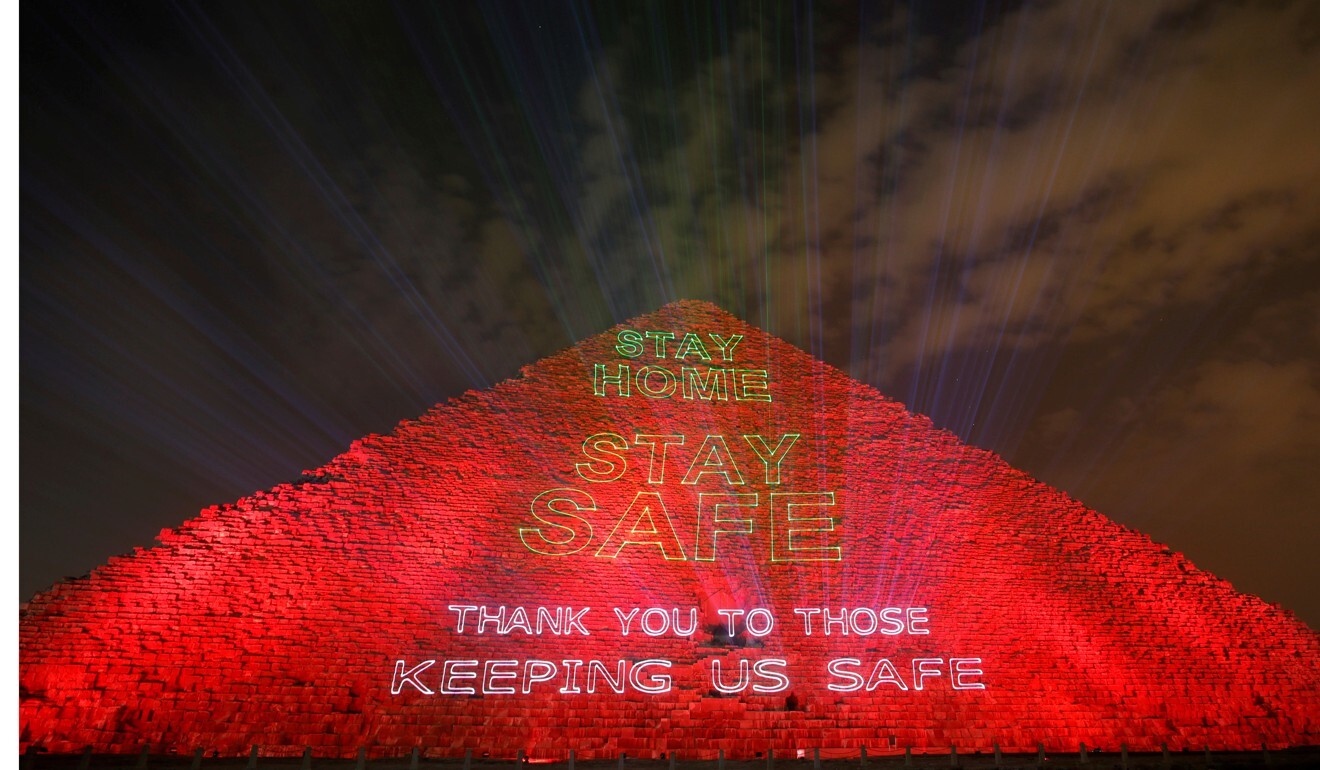
The pyramid of Khufu, the largest of the Giza pyramid complex. Photo: Reuters
Great Pyramid in Egypt lights up in solidarity
Egypt’s famed Great Pyramid was emblazoned Monday evening with messages of unity and solidarity with those battling the novel coronavirus the world over.
“Stay safe”, “Stay at home” and “Thank you to those keeping us safe,” flashed in blue and green lights across the towering structure at the Giza plateau, southwest of the capital Cairo.
Egypt has so far registered 656 Covid-19 cases, including 41 deaths. Of the total infected, 150 reportedly recovered.
Egypt has carried out sweeping disinfection operations at archaeological sites, museums and other sites across the country.
In tandem, strict social distancing measures were imposed to reduce the risk of contagion among the country’s 100 million inhabitants.
Tourist and religious sites are shuttered, schools are closed and air traffic halted.
Myanmar braces for ‘big outbreak’ after migrant worker exodus from Thailand
30 Mar 2020
Saudi king to pay for all patients’ treatment
Saudi Arabia will finance treatment for anyone infected with the coronavirus in the country, the health minister said on Monday.
The kingdom has registered eight deaths among 1,453 infections, the highest among the six Gulf Arab states.
Health Minister Tawfiq Al Rabiah said King Salman would cover treatment for citizens and residents diagnosed with the virus, urging people with symptoms to get tested.
“We are all in the same boat,” he told a news conference, adding that Crown Prince Mohammed bin Salman was overseeing containment efforts “night and day”.
Denmark eyes gradual reopening after Easter
Denmark may gradually lift a lockdown after Easter if the numbers of coronavirus cases and deaths remain stable, Prime Minister Mette Frederiksen said on Monday.
The Nordic country, which has reported 77 coronavirus-related deaths, last week extended until after Easter a two-week lockdown to limit physical contact between its citizens that began on March 11.
The number of daily deaths slowed to five on Sunday from eight and 11 on Saturday and Friday respectively. Denmark has reported a total of 2,577 coronavirus infections.
“If we over the next two weeks across Easter keep standing together by staying apart, and if the numbers remain stable for the next two weeks, then the government will begin a gradual, quiet and controlled opening of our society again, at the other side of Easter,” Frederiksen said.
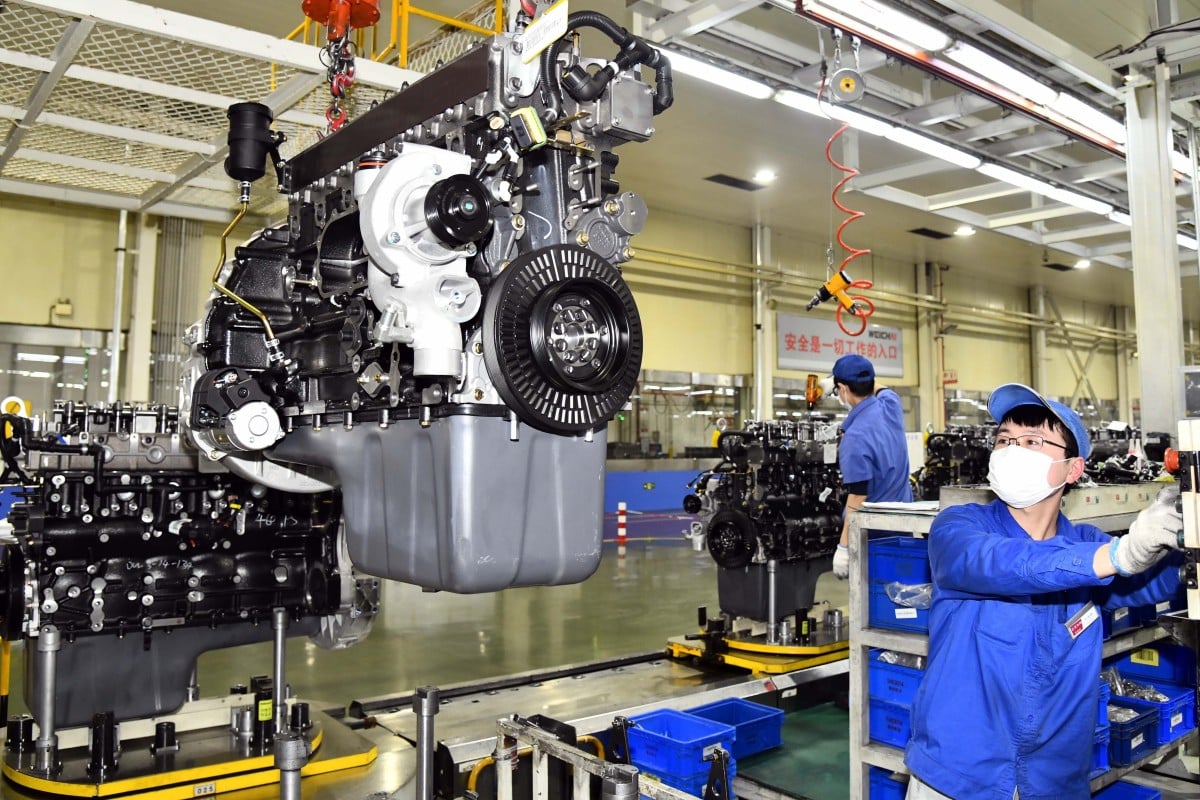
Despite PMI data showing a return to growth in both the manufacturing and non-manufacturing sectors, China’s economic activity is still far from normal
Headwinds include the threat of global recession, a second wave of coronavirus infections and a property slump, analysts warn
China’s economy has shown signs of recovery after a dismal start to the year. Photo: Xinhua
China’s economy showed signs of a recovery in March after a nationwide lockdown paralysed business in February, but analysts warned that it is not yet out of the woods.
Despite stronger-than-expected government data released on Tuesday, a series of threats lying ahead could derail China’s fragile recovery, including a second wave of infections, a global recession, worsening deflation due to plunging oil prices and a potentially sharp fall in the property market.
“While the lowest point is behind us, it’s not the time to celebrate,” said Larry Hu, chief China economist at Macquarie Bank.
For now, March’s figures suggest that business conditions are improving considerably, as more people are able to return to work and coronavirus cases continue to fall.
While the lowest point is behind us, it’s not the time to celebrateLarry Hu
The official purchasing managers’ index (PMIs) surveys showed that both the manufacturing and services sectors returned to growth in March, with many factories and retailers reopening as mainland authorities got the pandemic under control.
It will be welcome news for Beijing after a series of economic data plunged to all-time lows in January and February – including February’s PMIs, which are viewed as leading indicators of the state of the economy for the month ahead.
The manufacturing PMI, a survey of sentiment among factory owners, bounced back to 52.0 in March from 35.7 in February, which was an all-time low by some distance.
China’s non-manufacturing PMI – including both the services and construction sectors – was even weaker in February at 29.6, but its recovery to 52.3 was more marked.
Coronavirus: What impact will the economic fallout from the Covid-19 pandemic have on you?
A number above 50 signifies growth in sector activity, while a number below indicates contraction.
Both indices were significantly higher than expected and produced the V-shaped recovery in sentiment that policymakers had been so desperately pursuing.
But analysts warned that this may be short-lived as virus containment measures are set to sap demand across the globe, hitting China’s exports hard.
This was perhaps reflected in the fact that while many key components of the PMIs returned to growth in March, new export orders remained negative at 46.4.
Coronavirus: Chinese companies cut salaries and staff in industries hit hardest by Covid-19
“We would like to emphasise that the 52 reading [for manufacturing PMI] actually means a weak business resumption,” said Lu Ting, chief China economist at Nomura.
“We view the jump in both the manufacturing and non-manufacturing PMIs in March as one-off gains from the very low comparison bases in February.”
The dramatic collapse of the economy in the second month of the year meant March’s economic data was always likely to show a positive spike, with PMIs highly sensitive to short-term fluctuations in business conditions due to the way they are collated. Researchers simply ask respondents if things are better or worse than they were the previous month.
“This does not mean output is now back to its pre-virus trend,” said Julian Evans-Pritchard, senior China economist at Capital Economics, in a note. “Instead, it simply suggests that economic activity improved modestly relative to February’s dismal showing, but remains well below pre-virus levels. This is consistent with what the daily activity indicators show.”
It simply suggests that economic activity improved modestly relative to February’s dismal showing, but remains well below pre-virus levelsJulian Evans-Pritchard
Even the Chinese government urged caution against reading too much into the figures.
“We cannot say China’s economy has fully returned to normal levels based on a single month. We need to continue observing changes in the following months,” said a National Bureau of Statistics spokesman, adding that 96.6 per cent of large and medium-sized businesses were back to work as of March 25.
The official PMI survey, which is produced by the National Bureau of Statistics, is weighted more towards larger companies, including state-owned firms that have been the focus of government efforts to review production.
The Caixin-Markit manufacturing PMI data set to be published on Wednesday is weighted more towards smaller, private-sector firms and could show a less buoyant result given their struggles to resume operations.
A new phase of coronavirus blame game: what is the legacy of Covid-19 on global supply chains?
Officials in Beijing have been vocal in recent days about their concerns of a possible
. At a press conference in the capital on Monday, vice-minister of industry and information technology Xin Guobin said that small businesses and exporters might “struggle to survive” in the months ahead, due to global economic turbulence.
That was reflected in a new study by investment firm Fidelity International that showed while more than half of restaurants in China have reopened, daily turnover was 40 to 50 per cent below levels seen before the outbreak. Hotel occupancy figures, meanwhile, remain in single digits.
“Expect further slack in quarters three and four, which means the authorities will have to postpone their target to double gross domestic product growth levels to the first half of 2021,” said Carlos Casanova, Asia-Pacific economist at insurer Coface.
Dutch inquiry follows recall of 600,000 face masks
Ambassador rejects concerns China has a political agenda alongside medical support
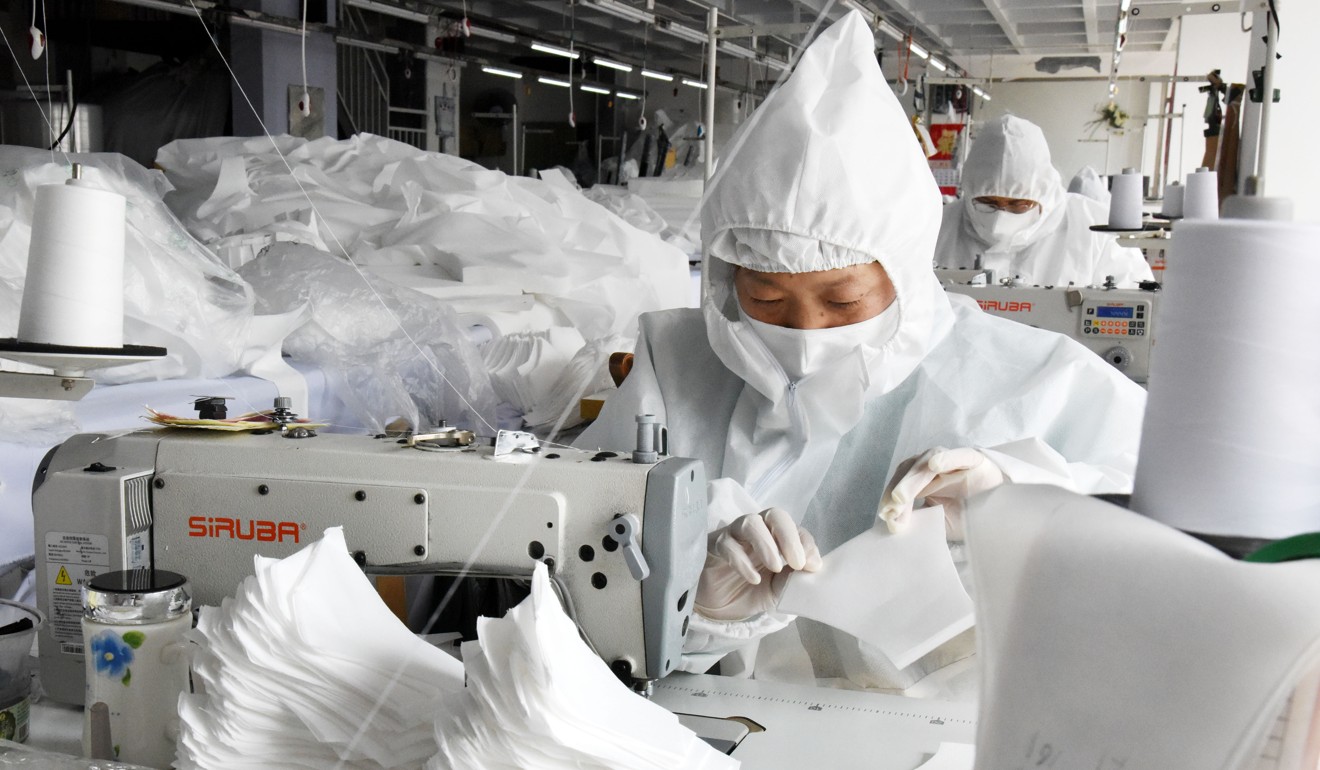
In early March, China’s daily output of face masks reached 116 million units. Photo: Xinhua
China’s embassy in the Netherlands said on Monday that it was closely following a Dutch investigation into reportedly defective masks imported from China and called for the issue not to be politicised.
Xu Hong, China’s ambassador to the Netherlands, made the comment after Dutch officials recalled more than 600,000 face masks which were found to be unsuitable for intensive care medical staff.
“The embassy paid high attention to the March 28 news about the ‘defective’ masks that Dutch government purchased from China, and contacted the Dutch Ministry of Foreign Affairs and the Ministry of Health in the first time to verify the information,” Xu said, according to a statement published on the embassy’s website.
Xu said he had spoken by telephone with the Dutch Minister for Medical Care and Sport Martin van Rijn, on Sunday about the issues and said “if necessary” China would help the Dutch investigation into the quality of the masks.
Netherlands recalls 600,000 face masks from China due to low quality
29 Mar 2020
According to the Dutch Ministry of Health, Welfare and Sport, the masks did not fit well and the filters did not function properly. It was not immediately clear whether the batch in question was given to the Netherlands as a donation or had arrived through a commercial transaction.
“The Netherlands is still looking into the situation, and if there is any further information, it will inform the Chinese side in the first time,” Xu said.
China has ramped up medical assistance abroad where the novel coronavirus pandemic has shown no signs of easing, but China’s efforts have run into rising concerns about the poor quality protective gear and test equipment it offered.
In early March, China’s daily output of face masks reached 116 million units. Picture: Xinhua
Xu also rejected concerns that China had a political agenda accompanying its medical support. He called for its assistance in not to be politicised.
“The reason why China supports the Netherlands and other countries to fight the pandemic is very simple: we are trying to save lives,” Xu said.
“There is no ‘geopolitical consideration’ as a few claimed. It is normal if some problems arise during the cooperation. These problems can be solved in an objective manner, but should not be politicised.”
It is not the first time European countries have had problems with coronavirus-related medical equipment manufactured in China.
Why China’s ‘mask diplomacy’ is raising concern in the West
The company said it would replace the test kits sent to Spain.
On Thursday, the Chinese embassy in Spain said on Twitter that the Bioeasy test kits had not been approved by China’s National Medical Products Administration and were not included in the medical supplies sent by the Chinese government to Spain.
Separately, the Philippines’ health department on Sunday apologised for comments it had made a day earlier that two batches of coronavirus test kits provided by China were substandard, and acknowledged that the quality of the test kits did meet global standards.
Image copyright GETTY IMAGESImage caption Millions are workers are defying a curfew and returning home
When I spoke to him on the phone, he had just returned home to his village in the northern state of Rajasthan from neighbouring Gujarat, where he worked as a mason.
In the rising heat, Goutam Lal Meena had walked on macadam in his sandals. He said he had survived on water and biscuits.
In Gujarat, Mr Meena earned up to 400 rupees ($5.34; £4.29) a day and sent most of his earnings home. Work and wages dried up after India declared a 21-day lockdown with four hours notice on the midnight of 24 March to prevent the spread of coronavirus. (India has reported more than 1,000 Covid-19 cases and 27 deaths so far.) The shutting down of all transport meant that he was forced to travel on foot.
“I walked through the day and I walked through the night. What option did I have? I had little money and almost no food,” Mr Meena told me, his voice raspy and strained.
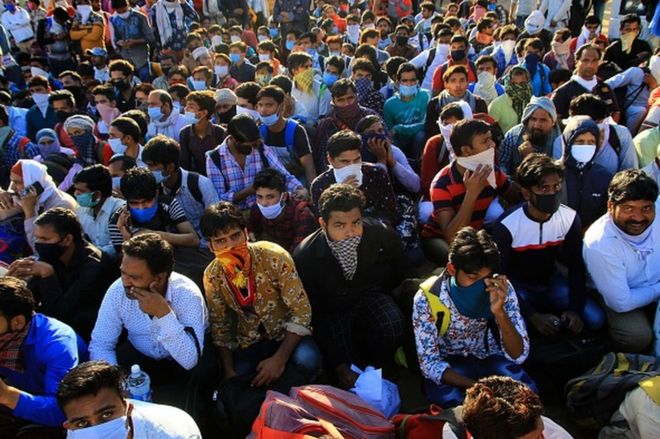
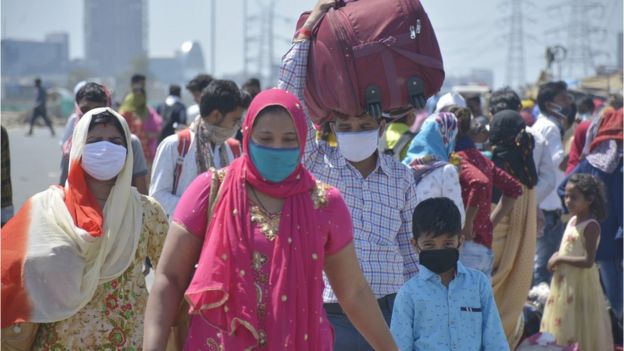
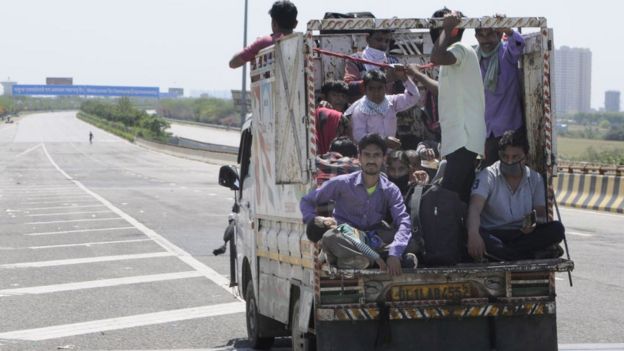
He was not alone. All over India, millions of migrant workers are fleeing its shuttered cities and trekking home to their villages.
These informal workers are the backbone of the big city economy, constructing houses, cooking food, serving in eateries, delivering takeaways, cutting hair in salons, making automobiles, plumbing toilets and delivering newspapers, among other things. Escaping poverty in their villages, most of the estimated 100 million of them live in squalid housing in congested urban ghettos and aspire for upward mobility.
Image copyright GETTY IMAGESImage caption Informal workers are the backbone of India’s big city economies
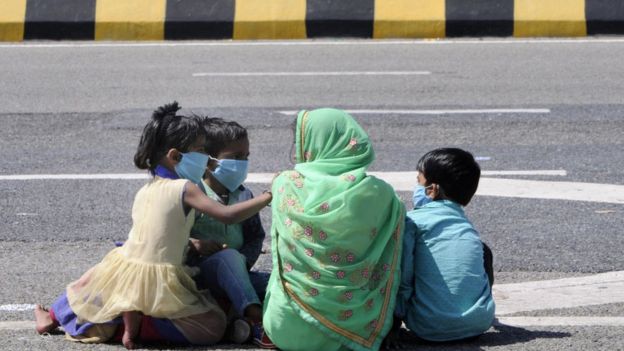
Last week’s lockdown turned them into refugees overnight. Their workplaces were shut, and most employees and contractors who paid them vanished.
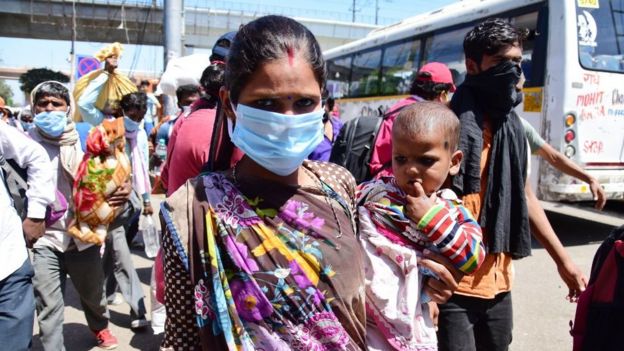
Sprawled together, men, women and children began their journeys at all hours of the day last week. They carried their paltry belongings – usually food, water and clothes – in cheap rexine and cloth bags. The young men carried tatty backpacks. When the children were too tired to walk, their parents carried them on their shoulders.
They walked under the sun and they walked under the stars. Most said they had run out of money and were afraid they would starve. “India is walking home,” headlined The Indian Express newspaper.
The staggering exodus was reminiscent of the flight of refugees during the bloody partition in 1947. Millions of bedraggled refugees had then trekked to east and west Pakistan, in a migration that displaced 15 million people.
Image copyright GETTY IMAGESImage caption Migrant labourers feel they have more social security in their villages
This time, hundreds of thousands of migrant workers are desperately trying to return home in their own country. Battling hunger and fatigue, they are bound by a collective will to somehow get back to where they belong. Home in the village ensures food and the comfort of the family, they say.
Clearly, a lockdown to stave off a pandemic is turning into a humanitarian crisis.
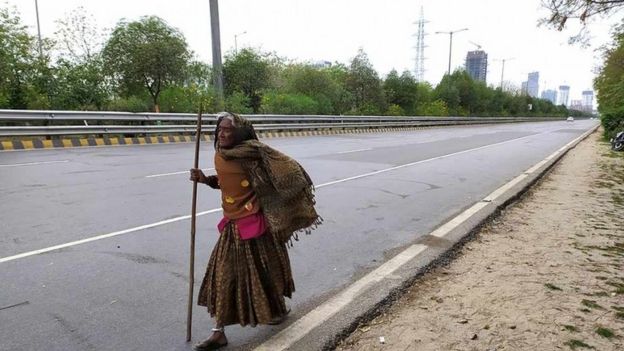
Among the teeming refugees of the lockdown was a 90-year-old woman, whose family sold cheap toys at traffic lights in a suburb outside Delhi.
Kajodi was walking with her family to their native Rajasthan, some 100km (62 miles) away. They were eating biscuits and smoking beedis, – traditional hand-rolled cigarettes – to kill hunger. Leaning on a stick, she had been walking for three hours when journalist Salik Ahmed met her. The humiliating flight from the city had not robbed her off her pride. “She said she would have bought a ticket to go home if transport was available,” Mr Ahmed told me.
Others on the road included a five-year-old boy who was on a 700km (434 miles) journey by foot with his father, a construction worker, from Delhi to their home in Madhya Pradesh state in central India. “When the sun sets we will stop and sleep,” the father told journalist Barkha Dutt. Another woman walked with her husband and two-and-a-half year old daughter, her bag stuffed with food, clothes and water. “We had a place to stay but no money to buy food,” she said.
Then there was Rajneesh, a 26-year-old automobile worker who walking 250km (155 miles) to his village in neighbouring Uttar Pradesh. It would take him four days, he reckoned. “We will die walking before coronavirus hits us,” the man told Ms Dutt.
He was not exaggerating. Last week, a 39-year-old man on a 300km (186 miles) trek from Delhi to Madhya Pradesh complained of chest pain and exhaustion and died; and a 62-year-old man, returning from a hospital by foot in Gujarat, collapsed outside his house and died. Four other migrants, turned away at the borders on their way to Rajasthan from Gujarat, were mowed down by a truck on a dark highway.
As the crisis worsened, state governments scrambled to arrange transport, shelter and food.
Image copyright SALIK AHMED/OUTLOOKImage caption Ninety-year-old Kajodi Devi is walking from Delhi to her village
But trying to transport them to their villages quickly turned into another nightmare. Hundreds of thousands of workers were pressed against each other at a major bus terminal in Delhi as buses rolled in to pick them up.
Delhi chief minister Arvind Kejriwal implored the workers not to leave the capital. He asked them to “stay wherever you are, because in large gatherings, you are also at risk of being infected with the coronavirus.” He said his government would pay their rent, and announced the opening of 568 food distribution centres in the capital. Prime Minister Narendra Modi apologised for the lockdown “which has caused difficulties in your lives, especially the poor people”, adding these “tough measures were needed to win this battle.”
Whatever the reason, Mr Modi and state governments appeared to have bungled in not anticipating this exodus.
Mr Modi has been extremely responsive to the plight of Indian migrant workers stranded abroad: hundreds of them have been brought back home in special flights. But the plight of workers at home struck a jarring note.
“Wanting to go home in a crisis is natural. If Indian students, tourists, pilgrims stranded overseas want to return, so do labourers in big cities. They want to go home to their villages. We can’t be sending planes to bring home one lot, but leave the other to walk back home,” tweeted Shekhar Gupta, founder and editor of The Print.
Image copyright GETTY IMAGESImage caption There is a precedent for this kind of exodus during crisis
The city, says Chinmay Tumbe, author of India Moving: A History of Migration, offers economic security to the poor migrant, but their social security lies in their villages, where they have assured food and accommodation. “With work coming to a halt and jobs gone, they are now looking for social security and trying to return home,” he told me.
Also there’s plenty of precedent for the flight of migrant workers during a crisis – the 2005 floods in Mumbai witnessed many workers fleeing the city. Half of the city’s population, mostly migrants, had also fled the city – then Bombay – in the wake of the 1918 Spanish flu.
When plague broke out in western India in 1994 there was an “almost biblical exodus of hundreds of thousands of people from the industrial city of Surat [in Gujarat]”, recounts historian Frank Snowden in his book Epidemics and Society.
Half of Bombay’s population deserted the city, during a previous plague epidemic in 1896. The draconian anti-plague measures imposed by the British rulers, writes Dr Snowden, turned out to be a “blunt sledgehammer rather than a surgical instrument of precision”. They had helped Bombay to survive the epidemic, but “the fleeing residents carried the disease with them, thereby spreading it.”
More than a century later, that same fear haunts India today. Hundreds of thousands of the migrants will eventually reach home, either by foot, or in packed buses. There they will move into their joint family homes, often with ageing parents. Some 56 districts in nine Indian states account for half of inter-state migration of male workers, according to a government report. These could turn out to be potential hotspots as thousands of migrants return home.
Image copyright GETTY IMAGESImage caption The fleeing migrants could spread the disease all over the country
Partha Mukhopadhyay, a senior fellow at Delhi’s Centre for Policy Research, suggests that 35,000 village councils in these 56 potentially sensitive districts should be involved to test returning workers for the virus, and isolate infected people in local facilities.
In the end, India is facing daunting and predictable challenges in enforcing the lockdown and also making sure the poor and homeless are not fatally hurt. Much of it, Dr Snowden told me, will depend on whether the economic and living consequences of the lockdown strategy are carefully managed, and the consent of the people is won. “If not, there is a potential for very serious hardship, social tension and resistance.” India has already announced a $22bn relief package for those affected by the lockdown.
The next few days will determine whether the states are able to transport the workers home or keep them in the cities and provide them with food and money. “People are forgetting the big stakes amid the drama of the consequences of the lockdown: the risk of millions of people dying,” says Nitin Pai of Takshashila Institution, a prominent think tank.
“There too, likely the worst affected will be the poor.”
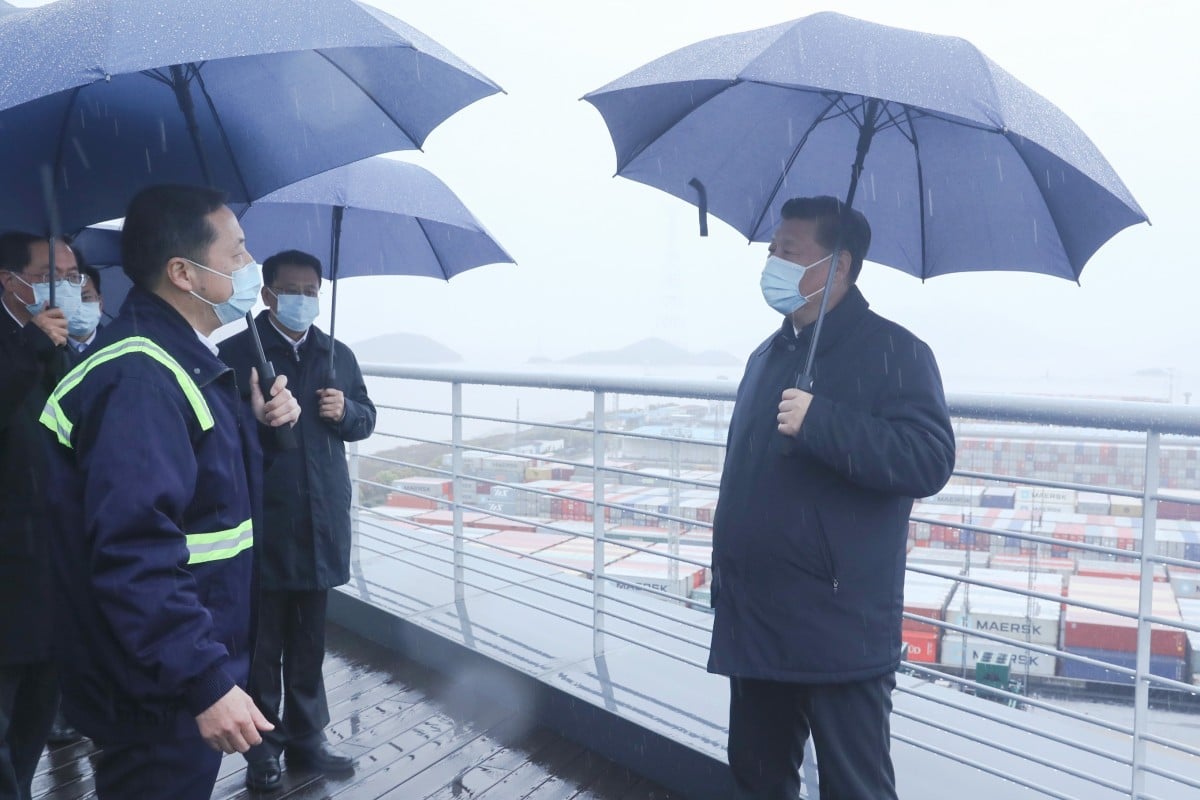
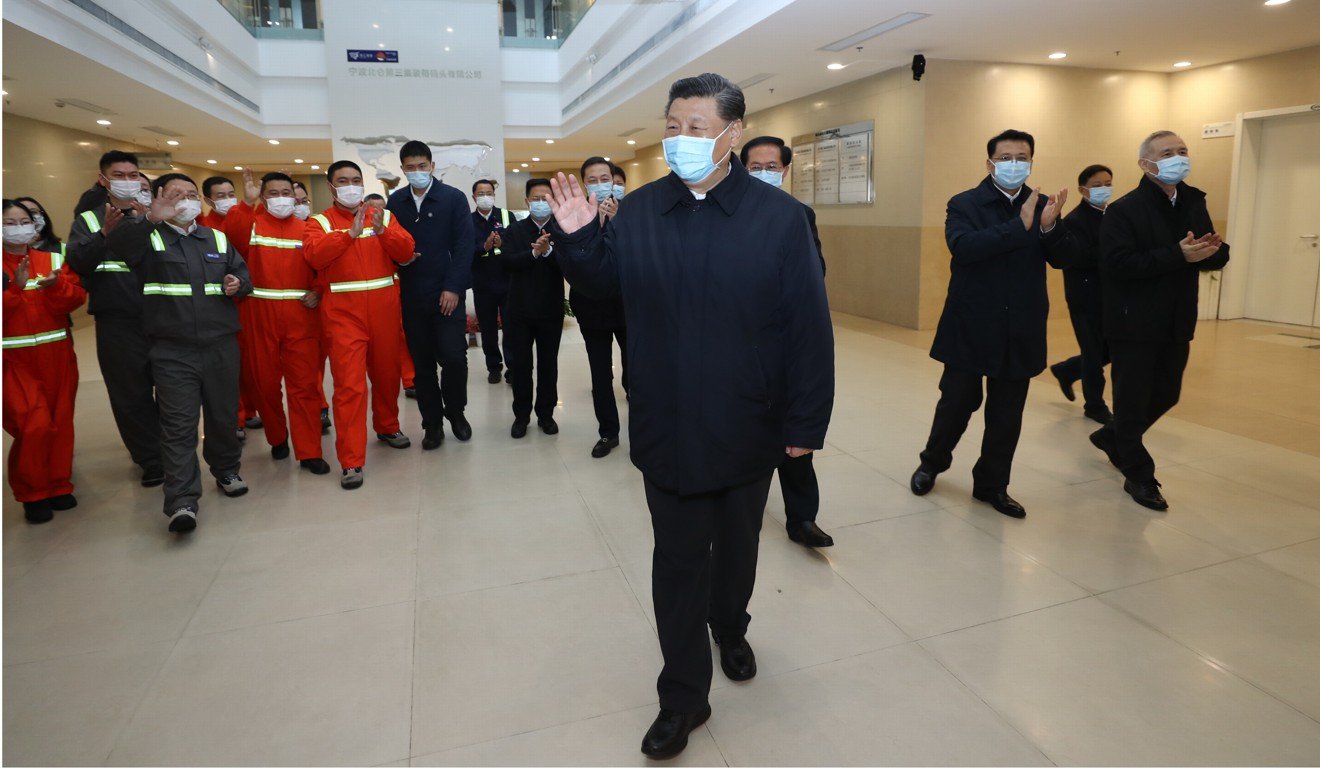
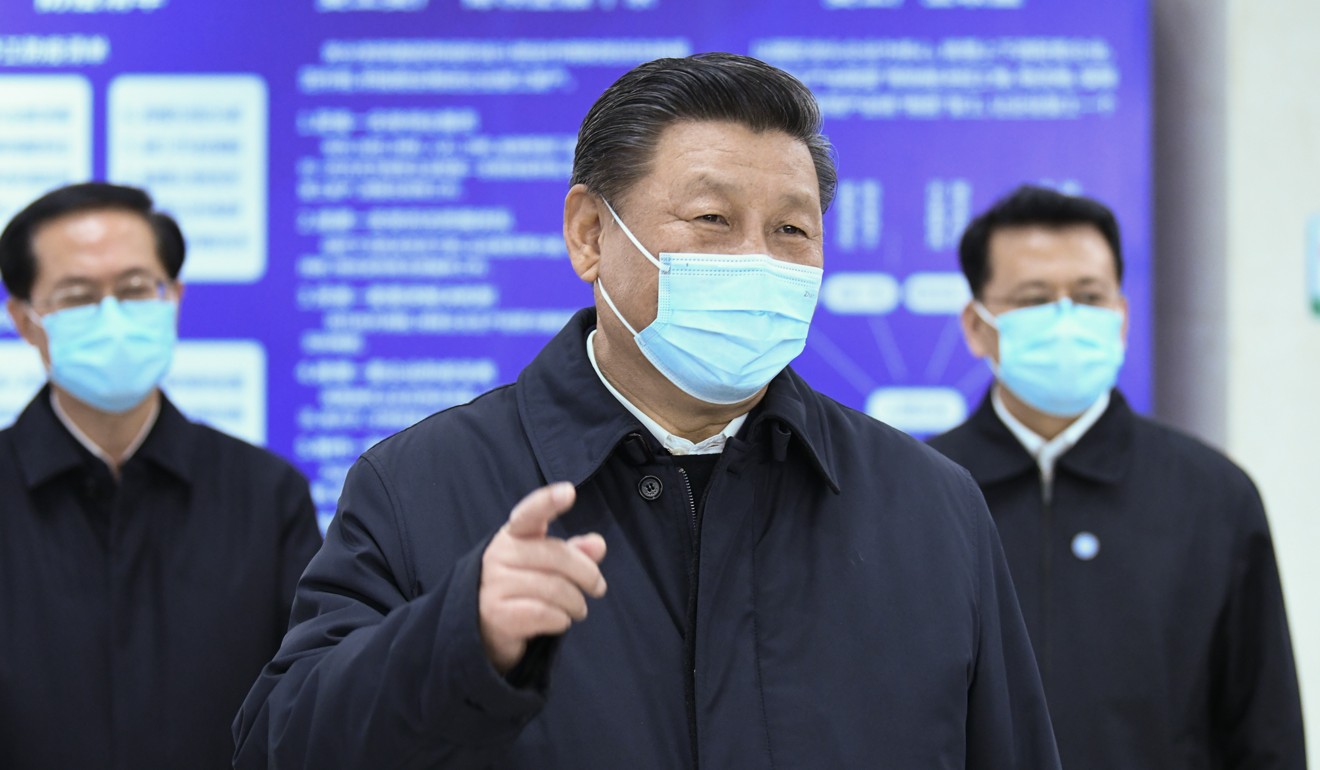
visited the industrial powerhouse of Zhejiang province on Sunday in a move state media described as a clear message the country was ready to get the economy back on track amid the “new normal” of dealing with the coronavirus.
The trip, to Ningbo – one of the world’s busiest ports and a trade hub for eastern China – was Xi’s first outside Beijing since he visited Wuhan, the initial epicentre of the Covid-19 outbreak, earlier in the month.
As well as a visiting the port, he spoke to workers at an industrial zone for car part manufacturers, where he learned about the latest efforts to restart production, Xinhua said in a brief report.
The visit came after two months of almost total lockdown in many parts of the country that disrupted businesses, transport and people’s daily lives, and ground the economy to a near standstill.
While local transmissions of the coronavirus in China appear to be under control, Beijing has implemented strict measures to prevent imported cases, including slashing international flights and banning most foreigners from entering the country.
In a separate report, Xinhua said Xi’s visit sent “a clear message” that China was resuming its industrial production and social activities, and described the fight against the coronavirus as the “new normal”.
Reviving the economy and battling a deadly disease were Xi’s “two tough battles”, it said.
Xi’s choice of destination was a clear message that restarting the economy is a top priority. Photo: Xinhua
Zhejiang is something of a power base for Xi, who spent nearly five years there during his climb through the ranks of the Communist Party.
One of the country’s biggest trading hubs, the province generated 3 trillion yuan (US$423.2 billion) in foreign trade last year, or more than 13 per cent of the national total, according to official figures.
“It’s a highly export-oriented economy … which has made it crucial not only to China’s development plan but also to safeguarding the stability of the global supply chain,” Xinhua said.
Observers said Xi’s visit was evidence of Beijing’s determination to get the economy back up and running as soon as possible.
Zhao Xijun, an economics professor at Renmin University, said Ningbo was a key part of the export economy and a base for many local and foreign entrepreneurs.
“It is a clear signal that China, after getting domestic infections under control, is now prioritising economic growth,” he said.
“It also shows the country will keep developing its economy and opening up its markets.”
But hopes of a quick recovery for the Chinese economy have been dashed by the spread of the coronavirus across Europe and the United States, causing a sharp decline in demand for Chinese goods.
Xi spent five years in Zhejiang while climbing the ranks of the Communist Party. Photo: Xinhua
In a meeting on Friday, the Communist Party’s Politburo said it would step up macroeconomic policy adjustments and pursue a more proactive fiscal policy while optimising measures to control the coronavirus to speed up the restoration of production, doing whatever it could to “minimise the losses caused by the epidemic”.
“China has successfully reopened much of its economy from the extremes of the coronavirus lockdown, but now faces a new problem: an impending collapse in demand for its exports as its customers go into lockdowns of their own,” Gavekal Dragnomics said in a research report.
“That shock to industry and manufacturing employment means that China will not enjoy the hoped-for V-shaped recovery in growth.”
Anyone caught breaking Singapore’s social distancing rules could be jailed from Friday, as the city state ramped up its coronavirus defence and announced the introduction of distance learning for schools.
Under updates to its powerful infectious diseases law, anyone who intentionally sits less than 1 metre away from another person in a public place or on a fixed seat demarcated as not to be occupied, or who stands in a queue less than a metre away from another, will be guilty of an offence.
Offenders can be fined up to S$10,000 (US$6,990), jailed for up to six months, or both. The rules, in place until April 30, can be applied to individuals and businesses.
The news was followed later by an announcement from the education ministry that starting from April, schools will start conducting one day of home-based learning for students per week.
Singapore’s new social distancing laws send needed signal, experts say
27 Mar 2020
“The recent spike in imported cases signals a new phase in our nation’s fight against Covid-19. To support further safe distancing, schools will progressively transit to a blended learning model, starting with one day of home-based learning a week,” the ministry said in a statement.
It added schools will remain open for students whose parents are not able to secure alternative childcare arrangements.
Hundreds of thousands of students in Singapore returned to class on Monday after a week of school holidays, despite growing calls for schools to be closed.
Singapore is one of the few jurisdictions in the region that has yet to suspend schools, unlike Hong Kong, Thailand, Indonesia, and Malaysia.
Education Minister Ong Ye Kung had earlier cited scientific evidence, saying that the pneumonia-like Covid-19 illness does not affect the young as much as adults.
Authorities in the city state, however, have said that suspending schools and closing workplaces are among the next steps to be taken should the situation worsen. Singapore has confirmed 683 cases so far, of which 172 have recovered and two died.
Global condom shortage looms amid virus lockdowns
A global shortage of condoms is looming, the world’s biggest producer said, after a coronavirus lockdown forced it to shut down production.
Malaysia’s Karex makes one in every five condoms globally. It has not produced a single condom from its three Malaysian factories in the past 10 days because of the lockdown imposed by the government to halt the spread of the virus.
That’s already a shortfall of 100 million condoms, normally marketed internationally by brands such as Durex, supplied to state health care systems such as Britain’s NHS or distributed by aid programmes such as the UN Population Fund.
“We are going to see a global shortage of condoms everywhere, which is going to be scary,” Karex Chief Executive Goh Miah Kiat said this week.
“My concern is that for a lot of humanitarian programmes deep down in Africa, the shortage will not just be two weeks or a month. That shortage can run into months.”
The other major condom-producing countries are China, where the coronavirus led to widespread factory shutdowns, and India and Thailand, which are seeing infections spiking only now.
Goh said Karex was in the process of appealing to the government for an exemption to operate under specific conditions. Malaysia is approving other essential goods producers to operate with half of their workforce.
“The good thing is that the demand for condoms is still very strong because like it or not, it’s still an essential to have,” Goh said. “Given that at this point in time people are probably not planning to have children. It’s not the time, with so much uncertainty.”
China to ban most foreign arrivals
China has banned most foreigners from entering the country in an effort to block the spread of the coronavirus through imported cases.
With several exceptions, including transit visas and foreigners arriving via Hong Kong and Macau with short-term entry permits, entry visas issued to foreigners will be suspended as an “interim measure”, according to a statement late on Thursday by the country’s foreign ministry.
“In view of the rapid spread of the new coronavirus epidemic worldwide, China has decided to temporarily suspend entry of foreigners with currently valid visas and residence permits in China,” the ministry said.
“This is an interim measure that China has to take in order to respond to the current epidemic situation, with reference to the practice of many countries,” it added. “The Chinese side will adjust the above measures according to the epidemic situation through separate announcements.”
Pakistan aid workers lack basic kit
Pakistan’s biggest charity, famous for its emergency services for the poor, is kitting staff out in raincoats and rubber boots in the battle against the coronavirus as it can’t get hold of proper personal protective equipment, the organisation says.
Pakistan has reported the highest number of coronavirus infections in South Asia, with 1,179 cases and nine deaths, but health experts say there is a lack of public awareness about the virus and the cash-strapped government is ill-prepared to tackle it.
The Edhi Foundation has for decades stepped in to help when government services fail communities and it runs the country’s largest ambulance service.
Now it has had to train dozens of staff on how to handle suspected coronavirus patients. But providing them with proper protection is a problem given a nationwide shortage of the equipment.
“We’ve compromised on certain things and use alternatives,” Facial Edhi, head of the Edhi Foundation, said at his office in Karachi, Pakistan’s biggest city, on Thursday.
“Full aprons are in short supply in the market.”
He said he was confident the raincoats would work just as well.
South Korea pleads with residents to stay indoors
Authorities in South Korea pleaded with residents on Friday to stay indoors and avoid large gatherings as new coronavirus cases hovered close to 100 per day.
South Korea reported 91 new infections on Friday, taking the national tally to 9,332, the Korea Centres for Disease Control and Prevention said. The country has reported similar daily numbers for the past two weeks, down from a high of over 900 in late February.
The government has sought to convince a restless public that several more weeks of social distancing and self-isolation may be needed to allow health authorities to tamp down the smaller but still steady stream of new cases.
“As the weather is getting nicer, I know many of you may have plans to go outside,” said Yoon Tae-ho, director general for public health policy at the health ministry. “But social distancing cannot be successful when it’s only an individual, it needs to be the whole community.”
Coronavirus: California officials alarmed by rate of infection
27 Mar 2020
Italy reports 662 new deaths, with uptick in new cases
Italy is reporting an uptick in new novel coronavirus infections, after four consecutive days in which new cases had decreased.
The country now has 62,013 active cases, a daily increase of 4,492, the Italian Civil Protection Agency said in its bulletin.
On Wednesday the daily variation was 3,491, on Tuesday 3,612, on Monday 3,780, on Sunday 3,957, and on Saturday a record 4,821.
There are also 662 new fatalities, bringing the total death toll to 8,165, while overall infections, including deaths and recoveries, have risen to 80,539, a daily increase of 8.3 per cent.
Recoveries are up by around 11 per cent to 10,361, while the number of intensive care patients – a closely watched figure given the shortage of hospital beds – has risen by 3.5 per cent, to 3,612.
Russia closes all restaurants nationwide
Russia is temporarily closing restaurants nationwide for a nine-day period starting on Saturday to prevent the spread of the coronavirus.
Restaurants will still be able to provide delivery services during that time, according to the decree by Prime Minister Mikhail Mishustin, published on his website on Friday.
Russia has reported more than 800 cases of coronavirus, predominantly in Moscow, which has seen at least two virus-related deaths. Mayor Sergei Sobyanin has warned that the actual number of cases is probably “significantly more”.
The country has already prohibited regular international flights, and imposed strict quarantine measures for anyone entering the country and anyone who could have been exposed to someone infected with the virus – though has not yet opted to impose lockdown measures like those seen elsewhere.
Coronavirus containment measures spark prison protests across Italy as nation goes into lockdown
First casualty in Kenya
Kenya has recorded its first coronavirus death as a rapid rise in confirmed cases puts Africa’s fragile health systems to the test.
Kenyan Health Cabinet Secretary Mutahi Kagwe said a 66-year-old Kenyan man died on Thursday afternoon despite treatment in an intensive care unit.
Kagwe said the man, who arrived into the country on March 13 from South Africa via Swaziland, was a diabetic. Also on Thursday, three women aged between 30 and 61 tested positive for Covid-19, the disease caused by the coronavirus, taking the country’s total to 31.
Kenya is the second country in East Africa and the 15th on the continent to confirm a coronavirus-related death. Algeria has the highest death toll in Africa with 25 fatalities, while Egypt has reported 24 and Morocco 11.
About a week ago, the continent of 54 countries had reported fewer than 300 cases. But by Friday Africa had 3,221 confirmed cases and 87 deaths. WHO regional director for Africa Matshidiso Moeti said on Thursday that the situation in Africa was “evolving very quickly in terms of geographic spread and the increasing number of cases”.
Australian military to enforce quarantine
The Australian military will help enforce the quarantine of travellers returning to the country, with the prime minister unveiling strict new measures and door-to-door checks on Friday to rein in the spread of Covid-19.
With some two-thirds of Australia’s 3,000 Covid-19 cases still linked to overseas travel, Scott Morrison said 14-day home quarantines would now be actively policed with the help of the military.
Thousands of citizens and residents are still arriving in Australia every day and there have been instances of return travellers repeatedly breaking a promise to stay at home.
Morrison said all returnees arriving after midnight Saturday would now be kept in hotels in the city of arrival for the duration of their quarantine.
Those already on Australian soil and under orders to self-quarantine for two weeks will face active checks, he said.
Quarantine measures will be getting “a lot tougher and a lot stricter,” Morrison said, adding the Australian Defence Force would “assist in the compliance with these arrangements.”
Afghanistan to release 10,000 prisoners
Afghanistan will release at least 10,000 prisoners over the age of 55 in an attempt to prevent the spread of the coronavirus, officials said on Thursday.
“The president has issued a decree that several thousand prisoners will be released soon due to coronavirus,” an official in President Ashraf Ghani’s office said.
Those released will not include members of Islamist militant groups the Taliban or Islamic State, and the process will be completed within 10 days, said two government officials.
Afghanistan has reported 91 cases of coronavirus and three deaths. The country’s western Herat province has recorded at least 54 of the 75 total cases reported in the last week.
International aid groups in recent weeks have raised concerns about the possibility of the coronavirus spreading in prisons across Afghanistan.
Giuseppe Remuzzi’s comments were seized on by Chinese state media amid the acrimonious row with the US, but he says the key question is how far Covid-19 had spread before it was identified
Academic says ‘strange pneumonias’ in Italy last November suggest it may have reached Europe before anyone knew what the disease was
Giuseppe Remuzzi told NPR there had been ‘strange pneumonias’ in Italy in November and December. Photo: Handout
The coronavirus that causes Covid-19 may have spread beyond China before the health authorities had even discovered the disease, according to the Italian professor who recently said there had been “very strange pneumonias” in Europe as early as November last year.
Remuzzi’s comments attracted much attention in China, where the authorities have been working hard to steer the international narrative about the pandemic, and stop people describing it as the “China virus” or “Wuhan virus” after the city where the disease was first identified.
In an interview with the Chinese science and technology news outlet DeepTech, which was published on Tuesday, Remuzzi said the key point in his NPR interview was not where the virus came from, but how far it had spread before it was discovered.
Coronavirus: Italy has a brief glimpse of hope as new cases drop to a five-day low
24 Mar 2020
He said a major question was how long the disease, which has so far infected more than 378,000 and killed over 16,500 people worldwide, had been spreading in China before health authorities realised its severity.
Taking into account the long incubation period, Remuzzi said he would not be surprised if some asymptomatic carriers had travelled around China or even abroad before December.
The professor also said that while it was possible it originated outside Wuhan, there had so far been no proof to support the theory.
As the outbreak gathered pace in the US, where it has now killed more than 500 people, Washington has escalated its rhetoric. President Donald Trump had repeatedly referred to it publicly as the “Chinese virus” until he changed tone on Monday and declined to use the phrase.
China, meanwhile, has described the rhetoric adopted by “certain US politicians and senior officials” as an attempt to defame and stigmatise China over the pandemic.
A number of Chinese state media outlets, including party mouthpiece People’s Daily and its tabloid affiliate Global Times, seized on Remuzzi’s comments about “strange pneumonias” to counter the “Chinese virus rhetoric”.
Coronavirus: why are so many more people dying in Italy than Germany?
23 Mar 2020
In the NPR interview, Remuzzi tried to explain why Italy had been caught off guard when the outbreak started gathering pace in February.
He discussed the difficulty of combating a disease that people did not know existed, and said the unusual cases in November and December could mean that virus was already circulating in Lombardy, the country’s worst-hit region, before people were aware of what was unfolding in Wuhan.
Remuzzi also shared details of the early suspected cases in Lombardy with DeepTech and Chinese state-run international network CGTN.
Remuzzi said he had learned about the cases from a few general practitioners and he has not yet been able to verify the information.
But he said there are some other suspicious cases he “knows for sure”, including two pneumonia cases in Scanzorosciate in northern Italy in December, where the patients developed high fever, a cough and had difficulty in breathing.
He said there had also been 10 patients who developed bilateral interstitial pneumonia in two other nearby towns, Fara Gera D’Adda and Crema, who had similar symptoms.
Coronavirus: confusion as Chinese face masks bound for Italy end up in Czech Republic
23 Mar 2020
Remuzzi said local doctors considered these cases to be “unusual” but ruled out the possibility of seasonal influenza, as all these patients had been vaccinated.
“The reason we don’t know if it was Covid-19 is because at that time this could not be tested; the patients didn’t have X-rays,” he told CGTN.
They recovered within 15 days, with some receiving two or three courses of antibiotics.
Remuzzi added there had also been a patient diagnosed with bilateral interstitial pneumonia in Alzano Lombardo Hospital in Lombardy around the time.
Virus may have jumped from animal to humans long before the first detection in Wuhan, according to research by an international team of scientists
Findings significantly reduce the possibility of the virus having a laboratory origin, director of the US National Institute of Health says
An international team of scientists say the coronavirus may have jumped from animal to humans long before the first detection in China. Photo: AP
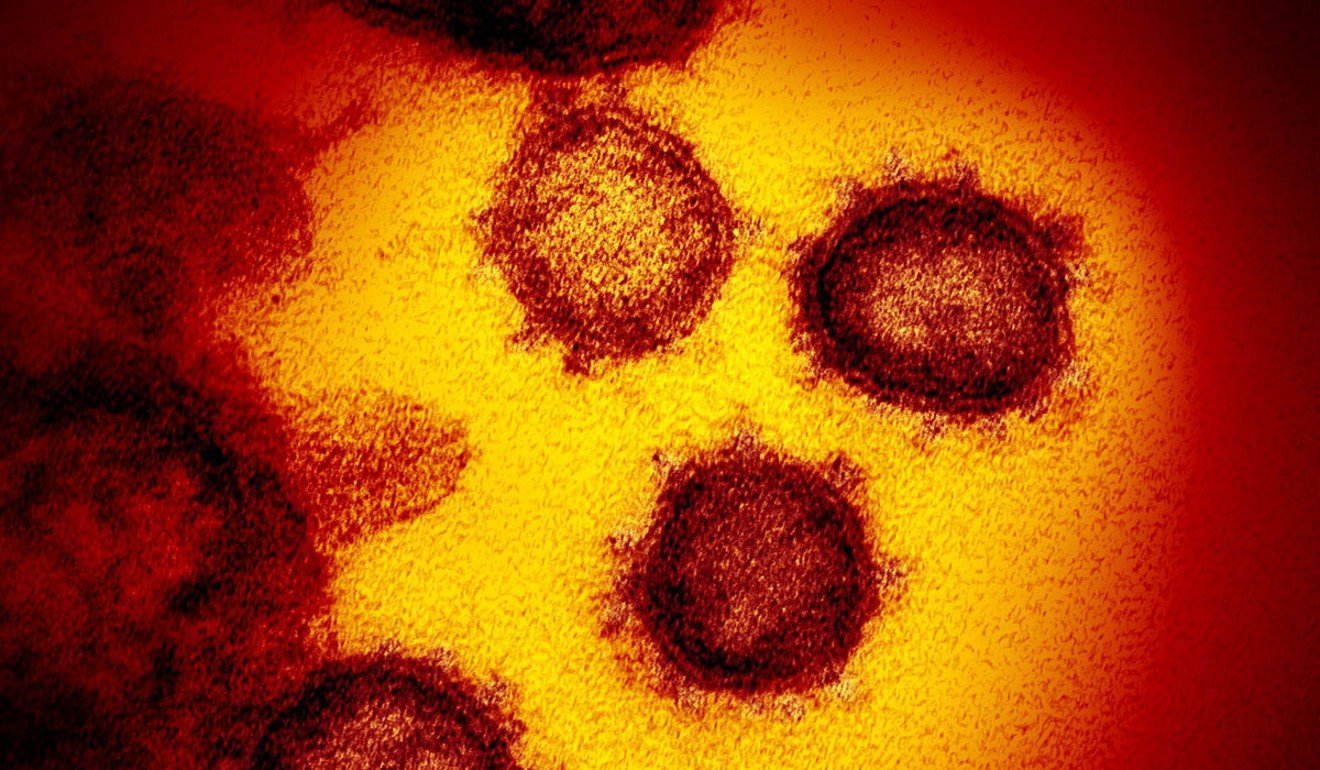
The coronavirus that causes Covid-19 might have been quietly spreading among humans for years or even decades before the sudden outbreak that sparked a global health crisis, according to an investigation by some of the world’s top virus hunters.
Researchers from the United States, Britain and Australia looked at piles of data released by scientists around the world for clues about the virus’ evolutionary past, and found it might have made the jump from animal to humans long before the first detection in the central China city of Wuhan.
Though there could be other possibilities, the scientists said the coronavirus carried a unique mutation that was not found in suspected animal hosts, but was likely to occur during repeated, small-cluster infections in humans.
The study, conducted by Kristian Andersen from the Scripps Research Institute in California, Andrew Rambaut from the University of Edinburgh in Scotland, Ian Lipkin from Columbia University in New York, Edward Holmes from the University of Sydney, and Robert Garry from Tulane University in New Orleans, was published in the scientific journal Nature Medicine on March 17.
Dr Francis Collins, director of the US National Institute of Health, who was not involved in the research, said the study suggested a possible scenario in which the coronavirus crossed from animals into humans before it became capable of causing disease in people.
“Then, as a result of gradual evolutionary changes over years or perhaps decades, the virus eventually gained the ability to spread from human to human and cause serious, often life-threatening disease,” he said in an article published on the institute’s website on Thursday.
In December, doctors in Wuhan began noticing a surge in the number of people suffering from a mysterious pneumonia. Tests for flu and other pathogens returned negative. An unknown strain was isolated, and a team from the Wuhan Institute of Virology led by Shi Zhengli traced its origin to a bat virus found in a mountain cave close to the China-Myanmar border.
The two viruses shared more than 96 per cent of their genes, but the bat virus could not infect humans. It lacked a spike protein to bind with receptors in human cells.
Coronaviruses with a similar spike protein were later discovered in Malayan pangolins
by separate teams from Guangzhou and Hong Kong, which led some researchers to believe that a recombination of genomes had occurred between the bat and pangolin viruses.
Doctors in Wuhan began noticing a surge in the number of people suffering from a mysterious pneumonia in December. Photo: Handout
But the new strain, or SARS-Cov-2, had a mutation in its genes known as a polybasic cleavage site that was unseen in any coronaviruses found in bats or pangolins, according to Andersen and his colleagues.
This mutation, according to separate studies by researchers from China, France and the US, could produce a unique structure in the virus’ spike protein to interact with furin, a widely distributed enzyme in the human body. That could then trigger a fusion of the viral envelope and human cell membrane when they came into contact with one another.
Some human viruses including HIV and Ebola have the same furin-like cleavage site, which makes them contagious.
It is possible that the mutation happened naturally to the virus on animal hosts. Sars (severe acute respiratory syndrome) and Mers (Middle East respiratory syndrome), for instance, were believed to have been direct descendants of species found in masked civets and camels, which had a 99 per cent genetic similarity.
There was, however, no such direct evidence for the novel coronavirus, according to the international team. The gap between human and animal types was too large, they said, so they proposed another alternative.
“It is possible that a progenitor of SARS-CoV-2 jumped into humans, acquiring the genomic features described above through adaptation during undetected human-to-human transmission,” they said in the paper.
“Once acquired, these adaptations would enable the pandemic to take off and produce a sufficiently large cluster of cases to trigger the surveillance system that detected it.”
They said also that the most powerful computer models based on current knowledge about the coronavirus could not generate such a strange but highly efficient spike protein structure to bind with host cells.
The study had significantly reduced, if not ruled out, the possibility of a laboratory origin, Collins said.
“In fact, any bioengineer trying to design a coronavirus that threatened human health probably would never have chosen this particular conformation for a spike protein,” he said.
The findings by Western scientists echoed the mainstream opinion among Chinese researchers.
Zhong Nanshan, who advises Beijing on outbreak containment policies, had said on numerous occasions that there was growing scientific evidence to suggest the origin of the virus might not have been in China.
“The occurrence of Covid-19 in Wuhan does not mean it originated in Wuhan,” he said last week.
A doctor working in a public hospital treating Covid-19 patients in Beijing said numerous cases of mysterious pneumonia outbreaks had been reported by health professionals in several countries last year.
Re-examining the records and samples of these patients could reveal more clues about the history of this worsening pandemic, said the doctor, who asked not to be named due to the political sensitivity of the issue.
“There will be a day when the whole thing comes to light.”












 CHINDIA ALERT: You'll be living in their world, very soon