29/04/2020
BEIJING (Reuters) – China announced on Wednesday that its parliament will open a key annual session on May 22, signalling that Beijing sees the country returning to normal after being reduced to a near-standstill for months by the COVID-19 epidemic.
During the gathering of the National People’s Congress in the capital, delegates will ratify major legislation, and the government will unveil economic targets, set defence spending projections and make personnel changes. The ruling Communist Party also typically announces signature policy initiatives.
The session was initially scheduled to start on March 5 but was postponed due to COVID-19, which has infected nearly 83,000 people and killed more than 4,600 on the mainland after emerging late last year in the central city of Wuhan.
As the epidemic has subsided, economic and social life gradually returned to normal, making it possible for the congress to convene, the official Xinhua news agency quoted the standing committee of the NPC, the legislature’s top decision-making body, as saying.
The committee also appointed Huang Runqiu as the new minister for ecology and environment, a post vacated when predecessor Li Ganjie became deputy Communist Party chief for Shandong province earlier this month, Xinhua reported.
Tang Yijun was also named as the new justice minister to replace Fu Zhenghua, who has reached the retirement age of 65 for ministers.
The Chinese People’s Political Consultative Conference (CPPCC), an advisory body to parliament, has proposed starting its annual session a day before the parliamentary session opens.
Analysts expect China to roll out additional fiscal stimulus in order to cushion the blow from COVID-19, which has developed in to a worldwide pandemic that some fear will trigger a severe global recession.
China’s economy contracted for the first time on record during the January-March period, when the government imposed severe travel and transport restriction to curb the spread of the epidemic.
Parliament is also expected to discuss the anti-government protests in Hong Kong, amid growing speculation that Beijing take steps to strengthen its grip on the city.
It is unclear how long parliament and its advisory body will meet for this time, and people familiar with the matter have told Reuters that this year’s annual sessions could be the shortest in decades due to COVID-19 concerns. Usually more than 5,000 delegates descend on Beijing from all over China for at least 10 days.
Beijing city plans to ease quarantine rules as early as Thursday, two sources familiar with the situation told Reuters, ahead of the key political meetings.
People arriving in the capital from other parts of China will no long have to be quarantined for two weeks unless they come from high-risk areas such as Heilongjiang in the north and some parts of Guangdong in the southeast, the sources said.
Source: Reuters
Posted in 22, 65, additional, advisory body, amid, analysts, announced, announces, annual, annual session, anti-government protests, appointed, arliamentary session, became, before, Beijing, blow, body, capital, central city, changes, China, China’s economy, Chinese People’s Political Consultative Conference (CPPCC), City, Communist Party, communist party chief, Congress, contracted, convene, Country, COVID-19, COVID-19 epidemic, curb, day, decision-making, defence spending, delegates, deputy, developed, due, during, earlier, Economic, economic targets, emerging, epidemic, expect, first time, fiscal stimulus, gathering, global recession, Government, gradually, grip, growing, Guangdong, Heilongjiang, Hong Kong, imposed, infected, initially, initiatives, January, justice minister, key session, killed, late last year, legislation, legislature’s, mainland, Major, make, making, March, May, minister for ecology and environment, ministers, months, more than, named, National People’s Congress, near-standstill, nearly, new, normal, on record, opens, order, parliament, parliamentary session, People, Period, personnel, policy, possible, Post, postponed, predecessor, projections, proposed, quarantine, quoted, ratify, reached, reduced, replace, reported, restriction, retirement age, returned, returning, roll out, ruling, saying, scheduled, session, set, severe, shandong province, signalling, signature, social life, speculation, spread, start, starting, strengthen, subsides, take steps, the standing committee of the NPC, this month, Thursday, to cushion, to open, top, Transport, travel, trigger, typically, Uncategorized, unclear, unveil, vacated, Wednesday, when, worldwide pandemic, Wuhan, Xinhua, Xinhua News Agency |
Leave a Comment »
19/10/2019
- ‘Only when China is good, can the world get better,’ president says in congratulatory letter read out at launch of event to promote global trade
- Summit opens two weeks after South Korean giant Samsung closes its last factory in mainland China with the loss of thousands of jobs
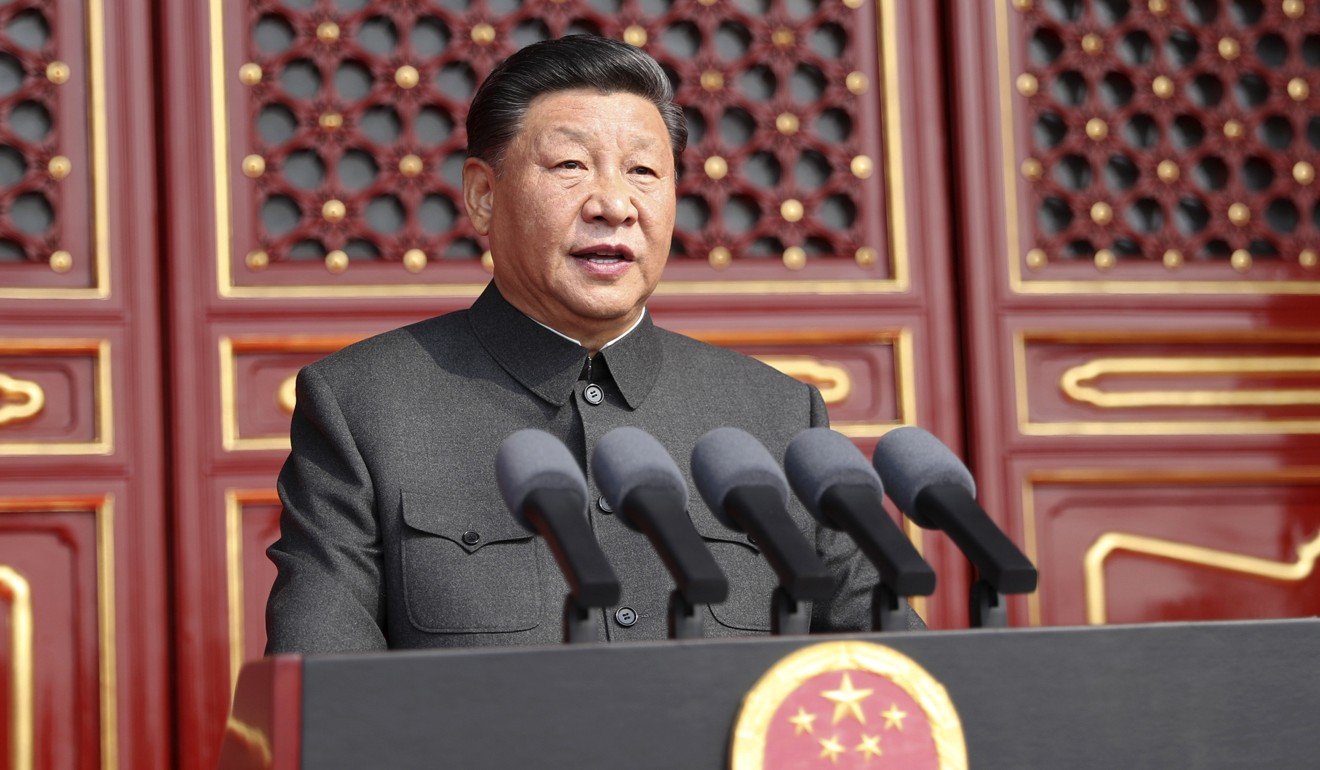
Xi Jinping has praised multinational companies for the role they have played in China’s opening up over the past four decades. Photo: AFP
Just a day after China reported its slowest ever quarterly economic growth,
on Saturday reiterated his promise to keep opening up the nation’s markets to companies and investors from around the world.
“The door of China’s opening up will only open wider and wider, the business environment will only get better and better, and the opportunities for global multinational companies will only be more and more,” he said in a congratulatory letter read out by Vice-Premier Han Zheng at the inaugural Qingdao Multinationals Summit in the east China city.
The two-day event, which ends on Sunday, was organised by China’s commerce ministry and the provincial government of Shandong with the aim, according to its website, of giving multinational companies “the opportunity to articulate their business values and vision” and “promote cooperation with host countries”.
In his letter, Xi praised multinational companies for the role they had played in China’s opening up and reform over the past four decades, describing them as “important participants, witnesses and beneficiaries”.
China was willing to continue opening up to benefit not only itself but the world as a whole, he said.
“Only when the world is good, China is good. Only when China is good, can the world get better.”
Despite its upbeat tone, Xi’s message comes as Beijing is facing intense scrutiny from the international business community over its state-led economic model – one of the main bones of contention in its trade war with the US – and its attempts to prevent foreign firms from speaking out on issues it deems too sensitive, from
Hong Kong to
human rights.
Foreign firms have also long complained about the barriers they face when trying to access China’s markets and the privileged treatment it gives to state-owned enterprises. Even though Beijing has promised to reform its state sector, foreign businesses have complained of slow progress, and just last month the
European Union Chamber of Commerce urged the EU to take more defensive measures against China’s “resurgent” state economy.
Xi promised “more and more” opportunities for global firms. Photo: AP
Sheman Lee, executive director of Forbes Global Media Holding and CEO of Forbes China, said at the Qingdao summit that foreign firms were facing a difficult trading environment in the world’s second-largest economy.
“Multinationals have seen their growth in China slow in recent years because of the growing challenge from local firms, a gradually saturating market and rising operation costs,” he said.
Craig Allen, president of the US-China Business Council, said that many multinational companies were reluctant to release their best products in China out of fear of losing their intellectual property.
China still not doing enough to woo foreign investment
In his letter, Xi said that over the next 15 years, the value of China’s annual imports of goods would rise beyond US$30 trillion, while the value of imported services would surpass US$10 trillion a year, creating major opportunities for multinational companies.
China would also reduce tariffs, remove non-tariff barriers and speed up procedures for customs clearance, he said.
Commerce Minister Zhong Shan said at the opening ceremony that China would also continue to improve market access and intellectual property protection.
The country supported economic globalisation and would safeguard the multilateral trade system, he said, adding that it was willing to work with the governments of other countries and multinational corporations to promote economic globalisation.
Xi Jinping says the value of China’s annual goods imports will rise beyond US$30 trillion over the next 15 years. Photo: Bloomberg
The promise to continue to open up China’s markets came after the
State Council
– the nation’s cabinet – made exactly the same pledge at its weekly meeting on Wednesday.
After the latest round of trade war negotiations in Washington, Beijing said it had achieved “substantive progress” on intellectual property protection, trade cooperation and technology transfers, all of which have been major bones of contention for the United States.
Despite its pledge to welcome multinational companies into its market, China is in the process of creating a list of “unreliable foreign entities” it considers damaging to the interests of Chinese companies. The roster, which is expected to include FedEx, is seen as a response to a similar list produced earlier by the United States.
Xi’s gesture would also appear to have come too late for South Korean multinational
, which announced on October 4 it had ended the production of smartphones at its factory in Huizhou, Guangdong province – its last in China – with the loss of thousands of jobs.
Source: SCMP
Posted in barriers, Beijing, bones of contention, CEO, Chamber of Commerce, China’s door, China’s State Council, closes, Commerce Minister Zhong Shan, complained, customs clearance, delegates, EU, European Union, Factory, FedEx, Forbes China, Forbes Global Media Holding, Foreign firms, guangdong province, Hong Kong, Huizhou, Huizhou City, Human rights, Intellectual property, intellectual property protection, mainland, Mainland China, Multinationals Summit, nation’s cabinet, only open wider, President Xi Jinping, procedures, Qingdao, Samsung, Samsung Electronics, smartphones, South Korean giant, South Korean multinational, speed up, technology transfers, trade cooperation, Uncategorized, United States, US-China Business Council, Washington |
Leave a Comment »



 CHINDIA ALERT: You'll be living in their world, very soon