28/05/2020
WASHINGTON/NEW DELHI (Reuters) – U.S. President Donald Trump said on Wednesday he had offered to mediate a standoff between India and China at the Himalayan border, where soldiers camped out in a high-altitude region have accused each other of trespassing over the disputed border.
“We have informed both India and China that the United States is ready, willing and able to mediate or arbitrate their now raging border dispute,” Trump said in a Twitter post.
The standoff was triggered by India’s construction of roads and air strips in the region as it competes with China’s spreading Belt and Road initiative, involving infrastructure development and investment in dozens of countries, Indian observers said on Tuesday.
Both were digging defences and Chinese trucks have been moving equipment into the area, the officials said, raising concerns about an extended standoff.
There was no immediate response from either India or China to Trump’s offer. Both countries have traditionally opposed any outside involvement in their matters and are unlikely to accept any U.S. mediation, experts said.
China’s ambassador to India, Sun Weidong, struck a conciliatory note, saying the two Asian countries should not let their differences overshadow the broader bilateral relationship.
“We should adhere to the basic judgment that China and India are each other’s opportunities and pose no threat to each other. We need to see each other’s development in a correct way and enhance strategic mutual trust,” he said, speaking in a webinar on China’s experience of fighting COVID-19.
“We should correctly view our differences and never let the differences shadow the overall situation of bilateral cooperation.”
The two countries are engaged in talks to defuse the border crisis, an Indian government source said. “These things take time, but efforts are on at various levels, military commanders as well as diplomats,” the source said.
The Chinese side has been insisting that India stop construction near the Line of Actual Control or the de facto border. India says all the work is being done on its side of the border and that China must pull back its troops.
Trump in January offered to “help” in another Himalayan trouble spot, the disputed region of Kashmir that is at the center of a decades-long quarrel between India and Pakistan.
But the U.S. offer triggered a political storm in India, which has long bristled at any suggestion of third-party involvement in tackling Kashmir which it considers an integral part of the country.
Source: Reuters
Posted in accused, adhere, air strips, ambassador to India, arbitrate, Asian countries, Belt and Road Initiative, bilateral cooperation, bilateral relationship, border, broader, China, Chinese, competes, conciliatory, Construction, countries, COVID-19, de facto border, decades-long, defences, development, differences, digging, diplomats, dispute, disputed, Dozens, equipment, high-altitude region, Himalayan, Himalayan border, India, Indian, indian government, Infrastructure, Investment, involving, judgment, Kashmir, Line of Actual Control, military commanders, moving, New Delhi, note, observers, opportunities, overshadow, Pakistan, quarrel, raging, ready, willing and able, roads, soldiers, spreading, standoff, to mediate, trespassing, trouble spot, trucks, Twitter, U.S. President Donald Trump, Uncategorized, United States, Washington |
Leave a Comment »
24/05/2020
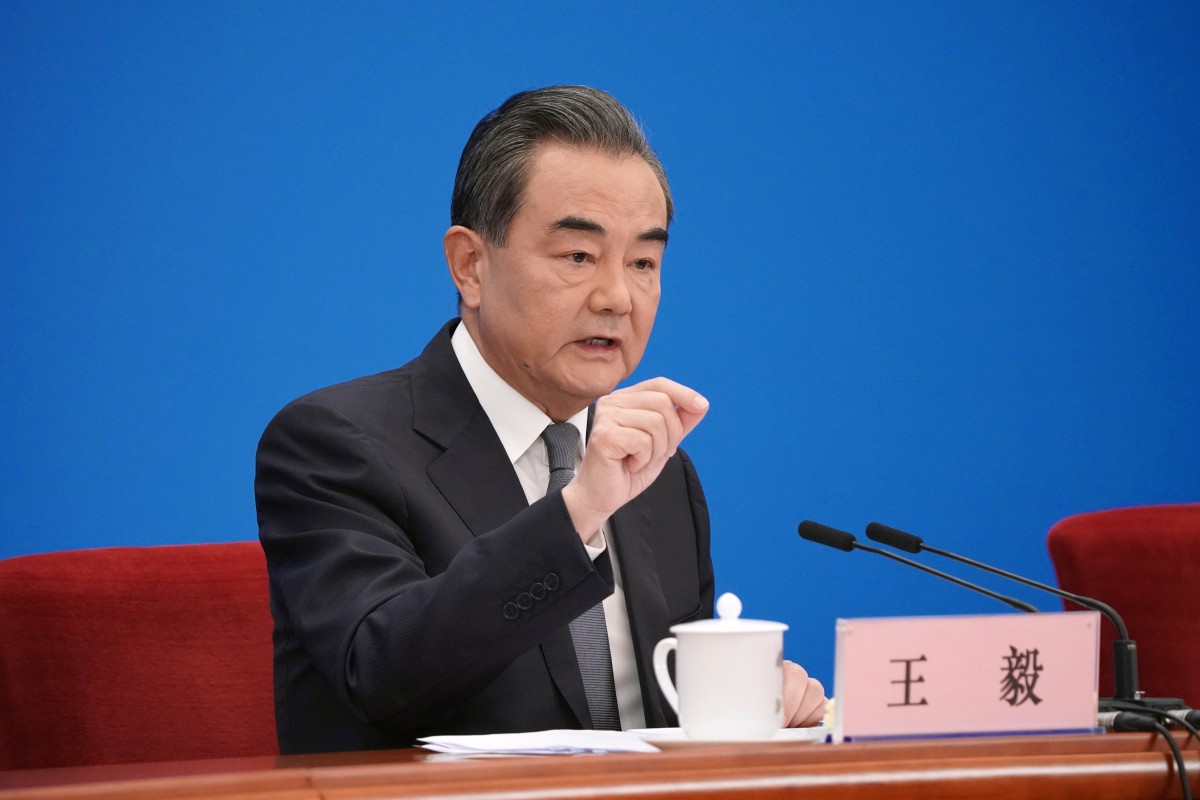
- Countries must respect each others’ systems and be wary of US political forces who want to ‘hijack relations’, Wang tells press conference at ‘two sessions’
- Beijing is not looking for confrontation and wants to work with Washington to fight coronavirus, minister says
Foreign Minister Wang Yi said China did not want to replace or change the US. Photo: Xinhua
China and the US should try to avoid a new cold war and find new ways to cooperate despite their differences, China’s Foreign Minister Wang Yi said on Sunday.
“We need to be alert to efforts by some political forces in America to hijack China-US relations and who try to push the two countries towards a so-called ‘new cold war’.
“This is a dangerous attempt to turn back the course of history,” Wang told a press conference on the sidelines of the annual parliamentary meetings known as the ‘two sessions’.
Ties between the two countries have further worsened due to escalating tensions over the handling of the Covid-19 pandemic.
Voices calling for decoupling have been on the rise in the US, with some arguing that the two countries are edging towards a new cold war akin to that against the Soviet Union.
Wang called for the two countries to respect each other’s political systems and to find a way to get along despite their differences.
The two nations should step up cooperation on global pandemic control, and coordinate on macro policies to deal with the economic impact.
“China has no intention of changing the United States, much less replacing it. The US should give up the wishful thinking that it can change China.”
“For the benefit of the two peoples, as well as the future and well-being of humankind, China and the US should and must find a way to coexist peacefully despite the differences in system and cultures of the two societies.”
Wang said China will not seek confrontation with the United States, but China is determined to protect its sovereignty, territorial integrity and development.
Posted in America, annual, attempt, ‘hijack relations’, ‘new cold war’, ‘two sessions’, Beijing, benefit, Board of Councilors of the Japan Business Federation, calling, changing, China, China-US relations, coexist, Cold War, CONFRONTATION, cooperate, cooperation, coordinate, coronavirus, countries, course of history, Covid-19 pandemic, cultures, dangerous, Decoupling, determined, development, differences, economic impact, escalating, fight, Foreign Minister Wang Yi, future, global, handling, hijack, humankind, intention, macro policies, pandemic control, parliamentary meetings, peacefully, people's, political forces, press conference, protect, replacing, sidelines, societies, sovereignty, Soviet Union, system, systems, tensions, territorial integrity, to turn back, Uncategorized, United States, Voices, Washington, well-being, wishful thinking, worsened |
Leave a Comment »
20/05/2020
TAIPEI (Reuters) – Taiwan cannot accept becoming part of China under its “one country, two systems” offer of autonomy , President Tsai Ing-wen said on Wednesday, strongly rejecting China’s sovereignty claims and likely setting the stage for an ever worsening of ties.
China responded that “reunification” was inevitable and that it would never tolerate Taiwan’s independence.
In a speech after being sworn in for her second and final term in office, Tsai said relations between Taiwan and China had reached an historical turning point.
“Both sides have a duty to find a way to coexist over the long term and prevent the intensification of antagonism and differences,” she said.
Tsai and her Democratic Progressive Party won January’s presidential and parliamentary elections by a landslide, vowing to stand up to China, which claims Taiwan as its own and says it would be brought under Beijing’s control by force if needed.
“Here, I want to reiterate the words ‘peace, parity, democracy, and dialogue’. We will not accept the Beijing authorities’ use of ‘one country, two systems’ to downgrade Taiwan and undermine the cross-strait status quo. We stand fast by this principle,” Tsai said.
China uses the “one country, two systems” policy, which is supposed to guarantee a high degree of autonomy, to run the former British colony of Hong Kong, which returned to Chinese rule in 1997. It has offered it to Taiwan, though all major Taiwanese parties have rejected it.
China’s Taiwan Affairs Office, responding to Tsai, said Beijing would stick to “one country, two systems” – a central tenet of Chinese President Xi Jinping’s Taiwan policy – and “not leave any space for Taiwan independence separatist activities”.
“Reunification is a historical inevitability of the great rejuvenation of the Chinese nation,” it said. “We have the firm will, full confidence, and sufficient ability to defend national sovereignty and territorial integrity.”
China views Tsai as a separatist bent on formal independence for Taiwan. Tsai says Taiwan is an independent state called the Republic of China, its official name, and does not want to be part of the People’s Republic of China governed by Beijing.
TAIWAN OPEN TO DIALOGUE
China has stepped up its military drills near Taiwan since Tsai’s re-election, flying fighter jets into the island’s air space and sailing warships around Taiwan.
Tsai said Taiwan has made the greatest effort to maintain peace and stability in the narrow Taiwan Strait that separates the democratic island from its autocratic neighbour China.
“We will continue these efforts, and we are willing to engage in dialogue with China and make more concrete contributions to regional security,” she added, speaking in the garden of the old Japanese governor’s house in Taipei, in front of a socially-distanced audience of officials and diplomats.
Taiwan has become a rising source of friction between China and the United States, with the Trump administration strongly backing Taiwan even in the absence of formal diplomatic ties.
U.S. Secretary of State Mike Pompeo sent his congratulations to Tsai on Tuesday, praising her “courage and vision in leading Taiwan’s vibrant democracy”, in a rare high-level message from Washington direct to Taiwan’s government.
China’s Foreign Ministry condemned Pompeo’s remarks, and said the government would take “necessary countermeasures”, though did not elaborate.
China cut off a formal talks mechanism with Taiwan in 2016 after Tsai first won election.
Yao Chia-wen, a senior adviser to Tsai, told Reuters the chance of talks with China were small given ongoing tensions.
“We are ready to engage with them any time, but China is unlikely to make concessions to Taiwan,” he said. “In the next four years there’s little chance for the cross-strait relationship to improve.”
Source: Reuters
Posted in antagonism, authorities, autocratic, autonomy, ‘peace, parity, democracy, and dialogue’, “necessary countermeasures”, Beijing, by force, central tenet, China, China’s Foreign Ministry, China’s sovereignty, Chinese President Xi Jinping’s, claims, coexist, condemned, congratulations, cross-strait, democratic island, Democratic Progressive Party, differences, downgrade, elaborate, Elections, former, former British colony, Government, guarantee, historical, Hong Kong, independence, inevitable, intensification, Japanese governor’s house, Landslide, Mike Pompeo, military drills, neighbour, parliamentary, People’s Republic of China, President, President Tsai Ing-wen, presidential, principle, rejects, rejuvenation, remarks, Republic of China, reunification, rule, status quo, Taipei, Taiwan, Taiwan Affairs Office, Taiwan Strait, Trump administration, turning point, U.S. Secretary of State, Uncategorized, undermine, United States, Washington |
Leave a Comment »
31/08/2019
Chinese Premier Li Keqiang meets with Philippine President Rodrigo Duterte at the Great Hall of the People in Beijing, capital of China, Aug. 30, 2019. (Xinhua/Ding Lin)
BEIJING, Aug. 30 (Xinhua) — Chinese Premier Li Keqiang said Friday that the common interests between China and the Philippines far outweigh the differences in his meeting with visiting Philippine President Rodrigo Duterte.
Li said that China is willing to cooperate with the Philippines on the basis of mutual respect, equality and mutual benefit, and seek better synergy between the Belt and Road Initiative and the Philippines’ “Build, Build, Build” program, so as to promote sustained, stable and healthy development of bilateral relations and cooperation.
Li said that the current situation in the South China Sea is generally stable and the countries in the region are living in peace.
China always acts with the greatest sincerity and is willing to work together with the Philippines and ASEAN countries to achieve the Code of Conduct (COC) in the South China Sea in the period when the Philippines serves as a coordinating country for China-ASEAN relations, said Li.
Li also expected joint efforts to promote offshore oil and gas development, and safeguard peace and stability in the South China Sea and the region.
Duterte said the Philippine side is willing to further expand exchanges and cooperation with China in such fields as the economy, trade and people-to-people exchanges, so as to promote bilateral ties and secure the two peoples concrete benefits.
Duterte said the Philippines will never confront China.
On the South China Sea issue, Duterte said Western countries are not COC negotiators and should not hinder the efforts of regional countries in this regard.
He said as the Philippines now is fulfilling its responsibilities as a coordinating country for China-ASEAN relations, the Philippine side will work with China and ASEAN countries to actively promote the adoption of the COC during his term of office.
Duterte also expressed the willingness to push forward common development with China on offshore oil and gas.
Source: Xinhua
Posted in "Build, Build, Build" program, asean countries, Belt and Road Initiative, Belt and Road Initiative (BRI), China alert, China-ASEAN relations, Chinese premier Li Keqiang, Code of Conduct (COC), common interests, differences, Philippine President, Philippines, Rodrigo Duterte, South China Sea, Uncategorized, Western countries |
Leave a Comment »
06/07/2019
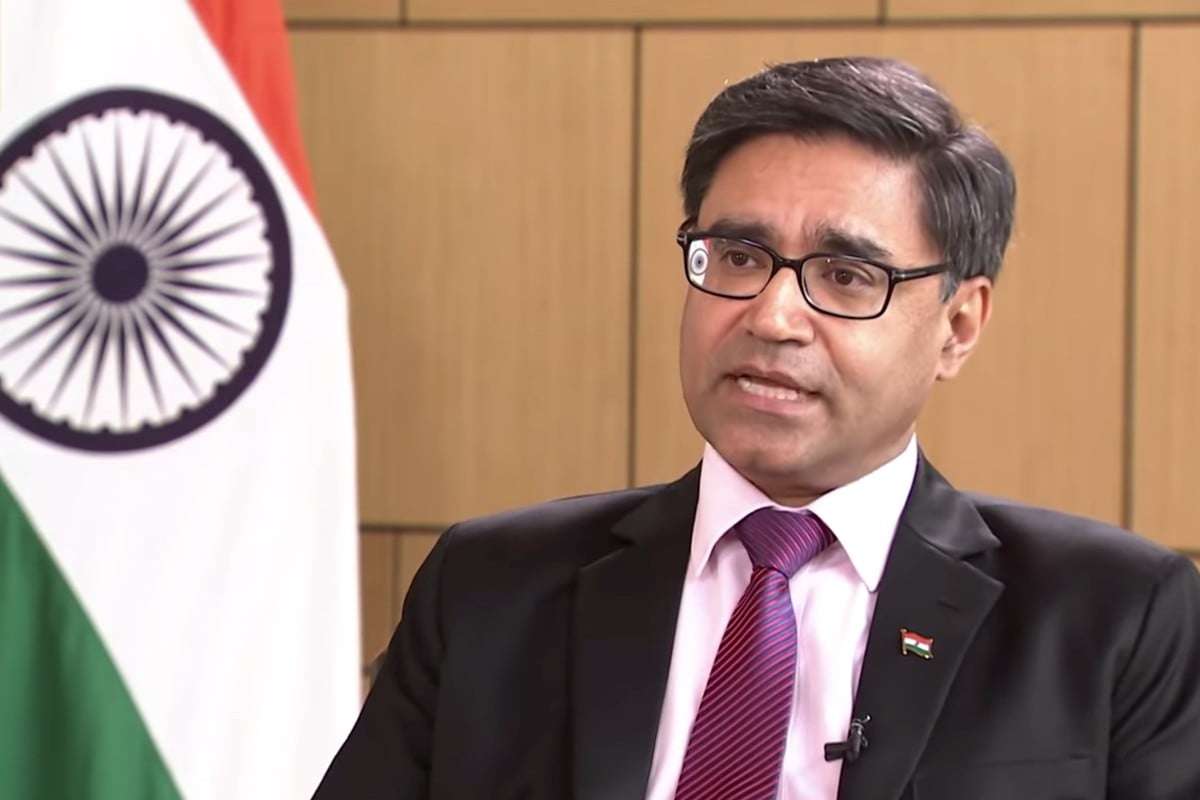
- Ambassador Vikram Misri has called on China to balance its US$60 billion trade deficit with India ‘before the issue becomes politically sensitive’
- He also says India will not take sides over its use of US-blacklisted Huawei, as ‘any decision taken over this will only be taken in our national interest’
Indian ambassador to China Vikram Misri says that while the countries’ differences will not derail ties, there are still thorny issues to grapple with. Photo: CGTN
so they do not get in the way of the Asian superpowers working together for global stability, India’s top diplomat in China said on Friday.
To emphasise his point, Ambassador Vikram Misri listed eight long-standing and new bilateral issues that required attention, including
’s almost US$60 billion trade deficit with China, cooperation on counterterrorism and a
.
“This trade imbalance is not economically sustainable in the long run,” said Misri at an Asia Society event in Hong Kong. “It is in our mutual interest to find workable solutions before the markets react in unpredictable ways and the issue becomes politically sensitive.”
Frosty ties between two of the world’s largest economies have thawed in the past year following a 73-day
in 2017, with Beijing seeking to forge closer ties with New Delhi amid its ongoing trade and tech war with the United States.
Ivanka Trump, the unlikely messenger of India-US relations
In May, Beijing dropped its long-held objections towards United Nations sanctions on
, the founder and leader of terrorist group Jaish-e-Mohammed, which was behind the suicide bombing of Indian soldiers that brought India and Pakistan to the brink of war earlier this year.
Analysts said this would pave the way for a better relationship between India and China.
Misri said both countries enjoyed a “full-spectrum relationship” of economic, commercial and people-to-people ties, and this was reinforced by the “strong personal bond” Indian Prime Minister
and Chinese President
had, despite the “elements of competition”.
The leaders of the two nations met four times last year and twice in 2019, with Xi set to visit India later this year. Both men share an understanding that “our rise can be mutually reinforcing” and a mutual interest in “preventing differences from turning into disputes”, the ambassador added.
But while Misri, a career diplomat posted to Beijing at the start of this year, stressed that differences would not derail ties, he made no bones about the thorny issues both sides are grappling with.
Will Modi’s snub of Xi’s belt and road derail China-India ties?
Both nations are still engaged in the second of a three-stage process to settle their border dispute – the world’s largest in terms of area, he said.
The first stage was an agreement on the political parameters for a boundary settlement in 2005. The current stage involves agreeing on a framework for a boundary settlement, which Misri said would be translated “into a delineated and demarcated boundary” in the final stage.
Communication over water and shared rivers has also been a key area of cooperation for the two nations.
Indian ambassador to China Vikram Misri speaking at the Asia Society in Hong Kong. Photo: Asia Society
They have established channels for information sharing on cross-frontier rivers, which last year enabled the Chinese side to warn the relevant Indian authorities of a landslide which would send a large amount of water to India. While in this instance the two sides were able to avert a loss of life, they can do more to broaden cooperation, Misri said.
He alluded to how China and India are vying for influence in the Indian Ocean, saying it was an area where both had “contiguous zones of maritime interest”.
The two sides need to work together to preserve peace and stability in the Indo-Pacific region – which stretches from the Indian Ocean to the central Pacific Ocean – and ensure transparent economic and commercial cooperation, infrastructure and connectivity, he said.
As China, India and Russia draw close, has Trump overplayed his hand?
Misri, who served as the private secretary to Modi as well as former prime ministers Manmohan Singh and I.K. Gujral, said there were three areas of mutual interest for India and China.
Besides a “peaceful periphery”, they should cooperate to ensure there are open international systems regarding trade and technology, and that global governance is reformed so the voices of nations such as theirs can be heard.
The Russia-India-China trilateral meeting on the sidelines of last month’s
summit in Osaka, where leaders discussed issues ranging from energy security to climate change, was an opportunity to discuss alternative viewpoints on changing international issues.
This was crucial amid the economic instability caused by
, that were causing “generalised damage” to the global economy, Misri said.
In the question and answer session with the event’s 112 attendees, Misri was asked if India was feeling the pressure to choose in the face of US efforts to get its allies to reconsider using or ban Chinese tech firm
from their superfast 5G networks.
Washington says Huawei equipment could be used by Beijing for spying and the US Commerce Department has placed the company on its entity list, effectively banning US companies from selling equipment and components to it.
When US President
and Xi met at the G20 summit, Trump announced American companies could resume sales to Huawei as long as the products involved did not threaten national security.
Misri referred to this, and said: “Let’s see how it shapes up.”
He added the issue was far from decided for India as it had only achieved 4G connectivity recently and was not yet ready to build out its
Still, he said, “there’s no question on taking sides over this”. “Our leadership is very clear that any decision taken over this will only be taken in our national interest.”
Source: SCMP
Posted in 5G infrastructure, Ambassador Vikram Misri, Asia Society, Beijing, China alert, cross-frontier rivers, differences, disputes, Huawei, India alert, Indian Prime Minister Narendra Modi, manmohan singh, New Delhi, Osaka, President Xi Jinping, Russia, Russia-India-China trilateral meeting, Uncategorized, us commerce department, US President Donald Trump |
Leave a Comment »
13/02/2019
LONDON, Feb. 12 (Xinhua) — China and UK should keep the long-term interests and larger picture in mind, look at each other’s development as opportunities, respect each other’s sovereignty, security and right to development, handle our differences properly and enhance strategic mutual trust, Chinese Ambassador to Britain Liu Xiaoming has said.
The Chinese diplomat made the remarks while attending the Chinese New Year Dinner by the Cities of London and Westminster Conservative Association on Monday night.
“If we compare China-UK relations to a building, it could not stand tall without a solid foundation. This foundation is the mutual confidence between our two countries,” he said.
Recalling that the world economy is under downward pressure, with surging protectionism and unilateralism making things doubly difficult. Against this situation, Liu said it is all the more important that China and the UK advocate free trade, oppose protectionism and promote open cooperation.
“We hope that the UK would continue to provide a fair, transparent and non-discriminatory business environment for Chinese companies. We hope you will make successful Chinese companies such as Huawei feel welcome here in Britain, and convince them that the UK is a trustworthy place to put their money,” said the Chinese ambassador.
Liu said both China and the UK are known for their profound cultural heritage and important contribution to the progress of human civilization.
“I hope that in the new year our two countries will continue to enhance cultural and people-to-people exchanges, and deepen mutual understanding and strengthen friendship.”
The ambassador also hoped that people from all walks of life in both China and UK will join hands to cement the foundation for a solid and magnificent edifice of bilateral relations.
British Prime Minister Theresa May sent a congratulatory message to the event, saying that it is an important moment to recognize the contribution of the Chinese community in London and across the whole of the United Kingdom.
“The Chinese community’s expanding business expertise, scientific inquiry and cultural heritage and traditions are of immense value to our country – not least here in London, where the vibrancy of Chinatown stands as a strong beacon for the Chinese community and a reminder of all that they have contributed to our society,” she said.
Source: Xinhua
Posted in ambassadors, British Prime Minister, China alert, Chinatown, chinese new year, differences, free trade, Huawei, Liu Xiaoming, London and Westminster Conservative Association, mutual trust, Theresa May, UK, Uncategorized |
Leave a Comment »





 CHINDIA ALERT: You'll be living in their world, very soon