Archive for ‘diplomat’

18/05/2020

China sends special investigation team to Israel after ambassador’s death

  • Details remain scant one day after body of 57-year-old diplomat Du Wei is found at his home in Tel Aviv
  • Top Israeli foreign ministry official extends condolences to deputy ambassador Dai Yuming
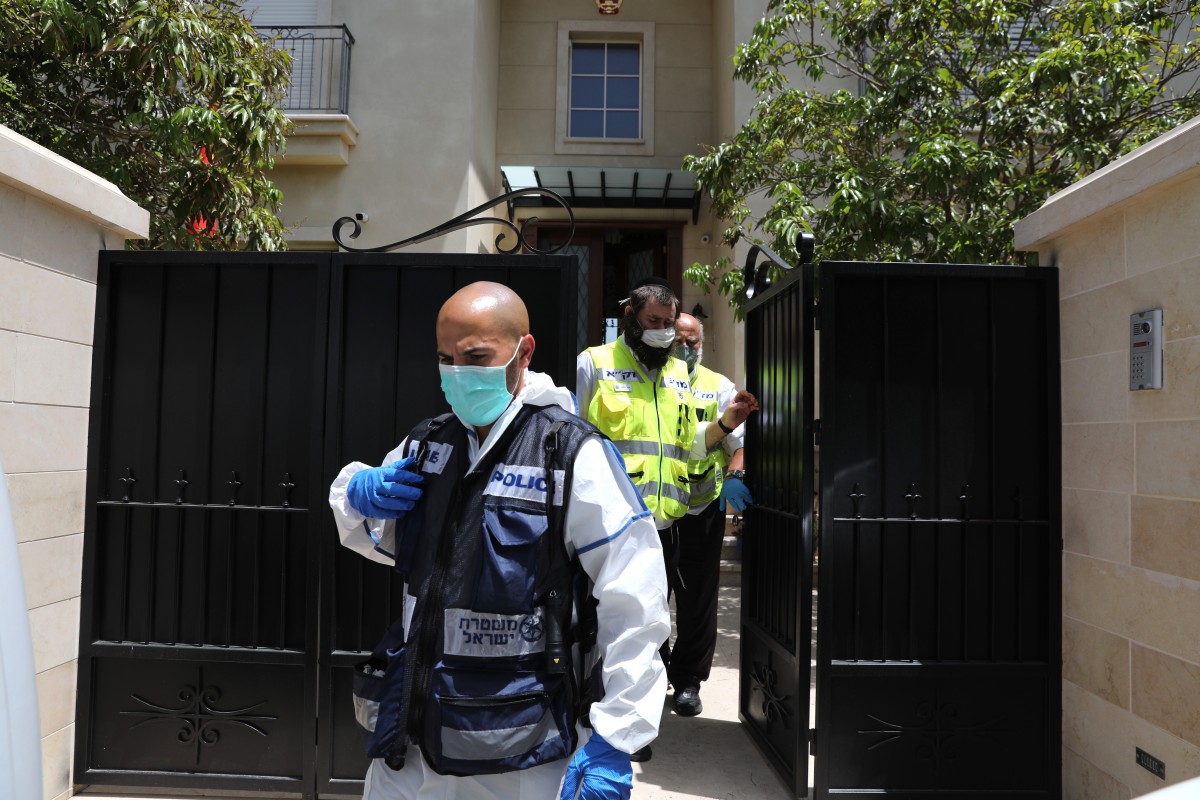
Police, ambulance and embassy staff at the residence where Chinese ambassador Du Wei was found dead on Sunday. Photo: EPA-EFE
China is sending a special investigative team to Israel following the sudden death of its ambassador Du Wei, whose body was found at his residence on Sunday.
The team, accompanied by a member of Du’s family, was due to travel on Monday, and will handle arrangements for the remains, as well as conducting its own internal investigation, according to Israeli newspaper Haaretz.
Israel’s foreign ministry said its director general Yuval Rotem had spoken with deputy ambassador Dai Yuming to express his condolences. Local police are continuing to investigate at Du’s residence in a suburb of Herzliya, near Tel Aviv.
Details from the Chinese side have been scant. China’s foreign ministry provided a statement to AFP on Sunday which said the preliminary verdict was that Du, 57, had died unexpectedly for health reasons, and details awaited further confirmation. AFP also reported that Du’s wife and son were not with him in Tel Aviv.

“As far as I know, China’s ambassador to Israel Du Wei passed away in ambassador’s residence in Tel Aviv this morning for physical reasons. It happened abruptly,” said Hu Xijin, editor-in-chief of state media tabloid Global Times in a tweet late on Sunday night.

Du was last seen in public on Tuesday in a video conference with an official from Israel’s foreign affairs ministry, according to the embassy website.

James Dorsey, senior fellow at the S. Rajaratnam School of International Studies in Singapore, said Du’s untimely death should be seen as a personal, rather than a political, tragedy for the growing relationship between China and Israel, but he said it came at an important moment for the two countries because of rising US-China tensions.

Dorsey said Israel’s increasing hi-tech cooperation with China, as well as continuing US hostility to Iran – which has close ties with China – were potentially problematic for relations between the two countries.

“I’m not sure that the China-Israel relationship can be seen as independent of the Israel-US relationship. One could argue that the Chinese may be well advised to very quickly replace him soon,” Dorsey said. “Israel could find itself on the fault line of deepening US-China decoupling,” he added.

Israel’s ambassador to China in quarantine after ‘infected’ flight to Seoul
28 Feb 2020

Following a brief trip to Jerusalem on Wednesday – his first foreign visit since March – US Secretary of State Mike Pompeo renewed warnings about China-Israel ties in an interview with Israeli state-owned media outlet Kan News.

“We do not want the Chinese Communist Party to have access to Israeli infrastructure, Israeli communication systems, all of the things that put Israeli citizens at risk,” he said.

China’s embassy in Tel Aviv blasted Pompeo’s comments as “absurd” and “ill-intentioned”. However, the embassy statement was not written by Du, but by a spokesperson.

Du had only served in Israel since February. Just before his arrival, the Chinese embassy had to issue an apology after then-acting ambassador Dai denounced Israel’s tightened restrictions on Chinese visitors by comparing them to the Holocaust.
During his brief tenure, Du gave frequent interviews to local media, speaking mainly about China’s virus control measures, US-China tensions, and friendship between China and the Jewish people.
Du had worked as a career diplomat since entering China’s foreign service in 1989. Before his appointment in Tel Aviv, he served as China’s ambassador to Ukraine from 2016-2019.
Source: SCMP
01/03/2019

China’s envoy says Turkish Uighur criticism could hit economic tie

ANKARA (Reuters) – Turkey risks jeopardising economic ties with China if it keeps criticising Beijing’s treatment of Uighur Muslims, China’s envoy to Ankara warned, just as Chinese firms are looking to invest in Turkish energy and infrastructure mega-projects.

Last month Turkey broke a long silence over the fate of China’s Uighurs, saying more than one million people faced arbitrary arrest, torture and political brainwashing in Chinese internment camps in the country’s northwestern Xinjiang region.

Turkey’s Foreign Minister Mevlut Cavusoglu repeated Ankara’s concern at a United Nations meeting this week, calling on China to respect human rights and freedom of religion.

China has denied accusations of mistreatment and deems criticism at the United Nations to be interference in its sovereignty. Beijing says the camps are re-education and training facilities that have stopped attacks previously blamed on Islamist militants and separatists.

For now, Deng said that many Chinese companies were looking for investment opportunities in Turkey including the third nuclear power plant Ankara wants to build.

Several Chinese firms including tech giant Alibaba, are actively looking at opportunities in Turkey after the lira’s sell-off has made local assets cheaper.

In addition to Alibaba, which last year purchased Turkish online retailer Trendyol, other companies holding talks included China Life Insurance and conglomerate China Merchants Group, Deng said.

GAPING DEFICIT

Deng said Chinese banks wanted to invest in Turkey, following the lead of Industrial and Commercial Bank of China (ICBC) which bought Tekstilbank in 2015.

Chinese investment in Turkey would help narrow Ankara’s gaping current account deficit, which stood at $27.6 billion last year. Turkey’s trade deficit with China alone stood at $17.8 billion last year, according to Trade Ministry data.

In January, Turkey’s Finance Minister Berat Albayrak said it was “impossible” for Turkey to maintain such a trade deficit with China and other Asian countries, saying the government was considering taking measures.

Deng said he did not expect Turkey to take protectionist steps. “Both countries are strictly against such policies, and both economies need an open world economy,” he said.

He also called on Turkey to adopt Chinese payment platforms such as WeChat and AliPay. “People don’t want to pay in cash and the population here is very young so they wouldn’t have trouble adapting to new technologies,” Deng said.

Good diplomatic and political ties, however, would remain crucial for developing economic ties and attracting more Chinese investment, he said, adding that he had raised the issue with Cavusoglu on Tuesday, a day after the foreign minister’s intervention at the United Nations.

“The most important issue between countries are mutual respect,” he said. “Would you stay friends if your friend criticized you publicly every day?

Source: Reuters

14/02/2019

Sweden replaces China envoy in furore over dissident bookseller

STOCKHOLM (Reuters) – Sweden said on Thursday it had replaced its ambassador to China after her “incorrect” handling of unauthorized meetings intended to help free dissident bookseller Gui Minhai.

The Hong Kong-based, Swedish publisher of books critical of China’s communist leaders was abducted in Thailand in 2015 and later appeared in custody in mainland China.

His daughter Angela Gui said this week she had met ambassador Anna Lindstedt and two businessmen in Stockholm in January, where she was advised to keep quiet about her father’s case while negotiations were proceeding.

Sweden’s Foreign Ministry said that was not an official meeting, and Lindstedt had now returned to Sweden with an interim envoy sent to Beijing during an inquiry.

“Neither the Foreign Ministry nor the Foreign Minister were informed until after the event,” ministry spokesman Rasmus Eljanskog said in an emailed statement.

“As a consequence of the incorrect manner in which the said meetings were handled, we are now conducting an internal investigation.”

Gui, 54, became a Swedish citizen after studying there in the 1980s. After the abduction, he was released in October 2017, but his whereabouts were unclear until January last year when his daughter said he was seized by Chinese agents on a Beijing-bound train in the presence of Swedish diplomats.

China later confirmed it had detained him again.

In her blog, Angela Gui said Lindstedt invited her to Stockholm to meet two businessmen who could help secure her father’s release.

“OUTRAGEOUS SCANDAL”

“The businessman said, ‘you care about Anna (Lindstedt), right? If you keep talking to the media it’ll damage her career. You don’t want her to come to any harm, do you?’”, she said in the post on blog portal Medium.

“In order for this to happen (negotiations), I was told I needed to be quiet. I wasn’t to tell anyone about this, or say anything publicly about the case,” she added.

“I’m not going to be quiet in exchange for … an arbitrary promise that my father ‘might’ be released. Threats, verbal abuse, bribes, or flattery won’t change that.”

China’s Foreign Ministry declined comment, with spokeswoman Hua Chunying saying she knew nothing about Gui’s latest situation. On its website, China’s embassy in Stockholm said it had not authorized anyone to “engage” with Gui’s daughter.

“The Chinese side handles the Gui Minhai case in accordance with law and legal procedure,” it said.

Gui’s original abduction – along with four others in the Hong Kong book trade – fed worries about interference from Beijing despite guarantees of wide-ranging freedoms for the former British colony which returned to Chinese rule in 1997.

The four others have since returned to Hong Kong. The United States and European Union have urged Gui’s release.

Sweden said it was continuing to seek Gui’s freedom, as Lindstedt faced scathing criticism for what the leader of Sweden’s Left Party called an “outrageous scandal”.

“A Swedish ambassador has done the bidding of a dictatorship and tried to silence the daughter of a Swedish political prisoner in China,” Jonas Sjostedt told local TV.

“I don’t think we have seen a worse scandal in Swedish foreign administration for decades.”

Lindstedt could not immediately be reached for comment.

Source: Reuters

Law of Unintended Consequences

continuously updated blog about China & India

ChiaHou's Book Reviews

continuously updated blog about China & India

What's wrong with the world; and its economy

continuously updated blog about China & India