31/05/2020
- China’s leadership has made it clear to its people that the world will become more dangerous and they must be prepared for hard times
- Beijing’s relatively small stimulus response to Covid-19 suggests it wants to save its economic policy ammunition for a bigger battle
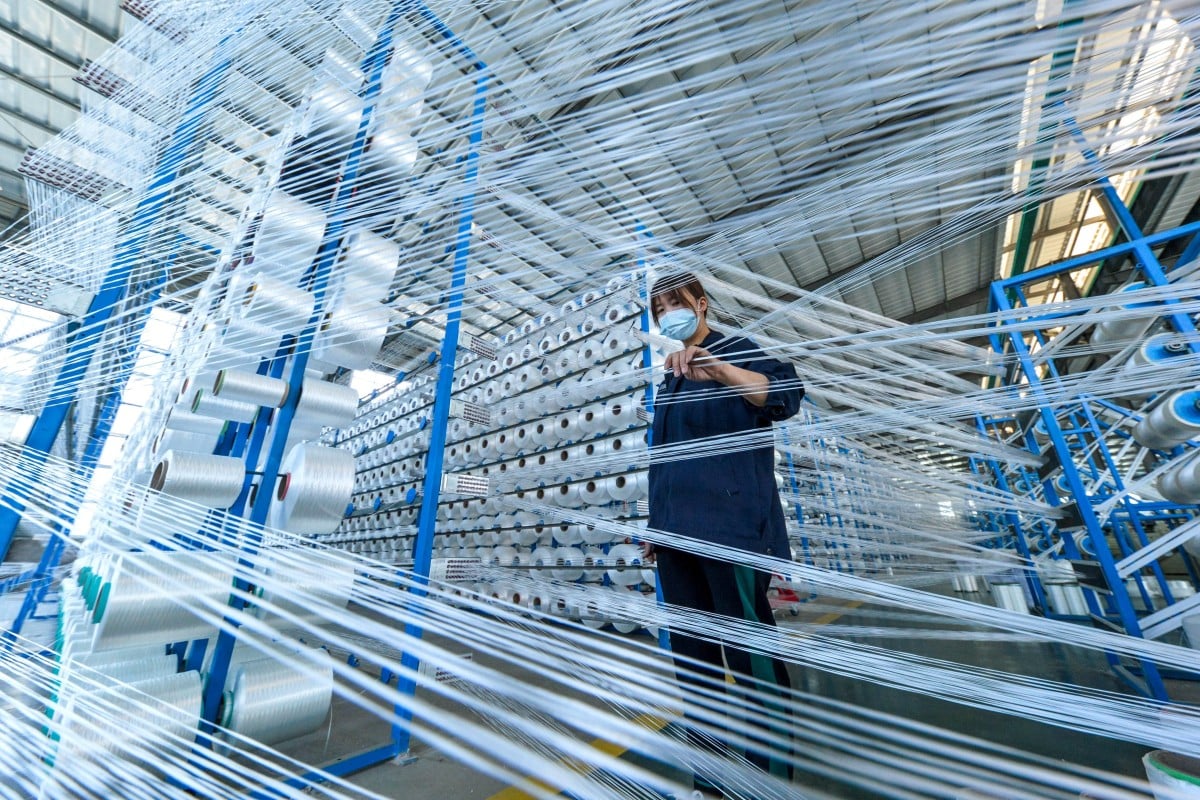
China opted not to set a GDP target for 2020. Photo: Xinhua
Beijing’s decision not to set an annual GDP target for 2020 – for the first time since 2002 – is a sign it is putting stability ahead of growth as part of its preparations for an escalating conflict with the
United States.
Economic development has always been the central theme for Beijing since it established diplomatic relations with the US in 1979. But this year it has given priority to job creation and tackling poverty. The coronavirus outbreak might appear to have been the reason for the shift, but the underlying factor is the tension with the US.
Covid-19 offered a preview of what a decoupling of China and US might look like: aircraft grounded, cargo flows disrupted, value chains broken, goodwill and cooperation lost, blame games started.
Both countries have suffered heavy human and economic losses from the coronavirus, yet that did not inspire them to work together. Instead, hostility and rivalry has thrived, and neither wants to blink first.
The Chinese leadership has made it clear to its people that the world will become more dangerous and they must be prepared for hard times. As such, the government is saving its economic policy ammunition.
While the stimulus plans introduced in the US, Germany, Japan and France exceed 10 per cent of their national GDP and interest rates have been cut to the bone, Beijing stopped at just 1 trillion yuan (US$140 billion) worth of special treasury bonds and 1.6 trillion yuan of additional local government bonds. In total, about 2.6 per cent of GDP.
Interest rates in China – 2.7 per cent on 10-year bonds – are some of the highest among major economies.
China’s 6.6 per cent defence spending boost lowest in three decades
China’s budget fiscal deficit has increased to 3.6 per cent of GDP for 2020, but the larger deficit is mainly from tax and fee cuts instead of increased fiscal expenses, except for an increased military spending.
Beijing is calling on provincial and local authorities to tighten their belts, which is unusual for a government that has huge assets and can increase spending at any time through quantitative easing.
So why is the government, which is known for intervening in the economy, being so restrained?
It is bracing itself for a perceived period of turbulence and hardship as its relationship with the US turns sour. It is putting jobs and social stability on top of its agenda, instead of growth.
Beijing is refraining from excessive spending, eliminating sources of potential instability, making appeals to the most vulnerable social groups, and saving its power for a bigger test.
Against that backdrop, the National People’s Congress passed the national security legislation on Hong Kong. Beijing knew the bill would anger the US, but did it anyway.
Hong Kong is known as China’s gateway to the international capital market and the largest offshore yuan market, but Beijing is ready to trade losses on the financial and economic front for potential gain on a fortified national security fence.
All this points to the suggestion that Beijing is preparing for the possibility of decoupling from the US, even if it doesn’t necessarily want to.
The threat of a new Cold War is clouding the world. The theme of life for one or two generations of people on both sides of the Pacific may shift from growth and prosperity to struggle and confrontation.
China and the US have yet to collide totally, but that moment is drawing near.
Source: SCMP
Posted in 1979, 2020, aircraft grounded, ammunition, ‘new cold war’, be prepared, Beijing, Beijing’s, bigger battle, blame games, cargo flows disrupted, central theme, Chinese leadership, collide, CONFRONTATION, cooperation, coronavirus, coronavirus outbreak, Decoupling, diplomatic relations, Economic development, economic losses, Economic policy, France, from, GDP target, Germany, goodwill, growth, hard times, hostility, Japan, leadership, lost, military spending, more dangerous, National People’s Congress, Pacific, People, preparing, prosperity, rivalry, small stimulus response, struggle, The US, thrived, to decouple, Uncategorized, United States, value chains broken, World |
1 Comment »
06/04/2020
(Reuters) – The Utah-based Church of Jesus Christ of Latter-day Saints, also known as the Mormon church, plans to open its first temple in mainland China at a time when Beijing has been clamping down steadily on religious freedoms.
The temple in the eastern Chinese city of Shanghai will help fill a gap left by renovation work since last July at the church’s temple in Hong Kong, Russell M. Nelson, president of the church, announced on Sunday.
He also said seven other temples would open, including one in Dubai, its first in the Middle East.
“In Shanghai, a modest, multipurpose meeting place will provide a way for Chinese members to continue to participate in ordinances of the temple,” Nelson said.
“Because we respect the laws and regulations of the People’s Republic of China, the Church does not send proselytizing missionaries there; nor will we do so now,” he said.
A former cardiac surgeon, Nelson has spent time in China, studied Mandarin and was granted an honorary professorship by China’s Shandong University School of Medicine.
In January, the church sent two planeloads of protective medical equipment to the Children’s Medical Center in Shanghai to help manage the coronavirus outbreak.
No official figure is available for the number of Mormons in China.
China’s constitution guarantees religious freedom but under President Xi Jinping Beijing has tightened restrictions on religions seen as a challenge to the authority of the ruling Communist Party.
The government has cracked down on underground churches, both Protestant and Catholic, and has rolled out legislation to increase oversight of religious education and practices.
Chinese law requires that places of worship register and submit to government oversight, but some have declined to register and are known as “house” or “underground” churches.
The Chinese government formally recognizes five religions: Buddhism, Taoism, Islam, Catholicism and Protestantism.
“Expatriate and Chinese congregations will continue to meet separately. The Church’s legal status there remains unchanged,” Nelson said.
“In an initial phase of facility use, entry will be by appointment only. The Shanghai Temple will not be a temple for tourists from other countries,” he said.
In 2018, the Vatican and China signed an agreement on the appointment of Roman Catholic bishops, a breakthrough on an issue that for decades fuelled tensions between the Holy See and Beijing and thwarted efforts toward diplomatic relations.
Source: Reuters
Posted in Beijing, Catholic, Catholicism, Children’s Medical Center, Church of Jesus Christ of Latter-day Saints, diplomatic relations, Dubai, first templ, first temple, Mainland China, Mandarin, Middle East, Mormon church, Mormons, open, People’s Republic of China, President Xi Jinping, Protestant, Protestantism, Roman Catholic bishops, Shandong University School of Medicine, Shanghai, Taoism, Uncategorized, Utah, Vatican |
Leave a Comment »
06/10/2019
- Leaders exchange congratulatory messages on 70th anniversary of diplomatic relations amid speculation that Kim Jong-un will visit China soon
- It comes after Pyongyang’s denuclearisation negotiations with Washington broke off in Stockholm without any breakthroughs
North Korean leader Kim Jong-un (left) may soon visit China again. He last met Xi Jinping during the Chinese leader’s trip to Pyongyang in June. Photo: AFP
China and
North Korea on Sunday vowed to continue strengthening their ties that have “stood the test of time”, hours after another squabble broke out between Pyongyang and Washington over the breakdown of their first nuclear talks in eight months.
Chinese President Xi Jinping exchanged congratulatory messages with North Korean leader Kim Jong-un on the 70th anniversary of diplomatic ties, according to state media in both countries, amid speculation that Kim will soon pay another visit to China.
Observers said the communist neighbours’ warm exchanges and Kim’s possible visit showed Beijing and Pyongyang shared mutual interests and needed each other in their respective geopolitical plans to counter Washington – especially as they both come under pressure from US President Donald Trump.
The two countries are said to be
preparing for Kim to visit China as early as Sunday, which would be his fifth China trip since March last year and the first since Xi’s state visit to Pyongyang in June.
But given Pyongyang’s denuclearisation negotiations with Washington on Saturday – which broke off in Stockholm without any breakthroughs – China and North Korea may need to reconsider or delay Kim’s visit to avoid criticism of Beijing’s role in the nuclear talks, one expert suggested.
“The triangular ties between China, the United States and North Korea are of immense importance in finding a solution to the nuclear issue on the Korean peninsula and Beijing’s role in the talks has always been sensitive, especially in the eyes of the US and its allies,” said Wang Sheng, a North Korea specialist at Jilin University.
“While China will almost certainly reiterate its stance to support continued dialogue and talks between Pyongyang and Washington, it may not be a good time for Kim’s high-profile visit just a day after their talks broke down, which would inevitably make it more difficult for China to play a mediating role,” he said.
On Sunday, Xi said the traditional friendship between the two countries had “stood the test of time and changes in the international landscape, growing stronger with the passage of time” and “made important and positive contributions to regional peace and stability”, according to Chinese state news agency Xinhua.
Citing his five recent meetings with Kim, Xi said bilateral ties had entered a new era and China would promote “long-term, healthy and stable” relations with North Korea.
Kim also hailed the special relationship between the two countries, which he said had been forged “at the cost of blood” and “weathered all tempests while sharing weal and woe with each other”, the Korean Central News Agency reported.
North Korean mouthpiece Rodong Sinmun meanwhile said in a commentary that bilateral ties with Beijing were “fully in accordance” with the interests of the two sides and would develop “regardless of the international situation”, according to South Korea’s Yonhap news agency.
The lavish praise for Sino-North Korean relations comes as a group of working-level officials from North Korea are working with the Chinese side for a possible visit by Kim in the next few days, according to South Korea’s Dong-A Ilbo.
China and North Korea have set aside their differences as both countries come under pressure from US President Donald Trump. Photo: AFP
North Korea was among the first countries to recognise the
People’s Republic of China
70 years ago and Xi has exchanged three messages with Kim in the past month, repeatedly pledging to move closer despite lingering grievances over Pyongyang’s nuclear brinkmanship.
In the face of Trump’s increasingly antagonistic approach, the former communist allies – whose relationship deteriorated over Beijing’s support for the UN sanctions against the North, led by Washington – have set aside their differences to patch up ties in recent months.
Meanwhile, Pyongyang’s first nuclear talks with Washington in eight months ended on Saturday with the two sides offering conflicting assessments of their first formal discussion since the failed Trump-Kim summit in Vietnam in February.
North Korea’s top negotiator Kim Myong-gil expressed his “great displeasure” with the discussions, blaming Washington and urging the Trump administration to correct its course and keep the talks alive or “forever close the door to dialogue”, according to Yonhap.
North Korean negotiator Kim Myong-gil expressed his “great displeasure” with the discussions on Saturday. Photo: AP
But the US State Department issued a rebuke hours later, claiming the negotiators had a “good discussion”. State Department spokeswoman Morgan Ortagus said in a statement that the US had put forward “creative ideas” and “a number of new initiatives that would allow us to make progress in each of the four pillars of the Singapore joint statement”.
The two countries were not expected to “overcome a legacy of 70 years of war and hostility on the Korean peninsula through the course of a single Saturday”, she said, adding that Washington would return for more discussions with Pyongyang in two weeks at Sweden’s invitation.
As Trump administration enters survival mode, foreign policy moves are anyone’s guess
Wang from Jilin University said the breakdown of another round of talks had again laid bare the huge gap between the two sides over a long list of issues, from the definition of denuclearisation to their vastly different, often conflicting, demands and interests.
“It’s very likely that Washington has again rejected some of Pyongyang’s key demands in the recent talks, such as providing a security guarantee for Kim’s regime and a range of economic sanctions relief,” he said.
And with North Korea a polarising issue in the looming US presidential poll for Trump as he seeks to score diplomatic points for his re-election bid, it might become even more challenging for the two sides to narrow their differences.
“The breakdown of the talks should not be seen as a failure,” Wang said. “It simply underscores the difficulty of reaching any consensus in the nuclear talks, which still have a long way to go.”
Source: SCMP
Posted in 70th anniversary, Beijing, breakthroughs, broke off, China alert, collapse, denuclearisation negotiations, diplomatic relations, Dong-A Ilbo, geopolitical plans, invitation, Jilin University, Kim Jong-un, Korean Central News Agency, Korean peninsula, North Korea, nuclear brinkmanship, nuclear talks, People’s Republic of China, President Donald Trump, Pyongyang, Sino-North Korean relations, South Korea, speculation, Stockholm, strengthen ties, Sweden, Trump-Kim summit, U.S. State Department, UN sanctions, Uncategorized, United States, US nuclear talks, Vietnam, visit, vow, Washington, without, Xi JinPing, Xinhua News Agency, Yonhap news agency |
Leave a Comment »
11/09/2019
Chinese Premier Li Keqiang meets with an American delegation visiting China for a dialogue with Chinese entrepreneurs and exchanges views with them on China-U.S. trade relations in Beijing, capital of China, Sept. 10, 2019. The delegation consists of U.S. business entrepreneurs and some former high-level officials. (Xinhua/Yao Dawei)
BEIJING, Sept. 10 (Xinhua) — Premier Li Keqiang on Tuesday met with American delegation visiting China for a dialogue with Chinese entrepreneurs and exchanged views with them on China-U.S. trade relations.
The delegation consists of U.S. business entrepreneurs and some former high-level officials.
This year marks 40th anniversary of the establishment of diplomatic relations between the People’s Republic of China and the United States. Over the past 40 years, the two countries have witnessed forward-moving economic and trade ties with win-win results, Li said.
While stressing the importance of extensive common interests between China and the U.S., Premier Li suggested that both sides, in accordance with the consensus reached by the two heads of state, should follow principles of equality and mutual respect, seek common ground and continue to explore approaches accepted by both sides to resolve differences.
China will open only wider to the outside world, and is committed to creating a market-oriented, law-based international business environment where domestic and foreign enterprises are treated equally and protection of intellectual property is given priority to.
China has fully liberalized its manufacturing sector and accelerated the opening up of its service sector, the premier said.
“China has a vast market. We welcome enterprises from all countries, including those from the United States, to expand economic, trade and investment cooperation with China and achieve mutually beneficial results,” Li added.
The American entrepreneurs said that U.S. companies, which were inspired by China’s new measures to open up, are looking at the current U.S.-China trade frictions from a long-term perspective, opposing actions to weaken economic relations with China and economic decoupling between the two countries.
They also voiced their hope that bilateral economic and trade consultations will gain ground with an agreement being reached at an early date.
Source: Xinhua
Posted in 40th anniversary, American delegation, Chinese entrepreneurs, Chinese premier Li Keqiang, diplomatic relations, People's Republic of China (PRC), Premier Li Keqiang, Uncategorized, United States |
Leave a Comment »
07/09/2019
NEW YORK, Sept. 7 (Xinhua) — Overseas Chinese in New York City presented a brilliant concert late Friday night in Lincoln Center to mark the 40th anniversary of the establishment of the diplomatic relations between China and the United States and to celebrate the forthcoming Mid-Autumn Festival.
The 2019 Golden Night Concert, staged by The Asian Cultural Symphony of the USA, featured a mix of well-known classical western and Chinese symphonies, operas and songs, attracting hundreds of overseas Chinese and American audience.
Young Chinese songwriter and singer Huo Zun performed three songs at the concert, including his signature song Rolled-Up Pearl Curtain, the unique pop-song One Night in Beijing, and a Peking opera excerpt Butterfly Love from The Great Concubine of Tang in cooperation with renowned Peking opera singer Li Jun, winning prolonged warm applause.
Li Jun’s Peking opera excerpt Morning Sun in Heart from Climbing Tiger Mountain and Wang Hongli’s Henan opera excerpt from Mulan enchanted the audience with the quintessence of traditional Chinese culture.
Famed female vocalist Zheng Xulan staged her classic pieces Shepherdess Song and The Sea, The Homeland, renewing old memories of overseas Chinese.
Also presented included The Toreador Song from Carmen by baritone Nigel Smith, Tambourin Chinois and Zigeunerweisen by violinist Lin Zhaoliang, and Hulunbuir Grassland by the Krliu family singers.
The concert served as a platform for overseas Chinese to convey their goodwill. Over the past 40 years, Chinese American made significant contribution in bridging China-U.S. exchange in a variety of aspects. As the center of classical music in New York City and a coveted platform by artists, Lincoln Center witnessed another wonderful cultural exchange between the East and the West.
Source: Xinhua
Posted in 40th anniversary, Asian Cultural Symphony of the USA, brilliant concert, Butterfly Love from The Great Concubine of Tang, Carmen, celebrate, China alert, China-U.S. exchange, cultural exchange, diplomatic relations, Golden Night Concert, Henan opera, Hulunbuir Grassland, Lincoln Center, Mid-Autumn Festival, Morning Sun in Heart from Climbing Tiger Mountain, Mulan, New York City, One Night in Beijing, operas, Overseas Chinese, Peking opera, Rolled-Up Pearl Curtain, Shepherdess Song and The Sea, singer, songs, symphonies, Tambourin Chinois and Zigeunerweisen, the East and the West, The Homeland, The Toreador Song, Uncategorized, United States |
Leave a Comment »
03/09/2019
Li Zhanshu, chairman of the National People’s Congress (NPC) Standing Committee, meets with a delegation led by U.S. Senator Steve Daines, also co-chair of the U.S. House of Senate U.S.-China Working Group, and U.S. Senator David Perdue in Beijing, capital of China, Sept. 2, 2019. (Xinhua/Ding Haitao)
BEIJING, Sept. 2 (Xinhua) — Top legislator Li Zhanshu met with a delegation led by U.S. Senator Steve Daines and Senator David Perdue here on Monday.
Commending their long-term efforts to promote the development of bilateral relations and exchanges between the legislative bodies, Li, chairman of the Standing Committee of the National People’s Congress (NPC), said this year marks the 70th anniversary of the founding of the People’s Republic of China and the 40th anniversary of the establishment of diplomatic relations between China and the United States.
He said history has proven that China and the United States stand to gain from cooperation and lose from confrontation and a healthy China-U.S. relationship meets the common interests of both countries and the world.
China is committed to the road of peaceful development and upholds an opening strategy featuring mutual benefit and win-win results, said Li, adding that the NPC is ready to work with the U.S. Congress to enhance cooperation and to properly handle differences and sensitive issues through dialogue and constructive means.
Daines, also co-chair of the U.S. House of Senate U.S.-China Working Group, and Perdue said U.S.-China relations are one of the most important bilateral relations in the world and members from the working group are ready to make efforts to promote mutual understanding between the two governments and the two peoples.
Wang Chen, vice chairperson of the Standing Committee of the National People’s Congress, met with Daines and Perdue earlier in the day.
Source: Xinhua
Posted in 40th anniversary, 70th anniversary, Beijing, chairman of the Standing Committee of the National People's Congress (NPC), China alert, China-U.S. relationship, diplomatic relations, founding, founding of the People's Republic of China (PRC), Senator David Perdue, Senator Steve Daines, Top legislator Li Zhanshu, U.S. House of Senate, U.S.-China Working Group, Uncategorized, United States, vice chairperson of the Standing Committee of the National People's Congress, Wang Cheng |
Leave a Comment »





 CHINDIA ALERT: You'll be living in their world, very soon