Chindia Alert: You’ll be Living in their World Very Soon
aims to alert you to the threats and opportunities that China and India present. China and India require serious attention; case of ‘hidden dragon and crouching tiger’.
Without this attention, governments, businesses and, indeed, individuals may find themselves at a great disadvantage sooner rather than later.
The POSTs (front webpages) are mainly 'cuttings' from reliable sources, updated continuously.
The PAGEs (see Tabs, above) attempt to make the information more meaningful by putting some structure to the information we have researched and assembled since 2006.
In response to the 2008 global financial crisis, China pumped a 4 trillion yuan (US$575 billion) into its economy but it led to a mountain of local government debt
Various early indicators suggest China’s economy will slow in the first quarter of 2020, with some suggestions it will suffer a first contraction since 1976
President Xi Jinping said China must accelerate construction of “new infrastructures such as 5G networks and data centres” on top of speeding up “key projects and major infrastructure construction” in response to the economic impact caused by the coronavirus outbreak. Photo: Xinhua
China should not try to bolster its coronavirus-hit economy by again resorting to a massive debt-fuelled fiscal and monetary stimulus programme, according to a group of government advisers.
Various early indicators suggest China’s economy will slow in the first quarter of 2020, with some even suggesting it will suffer a first contraction since the end of the Cultural Revolution in 1976.
This raises the question if China will miss its key 2020 growth target, with voices on both sides of the debate discussing what stimulus policies are needed to offset the deep impact of the coronavirus.
China is already leaning towards some additional stimulus, with Premier Li Keqiang ordering the central bank pump additional money into the banking system, while President Xi Jinping has announced the need for more spending on “new infrastructure”.
Are there other ways out for China except stimulus policies?Liu Shijin
“Are there other ways out for China except stimulus policies?” rhetorically asked Liu Shijin, who previously worked closely with Vice-Premier Liu He, the top economic aide to Xi, at the Development Research Centre, the think tank attached to the State Council.
“If it really works, why can’t Japan and the United States reach a 5 per cent growth rate?”
It is believed China will need to achieve an average 5.6 per cent growth in 2020 to achieve its goal of doubling the size of its economy from 2010, which is a key goal for
China’s economy grew by 6.1 per cent in 2019, and while it was the slowest in 29 years, the US economy only grew 2.3 per cent, with Japan’s estimated to grow by 0.9 per cent.
What is gross domestic product (GDP)?
Liu Shijin, who is now a deputy head of the China Development Research Foundation and a policy adviser to the People’s Bank of China, argued that a growth rate averaging 5 per cent over the next decade is sufficient for China to meet its development goals.
Growth in 2020, though, may well be below 5 per cent given that the impact of the coronavirus is “unprecedented” and larger than both severe acute respiratory syndrome (Sars) in 2003 and the 2008 global financial crisis.
Xi said earlier this month that China must accelerate construction of “new infrastructures such as 5G networks and data centres” on top of speeding up “key projects and major infrastructure construction already included in state plans” like additional high-speed railway lines in response to the economic impact caused by the coronavirus outbreak.
But as this will mainly rely on corporate and private investment, Liu Shijin feels it will be too small to engineer a major rebound in the growth rate.
When encountering challenges, we should first push forward new reform measures to unleash growth potential. Now is the right timeLiu Shijin
“It’s a different thing compared to real [government-led] economic stabilisation,” Liu Shijin told a web seminar hosted by Peking University’s National School of Development on Wednesday.
“When encountering challenges, we should first push forward new reform measures to unleash growth potential. Now is the right time.”
Instead, to support longer-term growth, China should put its efforts into the development of its “city clusters”, which could lead to higher spending on housing construction, urban infrastructure and manufacturing, added Liu Shijin, which would increase the growth rate by up to an additional percentage point over the next decade.
China has so far refrained from the massive stimulus programme it adopted in 2008 in response to the global financial crisis, which included a 4 trillion yuan (US$575 billion) plan that pumped cheap money into government-backed projects but also created a mountain of local government debt.
Trump bans travel from Europe to the US as coronavirus pandemic hits actor Tom Hanks and the NBA
Zhang Bin, a senior researcher at the Chinese Academy of Social Sciences, said infrastructure construction will remain an important part of any plan to support growth.
“If the funding [for the 4 trillion yuan stimulus] had come solely from treasury bonds or local government bonds [rather than risky lending], there wouldn’t be so much shadow banking, unmanageable credit expansion, high leverage, implicit liabilities or financial risks,” he said.
“If the balance sheets of corporations, households and local governments can’t be repaired, it might lead to insufficient demand and a decline into a vicious [downward] cycle.”
Zhang, like Liu Shijin, is a key member of the China Finance 40 Forum, a group of state economists who advocate more structural reforms to support the Chinese economy. In particular, Zhang has set sights on reforms that would boost consumption, which accounted for 58 per cent of Chinese growth last year.
“The biggest weak link of the Chinese economy is that 200 to 300 million migrant workers can’t [legally] settle in big cities,” he said. “Only if they are able to settle in the city that China can be called a real well-off society. It will also boost the economy, lift demand for manufactured goods and unleashed consumption potential.”
Currently, most large Chinese cities only provide social services including health care and schooling to residents who have a legal permit, or hukou. Most migrant workers who come to the big cities for jobs are blocked from obtaining a hukou, meaning they have to travel back to their rural hometowns to have access to basic social services, so often do not settle in their adopted city.
In response to this idea, Xu Yuan, a professor at Peking University, called for the government to build 10 million affordable housing units annually to accommodate new urban citizens, which would address short-term economic pain and serve the nation’s long-term development.
China will release its annual growth target as well as other key goals, including the fiscal deficit ratio and local bond quota, at the National People’s Congress, although the annual parliamentary convention, previously scheduled for March 5, has been postponed, with a new date yet to be announced.
NEW DELHI (Reuters) – Indian Prime Minister Narendra Modi called on the nation to work toward ending the consumption of single-use plastics by 2022, in a speech on Wednesday.
“Hygiene, protection of environment and protection of life were of keen interest to Gandhi,” said Modi, speaking on the anniversary of the freedom movement leader’s birth. “Plastic is dangerous to all these three goals. So we need to reach the goal of ending single-use plastic by 2022.”
Meanwhile, India held off a plan to impose a blanket ban on single-use plastics as it was seen as a measure too disruptive for industry at a time when India is dealing with an economic slowdown and job losses, officials told Reuters on Tuesday.
In a tweet on Wednesday, India’s environment ministry however, denied that it had planned to issue a ban.
“India, today is on the verge of starting a historic movement against #SingleUsePlastic, setting an example for the world. At such a time, discovering a shelved ban, when none was planned is indeed misleading & doesn’t do justice to its fight against single use plastic,” the ministry said in a tweet.
Reuters had in August reported that India was set to impose a nationwide ban on plastic bags, cups and straws on Oct. 2, in a sweeping measure to stamp out single-use plastics from cities and villages that rank among the world’s most polluted.
Concerns are growing worldwide about plastic pollution, especially in oceans, where nearly 50% of single-use plastic products end up, killing marine life and entering the human food chain, studies have shown.
The Chief Economic Adviser, K Subramanian, disagreed with the idea of industry-specific incentives and argued for structural reforms in land and labour markets. Members of Prime Minister Narendra Modi’s economic advisory council sound inchoate, resorting to social media and opinion editorials to counter one another.
In essence, the quibble among the members of the economic team of Mr Modi and his government is not about whether India is facing an economic slowdown or not, but about how grave the current economic crisis is.
To put all this in context, it was less than just two years ago, in November 2017, that the global ratings agency Moody’s upgraded India’s sovereign ratings – an independent assessment of the creditworthiness of a country – for the first time in 14 years.
Image copyrightGETTY IMAGESImage captionSales of cars and SUVs have slumped to a seven-year low
Justifying the upgrade, Moody’s had then argued that the economy was undergoing dramatic “structural” reforms under Mr Modi.
In the two years since, Moody’s has downgraded its 2019 GDP growth forecast for India thrice – from 7.5% to 7.4% to 6.8% to 6.2%.
The immediate questions that arise now are: is India’s economic condition really that grim and, if yes, how did it deteriorate so rapidly?
To make matters worse, Finance Minister Nirmala Sitharaman presented her first budget recently with some ominous tax proposals that threatened foreign capital flows and dented investor confidence. It sparked criticism and Ms Sitharaman was forced to roll back many of her proposals.
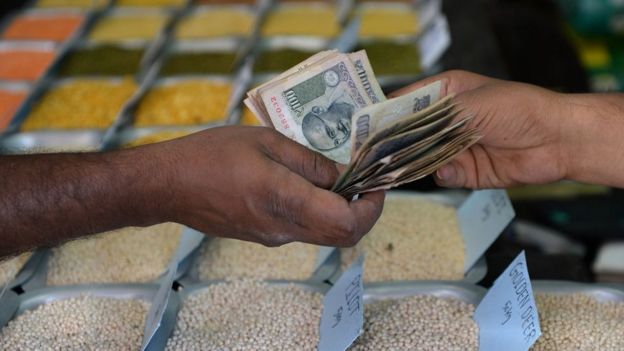
Image copyright GETTY IMAGESImage caption In 2016, India withdrew 85% of all currency notes from the economy
So, it is indeed true that India is facing a sharp economic downturn and severe loss of business confidence.
The alarm over the economic condition is not merely a reflection of a slowdown in GDP growth but also the poor quality of growth.
Private sector investment, the mainstay of sustainable growth in any economy, is at a 15-year low.
In other words, there is almost no investment in new projects by the private sector. The situation is so bad that many Indian industrialists have complained loudly about the state of the economy, the distrust of the government towards businesses and harassment by tax authorities.
But India’s economic slowdown is neither sudden nor a surprise.
Behind the fawning headlines in the press over the past five years about the robustness of India’s growth was a vulnerable economy, straddled with massive bad loans in the financial sector, disguised further by a macroeconomic bonanza from low global oil prices.
India’s largest import is oil and the fortuitous decline in oil prices between 2014 and 2016 added a full percentage point to headline GDP growth, masking the real problems. Confusing luck with skill, the government was callous about fixing the choked financial system.
Media caption What is really happening with India’s economy?
This move destroyed supply chains and impacted agriculture, construction and manufacturing that together account for three-quarters of all employment in the country.
Before the economy could recover from the currency ban shock, the government enacted a transition to a new indirect taxation system of the Goods and Services Tax (GST) in 2017. The GST rollout wasn’t smooth and many small businesses initially struggled to understand it.
Such massive external shocks to the economy, coupled with a reversal in low oil prices, dealt the final blow to the economy. Millions of Indians started to lose their jobs and rural wages remained stagnant. This, in turn, impacted consumption, slowing down the economy sharply.
Not easy
The wobbly state of the economy has also thrown government finances in disarray: tax revenues are much below expectations.
On Monday, the government got a much-needed breather when India’s central bank announced a $24bn (£19bn) one-time payout for the cash-starved government. (This amount is more than the dividend paid by the central bank to the government in all five years of the Congress rule between 2009 and 2014.)
The solutions to the economic crisis are not easy.
Indian industry, fed and fattened with government protection through decades, is once again clamouring for tax cuts and financial incentives.
But it is not clear that such benefits will revive private sector investment and domestic consumption immediately.
For all the hype about the Make in India programme, hailed as the harbinger of the country’s emergence as a manufacturing power, India’s dependence on China for goods has only doubled in the past five years.
India today imports from China the equivalent of 6,000 rupees ($83; £68) worth of goods for every Indian, which has doubled from 3,000 rupees in 2014.
So, India is neither making goods for itself nor for the world.
Image copyright AFPImage caption India’s agrarian crisis is a major stumbling block
Ornamental tax and other fiscal incentives to specific industries are not suddenly going to make Indian manufacturers competitive and stop India’s addiction for affordable Chinese goods. If any, the trade spat between China and the United States only saw countries such as Vietnam and Bangladesh benefit and not India.
More currency or trade tariffs are not the solutions either. The central bank has lowered interest rates and there is some push to lowering the cost of capital for industry. But again, Indian industry will invest more only when demand for goods and services increases. And demand will increase only when wages increase, or there is money in the hands of people.
So, the only immediate solution for India seems to be to boost consumption through a stimulus given directly to people, in the classical Keynesian mould.
Of course, such a stimulus should be combined with reforms to boost business morale and confidence.
In sum, India’s economic picture is not pretty.
It is important for India’s political leadership to see this not-so-pretty picture and not hide behind rose tinted glasses. Prime Minister Modi has a unique electoral mandate to embark on bold moves to truly transform the economy and pull India out of the woods.
BEIJING (Reuters) – China’s central bank on Sunday pledged to further support the slowing economy by spurring loans and lowering borrowing costs, following data that showed a sharp drop in February’s bank lending due to seasonal factors.
The central bank is widely expected to ease monetary policy further this year to encourage lending especially to small and private firms vital for growth and job creation.
The central bank’s “prudent” monetary policy will emphasize on counter-cyclical adjustments, said People’s Bank of China (PBOC) Governor Yi Gang, using a phrase that implies the need to fight an economic slowdown.
“The global economy still faces some downward pressure and China faces many risks and challenges in its economy and financial sector,” Yi said at a press conference on the sidelines of the country’s annual meeting of parliament.
There is still some room for the PBOC to cut reserve requirement ratios (RRRs), although the amount of room is less compared with a few years ago, Yi said.
The PBOC has cut the amount of cash that commercial banks need to set aside as reserves five times in the past year to spur lending to small businesses in the private sector. The RRR for big banks is now at 13.5 percent and the ratio for small- to medium-size banks is at 11.5 percent.
Yi said lending rates for small firms are still relatively elevated due to higher risk premiums and the central bank will forge ahead with reforms to lower such risk premiums.
High risk premiums on loans to small firms reflect commercial banks’ traditional reluctance to extend credit to the sector because of concerns about their creditworthiness.
PBOC data on Sunday showed new bank loans in China fell sharply in February from a record the previous month, but the drop was likely due to seasonal factors, while policymakers continue to press lenders to help cash-strapped firms stay afloat.
A pull-back in February’s tally had been widely expected as Chinese banks tend to front-load loans at the beginning of the year to get higher-quality customers and win market share.
Chinese banks made 885.8 billion yuan ($131.81 billion) in net new yuan loans in February, down sharply from a record 3.23 trillion yuan in January, when several other key credit gauges also picked up modestly in response to the central bank’s policy easing.
Yi said combined January-February new loans and total social financing (TSF), a broad measure of credit and liquidity in the economy, could paint a more accurate picture as they showed a rise of 374.8 billion yuan and 1.05 trillion yuan from a year earlier, respectively.
DEBT DEFAULTS
Analysts say China needs to revive weak credit growth to help head off a sharper economic slowdown this year, but investors are worried about a further jump in corporate debt and the risk to banks as they relax their lending standards.
Corporate bond defaults hit a record last year, while banks’ non-performing loan ratio notched a 10-year high.
Pan Gongsheng, a vice governor at the PBOC, told the same briefing that China will control the amount of bond defaults in 2019, using both legal and market means.
Pan conceded that bond defaults increased last year, but the level of defaults was not high compared with China’s average bad loan ratio.
Premier Li Keqiang told parliament on Tuesday that monetary policy would be “neither too tight nor too loose”. Li also pledged to push for market-based reforms to lower real interest rates.
Chinese policymakers have repeatedly vowed not to open the credit floodgates in an economy already saddled with piles of debt – a legacy of massive stimulus during the global financial crisis in 2008-09 and subsequent downturns.
Sources have told Reuters the central bank is not ready to cut benchmark interest rates just yet, but is likely to cut market-based rates.
Yi said the downward trend in TSF has been initially curbed and broad M2 money supply growth will be more or less in line with nominal gross domestic product growth in 2019, Yi added.
Central bank data showed growth of outstanding TSF, a rough gauge of broad credit conditions, slowed to 10.1 percent in February from January’s 10.4 percent, versus a record low of 9.8 percent in December.
M2 money supply grew 8.0 percent in February from a year earlier, missing forecasts, the central bank data showed. Yi said China’s macro leverage ratio, or the amount of debt relative to GDP, was at 249.4 percent at the end of 2018, a fall of 1.5 percentage points from a year earlier, Yi said.
Analysts note there is a time lag before a jump in lending will translate into growth, suggesting business conditions may get worse before they get better.
Most economists expect a rocky first half before conditions begin to stabilize around mid-year as support measures begin to have a greater impact.
China’s economic growth is expected to cool to around 6.2 percent this year, a 29-year low, according to Reuters polls.
Growth slowed to 6.6 percent last year, with domestic demand curbed by higher borrowing rates and tighter credit conditions and exporters hit by the escalating trade war with the United States.




 CHINDIA ALERT: You'll be living in their world, very soon