Archive for ‘IMF’

17/04/2020

China’s virus-hit economy shrinks for first time in decades

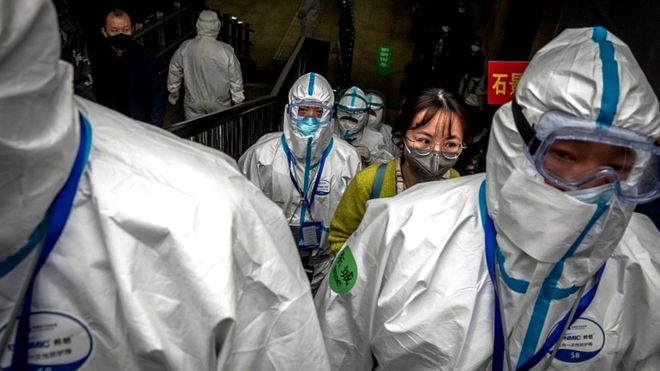
Train passengers arrive from WuhanImage copyright EPA

China’s economy shrank for the first time in decades in the first quarter of the year, as the virus forced factories and businesses to close.

The world’s second biggest economy contracted 6.8% according to official data released on Friday.

The financial toll the coronavirus is having on the Chinese economy will be a huge concern to other countries.

China is an economic powerhouse as a major consumer and producer of goods and services.

This is the first time China has seen its economy shrink in the first three months of the year since it started recording quarterly figures in 1992.

“The GDP contraction in January-March will translate into permanent income losses, reflected in bankruptcies across small companies and job losses,” said Yue Su at the Economist Intelligence Unit.

Last year, China saw healthy economic growth of 6.4% in the first quarter, a period when it was locked in a trade war with the US.

In the last two decades, China has seen average economic growth of around 9% a year, although experts have regularly questioned the accuracy of its economic data.

Its economy had ground to a halt during the first three months of the year as it introduced large-scale shutdowns and quarantines to prevent the virus spread in late January.

As a result, economists had expected bleak figures, but the official data comes in slightly worse than expected.

Among other key figures released in Friday’s report:

  • Factory output was down 1.1% for March as China slowly starts manufacturing again.
  • Retail sales plummeted 15.8% last month as many of shoppers stayed at home.
  • Unemployment hit 5.9% in March, slightly better than February’s all-time high of 6.2%.
Presentational grey line

Analysis: A 6% expansion wiped out

Robin Brant, BBC News, Shanghai

The huge decline shows the profound impact that the virus outbreak, and the government’s draconian reaction to it, had on the world’s second largest economy. It wipes out the 6% expansion in China’s economy recorded in the last set of figures at the end of last year.

Beijing has signalled a significant economic stimulus is on the way as it tries to stabilise its economy and recover. Earlier this week the official mouthpiece of the ruling Communist Party, the People’s Daily, reported it would “expand domestic demand”.

But the slowdown in the rest of the global economy presents a significant problem as exports still play a major role in China’s economy. If it comes this will not be a quick recovery.

On Thursday the International Monetary Fund forecast China’s economy would avoid a recession but grow by just 1.2% this year. Job figures released recently showed the official government unemployment figure had risen sharply, with the number working in companies linked to export trade falling the most.

Presentational grey line

China has unveiled a range of financial support measures to cushion the impact of the slowdown, but not on the same scale as other major economies.

“We don’t expect large stimulus, given that that remains unpopular in Beijing. Instead, we think policymakers will accept low growth this year, given the prospects for a better 2021,” said Louis Kuijs, an analyst with Oxford Economics.

Since March, China has slowly started letting factories resume production and letting businesses reopen, but this is a gradual process to return to pre-lockdown levels.

Media caption Why does China’s economy matter to you?

China relies heavily on its factories and manufacturing plants for economic growth, and has been dubbed “the world’s factory”.

Stock markets in the region showed mixed reaction to the Chinese economic data, with China’s benchmark Shanghai Composite index up 0.9%.

Japan’s Nikkei 225 jumped 2.5% on Friday, although this was largely due to gains on Wall Street after US President Donald Trump unveiled plans to ease lockdowns.

Source: The BBC

09/10/2019

Technology, not China, can be blamed for regional job losses in developed countries, IMF finds

  • Competition from China is not the primary reason for regional job losses in rich countries, new IMF research finds
  • Study finds technological advancement is bigger driver of unemployment, undermining populist argument China is stealing manufacturing jobs
The IMF said automation displaced more jobs in rich countries than China’s growing productivity. Photo: SCMP

Automation rather than market competition from China can be blamed for regional job losses suffered in developed countries, including American rust belt states, according to new research by the International Monetary Fund released on Wednesday.

“Increases in import competition in external markets associated with the rise of China’s productivity do not have marked effects on regional unemployment,” the Washington-based fund said in an academic paper. “Only technology shocks tend to have lasting effects, with even larger unemployment rises for vulnerable lagging regions.”

The paper, which looked at regional disparities within advanced countries, undermines a key argument pushed by US President Donald Trump in the ongoing trade war

 between Washington and Beijing – that China has been stealing American technology and jobs.
Although the research did not mention Trump, the IMF said the argument that market competition displaced jobs was flawed as imports from China could only cause job losses in the near term and such impact “quickly abates”.

The US goods trade deficit with China hit a record of US$419.2 billion in 2018, which the Trump administration has blamed for a decline in US manufacturing jobs.

In the paper, the IMF classified a region as “lagging” if two conditions were met – initial real gross domestic product (GDP) per capita was below the country’s median in 2000, and the region’s average growth between 2000 to 2017 was below average.

Labour productivity tended to be lower and employment in the agriculture sector higher in lagging regions, the IMF said. Within the United States, per capita GDP in the state of New York is 100 per cent higher than in Mississippi, parts of which are considered within the rust belt.

While increases in import competition tended to reduce labour force participation after one year, this impact faded quickly and did not have significant effects on regional unemployment on average, IMF analyst Weicheng Lian said.

The impact of technology was more far-reaching, however, with researchers pinpointing it as the main driver of rising unemployment in lagging regions.

Automation pressures

translate into a decline in the cost of machinery and equipment, leading to more persistent rises in unemployment and declines in labour force participation in lagging regions, compared with less vulnerable regions, the study said.

Lian said that poorer regions tend to specialise in agriculture and manufacturing industries rather than high productivity service sectors such as information technology, communications and finance.
“We find that a negative technology shock … raises unemployment in all regions that are more vulnerable to automation, but lagging regions are particularly hurt,” she said.
China-US trade war may cost US$700 billion by 2020 in synchronised global slowdown, new IMF chief says

US-China trade war could cost world economy US$700 billion by 2020: IMF

Read more

China tones down expectations ahead of US trade war talks as Vice-Premier Liu He leads team to Washington

China tones down expectations ahead of US trade war talks

Read more

Kristalina Georgieva is the new IMF chief, taking over from Christine Lagarde

Kristalina Georgieva is the new IMF chief

Read more

China, US urged to ease trade war tensions that are ‘weighing on’ global commerce, says IMF chief economist

China, US urged to ease tensions that are ‘weighing on global trade’

Read more

US-China trade war caused ‘self-inflicted’ damage to the global economy, says IMF after third 2019 forecast cut

US-China trade war caused ‘self-inflicted’ damage to the global economy

17/08/2019

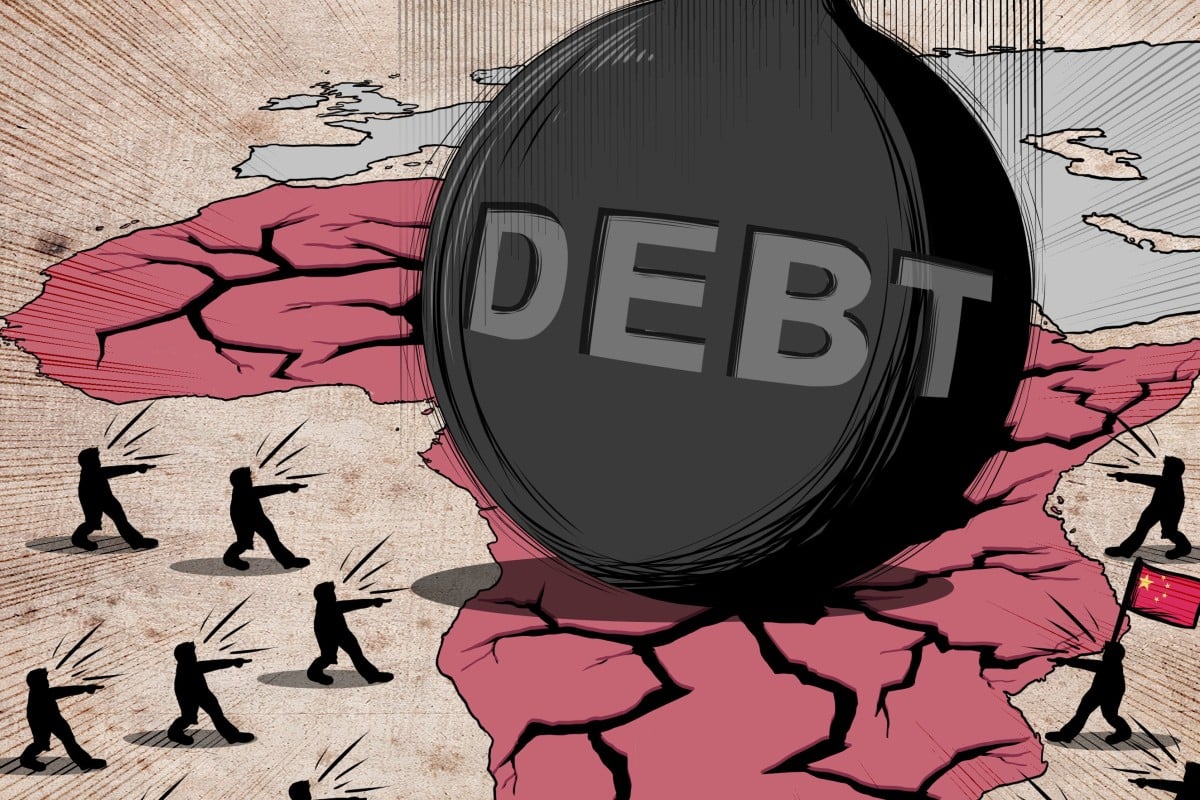
Are Chinese infrastructure loans putting Africa on the debt-trap express?

  • Beijing has lent billions of dollars to countries on the continent to build railways, highways and airports but critics say the borrowings are unsustainable
  • Chinese officials say the projects will pay off in the long run and host nations are well aware of their limits and needs
Illustration: Lau Kakuen
When Clement Mouamba went to Beijing last year, he had two main tasks.
The prime minister of the Republic of Congo needed to find out exactly how much his country owed to China, a number the struggling, oil-rich central African nation had until then not been able to provide the International Monetary Fund (IMF) to qualify for a bailout. He also needed to convince Beijing to restructure its debt to ensure sustainability.
The IMF had put talks for further loans on hold until Mouamba’s administration could say exactly how much it had to repay to the country’s external creditors, including China – the republic’s single largest bilateral lender – and oil multinationals such as Glencore and Trafigura.
The country, which heavily depends on oil revenue, turned to China and private oil majors for funding to run the government when in 2014 oil prices fell from a high of US$100 per barrel to as low as US$30.

Critics say countries on the continent are being burdened with unrealistic levels of debt for inviable infrastructure backed and built by China without adequate transparency and scrutiny.

The biggest concern is that several African countries will be left with huge debts and grandiose infrastructure that they cannot maintain and run profitably. I liken it to borrowing money to buy a Tesla when you don’t have adequate access to electricity: Obert Hodzi of the University of Helsinki in Finland

But Chinese observers say the West must take some of the blame for the countries’ debt problems and that the support China offers will benefit the host countries in the long run.

In the early 1990s, when China began to embrace Africa again after years of isolation from the outside world, the aspiring manufacturer was at a serious disadvantage in the race for raw materials and markets for its industrial goods.

The former colonial powers of the West had already sewn up deals for many of the continent’s most lucrative and readily exploitable reserves, from fossil fuels to minerals.

China needed new strategies to convince African governments to allow it access raw materials for its industries and markets for its products to a largely unfamiliar partner.

China also wanted to challenge the dominance of the US in global trade and politics so it courted allies in Africa to help it push for political legitimacy in international institutions.

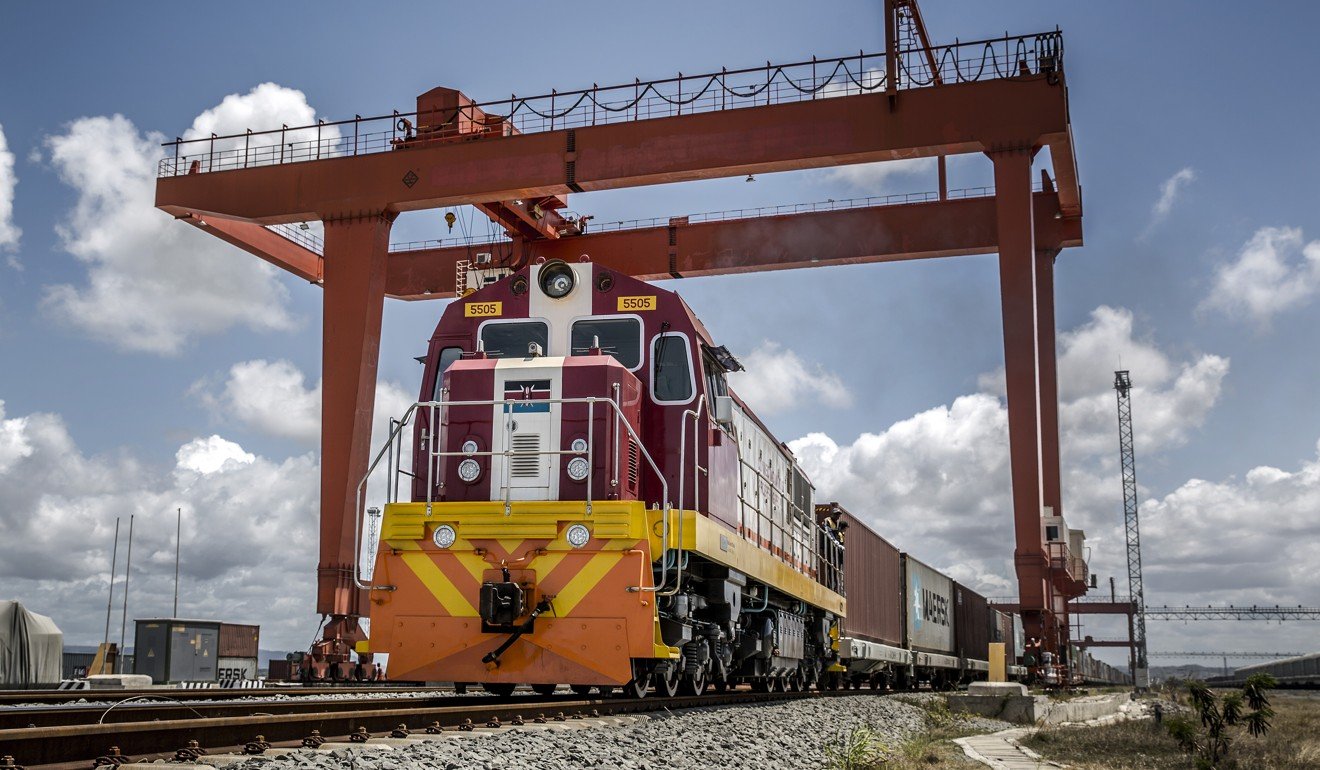
A Kenya Railways freight train leaves the port station on the Mombasa-Nairobi railway in Mombasa, Kenya, a huge project backed by China. Photo: Bloomberg

At the time, many African leaders were under fire to liberalise their economies. China’s approach was to promise not to meddle in individual country’s internal affairs and assure African countries that they could get billions in exchange for future delivery of minerals through resource-backed deals.

Beijing sold its policies that it had no conditions attached to its development finance. In the drive to drum up business, China promised affordable loans for African countries to build roads, bridges, highways, airports and power dams.

Is Kenya’s Chinese-built railway a massive white elephant?

But Beijing also pursued tied finance, ensuring that countries borrowing from China used Chinese contractors to implement the projects rather than open them up to outside bids.

In addition, many of the deals were built on weak financial, technical and environmental conditions, with Chinese state firms conducting the technical feasibility, environmental impact assessment and financial viability studies for free for projects that they also build.

For example, in Kenya, the China Road and Bridge Corporation conducted a free feasibility study that was used in the construction of the railway.

The same company was handed the contract to implement the project and is operating both the passenger and cargo train service for a fee.

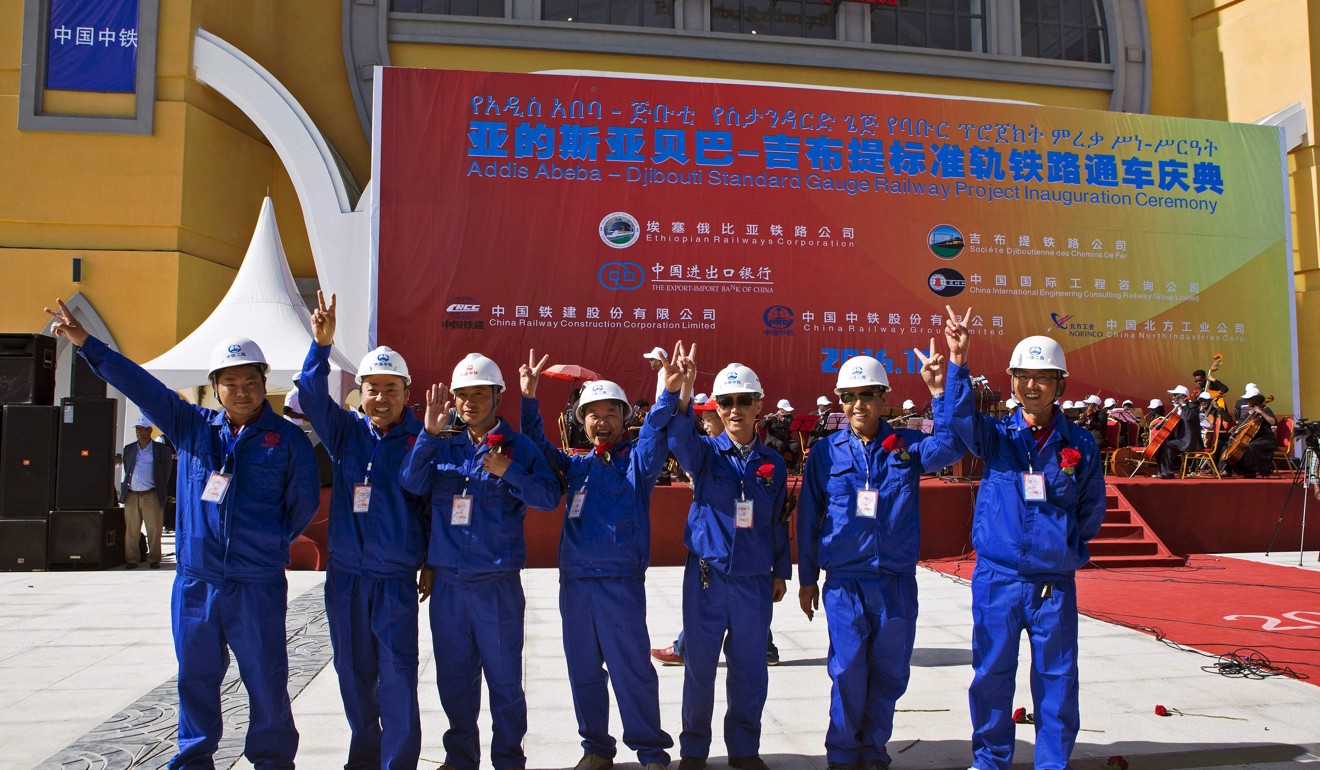
Chinese companies were responsible for the construction of a rail line between Addis Ababa and Djibouti. Photo: AFP

In contrast, the World Bank and its partner institution, the IMF, demand that such studies be done by an independent consultant and not by the company that implements the project.

According to data compiled by the China-Africa Research Initiative, at the Johns Hopkins University School of Advanced International Studies, Beijing has advanced loans worth US$143 billion to African countries since 2000, levels that some critics say are unsustainable for the borrowers.

China meets resistance over Kenya coal plant, in test of its African ambitions

For many of China’s new African partners, these arrangements – from easy lending terms, to non-competitive bidding and opaque contract details – have led to new problems – problems that corrupt or poorly managed governments now share substantial responsibility.

Some critics, both in the West and in host countries, suggest there is a “debt-trap strategy” at the heart of Beijing’s push for international business and influence, but there is no evidence that China deliberately pushes other countries into debt to seize their assets or gain sway.

However, the drive for overseas contracts and big business has led some countries into difficulties with new debts, and there are question marks over the viability of many of the projects the money is funding.

Obert Hodzi, an international relations expert at the University of Helsinki in Finland, said the Addis Ababa-Djibouti railway and the Mombasa-Nairobi railway were good examples of huge projects that were financed by easy borrowing terms from China but were not sustainable and that had in turn forced the African partners to seek further Chinese help.

“The biggest concern is that several African countries will be left with huge debts and grandiose infrastructure that they cannot maintain and run profitably,” Hodzi said. “I liken it to borrowing money to buy a Tesla when you don’t have adequate access to electricity.”

Ken Opalo, a Kenyan scholar at Georgetown University in Washington, said the key issue was the inability of African countries to design projects that were actually needed for the local economies.

A road is not just a means of transport but an economic belt or corridor that will catalyse the development of the whole region: Huang Xueqing, spokeswoman for the Chinese embassy in Nairobi

“Most African countries have been willing to accept projects designed, financed, and implemented by Chinese firms,” Opalo said.
“It would be better to decouple the feasibility studies and design phases of projects from the financing. That way African governments can ensure that they are truly getting value for money.”
But Chinese officials said Beijing had invested in infrastructure largely at the request of the host countries, adding that it could take time to yield returns on the projects.

Huang Xueqing, spokeswoman for the Chinese embassy in Nairobi, said the projects were valid assets with value that would grow in time.

“So, in the long run, it is beneficial to the host countries. Just like when young people buy a house with a mortgage, they may take some debts, but they have a place to live in and have their own assets,” Huang said.

“Underdeveloped infrastructure is the bottleneck that has been holding back Africa’s development. Up to today, many African countries, although in the same continent, are not connected with direct flights, railways or even roads. You have to fly to Paris or Zurich in order to get to some African countries.

“A road is not just a means of transport but an economic belt or corridor that will catalyse the development of the whole region.”

Huang said Beijing had advised the countries to act within their means and not to overstretch themselves when they considered projects that might not be in line with local conditions.

“When making investment decisions, the Chinese side, along with the recipient countries, carry out rigorous feasibility studies and evaluations. We do things according to our ability,” she said.

China’s leadership has also said it is paying close attention to the fiscal and financial difficulties faced by some African countries.

“As a good friend and good brother … the Chinese side is willing to lend a helping hand when needed by the African people to help them overcome temporary difficulties,” State Councillor and Foreign Minister Wang Yi said in January while on a trip to Ethiopia, adding that the debt situation in Africa is also a legacy issue.

China must allay any debt-trap fears in its dealings with Africa

“The African debt issue does not come up today, still less is it caused by the Chinese side. The African people know who are the initiators of African debt.”

The West should take a lot of the blame for worsening debt problems in some African countries, according to Li Anshan, from Peking University’s Centre for African Studies.

He cited the cases of Liberia and the Democratic Republic of Congo, two countries that have had close relations with the West for many years but remain ravaged by war and poverty despite immense natural resources.

“China-Africa relations have been going on for quite some time. Is there any African country which has got poorer because of its deal with China?” Li said.

Gyude Moore, a former Liberian minister of public works whose department oversaw construction and maintenance of various public infrastructure funded and built by China, said it would be difficult to imagine that China would knowingly ensnare its partners in debt.

“China attempts to differentiate itself from Western donors by limiting non loan-related conditionality. China also practices non-interference, so how a country manages its resources, treats its people or deploy its finances were considered ‘internal’,” he said.

“So, Chinese loans are negotiated faster and place less emphasis on public financial management.”

Moore, now a visiting fellow at the Centre for Global Development, said there were trade-offs in such situations.

China focuses on sustainable projects to dismiss fears of African debt trap

“If the loans are going to be fast – the due diligence will not be as rigorous. Chinese project selection mixes political with economic considerations. So, while a project may not make as much economic sense, it may pay political dividends,” he said.

He said non-transparent processes would invite abuse, be they Chinese, Western or African.

Other observers say the question of opacity is more directly related to China’s own economic system.

Howard French, author of China’s Second Continent: How a Million Migrants are Building a New Empire in Africa, said China has very limited transparency and public accountability in its own domestic processes.

The Mombasa railway station is seen in Mombasa, Kenya, in 2018. Photo: Xinhua

“So it would be unusual to expect that China would introduce greater transparency and accountability in its dealings with African countries than it is used to at home – that is, unless African governments insist on it,” French said.

“And this is where African governance comes in. African states should insist on contract transparency but often don’t do so because that offers leaders plentiful opportunities for graft.”

David Shinn, professor of international relations at George Washington University in Washington, agreed that China’s lack of loan transparency was a huge problem and increased the risk of corruption on both the African and Chinese sides. But he also said that in some cases, African governments might have negotiated poorly.

“This is, however, the responsibility of the African government. I don’t think China is purposely trying to encourage African debts in order to gain leverage,” Shinn said.

“In fact, China is becoming more careful about its lending because it is concerned it has made too much credit available to some African countries.”

China ‘ready to talk’ about trade deal with East Africa bloc

Huang Hongxiang, director of China House, a Nairobi-based consultancy that helps Chinese in Africa integrate better, agreed, saying the Chinese government needs to communicate more about projects in Africa but African countries also have a bigger part to play in ensuring better deals.

“On commercial viability, accountability, transparency and governance, I believe the responsibility does not lie with China, the US or the West but in the hands of African countries,” he said.

Wherever the fault lies, one thing is clear when money is wasted on ill-designed projects that have little to no economic return, according to Opalo.

“The lack of planning and transparency creates default risks … [and] African taxpayers will be left holding the bag.”

This article is the third in a series examining the local impact of Chinese investment and infrastructure projects in Africa. Read part one  here and part two

 here

.

The next report will examine whether African countries can speak with one voice in relations with China.
Source: SCMP
29/06/2019

Belt and Road Economic Information Partnership to build info bridge

BEIJING, June 28 (Xinhua) – Set to build an “information bridge” for the Belt and Road Initiative (BRI) construction, attendees of the Belt and Road Economic Information Partnership (BREIP) in Beijing believed it would reduce the “information deficit” between countries.

The partnership, designed to eliminate information asymmetry in implementing the BRI, offers demonstration, guidance and services to participants of the BRI, and create a new platform for international cooperation.

The platform of BRInfo, operated and maintained by China Economic Information Service (CEIS) under Xinhua News Agency, allows BREIP members to share information and conduct cooperation.

Alfred Schipke, IMF Senior Resident Representative for China, said it would be important to strengthen policy frameworks and foster capacity development in China and in partner countries.

“The effective sharing of information will be more and more important. Here, the BREIP could be a key platform,” Schipke said.

New commercial opportunities will surely be created with information from professional institutions and needs of enterprises brought together, so as to promote mutual understanding, said Liu Zhengrong, vice president of Xinhua News Agency.

The BREIP, offering news service and information assurance, has provided a platform of news and economic information for countries and regions to expand cooperation, noted Marat Abulkhatin, first deputy chief editor of TASS Russian News Agency.

Domestic information reports growing significance now in global market, and under the BRInfo mechanism, news agencies can help to further eliminate information asymmetry, said Raphael Juan, director of markets at Brazilian CMA News Agency.

Polish government and enterprises look forward to better understanding different market situations and making better decisions with the economic information shared on the BREIP, said Ryszard Marcin Nizewski, product director with Polish Press Agency.

The BRI has made great contributions to international trade and the international economy, and its achievements have far exceeded expectations. It is believed that the BREIP will also become a multi-faceted cooperation tool, according to Dzmitry Prymshyts, deputy director for Research and Innovation of the Institute of Economics of the National Academy of Sciences of Belarus.

This platform could decrease the “information deficit” between countries while growing into a timely, objective and solid source of information, Prymshyts said.

The BREIP, established in Beijing on Thursday, was initiated by Xinhua News Agency and co-founded by more than 30 institutions including well-known news agencies, information service providers, research institutions, chambers of commerce and associations from more than 20 countries and regions in Asia, Europe, Africa, Latin America and Oceania.

Source: Xinhua

18/05/2019

IMF’s Lagarde says U.S.-China trade war could be risk for world economic outlook

TASHKENT (Reuters) – The trade war between the United States and China could be a risk to the world economic outlook if it is not resolved, International Monetary Fund Managing Director Christine Lagarde told Reuters on Friday during a visit to Uzbekistan.

“Obviously, the downside risk that we have is continued trade tensions between the United States and China,” Lagarde said, referring to the IMF’s world economic outlook.

“And if these tensions are not resolved, that clearly is a risk going forward.”

The IMF last month cut its growth forecast for 2019 to 3.3%, down from the 3.5% it had previously predicted.

It warned at the time that growth could slow further due to trade tensions and a potentially disorderly British exit from the European Union.

“But we expect that at the end of 2019 and in 2020 it will bounce back,” Lagarde said of the world economic outlook on Friday.

The United States infuriated China this week when it announced it was putting Huawei Technologies Co Ltd, the world’s biggest telecoms equipment maker, on a blacklist that could make it hard to do business with U.S. companies.

On Friday Beijing suggested a resumption of talks between the world’s two largest economies would be meaningless unless Washington changes course.

Source: Reuters

10/04/2019

IMF revises up China’s growth forecast for 2019 to 6.3 pct

WASHINGTON, April 9 (Xinhua) — The International Monetary Fund (IMF) on Tuesday revised up the 2019 growth projection for China to 6.3 percent, up 0.1 percentage point from its previous estimation in January, according to the newly released April 2019 World Economic Outlook (WEO).

The upward revision reflected the combined impact of recent developments in the China-U.S. trade talks, China’s stronger-than-expected expansionary fiscal policy, and a slowing global economy, Changyong Rhee, director of the IMF’s Asia and Pacific Department, told Xinhua.

“We have to revise our growth forecast due to more fiscal expansion, at the same time, the global economy has started to slow down, that actually has negative impact on that,” Rhee said, adding that the IMF made the latest projection taking into account both positive and negative factors.

In its latest annual government work report, China set the 2019 gross domestic product (GDP) growth target at 6-6.5 percent. The world’s second-largest economy also pledges to continue pursuing high-quality development.

The IMF’s medium-term forecast sees a gradual slowdown in China “as internal rebalancing toward a private-consumption and services-based economy continues and regulatory tightening slows the accumulation of debt and associated vulnerabilities.”

In the latest WEO report, it projected a 6.1 percent growth rate for China in 2020, slightly down from the previous estimation of 6.2 percent.

The report highlighted trade tensions as one of the key sources of downside risk to the global outlook, noting that raising tariffs would lead to higher prices for consumers, and trade policy uncertainty would reduce business investment, disrupt supply chains, and dampen productivity growth.

Source: Xinhua

26/02/2019

Trump: US and China ‘very very close’ on deal

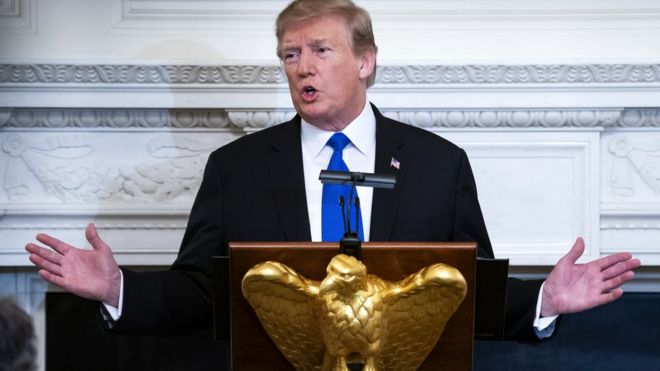
US President Donald Trump addresses US governors at the White HouseImage copyrightAFP

President Donald Trump has said that the US and China are “very very close” to signing a trade agreement, potentially ending the long-running feud between the two countries.

Mr Trump told US governors on Monday that both nations “are going to have a signing summit”.

“Hopefully, we can get that completed. But we’re getting very, very close,” he said.

It follows a decision to delay imposing further trade tariffs on Chinese goods.

At the weekend, Mr Trump said both sides had made “substantial progress” in trade talks following a summit in Washington last week.

The rise in import duties on Chinese goods from 10% to 25% was due to come into effect on 1 March.

Instead, Mr Trump said the US is now planning a summit with Chinese Premier Xi Jinping at the US President’s Mar-a-Lago resort in Florida.

US shares rose on the decision to delay tariffs, with the Dow Jones Industrial Average closing 0.23% higher at 26,091.9.

The S&P 500 and the Nasdaq also finished trading in positive territory.

As he prepared to meet North Korean leader Kim Jong-un in Vietnam, Mr Trump also tweeted that a China trade deal was in “advanced stages”.

Mr Trump’s decision to delay tariff increases on $200bn (£153bn) worth of Chinese goods was seen as a sign that the two sides were moving ahead in settling their damaging trade war.

Last week, Mr Trump noted progress in the latest round of negotiations in Washington, including an agreement on currency manipulation, though no details were disclosed.

Sources told CNBC on Friday that China had committed to buying up to $1.2 trillion in US goods, but there had been no progress on the intellectual property issues.

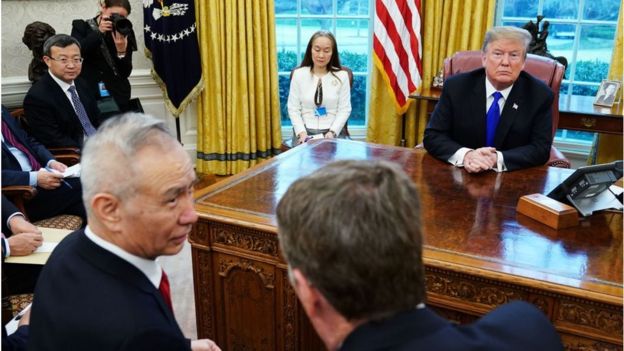
Donald Trump and China's Vice Premier Liu He in the Oval OfficeImage copyrightAFP
Image captionPresident Trump met China’s Vice Premier Liu He on Friday

Gregory Daco, chief US economist at Oxford Economics, said: “We had anticipated such a delay and believe a handshake agreement in which China will promise to import more agricultural products, work towards a stable currency and reinforce intellectual property rights protection will be achieved in the coming weeks.

“However, we don’t foresee a significant rollback of existing tariffs, and see underlying tensions regarding China’s strategic ambitions, its industrial policy, technological transfers and ‘verification and enforcement’ mechanisms remaining in place.”

What has happened in the trade war so far?

Mr Trump initiated the trade war over complaints of unfair Chinese trading practices.

That included accusing China of stealing intellectual property from American firms, forcing them to transfer technology to China.

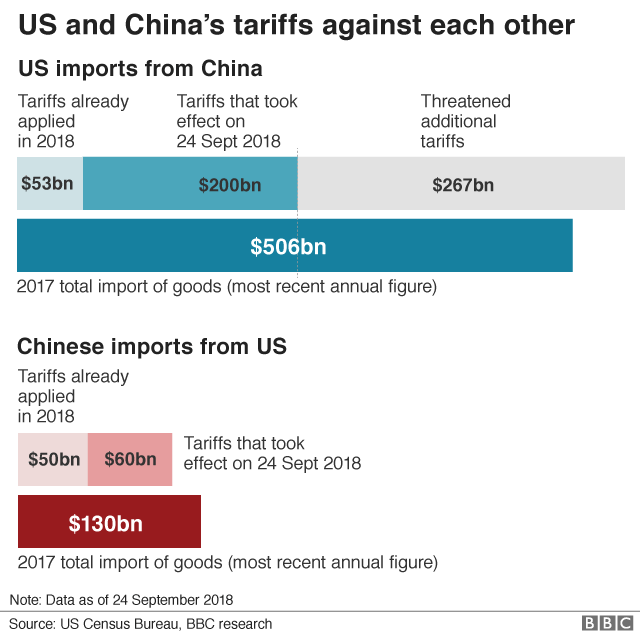
The US has imposed tariffs on $250bn worth of Chinese goods, and China has retaliated by imposing duties on $110bn of US products.

Mr Trump has also threatened further tariffs on an additional $267bn worth of Chinese products – which would see virtually all of Chinese imports into the US become subject to duties.

US and China's tariffs against each other

The trade dispute has unnerved financial markets, risks raising costs for American companies and is adding pressure to a Chinese economy that is already showing signs of strain.

It has also stoked fears about the impact on the global economy.

Last year, the International Monetary Fund warned the trade war between the US and China risked making the world a “poorer and more dangerous place”.

Source: The BBC

01/12/2015

Boost for China as it joins IMF elite – FT.com

The IMF on Monday gave a major vote of confidence to China and its reform efforts, giving the renminbi greater weighting than the yen or pound as it included the currency in its elite basket of reserve currencies.

Chinese one-hundred yuan banknotes are stacked for a photograph at the Korea Exchange Bank headquarters in Seoul, South Korea, on Thursday, Feb. 27, 2014. Photographer: SeongJoon Cho/Bloomberg

The vote by the board to make the renminbi the fifth currency in the basket used to value the IMF’s own de facto currency followed months of deliberation at the fund and years of lobbying by a Beijing eager for the recognition.

“The Rmb’s elevation to the club of elite global reserve currencies is a big step for China and a significant one for the international monetary system,” said Eswar Prasad, professor of economics at Cornell University and a former IMF China mission chief.

The renminbi will become the third biggest currency in the “special drawing rights” basket when it takes effect on October 1. The move is largely symbolic but Christine Lagarde, IMF managing director, called it a “milestone” in China’s economic reform “journey” and its integration into the global financial system.

Following the move the currency slipped 0.19 per cent to Rmb6.4374 against the dollar in offshore trading in Hong Kong.

The People’s Bank of China set its daily “fix” — the onshore rate around which the currency can trade 2 per cent either side — at Rmb6.3973 per dollar, its fourth consecutive slightly weaker rate.

Investors generally expect China to allow its currency to weaken gradually but few see much likelihood of a repeat of its 3 per cent August devaluation, which sent shockwaves through global markets.

Source: Boost for China as it joins IMF elite – FT.com

Law of Unintended Consequences

continuously updated blog about China & India

ChiaHou's Book Reviews

continuously updated blog about China & India

What's wrong with the world; and its economy

continuously updated blog about China & India