Archive for ‘Economics’

19/07/2012

* India arrests after riot at Maruti plant leave one dead

BBC News: “At least 80 people have been arrested after violent clashes between workers and managers at a Maruti Suzuki factory near the Indian capital, Delhi.

One person died and more than 85 were injured, including two Japanese nationals, in the riot at the Manesar plant on Wednesday evening.

Maruti, India’s biggest carmaker, has halted production at the factory.

Managers and workers blame each other for starting the clashes, which follow months of troubled labour relations.

The violence at the vast factory in Haryana state is believed to have erupted after an altercation between a factory worker and a supervisor.

Workers reportedly ransacked offices and set fires at the height of the riot. A charred body was found afterwards in a damaged conference room – the identity of the person who died has not yet been established.

Dozens of staff, both management and shop-floor workers, were taken to a nearby hospital.

Security has now been tightened at the plant, which employs more than 2,000 people and produces more than 1,000 of Maruti’s top-selling cars each day, and accounts for about a third of its annual production.

Maruti Suzuki, a joint venture between Maruti and Japan’s Suzuki Motor Corporation, has a 50% share of India’s booming car market.

It has been hit by a series of strikes since June 2011, when workers went on a 13-day strike demanding the recognition of a new union.”

via BBC News – India arrests after riot at Maruti plant leave one dead.

19/07/2012

* China pledges $20bn in credit for Africa at summit

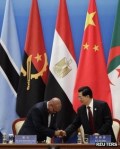
BBC News: “China has pledged $20bn (£12.8bn) in credit for Africa over the next three years, in a push for closer ties and increased trade.

President Hu Jintao made the announcement at a summit in Beijing with leaders from 50 African nations. He said the loans would support infrastructure, agriculture and the development of small businesses.

The Chinese leader also called for better co-operation with African countries on international affairs.

As developing nations, China and countries in Africa should work better together in response to “the big bullying the small, the strong domineering over the weak and the rich oppressing the poor” in international affairs, said Mr Hu.

The loan is double the amount China pledged in a previous three-year period in 2009, since which time China has been Africa’s largest trading partner.

Trade between the two hit a record high of $166bn (£106bn) in 2011, Chinese Commerce Minister Chen Deming wrote in the China Daily newspaper, ahead of the two-day forum.

“We want to continue to enhance our traditional friendship… rule out external interference and enhance mutual understanding and trust,” said Mr Hu.”

via BBC News – China pledges $20bn in credit for Africa at summit.

19/07/2012

Bad as the situation for Chinese farmers, it pales into insignificance compared to the plight of Indian farmers. 10s of thousands of Indian farmers have committed suicide this year alone due to their inability to face the future with mounting debts, and poor harvests. Read http://www.indiatribune.com/index.php?option=com_content&view=article&id=5389:every-12-hours-one-farmer-commits-suicide-in-india&catid=106:magazine

17/07/2012

* Fracking in U.S. Lifts Guar Farmers in India

NY Times: “Sohan Singh’s shoeless children have spent most of their lives hungry, dirty and hot. A farmer in a desert land, Mr. Singh could not afford anything better than a mud hut and a barely adequate diet for his family.

Farmers waited this month to receive free guar seeds from an Indian company.

But it just so happens that when the hard little bean that Mr. Singh grows is ground up, it becomes an essential ingredient for mining oil and natural gas in a process called hydraulic fracturing.

Halfway around the world, earnings are down for an oil services giant, Halliburton, because prices have risen for guar, the bean that Mr. Singh and his fellow farmers raise.

Halliburton’s loss was, in a rather significant way, Mr. Singh’s gain — a rare victory for the littlest of the little guys in global trade. The increase in guar prices is helping to transform this part of the state of Rajasthan in northwestern India, one of the world’s poorest places. Tractor sales are soaring, land prices are increasing and weddings have grown even more colorful.

“Now we have enough food, and we have a house made of stone,” Mr. Singh said proudly while his rail-thin children stared in awe.

Guar, a modest bean so hard that it can crack teeth, has become an unlikely global player, and dirt-poor farmers like Mr. Singh have suddenly become a crucial link in the energy production of the United States.”

via Fracking in U.S. Lifts Guar Farmers in India – NYTimes.com.

17/07/2012

* Chinese Businesses Get Advice on U.S. Investment

WSJ: “Looking to ease the way for Chinese investment in the U.S., the U.S. Chamber of Commerce is advising Chinese businesses not to count on “personal relationships” with government officials as a key to success.

The advice came in a report prepared by the U.S. Chamber for an investment forum Tuesday in Beijing. The event, co-hosted by the China Center for International Economic Exchanges, a Chinese government think tank, was expected to draw about 400 business executives and government officials, current and past.

A subsidiary of Aviation Industry Group of China last year bought Cirrus Industries, a Minnesota maker of propeller aircraft.

The U.S. Chamber said it was acting on its own initiative, though the U.S. government, seeking to lift economic growth, also has been trying to encourage Chinese investment. Chinese business leaders regularly say they are interested in investing in the U.S. but fear political opposition.

“We’re trying to showcase Chinese investment in the U.S.,” said Myron Brilliant, a senior vice president at the U.S. Chamber. “In a lot of areas there aren’t a lot of hurdles to investment.”

The 38-page report is based on interviews with Chinese business officials who have invested in the U.S. Some of its suggestions are obvious: “win-win cooperation can create great opportunities,” said advice attributed to Cirrus Industries Inc., a Duluth, Minn., propeller-aircraft maker purchased last year by a subsidiary of Aviation Industry Group of China.

But other advice reflects important differences between how business is done in the U.S. and in China. “Unlike in China, personal relations with officials play a very small part in the enforcement of laws and regulation,” said the report’s introduction.

Another tidbit for would-be Chinese investors: “The U.S. media [are] completely independent of the government, so even if some local officials welcome your investment, others might voice opposition in the media. Do not be discouraged by this.”

Chinese direct investment in the U.S. last year totaled $4.5 billion, according to New York market research firm Rhodium Group, a tiny portion of the foreign-direct investment in the U.S. The Commerce Department, which uses a different methodology from Rhodium, said FDI in the U.S. reached $227 billion in 2011.

via Chinese Businesses Get Advice on U.S. Investment – WSJ.com.

17/07/2012

* WTO: China discriminates against foreign card companies

BBC News: “The World Trade Organisation has ruled that China discriminates against foreign credit-card and debit-card providers.

A panel of the trade body said China maintains a monopoly on yuan-denominated payment cards which breaks WTO rules. Only one company, China UnionPay, is allowed to process domestic currency transactions. This limits foreign providers such as Visa and Mastercard.

There is a 60-day period in which either side can appeal against the ruling.

The Obama administration first lodged the complaint in 2010.

US companies have been trying to get greater access to the massive China market.

“Today’s win highlights that tackling unfair Chinese trade practices has been a priority of this president”, Jay Carney, White House press secretary

Currently, they can only issue cards in partnership with Chinese banks and China UnionPay.

Visa said in a statement that the company is “hopeful that this ruling will pave the way for international payment companies to participate in the domestic payments marketplace in China”.

The decision by the WTO is being hailed as a “win” by the US government. The trade gap with China has become a campaign issue in the upcoming elections.

“Today’s win highlights that tackling unfair Chinese trade practices has been a priority of this president,” said Jay Carney, White House press secretary.

Tim Reif from the US Trade Representative’s office said the ruling would support about 6,000 jobs if it goes through.

However, the WTO did not agree with all the claims raised by the United States.”

via BBC News – WTO: China discriminates against foreign card companies.

15/07/2012

* Google Tries Something Retro – Made in the U.S.A.

NYTimes: “Etched into the base of Google’s new wireless home media player that was introduced on Wednesday is its most intriguing feature. On the underside of the Nexus Q is a simple inscription: “Designed and Manufactured in the U.S.A.”

The Google executives and engineers who decided to build the player here are engaged in an experiment in American manufacturing. “We’ve been absent for so long, we decided, ‘Why don’t we try it and see what happens?’ ” said Andy Rubin, the Google executive who leads the company’s Android mobile business.

Google is not saying a lot about its domestic manufacturing, declining even to disclose publicly where the factory is in Silicon Valley. It also is not saying much about the source of many of its parts in the United States. And Mr. Rubin said the company was not engaged in a crusade.

Still, the project will be closely watched by other electronics companies. It has become accepted wisdom that consumer electronics products can no longer be made in the United States. During the last decade, abundant low-cost Chinese labor and looser environmental regulations have virtually erased what was once a vibrant American industry.

Since the 1990s, one American company after another, including Hewlett-Packard, Dell and Apple, has become a design and marketing shell, with production shifted to contract manufacturers in Shenzhen and elsewhere in China.

Now that trend may be showing early signs of reversing.

It’s a trickle, but some American companies are again making products in the United States. While many of those companies have been small, like ET Water Systems, there have also been some highly visible moves by America’s largest consumer and industrial manufacturers. General Electric and Caterpillar, for example, have moved assembly operations back to the United States in the last year. (Airbus, a European company, is said to be near a deal to build jets in Alabama.)

There is no single reason for the change. Rising labor and energy costs have made manufacturing in China significantly more expensive; transportation costs have risen; companies have become increasingly aware of the risks of the theft of intellectual property when products are made in China; and in a business where time-to-market is a competitive advantage, it is easier for engineers to drive 10 minutes on the freeway to the factory than to fly for 16 hours.

That was true for ET Water Systems, a California company. “You need a collaboration that is real time,” said Pat McIntyre, chief executive of the maker of irrigation management systems, which recently moved its manufacturing operation from Dalian, China, to Silicon Valley. “We prefer local, frankly, because sending one of our people to China for two weeks at a time is challenging.”

Harold L. Sirkin, a managing director at Boston Consulting Group, said, “At 58 cents an hour, bringing manufacturing back was impossible, but at $3 to $6 an hour, where wages are today in coastal China, all of a sudden the equation changes.”

The firm reported in April that one-third of American companies with revenue greater than $1 billion were either planning or considering to move manufacturing back to the United States. Boston Consulting predicted that the reversal could bring two million to three million jobs back to this country.”

via Google Tries Something Retro – Made in the U.S.A. – NYTimes.com.

This cost difference is continuing to erode away as China has been increasing its basic wages by between 10-15% per annum for the last 10 years and intends to continue doing so in order to improve the standard of living of the working person thereby passing on the benefits of the improving GDP.

See also:

14/07/2012

* Wuhan airport to build new terminal

China Daily: “A new terminal will be built in the Wuhan Tianhe International Airport before 2015 to meet increasing passenger demand in Central China’s Hubei province, local media reported on Friday.

The project will cost about 16 billion yuan ($2.5 billion), and will occupy an area of 370,000 square meters with a 3,600-meter long and 60-meter wide runway, the Chutian Metropolis Daily reported.

The new runway can guarantee the safe takeoff and landing of the Airbus A380, the report said.

The project, already approved by the National Development and Reform Commission, will start construction before October. The terminal will be built in a flying-phoenix shape, representing local culture.

A parking apron with capacity for 60 planes will also be built, the report said.

According to airport data, more than 12 million domestic and foreign passengers arrived at, or left from, the airport last year, only 1 million less than the airport’s capacity of 13 million.

The airport is expected to receive about 14 million passengers this year.”

via Wuhan airport to build new terminal |Society |chinadaily.com.cn.

The current Wuhan airport was only opened in 1995, and a new one is planned for2015 – looking to the future.

London Heathrow was built in 1929 and expanded to its modern configuration after WW2. It is limited by its two main runways. Yet, after years of debate, neither has a decision been made to build a third runway nor has an alternative solution been discussed seriously – there being so many contenders ranging from expanding Gatwick or another nearby airport or even expanding provincial airports like Manchester or Birnmingham; plus a proposed contentious new airport in the Thames Estuary favoured by London Mayor Boris Johnson. Case of looking to the past?

See also: https://chindia-alert.org/economic-factors/chinas-infrastructure/

13/07/2012

* Monsoon plays truant, Indian government’s fingers crossed

Times of India: “Delayed monsoon in Maharashtra, Karnataka and Andhra Pradesh is worrying the government with prices of fruit and vegetables up 50 percent in 10 days and the water level in reservoirs nearly half of last year.

“We are keeping our fingers crossed till July 15. There appears to be a delay in the monsoon,” said a senior agriculture ministry official, not wanting to be named.

He said the ministry hoped for normal rains from Sunday.

Tomatoes, which cost Rs 25 per kg on an average in Delhi 10 days ago was selling at Rs 55 per kg on Thursday. Potatoes which cost Rs 10 per kg are now selling at Rs 20 per kg here.

The overall monsoon deficiency in the country was 23 percent till Tuesday, the meteorological department said.

The rainfall deficit, said the met department, was 40 percent in the northwest, 22 percent in the central region and 13 percent in the eastern and northeastern regions, which produce the bulk of the summer crop.

In Haryana and Punjab, the deficit was 71 percent and 73 percent respectively, it said.

Around 60 percent of the country’s agriculture depends on monsoon rains. As such, the ministry has asked states to keep alternative plans ready in case the situation does not improve.”

via Monsoon plays truant, government’s fingers crossed – The Times of India.

See also: https://chindia-alert.org/2012/07/02/india-to-launch-75m-mission-to-forecast-rains/

11/07/2012

* Socialist market economy turning point for China

Xinhua: “Good education, housing, medical care and insurance are within the reach of more Chinese since the adoption of a market economy, according to a Tuesday commentary in the People’s Daily, the flagship newspaper of the Communist Party of China (CPC).

The formation and improvement of China’s socialist market economy has reshaped the lives of 1.3 billion people and exerted an influence on the future of the whole world, wrote Ren Zhongping.

In the past 20 years, the most populous nation has become the world’s second-largest economy and has stood among middle-income countries in terms of its per capita gross domestic product, Ren said.

China turned itself from a seller’s market to a buyer’s market and became the world’s biggest exporter and a member of the World Trade Organization, Ren said.

At the beginning, China’s transformation faced many obstacles, including domestic prejudice and doubts of foreign countries, Ren said.

However, the “China miracle” surprised everyone, Ren wrote.

“It is said that everything happened in the past 20 years could not be planned in any plan,” Ren said.

Focusing on developing productivity, adhering to the common development of public-owned and private economies and integrating market allocation with the government regulation helped make China successful, Ren said.

However, the problems that have emerged after development are no smaller than those that existed before China’s prosperity, Ren said.

It’s imperative to enhance the quality of economic development, eliminate factors that hamper economic growth mode and smash the administrative monopoly so as to further free development of the private economy, Ren said.

The author called for a sound insurance system that can relieve social anxiety and narrow the income gap, as well as stark government reforms.

Unswerving reform is the only way to realize the goal of “establishing a sound social market economic system by 2020,” Ren said.

Changing China’s economic growth mode, promoting transformation of government functions and boosting equality in public services will allow China to shoulder a sea of challenges both now and in the future, Ren wrote.”

via Socialist market economy turning point for China: People’s Daily – Xinhua | English.news.cn.

A fair summary of the past 20 years and a good prognostication of the next twenty.

Related articles

Law of Unintended Consequences

continuously updated blog about China & India

ChiaHou's Book Reviews

continuously updated blog about China & India

What's wrong with the world; and its economy

continuously updated blog about China & India