Archive for ‘Economics’

18/10/2019

China, Mauritius sign free trade agreement

BEIJING, Oct. 17 (Xinhua) — China and Mauritius signed a free trade agreement (FTA) here Thursday, the first FTA between China and an African country, according to the Ministry of Commerce (MOC).

The China-Mauritius FTA is the 17th FTA signed by China.

The agreement covers trade in goods and services and investment and economic cooperation.

The FTA will not only provide a more powerful institutional guarantee to deepen bilateral economic and trade relations, but also boost China-Africa economic and trade cooperation, according to the MOC.

Negotiations on the China-Mauritius FTA were officially launched in December 2017. The two sides formally concluded the negotiations on Sept. 2, 2018, after four rounds of intensive negotiations.

In the area of trade in goods, China and Mauritius will eventually achieve zero tariffs on 96.3 percent and 94.2 percent of product tariff items, respectively, involving 92.8 percent of import volume for both countries from each other.

For the remaining tariff items of Mauritius, the tariffs will also be greatly cut, and the maximum tariffs for most of the involved products will not exceed 15 percent.

China’s main exports to Mauritius, such as iron and steel products, textiles and other light industrial products, will benefit from it.

Special sugar produced in Mauritius will also enter the Chinese market gradually.

The two sides also agreed on rules of origin, trade remedies, technical barriers to trade and sanitary and phytosanitary issues.

In the area of trade in services, China and Mauritius both promised to open up more than 100 sub-sectors.

Mauritius will open up more than 130 sub-sectors in important service fields such as communications, education, finance, tourism, culture, transportation and traditional Chinese medicine to China.

This is the highest level of opening up in the field of services in Mauritius so far.

In the field of investment, the agreement has been greatly upgraded from the 1996 China-Mauritius bilateral investment protection agreement in terms of protection scope, protection level and dispute settlement mechanism.

This is the first time that China has upgraded the previous investment protection agreement with an African country, which will not only provide stronger protection for Chinese enterprises to go to Mauritius, but also help them further boost investment cooperation in Africa through the platform of Mauritius, according to the MOC.

Meanwhile, the two sides also agreed to further deepen economic and technical cooperation in agriculture, finance, medical care, tourism and other fields.

The two sides will undergo respective domestic procedures for the agreement to take effect.

Source: Xinhua

18/10/2019

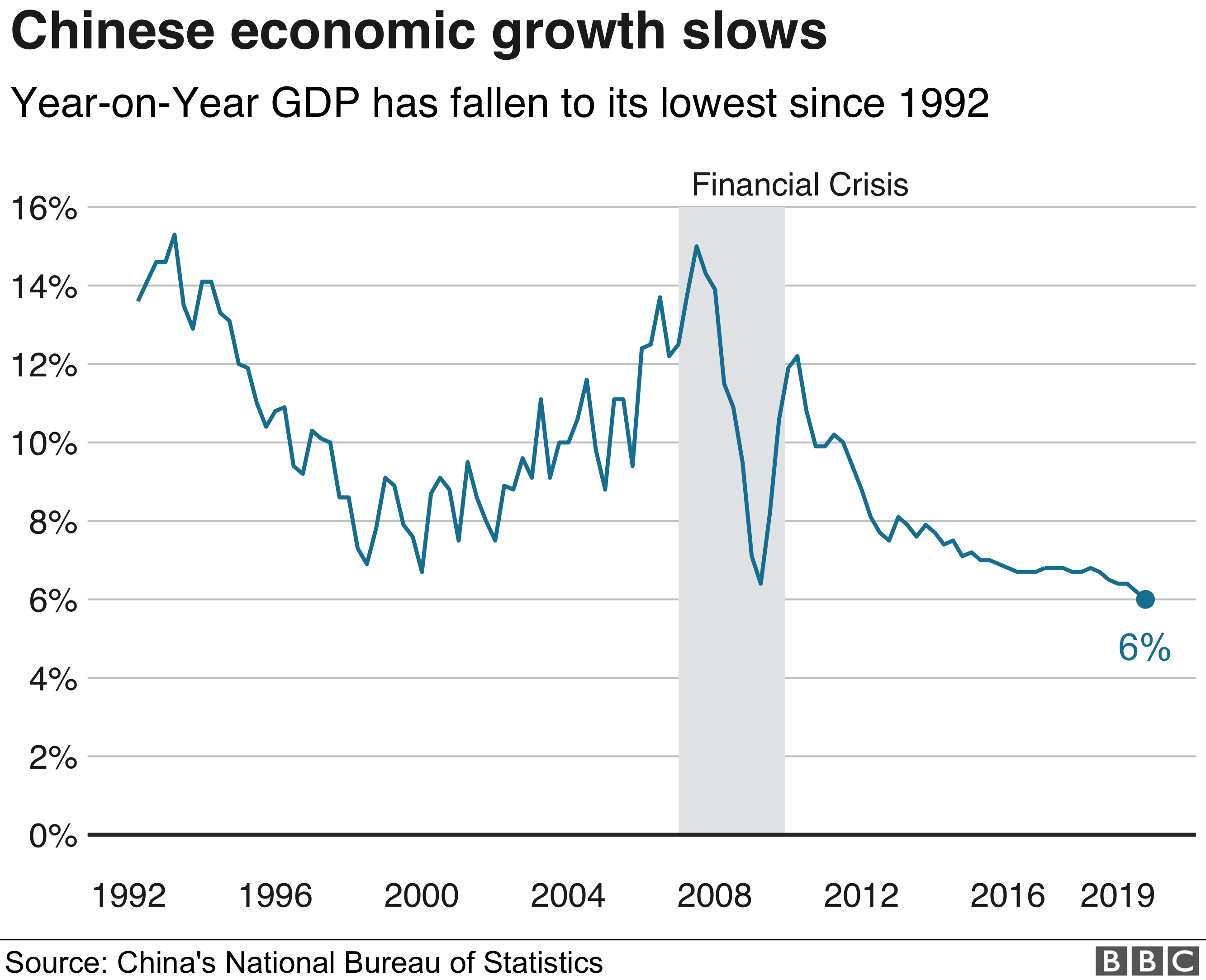
China economy: Third quarter growth misses expectations

China’s economy grew at a slower pace than expected in the third quarter as it struggled with a US-led trade war and softer domestic demand.

In the three months to September, the economy expanded 6% from a year earlier, official figures showed.

The result fell just short of expectations for 6.1% growth for the period.

The slowdown comes despite government efforts to support the economy, including measures such as tax cuts.

The latest figures mark a further loss of momentum in the world’s second largest economy, which had already seen growth languishing at its slowest pace in around three decades.

The rate remained within the government’s target range for annual growth of between 6% and 6.5%.

The strength of the Chinese economy is closely watched as slowing growth can have far-reaching consequences for the global economy.

The country has become a key engine of growth in recent decades. Its healthy demand for a range of products, from commodities to machinery, has supported growth around the world.

Some analysts worry that a sharp slowdown in China could hurt an already sluggish world economy and increase the risk of a recession.

Chart on China GDP

Julian Evans-Pritchard, senior China economist at Capital Economics, said pressure on the Chinese economy “should intensify in the coming months”.

He said more intervention by policymakers to support the economy was likely “but it will take time for this to put a floor beneath economic growth”.

What challenges does China face?

China has been fighting a trade war with the US for the past year, which has created uncertainty for businesses and consumers.

At the same time, it faces domestic challenges including a swine fever outbreak that has fuelled inflation and hit consumer spending.

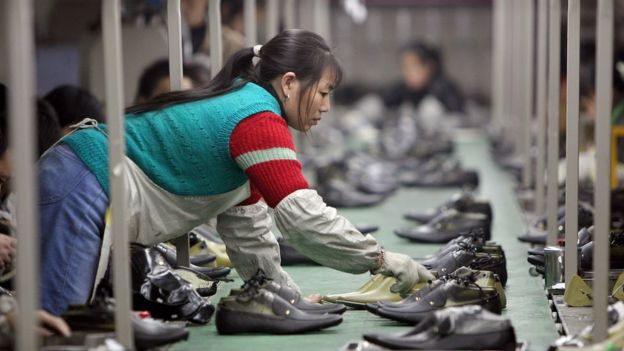
A woman works in a shoe factory in ChinaImage copyright GETTY IMAGES
Image caption China accounted for 16% of global gross domestic product in 2018, according to the McKinsey Global Institute

This week the International Monetary Fund trimmed its 2019 growth forecast for China to 6.1% from 6.2% due to the long-running trade dispute and slowing domestic demand.

But there have been some signs of progress toward resolving the trade battle, with the US and China reaching a “phase one deal” earlier this month.

The government has sought to help the economy through tax cuts and by taking measures to boost liquidity in the financial system.

Still, some analysts say the government has become more cautious in providing stimulus amid growing concerns about China’s rising debt pile.

Presentational grey line
Analysis box by Karishma Vaswani, Asia business correspondent

Any analysis of China’s economic data has to come with a caveat: Many economists believe the actual figures are much lower than what we are told, but it’s the trajectory of growth and signalling from the government that you should pay attention to.

The fact that the growth figures have come in below market expectations indicate that China’s economy is hurting more than many thought.

There were signs from China that these numbers were going to be worrying. Earlier this week, Premier Li Keqiang made the unusual move to warn local officials that they must do “everything” to make sure they hit growth targets for this year.

China’s economy is being hit on three fronts: The US-led trade war, slowing demand at home and rising domestic challenges including the outbreak of swine fever that has dealt a huge blow to its pork farmers. It’s also pushed up prices for consumers.

China’s slowdown is nothing new. But these challenges pose new headaches for policymakers who are trying to manage the slowdown. The country’s political stability depends on economic security – and over the last forty years, that’s what the Communist Party has delivered. They’re under pressure to keep that contract.

Source: The BBC

17/10/2019

Vice premier calls for high-quality development in Chongqing

CHINA-CHONGQING-HAN ZHENG-RESEARCH TRIP(CN)

Vice Premier Han Zheng, also a member of the Standing Committee of the Political Bureau of the Communist Party of China Central Committee, learns about applications of smart robot and 5G technology in fields like remote driving, education and tourism, at an experience park in southwest China’s Chongqing Municipality, Oct. 15, 2019. Han made a research trip to Chongqing on Monday and Tuesday. (Xinhua/Liu Weibing)

CHONGQING, Oct. 16 (Xinhua) — Vice Premier Han Zheng has called on southwest China’s Chongqing Municipality to promote high-quality development and continue to break new ground in all areas.

Han, also a member of the Standing Committee of the Political Bureau of the Communist Party of China Central Committee, made the remarks during a research trip to Chongqing on Monday and Tuesday.

Chongqing should play a key role in advancing the large-scale development of the western region, promoting the joint construction of the Belt and Road Initiative and the green development of the Yangtze River Economic Belt.

During his visit to an auto research and development center and a new-energy vehicle (NEV) manufacturer, Han stressed more input in research to make breakthroughs in key auto parts, and called for the building of homegrown auto brands, wider application of NEVs in urban public transport and the sustainable development of the industry.

Efforts should be made to foster intelligent industries, popularize intelligent technologies and knowledge, and develop intelligent economy, he added.

In his visit to a semi-conductor firm, Han encouraged local companies to enhance their competitiveness and asked local authorities to further improve the business environment.

Source: Xinhua

17/10/2019

China says it hopes to reach phased trade pact with U.S. as early as possible

BEIJING (Reuters) – China’s commerce ministry said on Thursday that China hoped to reach a phased agreement with the United States over trade as early as possible, and make progress on canceling tariffs on each others’ goods.

A phased agreement would help restore market confidence and reduce uncertainty, Gao Feng, spokesman at the ministry, told reporters, adding that both sides were maintaining close communication.

On Oct. 11, U.S. President Donald Trump outlined the first phase of a deal to end the trade war with China and suspended a threatened tariff hike, but officials on both sides said much more work needed to be done before an accord could be agreed.

Trump had originally planned to proceed with a hike in tariffs to 30% from 25% on about $250 billion worth of Chinese goods last week. But the U.S. administration has yet to make a decision on how to address planned 10% tariffs on roughly $156 billion of Chinese goods due to take effect on Dec. 15.

U.S. and Chinese trade negotiators are working on nailing down a Phase 1 trade deal text for their presidents to sign next month, U.S. Treasury Secretary Steven Mnuchin said on Wednesday.

Mnuchin said the Trump administration’s “objective” was for the agreement to be signed between the presidents of the two countries at a Nov. 16-17 summit of Asia-Pacific Economic Cooperation countries in Santiago, Chile.

Working-level representatives from both countries are working on specifics of an agreement now, Gao said.
In recent days, there have been positive signs from China.
China’s securities regulator on Friday unveiled a firm timetable for scrapping foreign ownership limits in futures, securities and mutual fund companies for the first time.
Increasing foreign access to the sector is among the U.S. demands at the trade talks.
A day before, the U.S. Department of Agriculture confirmed net sales of 142,172 tonnes of U.S. pork to China in the week ended Oct. 3, the largest weekly sale to the world’s top pork market on record.
Trump said China had agreed to make purchases of $40 billion to $50 billion in U.S. agricultural goods. Mnuchin said the purchases would be scaled up to that amount annually.
On Wednesday, Chinese Premier Li Keqiang said China will remove business restrictions on foreign banks, brokerages and fund management firms, without giving details.
Source: Reuters
09/10/2019

Technology, not China, can be blamed for regional job losses in developed countries, IMF finds

  • Competition from China is not the primary reason for regional job losses in rich countries, new IMF research finds
  • Study finds technological advancement is bigger driver of unemployment, undermining populist argument China is stealing manufacturing jobs
The IMF said automation displaced more jobs in rich countries than China’s growing productivity. Photo: SCMP

Automation rather than market competition from China can be blamed for regional job losses suffered in developed countries, including American rust belt states, according to new research by the International Monetary Fund released on Wednesday.

“Increases in import competition in external markets associated with the rise of China’s productivity do not have marked effects on regional unemployment,” the Washington-based fund said in an academic paper. “Only technology shocks tend to have lasting effects, with even larger unemployment rises for vulnerable lagging regions.”

The paper, which looked at regional disparities within advanced countries, undermines a key argument pushed by US President Donald Trump in the ongoing trade war

 between Washington and Beijing – that China has been stealing American technology and jobs.
Although the research did not mention Trump, the IMF said the argument that market competition displaced jobs was flawed as imports from China could only cause job losses in the near term and such impact “quickly abates”.

The US goods trade deficit with China hit a record of US$419.2 billion in 2018, which the Trump administration has blamed for a decline in US manufacturing jobs.

In the paper, the IMF classified a region as “lagging” if two conditions were met – initial real gross domestic product (GDP) per capita was below the country’s median in 2000, and the region’s average growth between 2000 to 2017 was below average.

Labour productivity tended to be lower and employment in the agriculture sector higher in lagging regions, the IMF said. Within the United States, per capita GDP in the state of New York is 100 per cent higher than in Mississippi, parts of which are considered within the rust belt.

While increases in import competition tended to reduce labour force participation after one year, this impact faded quickly and did not have significant effects on regional unemployment on average, IMF analyst Weicheng Lian said.

The impact of technology was more far-reaching, however, with researchers pinpointing it as the main driver of rising unemployment in lagging regions.

Automation pressures

translate into a decline in the cost of machinery and equipment, leading to more persistent rises in unemployment and declines in labour force participation in lagging regions, compared with less vulnerable regions, the study said.

Lian said that poorer regions tend to specialise in agriculture and manufacturing industries rather than high productivity service sectors such as information technology, communications and finance.
“We find that a negative technology shock … raises unemployment in all regions that are more vulnerable to automation, but lagging regions are particularly hurt,” she said.
China-US trade war may cost US$700 billion by 2020 in synchronised global slowdown, new IMF chief says

US-China trade war could cost world economy US$700 billion by 2020: IMF

Read more

China tones down expectations ahead of US trade war talks as Vice-Premier Liu He leads team to Washington

China tones down expectations ahead of US trade war talks

Read more

Kristalina Georgieva is the new IMF chief, taking over from Christine Lagarde

Kristalina Georgieva is the new IMF chief

Read more

China, US urged to ease trade war tensions that are ‘weighing on’ global commerce, says IMF chief economist

China, US urged to ease tensions that are ‘weighing on global trade’

Read more

US-China trade war caused ‘self-inflicted’ damage to the global economy, says IMF after third 2019 forecast cut

US-China trade war caused ‘self-inflicted’ damage to the global economy

08/10/2019

World’s longest double-deck suspension bridge opens to traffic

CHINA-HUBEI-WUHAN-DOUBLE-DECK SUSPENSION BRIDGE-OPENING TO TRAFFIC (CN)

Aerial photo taken on Sept. 25, 2019 shows the Yangsigang Yangtze River bridge in Wuhan, capital of central China’s Hubei Province. The double-deck suspension bridge with the longest span in the world opened to traffic in Wuhan on Oct. 8. The double-deck road bridge over the Yangtze River, with a 1,700-meter-long main span, stretches 4.13 km in total length. The top deck of the 10th Yangtze River bridge has six lanes with a designed speed of 80 kph while the bottom deck also has six lanes but with a designed speed of 60 kph. (Xinhua/Xiong Qi)

WUHAN, Oct. 8 (Xinhua) — A double-deck suspension bridge with the longest span in the world opened to traffic in Wuhan, capital of central China’s Hubei Province, on Tuesday.

The first double-deck road bridge over the Yangtze River, with a 1,700-meter-long main span, stretches 4.13 km in total length.

The top deck of the 10th Yangtze River bridge has six lanes with a designed speed of 80 kph while the bottom deck also has six lanes but with a designed speed of 60 kph.

On the top deck there are also two sightseeing sidewalks and on the bottom deck there are two cycleways together with two sidewalks.

“The Yangsigang Yangtze River bridge is the world’s longest-spanning double-deck suspension bridge,” said Xu Gongyi, chief designer of the structure.

The new bridge will help ease traffic congestion and promote more balanced city development, said Lin Chi, vice president of Wuhan Urban Construction Investment and Development Group Co., Ltd.

Source: Xinhua

06/10/2019

Xinhua Headlines: China’s Greater Bay Area busy laying foundation for innovation

As China aims to develop its Greater Bay Area into an international innovation and technology hub, innovation and entrepreneurship resources are shared in the area to provide more opportunities for young Hong Kong and Macao entrepreneurs.

The provincial government of Guangdong has stepped up efforts to improve basic research capability, considered the backbone of an international innovation and technology hub, by building large scientific installations and launching provincial labs.

by Xinhua writers Liu Yiwei, Quan Xiaoshu, Wang Pan, Jing Huaiqiao

GUANGZHOU, Oct. 5 (Xinhua) — Hong Kong man Andy Ng was surprised his shared workspace Timetable was rented out completely only six months after it had started operation in Guangzhou, capital of south China’s Guangdong Province.

While studying economics at City University of Hong Kong, Ng set up his first business, developing an online education platform, but soon realized the Hong Kong market was too small. After earning a master’s degree in the UK in 2017, Ng returned to China and chose Guangzhou as his new base.

Timetable is now accumulating popularity and even fans in Dianping.com, China’s major online consumer guide. Ng feels lucky that his business caught the implementation of the Guangdong-Hong Kong-Macao Greater Bay Area (GBA) development plan.

The bay area, covering 56,000 square km, comprises Hong Kong and Macao, as well as nine cities in Guangdong. It had a combined population of about 70 million at the end of 2017, and is one of the most open and dynamic regions in China.

Aerial photo taken on July 11, 2018 shows the Hong Kong-Zhuhai-Macao Bridge in south China. (Xinhua/Liang Xu)

In July 2017, a framework agreement on the development of the bay area was signed. On February 18 this year, China issued the more specific Outline Development Plan for the Guangdong-Hong Kong-Macao Greater Bay Area. One of its major aims is to develop the area into an international innovation and technology hub.

OPPORTUNITIES FOR YOUTH

The plan proposes that innovation and entrepreneurship resources be shared in the bay area to provide more opportunities for young Hong Kong and Macao entrepreneurs.

An incubator for entrepreneurship, Timetable is home to 52 companies, including 15 from Hong Kong and Macao, such as Redspots, a virtual reality company that won the Hong Kong Information and Communications Technology (ICT) Awards 2019.

“I persuaded them one by one to come here,” Ng said. “I told them of my own experience that the GBA is a great stage for starting a business with ever-upgrading technologies, ever-changing consumer tastes and a population 10 times that of Hong Kong.”

Timetable is a startup base of the Guangzhou Tianhe Hong Kong and Macao Youth Association, which has assisted 65 enterprises founded by Hong Kong and Macao young people since its establishment in October 2017.

The association and its four bases provide a package of services from training and registering to policy and legal consultation, said Chen Jingzhan, one of the association founders.

Tong Yat, a young Macao man who teaches children programming, is grateful the association encouraged him to come to Guangdong, where young people enjoy more preferential policies to start their own businesses.

“The GBA development not only benefits us, but paves the way for the next generation,” Tong said. “If one of my students were to become a tech tycoon in the future and tell others that his first science and technology teacher was me, I would think it all worthwhile.”

In the first quarter of this year, there were more than 980 science and technology business incubators in Guangdong, including more than 50 for young people from Hong Kong and Macao, said Wu Hanrong, an official with the Department of Science and Technology of Guangdong Province.

INNOVATION HIGHLAND

As the young entrepreneurs create a bustling innovative atmosphere, the Guangdong government has stepped up efforts to improve basic research capability, considered the backbone of an international innovation and technology hub, by building large scientific installations and launching provincial labs.

Several large scientific facilities have settled in Guangdong. China Spallation Neutron Source (CSNS) operates in Dongguan City; a neutrino observatory is under construction in Jiangmen City; a high intensity heavy-ion accelerator is being built in Huizhou City.

Aerial photo taken on June 23, 2019 shows the construction site of the Jiangmen Underground Neutrino Observatory (JUNO) in Jiangmen, south China’s Guangdong Province. (Xinhua/Liu Dawei)

Guangdong also plans to build about 10 provincial labs, covering regenerative medicine, materials, advanced manufacturing, next-generation network communications, chemical and fine chemicals, marine research and other areas, said Zhang Yan, of the provincial department of science and technology.

Unlike traditional universities or research institutions, the provincial labs enjoy a high degree of autonomy in policy and spending. A market-oriented salary system allows them to recruit talent from all over the world, and researchers from other domestic organizations can work for the laboratories without giving up their original jobs, Zhang said.

The labs are also open to professionals from Hong Kong and Macao. Research teams from the universities of the two special administrative regions have been involved in many of the key programs, Zhang said.

For example, the provincial lab of regenerative medicine and health has jointly established a regenerative medicine research institute with the Chinese University of Hong Kong, a heart research center with the University of Hong Kong, and a neuroscience research center with the Hong Kong University of Science and Technology (HKUST).

Photo taken on July 24, 2019 shows a rapid cycling synchrotron at the China Spallation Neutron Source (CSNS) in Dongguan, south China’s Guangdong Province. (Xinhua/Liu Dawei)

Guangdong has been trying to break down institutional barriers to help cooperation, encouraging Hong Kong and Macao research institutions to participate in provincial research programs, exploring the cross-border use of provincial government-sponsored research funds, and shielding Hong Kong researchers in Guangdong from higher mainland taxes.

NANSHA FOCUS

Located at the center of the bay area, Guangzhou’s Nansha District is designed as the national economic and technological development zone and national free trade zone, and is an important pivot in building the area into an international innovation and technology hub.

The construction of a science park covering about 200 hectares started on Sept. 26. Gong Shangyun, an official with the Nansha government, said the park will be completed in 2022.

Jointly built by the Guangzhou government and the Chinese Academy of Sciences (CAS), the science park will accommodate CAS research institutes from around Guangzhou, including the South China Sea Institute of Oceanology, the South China Botanical Garden (SCBG) and the Guangzhou Institute of Energy Conversion.

Ren Hai, director of the SCBG, is looking forward to expanding the research platforms in Nansha. “We will build a new economic plant platform serving the green development of the Pearl River Delta, a new botanical garden open to the public, and promote the establishment of the GBA botanical garden union.”

Wang Ying, a researcher with the SCBG, said the union will help deepen the long cooperation among its members and improve scientific research, science popularization and ecological protection. “Predecessors of our botanical garden have helped the Hong Kong and Macao counterparts gradually establish their regional flora since the 1950s and 1960s.”

HKUST also started to build a new campus in Nansha the same day as the science park broke ground. “Located next to the high-speed rail station, the Guangzhou campus is only a 30-minute journey from the Hong Kong campus. A delegation from the HKUST once paid a visit to the site and found it very convenient to work here,” Gong said.

Chief Executive of the Hong Kong Special Administrative Region (HKSAR) Carrie Lam hoped the new campus would help create a new chapter for the exchanges and cooperation on higher education between Guangzhou and Hong Kong, and cultivate more talents with innovative capabilities.

Nansha’s layout is a miniature of the provincial blueprint for an emerging international innovation and technology hub.

“We are seeking partnership with other leading domestic research institutions and encouraging universities from Hong Kong and Macao to set up R&D institutions in Guangdong,” said Zhang Kaisheng, an official with the provincial department of science and technology.

“We are much busier now, because research institutes at home and abroad come to talk about collaboration every week. The GBA is a rising attraction to global scientific researchers,” Zhang said.

Source: Xinhua

05/10/2019

Economic Watch: Foreign investors show strong appetite for Chinese market

BEIJING, Oct. 4 (Xinhua) — Despite the slowing momentum of global trade growth, China remains attractive to the world’s multinationals with its huge consumer market, optimized business environment and innovation capability.

EXPANDING PRESENCE

Swiss tech giant ABB began construction of its new 67,000-square meter robotics manufacturing and research facility in Shanghai in September with an investment of 150 million U.S. dollars.

It is designed to be the most advanced, automated and flexible factory in the global robotics industry, utilizing the latest manufacturing processes –– a cutting-edge center where robots make robots.

Since 1992, ABB has invested more than 2.4 billion U.S. dollars in China, with nearly 20,000 employees in total. China has become the company’s second-largest market.

“In the future, we will continue to expand investment in the country, further optimize the business layout and enhance innovation capability,” said Gu Chunyuan, president of ABB Asia, Middle East and Africa Region.

German company Henkel, a leading player in industrial and consumer businesses, also has a long-term commitment to and strong confidence in China. Early this year, Henkel announced it is stepping up investment by around 300 million euros annually to build on its strengths and capture opportunities.

“China will be one of the focal markets. We will strengthen our position by accelerating the launch of new brands and innovations, increasing our marketing investments and driving digitalization even further,” said Jeremy Hunter, president of Henkel Greater China.

Having established its first office in Beijing in 1988, the company now has around 5,000 employees at 25 sites across China. The production output of its manufacturing plant in Yantai of Shandong Province has increased more than 50 times over the years.

EMBRACING OPPORTUNITIES

“China’s huge market, steady growth momentum, complete industrial infrastructure as well as rich talent resources are all very attractive, ” said Gu Chunyuan.

As ABB’s second-biggest market, China’s increasingly optimized business climate, more energetic and effective market system and deepened opening-up policies have lured the company to beef up its confidence in the China market, he said.

As the center of the world’s manufacturing industry, China has witnessed unprecedented upgrading and transformation of industries toward digitalization and intelligence, which will unleash huge market potential, said Gu, adding that China’s development has brought many opportunities to the company, and convinced ABB to expand investment.

Hunter attributed Henkel’s success in China to the country’s continuous efforts of pursuing innovation-driven economic development, which has fostered a favorable environment for the company.

“Moreover, China has become a global force in digital technologies. Accelerated digitalization has also been a key driver for Henkel,” said Hunter, noting that the rapid transformation of China’s manufacturing and consumption upgrading are also driving demand for the company.

EXPECTING GROWTH

Foreign investors agree that the Chinese economy offers them indispensable certainty and confidence with its positive outlook.

Commenting on China’s efforts on pushing for all-around opening-up and building a stable, transparent and predictable investment environment, Gu said these measures will bring huge development opportunities for foreign-funded companies.

“We believe that China’s further opening-up will promote the globalization as well as the liberalization and facilitation of trade,” Gu said.

Hunter noted China will maintain its unparalleled momentum in industrial and consumption upgrading and its integration into global flows of trade, talent and innovation.

“I believe that the Chinese market will go beyond just participating in these areas to actively shaping their future development,” he said.

Source: Xinhua
05/10/2019

People enjoy leisure time during National Day holiday in China

CHINA-NINGXIA-ZHONGWEI-TOURISM (CN)

Visitors tour the desert on camels at Shapotou Scenic Area in Zhongwei, northwest China’s Ningxia Hui Autonomous Region, Oct. 3, 2019. Since the start of the National Day holiday, Shapotou Scenic Area has entered its peak season for tourism. (Photo by Yang Zhisen/Xinhua)

Source: Xinhua

05/10/2019

India’s onion crisis: Why rising prices make politicians cry

A labourer carries a sack of onions at a wholesale vegetable market on the outskirts of Amritsar on September 19, 2019.Image copyright GETTY IMAGES
Image caption The onion is India’s most “political” vegetable

Onion prices have yet again dominated the headlines in India over the past week. BBC Marathi’s Janhavee Moole explains what makes this sweet and pungent vegetable so political.

The onion – ubiquitous in Indian cooking – is widely seen as the poor man’s vegetable.

But it also has the power to tempt thieves, destroy livelihoods and – with its fluctuating price a measure of inflation – end the careers of some of India’s most powerful politicians.

With that in mind, it’s perhaps unsurprising those politicians might be feeling a little concerned this week.

So, what exactly is happening with India’s onions?

In short: its price has skyrocketed.

Onion prices had been on the rise in India since August, when 25 rupees ($0.35; £0.29) would have got you a kilo. At the start of October, that price was 80 rupees ($1.13; £0.91).

Fearing a backlash, the Bharatiya Janata Party (BJP)-led government banned onion exports, hoping it would bring down the domestic price. And it did.

Vegetable vendors sell onions by the road, at Sector 25 on September 24, 2019 in Noida, India.Image copyright GETTY IMAGES
Image caption Onion prices peaked by the end of September

A kilo was selling for less than 30 rupees on Thursday at Lasalgaon, Asia’s largest onion wholesale market, located in the western state of Maharashtra.

However, not everyone is happy.

While high prices had angered consumers in a sluggish Indian economy, the fall in prices sparked protests by exporters and farmers in Maharashtra, where state elections are due in weeks.

And it is not just at home where hackles have been raised: the export ban has also strained trade relations between India and its neighbour, Bangladesh, which is among the top importers of the vegetable.

But why does the onion matter so much?

The onion is a staple vegetable for the poor, indispensable to many Indian cuisines and recipes, from spicy curries to tangy relishes.

“In Maharashtra, if there are no vegetables or you can’t afford to buy vegetables, people eat ‘kanda bhakari’ [onion with bread],” explains food historian Dr Mohseena Mukadam.

True, onions are not widely used in certain parts of the country, such as the south and the east – and some religious communities don’t eat them at all.

But they are especially popular in the more populous northern states which – notably – send a higher number of MPs to India’s parliament.

“Consumers in northern India wield more power over the federal government. So although consumers in other parts of India don’t complain as much about higher prices, if those in northern India do, the government feels the pressure,” says Milind Murugkar, a policy researcher.

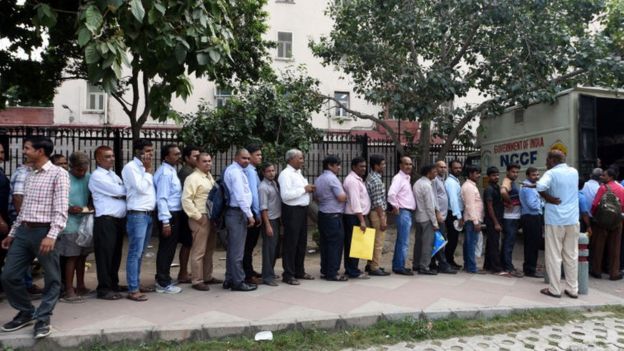
People stand in a queue to buy onions sold at Rs. 22 per kg by the Government of India, outside Krishi Bhawan on September 24, 2019 in New Delhi, India.Image copyright GETTY IMAGES
Image caption Onions are so ubiquitous that the government has been selling them at subsided rates

A drop in prices also affects the income of onion farmers, mainly in Maharashtra, Karnataka in the south and Gujarat in the west.

“Farmers see the onion as a cash crop that grows in the short term, and grows well in dry areas with less water,” says Dipti Raut, a journalist, who has been on the “onion beat” for years.

“It’s like an ATM machine that guarantees income to farmers and sometimes, their household budget depends on the onion produce,” she said.

Onions have even attracted robbers: when prices skyrocketed in 2013, thieves tried to steal a truck loaded with onions, but were caught by the police.

Why do politicians care about the onion?

Put simply, because the price moving too far one way or another is likely to anger a large block of voters, be they everyday households, or the country’s farmers.

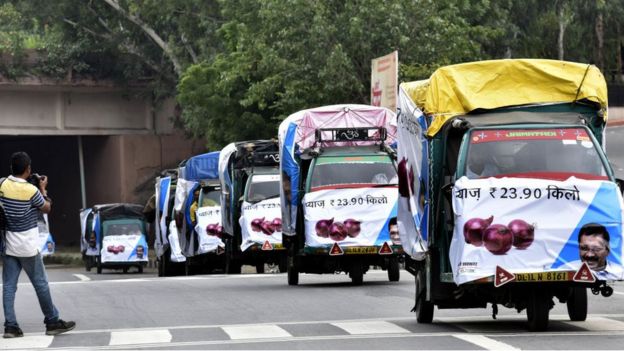
Control rate onion vans seen after flagged off by Chief Minister of Delhi Arvind Kejriwal, at Delhi secretariat, on September 28, 2019 in New Delhi, India.Image copyright GETTY IMAGES
Image caption The Delhi government transported 70 vans full of subsidised onions

Onions are so crucial they have even featured in election campaigns. The Delhi state government bought and sold them at subsidised rates in September when prices were at their peak: chief minister Arvind Kejriwal, it should be noted, is up for re-election next year.

Meanwhile, Indira Gandhi swept to power in 1980 on slogans that used soaring onion prices as a metaphor for the economic failures of the previous government.

But why did onion prices rise this year?

A drop in supply, due to heavy rains and flooding destroying the crop in large parts of India, and damaging some 35% of the onions stocks in storage, according to Nanasaheb Patil, director of the National Agricultural Co-operative Marketing Federation.

He said the flooding had also delayed the next round of produce, which was due in September.

An Indian restaurant worker cuts onions for curries in New Delhi on September 11, 2015.Image copyright GETTY IMAGES

“This has become a fairly regular phenomenon in recent decades,” Mr Murugkar said. “Onion prices swing heavily with a small drop or increase in production.”

In fact, the shortage – and subsequent rise in prices – happens almost every year around this time, according to Ms Raut.

“It’s a vicious cycle and the trader lobby and middlemen benefit from even the slightest price fluctuations,” she added.

What’s the solution?

Ms Raut says more grass-root planning and better storage facilities and food processing services will ease the problem – and making a variety of cash crops and vegetables available across the country would also ease the pressure on onions.

“The government is quick to act when onion prices rise. Why don’t they act as swiftly when prices fall?” asked Vikas Darekar, an onion farmer in Maharashtra. He said the government should buy onions from farmers at a “fair price”.

Mr Murugkar, however, feels that the government should never interfere in “onion matters”.

“If you are interested in raising purchasing power of the people, they should not curtail exports. Do we have such a ban on software exports? It’s really absurd. A government which has won such a huge majority should be able to withstand the pressures from a few consumers.”

Source: The BBC

Law of Unintended Consequences

continuously updated blog about China & India

ChiaHou's Book Reviews

continuously updated blog about China & India

What's wrong with the world; and its economy

continuously updated blog about China & India