Archive for ‘Economics’

18/05/2019

IMF’s Lagarde says U.S.-China trade war could be risk for world economic outlook

TASHKENT (Reuters) – The trade war between the United States and China could be a risk to the world economic outlook if it is not resolved, International Monetary Fund Managing Director Christine Lagarde told Reuters on Friday during a visit to Uzbekistan.

“Obviously, the downside risk that we have is continued trade tensions between the United States and China,” Lagarde said, referring to the IMF’s world economic outlook.

“And if these tensions are not resolved, that clearly is a risk going forward.”

The IMF last month cut its growth forecast for 2019 to 3.3%, down from the 3.5% it had previously predicted.

It warned at the time that growth could slow further due to trade tensions and a potentially disorderly British exit from the European Union.

“But we expect that at the end of 2019 and in 2020 it will bounce back,” Lagarde said of the world economic outlook on Friday.

The United States infuriated China this week when it announced it was putting Huawei Technologies Co Ltd, the world’s biggest telecoms equipment maker, on a blacklist that could make it hard to do business with U.S. companies.

On Friday Beijing suggested a resumption of talks between the world’s two largest economies would be meaningless unless Washington changes course.

Source: Reuters

17/05/2019

Chinese police detain driver after three pedestrians are mowed down at roadside

  • Police in Shenzhen look for clues to accident in driver’s medical records
  • Motorist complains of ‘sudden attack’ at time of accident
Police in Shenzhen, Guangdong province, are investigating a driver’s medical history after a fatal accident on Thursday. Photo: Weibo
Police in southern China have detained a motorist after three people were killed and seven injured in a car accident on Thursday night.
Officers said a car went out of control and struck pedestrians on a road in Nanshan district in Shenzhen, Guangdong province, at about 7.20pm. The 23-year-old driver, surnamed Liu, was taken into custody.
In a statement online, the Shenzhen public security bureau said blood and urine tests showed the driver was sober and drug-free. They said medicine for epilepsy was found in the vehicle.
Two dead, six injured in Japan after bus drives through pedestrians in Kobe

During questioning, Liu told officers he lost control of car because he had had “a sudden attack”, but did not elaborate.

Police said they were examining Liu’s medical records.

In China, people with epilepsy are not allowed to apply for a driving licence, according to regulations from the Ministry of Public Security.

Source: SCMP

16/05/2019

4th Silk Road int’l expo concludes in Xi’an

XI’AN, May 16 (Xinhua) — The fourth Silk Road International Exposition concluded Wednesday in Xi’an, capital of northwest China’s Shaanxi Province.

During the five-day expo, 65 contracts in various fields including education, medical care, modern agriculture and intelligent manufacturing were signed with a total investment of 115.1 billion yuan (about 16.7 billion U.S. dollars).

Themed “New Era, New Pattern, and New Development,” the fourth Silk Road International Exposition attracted more than 2,000 Chinese enterprises and more than 200 overseas enterprises from 25 countries and regions, including Russia, the United States and Cambodia.

More than 30 activities and exhibitions were staged during the five-day event, including forums, conferences and investment and trade activities. An international forum on poverty relief was first held during the expo to contribute China’s experience and efforts to the global poverty reduction.

Known in ancient times as Chang’an, Xi’an was the starting point of the ancient Silk Road and plays a key role in the Belt and Road Initiative.

Source: Xinhua

12/05/2019

Chinese opera on legendary monk to debut in New York City

NEW YORK, May 11 (Xinhua) — An opera featuring the famous monk Jianzhen of China’s Tang Dynasty (618-907 A.D.) will be presented at New York City’s Lincoln Center next month, according to local theatrical sources.

Based on true history, “Voyage To The East – A Fearless Buddhist Master’s Mission To Japan” told the story of monk Jianzhen, who started sailing to Japan in 742 A.D., but only succeeded in 754 A.D. after five failed attempts. Apart from spreading Buddhism, he also introduced Chinese art, medicine and craftsmanship to Japan, thus becoming a highly respected figure in both nations.

Famous Chinese-American opera singer Tian Haojiang plays Jianzhen in the opera. Tian reportedly has had over 1,400 performances of some 50 roles in all major opera houses worldwide. In order to better depict the role, Tian lived with real monks for some time in Daming Temple of east China’s Yangzhou city, where Jianzhen had stayed before embarking on his journey to Japan.

Produced by China’s Jiangsu Performing Arts Group, the opera’s score is a fusion of modern opera with the original sound of the Japanese koto, the zither, the Chinese guzheng, temple blocks and Buddhist chants.

The opera will be staged on June 22 to 23 at the David H. Koch Theatre of the Lincoln Center.

Source: Xinhua

11/05/2019

China, BiH, Serbia to remake classic movie “The Bridge”

SARAJEVO, May 10 (Xinhua) — An agreement has been signed in Beijing on recording a remake of the 1969 movie “The Bridge” by the Sarajevo Film Center (SFC), Shanghai Huahua Culture Media Co. Ltd and Dandelion Productions Inc. of Serbia, SFC Director Jasmin Durakovic told Xinhua on Friday.

Directed by Hajrudin “Siba” Krvavac, “The Bridge” tells the story of partisans during World War II who send an elite team of explosive experts to blow up a strategically important bridge.

Durakovic emphasized that all movies directed by Krvavac are precious cultural assets in the Bosnia and Herzegovina’s (BiH) film archives.

He hopes that the remake of “The Bridge” — and possibly also of “Walter Defends Sarajevo” — will present the culture of BiH and the region through the global language of the film to today’s audiences.

Durakovic said he was highly confident that the remake will attract audiences in the countries of the former Yugoslavia, in other European countries and even in the United States.

In a telephone interview with Xinhua, Huahua Chief Executive Officer Kefei Wang, said his company will use cutting-edge film technology to present this period of history and its heroes “so as to revitalize the classics and live up to the profound expectations of the people of China, Serbia, and Bosnia and Herzegovina for movies.”

Production on the remake will begin in early 2020.

Source: Xinhua

10/05/2019

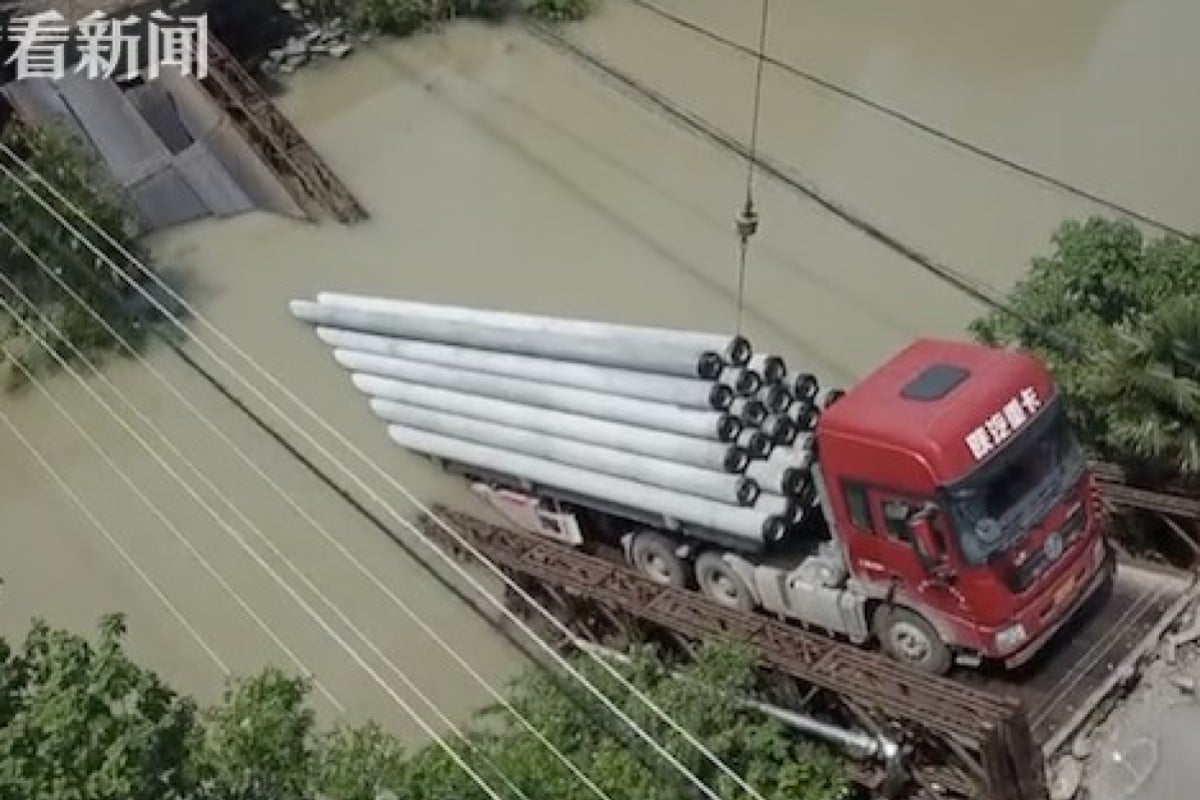
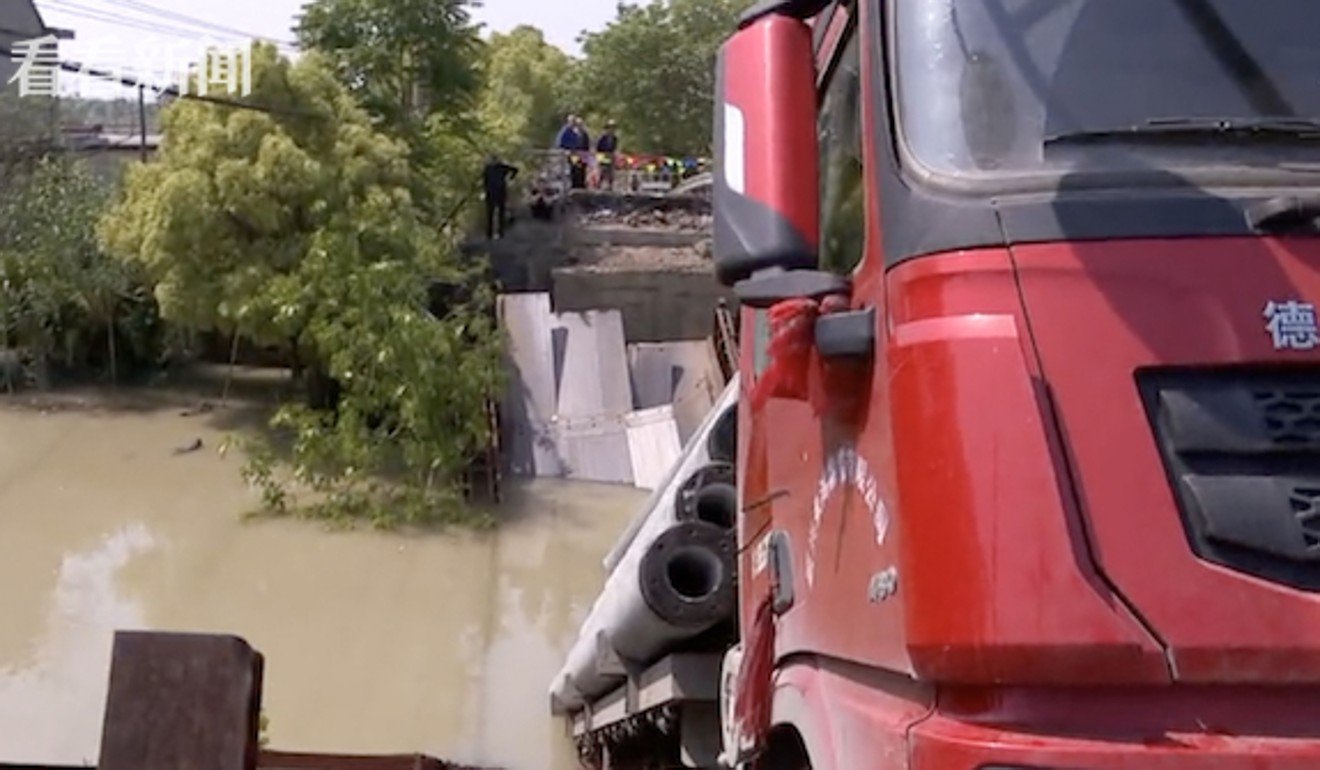
Chinese truck driver collapses steel bridge and dumps 100-tonne load of concrete pipes into river

  • Driver who used map app to find construction site sent to crossing for light traffic
  • Villagers say bridge was used by pedestrians and cars only
Recovery crews attempt to pull the truck and its load from the river in eastern Zhejiang province. Photo: Weibo
A trucker in eastern Zhejiang province collapsed a steel bridge by crossing it with a load weighing 50 times the bridge’s capacity.
The driver, surnamed Zhang, said he missed the two-tonne load warning sign when he tried to take dozens of concrete pipes to a construction site on Thursday morning, Kankannews.com reported.
He was not familiar with the area and used the bridge suggested by his digital map.
When the laden truck, weighing about 100 tonnes, was halfway across, the structure gave way, pitching the vehicle and its cargo into the water below. The driver managed to escape.
The truck’s load was 50 times the bridge’s breaking capacity. Photo: Weibo
Truck driver left hanging after crane smashes into bridge
Residents of a nearby village said a concrete bridge on the site fell into disrepair and was dismantled. It was replaced with a temporary steel structure a couple of years ago.

The new span was intended only for foot traffic and light vehicles, they said.

The pipes were recovered on Thursday evening.

Source: SCMP

07/05/2019

China’s iconic revolutionary base Yan’an bids farewell to poverty

XI’AN, May 7 (Xinhua) — Yan’an, a former revolutionary base of the Communist Party of China (CPC), is no longer labeled “poor,” as its last two impoverished counties have shaken off poverty, the Shaanxi provincial government announced Tuesday.

Yan’an hosted the then headquarters of the CPC and the center of the Communist revolution from 1935 to 1948. The city is now home to more than 350 sites related to the Chinese revolution.

The counties of Yanchuan and Yichuan, with a population of 192,000 and 120,000 respectively and both located along the western bank of the Yellow River, have limited fertile valley fields. Villagers there had been plagued by poverty for decades.

American journalist Edgar Snow wrote in his 1937 book “Red Star over China” that the area was “one of the poorest parts of China” he had seen.

According to the provincial poverty relief office, poverty-stricken residents in the two counties now only account for 1.06 and 0.58 percent respectively of their populations, meeting the country’s requirement for an impoverished county to shake off the title.

An investment of 6.25 billion yuan (920 million U.S. dollars) from the central and local governments has been poured into Yan’an over the past four years.

To make sure that every household can get rid of poverty, the city has sent a total of 1,784 Party chiefs, 1,546 working teams and 37,400 cadres to live in the villages to help with poverty alleviation.

A total of 693 impoverished villages in the city have shaken off poverty, with 195,000 people being lifted out of poverty.

The cradle of the revolution has continued to undergo tremendous changes over the past decades. Improved environment and infrastructure, booming agricultural economy, increasingly affordable education, healthcare, and multiple career choices for rural residents have rejuvenated the city.

Yan’an will continue to help the remaining impoverished people shake off poverty, and strive to enter a moderately prosperous society in all respects with the rest of the country by 2020, said Xu Xinrong, Party chief of the city.

Source: Xinhua

05/05/2019

India’s rural pain goes beyond farmers, and it may be a problem for Modi

ZADSHI VILLAGE, India (Reuters) – Three years ago, brick mason Pundlik Bhandekar was always busy as farmers in his tiny hamlet in Maharashtra commissioned new houses and nearby towns were undergoing rapid urbanisation. Now, as the rural economy sinks and the pace of construction slows, Bhandekar is struggling to get work.

“I used to get a new construction project before I could even finish one. People would come to my house to check when I would be free to work for them,” said Bhandekar, as he sat with friends under the shade of a tree on a hot afternoon.

From daily wage workers such as masons, to barbers and grocery shop owners – just about everyone in Zadshi village, some 720 km (450 miles) from India’s financial hub Mumbai, says a drop in farm incomes has dented their livelihoods.

Their woes are symptomatic of a wider problem across India, where more than half of the country’s 1.3 billion people are dependent on agriculture for their livelihoods, as the slowdown in the rural economy is felt in the dampening sales of consumer goods, especially the biggest such as car and motorbike sales.

The slowdown has also dented Prime Minister Narendra Modi’s popularity in the hinterland that propelled him to power in 2014, and political strategists say it may mean he struggles to form a majority after voting in a staggered general election that began on April 11 concludes on May 19.

Zadshi has been almost entirely dependent on annual cotton and soybean crops that, according to farmers, have given lacklustre returns in the past few years due to a dip in prices, droughts and pest attacks.

And as incomes have dropped, farmers have cut back on big-ticket spending such as building new houses, digging wells or laying water pipelines, squeezing employment opportunities for people such as Bhandkekar.

“No one is interested in hiring us. We are ready to work even at 250 rupees ($3.60) per day,” said Bhandekar, who charged 300 rupees a day when work was steady, but now gets work only once or twice in a fortnight.

LOWER WAGES, LESS SPENDING

Economic data reflects the plight of farmers and daily wage workers.

Retail food inflation in the fiscal year ended on March 31 fell to 0.74 percent, even as core inflation stood at 5.2 percent, according to Bank of America Merrill Lynch Research, eroding the spending power of farmers.

Inflation adjusted wage growth for workers involved in crop sowing was just 0.6 percent 2018/19 compared with 6.5 percent in 2013/14.

The value of farm produce at constant prices grew 15 percent in the past five years, compared with 23 percent in the previous five, while the manufacturing sector grew 40 percent, against 32.6 percent in the previous five years, government data shows.

“Lower rural wages will result in lesser spending, which in turn will reduce demand for goods and services that are part of the rural basket,” Rupa Rege Nitsure, group chief economist at L&T Finance Holdings in Mumbai, told Reuters.

The government needs to spend more in rural areas to generate employment and boost incomes, Nitsure said.

Modi’s Hindu nationalist government did introduce various support schemes in the past six months, such as a 6,000 rupees yearly handout to small farmers.

The main opposition Congress party has gone much further with its pledges though, saying it would introduce a basic minimum income, where the country’s poorest families would get 72,000 rupees annually, benefiting some 250 million people.

RISING UNEMPLOYMENT

In Zadshi, as the mercury touched a searing 40 degrees Celsius(104F), a group of villagers gathered under the trees lining a dusty road and began chatting about everything from crop prices to politics.

“What else we can do? Had work been available in urban areas, we could have moved there but even in the cities construction has slowed down,” said Amol Sontakke, an unskilled labourer who works in farms and on construction sites.

Job opportunities have slowed even in urban areas and India’s unemployment rate touched 7.2 percent in February, the highest since September 2016, according to data compiled by the Centre for Monitoring Indian Economy (CMIE). Official data is unavailable for recent periods.

The mood in Zadshi was glum. While four dozen villagers interviewed by Reuters were hopeful that if there was a good monsoon this year it could improve farm incomes, they’ve been cutting back on spending in the meantime.

“People are thinking twice before buying new clothes during festivals,” said Avinash Gaurkar, a farmer currently doubling up as a part-time driver. “Buying big-ticket items such as motorcycles or refrigerators is out of the question.”

Two years ago Gaurkar began building a house, but had to give up midway as his five-acre farm could not generate the money needed, he said, pointing towards a half-finished structure without doors.

In 2018, just four villagers bought new motorbikes compared with as many as 10 a year about four years ago, said cotton farmer Raju Kohale, whose son is sitting at home unemployed after graduating as an engineer.

“Poor monsoon or lower prices, something or the other has been hurting us in the past few years,” Kohale said.

MODI AGAIN?

In the 2014 general election, most in Zadshi voted for Modi, but the farmers’ distress has swayed many towards the opposition Congress party. That was clear from Reuters’ interviews with 48 villagers, who cast their ballots last month.

Farmers are at the bottom of the Modi administration’s priority list, said labourer Sagar Bahalavi.

“They are building big roads to connect metros and calling it development. How is that useful for us?” he said.

Some, though, want to give Modi a second chance.
“Modi’s intentions are good, it’s the bureaucratic system that is not supporting him,” said Gulab Chalakh, who owns a 20-acre farm and is among the richest in the village. “We should give him another chance.”
Source: Reuters
02/05/2019

Why jobs are dominating the Indian election

As unemployment climbs in India, job creation is top of the agenda this election season.

By some estimates the country needs to create eight to ten million jobs each year to tackle the problem. But is the goal achievable?

Source: The BBC

29/04/2019

Cambodian PM says China ready to help if EU imposes sanctions

PHNOM PENH (Reuters) – China will help Cambodia if the European Union (EU) withdraws special market access over its rights record, Cambodian Prime Minister Hun Sen said on Monday as he announced a 600 million yuan ($89 million) Chinese aid package for his military.

Hun Sen, who is on a five-day trip to China to attend a Belt and Road Initiative (BRI) forum in Beijing, held bilateral talks with President Xi Jinping and signed several agreements with Cambodia’s most important ally.

Cambodia benefits from the EU’s “Everything But Arms” trade scheme which allows the world’s least developed countries to export most goods to the EU free of duties.

But Cambodia risks losing the special access to the world’s largest trading bloc over its human rights records.

During a meeting with Chinese Prime Minister Li Keqiang, Li pledged to help Cambodia if the EU withdraws the market access, according to a post on Hun Sen’s official Facebook page.

“In this regard … Prime Minister Li Keqiang also confirmed his efforts to help Cambodia,” the post said.
China is Cambodia’s biggest aid donor and investor, pouring in billions of dollars in development aid and loans through the Belt and Road initiative, which aims to bolster land and sea links with Southeast Asia, Central Asia, the Middle East, Europe and Africa.
Unlike Western countries, China does not question Cambodia’s record on rights.
The EU, which accounts for more than one-third of Cambodia’s exports, including garments, footwear and bicycles, in February began an 18-month process that could lead to the suspension of the special market access.
Among the agreements Hun Sen struck in China was one for Huawei Technologies to help Cambodia develop a system for 5G technology. The Chinese tech giant has ambitions to build the next generation of data networks across the world and boasts 40 commercial 5G contracts worldwide.
China also agreed to import 400,000 tonnes of Cambodian rice, according to Hun Sen’s Facebook page.
“China will continue to support the national defence sector in Cambodia, and in this regard, the Chinese president announced that China will provide 600 million yuan to Cambodia’s defence sector,” the post said.
Source: Reuters
Law of Unintended Consequences

continuously updated blog about China & India

ChiaHou's Book Reviews

continuously updated blog about China & India

What's wrong with the world; and its economy

continuously updated blog about China & India