Chindia Alert: You’ll be Living in their World Very Soon
aims to alert you to the threats and opportunities that China and India present. China and India require serious attention; case of ‘hidden dragon and crouching tiger’.
Without this attention, governments, businesses and, indeed, individuals may find themselves at a great disadvantage sooner rather than later.
The POSTs (front webpages) are mainly 'cuttings' from reliable sources, updated continuously.
The PAGEs (see Tabs, above) attempt to make the information more meaningful by putting some structure to the information we have researched and assembled since 2006.
– The last nine poverty-stricken county-level regions in east China’s Anhui Province have been removed from the country’s list of impoverished counties.
– This marks that all county-level regions in the Yangtze River Delta, consisting of Shanghai and the provinces of Jiangsu, Zhejiang and Anhui, have been officially lifted out of poverty for the first time in history.
HEFEI, April 29 (Xinhua) — Sitting in front of his smartphone, Zhang Chuanfeng touts dried sweet potatoes to viewers on China’s popular video-sharing app Douyin, also known as TikTok.
“These are made from sweet potatoes I grew myself. They are sweet and have an excellent texture,” said Zhang while livestreaming in Tangjiahui Township of Jinzhai County in east China’s Anhui Province. Tucked away in the boundless Dabie Mountains, the township used to have the biggest poor population in the county.
Aerial photo taken on April 16, 2020 shows residential buildings in Dawan Village of Jinzhai County, east China’s Anhui Province. (Xinhua/Liu Junxi)
Jinzhai County is among the last nine county-level regions in Anhui that have been removed from the country’s list of impoverished counties, according to an announcement issued by the provincial government Wednesday. They are also the last group of county-level regions that bid farewell to poverty in the Yangtze River Delta.
E-COMMERCE
Zhang might seem like a typical e-commerce businessman reaping success in China’s booming livestreaming industry. But his road to success has been a lot bumpier: he suffers from dwarfism.
A little more than 1.4 meters tall, Zhang has a babyface, making him “look like a junior school student,” he said. But the man, 38, is the father of a nine-year-old boy.
For Zhang, life was tough before 2014. “Nobody wanted me because of my ‘disabilities’ when I went out to look for jobs,” he said. “I was turned down again and again.”
Zhang was put on the government’s poverty list in 2014 as China implemented targeted poverty-relief measures. With the help of local officials, he got a bank loan of 10,000 yuan (about 1,400 U.S. dollars) and bought 22 lambs. He tended the animals whole-heartedly and seized every opportunity to learn how to raise them more professionally.
Zhang Chuanfeng feeds his lambs in Zhufan Village of Jinzhai County, east China’s Anhui Province, April 26, 2017. (Xinhua/Zhang Duan)
Within a year, the number of his lambs expanded to hundreds. In 2016, Zhang’s earnings exceeded 100,000 yuan, more than enough for him to cast off poverty.
Riding on this success, Zhang began to seek new opportunities. He rented a shop and started selling products online to embrace an e-commerce strategy the local government introduced in 2017.
More than 100 online shops, including Zhang’s, in the county have helped more than 7,000 poverty-stricken households sell about 73 million yuan worth of local specialties since 2018. Zhang alone earned 500,000 yuan from a sales revenue of 5 million yuan last year.
A villager arranges local specialties for sale at Dawan Village of Jinzhai County, east China’s Anhui Province, April 17, 2020. (Xinhua/Liu Junxi)
WICKERWORK SUCCESS
About 100 km north of Jinzhai lies Funan, a place that used to be vulnerable to constant floods.
Zhang Chaoling, who lives by the Huaihe River in Funan County, had to flee her hometown at a young age due to floods, but has flourished on a willow plantation along the river later.
“The land is largely covered by silt following continual flooding in the past. It is an ideal place to plant willows and make wickerwork,” Zhang said.
Zhang left her hometown for Guangzhou in 1993 and found a job in a garment factory. A few years later, she founded a trading company with her husband in Guangzhou, selling wickerwork products from her hometown to other countries.
Zhang returned to her hometown and set up a wickerwork production base in 2011. Funan is famous for its delicate wickerwork. Skilled craftsmen traditionally use local willow as a raw material to weave products such as baskets, furniture and home decorations.
A villager arranges wickerwork products in Funan County, east China’s Anhui Province, April 15, 2020. (Photo by Zhou Mu/Xinhua)
“The flood is well controlled now. I remember the last huge flood came in 2007,” Zhang said.
Taking advantage of the fertile land along the Huaihe River, she plants over 130 hectares of willow trees and employs hundreds of locals mostly in their 50s and 60s.
“I can process 100 to 150 kg of willow twigs per day, from which I make around 80 yuan,” said Geng Shifen, who peels willow twigs with a clamp next to the plantation.
A total of 130,000 people are engaged in the wickerwork industry in Funan, creating an output of nearly 9 billion yuan in 2019, and helping 15,000 locals shake off poverty, local statistics showed.
POVERTY REDUCTION FEAT
The Anhui provincial government Wednesday announced that its last nine county-level regions including Jinzhai and Funan are removed from the country’s list of impoverished counties.
This marks that all 31 impoverished county-level regions in Anhui have shaken off poverty, echoing China’s efforts to eradicate absolute poverty by the end of 2020.
With the announcement, all county-level regions in the Yangtze River Delta have been officially lifted out of poverty for the first time in history.
A bus runs on a rural road in Jinzhai County, east China’s Anhui Province, April 17, 2020. (Xinhua/Liu Junxi)
Covering a 358,000-square-km expanse, the Yangtze River Delta, consisting of Shanghai and the provinces of Jiangsu, Zhejiang and Anhui, is one of the most populated and economically dynamic areas in China, contributing one-fourth of the country’s GDP.
Anhui had a population of 63.65 million as of 2019, official data showed. The poor population in the province had decreased from 4.84 million in 2014 to 87,000 in 2019, and the poverty headcount ratio had been reduced from 9.1 percent to 0.16 percent during the period, according to the provincial poverty relief office.
A county can be removed from the list if its impoverished population drops to less than 2 percent, according to a national mechanism established in April 2016 to eliminate poverty in affected regions. The ratio can be loosened to 3 percent in the western region.
By the end of 2019, 5.51 million people in China were still living in poverty.
“We will continue our work to prevent people from returning to poverty, and help the remaining poor population shake off poverty by all means,” said Jiang Hong, director of the Anhui provincial poverty relief office.
Image copyright JEN SMITHImage caption Jen Smith lives in Shenzhen, where it’s compulsory to wear a mask outside at all times
My Money is a series looking at how people spend their money – and the sometimes tough decisions they have to make. Here, Jen Smith, a children’s TV presenter from Shenzhen in southern China, takes us through a week in her life, as the country slowly emerges from the coronavirus pandemic.
Over to Jen…
Since being in lockdown I’ve been bingeing on Keeping Up With the Kardashians. It starts with one episode after dinner, blink, and suddenly it’s 3am. YouTube, Facebook, Google and Instagram are all banned here, so you’d think I’d be a binge-free socialite after a year and a half living in China. Well, those sites are banned unless you have a VPN – I pay $120 (£97) a year for mine, so Sunday was a late night, with a lie-in until 10.30 this morning.
I go for a run – mask and all, as it’s currently illegal to be outside without one. I make my coffee (bought in the UK), fruit smoothie (about 20 yuan, $2.82, £2.27) and cereal (80 yuan a packet) before cycling to work.
Today is a bit of a crazy day in the studio. I work as a children’s TV presenter. My company has profited from the lockdown as more children are watching the shows non-stop – meaning a rapid turnaround for us.
We shoot two shows from 2-6pm then “break” for a meeting. We discuss tomorrow’s shoot while I eat dinner – homemade aubergine curry. It is normal for the Chinese to eat breakfast, lunch and dinner at work. Normally the company gives all staff 25 yuan through a food-ordering app, and the whole company would eat together. However, because of the current social distancing, that social time is in the far distant past!
I make it home for 8pm, order some deep-fried cauliflower as a snack (45 yuan) and start the inevitable Kardashian binge.
Total spend: 65 yuan ($9.10, £7.37)
Image copyright JEN SMITHImage caption Workers often have a midday nap in the office
It’s a much earlier start (7.30am), but the same morning routine. On my cycle to work I notice that the traffic is almost back to normal – Shenzhen is inhabited by well over 12 million people, so as you can imagine rush hour is intense. This doesn’t change the fact that everywhere you go you have to scan a QR code – leaving my apartment, using the walkway by the river, and getting into the building I work in.
After a morning of shooting I eat homemade potato curry and settle down for a nap. Naptime is such a commonality in China that people store camp beds at the office. I order a coffee and banana chips (20 yuan) for a pick-me-up before the afternoon’s shooting.
It’s St Paddy’s Day so I head to the local pubs area, catch dinner at a French restaurant (222 yuan), then a few drinks (25 yuan – mainly bought by men at the bar for us) before a very tipsy cycle home.
Total spend: 242 yuan ($34, £25)
Image copyright JEN SMITHImage caption A disposable cover reduces the risk of transmitting the virus by touching lift buttons
The morning’s shoot (thankfully) was cancelled, so I nursed a hangover in bed until around 11am, at which point I had a phone meeting for a company that I do “plus-size” modelling for (for context I’m a UK size 12). I eat a bowl of cereal and order more cauliflower (45 yuan) while I watch a film.
At 2.30pm an intern picks me up, and we head to the government building to apply for a new work visa. Ironically, the image taken for my visa is Photoshopped to remove wrinkles, freckles and my frizzy hair. When I ask why this is being done for an identification document, the intern replies that the government wants it to be neat, and “the Chinese way” is to have altered photos.
I don’t argue, and have an interview before I hand in my passport. The whole process takes around two hours, so I order food to my house while on the way home (150 yuan for burger, salad and cake!) I take a taxi across town which ends up being 39.05 yuan.
The day starts at 8.30am with coffee and reading, before I get a manicure (280 yuan). My nail lady has been very worried about the state of my hands during the virus, so she spends a whopping two and a half hours treating them while I watch a film (0.99 yuan – bought by her). Because the manicure was so long I don’t have time to eat lunch before our fitness shoot, which runs from 2-5.30pm. I then have an appointment to sign into a building which I’ll shoot in tomorrow.
The building is near a supermarket called Ole (one of the only western supermarkets), and I pick up groceries for 183 yuan before heading home to cook, listen to podcasts and prep for the big day of shooting on Friday.
Total spend: 463 yuan ($64, £52.5)
Image copyright JEN SMITHImage caption Jen filming in front of a green screen – a more colourful digital background will be added later in post-production
Fridays are generally my busiest day. The way the Chinese seem to function, is a boss will say “I want this done now” and then employees rush to finish it. Generally, they will write scripts on Monday and Tuesday, discuss Wednesday, then we shoot later in the week. The poor editors, despite mandatory office hours during the week, then have to work tirelessly through the weekend to achieve a Sunday evening deadline.
I start with mashed avocado and a hard-boiled egg before work. The morning shoot runs from 9.30-11.40am, and I have an early lunch – homemade curry again, before my regular nap time. The afternoon shoot is three hours, so I have time to pop home and shower before a live stream at 6pm. I take a taxi to and from the live stream which ends up being 28 yuan.
Total spend: 28 yuan ($3.92, £3.18)
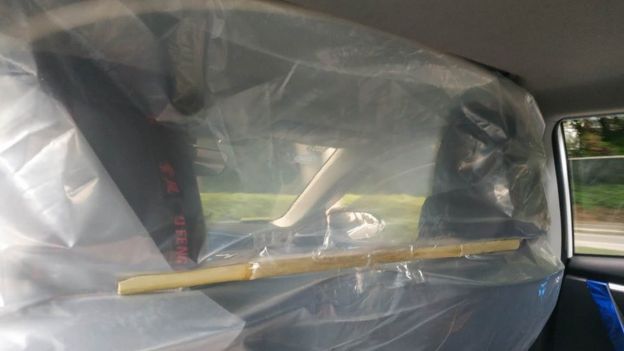
Image copyright JEN SMITHImage caption A taxi driver has improvised a screen to reduce the risk of picking up Covid-19 from a passenger
Finally the weekend! Although things are slowly getting better in China after the coronavirus outbreak, there’s still not too much to do. So I use this time to write, play my piano and generally chill inside. Around 3pm, I venture outside to the shops to pick up some snacks (159.60 yuan) before settling in to ring my family back in the UK with a homemade cocktail – a friend of mine in Canada is doing a daily live stream, “quarantinis” where he teaches you how to make cocktails!
What’s interesting is that a lot of people have started leaving their houses again, but it is still illegal to go outside without a mask on, and temperature checks are taken everywhere. I was even refused entry to a building due to being foreign. I imagine this is because recently the only new cases are being brought in by non-Chinese travelling back to China.
Total spend: 159.60 yuan ($22, £18)
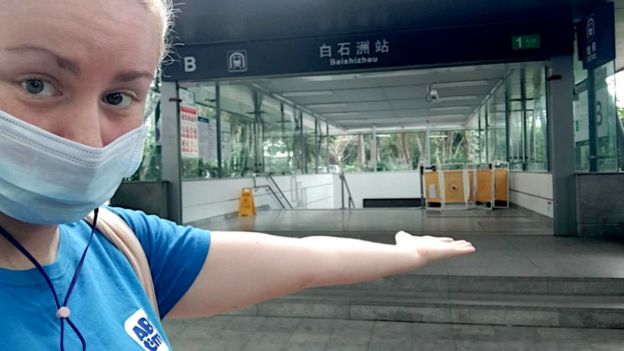
Image copyright JEN SMITHImage caption Shenzhen’s Metro system is still very quiet
It’s another slow day for me as many foreigners have not yet returned to China, so most of my friends are out of the country. I start the day by reviewing potential scripts.
This takes me to 1.30pm without realising I haven’t eaten. I decide to go for a quick run and I return to eat mashed avocado and a hard-boiled egg.
I home-bleach my hair with products bought in the UK, then head back to editing again. About half way through the afternoon I take a little break to practice Chinese. I use an app which is fantastic and free! Definitely worth everyone downloading this during social distancing so you can learn new skills!
For dinner I order online again, a three-dish meal for 160 yuan.
Chinese President Xi Jinping poses for a group photo with foreign delegates attending the 2019 New Economy Forum before meeting with them at the Great Hall of the People in Beijing, capital of China, Nov. 22, 2019. (Xinhua/Huang Jingwen)
BEIJING, Nov. 22 (Xinhua) — Chinese President Xi Jinping said on Friday realizing the Chinese dream of national rejuvenation is by no means to seek hegemony.
Saying he has full confidence in China’s prospects for development, Xi noted China does not intend to replace any power, rather, its aim is to “regain the dignity and status it deserves.”
The president made the remarks when meeting with foreign delegates attending the 2019 New Economy Forum held in Beijing.
China, with a 5,000-year-old history of civilization, is home to the four great inventions that had contributed tremendously to the progress of human civilization. The country had become a semi-colonial and semi-feudal society since the Opium Wars, but the Chinese people had never yielded and spared no effort in seeking a path to national rejuvenation, Xi stressed.
Earth-shattering changes have taken place since the founding of the People’s Republic of China 70 years ago, and the humiliating history of China as a semi-colonial and semi-feudal country will never be repeated, he said.
“The fundamental reason is that we have found a correct path that suits China’s national conditions, conforms to the trends of the times and enjoys the support of the people. The path is socialism with Chinese characteristics,” Xi said.
With full confidence, the Chinese people will unswervingly follow this path, he added.
Xi noted that innovation is a major theme of the current times, as the world is undergoing changes rarely seen in a century, featuring a new round of technological revolution and rapid industrial transformation.
The common challenges facing humanity call for concerted efforts of all countries. No country can become an independent innovation center or enjoy fruits of innovation alone, Xi said. “Innovation should benefit the world rather than being encaved.”
He said China is willing to carry out cooperation in innovation with other countries including the United States, so as to better benefit the people of the two countries and the world.
Despite great achievements, China will continue to adhere to the traditional concept of “harmony in diversity,” stick to the path of peaceful development, and strive for mutually beneficial cooperation with other countries, Xi told the foreign delegates.
China will stick to the reform and opening-up through bold innovations and with a manner of “feeling the rocks on the riverbed when crossing the river,” he said.
“The more resistance we are confronted with, the more determined we will be to open up,” Xi said. “I have full confidence in China’s prospects of development.”
During the meeting, former U.S. Secretary of State Henry Kissinger, former U.S. Treasury Secretary Henry Paulson, Egyptian Tourism Minister Dalia al-Mashat, former Japanese Foreign Minister Yoriko Kawaguchi, and Credit Suisse Group AG CEO Tidjane Thiam exchanged views, and expressed their support for innovation cooperation.
The 2019 New Economy Forum, which focused on development trends and social impacts of innovation, gathered more than 500 delegates from more than 60 countries around the world.
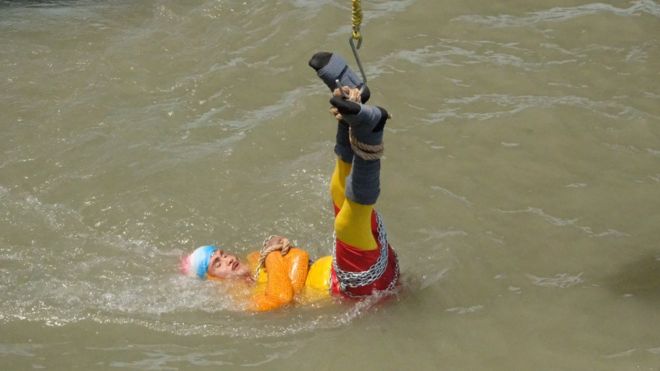
Image copyright EI SAMAYImage caption Chanchal Lahiri went by the stage name Mandrake
An Indian magician, who attempted to recreate Harry Houdini’s famed trick by jumping shackled into a river, is feared dead.
Chanchal Lahiri was meant to escape and swim to safety but did not emerge from the Hooghly river in West Bengal state.
Spectators who had gathered to watch him take the plunge on Sunday informed the police, who say they are searching for him.
Mr Lahiri, also known as Mandrake, was lowered into the river from a boat.
He was shackled with six locks and a chain as spectators on two boats watched him. Several people had also gathered by the shore and some stood on the landmark Howrah Bridge in Kolkata (formerly Calcutta).
Police and a team of divers canvassed the area but as of Sunday evening local time, they had been unable to find the magician. One officer told the Hindustan Times newspaper that Mr Lahiri could not be declared dead until the body was found.
Jayant Shaw, a photographer with a local newspaper, witnessed Mr Lahiri attempting the trick. He told the BBC that he spoke to him before the magician started his act.
“I asked him why he risked his life for magic,” Mr Shaw said. “He [Mr Lahiri] smiled and said, ‘If I do it right, it’s magic. If I make a mistake, it becomes tragic.'”
The magician told him that he wanted to do this trick in order “to revive interest in magic”.
This is not the first time that Mr Lahiri had attempted a risky underwater trick.
He was lowered into the same river inside a glass box more than 20 years ago but had managed to escape to safety.
Mr Shaw had also witnessed Mr Lahiri’s previous underwater trick.
“I never thought he would not come out of the water this time,” he said.
Driver who used map app to find construction site sent to crossing for light traffic
Villagers say bridge was used by pedestrians and cars only
Recovery crews attempt to pull the truck and its load from the river in eastern Zhejiang province. Photo: Weibo
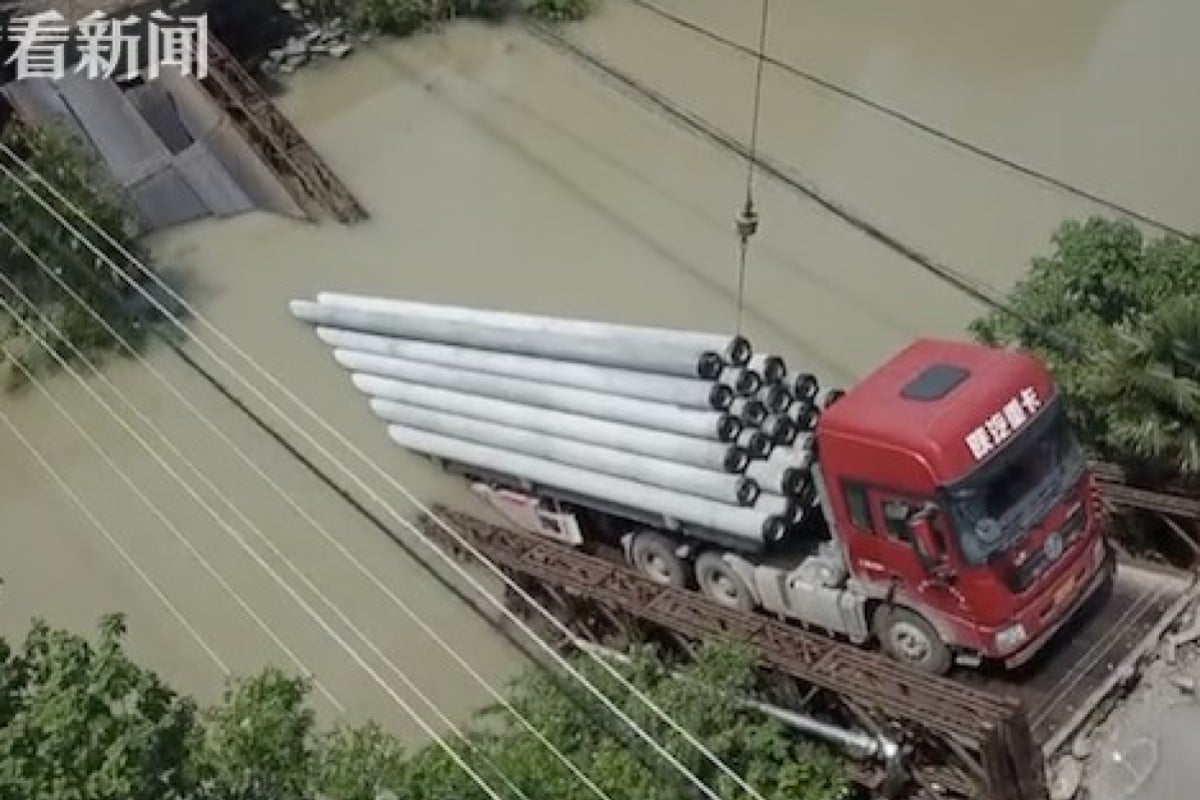
A trucker in eastern Zhejiang province collapsed a steel bridge by crossing it with a load weighing 50 times the bridge’s capacity.
The driver, surnamed Zhang, said he missed the two-tonne load warning sign when he tried to take dozens of concrete pipes to a construction site on Thursday morning, Kankannews.com reported.
He was not familiar with the area and used the bridge suggested by his digital map.
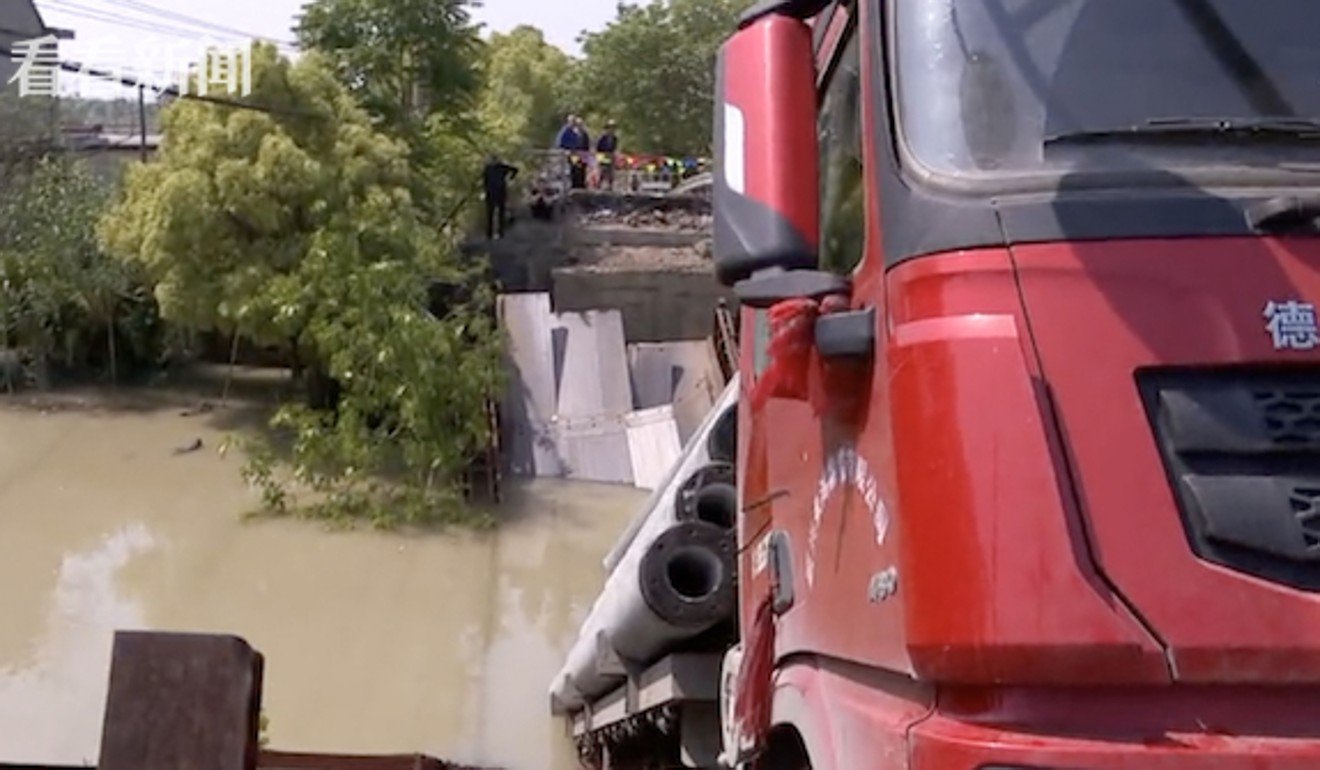
When the laden truck, weighing about 100 tonnes, was halfway across, the structure gave way, pitching the vehicle and its cargo into the water below. The driver managed to escape.
The truck’s load was 50 times the bridge’s breaking capacity. Photo: Weibo
Truck driver left hanging after crane smashes into bridge
Residents of a nearby village said a concrete bridge on the site fell into disrepair and was dismantled. It was replaced with a temporary steel structure a couple of years ago.
The new span was intended only for foot traffic and light vehicles, they said.
Image copyrightMANSI THAPLIYALImage captionAtmabodhanand, 26, stopped taking food on 24 October
Over the past two decades, holy men in India have gone on dozens of fasts demanding governments honour their promise to revive the polluted Ganges, a river revered by Hindus. The recent death of one of the most prominent hunger strikers made headlines. Soutik Biswas went to find out more.
In a quiet ashram (retreat) near the pilgrim town of Haridwar, a young seer says he would die to save the Ganges.
Atmabodhanand is on the 40th day of a fast begun after the ashram’s most prominent resident starved himself to death two months ago.
The 26-year-old computer science dropout from Kerala state spends his days lying under a blanket on a bed beneath a mango tree. When night falls and the air gets chillier, he moves inside the spartan quarters and sleeps.
“I am ready to die,” he told me. “Our ashram has a history of sacrifice.”
Matri Sadan is a leafy, three-acre ashram that sits on the edge of the river. Atmabodhanand stopped taking food on 24 October and now survives on water, salt and honey – his is the 60th such fast by residents since it was founded in 1997.
Using a mix of folksy activism and hunger strikes, residents have put pressure on successive governments to scrap big dams, ban sand mining, clean up the river and pass laws to protect it. Many governments have acceded to their demands in the past.
Image captionThe Ganges is the longest river in India
Seven years ago Swami Nigamanand, 36, fell into a coma and died after refusing food for 115 days – the longest hunger strike in the ashram’s history. He had demanded the government halt all stone quarrying near the river.
A 39-year-old local seer and ashram resident, Sant Gopal Das, is currently being force fed in hospital to keep him alive.
But it was the death in October of GD Agarwal, an 86-year-old former environmental engineer, that grabbed international headlines. Agarwal, also known as Swami Gyan Swaroop Sanand, died after fasting for 111 days at the ashram.
Agarwal was an alumnus of University of California, Berkeley, and taught at the elite Indian Institute of Technology. He worked as an engineer with the federal pollution control authority and was a vocal critic of the government’s half-hearted efforts at cleaning up the river. In 2011, he renounced the material world and became a seer. Before his death he wrote three letters to Prime Minister Narendra Modi with his demands . He didn’t receive an answer.
“He was an inspiration to us all to do the best, and be our best, in all that we do,” Mary Stacey of the University of California wrote to the ashram after his death.
Two days after Agarwal began refusing water, his condition deteriorated and he died after being forcibly moved to the hospital. Within two weeks, Atmabodhanand took up the cudgels and began his hunger strike, inspired by his famous predecessor. He also believes that one man’s hunger can “bring back the river from the dead”.
Image captionEnvironmentalist GD Agarwal died in October after a 111-day-long hunger strike
The longest Indian river, Ganges flows from the Himalayas to the Bay of Bengal. Concerns over the declining water levels and waning health of the 2,500km (1,553-mile)-long river, which supports a quarter of India’s 1.3 billion people, have been mounting for years.
Hindus revere the river as a god, and believe that bathing in her waters can wash away a person’s sins.
But the Ganges has been choked by more than 1,000 irrigation dams, the water table in its basin shrunk by reckless extraction of groundwater and its own water poisoned by toxic industrial effluent and household sewage. The river in Haridwar itself caught fire in 1984 when someone put a lit match on the water. “Indians are killing the Ganges with pollution and the polluted Ganges, in turn, is killing Indians,” says Victor Mallet, author of River of Life, River of Death, a new book on the river.
Now, say the seers at the ashram, Narendra Modi’s Hindu nationalist BJP government, which rode to power in 2014 promising to clean up the Ganges, is “arrogant and isn’t interested in saving the river”.
They find it ironical that despite Agarwal being close to a Hindu nationalist organisation, he actually appeared to be listened to more by the previous Congress government. He fasted eight times while it was in power, and extracted some major concessions, including scrapping a dam and declaring a key 100km stretch of the river as sensitive.
“We will die for the river. If the government wants blood, we will give them blood,” says Swami Shivanand, the 72-year-old head of the ashram, who has also fasted in the past.
Image captionThe Ganges is one of the world’s most polluted rivers
Five years ago, Atmabodhanand quit college and travelled from Kerala in the south to Haridwar in northern Uttarakhand state by train, bus and foot. Seeking a life of renunciation, he says he was disillusioned by the way most holy men lived, and decided to end his life by disappearing into the Himalayas.
That is when he met Swami Shivanand who took him in. At the ashram he immersed himself in prayers and other activities and ran its social media accounts.
Atmabodhanand has gone on eight hunger strikes since 2014. During his longest fast, which lasted 47 days, he had hypothermia – when the body loses heat faster than it can produce it – and had to be taken to hospital. He has protested against sand mining on the river and stone crushing on its banks, and ended his strikes, he says, after authorities listened to the demands and took steps.
“This time, it is a fight to the finish. It’s going to be a long haul,” he says.
On the day I visited the ashram, rattled authorities, panicky at the prospect of another hunger death on the premises, sent doctors with an ambulance to check Atmabodhanand and take blood and urine samples to test for blood sugar, malaria and dengue. His blood pressure was normal, and he had no fever.
They updated his medical records in a government log book called Medical Examination of Hunger Strikers. All this while, residents chided the officials and accused them of trying to take away the hunger striker to “poison” him in hospital. The officials wondered aloud what they would gain by “killing a hunger striker”.
Hunger as a form of political protest is not new to India – Gandhi is arguably the most famous hunger striker in history, having resorted to more than a dozen fasts, the longest one lasting 21 days.
Image captionAtmabodhanand lies on a bed under a tree in the ashram during the day
Much later, in 2011, anti-corruption campaigner Anna Hazare undertook a high-profile 12-day hunger strike to press for anti-corruption laws. But what makes the fasts at the ashram in Haridwar stand out are their frequency and the two deaths. “Hunger strikers believe that the voice of hunger has a power disproportionate to its source,” says Prof Sharman Apt Russell, author of Hunger: An Unnatural History. “Hunger can strengthen the weak, inspire the timid, bully the powerful.”
But the lack of widespread public support for the fasting residents of Matri Sadan is sometimes glaring. “People have become selfish. They don’t care about their own good any more,” says Atmabodhanand feebly.
Himanshu Thakkar, a water expert with the advocacy group South Asian Network on Dams, says the hunger strikes by the seers at Matri Sadan have had “some impact” all right. Sand mining on the river has been stopped from time to time, and stone crushing factories removed from near the river. “But my impression is fasting must be a part of a larger strategy in which people from different sections of society must be mobilised.”
Image captionSwami Punyanand is on a fruits only diet to prepare for a future hunger strike
The BJP’s water resources minister Nitin Gadkari says a $3bn plan involving 254 projects to clean up the river and its surroundings is in progress, and most of the cleaning work of the river will be completed by next year. “The people’s dream of a rejuvenated Ganges will soon be fulfilled,” he told a meeting in Delhi recently.
But the seers insist the government is not doing enough. So hunger remains a constant companion of the residents at the retreat.
“I am next in the queue. This time, we will not stop,” says Swami Punyanand, a 61-year-old former automobile workshop owner from Delhi who became a seer years ago. He has gone on a simple fruit diet to “prepare for fasting to death”.
In the hermitage of hunger, this is how they prepare to give up their lives for the river.
India is stepping up efforts to maximise its water use from the western rivers of the Indus basin, senior officials have told the BBC.
The move would involve building huge storage facilities and canals.
The three rivers flow through Indian-administered Kashmir but most of the water is allotted to Pakistan under an international treaty.
Experts say Delhi is using the water issue to put pressure on Pakistan in the dispute over Kashmir.Relations have deteriorated since a deadly militant attack on an Indian base in September. Pakistan denies any link to the attack.
Why India’s water dispute with Pakistan matters
Kashmir: Why India and Pakistan fight over it
Kashmir profiled
Indian Prime Minister Narendra Modi has said a government taskforce is finalising details of the water project, which he has made a priority.
“The ball has started rolling and we will see some results soon, most of them will be about building new storages in the basin,” one top official said on condition of anonymity.
Another senior official said: “We are quite familiar with the terrain as we have already built a number of structures there.
But he added: “We are talking about few years here.
“How much water is at stake?
India wants to “maximise” its use of water from the Indus, Chenab and Jhelum rivers. Millions of people in both countries depend on water in the rivers.
An official with India’s water resources ministry insisted that this action would be “well within” the terms of the Indus Water Treaty (IWT).
India began reviewing the treaty after the militant attack in Indian-administered Kashmir in September in which 19 soldiers were killed.Delhi accused Islamabad of being behind the attack and relations have plummeted, leading to a rise in cross-border tensions.
The IWT was signed in 1960 and allocated the three eastern rivers – the Ravi, Beas and Sutlej – of the Indus basin to India, while 80% of the three western ones – the Indus, Jhelum and Chenab – was allotted to Pakistan.
India says it has not fully utilised the 20% of water given to it in the three western rivers. Pakistan disputes this.
Officials in Delhi said the IWT allows India to irrigate 1.4 million acres of land using water from those rivers.
But they say only 800,000 acres are irrigated at present.
They added that the building of hydropower projects would also be accelerated.
India currently generates around 3,000MW of hydroelectricity from the western rivers, but the Indus basin is said to have a potential of nearly 19,000 MW.
How safe is the water treaty?
Pakistan is watching India’s moves closely.
India shares a heavily militarised international border with Pakistan
Speaking in an open debate of the United Nations Security Council on “water, peace and security” last month, Pakistan’s ambassador to the UN, Maleeha Lodhi, denounced any use of water as an “instrument of coercion and war”.
“The IWT is equally a good case study of what could go wrong if such agreements are not honoured or threatened by one of the state parties to be abrogated altogether.
“Water experts say the treaty seems to have at least survived because India is not talking about withdrawing from it.
But, they believe, maximising use of water from the western rivers in the Indus basin can still fuel tensions.
Islamabad is already unhappy with some of India’s existing water projects.It has asked the World Bank, which brokered the signing of the treaty between the two countries, for a court of arbitration to consider two Indian hydropower projects in the Indus basin.
India has objected to this move, prompting the bank to pause the dispute process while it tries to persuade the two countries to resolve their disagreements, fearing that otherwise the treaty itself could be in peril.
In 1987, Delhi suspended the Tulbul navigation project on the Jhelum river after Pakistan objected to it.But sources within India’s Water Resources Ministry say this project could now be revived.
“The decision to review the suspension signalled the Modi government’s intent to revive it irrespective of Pakistan’s protests,” the Times of India newspaper wrote.
“As an implication, India gets to control Jhelum water, impact Pakistan’s agriculture.
“What else could India do?
Some experts say India could also demand a review of the IWT.
“The review can be used to demand more rights over the western rivers,” says Himanshu Thakkar, a regional water resources expert with South Asian Network on Dams, Rivers and People.
Some water resources analysts believe Delhi will also have to be mindful of China before making any major move.
In September, Tibet blocked a tributary of the Yarlung Zangbo river (known as the Bramhaputra in India) as part of its most expensive hydro project, Chinese state-run news agency Xinhua reported.
The news came just when Indian media were suggesting that Delhi could pull out of the IWT.
“We need to remember that China is an upper riparian country in Indus and Bramhaputra basins and it is also Pakistan’s closest ally,” said Mr Thakkar.
Many experts agree that completing such huge and complex infrastructure projects may not be as swift as some Indian officials suggest.























 CHINDIA ALERT: You'll be living in their world, very soon