Chindia Alert: You’ll be Living in their World Very Soon
aims to alert you to the threats and opportunities that China and India present. China and India require serious attention; case of ‘hidden dragon and crouching tiger’.
Without this attention, governments, businesses and, indeed, individuals may find themselves at a great disadvantage sooner rather than later.
The POSTs (front webpages) are mainly 'cuttings' from reliable sources, updated continuously.
The PAGEs (see Tabs, above) attempt to make the information more meaningful by putting some structure to the information we have researched and assembled since 2006.
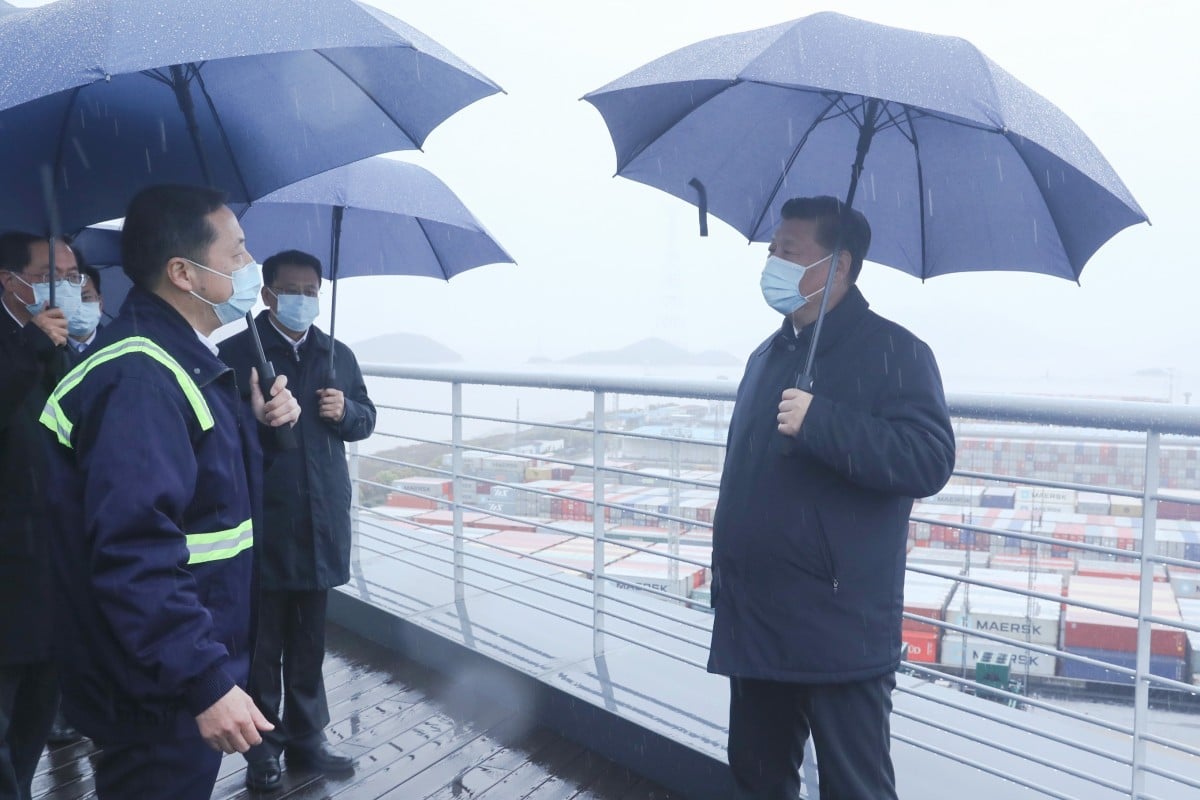
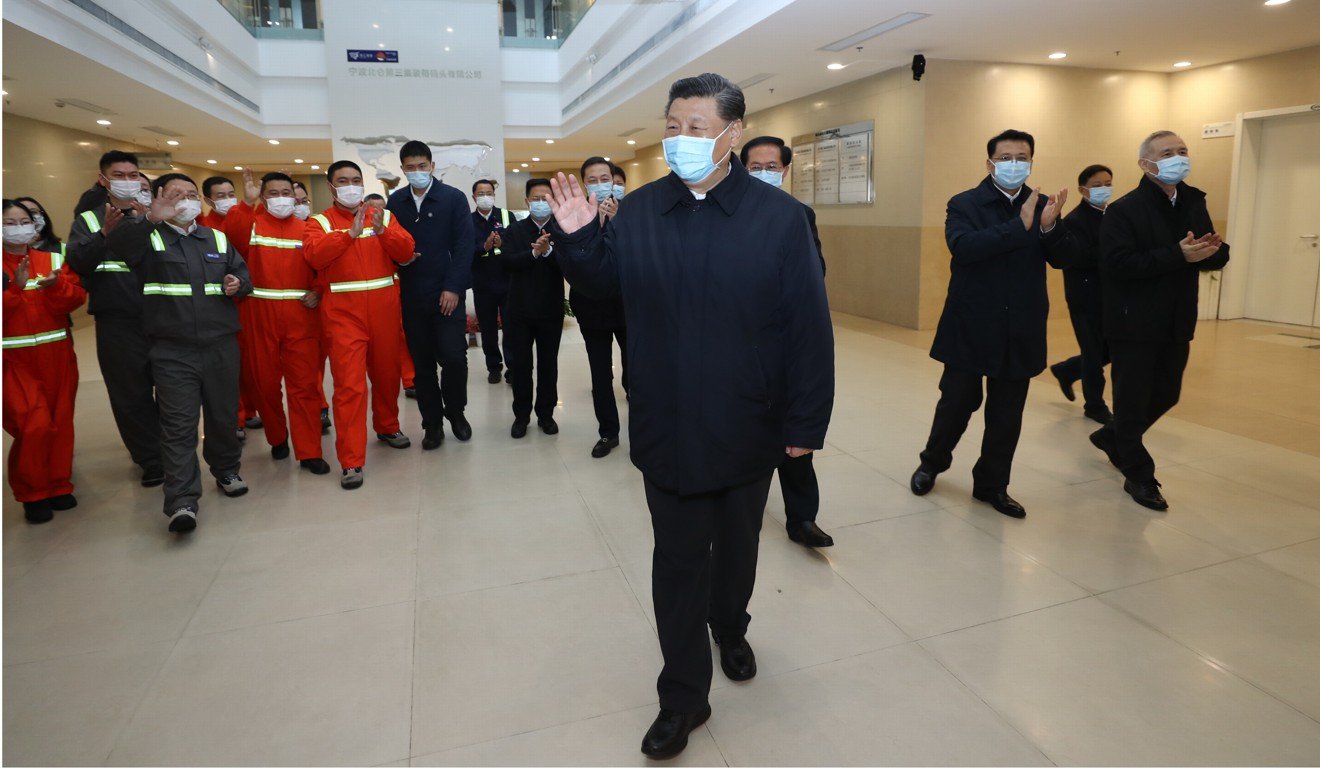
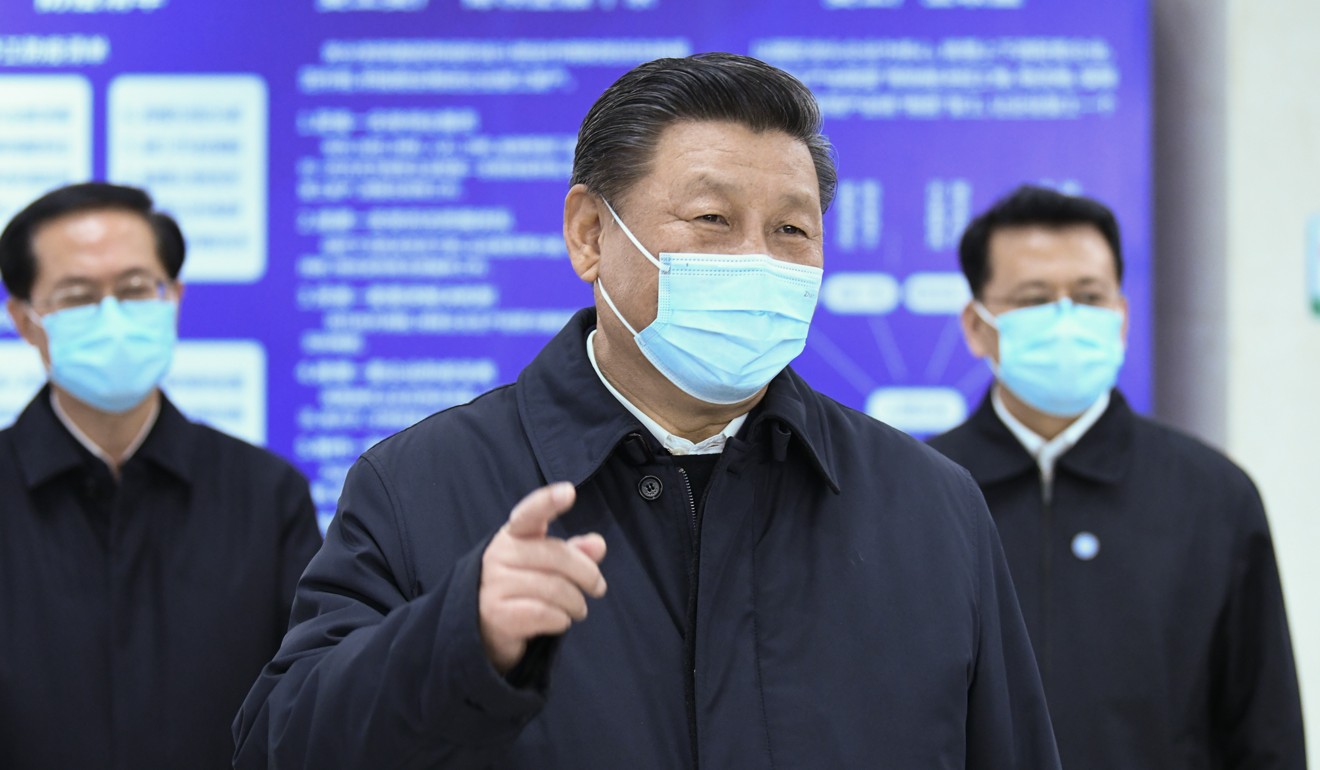
visited the industrial powerhouse of Zhejiang province on Sunday in a move state media described as a clear message the country was ready to get the economy back on track amid the “new normal” of dealing with the coronavirus.
The trip, to Ningbo – one of the world’s busiest ports and a trade hub for eastern China – was Xi’s first outside Beijing since he visited Wuhan, the initial epicentre of the Covid-19 outbreak, earlier in the month.
As well as a visiting the port, he spoke to workers at an industrial zone for car part manufacturers, where he learned about the latest efforts to restart production, Xinhua said in a brief report.
The visit came after two months of almost total lockdown in many parts of the country that disrupted businesses, transport and people’s daily lives, and ground the economy to a near standstill.
While local transmissions of the coronavirus in China appear to be under control, Beijing has implemented strict measures to prevent imported cases, including slashing international flights and banning most foreigners from entering the country.
In a separate report, Xinhua said Xi’s visit sent “a clear message” that China was resuming its industrial production and social activities, and described the fight against the coronavirus as the “new normal”.
Reviving the economy and battling a deadly disease were Xi’s “two tough battles”, it said.
Xi’s choice of destination was a clear message that restarting the economy is a top priority. Photo: Xinhua
Zhejiang is something of a power base for Xi, who spent nearly five years there during his climb through the ranks of the Communist Party.
One of the country’s biggest trading hubs, the province generated 3 trillion yuan (US$423.2 billion) in foreign trade last year, or more than 13 per cent of the national total, according to official figures.
“It’s a highly export-oriented economy … which has made it crucial not only to China’s development plan but also to safeguarding the stability of the global supply chain,” Xinhua said.
Observers said Xi’s visit was evidence of Beijing’s determination to get the economy back up and running as soon as possible.
Zhao Xijun, an economics professor at Renmin University, said Ningbo was a key part of the export economy and a base for many local and foreign entrepreneurs.
“It is a clear signal that China, after getting domestic infections under control, is now prioritising economic growth,” he said.
“It also shows the country will keep developing its economy and opening up its markets.”
But hopes of a quick recovery for the Chinese economy have been dashed by the spread of the coronavirus across Europe and the United States, causing a sharp decline in demand for Chinese goods.
Xi spent five years in Zhejiang while climbing the ranks of the Communist Party. Photo: Xinhua
In a meeting on Friday, the Communist Party’s Politburo said it would step up macroeconomic policy adjustments and pursue a more proactive fiscal policy while optimising measures to control the coronavirus to speed up the restoration of production, doing whatever it could to “minimise the losses caused by the epidemic”.
“China has successfully reopened much of its economy from the extremes of the coronavirus lockdown, but now faces a new problem: an impending collapse in demand for its exports as its customers go into lockdowns of their own,” Gavekal Dragnomics said in a research report.
“That shock to industry and manufacturing employment means that China will not enjoy the hoped-for V-shaped recovery in growth.”
LONDON/BEIJING (Reuters) – The world’s wealthiest nations poured unprecedented aid into the traumatized global economy on Thursday as coronavirus cases ballooned in the current epicentre Europe even as they waned at the pandemic’s point of origin, China.
With almost 219,000 infections and more than 8,900 deaths so far, the epidemic has stunned the world and drawn comparisons with painful periods such as World War Two, the 2008 financial crisis and the 1918 Spanish flu.
“This is like an Egyptian plague,” said Argentinian hotelier Patricia Duran, who has seen bookings dry up for her two establishments near the famous Iguazu Falls.
“The hotels are empty – tourist activity has died.”
RELATED COVERAGE
Factbox: Latest on the spread of coronavirus around the world
What you need to know about the coronavirus right now
Tourism and airlines have been particularly battered, as the world’s citizens hunker down to minimize contact and curb the spread of the flu-like COVID-19. But few sectors have been spared by a crisis threatening lengthy global recession.
On markets, investors have dumped assets everywhere, many switching to U.S. dollars as a safe haven. Other currencies hit historic lows, with Britain’s pound near its weakest since 1985.
Policymakers in the United States, Europe and Asia have slashed interest rates and opened liquidity taps to try to stabilise economies hit by quarantined consumers, broken supply chains, disrupted transport and paralysed businesses.
The virus, thought to have originated from wildlife on mainland China late last year, has jumped to 172 other nations and territories with more than 20,000 new cases reported in the past 24 hours – a new daily record.
Cases in Germany, Iran and Spain rose to over 12,000 each. An official in Tehran tweeted that the coronavirus was killing one person every 10 minutes.
LONDON LOCKDOWN?
Britain, which had sought to take a gradual approach to containment, was closing dozens of underground stations in London and ordering schools shut from Friday.
Some 20,000 military personnel were on standby to help and Queen Elizabeth was due to leave Buckingham Palace in the capital for her ancient castle at Windsor. Britain has reported 104 deaths and 2,626 cases, but scientific advisers say the real number of infections may be more than 50,000.
Italian soldiers transported corpses overnight from an overwhelmed cemetery in Europe’s worst-hit nation where nearly 3,000 people have died. Germany’s military was also readying to help despite national sensitivities over its deployment dating back to the Nazi era.
Supermarkets in many countries were besieged with shoppers stocking up on food staples and hygiene products. Some rationed sales and fixed special hours for the elderly.
Solidarity projects were springing up in some of the world’s poorest corners. In Kenya’s Kibera slum, for example, volunteers with plastic drums and boxes of soap on motorbikes set up handwashing stations for people without clean water.
Russia reported its first coronavirus death on Thursday.
Amid the gloom, China provided a ray of hope, as it reported zero new local transmissions in a thumbs-up for its draconian containment policies since January. Imported cases, however, surged, accounting for all 34 new infections.
The United States, where President Donald Trump had initially played down the coronavirus threat, saw infections close in on 8,000 and deaths reach at least 151.
Trump has infuriated Beijing’s communist government by rebuking it for not acting faster and drawn accusations of racism by referring to the “Chinese virus”.
“EXTRAORDINARY TIMES”
In a bewildering raft of financial measures around the world, the European Central Bank launched new bond purchases worth 750 billion euros ($817 billion). That brought some relief to bond markets and also halted European shares’ slide, though equities remained shaky elsewhere.
“Extraordinary times require extraordinary action,” ECB President Christine Lagarde said, amid concerns that the strains could tear apart the euro zone as a single currency bloc.
The U.S. Federal Reserve rolled out its third emergency credit programme in two days, aimed at keeping the $3.8 trillion money market mutual fund industry functioning.
China was to unleash trillions of yuan of fiscal stimulus and South Korea pledged 50 trillion won ($39 billion).
The desperate state of industry was writ large in Detroit, where the big three automakers – Ford Motor Co (F.N), General Motors Co (GM.N) and Fiat Chrysler Automobiles NV (FCHA.MI) (FCAU.N) – were shutting U.S. plants, as well as factories in Canada and Mexico.
With some economists fearing prolonged pain akin to the 1930s Great Depression but others anticipating a post-virus bounceback, gloomy data and forecasts abounded.
In one of the most dire calls, J.P. Morgan economists forecast the Chinese economy to drop more than 40% this quarter and the U.S. economy to shrink 14% in the next.
There was a backlash against conspiracy theories and rumours circulating on social media, with Morocco arresting a woman who denied the disease existed.
And in Brazil, where President Jair Bolsonaro initially labelled the virus “a fantasy”, more members of the political elite fell ill. At night, housebound protesters banged pots and pans, shouting “Bolsonaro out!” from their windows.
AutoNavi’s latest data shows increase in offline traffic and searches of major business districts
Traffic data could signal that consumer activity in China has entered a recovery
AutoNavi’s mobile app users can search the names of malls and shops to see real-time traffic data. Photo: AP
Data from AutoNavi, the maps app operated by Alibaba Group Holding, shows that traffic in major shopping districts in China picked up by an average of 30 per cent over the past month, as consumer activity gradually returns to normal now that the coronavirus infection rate appears to have peaked in the country.
The early sign of increased consumer activity in China contrasts with the panic and economic uncertainty now engulfing Europe and the US, as the widening pandemic forces governments around the world to take lessons from China on how to tackle the spread of the disease with curfews and social distancing measures.
AutoNavi’s latest big data report, released on Monday, shows that traffic in and around shopping districts in several major cities in the country rose 30 per cent over the weekend of March 14-15 compared with the weekend of February 15-16, when the coronavirus in China was at its height and many areas in the country were under lockdown.
China’s Meituan Dianping to join maps service battle
15 Aug 2019
“Consumer confidence is starting to rebound as the coronavirus comes under control,” said Guo Ning, vice-president of AutoNavi. “We are seeing more and more people stepping out, with offline consumption slowly recovering.”
Alibaba is the owner of the South China Morning Post.
China’s nearly two-month lockdown has dealt a hammer blow to the economy, with retail sales – a key metric of consumption – down by 20.5 per cent across the combined two months of January and February, marking the first decline on record. The virus has however proved a boon for China’s e-commerce sector, as shoppers stuck at home buy even more online.
The new data appears to show that the country’s offline economy could now see a slow recovery. This does not mean that retail businesses can slack off on preventive measures – hand sanitiser, extra cleaning and temperature monitoring are likely to remain fixtures of everyday life in shopping malls.
AutoNavi’s mobile app users can search the names of malls and shops to see real-time traffic data – often used to avoid visiting malls at peak periods. AutoNavi said the average 30 per cent increase in traffic refers to the combined volume of people using the app to navigate the shopping destinations.
Alibaba’s AutoNavi crosses 100 million daily users
5 Oct 2018
AutoNavi has more than 400 million monthly active users, according to company data. It was the first domestic travel platform to exceed 100 million daily active users.
Digital maps have become a key tool in China’s attempts to control the coronavirus pandemic, with competitor map apps from Baidu and Tencent also launching features to track population flows and provide information on clinics able to test for and treat the disease.
Covid-19, as the novel coronavirus is known, has now killed over 3,200 people in China and infected just over 80,000, of which around 68,000 have recovered. There are now around 87,000 confirmed cases outside China, according to the latest figures from health authorities.
NEW DELHI (Reuters) – India sought to boost growth in a federal budget on Saturday that raised spending on farms and expressways and offered cuts inpersonal taxes, but the measures fell short of market expectations and battered stocks.
Prime Minister Narendra Modi’s government is grappling with the country’s worst slowdown in a decade, with falling employment, consumption and investment ratcheting up the pressure to revive growth.
The government estimates growth this year to March 31 will slip to 5%, the weakest pace since the global financial crisis of 2008-09. It also warned an expected rebound the following year might entail a blow-out in fiscal deficit targets.
Finance Minister Nirmala Sitharaman, presenting the budget for the financial year beginning April 1, said 2.83 trillion rupees ($39.8 billion) will be allocated toward agriculture and allied activities, up 5.6 percent on the previous year.
RELATED COVERAGE
India raises import taxes in move set to spook some foreign firms
The funds will be deployed to help farmers set up solar power generation units as well as establish a national cold storage system to transport perishables.
Sitharaman also vowed to spend $50.7 billion in coming years on a federal water scheme to address challenges facing one of the world’s most water-stressed nations.
Agriculture accounts for near 15% of India’s $2.8 trillion economy and is a source of livelihood for more than half of the country’s 1.3 billion population.
Sitharaman announced a new personal tax system including cuts for those ready to give up a myriad of tax breaks. She also abolished payment of dividend distribution tax by companies to spur investment.
“People have reposed faith in our economic policy,” Sitharaman said to the thumping of desks in parliament. “This is a budget to boost their income and enhance their purchasing power.”
Opposition parties slammed the budget, saying it had failed to address the slowdown in consumer demand and investment. “The government is in complete denial that the economy faces a grave macro economic challenge,” said former finance minister P. Chidambaram.
But higher government spending has put pressure on public finances, prompting caution from rating agencies. Sitharaman said the fiscal deficit for the current year would widen to 3.8% of GDP, up from 3.3% targeted for the current year.
Gene Fang, associate managing director, sovereign risk at Moody’s, said: “India’s 2020/21 budget highlights the challenges to fiscal consolidation from slower real and nominal growth, which may continue for longer than the government forecasts.”
GOVERNMENT SPENDING
For fiscal 2020/21 Sitharaman set the fiscal deficit at 3.5 percent. Moody’s said India’s government debt is already significantly higher than the average for Baa-rated sovereigns, a product of persistent fiscal deficits.
To help finance government spending, Sitharaman set a target for selling stakes in state firms at 2.1 trillion rupees for 2020/21, more than three times the amount expected this year.
She said the government will sell a part of its holding in state-run Life Insurance Corp, the country’s biggest insurance company.
But many experts said the measures did not go far enough to address the slowdown and structural flaws.
“In a normal scenario this budget would have been considered as good providing tax benefit to the common man, corporate and focus on farmers’ incomes, but the situation required more,” said Vinod Nair, head of research at Geojit Financial Services in Kochi.
Indian shares slid to a more than three-month low after a special trading session on Saturday, dented by what analysts said was a lack of sufficient stimulus measures. The NSE Nifty 50 index .NSEI closed 2.5% lower while the benchmark S&P BSE Sensex .BSESN fell 2.4%
“Markets had very high expectations from the budget … these expectations have not been met,” said Deepak Jasani of HDFC Securities.
The government also announced higher duties on a host of imports from walnuts to phone parts. Taxes on imports of pre-assembled printed circuit boards were raised to 20% from 10% and there were new taxes on mobile phones ringers and display panels in a bid to boost local manufacturing.
In its annual economic report released on Friday the government predicted growth would rebound to 6.0% to 6.5% in the fiscal year beginning April 1.
Some economists say global trade tensions and the outbreak of coronavirus in China pose a new risk to economic recovery by hitting cross-border commerce and supply chains.
BEIJING, Dec. 21 (Xinhua) — Ask the silver-haired residents of the elderly care community Yinheyuan in central Beijing what they know about artificial intelligence (AI), and they will probably throw the question to the smart speakers within their reach.
These smart speakers, capable of interacting with users with voice-recognition technologies, are also part of the answer. Via voice command, senior residents can control lights, TVs and other home appliances, order food or ask for help.
AI is no longer a technical term used exclusively by professionals in China. Both young and old are enjoying the benefits of the growing smart economy.
After personal computers (PC), PC internet and mobile internet, the growth focus of China’s digital economy is shifting to smart technologies like AI, said Baidu Chairman and CEO Robin Li at the World Internet Conference in October.
In the smart economy era, Li predicted a declining reliance on cellphones and a rising popularity of other smart devices. AI chips, cloud computing services, among others, would become the new digital infrastructure, while innovative businesses will flourish as transport, health, education and other sectors go smart.
Wearable devices, smart home appliances, autonomous driving and smart cities are among the fastest-growing fields in the smart economy.
China is the largest smart speaker market in the world, accounting for 36 percent of global shipments in the third quarter of 2019, according to global market firm Strategy Analytics. It found in a July and August survey that 63 percent of Chinese people without a smart speaker planned to buy one within the following year. Another 22 percent planned to make a purchase later on.
Chinese firms are stepping up investment in 5G, AI and the Internet of Things to gain a foothold in the emerging field. By end-June, China had over 1,200 AI-related enterprises, according to the Ministry of Industry and Information Technology.
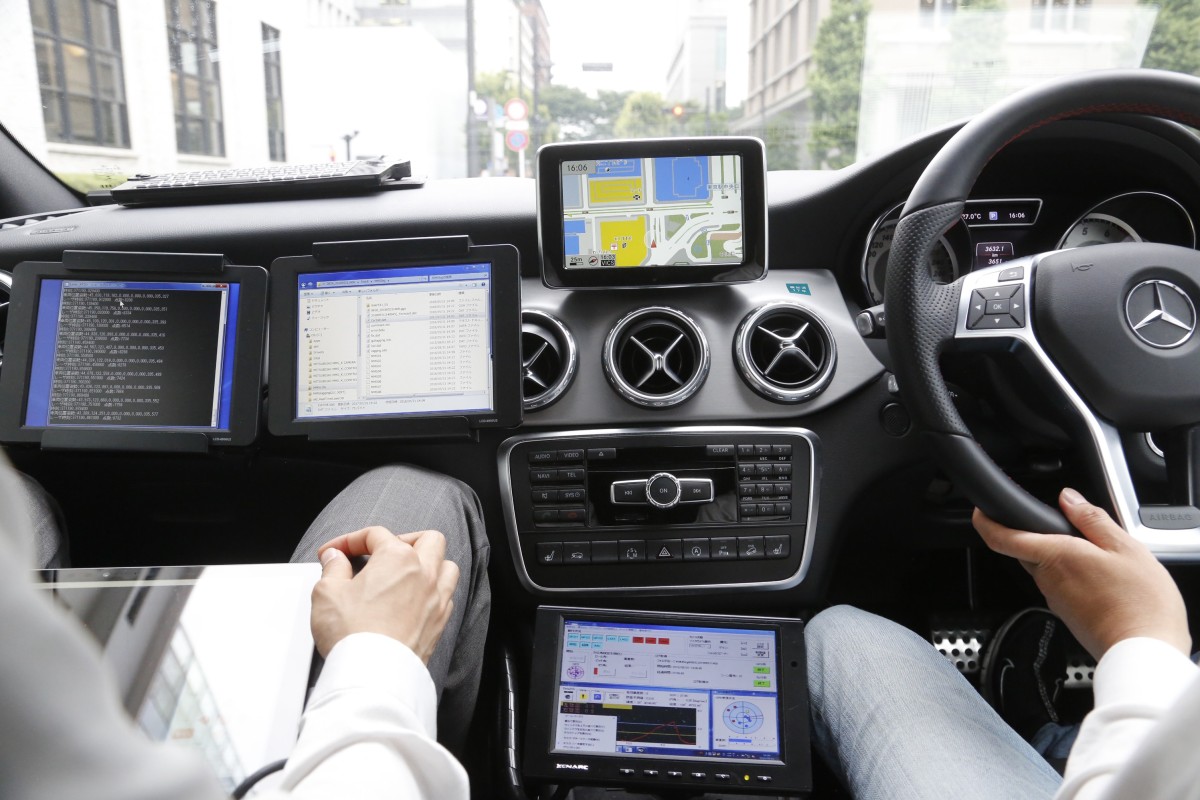
Baidu launched its autonomous driving open platform ApollBo in 2017 to coordinate cross-sector efforts in this field. It has launched several L4 autonomous driving vehicles in partnership with leading automobile companies, and a fleet of Apollo-powered robotaxis are now taking test runs in central China’s Changsha.
Nurturing a smart economy is also on the government agenda. China has passed a guideline to boost the integration of AI and the real economy this year, and plans to build some 20 national AI innovative development pilot zones by 2023.
The country’s AI sector is forecast to be worth more than 160 billion yuan (about 22.83 billion U.S. dollars) in 2020, spurring related sectors to exceed 1 trillion yuan, said Lin Nianxiu, deputy director with the National Development and Reform Commission, citing industrial data.
Lin said China would focus on 100 firms dedicated to AI technologies and relevant applications, improve the industrial ecosystem, facilitate the deep integration of AI and the real economy, and intensify its international collaboration on AI technology, standards, industries, laws and regulations and ethics.
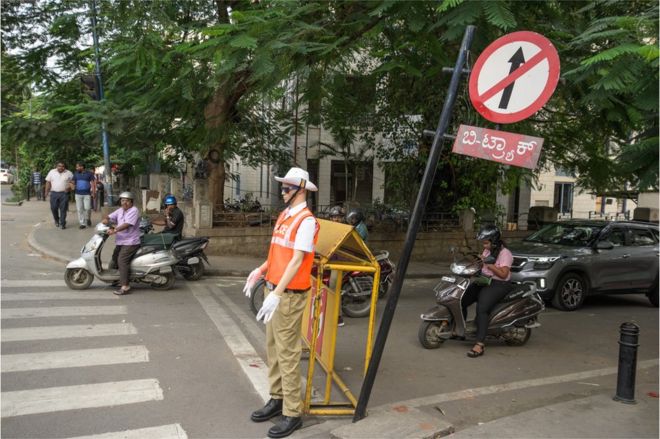
Image copyright ASIF SAUDImage caption The mannequins have been installed at major traffic crossings
One of India’s most gridlocked cities has come up with an unconventional solution to rein in errant drivers.
Mannequins dressed up as traffic police have been placed on roads in the southern city of Bangalore.
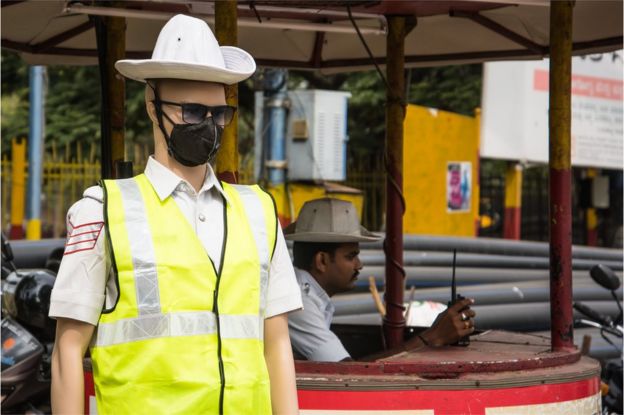
Dressed in police caps, white shirts and brown trousers, and wearing sunglasses, the mannequins are now on duty at congested junctions.
It’s hoped drivers will mistake them for real police and think twice about breaking the rules of the road.
Home to India’s IT industry, Bangalore has eight million registered vehicles on its streets. This number is expected to grow to more than 10 million by 2022.
At 18.7 km/h (11.61 mph) traffic speeds in the city are the second slowest in the country after Mumbai (18.5 km/h), according to a study by an office commute platform, MovinSync Technology Solutions. Cameras at traffic junctions have recorded more than 20,000 traffic violations every day.
But commuters have mixed feelings on whether mannequins can actually step in to help their real police counterparts.
Some feel they do.
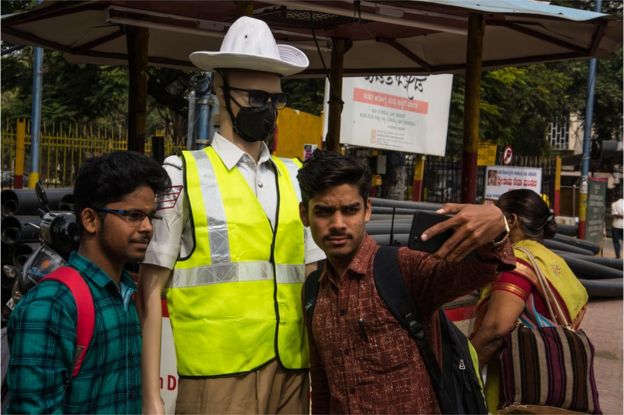
“They look good. It is only when you look closely that you feel it is not a real police constable. So it is making people wear their helmets at traffic junctions and drive their two-wheelers,” says Gautam T, a college student.
Gautam and his college mate Talah Fazal had taken a selfie with one of the mannequins placed in the southern part of the city.
Image copyright ASIF SAUD
Similarly, Saravana – who goes by a single name – and drives a three-wheeled auto-rickshaw, had parked his vehicle near a no-parking sign board right next to a mannequin in the central business district. But he said: “It makes you not jump the traffic signal.”
On Twitter, the tone has been largely one of amusement and derision.
Saleela Kappan, a public relations professional, said she found the concept “ridiculous”.
“These mannequins look too fit and fair compared to our Indian policemen to be posted on the road. I don’t think it will serve any purpose because people violate traffic rules even when policemen themselves are present at these junctions.”
Image copyright ASIF SAUD
BR Ravikante Gowda, a senior traffic police officer in Bangalore, explaining the reasoning behind this initiatives said: “The idea of placing these mannequins at a different location every day is because people behave differently when there is a policeman present at the junction. When he is not there, their behaviour is different.”
A constable, who did not want to be named, said that police also confuse drivers by mixing things up.
“It’s been a couple of weeks since we got them here. There is some hesitancy in jumping the traffic lights. They are confused when we replace the mannequin daily with one of our colleagues.”
WUHAN, Nov. 30 (Xinhua) — Central China’s Hubei Province on Friday opened a new high-speed railway that connects many of the province’s scenic spots and poverty-stricken areas.
The railway linking Wuhan, capital of Hubei, with Shiyan, a city in the northwest of the province, has designed maximum speeds of 250 kph and 350 kph in its two sections, according to China Railway Wuhan Group.
The railway passes five cities, home to 46 percent of Hubei’s population. It also snakes into the Qinling Mountains and reaches large expanses of impoverished areas there.
Dubbed the “most beautiful railway” in Hubei, the rail line links four national tourist attractions with the highest 5A-level ratings, including Mount Wudang, known for its many Taoist temples.
Zheng Zongli, a Wuhan resident and passenger on the first train on the line, hailed the railway for slashing travel time between the two cities of Wuhan and Shiyan to about two hours.
“It is so convenient that you can set out in the morning and arrive at Mount Wudang in the afternoon. It used to take more than a day,” he said.
Shi Lilong, chief of the poverty reduction office of Shiyan, said the railway would become a powerful weapon in the local battle against poverty by bringing the mountains and its sceneries closer to tourists, unlocking the tourism potential of the mountainous region.
Television report shows how drivers are willing to pay more than US$20,000 for a sham marriage with someone who has a valid registration
City authorities ration the number of plates that allow people to use their cars in the capital as part of efforts to tackle pollution and congestion
Beijing has started limiting the number of plates issued as part of its efforts to tackle the city’s notorious pollution and congestion. Photo: EPA-EFE
Some desperate Beijing motorists are resorting to sham marriages to get round strict licence plate rules that are designed to limit the number of cars allowed on the city’s congested roads.
A report by state broadcaster CCTV that aired on Sunday night claimed that some drivers were willing to pay the equivalent of tens of thousands of US dollars to marry someone with one of the prized plates, have it transferred into their name and then get divorced.
Specialist agencies charge over 160,000 yuan (US$22,700) to help their clients obtain a licence this way for a petrol-driven car, or over 110,000 yuan for an electric-powered one, according to the report.
The scam is the result of a licence lottery first introduced in 2011 to tackle the Chinese capital’s notorious congestion and pollution.
Chinese driver arrested for doctoring number plate to spell out obscene phrase
Because of the strict limits on the number of Beijing number plates issued, there are now 2,600 applicants for every one issued for petrol-powered vehicles. Those who wanted a licence for an electric car may have to wait until 2028, the report said.
The government has also been steadily lowering the annual quota for new local licences from 240,000 in 2013 to 100,000 last year.
The owners of locally registered cars are also banned from using them on one day a week, which is determined according to the plate number.
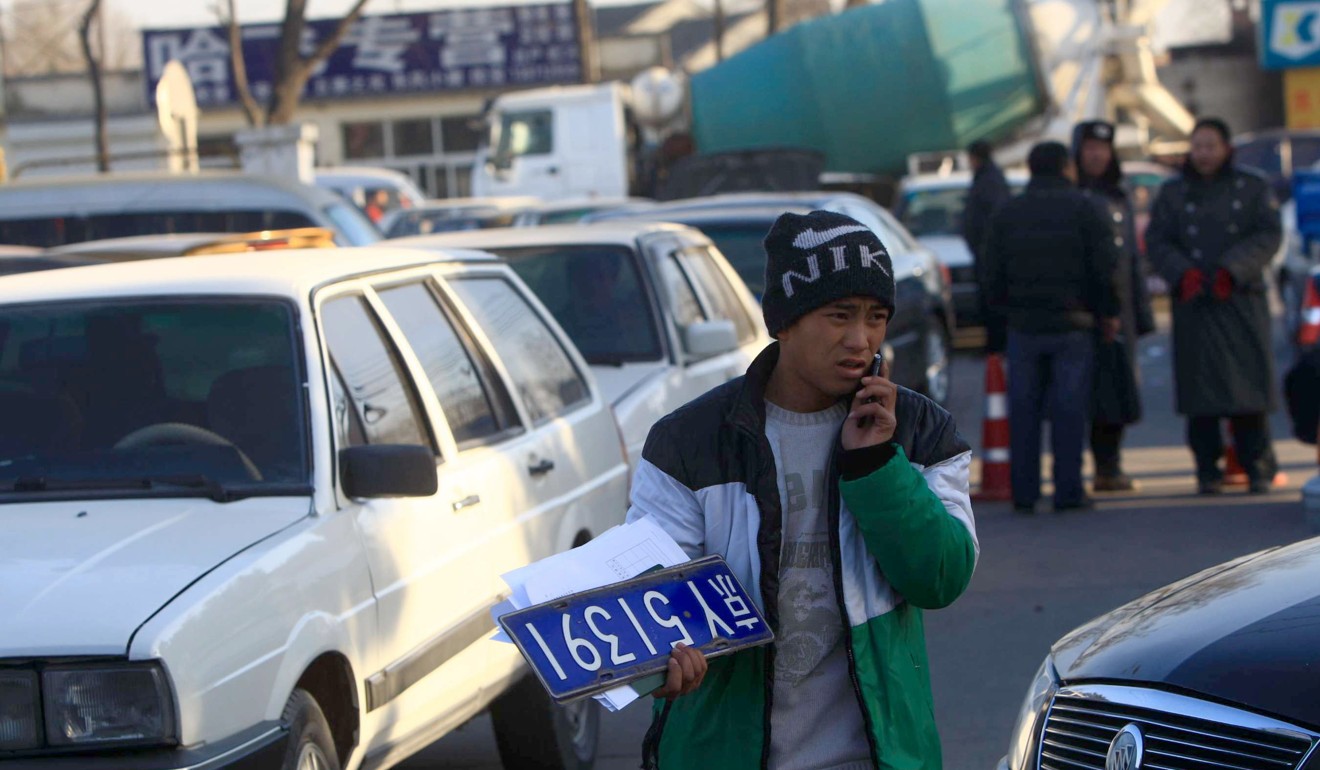
Cars that do not have a Beijing licence plate face severe limits on driving in the city. The owners of these cars must apply for a permit that only allows them to use their cars for seven days at a time – and as of this month they are only allowed 12 permits a year.
A man carries a number plate at a used car market in Beijing. Photo: AFP
The result is that many drivers have been looking for legal ways to get round the limits – with the sham marriages being one of the most extreme examples.
“We receive at least three or four clients a day asking to get a licence via fake marriages,” a manager at one agency told a CCTV reporter.
A staff worker helps go through all the procedures and if a suitable match is found, the process can be completed within 20 days.
Another loophole some are taking advantage of is to buy a car in the name of someone who has won the licence lottery, according to the agency.
Chinese police do U-turn on traffic crash after online crowd doubt official account
The actual user pays for the car in full, registers it under the licence owner’s name, and pays the latter a sum of money for using the licence – typically 20,000 yuan a year, 49,000 yuan for three years or 69,000 for a five-year deal.
In many cases, the two parties sign an agreement to limit the risk of a protracted dispute, but one judge warned that this was still a risky business.
Wang Lidan, a judge at Haidian District People’s Court in the northwest of the capital, told the programme makers that he knew of one case where a woman had paid a man with a Beijing licence to marry her, only for him to vanish after receiving the money.
Not only did the woman miss out on getting the licence but she faced an extra legal headache in getting a divorce.
Under Chinese law she had to first publish a notice about his disappearance in a newspaper and then wait three months before the divorce could go through the courts.
Record price for Beijing’s cubicle home shows desperation for hukou
Read more
Congestion or consumption? Beijing ponders trade-off on car purchases
Read more
Pollution alarm as tourism contaminates home of China’s hairy crab
MEXICO CITY, Nov. 12 (Xinhua) — China and Latin America sit on the opposite sides of the globe, but the formidably vast Pacific Ocean that separates them did not stop them from sharing a long history of exchanges.
Today, the major developing country in the East is forging an increasingly close partnership with the dynamic region in the Western Hemisphere, especially since Chinese President Xi Jinping took office in 2013, and set into motion what is now known as Xiplomacy.
In the past six years, Xi has visited 11 Latin American and the Caribbean (LAC) countries. On Tuesday, he is setting foot on the region for the fifth time as president, as he arrives in Brazil for the upcoming 11th BRICS summit.
Thanks in no small part to Xi’s push, the time-honored, distance-defying China-Latin America relationship is flourishing with new vitality. China has become the second largest trading partner of Latin America, while the latter is one of the fastest growing sources of exports to China. Two-way trade rose 18.9 percent year on year to 307.4 billion U.S. dollars in 2018.
GRAND VISION
Every time Xi visited Latin America, he reaffirmed China’s commitment to cementing bilateral friendship and expanding win-win cooperation.
His first trip to the region as head of state, in 2013, took him to Trinidad and Tobago, Costa Rica and Mexico. The following year saw him travel to Brazil, Argentina, Venezuela and Cuba.
It was in Brazil that Xi met with leaders from 11 LAC countries, and for the first time laid out his grand vision for building a China-Latin American community with a shared future.
“Let us seize the opportunities presented to us and work together to blaze new trails in building a community of shared destiny for common progress and usher in a bright future for the relations between China and Latin America and the Caribbean,” Xi said in a keynote speech at the first ever China-Latin American and Carribean Countries Leaders’ Meeting in 2014.
He then proposed a “1+3+6” cooperation framework to “promote faster, broader and deeper cooperation between the two sides for real results.”
The “1” refers to “one plan,” the Chinese-Latin American and Caribbean Cooperation Plan (2015-2019), formulated to promote inclusive growth and sustainable development.
The “3” alludes to “three engines” for driving practical cooperation for comprehensive development, namely trade, investment and financial cooperation.
The “6” means the six priority cooperation fields of energy and resources, infrastructure building, agriculture, manufacturing, scientific and technological innovation, and information technologies.
In 2016, Xi visited Ecuador, Peru and Chile. Two years later, he traveled to Argentina for the Group of 20 summit as well as Panama, a Central American country which established diplomatic ties with China in June 2017.
In a landmark speech at the Peruvian Congress in Lima in 2016, Xi expounded the significance of strengthening China-Latin America cooperation.
“With one fifth of the world’s total area and nearly one third of the world’s population, China and Latin America and the Caribbean are crucial forces for world peace and stability,” he said.
China, he added, “will increase sharing of governance experience and improve planning and coordination of macro policies with Latin American and Caribbean states to better synergize our development plans and strategies.”
Besides top-level engagement, Xi also reaches out to local people from all walks of life, in order to keep cementing the China-Latin America friendship and the public support for bilateral cooperation.
While in Costa Rica, Xi visited a family-run coffee plantation and tried some local brew. “I think some more coffee can well be exported to China,” Xi told his hosts with a smile.
Today, Costa Rica exports coffee to the Asian market, along with pork, dairy, pineapples and other high-quality agricultural goods, especially after the inauguration of the China International Import Expo in 2018.
NEW OPPORTUNITIES
With international cooperation within the framework of the Belt and Road Initiative (BRI) gaining steam worldwide, the Xi-proposed vision is creating new opportunities for China-Latin America cooperation.
The BRI, designed to promote common development along and beyond the ancient Silk Road trade routes, comprises the Silk Road Economic Belt and the 21st Century Maritime Silk Road, and the latter is closely connected to Latin America.
For two and a half centuries, from the mid-1500s to the early 1800s, galleons laden with Chinese silk, spices, porcelain and other goods sailed across the ocean to today’s port city of Acapulco on the Mexican Pacific coast.
Latin America is the natural extension of the 21st Century Maritime Silk Road, Xi said in a meeting with visiting Argentine President Mauricio Macri in May 2017.
In a congratulatory message to the second Ministerial Meeting of the China-Community of Latin American and Caribbean States (CELAC) Forum held in Chile on Jan. 22, 2018, Xi stressed that China and LAC countries “need to draw a new blueprint for our joint effort under the Belt and Road Initiative and open a path of cooperation across the Pacific Ocean that will better connect the richly endowed lands of China and Latin America and usher in a new era of China-LAC relations.”
During Xi’s visits, the Chinese president is always dedicated to better aligning the BRI — an open platform for cooperation — with the development plans of LAC countries.
In his meeting with Macri, Xi called for dovetailing the BRI with Argentina’s development strategy, expanding cooperation in such sectors as infrastructure, energy, agriculture, mining and manufacturing, and implementing existing major cooperation projects in hydro-power, railway and other fields.
Similarly, during the state visit to Panama in December 2018, Xi said the National Logistics Strategy of Panama 2030 and the BRI are highly compatible, calling on the two sides to synergize their respective development strategies, boost cooperation and promote connectivity.
So far, 19 LAC countries have signed BRI cooperation agreements with China. China-Latin America cooperation in various areas has effectively promoted local economic and social development, bringing visible and tangible benefits to the Latin American people.
Just as Xi said in his speech at the Peruvian Congress in 2016, “China will share its development experience and opportunities with the rest of the world and welcome other countries to board the express train of its development, so that we can all develop together.”
Image copyright DYFED-POWYS POLICEImage caption Trade in some species, including some types of crocodiles, is banned outright
People buying animal “souvenirs” have been warned they must check they are legal after police seized a number of crocodile skulls imported from China.
Police are investigating the finds after searching two properties in Machynlleth, Powys, on Wednesday.
Dyfed-Powys Police and North Wales Police said they had found “numerous” skulls across the searches.
Animal trade charity Traffic said importers and buyers must make sure they had the correct permits.
Richard Thomas, from Traffic, said some people would buy things such as skulls as a “talking point”.
Trade in some species, including some types of crocodiles, is banned outright, but others can be bought and sold as long as the exporting country issues permits.
The Convention on International Trade in Endangered Species of Wild Fauna and Flora is the main worldwide agreement controlling trade in wild animals and plants, and is signed by more than 180 countries.
In 2016, the UN estimated that the annual value of illegal wildlife trade was between $7bn-$23bn (£5.4bn-£17.8bn).
Traffic said demand for such items as horns, ivory, bones and skins was “driving unprecedented wildlife population declines”.









 CHINDIA ALERT: You'll be living in their world, very soon