Chindia Alert: You’ll be Living in their World Very Soon
aims to alert you to the threats and opportunities that China and India present. China and India require serious attention; case of ‘hidden dragon and crouching tiger’.
Without this attention, governments, businesses and, indeed, individuals may find themselves at a great disadvantage sooner rather than later.
The POSTs (front webpages) are mainly 'cuttings' from reliable sources, updated continuously.
The PAGEs (see Tabs, above) attempt to make the information more meaningful by putting some structure to the information we have researched and assembled since 2006.
BEIJING (Reuters) – China’s factory activity likely rose for a second straight month in April as more businesses re-opened from strict lockdowns implemented to contain the coronavirus outbreak, which has now paralysed the global economy.
The official manufacturing Purchasing Manager’s Index (PMI), due for release on Thursday, is forecast to fall to 51 in April, from 52 in March, according to the median forecast of 32 economists polled by Reuters. A reading above the 50-point mark indicates an expansion in activity.
While the forecast PMI would show a slight moderation in China’s factory activity growth, it would be a stark contrast to recent PMIs in other economies, which plummeted to previously unimaginable lows.
That global slump, caused by heavy government-ordered lockdowns, as well as the cautious resumption of business in China, suggests any recovery in the world’s second-largest economy is likely to be some way off.
“The recovery so far has been led by a bounce-back in production, however, the growth bottleneck has decisively shifted to the demand side, as global growth has weakened and consumption recovery has lagged amid continued social distancing,” Morgan Stanley said in a note.
“The expected slump in external demand has likely capped further recovery in industrial production.”
The latest official data showed 84% of mid-sized and small business had reopened as of April 15, compared with 71.7% on March 24.
Hobbled by the coronavirus, China’s economy shrank 6.8% in the first quarter from a year earlier, the first contraction since current quarterly records began.
That has left Chinese manufacturers with reduced export orders and a logistics logjam, as many exporters grapple with rising inventory, high costs and falling profits. Some have let workers go as part of the cost-cutting efforts.
A China-based brokerage Zhongtai Securities estimated that the country’s real unemployment rate, measured using international standards, could exceed 20%, equal to more than 70 million job losses and much higher than March’s official reading of 5.9%.
Sheng Laiyun, deputy head at the statistics bureau, said on Sunday migrant workers and college graduates are facing increasing pressures to secure jobs, while official jobless surveys show nearly 20% of employed workers not working in March.
Chinese authorities have rolled out more support to revive the economy. The People’s Bank of China earlier in April cut the amount of cash banks must hold as reserves and reduced the interest rate on lenders’ excess reserves.
BENGALURU (Reuters) – The Indian economy is likely to suffer its worst quarter since the mid-1990s, hit by the ongoing lockdown imposed to stem the spread of coronavirus, according to a Reuters poll, which predicted a mild and gradual recovery.
Over 2.6 million people tmsnrt.rs/3aIRuz7 have been infected by the coronavirus worldwide and more than 180,000 have died. Business and household lockdowns have disrupted supply chains globally, bringing growth to a halt.
The April 17-22 Reuters poll predicted the economy expanded at an annual pace of 3.0% last quarter but will shrink 5.2% in the three months ending in June, far weaker than expectations in a poll published last month for 4.0% and 2.0% growth, respectively.
The predicted contraction would be the first – under any gross domestic product calculation, which has changed a few times – since the mid-1990s, when official reporting for quarterly data began.
“The extended lockdown until early May adds further downside risk to our view of a 5% year-on-year GDP fall in the current quarter, the worst in the last few decades,” said Prakash Sakpal, Asia economist at ING.
“We don’t consider economic stimulus as strong enough to position the economy for a speedy recovery once the pandemic ends,” he said.
(Graphic: Reuters poll graphic on coronavirus impact on the Indian economy IMAGE link: here)
The Indian government announced a spending package of 1.7 trillion rupees in March to cushion the economy from the initial lockdown, which has been extended until May 3.
In an emergency meeting last week, the Reserve Bank of India cut its deposit rate again, after reducing it on March 27 and lowering the main policy rate by 75 basis points. It also announced another round of targeted long-term repo operations to ease liquidity.
But even with those measures, 40% of economists, or 13 of 32 – who provided quarterly figures – predicted an outright recession this year. Only one had expected a recession last month.
In the worst case, a smaller sample of respondents predicted, the economy would contract 9.3% in the current quarter. That compares with 0.5% growth in the previous poll’s worst-case forecast in late March, underscoring how rapidly the outlook has deteriorated.
The latest poll’s consensus view still shows the economy recovering again slowly in the July-September quarter, growing 0.8%, then 4.2% in October-December and 6.0% in the final quarter of the fiscal year, in early 2021.
But that compares with considerably more optimistic near-term forecasts of 3.3%, 5.0% and 5.6%, respectively, in the previous poll.
“A rebound in economic activity following the disruption is expected, but the low starting point of growth implies a gradual recovery,” said Upasana Chachra, chief India economist at Morgan Stanley.
“Indeed, before disruptions related to COVID-19, growth was slowing, with domestic issues of risk aversion in financial sector … (and) those concerns will likely stay after the COVID-19 disruptions have passed unless the policy response is much larger than expected,” she said.
The unemployment rate has tripled to 23.8% since the lockdown started on March 25, according to the Centre for Monitoring Indian Economy, a Mumbai-based research firm.
The Indian economy was now forecast to expand 1.5% in the fiscal year ending on March 31, 2021 – the weakest since 1991 and significantly lower than 3.6% predicted in late March. It probably grew 4.6% in the fiscal year that just ended.
Under a worst-case scenario, the median showed the economy shrinking 1.0% this fiscal year. That would be the first officially reported economic contraction for a 12-month period since GDP was reported to have contracted for calendar year 1979.
“Unless fiscal policy is also loosened aggressively alongside monetary policy, there is a big risk the drastic economic slowdown currently underway morphs into an annual contraction in output and that the recovery is hampered,” said Shilan Shah, senior India economist at Capital Economics.
All 37 economists who answered a separate question unanimously said the RBI would follow up with more easing, including lowering the repo and reverse repo rates and expanding the new long-term loans programme.
The RBI was expected to cut its repo rate by another 40 basis points to 4.00% by the end of this quarter. Already lowered twice over the past month by a cumulative 115 basis points, the reverse repo rate was forecast to be trimmed by another 25 points by end-June to 3.50%.
Young people starting out in the jobs market face a hit to their prospects that could endure years after the Covid-19-induced downturn has run its course
A generation of angry youth raises the spectre of political instability
Freelance filmmaker Anita Reza Zein had grown used to jam-packed production schedules requiring her to put in long hours and run on little sleep. Until Covid-19 struck.
Today, the talented Indonesian is suddenly free. With five projects on hold and many more potentially cancelled, she now spends her time working on a personal project, doing research for her work and occasionally going for a ride on a bicycle.
“I feel calm and patient although I’m jobless. Maybe because it’s still the third week [of social distancing] and I still have enough savings from my previous work,” said the 26-year-old, who is from Yogyakarta. “But I imagine life will become tougher in the next few months if the situation gets worse.”
Like her, millions of youths are now part of a job market in Southeast Asia that has been ravaged by the coronavirus pandemic. They are the unlucky cohort of 2020 whose fortunes have changed so drastically, so quickly.
Freelance filmmaker Anita Reza Zein now spends most of her time at home as her projects have all been frozen due to the spread of Covid-19. Photo: Anita Reza Zein
Just three months ago, many eager graduates were about to partake in a strong economy and possibly land decent pay cheques.
Today, job offers are being withdrawn and hiring halted, leading to a spike in regional youth unemployment in the short term. In the long term, the effects on the Covid-19 cohort could lead to wider social and political problems.
JOB MARKETS SHUT
The virus’ impact on economies and the job market in the region has been swift and devastating. Borders have been slammed shut, workers ordered to stay at home, and thousands of companies closed every week.
The biggest problem is the lack of certainty about how long this will last – the longer the governments keep their countries on lockdown, the worse the economic impact.
In Indonesia, for example, the virus has caused almost 2.8 million people to lose their jobs, according to the Manpower Ministry and the Workers Social Security Agency. Likewise, in Malaysia, an estimated 2.4 million people are expected to lose their jobs, going by data from the Malaysian Institute of Economic Research (MIER).
is bracing itself for a 5.3 per cent contraction in GDP for the full year, the worst since the Asian financial crisis in 1997.
“We think about seven million jobs have been lost already, and the figure will hit 10 million if the outbreak drags on for two to three more months,” said Kalin Sarasin, council member and head of the Thai Chamber of Commerce.
Lockdown for 34 million people in capital Jakarta as Indonesia fights surge in coronavirus deaths
For young jobseekers, the outbreak of the Covid-19 pandemic could hurt even more, with companies unwilling to open up new jobs for them.
“My clients who were open to fresh graduates previously have realigned searches [for candidates] who have at least one year of experience, as it’s a lot faster for someone with experience to scale up quickly and contribute,” said Joanne Pek, a recruiter at Cornerstone Global Partners’ Singapore office.
For many small and medium-sized enterprises (SMEs) such as Singapore-based restaurant chain The Soup Spoon, saving jobs – rather than recruiting – is the priority.
“We don’t want to let anyone go during this period, so we’re focused on protecting jobs,” said co-founder and director Benedict Leow, who employs some 250 workers.
THE COVID-19 COHORT
The looming economic downturn could have distinct consequences for the Class of 2020 that will outlast the economic downturn itself.
For one thing, the paucity of jobs could result in the Covid-19 cohort becoming a “lost generation” of sorts, said Achim Schmillen, a senior economist at the World Bank Social Protection and Jobs Global Practice.
“Research from around the globe shows that graduating in a recession can have significant and long-lasting impacts that can affect the entire career. In particular, it can lead to large initial earnings losses which only slowly recede over time,” he said.
Coronavirus: why there’s no quick fix for a Covid-19 vaccine
12 Apr 2020
Economics professor Jeff Borland of the University of Melbourne said that international studies showed that what happened to people when they first entered the labour market would affect them for the rest of their working lives.
“Many international studies have shown that trying to move into employment during a major economic downturn cuts the probability of employment and future earnings for a decade or more.
“Why this occurs is less well-established. Reasons suggested include being forced to take lower-quality jobs, losing skills and losing psychological well-being,” he said in a piece published on The Conversation website.
Malaysia sets up Covid-19 test zones in the capital to hunt for ‘hidden’ coronavirus cases
This could create “lasting scarring” on the graduates this year, said labour economist Walter Theseira.
“If their careers start badly, it would affect their earnings for a number of years because they would lack the same experience as peers who started in a more secure position,” the associate professor of economics at Singapore University of Social Sciences said.
Shrinking salaries and the downsizing of companies mean that graduates might have to seek out professions outside their areas of study to survive, said Grace Lee Hooi Yean, head of the Economics Department at Monash University, Malaysia.
She said youth unemployment in the country, which stands at 11.67 per cent, could rise sharply.
“This looming crisis could trap a generation of educated and capable youth in a limbo of unmet expectations and lasting vulnerability if the graduates are not ready to face reality and adapt to the new challenges,” she said.
How long will a coronavirus vaccine take? A Q&A with Jerome Kim
12 Apr 2020
This is fast becoming the reality for final-year medical student Rebecca K. Somasundaram, who has been left without a job due to the pandemic.
After being offered a residency programme at a top specialist hospital in Kuala Lumpur, she was notified a month ago that her placement had been made void until further notice. This has thrown the 24-year-old’s plans into disarray as she was hoping to enter the workforce soon to pay off her student debts. Her plans to get married next year have also been put on hold temporarily.
“I am in constant talks with the hospital to see if there is any way I can join them soon but seeing how things are unfolding so quickly, I am slowly losing hope,” she said.
Over in Indonesia, the pandemic will trigger job losses on a national scale. To combat this, the government would need to introduce strong fiscal measures and beef up its social protection policies, said the country’s former minister of finance Muhamad Chatib Basri.
Many people on lower incomes tend to work in the extraction industry, such as mining and palm oil, and these are the first industries hit due to the global slowdown.
“The rich will be able to brave the storm, but the poor have no means to do so,” he said.
Singapore migrant workers under quarantine as coronavirus hits dormitories
SPECTRE OF 1997
With partial lockdowns imposed in the capital of Jakarta, more needs to be done to ensure that vulnerable citizens have access to food and financial support.
Without government intervention, economic woes could soon translate into political instability, a scenario last seen in the Asian financial crisis.
In 1997, waves of discontent sparked racial riots in Indonesia that toppled the country’s long-time strongman Suharto, while in Thailand a political crisis created the conditions for populist leader Thaksin Shinawatra to rise.
Rising discontent could have serious implications at the ballot boxes, warned Basri, who said young voters were a key voting bloc for President Joko “Jokowi” Widodo.
Coronavirus: food security, Asia’s next battle in a post-Covid world
6 Apr 2020
In last year’s general elections, Jokowi proved a hit among the lower-educated youth who had benefited from the creation of largely unskilled jobs during his tenure.
“With more young people expected to become unemployed in the coming months, things will only get worse from here,” said Basri, who added that the country’s youth unemployment stood at almost 20 per cent in 2018.
Indonesia, which has 268 million people and is Southeast Asia’s largest economy, had 133 million workers as of last August, according to official data.
Close to 10 per cent or about 12.27 million are university graduates but among this group, about 5.67 per cent or some 730,000 were unemployed. This was higher than the country’s overall unemployment rate at that time, which was 5.28 per cent.
‘Ghosts’ deployed to scare Indonesians into staying home to slow spread of the coronavirus
GETTING IT RIGHT
Economists say, however, that all is not lost. Much will depend on policy and how governments focus on battling the virus on the public health and economic fronts. They point to Singapore, which has launched a robust response to the crisis.
On April 6, the Singapore government announced its third budget in two months to help companies and households tide over the crisis. In all, Singapore’s total stimulus package, which aims to save jobs and keep funds flowing to companies, will cost the government a massive S$59.9 billion (US$42 billion).
The Singapore government was also preparing for a labour market that would be reluctant to hire fresh graduates on a full-time basis, said Theseira.
“There are plans to implement large-scale subsidised traineeships, which may be more palatable to companies which are worried about taking on permanent headcount this year,” he noted. “As the economic situation improves, they can be converted to permanent positions.”
The next coronavirus: how a biotech boom is boosting Asian defences
4 Mar 2020
While jobs were being created for fresh graduates, many would still have to temper their expectations, such as taking jobs with lower starting pay, said DBS Bank economist Irvin Seah.
“There are still some jobs to go around. There are still some companies that may need workers. But they will need to be realistic,” he said.
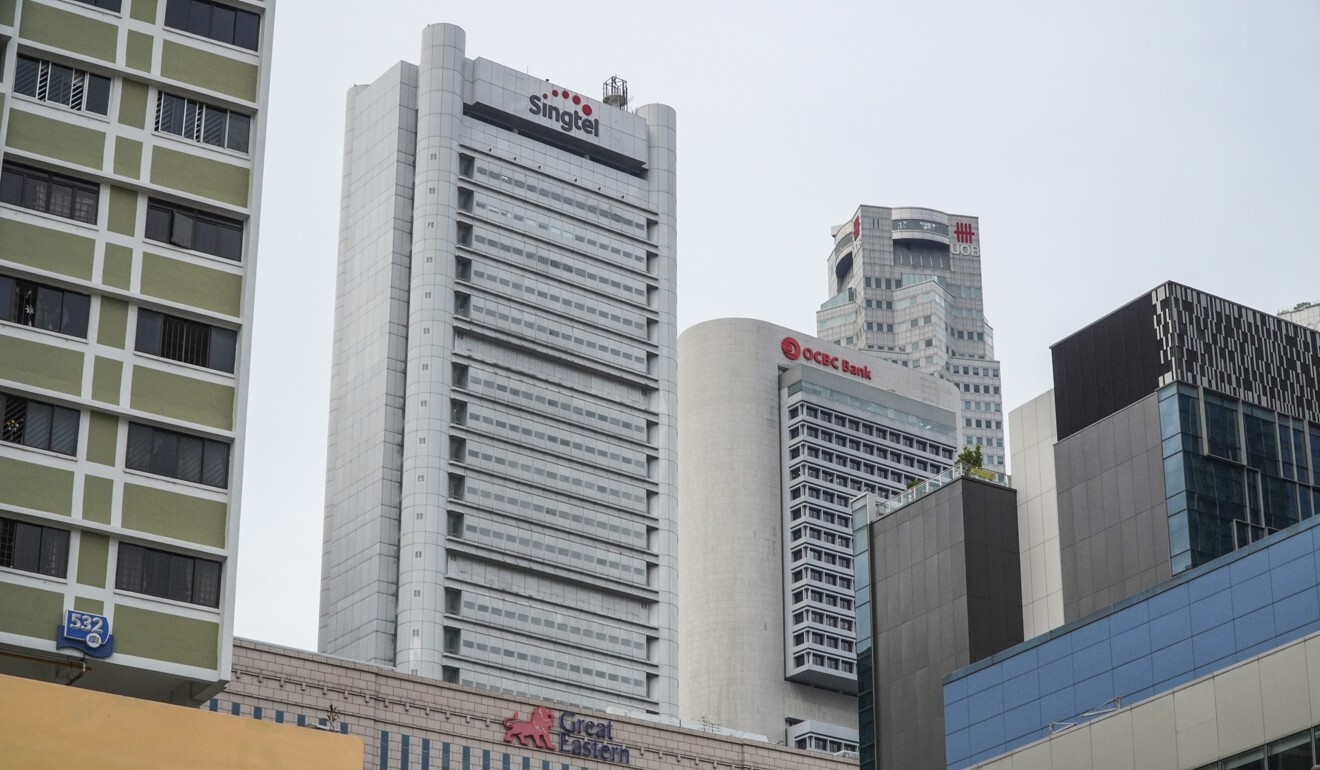
For instance, despite the downturn, Singapore telco Singtel expects to recruit over 300 fresh graduates for various permanent positions this year, according to Aileen Tan, the company’s Group Chief Human Resources Officer. Many of the new hires will be in new growth areas such as the Internet of Things, analytics and cloud.
The Singtel Comcentre building in Singapore. Photo: Roy Issa
Other companies that continue to hire include those in tech across the region, including e-commerce giant Shopee, food-delivery service Foodpanda and Amazon.
In Australia, Borland suggested helping young people to remain plugged into the labour market through government-funded paid internships, or even offering them loans to go for further studies and prevent a spell of unemployment.
For now, while some young jobseekers are taking a wait-and-see approach, the reality is hitting hard for others.
Final-year National University of Singapore student H.P. Tan had all but secured a job at a public relations firm last month, after three rounds of interviews.
The Faculty of Arts and Social Sciences undergraduate was rejected via an email from the agency, which said that they could no longer hire after Covid-19 started to drastically cut business.
“When I got that rejection, it was a turning point. I didn’t think I would be directly impacted,” said the 23-year-old.
“I also applied to a few other agencies but the response has been slow, so I am now freaking out at the possibility of not being able to find a job after graduation.”
The coronavirus pandemic has completely changed patterns of consumer psychology across the world, experts say
Complexity of the crisis, the number of variables and its magnitude make a consumer recovery unprecedented and difficult to predict
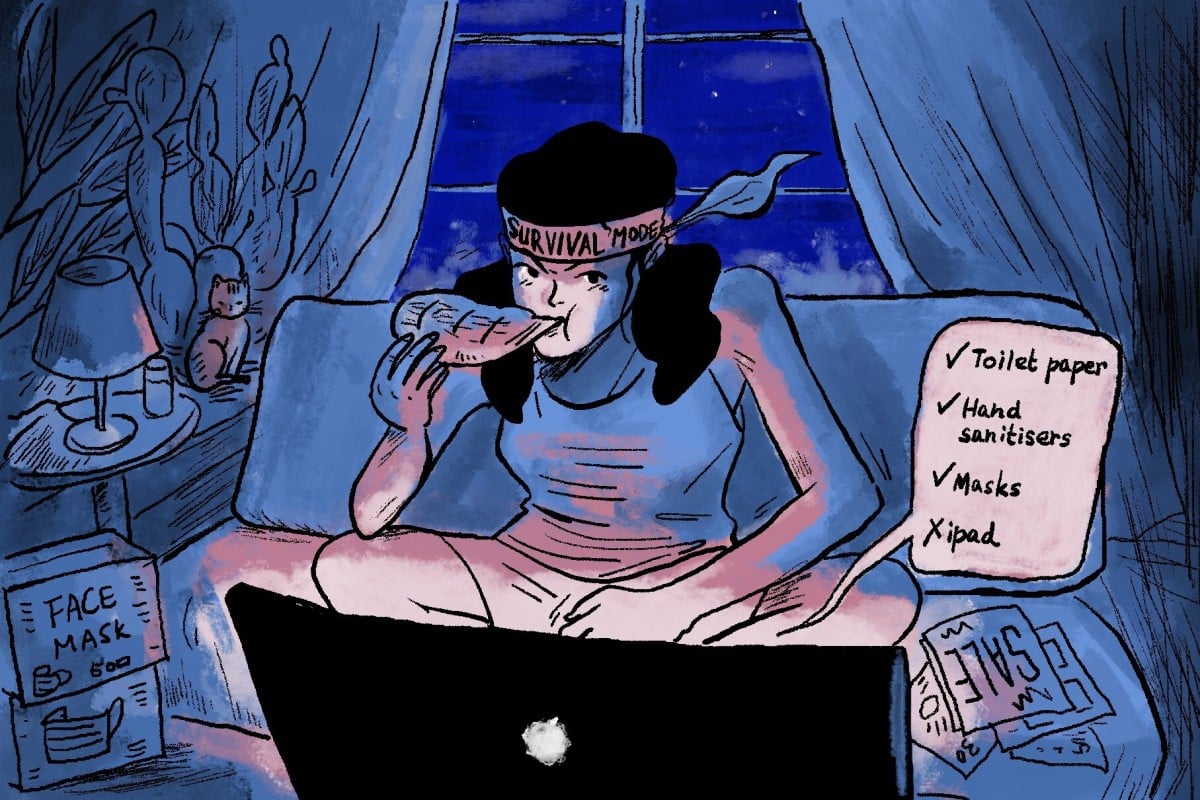
The coronavirus has caused panic buying around the world as consumers frantically stockpile of goods such as toilet paper, hand sanitisers and masks. Illustration: Brian Wang
Before the coronavirus crisis began rippling through the global economy, Susan Wang had big plans for 2020.
Not only was she going to buy a new Apple MacBook and iPad, plus a projector so she could host friends for movies at home, but she was set on making a career move.
“I was planning to change my job, but my headhunter told me that all recruitment has been postponed to the second quarter,” said the 27-year-old who works for a British company in Hong Kong.
“Our headquarters in London has a plan for redundancy, too. It is better to save some money in case I get laid off.”
As Covid-19 spreads across the world, sending stock markets reeling and prompting big companies to slash jobs, Wang has become increasingly frugal like scores of other consumers from China to the United States.
She has stopped eating at restaurants and now tries to keep her weekly food bill under HK$500 (US$64), whereas in the past she wouldn’t think twice about spending HK$100 per meal.
Amid mounting uncertainty, the coronavirus pandemic – which has claimed the lives of more than 41,000 people and infected at least 842,000 worldwide – is fundamentally changing consumer behaviour in Asia, Europe and North America.
Consumer experts said the 2009 global financial crisis, the Great Depression that started in 1929 and the September 11 terrorist attacks give some clues about how and when global consumption might recover. But the complexity of this crisis, the number of variables and its magnitude make this consumer recovery unprecedented and difficult to predict, they added.
Coronavirus: What impact will the economic fallout from the Covid-19 pandemic have on you?
“The coronavirus pandemic has completely changed patterns of consumer behaviour all over the world. People are afraid, and when people are afraid, they go into survival mode,” said Jesse Garcia, a Los Angeles-based consumer psychologist, who is also the CEO of market consulting firm My Marketing Auditors.
plummeted a record 44 per cent in February and those figures are only expected to get worse, with sales forecast to slump between 30 and 40 per cent in the first half of the year, according to the Hong Kong Retail Management Association.
In the US, retail sales dropped by 0.5 per cent in February, even before many states had issued stay-at-home orders to protect the world’s largest economy. The decline was the biggest fall since December 2018.
Experts say non-essential products and services are set to be worst affected by the coronavirus pandemic, while goods and services that can be consumed at home will see a spike in sales.
The coronavirus pandemic has completely changed patterns of consumer behaviour all over the world. People are afraid, and when people are afraid, they go into survival mode – Jesse Garcia
“Online consumer behaviour is frenetic,” said Ross Steinman, a professor of psychology at Widener University in the US state of Pennsylvania. “Consumers are refreshing and refreshing and refreshing websites to secure grocery delivery times, purchase paper towels from their usual big box retailer and scavenge for rice and canned soup from third party sellers on Amazon.
“A pronounced spike in coronavirus cases will only amplify the freneticism.”
So far, one of the biggest shortages for consumers is toilet paper. Television stations across the globe have beamed images of empty supermarket shelves and huge queues as people hoard toilet paper rolls, masks and hand sanitiser.
The frantic stockpiling can be explained by a psychological concept called informational conformity, said Vicki Yeung, associate professor at the Department of Applied Psychology at Lingnan University in Hong Kong.
A pronounced spike in coronavirus cases will only amplify the freneticism – Ross Steinman
“When people lack knowledge and are in an uncertain situation, they tend to follow the group’s behaviour and blindly conform, but once they obtain more information, and digest and process the situation, the panic gradually fades away,” she said.
“During this Covid-19 pandemic, people generally feel jittery and anxious because they feel their sense of control has disappeared.”
Unlike other recent global crises such as the September 11 attacks, the coronavirus is less a one-time sharp shock to the system and more of a rolling source of anxiety that could retreat and resurface repeatedly, consumer behaviour experts said.
This was the pattern with the Black Death plague that hit Europe in 1347 and returned episodically over many years, ultimately killing millions of people.
During this Covid-19 pandemic, people generally feel jittery and anxious because they feel their sense of control has disappeared – Vicki Yeung
“It may be we’ll have to shut down things again in October or August. And this could go on for years,” said Charley Ballard, an economist with Michigan State University in the US. “The more that happens, the more damage it does to buoyant consumer psychology.”
Furthermore, relative to the 2009 financial crisis and even the Great Depression, when much of the damage was concentrated at least initially in the financial sector, this crisis has seen virtually the entire economy grind to a halt all at the same time, devastating employment and consumption.
Last week, a record 3.3 million Americans applied for unemployment benefits within one week, as restaurants, hotels, barber shops, gyms and retail outlets shut down in a nationwide bid to stem the pandemic. The previous record of 695,000 was set in 1982.
On Tuesday, Goldman Sachs predicted the US jobless rate will hit 15 per cent in the second quarter of this year from the coronavirus economic freeze, and could rise further beyond that to near the historic peak of 24.9 per cent seen in 1933 during the Great Depression. Economists at the St. Louis district of the US Federal Reserve projected unemployment could cost as many as 47 million jobs in the US this year, sending the unemployment rate past 32 per cent before making a sharp recovery.
US now has world’s most coronavirus cases, surpassing China
China’s unemployment rate jumped to 6.2 per cent for January and February from 5.2 per cent in December and 5.3 per cent a year earlier. It was the highest level since records began in 2016, but did not include China’s estimated 291 million migrant workers.
Consumer spending accounts for more than 60 per cent of the Chinese economy and drives 70 per cent of the US economy. But with the pandemic causing many people to go into hibernation and likely to lead to cycles of job cuts, economists have predicted a consumer-led global recession by the second quarter of this year.
Just how long it will take for consumer behaviour to return to normal depends on each person’s psychological resilience, including how quickly they can adapt to change, how optimistic they are and whether they can adopt strategies to regain a sense of control, Yeung said.
Anirban Mukhopadhyay, chair professor of marketing at Hong Kong University of Science and Technology said as long as the coronavirus threat was still present, people would remain fearful to some extent. But he added that people were resilient.
Satellite images show world sites deserted amid coronavirus pandemic
“Human beings adapt to events and stimuli over time,” Mukhopadhyay said. “Research has shown that even people who win lotteries tend to return to their earlier levels of life satisfaction after some months, as do people who have to have amputations.
“So even if the source of the fear does not go away, we learn to live with it.”
Ballard, from Michigan State University, estimated it could take upwards of two years for American consumers to feel secure enough in their jobs and gain enough confidence to fully open their wallets. A longer and more episodic duration for the disease could push that higher, he added.
Further complicating the consumer picture, he said, is that many supply chains are at risk of breaking. And consumers will be wary of spending for a while in many traditional areas, including crowded sporting events and concerts, restaurants and flights.
A new phase of coronavirus blame game: what is the legacy of Covid-19 on global supply chains?
Some experts have even suggested that consumer behaviour may be permanently changed as a result of the pandemic.
“It seems very unlikely that people will get back to life as it was before, once the coronavirus is over,” said Andreas Kappes, a lecturer in psychology at City University of London.
“People’s behaviour is extremely orthodox, often referred to as the status quo bias and captured in expressions like ‘past behaviour best predicts future behaviour.’ Now, the crisis forces us to change our behaviour, radically, and we might discover that new way suits us better.”
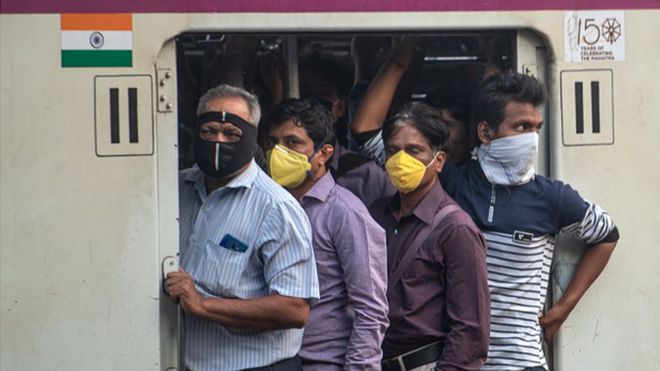
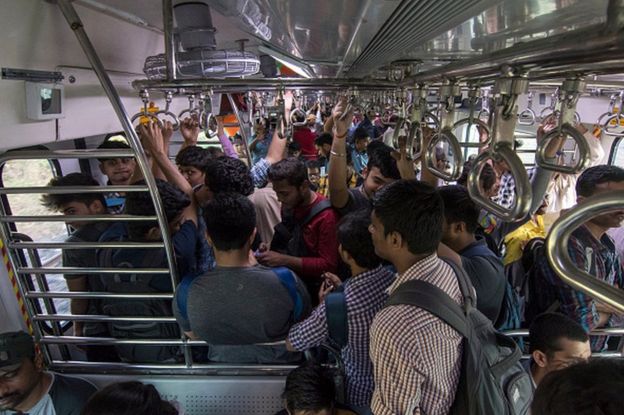
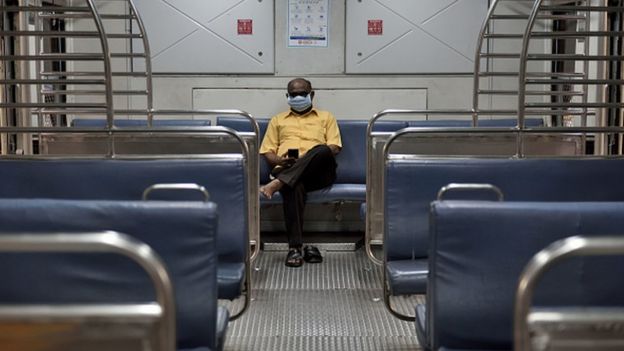
Image copyright GETTY IMAGESImage caption Many passengers have been wearing masks while travelling on the network
One of the world’s busiest urban rail systems will be shut down for ordinary commuters from Monday morning to prevent the spread of coronavirus infection in Mumbai, one of India’s most populous cities. Only government workers in “essential services” will be allowed to travel on a truncated service.
This was waiting to happen.
Consider this. Eight million people take Mumbai’s crowded suburban train network every day. Packed to nearly three times its capacity, this is one of the busiest railway systems in the world.
The 459km (285-mile) network is the lifeline of India’s financial and entertainment capital, accounting for nearly 80% of all commuting trips in the populous western city. The suburban trains “cover almost the distance up to [the] moon in one week,” the network’s website says.
The 66-year-old network carries 60,000 passengers per km per day, the highest among all the leading commuter rail systems in the world, say officials. The coaches are sturdy enough to carry a “super dense crush load”, a phrase coined by the railways to describe the intense crowding on Mumbai’s trains. This means that a nine-car train designed for 1,800 standing passengers will often carry up to 7,000 passengers, according to Monisha Rajesh, author of Around India in 80 Trains. “Mumbai’s local trains were certainly not for the fainthearted,” she wrote.
Image copyright GETTY IMAGESImage caption Mumbai’s suburban train network carries eight million passengers every day
Now consider this. The western state of Maharashtra, of which Mumbai is the capital, has confirmed more than 60 coronavirus infections, the highest in India so far. Scores of long distance trains out of the city have been cancelled, but the suburban network has continued to rumble on, raising fears of the mass spread of the virus on these packed trains. The crowded service was an easy target of a terror attack in 2006 when serial blasts ripped though a number of trains. At least 180 people were killed and more than 800 injured – the high casualty figure was attributed to overcrowding.
“From ports and landing places the local transport networks, particularly the railways, carried the virus from large cities to the smallest, remotest settlements,” said a report on the spread of the flu in Britain in 1918-1919.
So should one of the world’s busiest rail networks be shut down to stop a possible spread of the virus in a city that many fear could turn into a coronavirus hotspot?
Image copyright GETTY IMAGESImage caption Officials say ridership on the trains has dropped by 17% after the coronavirus scare
Economists like Shruti Rajagopalan believe so.
“India is conducting the fewest tests per million at the moment. If the virus is truly within the community, then given these two issues, the Mumbai outbreak cannot be contained and people will die without healthcare.
“Mumbai trains are the fastest and surest way to spread the virus (if it is within the community) to the densest parts of the city,” she told me.
There is enough precedent: China stopped trains, ferries, planes and buses from leaving the city of Wuhan; and on Thursday, London officials announced that up to 40 stations on the London Underground network are to be shut as the city attempts to contain the outbreak.
Others are not so sure about linking the spread of a pandemic to public transport systems. One study does not support the effectiveness of suspending mass urban transport systems to reduce or slow down a pandemic because, “whatever the relevance of public transport is to individual-level risk, household exposure most likely poses a greater threat”.
“I have not seen any data on the relative risk of public transportation compared with [dense places like] workplaces or schools,” Timothy Brewer, a professor of epidemiology at the University of California Los Angeles told Vox.com.
He said data from China suggested that “household contact was an important means of transmission outside of Wuhan, suggesting that prolonged contact [with a sick person] increases the risk of transmission”.
“If correct, then the time spent commuting and the density of people commuting could be important factors in assessing if public transportation is a risk factor for the disease’s transmission.”
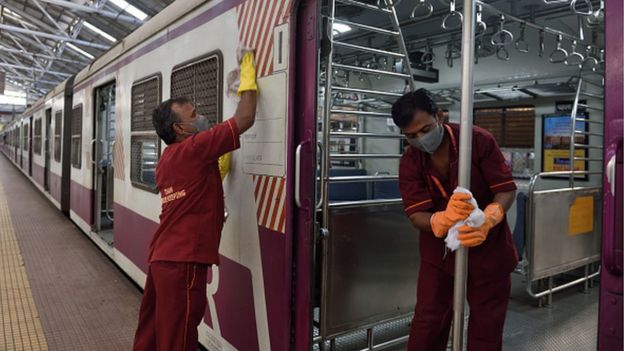
Image copyright GETTY IMAGESImage caption Trains on the network are being scrubbed clean to avoid the spread of infection
Shivaji Sutar, a senior communications officer of the railways, told me that the network was running an aggressive campaign to ease the rush: awareness announcements, posters and videos containing virus information.
They were also monitoring crowds, scrubbing the trains, taking the temperature of willing passengers and embarking on a drive against public spitting, he said.
A combination of awareness and panic has already led to a 27% drop in traffic on the network. But millions of people continue to take the train to work and home every day.
“This is more because of fear than anything else. Most of us have to take the network because we have to come to work. There is still no government directive to all companies to work from home. And apart from passengers wearing masks, I haven’t seen any other precautions being taken,” Rekha Hodge, who has been using the network for three decades, told me. That is bad news.
MUMBAI (Reuters) – India’s rural inflation rate surged faster than urban inflation for the first time in 19 months in January, and economists are optimistic that signals something the country desperately needs – a revival in demand in the rural economy.
Around two-thirds of India’s population depends on the rural sector with agriculture accounting for near 15% of India’s $2.8 trillion economy, and rising inflation suggests pricing power is returning to the hands of the farmers, say economists.
“This augurs well for farmers’ cash flows in the coming months. I expect early signs of demand revival to emerge from the rural belts, going ahead,” said Rupa Rege Nitsure, chief economist at L&T Financial Holdings.
Rural inflation rose to 7.73% in January, higher than the urban inflation rate – which was 7.39% – for the first time since June 2018. The latest data, released on Wednesday, also showed that overall inflation was 7.59% – its highest level in more than six years.
While the higher inflation readout, which comes at a time when India’s growth has likely slumped to 11-year lows, has fanned some concerns around stagflation, economists say the inflation numbers could also signal some momentum returning to rural growth.
The central bank is mandated to keep the retail inflation rate between 2-6% and it targets a medium-term inflation rate of 4%.
Rural inflation has been falling over the last year and half as a lack of proper infrastructure for storage and transport had left rural India with a glut of grains and the floods in several states in 2019 made matters worse for goods transportation.
“Better returns on food prices could improve the prolonged period of unfavourable terms of trade faced by the rural sector,” said Radhika Rao, economist with DBS Bank.
This could bring a glimmer of good news for the government, which has been trying to revive growth and boost consumption.
In its budget earlier this month, the government allocated 5.6% higher spends on agriculture and allied activities for the fiscal year 2020/21, as it seeks to kick-start demand.
While higher rural inflation could help kickstart economic growth, economists caution that urban demand revival remains a concern.
“To that extent that high inflation hurts urban spending, the overall demand dynamics stay unchanged,” Rao said.
NEW DELHI (Reuters) – India sought to boost growth in a federal budget on Saturday that raised spending on farms and expressways and offered cuts inpersonal taxes, but the measures fell short of market expectations and battered stocks.
Prime Minister Narendra Modi’s government is grappling with the country’s worst slowdown in a decade, with falling employment, consumption and investment ratcheting up the pressure to revive growth.
The government estimates growth this year to March 31 will slip to 5%, the weakest pace since the global financial crisis of 2008-09. It also warned an expected rebound the following year might entail a blow-out in fiscal deficit targets.
Finance Minister Nirmala Sitharaman, presenting the budget for the financial year beginning April 1, said 2.83 trillion rupees ($39.8 billion) will be allocated toward agriculture and allied activities, up 5.6 percent on the previous year.
RELATED COVERAGE
India raises import taxes in move set to spook some foreign firms
The funds will be deployed to help farmers set up solar power generation units as well as establish a national cold storage system to transport perishables.
Sitharaman also vowed to spend $50.7 billion in coming years on a federal water scheme to address challenges facing one of the world’s most water-stressed nations.
Agriculture accounts for near 15% of India’s $2.8 trillion economy and is a source of livelihood for more than half of the country’s 1.3 billion population.
Sitharaman announced a new personal tax system including cuts for those ready to give up a myriad of tax breaks. She also abolished payment of dividend distribution tax by companies to spur investment.
“People have reposed faith in our economic policy,” Sitharaman said to the thumping of desks in parliament. “This is a budget to boost their income and enhance their purchasing power.”
Opposition parties slammed the budget, saying it had failed to address the slowdown in consumer demand and investment. “The government is in complete denial that the economy faces a grave macro economic challenge,” said former finance minister P. Chidambaram.
But higher government spending has put pressure on public finances, prompting caution from rating agencies. Sitharaman said the fiscal deficit for the current year would widen to 3.8% of GDP, up from 3.3% targeted for the current year.
Gene Fang, associate managing director, sovereign risk at Moody’s, said: “India’s 2020/21 budget highlights the challenges to fiscal consolidation from slower real and nominal growth, which may continue for longer than the government forecasts.”
GOVERNMENT SPENDING
For fiscal 2020/21 Sitharaman set the fiscal deficit at 3.5 percent. Moody’s said India’s government debt is already significantly higher than the average for Baa-rated sovereigns, a product of persistent fiscal deficits.
To help finance government spending, Sitharaman set a target for selling stakes in state firms at 2.1 trillion rupees for 2020/21, more than three times the amount expected this year.
She said the government will sell a part of its holding in state-run Life Insurance Corp, the country’s biggest insurance company.
But many experts said the measures did not go far enough to address the slowdown and structural flaws.
“In a normal scenario this budget would have been considered as good providing tax benefit to the common man, corporate and focus on farmers’ incomes, but the situation required more,” said Vinod Nair, head of research at Geojit Financial Services in Kochi.
Indian shares slid to a more than three-month low after a special trading session on Saturday, dented by what analysts said was a lack of sufficient stimulus measures. The NSE Nifty 50 index .NSEI closed 2.5% lower while the benchmark S&P BSE Sensex .BSESN fell 2.4%
“Markets had very high expectations from the budget … these expectations have not been met,” said Deepak Jasani of HDFC Securities.
The government also announced higher duties on a host of imports from walnuts to phone parts. Taxes on imports of pre-assembled printed circuit boards were raised to 20% from 10% and there were new taxes on mobile phones ringers and display panels in a bid to boost local manufacturing.
In its annual economic report released on Friday the government predicted growth would rebound to 6.0% to 6.5% in the fiscal year beginning April 1.
Some economists say global trade tensions and the outbreak of coronavirus in China pose a new risk to economic recovery by hitting cross-border commerce and supply chains.
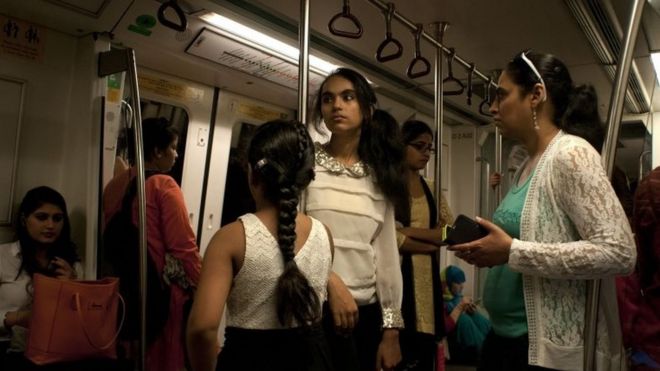
Image copyright GETTY IMAGESImage caption Mr Kejriwal has proposed free travel on buses and the city’s famed Delhi metro rail service
The chief minister of India’s capital Delhi created a minor sensation when he announced that women would no longer have to pay for public transport.
Arvind Kejriwal said that free rides on city buses and the metro would help improve women’s safety in the city.
Delhi reports some of the highest numbers of rape in India. The 2012 gang rape and murder of a student on a bus in the city sparked massive protests.
However not everyone is convinced that Mr Kejriwal’s proposal will help.
Dinesh Mohan, a transport expert with the Indian Institute of Technology in Delhi, told the BBC that making public transport free wouldn’t solve the problem.
“You need to think about the entire journey and not just the metro – you have to take into account how safe or unsafe sidewalks are and what the journey to the metro station is like in the first place. So if the idea is to make it safer for women, that experience has to be continuous. Safety can’t begin and end at the metro station. I don’t see any thought behind this initiative yet.”
Despite Mr Kejriwal’s announcement, women will have to wait a while to see if it is actually implemented.
The proposal still has to be approved by the federal government because it is an equity partner along with the Delhi government in the Delhi Metro Rail Corporation.
But Mr Kejriwal has said that the federal government’s permission is not necessary as the Delhi government will bear the cost.
Delhi transport minister Kailash Gahlot said since this qualifies as a subsidy, they did not require any such permission.
Some have dismissed the entire thing as a pre-election gimmick by Mr Kejriwal – Delhi will hold state assembly elections next year.
Architect and urban planner Sonal Shah said on Twitter that a number of factors had to be taken into consideration for women’s safety to be addressed effectively. She said that transport access was “not equal for men and women”, adding that a number of existing issues with public transport had to be addressed first.
NEW DELHI (Reuters) – Economists and investors are increasingly showing that they have little or no confidence in India’s official economic data – presenting whoever is elected as the next prime minister with an immediate problem.
There have been questions for many years about whether Indian government statistics were telling the full story but two recent controversies over revisions and delays of crucial numbers have taken those concerns to new heights.
The government itself has admitted there are deficiencies in its data collection.
A study conducted by a division of the statistics ministry in the 12 months ending June 2017 found that as much as 36 percent of the companies in the database used in India’s GDP calculations could not be traced or were wrongly classified.
But the ministry said there was no impact on GDP estimates as due care was taken to adjust corporate filings at the aggregate level.
Last December, the government held back the release of jobs data but an official report leaked to an Indian newspaper showed the unemployment rate had touched its highest level in 45 years.
Economists and investors are now voting with their feet – by using alternative sources of data and in some cases creating their own benchmarks to measure the Indian economy.
Ten economists and analysts at banks, think-tanks and foreign funds interviewed by Reuters said they were moving to use alternative data sources, or at least official data of a different kind.
Among the numbers they prefer are fast-moving indicators like car sales, air and rail cargo levels, purchasing managers’ index data, and proprietary indices created by the institutions themselves to track the economy.
Many economists said they were stunned when the government upwardly revised GDP growth for 2016/17 to 8.2 percent from 6.7 percent, although the demonetization of high value notes hit businesses and jobs in that financial year.
“Our response has been to spend time developing an Indian Activity Index, which takes a range of time series data that in the past were strongly correlated with real GDP growth and extract the common signal from them,” said Jeremy Lawson, chief economist at Aberdeen Standard Investments, which manages more than $700 billion in assets.
The preliminary evidence from the index, which includes components like car sales, air cargo and purchasing managers’ index data suggests the government has over-estimated GDP growth, he said.
Our index would suggest that there was stable growth, rather than the rapid acceleration suggested by the GDP figures,” he said, referring to three years of data from 2014.
Even those close to the government have said the lack of accuracy in the official data makes it much more likely that authorities will miss major swings in activity and be unable to react quickly to head off a crisis. It is also a problem for investors who may be misled into thinking the economy is more robust than it really is.
The economic wing of the Rashtriya Swayemsewak Sangh, the fountainhead of the ruling Hindu nationalist Bharatiya Janata Party, said the government and the Indian central bank missed anticipating a farm crisis that has now gripped the countryside, with low crop prices driving down farmers’ incomes.
“The fact is the government advisers and the monetary policy committee of the central bank could not diagnose the farm crisis, deflationary conditions in rural economy, and ignored the need to boost growth,” said Ashwani Mahajan, the co-convenor of the group, Swadeshi Jagran Manch, adding the government was now taking steps to address the problem.
The delayed response has cost Prime Minister Narendra Modi at least some support in the countryside in the current general election – although most political strategists still think he can probably hang onto power.
The opposition and other critics have said Modi suppressed jobs data and “massaged” economic growth numbers in an attempt to show that his government has done better than the previous administration.
A spokesman at Modi’s office said no official was available for comment as they were busy with the election while a finance ministry spokesman referred to Finance Minister Arun Jaitley’s previous comments.
In a blog in March, Jaitley criticized economists for doubting the credibility of data and accused them of running a fake campaign against the government.
IDLE CAPACITY
Some investors have been burned by believing in India’s high growth story.
Private power producers invested billions of dollars based on expectations of electricity demand that didn’t pan out in the rural economy. With economic growth pegged at over 8 percent a year, they had expected a pick up in demand by small businesses and household.
Many of the power producers are now facing bankruptcy and legal disputes as many of the new plants they built are working at about 60 percent of capacity.
In the real estate sector, developers said, it could take 3-4 years to clear about 500,000 unsold flats in and around New Delhi that were built on the assumption of higher income jobs in urban areas.
To be sure, the proportion of the Indian economy that is based on the unofficial sector, such as household enterprises, makes it a nightmare to assess economic activity.
P. C. Mohanan, former acting chairman of the national oversight body for statistics, who resigned to protest government interference over the release of the jobs figures and back series data on GDP, said the government hasn’t allocated the resources it needs to measure activity given the growth in the economy.
Gita Gopinath, the International Monetary Fund’s chief economist, told an Indian TV channel last month the IMF had raised the issue of “transparency” with Indian officials in data collection and, in particular, measurement of the GDP deflator – the adjusted inflation rate used to estimate real GDP.
In a statement, the statistics ministry said it was working to address the issue.
A senior official earlier said they were open to suggestions for improvement, just not “politically motivated” criticism.
There are already plans to revamp data compilation and capture the nuanced relationship between prices and real GDP, he said.
The mainland government will also seek to create a level playing field for businesses, most of which are privately-owned, in terms of market entry and regulation
Small and medium-sized firms are vulnerable to trade disputes and an economic slowdown even though they contribute the majority of growth and employment
China plans to make it easier and cheaper for businesses to access credit through subsidies and certain bank loans, according to a comprehensive policy guidelines jointly released by the Central Committee and the State Council on Sunday. Photo: Alamy
China will “remove all sorts of unreasonable barriers and restrictions” to help small and medium-sized enterprises which are seen as vital to help employment and economic growth amid the trade war with the United States.
Beijing plans to make it easier and cheaper for businesses to access credit through subsidies and certain bank loans, according to a comprehensive policy guidelines jointly released by the Central Committee of the Communist Party of China and the State Council on Sunday.
The mainland government will also seek to create a level playing field for businesses, most of which are privately-owned, in terms of market entry and regulation.
“Small and medium-sized enterprises is an dynamic power for national economic and social important and is critical for expanding employment, improving people’s livelihood, and to foster innovation,” the guidelines said. “For now, they are facing problems of rising production costs, difficulty in obtaining credit and insufficient capabilities to innovate – these issues demand high attention.”
China will “remove all sorts of unreasonable barriers and restrictions, trying to ensure fair competition and provide sufficient market in terms of market entry, licensing, bidding and the military-civil infusion,” it added.
While most of the policies are not completely new, the move to pull them together into a larger policy document, which will serve as a guideline for local authorities, shows China’s intention to stabilise the domestic economic situation as its trade disputes with the US continues.
Beijing has also designed a variety of financial policy tools, including targeted required reserve ratio cuts and the use of small and medium-sized enterprise loans as collateral for medium-term lending facilities granted by the central bank, meaning banks will have more incentives to offer financing.
To further boost lending, it will also offer some exemptions for interest received from value added tax, while also providing tax breaks for small firms and start-ups, a lower social security contribution ratio and an increase in government procurement, according to the guidelines.
Small and medium-sized enterprises is an dynamic power for national economic and social important and is critical for expanding employment, improving people’s livelihood, and to foster innovation.New guidelines
The need for the Chinese government to support small businesses became even more obvious last summer when it began its trade was with the US. Small private businesses are more vulnerable to trade disputes and an economic slowdown than state-owned enterprises, which are often bigger and enjoy favourable treatments from the government and banks, even though they contribute the majority of growth and employment.
Employment is the top priority on the agenda of Premier Li Keqiang this year, as shown in his government work report revealed last month. China has vowed to create 11 million new urban jobs this year and cap the surveyed urban unemployment rate at 5.5 per cent.
Morgan Stanley economists noted that China’s real gross domestic product growth may slow to 6.2 per cent in the first quarter.
“The main drag is slower investment growth, led by property construction and manufacturing [capital expenditure] amid still-subdued export and business sentiment,” Morgan Stanley economists Robin Xing, Jenny Zheng and Zhipeng Cai said.
The National Bureau of Statistics is due to release the first quarter economic data on April 17.









 CHINDIA ALERT: You'll be living in their world, very soon
