Chindia Alert: You’ll be Living in their World Very Soon
aims to alert you to the threats and opportunities that China and India present. China and India require serious attention; case of ‘hidden dragon and crouching tiger’.
Without this attention, governments, businesses and, indeed, individuals may find themselves at a great disadvantage sooner rather than later.
The POSTs (front webpages) are mainly 'cuttings' from reliable sources, updated continuously.
The PAGEs (see Tabs, above) attempt to make the information more meaningful by putting some structure to the information we have researched and assembled since 2006.
LONDON (Reuters) – The United Kingdom’s COVID-19 death toll surpassed 47,000 on Tuesday, a dire human cost that could define the premiership of Boris Johnson.
The Office for National Statistics said 42,173 people had died in England and Wales with suspected COVID-19 as of May 15, bringing the UK total to 47,343 – which includes earlier data from Scotland, Northern Ireland, plus recent hospital deaths in England.
A death toll of nearly 50,000 underlined Britain’s status as one of the worst-hit countries in a pandemic that has killed at least 345,400 worldwide.
Johnson, already under fire for his handling of the pandemic, has had to defend his top adviser Dominic Cummings who drove 250 miles from London to access childcare when Britons were being told to stay at home to fight COVID-19.
One Johnson’s junior ministers, Douglas Ross, resigned on Tuesday in protest. Johnson has stood by Cummings, saying the aide had followed the “instincts of every father”.
The government says that while it may have made some mistakes it is grappling with the biggest public health crisis since the 1918 influenza outbreak and that it has ensured the health service was not overwhelmed.
Unlike the daily death toll published by the government, Tuesday’s figures include suspected cases and confirmed cases of COVID-19, the respiratory disease caused by the novel coronavirus.
But even these figures underestimate the true number of deaths.
In March, Britain’s chief scientific adviser said keeping deaths below 20,000 would be a “good outcome”. In April, Reuters reported the government’s worst-case scenario was 50,000 deaths.
Disease experts are watching the total number of deaths that exceed the usual for amount for the time of year, an approach that is internationally comparable.
The early signs suggest Britain is faring badly here too.
Excess deaths are now approaching 60,000 across the UK, ONS statistician Nick Stripe said, citing the latest data – a toll equivalent to the populations of historic cities like Canterbury and Hereford.
Power-sharing agreement between rebel leader Riek Machar and President Salva Kiir gives hope to ending the conflict
Beijing has invested tens of millions of dollars in the country’s oilfields and sent more than 1,000 peacekeeping troops there
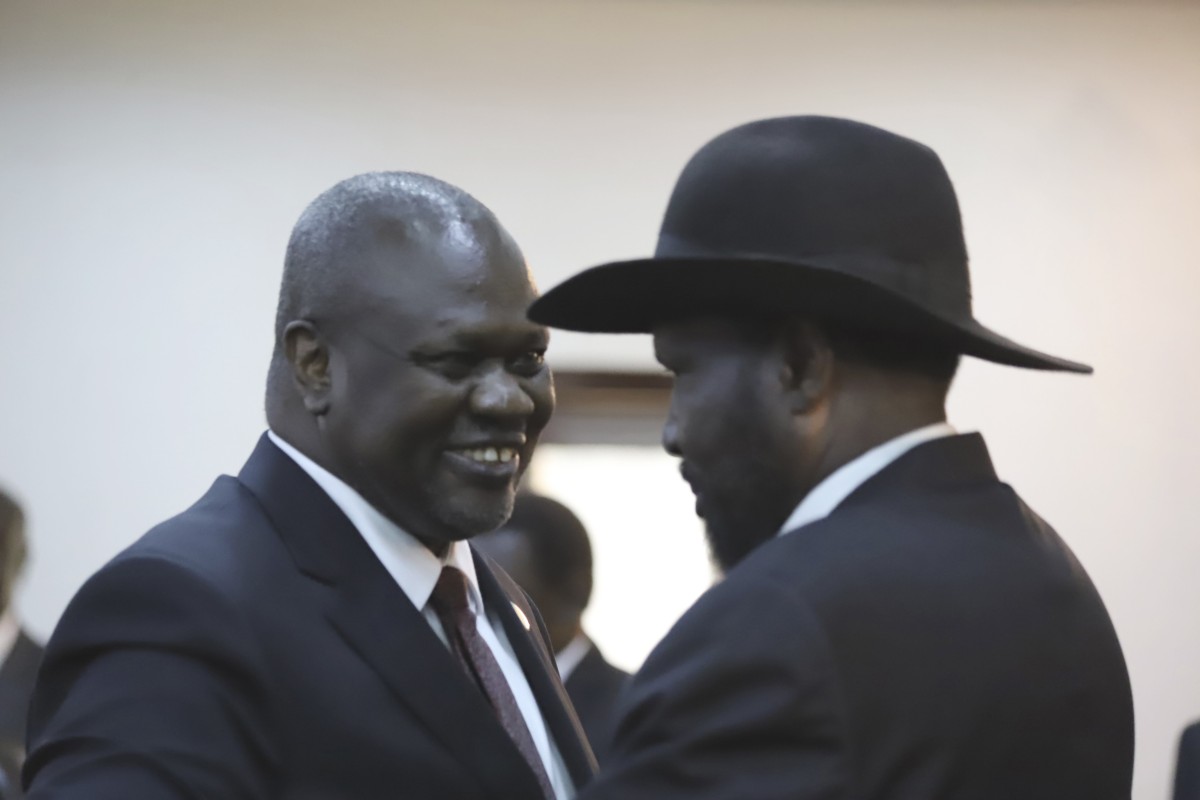
Rebel leader Riek Machar (left) and President Salva Kiir greet each other after the swearing-in ceremony at the State House in Juba on Saturday. Photo: AP
Beijing has welcomed “encouraging developments” in the South Sudan peace process after rebel leader Riek Machar and President Salva Kiir agreed to form a transitional coalition government.
Machar, the Sudan People’s Liberation Movement-In Opposition (SPLM-IO) leader, was among four vice-presidents sworn in on Saturday in the capital, Juba, in a power-sharing deal that gives hope to ending the more than six years of conflict which has killed some 400,000 people and displaced millions more.
“The Chinese side commends and welcomes these encouraging developments, especially the crucial consensus reached between President Kiir and Machar,” the Chinese embassy in Juba said in a statement.
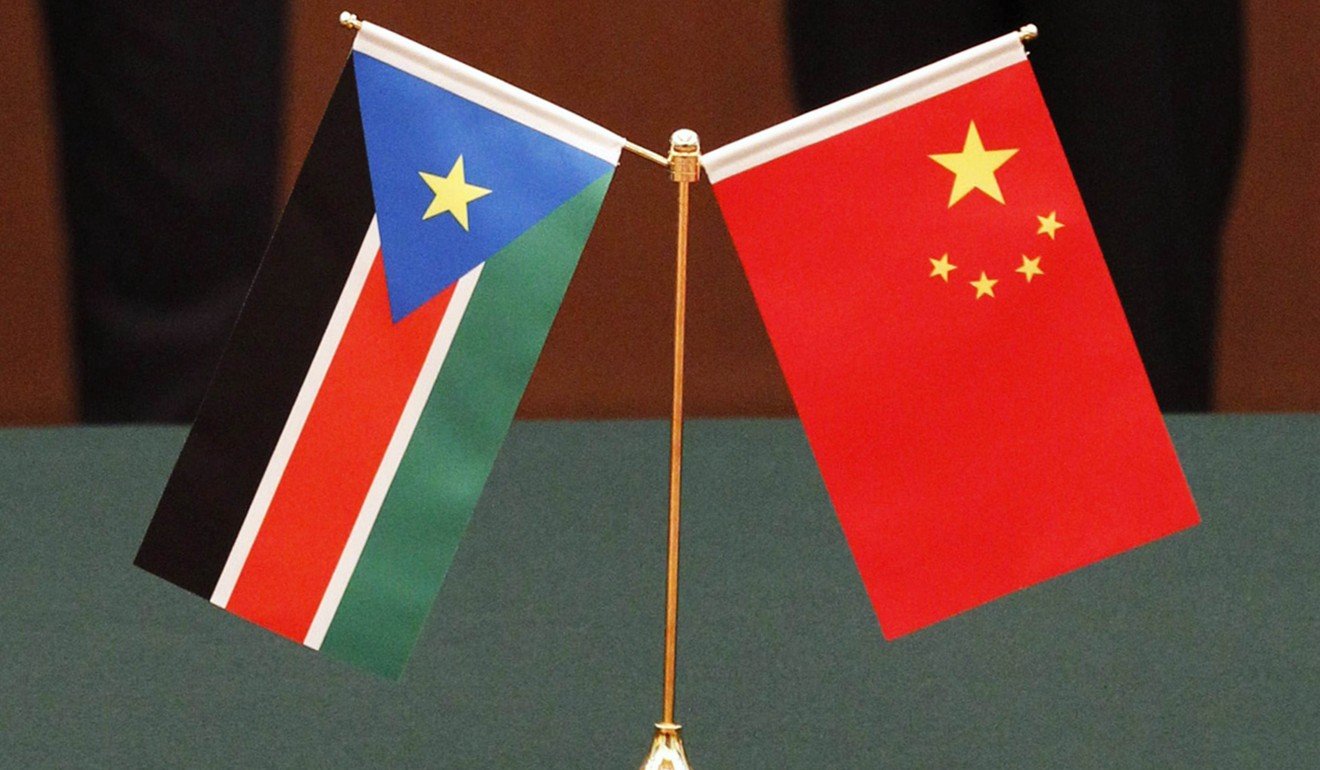
Stability in South Sudan is important for China, which has invested tens of millions of dollars in the country’s oilfields as it seeks to meet energy needs at home. China National Petroleum Corporation (CNPC) owns a 41 per cent stake in South Sudan’s largest oil consortium, Dar Petroleum Operating Company, while Sinopec, another Chinese state-owned firm, holds a 6 per cent stake.
Stability in South Sudan is important for China, which has major investments in the country’s oilfields. Photo: Reuters
China has also sent more than 1,000 troops to the United Nations’ peacekeeping mission in South Sudan, and has not followed the United States and other Western nations in imposing sanctions on leading political and military figures.
“We trust that the relevant parties of South Sudan will resolve the remaining issues in the spirit of mutual trust and understanding, and start a new chapter in the history of South Sudan,” the embassy statement added.
China has offered to help rebuild the country, promising to supply a unified security force that is supposed to be formed from the rival factions as part of the peace process. It has also helped to set up military camps to accommodate both government troops and members of the armed opposition.
Since the peace deal was signed between Kiir and rebel factions in September 2018, China said it had provided diplomatic and other support to military camps and training centres including 1,500 tonnes of rice, 2,500 tents, 50,000 blankets and 1,440 boxes of medicine.
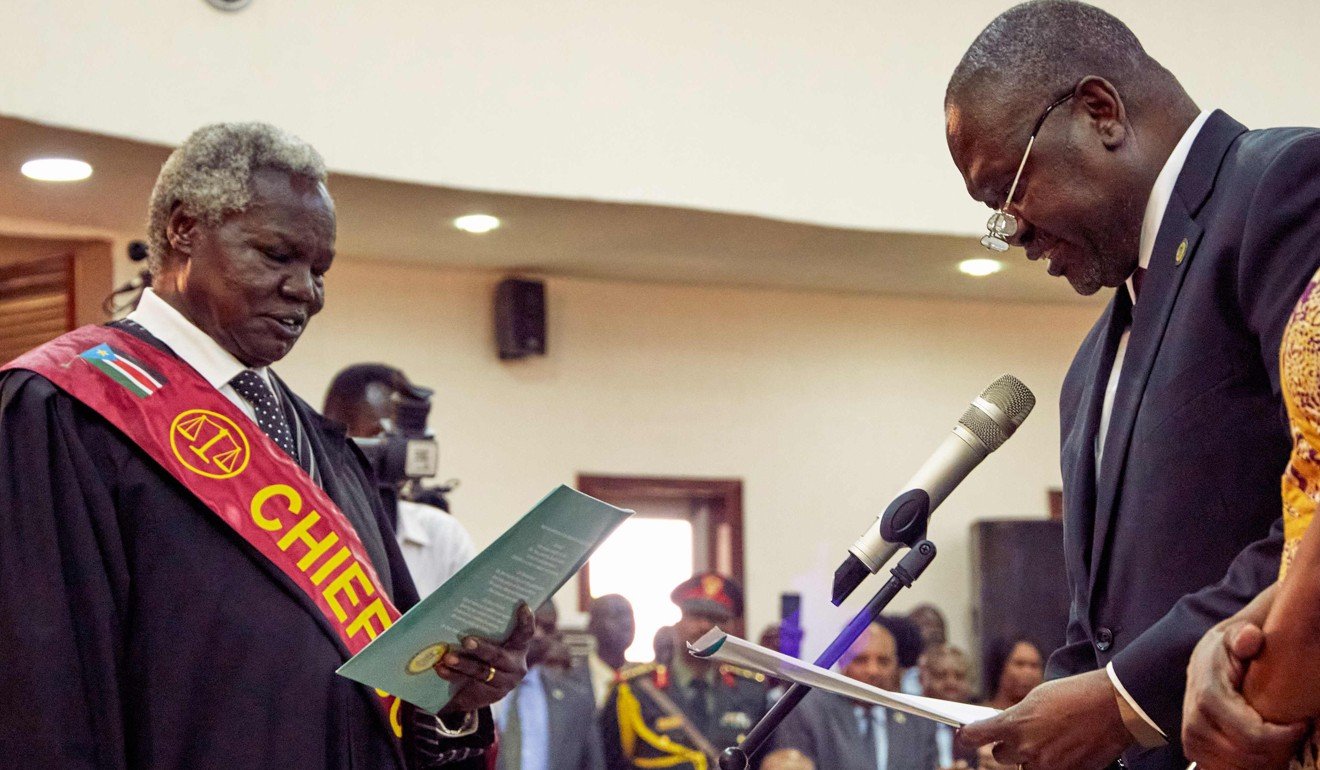
Riek Machar (right) is sworn in as the first vice-president of South Sudan. Photo: AFP
Machar was sworn in as the first vice-president alongside three others – James Wani Igga, Taban Deng Gai and Rebecca Nyandeng. Gai, a former ally of Machar who switched to the government side, was recently sanctioned by the US over serious human rights abuses. Nyandeng is the widow of John Garang, who led a long struggle for independence from Sudan before he died in a helicopter crash in 2005.
“I have forgiven my brother Riek Machar. I also ask for his forgiveness and I also forgive all those who still are holding out on this peace agreement,” Kiir said at a ceremony at the State House attended by regional leaders and diplomats.
After the swearing-in, Machar vowed to work together to end the suffering of South Sudanese.
“I reiterate my commitment to work closely with President Kiir to implement the agreement in letter and spirit,” Machar said.
From Angola to Zambia, China’s African partners brace for coronavirus blow to trade
14 Feb 2020
The South Sudanese have seen more war than peace since the East African nation – whose oilfields contribute about 98 per cent of the government’s revenue – seceded from the Republic of Sudan in 2011. Kiir and Machar formed the independent government but disagreements followed, leading to Machar’s sacking, sparking a bloody war along ethnic lines.
They again agreed to work together in 2015, but the deal fell apart a year later following renewed fighting. After international pressure and peace talks, a new deal was signed in September 2018, but Kiir and Machar have had to push back two deadlines to form the coalition government as they could not agree on issues such as having a unified army and the number of states – highly contentious since it affects the control of oil-rich regions. Machar also wanted his security assured.
On Thursday, Kiir said he had agreed to abolish the 32 states he created in 2015 and revert to the original 10 states.
According to a report released last week on China’s approach to UN peacekeeping in the region, Beijing had used its “economic leverage” in South Sudan.
“China has used its leverage to encourage the government and the opposition parties to negotiate, to come to an agreement, and to implement the ceasefire agreements,” said the report by the Norwegian Institute of International Affairs. “It has reportedly used its economic leverage by signalling that it would be unable to renew and expand its support to the South Sudanese government and the economy as long as the fighting was ongoing.”
Africa is a test lab for how China approaches international security and peacekeeping
8 Aug 2019
South Sudan had also provided an opportunity for Chinese soldiers to put their skills to the test on overseas missions and during armed conflict.
“South Sudan became a real-world laboratory [for China] to test the boundaries of its non-interference principle,” the report said.
Obert Hodzi, an international relations lecturer at the University of Liverpool in England, also said earlier that it was a way for China’s military to get the combat experience it needed.
“South Sudan provides ample opportunities for different segments of the Chinese army to practise, test their equipment and ability to conduct successful missions abroad,” Hodzi said.
Image copyright GETTY IMAGESImage caption Cases of coronavirus have risen sharply in South Korea, where the outbreak is worsening
The head of the World Health Organization (WHO) has expressed concern at the number of coronavirus cases with no clear link to China or other confirmed cases.
Dr Tedros Adhanom Ghebreyesus said the window of opportunity to contain the virus was “narrowing”.
Chinese health authorities reported a decrease in deaths and new cases of the coronavirus on Saturday.
But cases are on the rise in South Korea, Italy, Iran and other countries.
Outside China, more than 1,200 cases of the virus have been confirmed in 26 countries and there have been eight deaths, the WHO says.
They include two deaths in South Korea, which has the biggest cluster of confirmed cases apart from China and a cruise ship quarantined in Japan.
On Saturday, South Korea reported 142 new confirmed cases of the coronavirus, bringing the national tally to 346.
On Friday, doctors in Italy said a 78-year-old man became the first person in the country to die from the new coronavirus, Ansa news agency reported.
Earlier Italy had announced 16 more cases and its health minister said schools and offices would be closed and sports events cancelled in the affected regions.
China has reported 76,288 cases including 2,345 deaths. The new virus, which originated last year in Hubei province in China, causes a respiratory disease called Covid-19.
What did the WHO chief say?
Dr Tedros said the number of coronavirus cases outside China was “relatively small” but the pattern of infection was worrying.
“We are concerned about the number of cases with no clear epidemiological link, such as travel history to or contact with a confirmed case,” he said.
The new deaths and infections in Iran were “very concerning”, he said.
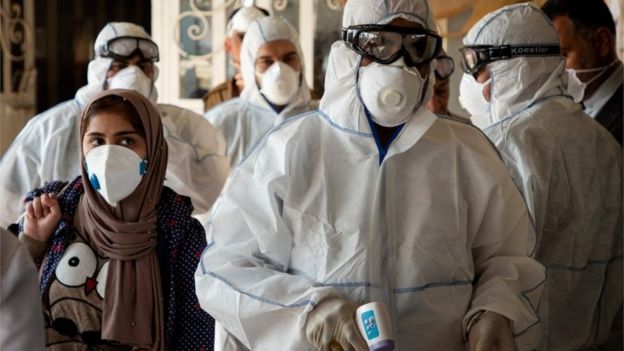
Image copyright AFPImage caption Iraq has been checking people at its border with Iran
But he insisted that the measures China and other countries had put in place meant there was still a “fighting chance” of stopping further spread and called on countries to put more resources into preparing for possible outbreaks.
What is the latest in South Korea?
Prime Minister Chung Sye-kyun declared a public health emergency as the total number of cases surpassed 300 on Saturday.
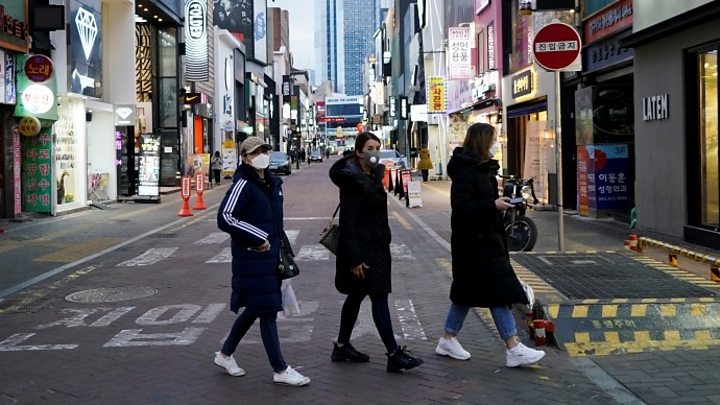
The southern cities of Daegu and Cheongdo have been declared “special care zones”. The streets of Daegu are now largely abandoned.
The nation’s capital, Seoul, banned demonstrations in central areas.
Two cases were also reported in Busan, South Korea’s second-largest city, and one on the Island of Jeju on Saturday – the first in both places.
Media caption People in Daegu have voiced concern over the spread of the virus
All military bases are in lockdown after three soldiers tested positive.
The authorities suspect the current outbreak in South Korea originated in Cheongdo, pointing out that a large number of sect followers attended the funeral of the founder’s brother from 31 January to 2 February.
The sect – known as Shincheonji – which has been accused of being a cult, said it had now shut down its Daegu branch and that services in other regions would be held online or individually at home.
As of Friday, more than 400 members of the church were showing symptoms of the disease, though tests were still ongoing, the city mayor said.
Can we answer your question on the coronavirus?
Here’s what others have been asking
Once you’ve had coronavirus, will you be immune?
Could the coronavirus become a pandemic?
Is the coronavirus worse than flu or Sars?
Hand sanitizers and warning signs
By Hyung Eun Kim, BBC Korean Service, Seoul
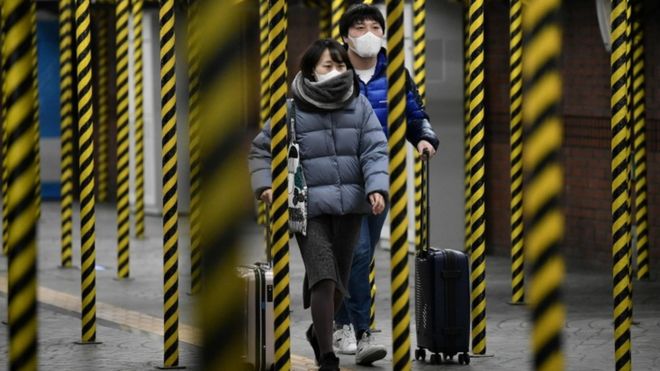
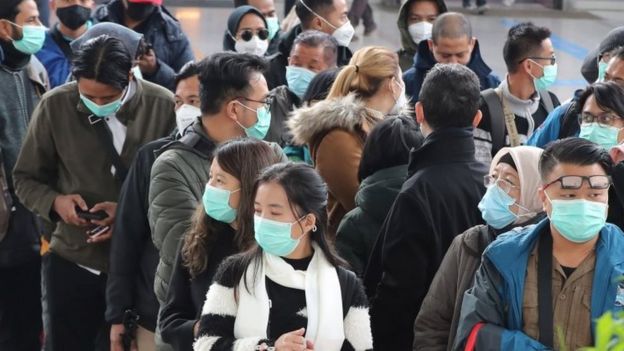
Many people in South Korea are wearing masks on a daily basis.
Hand sanitizers have been placed at public transport stops and building entrances.
Warning government signs are everywhere. They say: “Three ways to prevent further infection: wear a mask at all times; wash your hands properly with soap for more than 30 seconds; and cover yourself when coughing.”
Image copyright EPAImage caption New norm: Mask-wearing crowd in Seoul
Koreans have also developed several apps and websites that tell you how much risk you face where you are. They show where the infected people are within a 10km radius.
“I can’t miss work, what I can do is minimise contact with others and stay at home during the weekend,” Seung-hye Lim, a Seoul resident, told the BBC.
“I do wonder if we reacted too laxly initially or if it really is because of the specific service practices of the Shincheonji sect.”
So-young Sung, a mother of two in Seoul, told the BBC: “It feels like my daily life is collapsing.”
She said she was struggling to find pharmacies that had masks.
She added that checking coronavirus-related alarms from her children’s schools and kindergartens was now a daily routine for her.
What about the Iran cases?
In Iran the outbreak is centred on the holy city of Qom, south of the capital Tehran, which is a popular destination for Shia Muslims in the region.
Iran reported two more deaths in Qom on Friday, adding to the two deaths it reported on Thursday. A total of 18 cases have been confirmed in the country.
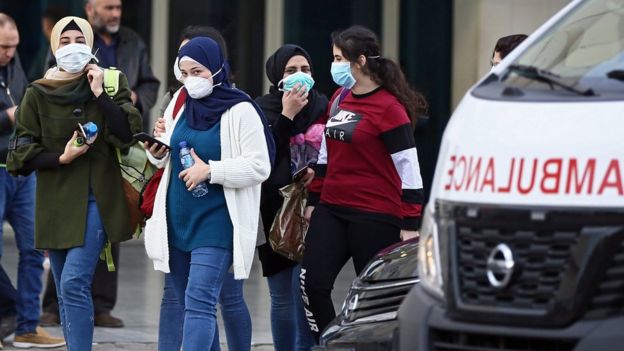
Lebanon has reported its first confirmed case – a 45-year-old woman who was detected as she arrived in Beirut from Qom. The UAE, Israel and Egypt have also reported cases.
Image copyright EPAImage caption Lebanon has confirmed its first case – a woman returning from the Iranian city of Qom
Meanwhile Canadian officials said one of the nine cases there was a woman who had recently returned from Iran.
WHO officials said both Iran and Lebanon had the basic capacity to detect the virus and the WHO was contacting them to offer further assistance.
But Dr Tedros said the organisation was concerned about the virus’s possible spread in countries with weaker health systems.
What about China and elsewhere?
The virus has now hit the country’s prison system, with more than 500 inmates confirmed infected.
They include 230 patients in a women’s prison in Wuhan. More cases have been found in a prison in the eastern province of Shandong and the south-eastern province of Zhejiang.
Some 36 people at a hospital in Beijing have also tested positive.
Senior officials have been sacked for mishandling management of the outbreak.
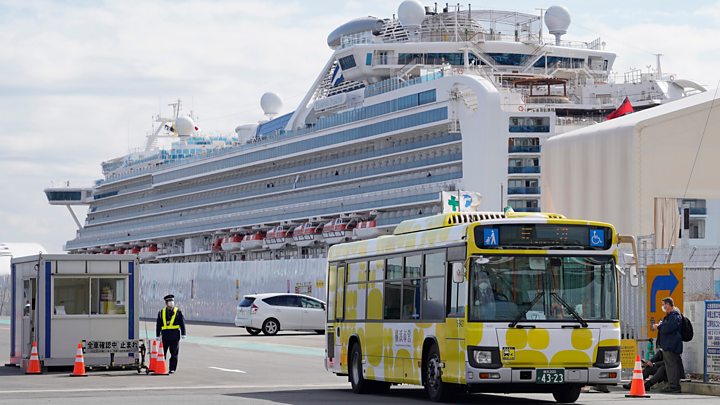
Passengers of the Diamond Princess cruise ship who have tested negative continue to disembark the ship in Yokohama after more than 14 days quarantined on board.
However, 18 American evacuees from the ship tested positive after arriving in the US, officials said. More than 300 other US nationals have arrived back in the US after disembarking.
Media caption Coronavirus: Quarantined passengers released from Japan ship
More than 150 Australian passengers have been evacuated from the ship and have already arrived in Darwin, where they will begin two more weeks of quarantine.
Australian officials said on Friday that six people had reported feeling unwell on arrival in Darwin and were immediately tested. Two of those people tested positive despite having received negative tests before leaving Japan.
The first batch of people from Hong Kong have also flown back to the city, where they will similarly be quarantined.
The decision, which follows a similar move by the US this week, came as the death toll from the outbreak soared to 259
Health officials on Friday confirmed the first cases in the UK after two people tested positive for the virus
A coach carrying British nationals evacuated from Wuhan arrives at the Arrowe Park Hospital in Wirral, near Liverpool in northwest England. Photo: AFP
Britain on Saturday said it was temporarily withdrawing some staff and their families from its diplomatic sites in China, as Beijing struggles to contain the nationwide new
The decision, which follows a similar move by the United States this week, came as the death toll from the outbreak soared to 259 and the total number of cases neared 12,000 within China.
The Sars-like virus has also begun to spread around the world, with more than 100 infections reported in more than 20 countries.
“We are committed to ensuring the safety and well-being of our staff and their families,” a spokesman for the British Foreign Office said.
“We are therefore temporarily withdrawing some UK staff, and their dependents from our embassy and consulates in China.”
He added that Britain’s ambassador in Beijing and staff needed to continue critical work will remain, and that British nationals in China would still have access to constant consular assistance.
The US, which on Friday temporarily banned the entry of foreign nationals, who had travelled to China over the past two weeks, has also made similar changes.
Two people in UK test positive for coronavirus
31 Jan 2020
On Wednesday, it authorised the departure of non-emergency government employees and their family members from its offices in Beijing, Chengdu, Guangzhou, Shanghai, and Shenyang.
And on Friday, it ordered all relatives of staff members under the age of 21 to leave China immediately.
A spokesman for the US Embassy in Beijing said it made the decision “out of an abundance of caution related to logistical disruptions stemming from restricted transportation and overwhelmed hospitals related to the novel coronavirus”.
Coronavirus outbreak: global businesses shut down operations in China
British health officials on Friday confirmed the first cases in the UK, after two members of the same family tested positive for the virus.
One of the two individuals is a student at the University of York, a university spokesman said on Saturday.
Also on Friday, 83 British citizens returned on a UK government-chartered flight from Wuhan, the Chinese city at the centre of the epidemic.
They were immediately taken to a hospital in northwest England for a two-week quarantine.
NEW DELHI (Reuters) – Indian cricketers wore army camouflage-style caps in a match with Australia on Friday in solidarity with Indian paramilitary police killed in a militant attack by a Pakistan-based group and in an unusually strong display of patriotic fervour in sport.
The suicide bombing last month killed 40 in Indian-controlled Kashmir, a region also claimed by Pakistan. The attack prompted India to launch an air strike inside Pakistan, which responded with an aerial attack the next day.
The Board of Control for Cricket in India (BCCI) has in recent days tried unsuccessfully to isolate Pakistan in the cricketing world. The International Cricket Council rejected India’s calls to boycott games against Pakistan, whose prime minister is former cricketing hero Imran Khan.
But there are still calls within India for the national team to pull out of a World Cup match against Pakistan in June in England.
The idea to sport the olive-and-black caps bearing the BCCI’s logo came from former Indian cricket captain and current player Mahendra Singh Dhoni, one of the game’s biggest stars and an honorary lieutenant colonel with the Indian army.
“It’s a special cap,” Indian captain Virat Kohli said before the third in a five-match one-day series with Australia. “This is to pay respect to the martyrs … and their families.”
He said all the players would donate their fees from the match to a national defence fund to help out the families of defence personnel who die on duty. Kohli also urged all Indians to contribute to the fund.
The BCCI posted a clip on Twitter of commentators for the match also wearing the caps, signing off the tweet with “#JaiHind”, or “Hail India”.
The board has scrapped the opening ceremony for the Indian Premier League Twenty20 tournament, which begins on March 23, and will donate the money saved to the families of those who died in the bomb attack.
Cricket historian Boria Majumdar said he could not remember seeing any Indian cricket team in the past making such a gesture, which he called a “peaceful political stand”.
“(Indian cricket) teams have expressed solidarity in the past but not this kind of public display of that solidarity,” Majumdar told Reuters.
“Sport has always been meshed with politics and people have often used it to make very strong points. This is yet another one. This is a peaceful way of expressing solidarity in a manner which I don’t see problematic at all.”
But Pakistani lawyer Abdullah Nizamani said on Twitter the BCCI and international cricket board should keep “sports away from petty politics”. Some Pakistanis even asked on social media if Indian cricketers would turn up for the World Cup match with Pakistan in military fatigues.
Nuclear-armed neighbours India and Pakistan have fought two of their three wars since independence over Kashmir, which both sides claim in full but rule in part.
Freda Bedi lived an unusual life. Born in a small town in England, she moved to India for love and ended up joining the independence movement. Her biographer, Andrew Whitehead, writes about her remarkable story.
“There are things deeper than labels and colour and prejudice, and love is one of them.”
These were the words of Freda Bedi, an English woman who overcame prejudice to marry an Indian Sikh and went on to challenge Indian notions about the role of a woman and a wife.
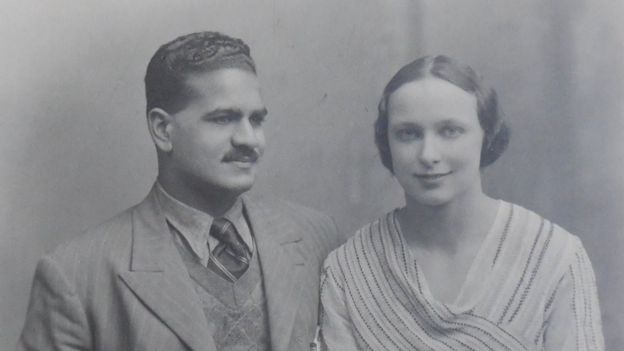
Freda and her boyfriend, Baba Pyare Lal Bedi (his friends called him BPL), met at Oxford where both were students.
This was the early 1930s and romances across the racial divide were rare – almost as rare as a girl from Freda’s background securing a spot at a top university. She was born, quite literally, above the shop in the city of Derby in England’s East Midlands, where her father ran a jewellery and watch repair business.
Freda could barely remember her father. He enlisted during the First World War and served in the Machine Gun Corps, where casualties were so high it was known as the “suicide club”. He died in northern France when his daughter was just seven years old. “This death shadowed my whole childhood,” she recalled – it shaped her political loyalties and prompted her lifelong spiritual quest.
Her years at Oxford were “the opening of the gates of the world”, as Freda once put it. She was part of “the Depression generation” – those who were students at a time of global crisis, mass unemployment and the rise of fascism.
She made firm friends at her college with young women who were rebellious by nature, and went with them to meetings of the Labour Club and the communist October Club.
Image captionFreda and BPL met as students at Oxford University
Driven by curiosity and by sympathy with those struggling against the Empire, she also went along to the weekly meetings of the Oxford Majlis, where radicals among the university’s small number of Indian students asserted their country’s case for nationhood. BPL Bedi, a handsome and cheerful Punjabi, was a regular there. A friendship developed into intellectual collaboration and, within months, Freda and BPL were a couple.
In the early 1930s, women’s colleges at Oxford were obsessed with sex or rather with preventing it. If a male student came to have tea in a female student’s room, a chaperone had to be present, the door left wide open and the bed had to be taken into the corridor. Freda’s college did its best to derail her relationship – she was disciplined for visiting BPL without a chaperone in what she was convinced was a case of racial discrimination.
But she was fortunate in her student friends. Barbara Castle, who later became a commanding British woman politician of her era, was thrilled when Freda confided that she intended to marry her boyfriend. “Well, thank goodness”, Barbara exclaimed. “Now at least you won’t become a suburban housewife!” Freda’s mother didn’t see things that way though. Her family were sternly disapproving, until BPL made a visit to Derby and managed to charm them.
Freda commented that the engagement caused “a minor sensation” in Oxford. That was an understatement. She believed she was the first Oxford woman undergraduate to marry an Indian fellow student. Some didn’t hide their disapproval. The registrar who conducted the marriage ceremony pointedly refused to shake hands with the couple.
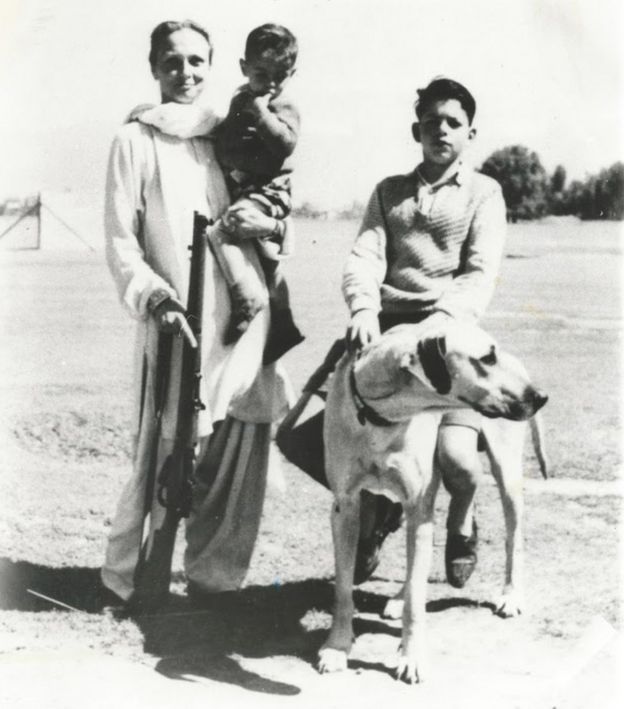
From the moment she married, Freda regarded herself as Indian and often wore Indian-style clothes. A year later, husband and wife and their four-month old baby, Ranga, set off by boat from Trieste, Italy, on the two-week journey to the western Indian city of Bombay (now Mumbai). “The nightmare was to get milk for myself to drink because I was feeding the baby”, Freda recalled. “And I remember the millions of cockroaches that used to come out at night in the ship’s kitchens – I used to go in and attempt to get milk.”
The couple had already been marked out by the British authorities as revolutionaries and potential trouble makers because of their student activism. When they disembarked in Bombay, their bags and cases were inspected for seven hours to check for left-wing propaganda. “Even Ranga’s little napkin was taken off and searched,” recalled Freda, “because they thought I might be carrying messages in it”.
The key test of Freda’s marriage was still to come – the first meeting with her Indian mother-in-law, a widow and matriarch known in the family as Bhabooji. From Bombay, the Bedis travelled non-stop for a couple of days to reach the small Punjabi city of Kapurthala, arriving at the family home close to midnight. Freda was wearing a white cotton sari – “not the ideal travelling dress, and nursing Ranga had not improved it”.
BPL bowed to touch his mother’s feet in the traditional expression of respect. “I copied him, feeling a little awkward,” Freda said, “but all my shyness disappeared when she smiled at us both with tears in her eyes, and embraced us and the child as if she could not hold us close enough.”
Although Freda was determined to fit in with her Indian extended family, her lifestyle was anything but conventional. BPL’s political stand extended to rejecting any share in his family’s wealth. They made their home in Lahore, one of the largest cities in Punjab, in a cluster of thatched huts without power or running water, keeping hens and a buffalo. It can’t have been the sort of life Freda had expected – nor would she have been used to the idea of sharing the household with her mother-in-law.
“Nowhere had I seen a white woman trying to be a typical Indian daughter-in-law”, commented Som Anand, a frequent visitor to the Bedis’ huts. “It surprised me to see Mrs Bedi coming to Bhabooji’s hut in the morning to touch her feet. In household matters she respected the old mother’s inhibitions. Her mother-in-law was an equally large hearted person; despite all her conservatism she had accepted a Christian into the family without a murmur.”
Image captionFreda and BPL moved to Kashmir after 1947 and remained politically active
When World War Two broke out, both BPL and Freda were outraged that India was being dragged into supporting the British war effort. BPL was detained in a desert prison camp to stop him sabotaging military recruitment in Punjab. Freda decided to make her own stand against her motherland.
She volunteered as a satyagrahi, a seeker of truth, and was among those chosen by Indian independence leader Mahatma Gandhi to defy emergency wartime powers. She travelled to her husband’s home village of Dera Baba Nanak and announced that she would “break the law by asking the people not to support the military effort until India became democratic”. The authorities didn’t know how to respond to a white woman staging such a protest – they hurriedly sent an English police inspector to the village, deeming it inappropriate for an Indian policeman to arrest an Englishwoman.
Freda was brought before a visiting magistrate that same morning – she has left her own account of the trial:
It was finished in 15 minutes. The man on the other side of the table was quite young still, and looked as though he had been to Oxford. His face was red.
“I find this as unpleasant as you do,” he murmured.
“Don’t worry. I don’t find it unpleasant at all.”
“Do you want the privileges granted to an Englishwoman?”
“Treat me as an Indian woman and I shall be quite content.”
She was sentenced to six months in jail, which was fairly standard, and also to hard labour, which she regarded as vindictive.
That turned out to be no more onerous than supervising the prison gardens, where women imprisoned for criminal rather than political offences – many were locked up for killing their abusive husbands – did most of the work.
“It was my destiny to go to India,” Freda asserted. It was her destiny too to make history as an English woman who went willingly to jail in support of India’s demand for freedom.
The Bedis’ political prominence persisted after independence, when they moved to Kashmir – Freda joined a left-wing women’s militia and worked with the radical nationalists who gained power there. In the 1950s, her life changed utterly when, during a UN assignment in Burma, she encountered Buddhism for the first time and became an enthusiastic convert.
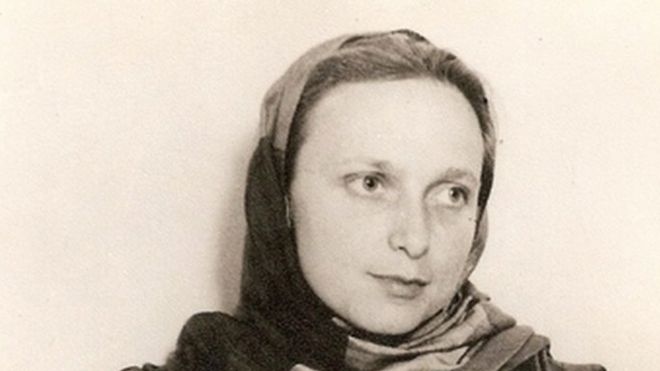
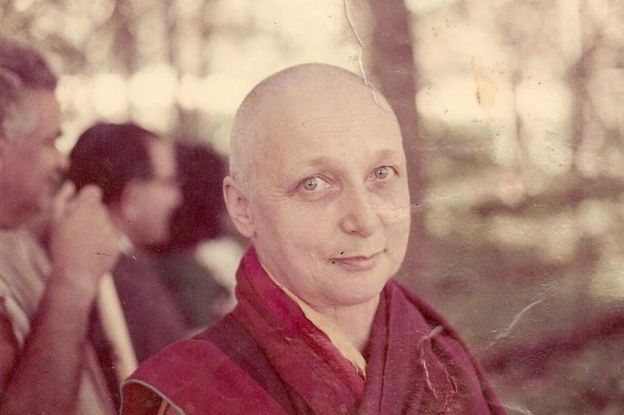
Image captionFreda became a Buddhist nun in the 1950s
When thousands of Tibetans fled across the Himalayas in 1959 to escape Chinese oppression, Freda devoted herself to helping these “brave and wonderful” refugees. She became steeped in Tibetan spirituality. And once she felt that she had fulfilled her role as a mother (the film star Kabir Bedi is one of her three surviving children), she broke convention again by taking vows as a Tibetan Buddhist nun. In her sixties, she travelled relentlessly to spread the word about Buddhist teachings but never returned to live in the West.
“India is my womanhood and my wife-hood,” she once declared. “I too am ‘dust that England bore, shaped and made aware’. Yet I am living in an Indian way, with Indian clothes, with an Indian husband and child on Indian soil, and I cannot feel even the least barrier or difference in essentials between myself and the new country I have adopted.”
Throughout her life, Freda was determined not to be constrained by barriers of race, religion, nation or gender. She delighted in challenging convention and confounding expectations – that is what makes her story so beguiling.









 CHINDIA ALERT: You'll be living in their world, very soon