Archive for ‘entrepreneurs’

09/05/2020

Coronavirus: China offers to help North Korea fight pandemic

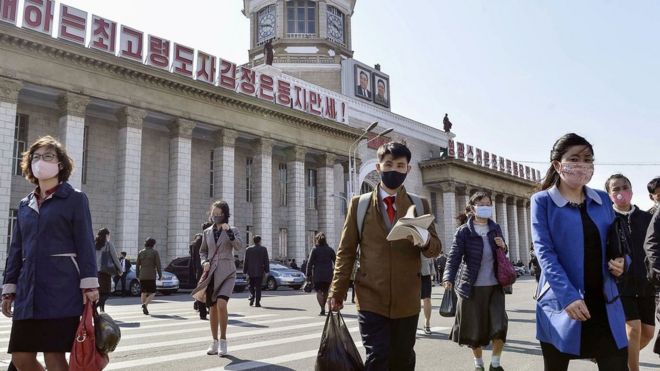
People wear face masks in front of Pyongyang Station in Pyongyang, North Korea (27 April 2020)Image copyright REUTERS
Image caption North Korea’s government maintains has not reported a single case of Covid-19 there

China’s president has expressed concern about the threat of the coronavirus to North Korea and offered help.

Xi Jinping was responding to a message that he received from the North Korean leader, Kim Jong-un.

Chinese state media reported that the message congratulated Mr Xi on China’s apparent success in fighting Covid-19.

North Korea’s government maintains that there has not been a single confirmed case there, though analysts have questioned whether that is possible.

North Korea was the first country to suspend tourism and to shut its borders in response to the virus, in the third week of January.

The country has a fragile health system, which experts fear would be quickly overwhelmed by even a small outbreak of Covid-19.

In his “verbal message of thanks”, Mr Xi said he highly appreciated Mr Kim’s support during China’s outbreak and “showed his personal attention to the situation of the pandemic and people’s health” in North Korea, according to state media.

Mr Xi called for more efforts to strengthen co-operation in preventing the spread of the coronavirus, and said China was “willing to continue to provide assistance within its own capacity for [North Korea] in the fight against Covid-19”.

On Friday, North Korean state media reported that Mr Kim had sent a verbal message to the president that “congratulated him, highly appreciating that he is seizing a chance of  victory in the war against the unprecedented epidemic”.
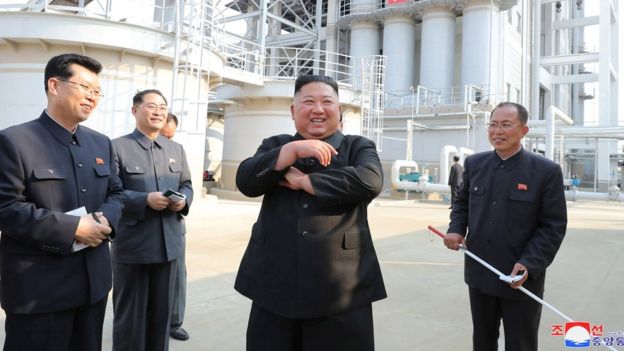
North Korean leader Kim Jong-un visits a fertiliser factory north of Pyongyang, reportedly on 2 May 2020Image copyright REUTERS
Image caption Kim Jong-un disappeared from public view for 20 days, before visiting a factory on 2 May

Mr Kim recently went 20 days without appearing in public, and missed the celebration of his grandfather’s birthday – one of the biggest events of the year.

Some media reports claimed he was “gravely ill”, or even dead.

But he then appeared at a fertiliser factory on 2 May – apparently in good health.

On Wednesday, South Korea’s National Intelligence Service told a parliamentary committee that there had been no signs the health rumours were true.

“He was performing his duties normally when he was out of the public eye,” a member of the committee, Kim Byung-kee, told reporters afterwards.

The lawmaker said the North Korean leader’s absence could have been down to a Covid-19 outbreak that the authorities in Pyongyang had not reported.

Presentational grey line

Analysis

By Celia Hatton, Asia Pacific Editor, BBC World Service

For months, North Korea-watchers have questioned Pyongyang’s claims that it has managed to isolate itself from Covid-19.

Admittedly, North Korea was the first country to suspend travel in response to the virus. There are unconfirmed reports that North Korean guards have been ordered to shoot at those who try to cross the lengthy border the North shares with China. However, it will be difficult to completely seal that dividing line for long. North Korea’s underground economy relies on illicit trade with Chinese entrepreneurs.

Beijing has a few good reasons for wanting to help North Korea. On a practical level, China needs to suppress a possible Covid-19 outbreak there if it wants to keep its own population healthy. Beijing also worries about what might happen inside North Korea if the virus takes hold. The North’s decrepit health system would quickly be overwhelmed by an outbreak of Covid-19, and that could threaten the fragile Kim Jong-un regime. Beijing has been Pyongyang’s biggest aid donor for decades, and it will continue to do what it can to keep Mr Kim in power. The alternatives to Kim Jong-un are much riskier for China, which does not want change on its doorstep.

China’s global political interests are also at play. Diplomatically, Mr Xi’s public exchange with Kim Jong-un underlines the seemingly close ties between China and North Korea. Pyongyang has been slow to accept public offers of help from the United States, and peace talks with Washington have stalled. If North Korea appeared to accept Beijing’s help, China would reassert itself as North Korea’s “true” ally in a time of need.

Presentational grey line

South Korea itself reported 18 new confirmed cases of Covid-19 on Saturday.

Seventeen of them are linked to a 29-year-old man who tested positive after spending time at five nightclubs and bars in Seoul’s Itaewon leisure district last weekend, the Yonhap news agency said.

Mayor Park Won-soon ordered nightclubs, bars and hostess venues across the capital to suspend business in response.

“Carelessness can lead to an explosion in infections – we clearly realised this through the group infections seen in the Itaewon club case,” Mr Park said.

Health officials have urged people who have visited the five venues in Itaewon to self-isolate and get tested to prevent additional transmissions. At least 1,500 people signed their entry logs, according to Yonhap.

The new infections brought the nationwide total to 10,840, while the death toll remained unchanged at 256.

Source: The BBC

06/10/2019

Xinhua Headlines: China’s Greater Bay Area busy laying foundation for innovation

As China aims to develop its Greater Bay Area into an international innovation and technology hub, innovation and entrepreneurship resources are shared in the area to provide more opportunities for young Hong Kong and Macao entrepreneurs.

The provincial government of Guangdong has stepped up efforts to improve basic research capability, considered the backbone of an international innovation and technology hub, by building large scientific installations and launching provincial labs.

by Xinhua writers Liu Yiwei, Quan Xiaoshu, Wang Pan, Jing Huaiqiao

GUANGZHOU, Oct. 5 (Xinhua) — Hong Kong man Andy Ng was surprised his shared workspace Timetable was rented out completely only six months after it had started operation in Guangzhou, capital of south China’s Guangdong Province.

While studying economics at City University of Hong Kong, Ng set up his first business, developing an online education platform, but soon realized the Hong Kong market was too small. After earning a master’s degree in the UK in 2017, Ng returned to China and chose Guangzhou as his new base.

Timetable is now accumulating popularity and even fans in Dianping.com, China’s major online consumer guide. Ng feels lucky that his business caught the implementation of the Guangdong-Hong Kong-Macao Greater Bay Area (GBA) development plan.

The bay area, covering 56,000 square km, comprises Hong Kong and Macao, as well as nine cities in Guangdong. It had a combined population of about 70 million at the end of 2017, and is one of the most open and dynamic regions in China.

Aerial photo taken on July 11, 2018 shows the Hong Kong-Zhuhai-Macao Bridge in south China. (Xinhua/Liang Xu)

In July 2017, a framework agreement on the development of the bay area was signed. On February 18 this year, China issued the more specific Outline Development Plan for the Guangdong-Hong Kong-Macao Greater Bay Area. One of its major aims is to develop the area into an international innovation and technology hub.

OPPORTUNITIES FOR YOUTH

The plan proposes that innovation and entrepreneurship resources be shared in the bay area to provide more opportunities for young Hong Kong and Macao entrepreneurs.

An incubator for entrepreneurship, Timetable is home to 52 companies, including 15 from Hong Kong and Macao, such as Redspots, a virtual reality company that won the Hong Kong Information and Communications Technology (ICT) Awards 2019.

“I persuaded them one by one to come here,” Ng said. “I told them of my own experience that the GBA is a great stage for starting a business with ever-upgrading technologies, ever-changing consumer tastes and a population 10 times that of Hong Kong.”

Timetable is a startup base of the Guangzhou Tianhe Hong Kong and Macao Youth Association, which has assisted 65 enterprises founded by Hong Kong and Macao young people since its establishment in October 2017.

The association and its four bases provide a package of services from training and registering to policy and legal consultation, said Chen Jingzhan, one of the association founders.

Tong Yat, a young Macao man who teaches children programming, is grateful the association encouraged him to come to Guangdong, where young people enjoy more preferential policies to start their own businesses.

“The GBA development not only benefits us, but paves the way for the next generation,” Tong said. “If one of my students were to become a tech tycoon in the future and tell others that his first science and technology teacher was me, I would think it all worthwhile.”

In the first quarter of this year, there were more than 980 science and technology business incubators in Guangdong, including more than 50 for young people from Hong Kong and Macao, said Wu Hanrong, an official with the Department of Science and Technology of Guangdong Province.

INNOVATION HIGHLAND

As the young entrepreneurs create a bustling innovative atmosphere, the Guangdong government has stepped up efforts to improve basic research capability, considered the backbone of an international innovation and technology hub, by building large scientific installations and launching provincial labs.

Several large scientific facilities have settled in Guangdong. China Spallation Neutron Source (CSNS) operates in Dongguan City; a neutrino observatory is under construction in Jiangmen City; a high intensity heavy-ion accelerator is being built in Huizhou City.

Aerial photo taken on June 23, 2019 shows the construction site of the Jiangmen Underground Neutrino Observatory (JUNO) in Jiangmen, south China’s Guangdong Province. (Xinhua/Liu Dawei)

Guangdong also plans to build about 10 provincial labs, covering regenerative medicine, materials, advanced manufacturing, next-generation network communications, chemical and fine chemicals, marine research and other areas, said Zhang Yan, of the provincial department of science and technology.

Unlike traditional universities or research institutions, the provincial labs enjoy a high degree of autonomy in policy and spending. A market-oriented salary system allows them to recruit talent from all over the world, and researchers from other domestic organizations can work for the laboratories without giving up their original jobs, Zhang said.

The labs are also open to professionals from Hong Kong and Macao. Research teams from the universities of the two special administrative regions have been involved in many of the key programs, Zhang said.

For example, the provincial lab of regenerative medicine and health has jointly established a regenerative medicine research institute with the Chinese University of Hong Kong, a heart research center with the University of Hong Kong, and a neuroscience research center with the Hong Kong University of Science and Technology (HKUST).

Photo taken on July 24, 2019 shows a rapid cycling synchrotron at the China Spallation Neutron Source (CSNS) in Dongguan, south China’s Guangdong Province. (Xinhua/Liu Dawei)

Guangdong has been trying to break down institutional barriers to help cooperation, encouraging Hong Kong and Macao research institutions to participate in provincial research programs, exploring the cross-border use of provincial government-sponsored research funds, and shielding Hong Kong researchers in Guangdong from higher mainland taxes.

NANSHA FOCUS

Located at the center of the bay area, Guangzhou’s Nansha District is designed as the national economic and technological development zone and national free trade zone, and is an important pivot in building the area into an international innovation and technology hub.

The construction of a science park covering about 200 hectares started on Sept. 26. Gong Shangyun, an official with the Nansha government, said the park will be completed in 2022.

Jointly built by the Guangzhou government and the Chinese Academy of Sciences (CAS), the science park will accommodate CAS research institutes from around Guangzhou, including the South China Sea Institute of Oceanology, the South China Botanical Garden (SCBG) and the Guangzhou Institute of Energy Conversion.

Ren Hai, director of the SCBG, is looking forward to expanding the research platforms in Nansha. “We will build a new economic plant platform serving the green development of the Pearl River Delta, a new botanical garden open to the public, and promote the establishment of the GBA botanical garden union.”

Wang Ying, a researcher with the SCBG, said the union will help deepen the long cooperation among its members and improve scientific research, science popularization and ecological protection. “Predecessors of our botanical garden have helped the Hong Kong and Macao counterparts gradually establish their regional flora since the 1950s and 1960s.”

HKUST also started to build a new campus in Nansha the same day as the science park broke ground. “Located next to the high-speed rail station, the Guangzhou campus is only a 30-minute journey from the Hong Kong campus. A delegation from the HKUST once paid a visit to the site and found it very convenient to work here,” Gong said.

Chief Executive of the Hong Kong Special Administrative Region (HKSAR) Carrie Lam hoped the new campus would help create a new chapter for the exchanges and cooperation on higher education between Guangzhou and Hong Kong, and cultivate more talents with innovative capabilities.

Nansha’s layout is a miniature of the provincial blueprint for an emerging international innovation and technology hub.

“We are seeking partnership with other leading domestic research institutions and encouraging universities from Hong Kong and Macao to set up R&D institutions in Guangdong,” said Zhang Kaisheng, an official with the provincial department of science and technology.

“We are much busier now, because research institutes at home and abroad come to talk about collaboration every week. The GBA is a rising attraction to global scientific researchers,” Zhang said.

Source: Xinhua

Law of Unintended Consequences

continuously updated blog about China & India

ChiaHou's Book Reviews

continuously updated blog about China & India

What's wrong with the world; and its economy

continuously updated blog about China & India