Chindia Alert: You’ll be Living in their World Very Soon
aims to alert you to the threats and opportunities that China and India present. China and India require serious attention; case of ‘hidden dragon and crouching tiger’.
Without this attention, governments, businesses and, indeed, individuals may find themselves at a great disadvantage sooner rather than later.
The POSTs (front webpages) are mainly 'cuttings' from reliable sources, updated continuously.
The PAGEs (see Tabs, above) attempt to make the information more meaningful by putting some structure to the information we have researched and assembled since 2006.
Documentary puts China’s literary hero into context: there is Dante, there’s Shakespeare, and there’s Du Fu
Theatrical legend Sir Ian McKellen brings glamour to beloved verses in British documentary
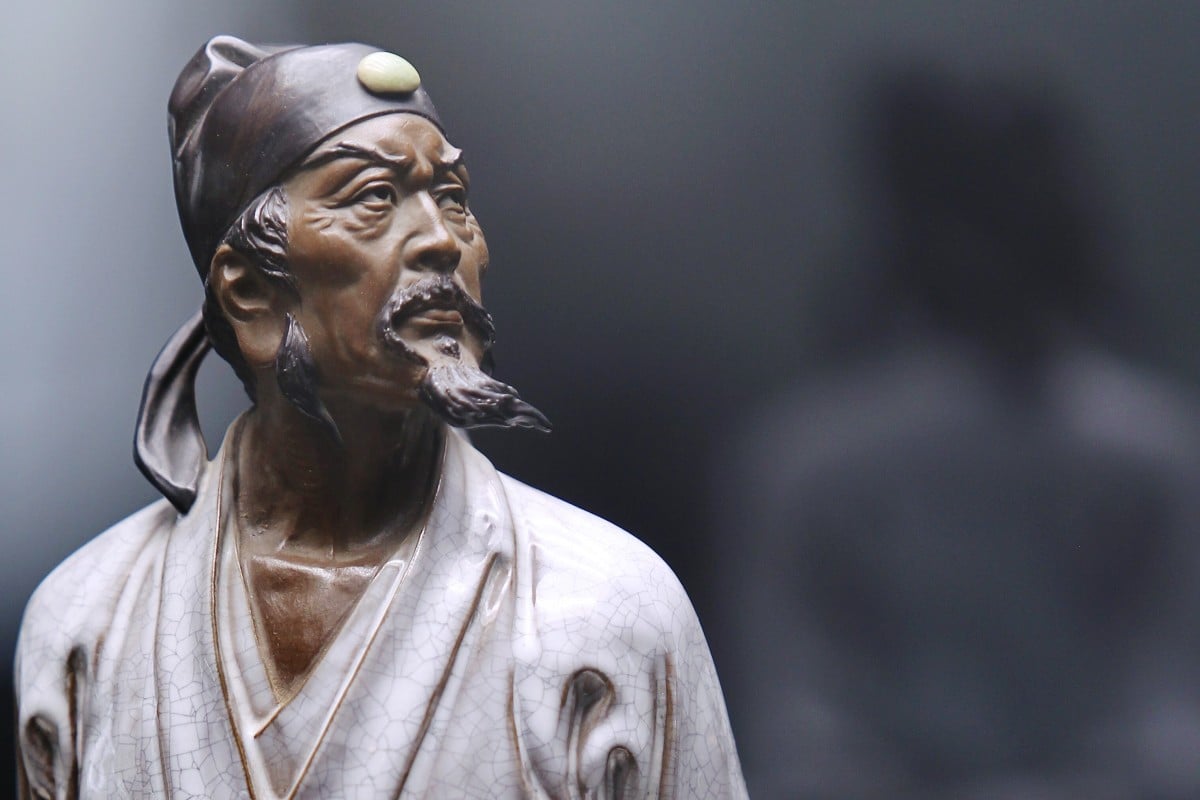
A ceramic figurine of Du Fu, a prominent Chinese poet of the Tang dynasty. Du is the subject of a new BBC documentary, thrilling devotees of his poetry. Photo: Simon Song
The resonant words of an ancient Chinese poet spoken by esteemed British actor Sir Ian McKellen have reignited in China discussion about its literary history and inspired hope that Beijing can tap into cultural riches to help mend its image in the wake of the coronavirus pandemic.
The BBC documentary Du Fu: China’s Greatest Poet has provoked passion among Chinese literature lovers about the poetic master who lived 1,300 years ago.
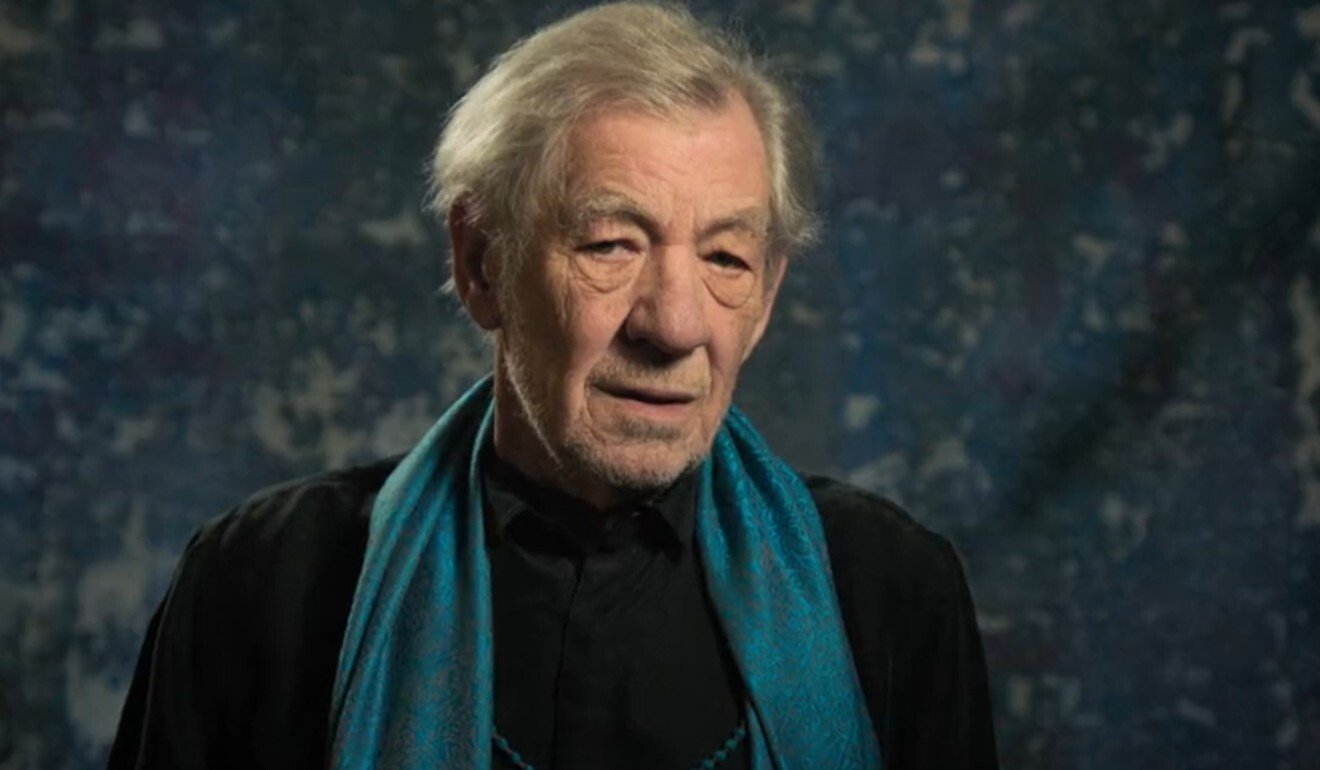
Sir Ian Mckellen read works of ancient Chinese poet Du Fu in Du Fu: China’s Greatest Poet. Photo: BBC Four / MayaVision International
The one-hour documentary by television historian Michael Wood was broadcast on television and aired online for British viewers this month but enthusiasm among Chinese audiences mean the trailer and programme have been widely circulated on video sharing websites inside mainland China, with some enthusiasts dubbing Chinese subtitles.
The documentary has drawn such attention in Du’s homeland that even the Communist Party’s top anti-graft agency has discussed it in its current affairs commentary column. Notably, Wood’s depiction of Du’s life from AD712 to 770 barely mentioned corruption in the Tang dynasty (618-907) government.
“I couldn’t believe it!!” Wood said in an email. “I’m very pleased of course … most of all as a foreigner making a film about such a loved figure in another culture, you hope that the Chinese viewers will think it was worth doing.”
Often referred to as ancient China’s “Sage of Poetry” and the “Poet Historian”, Du Fu witnessed the Tang dynasty’s unparalleled height of prosperity and its fall into rebellion, famine and poverty.
Writer, historian and presenter Michael Wood followed the footsteps of the ancient Chinese poet Du Fu in Yangtze River gorges. Photo: BBC Four / MayaVision International
Wood traced Du’s footsteps to various parts of the country. He interviewed Chinese experts and Western sinologists, offering historical and personal contexts to introduce some of Du’s more than 1,400 poems and verses chronicling the ups and downs of his life and China.
The programme used many Western reference points to put Du and his works into context. The time Du lived in was described as around the as the Old English poem Beowulf was composed and the former Chinese capital, Changan, where Xian is now, was described as being in the league of world cities of the time, along with Constantinople and Baghdad.
Harvard University sinologist Stephen Owen described the poet’s standing as such: “There is Dante, there’s Shakespeare, and there’s Du Fu.”
The performance of Du’s works by Sir Ian, who enjoyed prominence in China with his role as Gandalf in the Lord of the Rings movie series, attracted popular discussion from both media critics and general audiences in China, and sparked fresh discussion about the poet.
“To a Chinese audience, the biggest surprise could be ‘Gandalf’ reading out the poems! … He recited [Du’s poems] with his deep, stage performance tones in a British accent. No wonder internet users praised it as ‘reciting Du Fu in the form of performing a Shakespeare play,” wrote Su Zhicheng, an editor with National Business Daily.
A stone sculpture at Du Fu Thatched Cottage in Chengdu city, China. Photo: Handout
On China’s popular Weibo microblog, a viewer called Indifferent Onlooker commented on Sir Ian’s recital of Du’s poem My Brave Adventures: “Despite the language barrier, he conveyed the feeling [of the poet]. It’s charming.”
Some viewers, however, disagreed. At popular video-sharing website Bilibili.com, where uploads of the documentary could be found, a viewer commented: “I could not appreciate the English translation, just as I could not grasp Shakespeare through his Chinese translated works in school textbooks.”
Watching the documentary amid the coronavirus pandemic, some internet users drew comparisons of Du to Fang Fang, a modern-day award-winning poet and novelist who chronicled her life in Wuhan during the Covid-19 lockdown.
Shanghai pictured in April. Devastation wrought by the coronavirus pandemic has brought about a new suspicion of China. Photo: Bloomberg
The pandemic has infected more than 2.5 million people and killed more than 170,000. It has put the global economy in jeopardy, fuelling calls for accountability. British Foreign Secretary Dominic Raab last week called for a “deep dive” review and the asking of “hard questions” about how the coronavirus emerged and how it was not stopped earlier.
Steve Tsang, director of the SOAS China Institute at University of London, said the British establishment and wider public had changed its perception of Beijing as questions arose about outbreak misinformation and the political leverage of personal protective gear supply.
“The aggressive propaganda of the Chinese government is getting people in the UK to look more closely at China and see that it is a Leninist party-state, rather than the modernising and rapidly changing society that they want to see in China,” Tsang said.
On Sunday, a writer on the website of the National Supervisory Commission, China’s top anti-corruption agency, claimed – without citing sources – that the Du Fu documentary had moved “anxious” British audience who were still staying home under social distancing measures.
“If anyone wants to put the fear of the coronavirus behind them by understanding the rich Chinese civilisation, please watch this documentary on Du Fu,” it wrote, adding that promoting Du’s poems overseas could help “healing and uniting our shattered world”.
English-language state media such as CGTN and the Global Times reported on the documentary last week and some Beijing-based foreign relations publications have posted comments about the film on Twitter.
Wood said he had received feedback from both Chinese and British viewers that talked about “the need, especially now, of mutual understanding between cultures”.
“It is a global pandemic … we need to understand each other better, to talk to each other, show empathy: and that will help foster cooperation. So even in a small way, any effort to explain ourselves to each other must be a help,” Wood said.
He said the idea for producing a documentary about Du Fu started in 2017, after his team had finished the Story of China series for BBC and PBS.
Du Fu: China’s Greatest Poet first aired in Britain on April 7 on BBC Four, the cultural and documentary channel of the public broadcaster. It is a co-production between the BBC and China Central Television.
Wood said a slightly shorter 50-minute version would be aired later this month on CCTV9, Chinese state television’s documentary channel.
The film was shot in China in September, he said.
“I came back from China [at the] end of September, so we weren’t affected by the Covid-19 outbreak, though of course it has affected us in the editing period. We have had to recut the CCTV version in lockdown here in London and recorded two small word changes on my iPhone!” Wood said.
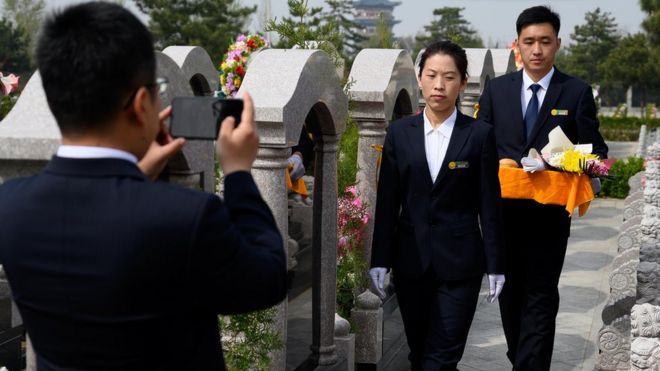
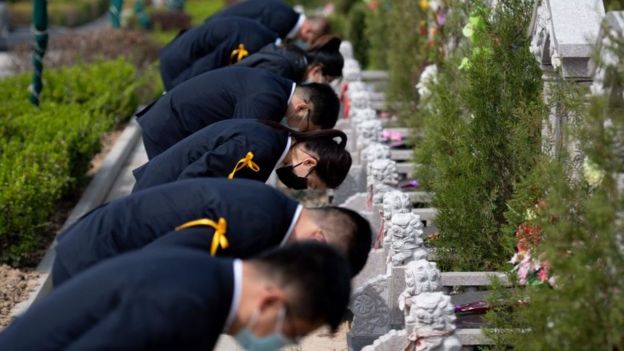
Image copyright GETTY IMAGESImage caption Staff film a tomb sweeping ceremony for a customer
People in China are paying their respects to dead ancestors digitally as the country continues to face the coronavirus outbreak.
The Qingming festival, also known as Tomb Sweeping Day, is usually a time when people visit the graves of friends and family, sprucing up the area and making offerings to their spirits.
But amid fears of another outbreak, the government has advised people to stay away and maintain social distancing.
That’s led to some cemeteries allowing people to come as long as they’ve booked a slot, while others are banning visits completely.
But other companies and burial places have turned to modern technology as they look for ways for families to continue the centuries-old tradition.
Li Quanxi, an official at Beijing’s civil affairs bureau, said: “We want to encourage people to transform social traditions amid the coronavirus outbreak.”
What is Qingming festival?
Qingming festival is one of the most important events in the calendar to commemorate ancestors who are no longer with you.
People clean the graves and burn items such as joss sticks and paper offerings – sometimes quite large ones – to honour the dead and transmit money and other goods to loved ones in the afterlife.
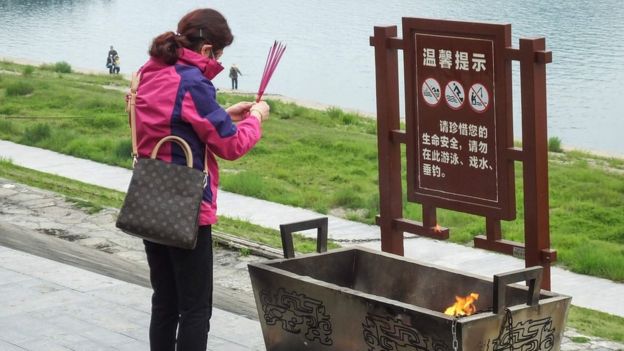
Image copyright AFPImage caption A woman burns incense ahead of the tomb sweeping festival
The tomb sweeping period falls between 28 March and 12 April.
Making offerings online
It is not completely unknown for pay their respects online, however, with the spread of Covid-19, there are now people who have no other option.
“Cloud tomb sweeping” allows people to “virtually” clean graves and make offerings to spirits.
One website providing this service is Heavenly Cemetery. On the surface, the website looks like any usual shopping site, although it also allows people to have their own memorial halls for their loved one so family and friends can join.
Relatives can light a candle, burn money and offer objects such as Chinese rice wine and beer. There is even an option for online tomb cleaning.
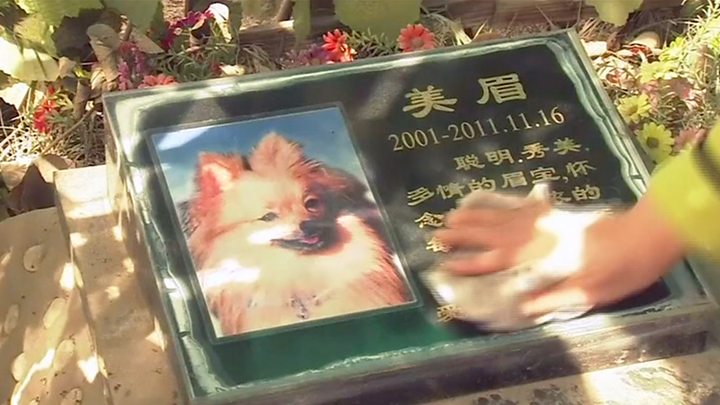
Media caption Watch: People pay respect to their deceased pets ahead of Tomb Sweeping Day
Funeral company Fu Shou Yuan International launched its own online tomb sweeping service on 12 March. It operates in more than 30 Chinese cities. In its first week, its website had about 87,000 visitors.
George Chen, whose grandparents are buried in Shanghai, visits their tombs every year but will be marking this year’s Tomb Sweeping Day online for the time being.
He told Shanghai Daily: “Old traditions are deeply rooted, but it is quite understandable because it is a special period. I will pay virtual respect and visit the scene once the epidemic ends.”
Getting someone to do it for you via livestream
While taking part in “cloud tomb sweeping” does mean you get to send offerings, it does not include the physical cleaning of a loved one’s tomb.
So some burial spots are now offering relatives a chance to watch a member of staff clean the tomb via a live stream. Others will send you photographs of the cleaned grave.
One cemetery in Shanghai is offering packages where a “valet sweep” starts from as little as 35 yuan (£4).
Image copyright GETTY IMAGESImage caption Staff hold a ceremony on behalf of a customer
Babaoshan funeral parlour, in Beijing, also offers live stream services.
Zhou Weihua, deputy director of the parlour, told Chinese news agency Xinhua that live streaming could become a future trend.
“Helping clients sweep tombs and holding online commemorative activities not only meets the demand in this special period but also offers more options for people to remember their deceased family members in the future.”
What about Wuhan?
China reported 3,199 deaths from coronavirus with 2,559 of those in Wuhan, where the first cases were recorded late last year.
The city is still in a lockdown which is expected to end on 8 April, and the government has announced that cemeteries will remain closed until 30 April.
Wuhan’s civil affairs department said it would make “unified arrangements to organise staff at cemeteries to hold a collective ceremony to pay tribute to the deceased”.
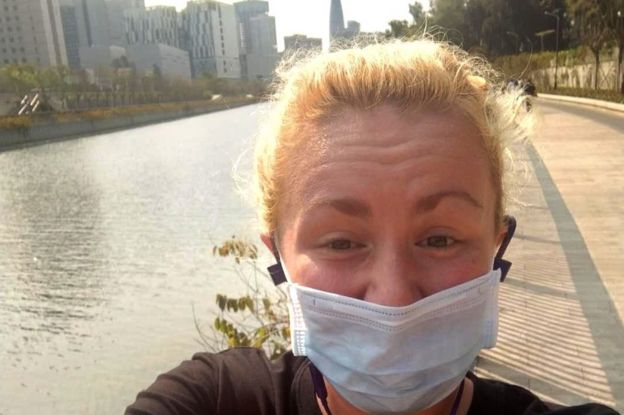
Image copyright JEN SMITHImage caption Jen Smith lives in Shenzhen, where it’s compulsory to wear a mask outside at all times
My Money is a series looking at how people spend their money – and the sometimes tough decisions they have to make. Here, Jen Smith, a children’s TV presenter from Shenzhen in southern China, takes us through a week in her life, as the country slowly emerges from the coronavirus pandemic.
Over to Jen…
Since being in lockdown I’ve been bingeing on Keeping Up With the Kardashians. It starts with one episode after dinner, blink, and suddenly it’s 3am. YouTube, Facebook, Google and Instagram are all banned here, so you’d think I’d be a binge-free socialite after a year and a half living in China. Well, those sites are banned unless you have a VPN – I pay $120 (£97) a year for mine, so Sunday was a late night, with a lie-in until 10.30 this morning.
I go for a run – mask and all, as it’s currently illegal to be outside without one. I make my coffee (bought in the UK), fruit smoothie (about 20 yuan, $2.82, £2.27) and cereal (80 yuan a packet) before cycling to work.
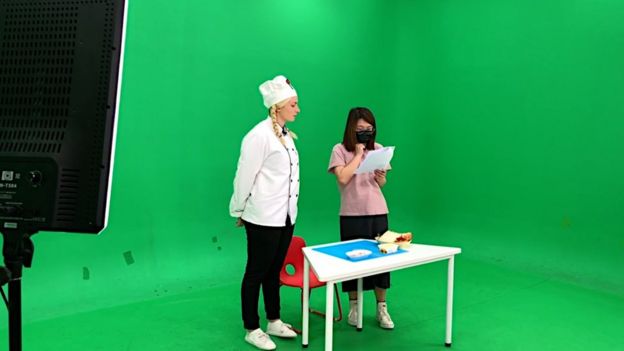
Today is a bit of a crazy day in the studio. I work as a children’s TV presenter. My company has profited from the lockdown as more children are watching the shows non-stop – meaning a rapid turnaround for us.
We shoot two shows from 2-6pm then “break” for a meeting. We discuss tomorrow’s shoot while I eat dinner – homemade aubergine curry. It is normal for the Chinese to eat breakfast, lunch and dinner at work. Normally the company gives all staff 25 yuan through a food-ordering app, and the whole company would eat together. However, because of the current social distancing, that social time is in the far distant past!
I make it home for 8pm, order some deep-fried cauliflower as a snack (45 yuan) and start the inevitable Kardashian binge.
Total spend: 65 yuan ($9.10, £7.37)
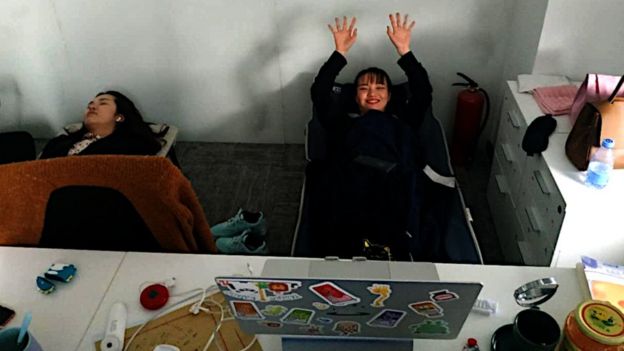
Image copyright JEN SMITHImage caption Workers often have a midday nap in the office
It’s a much earlier start (7.30am), but the same morning routine. On my cycle to work I notice that the traffic is almost back to normal – Shenzhen is inhabited by well over 12 million people, so as you can imagine rush hour is intense. This doesn’t change the fact that everywhere you go you have to scan a QR code – leaving my apartment, using the walkway by the river, and getting into the building I work in.
After a morning of shooting I eat homemade potato curry and settle down for a nap. Naptime is such a commonality in China that people store camp beds at the office. I order a coffee and banana chips (20 yuan) for a pick-me-up before the afternoon’s shooting.
It’s St Paddy’s Day so I head to the local pubs area, catch dinner at a French restaurant (222 yuan), then a few drinks (25 yuan – mainly bought by men at the bar for us) before a very tipsy cycle home.
Total spend: 242 yuan ($34, £25)
Image copyright JEN SMITHImage caption A disposable cover reduces the risk of transmitting the virus by touching lift buttons
The morning’s shoot (thankfully) was cancelled, so I nursed a hangover in bed until around 11am, at which point I had a phone meeting for a company that I do “plus-size” modelling for (for context I’m a UK size 12). I eat a bowl of cereal and order more cauliflower (45 yuan) while I watch a film.
At 2.30pm an intern picks me up, and we head to the government building to apply for a new work visa. Ironically, the image taken for my visa is Photoshopped to remove wrinkles, freckles and my frizzy hair. When I ask why this is being done for an identification document, the intern replies that the government wants it to be neat, and “the Chinese way” is to have altered photos.
I don’t argue, and have an interview before I hand in my passport. The whole process takes around two hours, so I order food to my house while on the way home (150 yuan for burger, salad and cake!) I take a taxi across town which ends up being 39.05 yuan.
The day starts at 8.30am with coffee and reading, before I get a manicure (280 yuan). My nail lady has been very worried about the state of my hands during the virus, so she spends a whopping two and a half hours treating them while I watch a film (0.99 yuan – bought by her). Because the manicure was so long I don’t have time to eat lunch before our fitness shoot, which runs from 2-5.30pm. I then have an appointment to sign into a building which I’ll shoot in tomorrow.
The building is near a supermarket called Ole (one of the only western supermarkets), and I pick up groceries for 183 yuan before heading home to cook, listen to podcasts and prep for the big day of shooting on Friday.
Total spend: 463 yuan ($64, £52.5)
Image copyright JEN SMITHImage caption Jen filming in front of a green screen – a more colourful digital background will be added later in post-production
Fridays are generally my busiest day. The way the Chinese seem to function, is a boss will say “I want this done now” and then employees rush to finish it. Generally, they will write scripts on Monday and Tuesday, discuss Wednesday, then we shoot later in the week. The poor editors, despite mandatory office hours during the week, then have to work tirelessly through the weekend to achieve a Sunday evening deadline.
I start with mashed avocado and a hard-boiled egg before work. The morning shoot runs from 9.30-11.40am, and I have an early lunch – homemade curry again, before my regular nap time. The afternoon shoot is three hours, so I have time to pop home and shower before a live stream at 6pm. I take a taxi to and from the live stream which ends up being 28 yuan.
Total spend: 28 yuan ($3.92, £3.18)
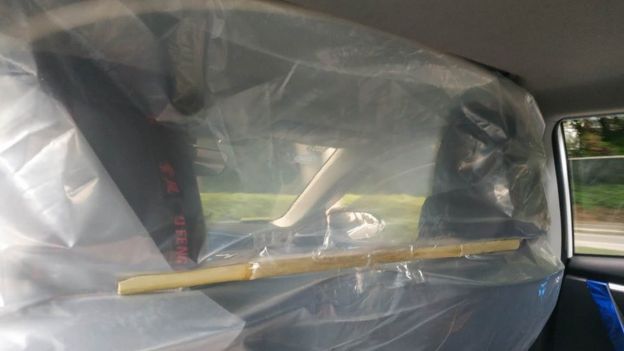
Image copyright JEN SMITHImage caption A taxi driver has improvised a screen to reduce the risk of picking up Covid-19 from a passenger
Finally the weekend! Although things are slowly getting better in China after the coronavirus outbreak, there’s still not too much to do. So I use this time to write, play my piano and generally chill inside. Around 3pm, I venture outside to the shops to pick up some snacks (159.60 yuan) before settling in to ring my family back in the UK with a homemade cocktail – a friend of mine in Canada is doing a daily live stream, “quarantinis” where he teaches you how to make cocktails!
What’s interesting is that a lot of people have started leaving their houses again, but it is still illegal to go outside without a mask on, and temperature checks are taken everywhere. I was even refused entry to a building due to being foreign. I imagine this is because recently the only new cases are being brought in by non-Chinese travelling back to China.
Total spend: 159.60 yuan ($22, £18)
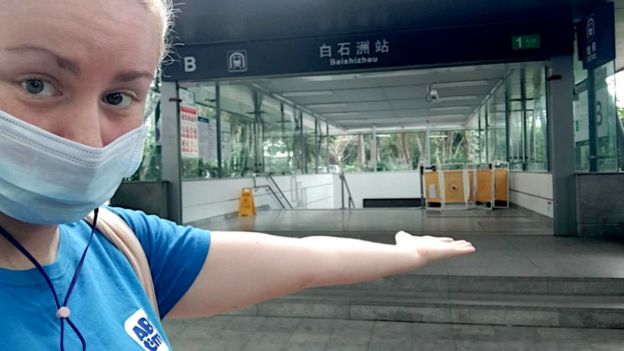
Image copyright JEN SMITHImage caption Shenzhen’s Metro system is still very quiet
It’s another slow day for me as many foreigners have not yet returned to China, so most of my friends are out of the country. I start the day by reviewing potential scripts.
This takes me to 1.30pm without realising I haven’t eaten. I decide to go for a quick run and I return to eat mashed avocado and a hard-boiled egg.
I home-bleach my hair with products bought in the UK, then head back to editing again. About half way through the afternoon I take a little break to practice Chinese. I use an app which is fantastic and free! Definitely worth everyone downloading this during social distancing so you can learn new skills!
For dinner I order online again, a three-dish meal for 160 yuan.
Laurence Fox has apologised for comments he made about the inclusion of a Sikh soldier in a World War One film.
The actor had previously referred to “the oddness in the casting” of a Sikh soldier in Sir Sam Mendes’ movie 1917.
“Fellow humans who are Sikhs, I am as moved by the sacrifices your relatives made as I am by the loss of all those who die in war, whatever creed or colour,” Fox tweeted.
“Please accept my apology for being clumsy in the way I expressed myself.”
His original comments attracted widespread criticism and historians drew attention to the contribution of Sikhs in the British Army during World War One.
Speaking on the James Delingpole podcast at the weekend, Fox said: “It’s very heightened awareness of the colour of someone’s skin because of the oddness in the casting.
“Even in 1917 they’ve done it with a Sikh soldier, which is great, it’s brilliant, but you’re suddenly aware there were Sikhs fighting in this war. And you’re like ‘OK, you’re now diverting me away from what the story is’.”
Media caption “We like to say that we’re the warrior race” Kameldeep Singh Samra explains the importance of remembering the role of Sikh soldiers in the First World War
The former Lewis star also responded to Delingpole’s comments about film-makers “shoehorning” people of different ethnicities into dramas.
Fox said: “It is kind of racist – if you talk about institutional racism, which is what everyone loves to go on about, which I’m not a believer in, there is something institutionally racist about forcing diversity on people in that way. You don’t want to think about [that].’
Fox later appeared on ITV’s Good Morning Britain, where he said the film, which has 10 Oscar nominations, was a “great movie” but that the casting “felt incongruous”. He also said people “shouldn’t be afraid to say how they feel”.
Presenter Piers Morgan told Fox his comments were “insulting to solders who had served” and were “an unfortunate thing to have said” and co-host Susanna Reid added: “Sikhs fought with British forces, not just with their own regiments – it’s a historical fact.”
Media caption Actor Laurence Fox clashed with an audience member over whether Meghan’s treatment in the press was “racist”
The actor clashed with audience member Rachel Boyle, a university lecturer and race and ethnicity researcher, who said the way Meghan Markle had been treated in the press was “racist”.
Fox responded to her by saying: “It’s not racism, we’re the most tolerant, lovely country in Europe. It’s so easy to throw the charge of racism at everybody and it’s really starting to get boring now.”
Footage of Fox’s appearance was widely shared on social media – with some praising his comments but others calling them offensive.
The main issues cited were that the “audience [was] not representative of the local area, leading to a pro-Conservative bias” and a “discussion on racism [was] felt to be offensive”.
The Legend of 1900 is taking more at the box office than the latest international and domestic blockbusters
An appetite for enhanced editions and 3D might have something to do with the surprise success of Giuseppe Tournatore’s forgotten flick
Tim Roth (left) stars in The Legend of 1900, the Giuseppe Tournatore that has taken Chinese cinema by storm.
China’s consumer class is always looking for the latest, most cutting-edge smartphone app or the most talked-about viral video. Who would have predicted, then, that a 21-year-old movie would take Chinese cinema by storm over the past few weeks?
What’s incredible is that The Legend of 1900 was hardly a classic in the first place.
Revolving around a piano prodigy (played by Tim Roth) who has spent his entire life on board an ocean liner, the movie received mixed reviews on its release in 1998, with disapproving critics lambasting it as “fragile” (Variety), “overwrought” (San Francisco Chronicle), schmaltz that “drowns in its own treacle” (Salon.com). The first English-language feature by Italian director Giuseppe Tornatore faded fast into obscurity, never reaching the heights of his revered Cinema Paradiso(1988).
And then Chinese audiences came to its rescue. Having never been released in China, Legend finally unspooled in mainland cinemas on November 15, alongside local romantic drama Somewhere Winter and Hollywood’s latest reboot, Charlie’s Angels.
Rather than becoming a sideshow to these two headlining blockbusters, the film broke out of the arthouse scene and crossed over to the mainstream: its opening weekend gross of 63.1 million yuan (HK$70.2 million) topped that of Angels, and its average of 13 viewers for each screening was higher than both Winter (11 viewers per screening) and Angels, which crashed with a mere eight.
A fortnight into its run, Legend had generated more than 130 million yuan, eclipsing its total takings of the past two decades. To put this into context, the film took in US$167,435 during its month-long release in the United States, in 1999. Adjusted for inflation, this figure would be about US$258,635 today, or 1.8 million yuan – that’s just 1.3 per cent of its gross during the first two weeks of its China run.
And it’s not just tills that are ringing: the rave online reviews must be music to Tornatore’s ears. On douban.com, China’s equivalent to Internet Movie Database, Legend secured an average rating of 9.3, far above those of current imports such as Knives Out
(8.5), Frozen II (7.3) and Midway (7.7), local blockbusters such as Better Days (8.4), or any of the flag-waving tub-thumpers that dominated Chinese cineplexes for weeks before and after National Day.
So the question is: why? One advantage Legend has over its box-office rivals is that it is a state-of-the-art 4K restoration of the original film. Chinese audiences have long been susceptible to enhanced editions of films: the 3D version of Titanic sailed into the record books with total takings of 946 million yuan during its two-month run in the country from April to June 2012.
The success of Legend could in part be attributed to young mainlanders’ pursuit of novelty: China is one of the few markets where 3D films, complete with their marked-up ticket prices, remain popular.
Chinese audiences have also embraced old films like never before, flocking to movies they could only hear or read about, or watch on pirated discs while the country lagged behind the rest of the world in the number of screens and foreign titles that could be shown on them.
There has also been a surge of interest in re-evaluating film heritage with festivals placing emphasis on introducing painstakingly restored films to viewers. In October, for example, the Pingyao International Film Festival hosted a programme of rarely seen titles from India’s socially conscious Parallel Cinema movement. The recent Hainan International Film Festival presented a more diverse offering, including classics such as Charlie Chaplin’s The Gold Rush (1925), Agnès Varda’s La Pointe Courte(1955) and Marc Webb’s (500) Days of Summer (2009).
It is in such programmes that legends are made and the old becomes the new.
People practice yoga at a park in New Delhi, India, June 21, 2019. TO GO WITH: Spotlight: Film, yoga, smartphone industries enhance China-India links (Xinhua/Zhang Naijie)
by Xinhua writers Chen Jian, Zhao Xu, Zhang Xingjun
CHENNAI, India, Oct. 11 (Xinhua) — “I would like to see a lot of collaboration between creative people from China and India, making stories that people from both countries would love to see,” said Bollywood star Aamir Khan before a film-promotion trip to China in early 2018.
As one of the most recognized Indian actors in China, Khan’s biographical sports film “Dangal” raked in nearly 1.3 billion yuan (190 million U.S. dollars) in the Chinese box office in 2017, making it the highest-grossing Indian film of all time in China.
Inspired by the real journey of an Indian wrestler, Khan acted the part of a strict father who turned his daughters into world-class athletes.
From “Dangal” and “Secret Superstar” to “Hichki” and “Thugs of Hindostan,” Bollywood hits have been immensely popular among Chinese moviegoers in recent years. Older generations were impressed by Indian films like “Awara” (1951) and “Caravan” (1971), which featured spectacular song-and-dance scenes.
Khan, who has visited China several times, said he felt Chinese and Indian people have many things in common. For example, both peoples attach great importance to family, he told Xinhua.
“Many people get to know a certain country through watching their movies. Through my work, quite a few foreign viewers start to know the sorrows and happiness of ordinary Indian people,” Khan said, adding that artists can help people with different cultural backgrounds understand each other.
Bollywood actress Rani Mukerji, whose Hindi comedy-drama film “Hichki” was screened in China last year, said Chinese audience watching her film with Chinese subtitles reacted similarly to Indian fans.
“You realize that you don’t have to know the language to connect with the film. I think that’s what makes movies so, so special … If the emotions are universal, it can connect anywhere,” she told Xinhua in an interview earlier this year.
In “Hichki,” Mukerji played the leading role of an aspiring teacher with Tourette Syndrome, who must prove herself by educating a group of underprivileged students.
Taking note of Bollywood’s developed industrial system and China’s huge film market, the Indian actress is also looking forward to India-China film co-productions.
“I am actually very keen to do India-China co-productions where I can be part of a Chinese film or Chinese actors can be part of Indian films,” she said.
YOGA IN CHINA
Before Yu Songsong, a young man from southwest China’s Guizhou Province, started to practice yoga, he knew little about India, where the practice originated.
Having spent the last six years learning yoga, he is attracted by the yoga culture and eager to travel to India.
Yu used to suffer from an emotional disorder. “It was yoga that turned me around. I was no longer lost. I’ve found a direction for my life,” he said.
Yu started to practice yoga when he was a freshman and became a vegetarian. “The physical and mental practices relieved me of psychological distress,” he said.
Through yoga, Yu is engaging in a comparative study in the philosophies of China and India, two ancient civilizations in the world.
“In the class, we discuss and compare the traditional Chinese theory that ‘man is an integral part of nature’ and the Indian idea that ‘the Buddha and I are one.’ Through this, we explore the similarities that underline the culture and civilizations of the two countries,” he said.
The China-India Yoga College, established at Kunming’s Yunnan Minzu University in June 2015, is China’s first yoga college. Fifty branches are planned to be opened in China’s major cities in the next three to five years, and are attracting batches of Indian yoga teachers to China, with 38-year-old Subbulakshmi Velusamy being one of them.
Velusamy arrived in Kunming in late 2015 and quickly adapted to the climate and life there. She said the local diet is light, which is very palatable to yoga practitioners and vegetarians.
Velusamy said teaching yoga in Yunnan was a wonderful experience as the Chinese people around her were very helpful and kind.
“They often chat with me after class and invite me to parties,” she told Xinhua in an earlier interview.
Velusamy said she was eager to learn about the ancient Chinese civilization. At the same time she introduced yoga to more Chinese as a unique and valuable Indian cultural asset.
Indian Prime Minister Narendra Modi has played a significant role in spreading yoga at home and abroad. He was instrumental in urging the United Nations to mark June 21 as International Yoga Day.
“Beyond exercise and health, yoga is about life, self-awareness and a connection with your soul. So I expect my students to understand their consciousness in today’s technologically-driven world,” said Rama Rathore, a yoga trainer in New Delhi.
CHINESE SMARTPHONE BRANDS
Smartphones are becoming easily available to everyone thanks to their affordable prices. With the exploding growth of Internet data usage and its access across the country, millions of Indians are now connected with the world thanks to their smartphones.
“It is the people’s window to the world and the growth opportunity in this sector is huge,” said Saifi Ali, a head researcher associated with a leading telecom operator located in Gurgaon on the outskirts of New Delhi.
“India has overtaken the United States in the smartphone market,” he said.
Meanwhile, Chinese smartphone brands, such as Xiaomi, Oppo and Vivo, have been successful in India’s fast growing market, according to global market research firm Canalys.
Xiaomi has been the leading smartphone brand in India for eight consecutive quarters, with a 28.3-percent market share for the second quarter of this year.
Xiaomi has become the first brand in India to sell more than 100 million smartphones within a span of five years, since the company began operations in the country in 2014.
Jobs and technical training provided by the Chinese companies have helped many Indian workers to enhance their technical skills and earn good money.
Neeraj Sharma, 25, is an Indian employee at MCM, a Noida-based Chinese company of smart terminal equipment. Sharma said he has learned a lot from the company and his technical skills have also improved.
“From here I started learning practical knowledge. Everything I know about the technology we are using here for SMT (Surface Mount Technology) and also in assembly is from this company. I started from the very lowest designation and right now I am working as a floor-in-charge there,” he told Xinhua in a recent interview.
Thanks to his stable income from MCM, Sharma, who is from the northern Uttar Pradesh state, has fulfilled his dream of buying a house in Noida, outside New Delhi.
“I came here, so at that time I had planned to buy a house here for my family. Right now I have already bought a small house. Maybe further in the future I will have a flat,” he said.


















 CHINDIA ALERT: You'll be living in their world, very soon
Laurence Fox apologises to Sikhs for ‘clumsy’ 1917 comment
Laurence Fox has apologised for comments he made about the inclusion of a Sikh soldier in a World War One film.
The actor had previously referred to “the oddness in the casting” of a Sikh soldier in Sir Sam Mendes’ movie 1917.
“Fellow humans who are Sikhs, I am as moved by the sacrifices your relatives made as I am by the loss of all those who die in war, whatever creed or colour,” Fox tweeted.
“Please accept my apology for being clumsy in the way I expressed myself.”
His original comments attracted widespread criticism and historians drew attention to the contribution of Sikhs in the British Army during World War One.
About 130,000 Sikh men took part in the war, making up 20% of the British Indian Army, according to the WW1 Sikh Memorial Fund.
End of Twitter post by @LozzaFox
“Even in 1917 they’ve done it with a Sikh soldier, which is great, it’s brilliant, but you’re suddenly aware there were Sikhs fighting in this war. And you’re like ‘OK, you’re now diverting me away from what the story is’.”
The former Lewis star also responded to Delingpole’s comments about film-makers “shoehorning” people of different ethnicities into dramas.
Fox said: “It is kind of racist – if you talk about institutional racism, which is what everyone loves to go on about, which I’m not a believer in, there is something institutionally racist about forcing diversity on people in that way. You don’t want to think about [that].’
Former Coronation Street actress Shobna Gulati responded with an image of Sikh soldiers and queried the inclusion of just one in the film.
End of Twitter post by @ShobnaGulati
Presenter Piers Morgan told Fox his comments were “insulting to solders who had served” and were “an unfortunate thing to have said” and co-host Susanna Reid added: “Sikhs fought with British forces, not just with their own regiments – it’s a historical fact.”
Morgan said he had agreed with other things Fox had said in the last two weeks, referring to the actor’s high-profile appearance on BBC One’s Question Time.
The actor clashed with audience member Rachel Boyle, a university lecturer and race and ethnicity researcher, who said the way Meghan Markle had been treated in the press was “racist”.
Fox responded to her by saying: “It’s not racism, we’re the most tolerant, lovely country in Europe. It’s so easy to throw the charge of racism at everybody and it’s really starting to get boring now.”
Footage of Fox’s appearance was widely shared on social media – with some praising his comments but others calling them offensive.
The programme received more than 250 complaints, the corporation revealed in its fortnightly report for the BBC complaints service.
The main issues cited were that the “audience [was] not representative of the local area, leading to a pro-Conservative bias” and a “discussion on racism [was] felt to be offensive”.
Source: The BBC
Posted in 'clumsy', 1917, apologises, BBC One, British Army, British forces, British Indian Army, comment, Film, Good Morning Britain, ITV, Laurence Fox, Meghan Markle, own regiments, Piers Morgan, Question Time, Sikh Memorial Fund, Sikh soldier, Sikhs, Uncategorized, World War One | Leave a Comment »