Archive for ‘Finland’

13/05/2020

Coronavirus: bamboo shortage forces Canada to send two giant pandas back to China

  • Calgary Zoo to ship pair back home after pandemic upends delivery of essential fresh produce
  • Er Shun and Da Mao refuse to eat some of the centre’s locally sourced supplies
The Calgary Zoo cannot guarantee supplies of fresh bamboo for its giant pandas.Photo: Calgary Zoo
A Canadian zoo has decided to send two adult giant pandas back to China because the

coronavirus pandemic has disrupted essential deliveries of fresh bamboo.
The Calgary Zoo said it previously had bamboo flown in from China directly, but was forced to switch to domestic supplies after flights were cancelled.
The pandas had refused to eat some of the local product, which had been degraded by longer delivery times, and the supplies could be disrupted without warning, the zoo said.

“Knowing a second wave of Covid-19 is likely, and the bamboo supply chain challenges will continue to negatively impact the zoo’s ability to bring bamboo to the giant pandas, the Calgary Zoo feels it’s critical to move the beloved giant pandas back to China where there are abundant local sources of bamboo as soon as possible,” the zoo said on Tuesday.

Giant pandas in Hong Kong mate naturally for the first time in a decade
Giant pandas feed almost exclusively on fresh bamboo and each adult chews through about 40kg (88 pounds) of the plant every day.
“We believe the best and safest place for Er Shun and Da Mao to be during these challenging and unprecedented times is where bamboo is abundant and easy to access,” Calgary Zoo president and chief executive Clément Lanthier said, referring to the two pandas. “This was an incredibly difficult decision to make but the health and well-being of the animals we love and care for always comes first.”
Er Shun and Da Mao arrived in Canada in 2014 as part of a 10-year agreement between Canada and China. They spent five years at the Toronto Zoo and arrived in Calgary in March 2018 with their cubs, Jia Panpan and Jia Yueyue.

It is unclear whether the cubs will be sent to China as well.

The zoo said the pandas would be deeply missed by staff, volunteers, donors and visitors from around the world. Although in-person farewells were not possible during the zoo’s temporary closure, the public could see the pandas online through PandaCam, it said.

In all, 58 giant pandas in 17 countries are on loan from China, according to the Chengdu Research Base of Giant Panda Breeding in Sichuan province.

Finland is the most recent recipient, taking delivery of a pair in January 2018, while 

Bei Bei, who was on temporary loan to the Smithsonian’s National Zoo in the United States

, was the last giant panda to return to China, in November 2019.

Source: SCMP
02/02/2020

Coronavirus: hundreds more Europeans flee China virus as second evacuation plane lands in France

  • An Airbus A380 landed at the military base of Istres in the southern French region of Bouches-du-Rhone on Sunday
  • Of the 180 French people who were flown back from Wuhan on Friday, one showed symptoms of being infected with the virus
An Airbus A380-84, believed to be carrying European citizens flown out from the coronavirus zone in Wuhan, approaches the Istres-Le Tube Air Base near Istres. Photo: AFP

A second French-chartered plane carrying 300 evacuees from China flew to France on Sunday as more foreigners fled China’s rapidly developing virus.

The Airbus A380 landed at the military base of Istres in the southern French region of Bouches-du-Rhone. A first French plane landed Friday.

Officials said that when this latest flight left the central Chinese city of Wuhan, none of the passengers had symptoms of coronavirus. They include French, Belgians, Dutch, Danes, Czechs, Slovaks and some citizens of African countries.

Authorities said the plane would drop off most of its passengers at Istres before leaving for Belgium with several dozen people from northern Europe. Authorities haven’t said if the travellers arriving at Istres will be put into quarantine.

Of the 180 French people who were flown back from Wuhan on Friday, one showed symptoms of being infected with the virus and was sent to a Marseille hospital for testing, French Health Minister Agnes Buzyn said.

The other passengers were being quarantined for 14 days at a large, isolated Mediterranean resort not far from Marseille near Carry-le-Rouet.

German Health Minister Jens Spahn said that two people who were flown back to Germany on Saturday were found to be infected with the virus. That brought the total of cases in Germany to 10. Spahn said the two had been symptom-free when they left Wuhan and when they arrived in Frankfurt, and that they were “doing well at the moment” in quarantine at a Frankfurt hospital.

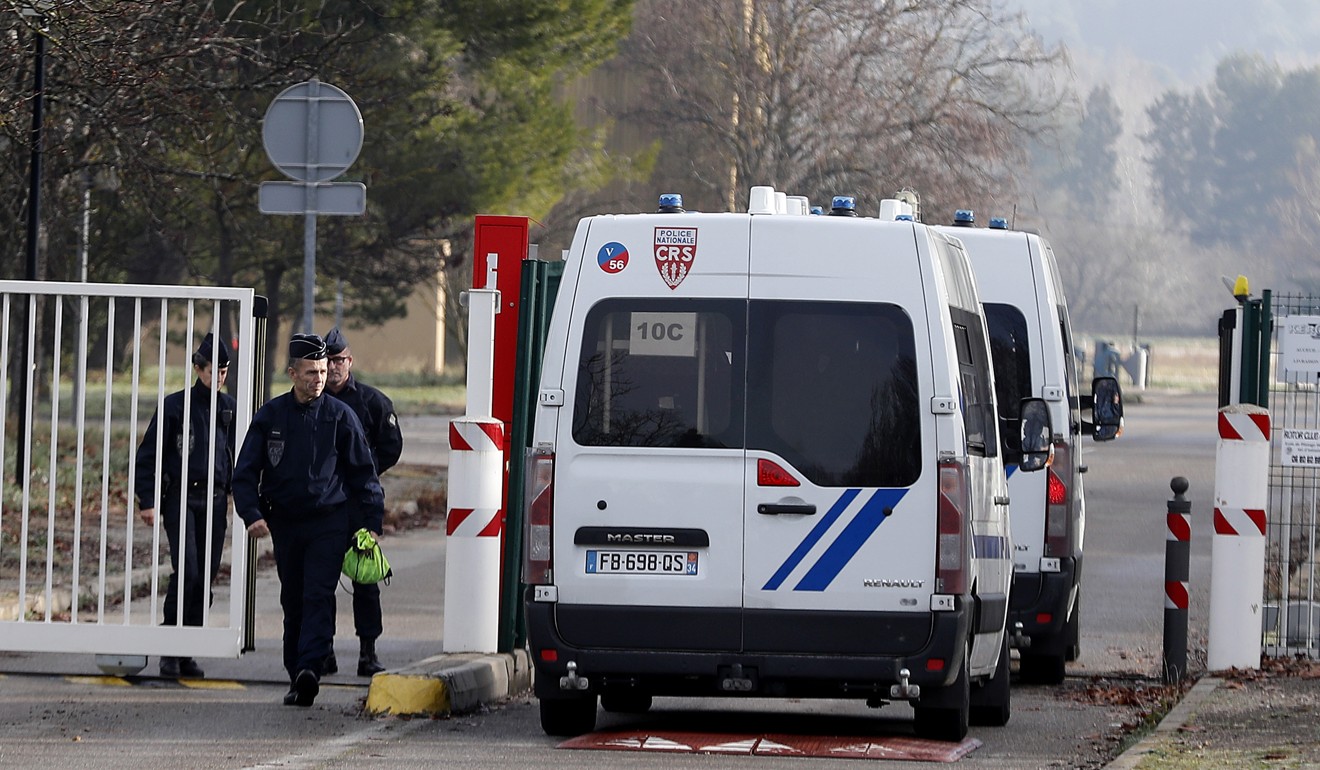
French police officers gather at the entrance gate of the ENSOSP (French National Fire Officers Academy) where French citizens will be quarantined after their repatriation from Wuhan. Photo: EPA-EFE
Europe has 25 reported cases of people who have been infected with the virus that emerged from Wuhan: Germany has 10; France has six; Russia, Italy and the U.K have two each and Finland, Sweden and Spain each have one.

The Italian foreign ministry said permission had been given for cargo flights to fly between Italy and China.

Separately, the special commissioner in charge of coordinating Italy’s efforts during the viral outbreak said consideration was being given to letting a handful of Chinese commercial airliners fly to Italy to pick up Chinese tourists and other Chinese citizens stranded in Italy by the suspension of commercial flights.

The commissioner, Angelo Borrelli, was quoted by Italian media as saying that Italy would like those flights, if approved, not to fly to Italy empty, but instead to bring back Italians from China. There are an estimated 500 other Italians in China who have apparently expressed an interest in returning home during the outbreak, but nothing firm had been decided on those flight possibilities.

Meanwhile, an estimated 3,000 tourists and others from China are stranded in Italy and want to return to home, according to Italian media.

Coronavirus:  Indonesia evacuates citizens, stops flights from China

2 Feb 2020

The death toll in China climbed Sunday to 304 and the number of infections rose to 14,380. In addition, the Philippines on Sunday reported the first death from the virus outside China.

On Saturday night, a Turkish military transport plane carrying 42 people arrived in Ankara from Wutan. The 32 Turkish, six Azerbaijani, three Georgian and one Albanian nationals will remain under observation in a hospital for 14 days, Health Minister Fahrettin Koca said.

Twenty Turkish personnel who took part in the evacuation will also be kept in quarantine.

The Egyptian government said 306 of its nationals would return home from Wuhan on a chartered plane later Sunday and will be subject to a 14-day quarantine. The online news outlet Masrawy reported that authorities prepared a hotel in the northwestern city of Marsa Matruh where the returnees would be quarantined.

Source: SCMP

05/09/2019

China earmarks site to store nuclear waste deep underground

  • Researchers will conduct tests at site in Gansu to see whether it will make a viable facility to store highly radioactive waste safely
  • Scientists say China has the chance to become a world leader in this field but has to find a way to ensure it does not leak
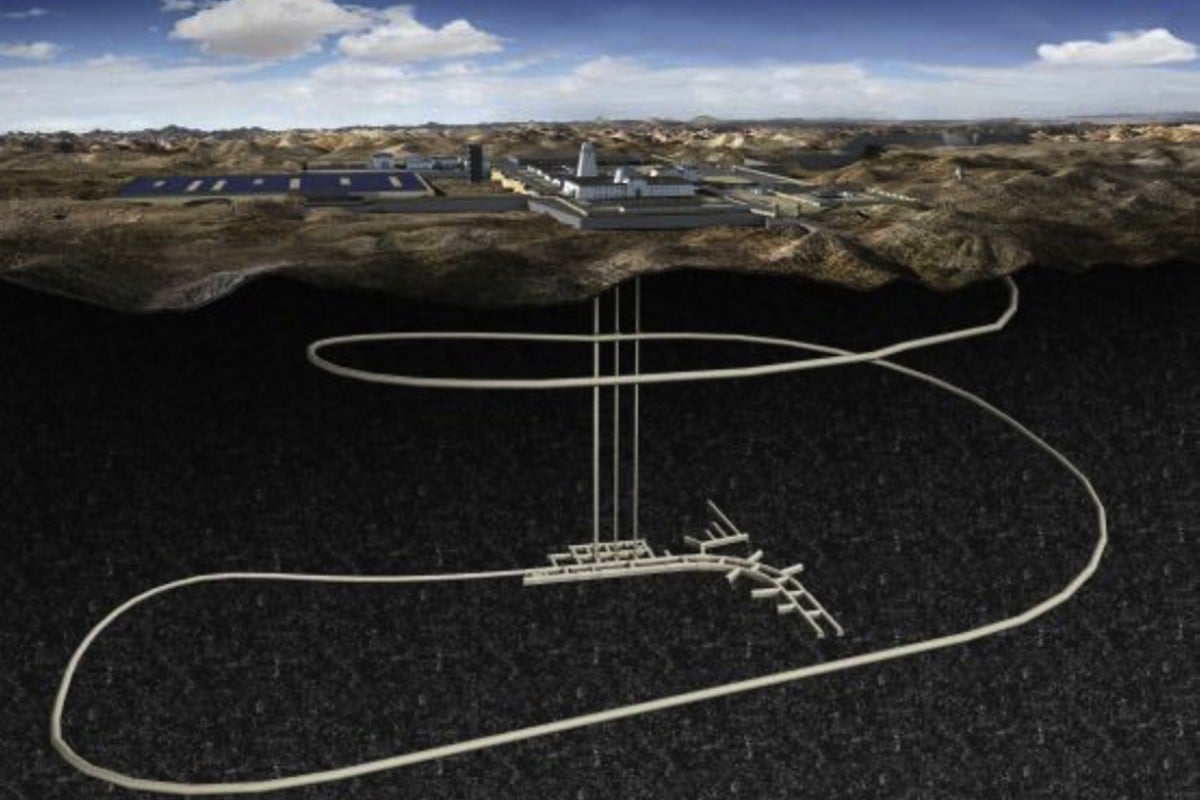
A preliminary design for the Beishan Underground Research Laboratory. Photo: Handout

China has chosen a site for an underground laboratory to research the disposal of highly radioactive waste, the country’s nuclear safety watchdog said on Wednesday.

Officials said work will soon begin on building the Beishan Underground Research Laboratory 400 metres underground in the northwestern province of Gansu.

Liu Hua, the head of the Chinese National Nuclear Safety Administration, said work would be carried out to determine whether it would be possible to build a repository for high-level nuclear waste deep underground.

“China sees radioactive waste disposal as a very important part [of the development nuclear energy],” said Liu. “To develop nuclear energy, we must have safe storage and disposal of nuclear waste.”

China condemns US blacklisting of nuclear firms and says American companies could be hurt as a result
The Chinese authorities see nuclear power an important source of energy that will help to curb carbon emissions and pollution as well as reducing its dependence on fuel imports.

But while the country has made great strides in the development of nuclear power, it needs to find a safe and reliable way of dealing with its growing stockpiles of nuclear waste.

Liu said the Gansu site had been identified as a possible location for a deep nuclear waste store after years of searching.

Once the laboratory is built, scientists and engineers will start experiments to confirm whether it will make a viable underground storage facility.

“Based on the data of the experiments, we can then decide if we are going to pick this as the final site,” he added.

China ‘actively promoting’ nuclear fuel processing plant with French Areva
Chinese officials usually stay tight-lipped about how nuclear waste is disposed of mainly because of fears that any discussion of the topic would trigger safety fears, although in recent years more efforts have been made to inform the public to win support.
Scientists say that nuclear waste can be divided into three categories depending on the level of radioactivity.
Low-level waste consists of minimally radioactive materials such as mop heads, rags, or protective clothing used in nuclear plants, while intermediate-level waste covers things such as filters and used reactor components.
High-level waste, however, is generated by the reprocessing of spent nuclear fuel and scientists generally agree that the safest way to dispose of it is to bury it deep underground in areas where the geology means it will have a minimal impact on the environment while it decays over thousands of years.
The facility will be built in a remote part of Gansu province. Photo: Handout

Some Chinese scientists said the country had the chance to lead the world in this area of research but others have expressed concerns about safety.

Jiang Kejun, a senior researcher at the Energy Research Institute of China’s National Development and Reform Commission, said that very few countries in the world are studying this form of nuclear waste disposal.

“It gives China an opportunity to be a leader in research in this area, plus China has the technology and financial means,” he said.

About a dozen countries including France, Switzerland, Japan, and the United States have carried out research in this area, but in recent years most have abandoned or scaled back their programmes.

At present there are storage sites operating in Finland and the US, but other countries such as Germany have abandoned plans to build similar facilities.

Washington blacklists Chinese nuclear firms for ‘helping military acquire US technology’

But despite broad scientific support for underground disposal, some analysts and many members of the public remain sceptical about whether it is really safe.

Lei Yian, an associate professor at the School of Physics at Peking University, said there was no absolute guarantee that the repositories would be safe when they are come into operation.

“Leakage has happened in [repositories] in the US and the former Soviet Union … it’s a difficult problem worldwide,” he said. “If China can solve it, then it will have solved a global problem.”

China is also building more facilities to dispose of low and intermediate level waste. Officials said new plants were being built in Zhenjiang, Fujian and Shandong, three coastal provinces that currently lack disposal facilities.

At present, two disposal sites for low and intermediate-level waste are in operation in Gansu and Guangdong provinces.

Source: SCMP

17/08/2019

Are Chinese infrastructure loans putting Africa on the debt-trap express?

  • Beijing has lent billions of dollars to countries on the continent to build railways, highways and airports but critics say the borrowings are unsustainable
  • Chinese officials say the projects will pay off in the long run and host nations are well aware of their limits and needs
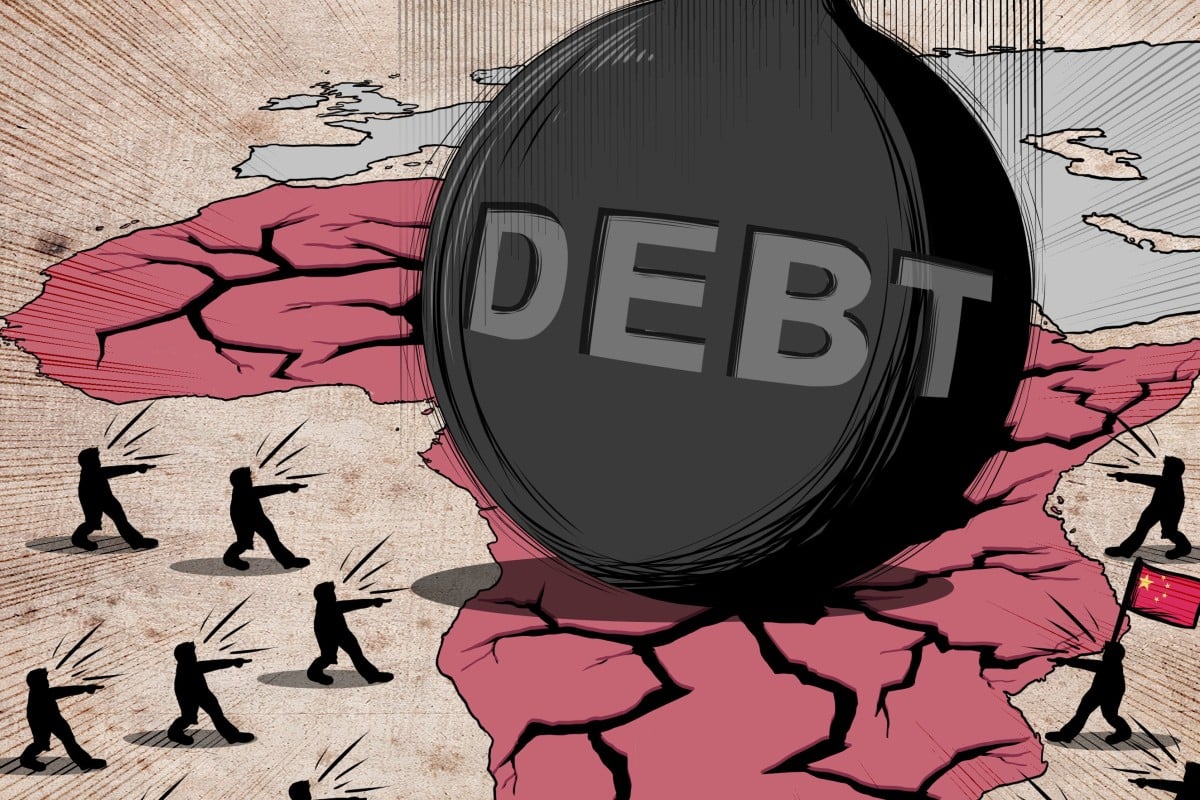
Illustration: Lau Kakuen
When Clement Mouamba went to Beijing last year, he had two main tasks.
The prime minister of the Republic of Congo needed to find out exactly how much his country owed to China, a number the struggling, oil-rich central African nation had until then not been able to provide the International Monetary Fund (IMF) to qualify for a bailout. He also needed to convince Beijing to restructure its debt to ensure sustainability.
The IMF had put talks for further loans on hold until Mouamba’s administration could say exactly how much it had to repay to the country’s external creditors, including China – the republic’s single largest bilateral lender – and oil multinationals such as Glencore and Trafigura.
The country, which heavily depends on oil revenue, turned to China and private oil majors for funding to run the government when in 2014 oil prices fell from a high of US$100 per barrel to as low as US$30.

Critics say countries on the continent are being burdened with unrealistic levels of debt for inviable infrastructure backed and built by China without adequate transparency and scrutiny.

The biggest concern is that several African countries will be left with huge debts and grandiose infrastructure that they cannot maintain and run profitably. I liken it to borrowing money to buy a Tesla when you don’t have adequate access to electricity: Obert Hodzi of the University of Helsinki in Finland

But Chinese observers say the West must take some of the blame for the countries’ debt problems and that the support China offers will benefit the host countries in the long run.

In the early 1990s, when China began to embrace Africa again after years of isolation from the outside world, the aspiring manufacturer was at a serious disadvantage in the race for raw materials and markets for its industrial goods.

The former colonial powers of the West had already sewn up deals for many of the continent’s most lucrative and readily exploitable reserves, from fossil fuels to minerals.

China needed new strategies to convince African governments to allow it access raw materials for its industries and markets for its products to a largely unfamiliar partner.

China also wanted to challenge the dominance of the US in global trade and politics so it courted allies in Africa to help it push for political legitimacy in international institutions.

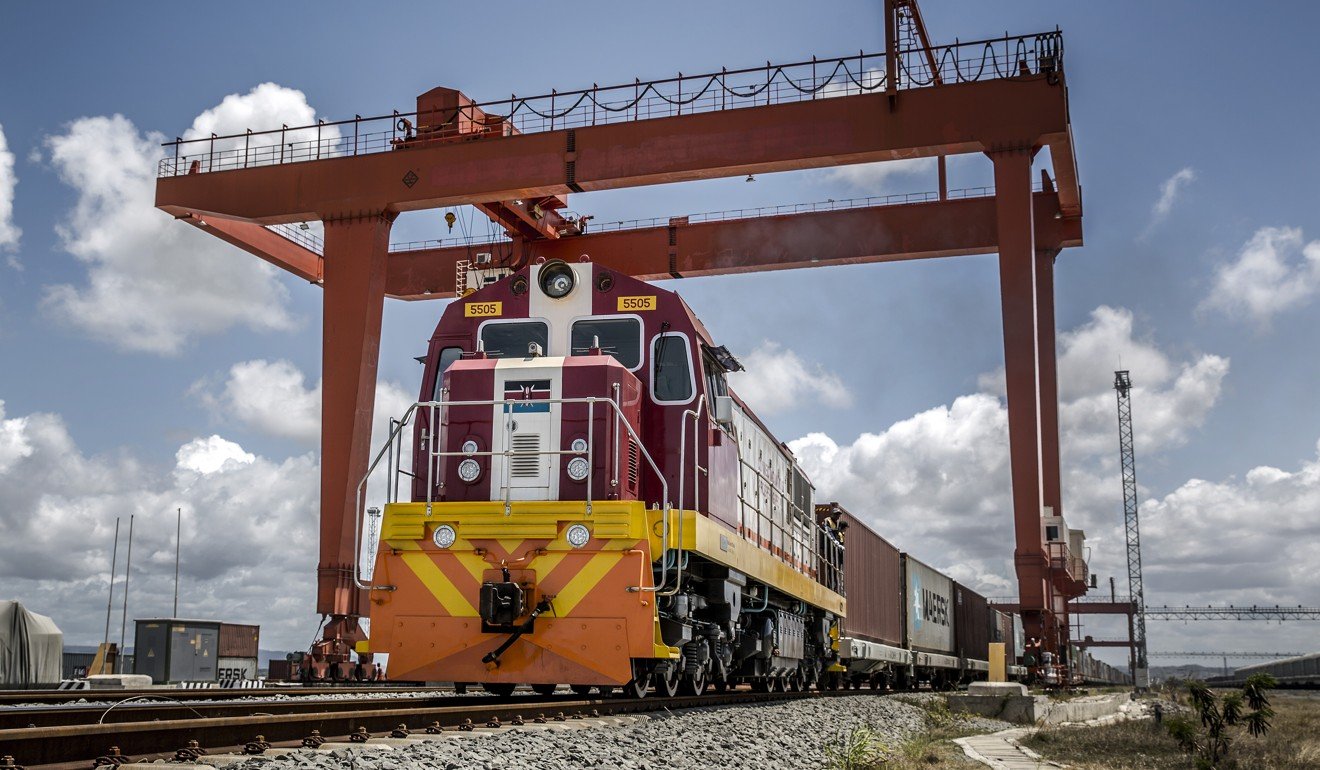
A Kenya Railways freight train leaves the port station on the Mombasa-Nairobi railway in Mombasa, Kenya, a huge project backed by China. Photo: Bloomberg

At the time, many African leaders were under fire to liberalise their economies. China’s approach was to promise not to meddle in individual country’s internal affairs and assure African countries that they could get billions in exchange for future delivery of minerals through resource-backed deals.

Beijing sold its policies that it had no conditions attached to its development finance. In the drive to drum up business, China promised affordable loans for African countries to build roads, bridges, highways, airports and power dams.

Is Kenya’s Chinese-built railway a massive white elephant?

But Beijing also pursued tied finance, ensuring that countries borrowing from China used Chinese contractors to implement the projects rather than open them up to outside bids.

In addition, many of the deals were built on weak financial, technical and environmental conditions, with Chinese state firms conducting the technical feasibility, environmental impact assessment and financial viability studies for free for projects that they also build.

For example, in Kenya, the China Road and Bridge Corporation conducted a free feasibility study that was used in the construction of the railway.

The same company was handed the contract to implement the project and is operating both the passenger and cargo train service for a fee.

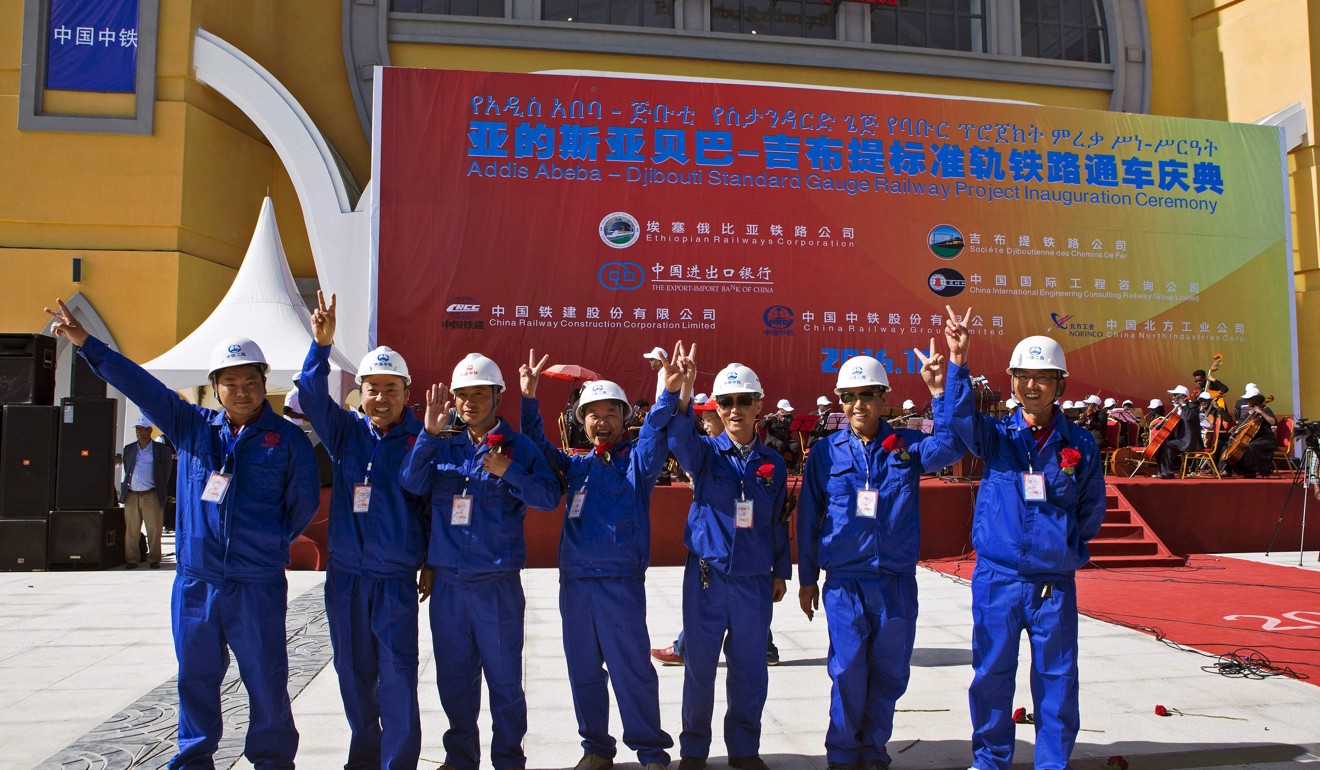
Chinese companies were responsible for the construction of a rail line between Addis Ababa and Djibouti. Photo: AFP

In contrast, the World Bank and its partner institution, the IMF, demand that such studies be done by an independent consultant and not by the company that implements the project.

According to data compiled by the China-Africa Research Initiative, at the Johns Hopkins University School of Advanced International Studies, Beijing has advanced loans worth US$143 billion to African countries since 2000, levels that some critics say are unsustainable for the borrowers.

China meets resistance over Kenya coal plant, in test of its African ambitions

For many of China’s new African partners, these arrangements – from easy lending terms, to non-competitive bidding and opaque contract details – have led to new problems – problems that corrupt or poorly managed governments now share substantial responsibility.

Some critics, both in the West and in host countries, suggest there is a “debt-trap strategy” at the heart of Beijing’s push for international business and influence, but there is no evidence that China deliberately pushes other countries into debt to seize their assets or gain sway.

However, the drive for overseas contracts and big business has led some countries into difficulties with new debts, and there are question marks over the viability of many of the projects the money is funding.

Obert Hodzi, an international relations expert at the University of Helsinki in Finland, said the Addis Ababa-Djibouti railway and the Mombasa-Nairobi railway were good examples of huge projects that were financed by easy borrowing terms from China but were not sustainable and that had in turn forced the African partners to seek further Chinese help.

“The biggest concern is that several African countries will be left with huge debts and grandiose infrastructure that they cannot maintain and run profitably,” Hodzi said. “I liken it to borrowing money to buy a Tesla when you don’t have adequate access to electricity.”

Ken Opalo, a Kenyan scholar at Georgetown University in Washington, said the key issue was the inability of African countries to design projects that were actually needed for the local economies.

A road is not just a means of transport but an economic belt or corridor that will catalyse the development of the whole region: Huang Xueqing, spokeswoman for the Chinese embassy in Nairobi

“Most African countries have been willing to accept projects designed, financed, and implemented by Chinese firms,” Opalo said.
“It would be better to decouple the feasibility studies and design phases of projects from the financing. That way African governments can ensure that they are truly getting value for money.”
But Chinese officials said Beijing had invested in infrastructure largely at the request of the host countries, adding that it could take time to yield returns on the projects.

Huang Xueqing, spokeswoman for the Chinese embassy in Nairobi, said the projects were valid assets with value that would grow in time.

“So, in the long run, it is beneficial to the host countries. Just like when young people buy a house with a mortgage, they may take some debts, but they have a place to live in and have their own assets,” Huang said.

“Underdeveloped infrastructure is the bottleneck that has been holding back Africa’s development. Up to today, many African countries, although in the same continent, are not connected with direct flights, railways or even roads. You have to fly to Paris or Zurich in order to get to some African countries.

“A road is not just a means of transport but an economic belt or corridor that will catalyse the development of the whole region.”

Huang said Beijing had advised the countries to act within their means and not to overstretch themselves when they considered projects that might not be in line with local conditions.

“When making investment decisions, the Chinese side, along with the recipient countries, carry out rigorous feasibility studies and evaluations. We do things according to our ability,” she said.

China’s leadership has also said it is paying close attention to the fiscal and financial difficulties faced by some African countries.

“As a good friend and good brother … the Chinese side is willing to lend a helping hand when needed by the African people to help them overcome temporary difficulties,” State Councillor and Foreign Minister Wang Yi said in January while on a trip to Ethiopia, adding that the debt situation in Africa is also a legacy issue.

China must allay any debt-trap fears in its dealings with Africa

“The African debt issue does not come up today, still less is it caused by the Chinese side. The African people know who are the initiators of African debt.”

The West should take a lot of the blame for worsening debt problems in some African countries, according to Li Anshan, from Peking University’s Centre for African Studies.

He cited the cases of Liberia and the Democratic Republic of Congo, two countries that have had close relations with the West for many years but remain ravaged by war and poverty despite immense natural resources.

“China-Africa relations have been going on for quite some time. Is there any African country which has got poorer because of its deal with China?” Li said.

Gyude Moore, a former Liberian minister of public works whose department oversaw construction and maintenance of various public infrastructure funded and built by China, said it would be difficult to imagine that China would knowingly ensnare its partners in debt.

“China attempts to differentiate itself from Western donors by limiting non loan-related conditionality. China also practices non-interference, so how a country manages its resources, treats its people or deploy its finances were considered ‘internal’,” he said.

“So, Chinese loans are negotiated faster and place less emphasis on public financial management.”

Moore, now a visiting fellow at the Centre for Global Development, said there were trade-offs in such situations.

China focuses on sustainable projects to dismiss fears of African debt trap

“If the loans are going to be fast – the due diligence will not be as rigorous. Chinese project selection mixes political with economic considerations. So, while a project may not make as much economic sense, it may pay political dividends,” he said.

He said non-transparent processes would invite abuse, be they Chinese, Western or African.

Other observers say the question of opacity is more directly related to China’s own economic system.

Howard French, author of China’s Second Continent: How a Million Migrants are Building a New Empire in Africa, said China has very limited transparency and public accountability in its own domestic processes.

The Mombasa railway station is seen in Mombasa, Kenya, in 2018. Photo: Xinhua

“So it would be unusual to expect that China would introduce greater transparency and accountability in its dealings with African countries than it is used to at home – that is, unless African governments insist on it,” French said.

“And this is where African governance comes in. African states should insist on contract transparency but often don’t do so because that offers leaders plentiful opportunities for graft.”

David Shinn, professor of international relations at George Washington University in Washington, agreed that China’s lack of loan transparency was a huge problem and increased the risk of corruption on both the African and Chinese sides. But he also said that in some cases, African governments might have negotiated poorly.

“This is, however, the responsibility of the African government. I don’t think China is purposely trying to encourage African debts in order to gain leverage,” Shinn said.

“In fact, China is becoming more careful about its lending because it is concerned it has made too much credit available to some African countries.”

China ‘ready to talk’ about trade deal with East Africa bloc

Huang Hongxiang, director of China House, a Nairobi-based consultancy that helps Chinese in Africa integrate better, agreed, saying the Chinese government needs to communicate more about projects in Africa but African countries also have a bigger part to play in ensuring better deals.

“On commercial viability, accountability, transparency and governance, I believe the responsibility does not lie with China, the US or the West but in the hands of African countries,” he said.

Wherever the fault lies, one thing is clear when money is wasted on ill-designed projects that have little to no economic return, according to Opalo.

“The lack of planning and transparency creates default risks … [and] African taxpayers will be left holding the bag.”

This article is the third in a series examining the local impact of Chinese investment and infrastructure projects in Africa. Read part one  here and part two

 here

.

The next report will examine whether African countries can speak with one voice in relations with China.
Source: SCMP
15/02/2019

Seizing on Huawei’s troubles, Samsung bets big on network gear

SEOUL (Reuters) – Samsung Electronics is pouring resources into its telecom network equipment business, aiming to capitalize on the security fears hobbling China’s Huawei, according to company officials and other industry executives.

Those efforts include moving high-performing managers and numerous employees to the network division from its handset unit, two Samsung sources said.
Potential customers are taking notice of Samsung’s efforts to reinvent itself as a top-tier supplier for 5G wireless networks and bridge a big gap with market leader Huawei and industry heavyweights Ericsson and Nokia.
French carrier Orange’s chief technology officer, Mari-Noëlle Jégo-Laveissière, visited Japan last year and was impressed with the pace of 5G preparations using alternative equipment makers including Samsung, a company representative told Reuters.

Orange, which operates in 27 markets and counts Huawei as its top equipment supplier, will run its first French 5G tests with Samsung this year.

Underscoring the growing importance of the business, South Korean Prime Minister Lee Nak-yeon visited Samsung’s network division in January. In a closed-door meeting during that visit, Samsung heir Jay Y. Lee asked for government help with recruiting high-level engineers.
Huawei is battling allegations by the United States and some other Western countries that its equipment could enable Chinese spying and should not be used in 5G networks, which will offer higher speeds and a host of new services.
Australia and New Zealand have joined the United States in effectively barring Huawei from 5G, and many other countries, especially in Europe, are considering a ban. Huawei denies that its gear presents any security risk.
Its woes have presented Samsung with a rare opportunity. Telecom firms would ordinarily stick with their 4G providers for 5G upgrades as they can use existing gear to minimize costs, but many firms may now be under political pressure to switch.

“We’re bolstering our network business to seize market opportunities arising at a time when Huawei is the subject of warnings about security,” said one of the Samsung sources.

The sources, who did not disclose specific figures for the employee moves, declined to be identified as they were not authorized to speak on the matter.

Keen to seek new growth, particularly as sales of its mainstay chips and smartphones have begun to drop, Samsung plans to invest $22 billion in 5G mobile technology and other fields over three years. It declined to break down how much will go to 5G and the other areas – artificial intelligence, biopharma and automotive electronic parts.

“Samsung is focused on building trust with our partners and leading the global 5G markets, regardless of other companies,” it said in an emailed statement to Reuters.

Asked about Samsung’s big push into network equipment, Huawei said in a statement that it welcomed competition in the market.

INDIA OPPORTUNITY

In India, Samsung is now in talks with Reliance Jio to upgrade its network to 5G, looking to build on what has perhaps been its biggest network success – becoming the key supplier for the upstart carrier.

“We don’t think 5G is far away in India,” a Samsung official with direct knowledge of the matter told Reuters. He declined to be named due to the sensitivity of the matter.

Samsung’s clients include U.S. firms AT&T Inc, Verizon Communications Inc and Sprint Corp and it has 5G network contracts with all three, though it was not clear how extensive those contracts are. It also sells to South Korean carriers and has partnered with Japanese mobile carriers to test its 5G equipment.

In many cases, Samsung supplies only small pieces of networks. According to market tracker Dell’Oro Group, the South Korean firm holds just 3 percent of the global telecom infrastructure market compared with 28 percent for Huawei.

Its network business made 870 billion won ($775 million) in operating profit last year, according to Eugene Investment & Securities. Filings show Nokia’s network business made about 1.2 billion euros ($1.4 billion) while Ericsson’s network operations made 19.4 billion Swedish crowns ($2.1 billion). Figures for Huawei were not available.

FINDING THE PEOPLE

One major hurdle for Samsung will be attracting talent amid a dearth of software engineers in South Korea.

“We need more software engineers and want to work with the government to find that talent,” Lee was quoted as saying by government officials at his meeting with the prime minister.

Samsung’s network business unit employs roughly 5,000 people, according to a government official in the southern city of Gumi where Samsung operates its manufacturing plants.

Kim Young-woo, an analyst at SK Securities, expects Samsung to hire 1,000-1,500 people for 5G network equipment this year. Samsung declined to comment on network employee levels and hiring plans.

But Samsung’s bet remains risky as the long-term nature of telecom network investment means change comes slowly.

Sweden’s Ericsson and Finland’s Nokia, which acquired the remnants of once-powerful network equipment companies Alcatel-Lucent and Nortel, have as yet seen little sales growth from Huawei’s problems, company executives said.

Both are in cost-cutting mode, even in the face of the 5G opportunity and the problems confronting their biggest rival.

Indeed, some network operators in Europe are warning that a Huawei ban – now under consideration in France, the UK, Germany and other countries – could push back deployment of 5G by as much as three years.

Others warn Samsung may struggle to develop a global sales and support organization.

“The way telcos purchase products and services from their suppliers demand a lot of time and resources, which is why Ericsson and Nokia have around 100,000 employees and Huawei almost twice as many,” said Bengt Nordstrom, CEO of telecom consultancy Northstream.

But Samsung is taking the long view. In December, it agreed to extend its Olympic partnership with the International Olympic Committee through to 2028 and expand its sponsorship to 5G technology.

The company did not want to leave its sponsorship spot open to Chinese rivals, a separate source with knowledge of the matter said.

“If Samsung dropped the top mobile sponsorship for the Olympic games beyond 2020, then who would have taken that spot? It would only have been China, Huawei.”

($1 = 1,122.8000 won)

Source: Reuters

16/01/2019

Peng Liyuan attends performance with Finnish first lady

CHINA-BEIJING-PENG LIYUAN-JENNI HAUKIO-PERFORMANCE (CN)

Peng Liyuan (R, front), the wife of Chinese President Xi Jinping, attends a show including poetry reading and musical performances with Jenni Haukio, wife of Finnish President Sauli Niinisto, in Beijing, capital of China, Jan. 15, 2019. (Xinhua/Zhai Jianlan)

BEIJING, Jan. 15 (Xinhua) — Peng Liyuan, the wife of Chinese President Xi Jinping, attended a performance with Jenni Haukio, wife of Finnish President Sauli Niinisto, on Tuesday.

The show, which included poetry reading and musical performances, was held in the stylish bookstore Page One situated in the Qianmen area, a significant symbol of old Beijing.

After having strolled around the bookstore and learning about the history of the bookstore and the surrounding block, Peng and Haukio enjoyed wonderful performances on the top floor. Peng also briefed Haukio on the history and recent renovation of the historic district of Dashilar.

During the show, students majoring in Finnish read Haukio’s award-winning poems, catching her by surprise.

Young ladies dressed in ancient costumes sang traditional Chinese poems with the accompaniment of piano and Chinese zither, a traditional Chinese instrument.

The performance ended with a violinist and a pianist playing a piece work composed by Finnish composer Jean Sibelius.

The show was performed by teachers and students from the Beijing Foreign Studies University and the China Conservatory of Music.

Haukio is in Beijing accompanying President Niinisto who is paying a state visit to China from Sunday to Wednesday.

Source: Xinhua

15/01/2019

China Focus: China, Finland vow to write new chapter in bilateral ties

CHINA-BEIJING-XI JINPING-FINNISH PRESIDENT-TALKS (CN)

Chinese President Xi Jinping (2nd R) and his wife Peng Liyuan (1st R) pose for a group photo with Finnish President Sauli Niinisto (2nd L) and his wife Jenni Haukio in Beijing, capital of China, Jan. 14, 2019. Xi held talks with Niinisto at the Great Hall of the People in Beijing on Monday. Before their talks, Xi held a welcome ceremony for Niinisto. (Xinhua/Ju Peng)

BEIJING, Jan. 14 (Xinhua) — Chinese President Xi Jinping and his visiting Finnish counterpart Sauli Niinisto agreed to work together to write a new chapter in bilateral ties during their talks on Monday.

Hailing that China and Finland have been committed to forging a future-oriented new-type of cooperative partnership in recent years, Xi said it is not only in line with both countries’ and people’s interests but also conducive to world peace, stability and prosperity that China and Finland enhance dialogue and cooperation.

The two countries need to adhere to mutual respect and trust, be open-minded and inclusive, respect each other’s development path and take each other’s core interests into consideration so as to promote the steady development of bilateral ties, Xi told Niinisto during the talks held at the Great Hall of the People.

Xi encouraged both countries to expand cooperation in new areas driven by innovation.

China appreciated Finland’s support to the Belt and Road Initiative, said Xi, adding that the country is ready to work with Finland to enhance Belt and Road cooperation.

He suggested the two countries make the best use of the China Railway Express and other facilities to boost two-way trade, conduct third-party cooperation, discuss opportunities for cooperation on the Arctic shipping routes and jointly build the Polar Silk Road.

Xi also called for enhanced cultural and people-to-people exchanges as the two presidents would jointly launch the 2019 China-Finland Year of Winter Sports in the hope of forging a model of winter sports cooperation.

The two countries need to jointly promote the reform on global governance, enhance cooperation on international affairs, push forward the establishment of the open world economy, safeguard the multilateral trading system, and implement the Paris Agreement on climate change, Xi said.

Stressing that China has always supported the European integration, Xi said China hopes Europe will maintain unity, stability, openness and prosperity and play an active and constructive role in the international arena, calling on Finland to continue contributing to China-Europe ties.

On the Arctic affairs, Xi said China stands ready to work with Finland to enhance cooperation under the framework of the Arctic Council and boost the sustainable development in the Arctic region.

China will also maintain close contact with Nordic countries and the Nordic Council of Ministers to develop cooperation between China and Nordic countries, Xi said.

Hailing the rapid development of bilateral ties, Niinisto said that Finland speaks highly of China’s achievements, values China’s role in international affairs and cherishes its friendship with China.

The Belt and Road Initiative proposed by Xi is very important, he said, adding that Finland is willing to play a positive role to better align this initiative with the European Union (EU) to promote the connectivity of the Eurasian continent.

During Niinisto’s visit to China, the two sides are scheduled to publish a joint action plan (2019-2023) on promoting the future-oriented new-type cooperative partnership between China and Finland.

Finland is ready to work with China to implement the action plan, strengthen pragmatic cooperation in areas including trade, innovation, environment, tourism, and Arctic affairs, boost people-to-people exchanges and cement cooperation on sports, particularly winter sports, Niinisto said.

It is important for the two countries to maintain close communication and coordination on international affairs under the current situation, he said, adding that Finland applauds China’s positive role in tackling climate change and safeguarding the multilateral trading system.

Finland will assume the rotating presidency of the EU in the second half of this year. The country will take this as an opportunity to promote closer ties between the EU and China, Niinisto said.

After the talks, the two presidents witnessed the signing of cooperation agreements and attended the inaugural ceremony of the 2019 China-Finland Year of Winter Sports.

During the 1952 Helsinki Olympic Games, the People’s Republic of China made its debut at the Olympic Games, and for the first time China’s national flag was raised at the Olympic arena, Xi said.

There is huge potential for cooperation on winter sports between the two countries given the high complementarity, Xi said while addressing the inaugural ceremony.

“I believe the 2019 China-Finland Year of Winter Sports will boost the two countries’ sports cooperation, inject new vitality to people-to-people exchanges, and further advance the future-oriented new-type cooperative partnership between China and Finland,” Xi said.

Finland supports China in hosting the 2022 Beijing Winter Olympic Games, Niinisto said, adding that he is glad Finland will be the first country to launch the Year of Winter Sports with China and he believes this will further promote friendship between the two countries.

China is on its way of becoming a big power in winter sports and Finland is willing to lend a helping hand, Niinisto said.

Niinisto is paying a state visit to China from Sunday to Wednesday at the invitation of Xi.

Law of Unintended Consequences

continuously updated blog about China & India

ChiaHou's Book Reviews

continuously updated blog about China & India

What's wrong with the world; and its economy

continuously updated blog about China & India