Archive for ‘flashpoint’

31/05/2020

Destined for conflict? Xi Jinping, Donald Trump and the Thucydides trap

  • Tense relations with the US and the question of whether armed confrontation can be avoided will loom large when China’s political elites meet
  • Structural shifts in balance of power have brought the countries closer to the brink, analyst says, with the South China Sea the most likely flashpoint
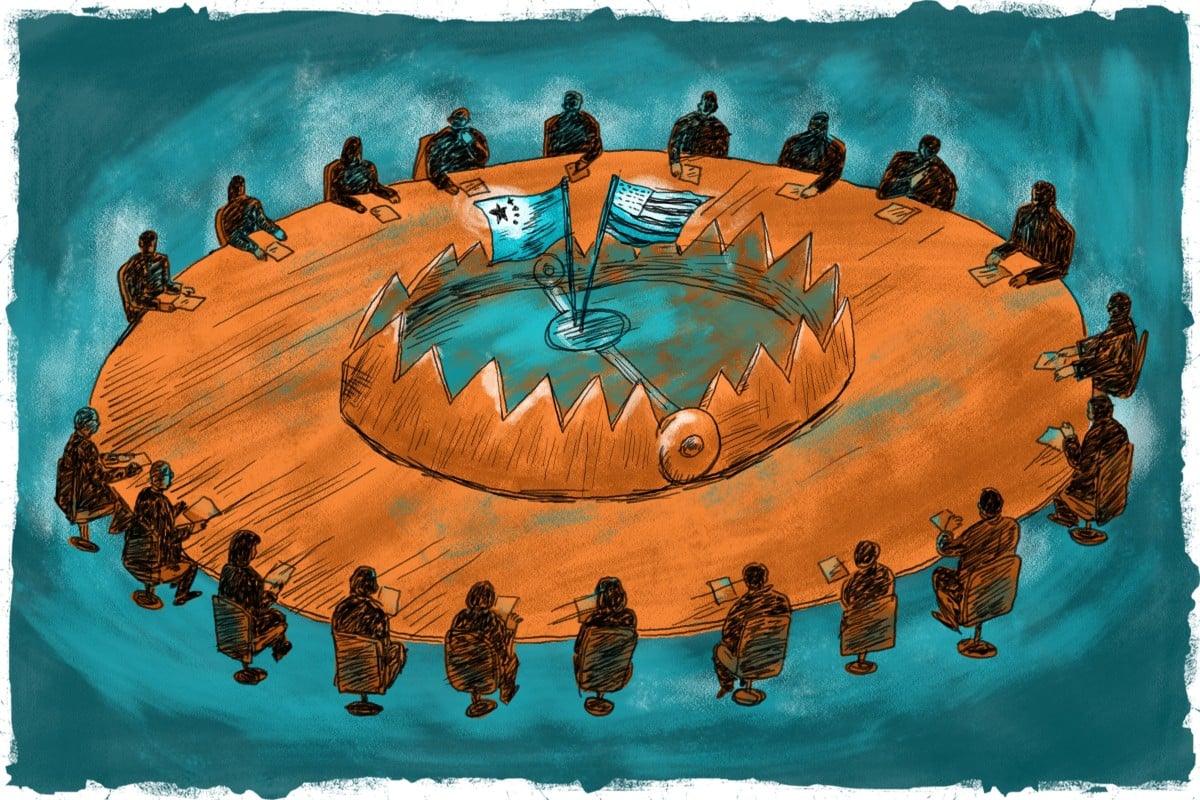
Illustration: Brian Wang
This is the fifth in a nine-part series examining the issues Chinese leaders face as they gather for their annual “two sessions” of the National People’s Congress and Chinese People’s Political Consultative Conference this week. This story looks at the sharp decline of US-China ties, and where it may lead.
When thousands of China’s elites flock to Beijing for the delayed national legislative session starting on Friday they will face a renewed debate about relations with the US. Specifically, can armed conflict between the two economic superpowers be avoided?
The question is not new, but it has taken on a new urgency as the acrimony escalates between Washington and Beijing amid the Covid-19 pandemic, exposing growing cracks in the current global order.

Harvard professor Graham Allison raised the question in a 2017 book, Destined for War: Can America and China Escape Thucydides’ Trap? The reference being to the Greek historian of 2,500 years ago and the conundrum named after him on the likelihood of armed conflict when a rising power challenges a ruling power.

President Xi Jinping has shown personal interest in the Thucydides trap concept, which Allison first posed in a 2012 newspaper article, referencing it on at least three occasions, including the eve of the swearing-in ceremony of US President Donald Trump three years ago.

Speaking at the World Economic Forum in Davos in January 2017, Xi said the Thucydides trap “can be avoided … as long as we maintain communication and treat each other with sincerity”.
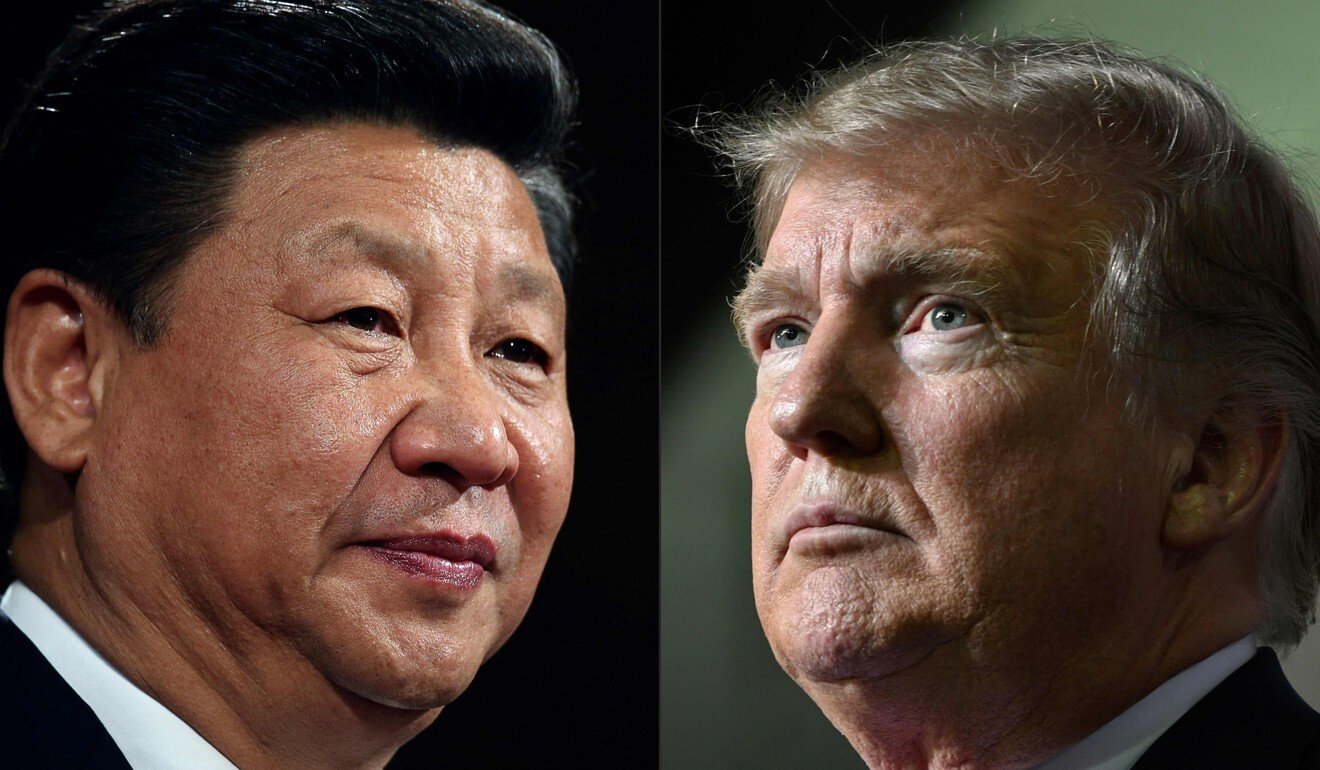
Xi Jinping referenced the Thucydides trap concept on the eve of Donald Trump’s swearing-in ceremony. Photos: AFP
But since then, the devastating Covid-19 pandemic has driven the deeply fraught US-China relations to the brink of an all-out confrontation as a result of strategic distrust and misperception, said Wang Jisi, president of Peking University’s Institute of International and Strategic Studies.

“China and the US are shifting from an all-around competition to a full-scale confrontation, with little room for compromise and manoeuvring,” Wang said in a speech in late March. “We cannot rule out the possibility that the two powers may fall into the Thucydides trap.”

That seems to sum up the tone of recent communications from the US side. Trump has vowed to “take whatever actions that are necessary” to seek reparations and hold China accountable for the Covid-19 disease that was first identified in the city of Wuhan at the end of last year. His top aides, especially Secretary of State Mike Pompeo and Defence Secretary Mark Esper, have been particularly blunt.
During the Munich Security Conference in February, Esper described China as a rising threat to the world order and urged countries to side with the US in preparing for “high intensity conflict against China”.

The prospects for bilateral ties are deeply worrying and we are just one step away from a new cold warZhu Feng, Nanjing University

Mainland authorities are usually reluctant to play up sensitive diplomatic topics during the annual gatherings of the National People’s Congress and the Chinese People’s Political Consultative Conference, known as the “two sessions”.

Domestic concerns, especially the socio-economic upheaval wrought by the pandemic, will no doubt dominate the week-long meetings as the country faces the deepest economic contraction in decades, mass unemployment, and a possible manufacturing exodus from China.

However, the sharp decline in relations with the US in recent months and its possible consequences are expected to loom large in the minds of over 5,000 participants at the two sessions, according to Gu Su, a political scientist at Nanjing University.

“Considering the boiling tensions with the US over Covid-19 and the resulting scrutiny of China’s global ambitions – which have dealt a heavy blow to the economy, especially at local levels, and left the country increasingly isolated – it may be hard to suppress such discussions,” Gu said.

Given the widespread public interest in these contentious topics, Xi and other top leaders may need to weigh in personally and set the tone for the national debate, especially on the future of China and US relations, he said.

But it would be unrealistic to expect major policy decisions on diplomacy, as “the two sessions are not usually known for substantial foreign policy deliberations”, said Zhu Feng, an international affairs expert at Nanjing University.

Paramilitary police officers patrol in Tiananmen Square near the Great Hall of the People in Beijing, where China’s political elites are about to meet for the “two sessions”. Photo: Reuters

‘Worst-case scenarios’

The deterioration of US-China ties has clearly alarmed Xi and his top aides. On April 8, the Chinese leader issued an unusually stark warning that “we must get ready for the worst-case scenarios” in light of unprecedented external adversity and challenges, according to Xinhua.
While the state news agency did not elaborate on what Xi meant by worst-case scenarios, a recent study by a Chinese government-backed think tank offered some hints.

The China Institutes of Contemporary International Relations (CICIR), affiliated with the Ministry of State Security, said Beijing may need to prepare for armed confrontation with Washington amid the worst anti-China backlash since the Tiananmen crackdown in 1989, according to Reuters, which cited an internal report.

The report warned that China’s overseas investments, especially the ambitious Belt and Road Initiative, could fall victim to rising anti-Chinese sentiments, while the US may accelerate efforts to counter Beijing’s expanding clout by increasing financial and military support for regional allies.

While the think tank declined to confirm the Reuters story, many international relations analysts shared similar bleak assessments of US-China relations.

“We are already in an all-around confrontation with the US, which sees both sides at odds on almost every front – from trade and tech tensions, military, ideological and geopolitical rivalry, to political and legal battles over the coronavirus,” Zhu said. “The prospects for bilateral ties are deeply worrying and we are just one step away from a new cold war.”

With much of the world still in the grip of the Covid-19 pandemic, Beijing’s critics and opponents, led by the US, have upped the ante in the blame-shifting game as they line up to pursue an international investigation into the origins of the deadly virus.

The coronavirus has also derailed most of China’s diplomatic agenda for the first half of the year, with Xi’s planned state visits to Japan and South Korea postponed.

Meanwhile, China’s relations with the European Union have become more tense, though Beijing managed to dodge a bullet at this week’s World Health Assembly, which adopted a mildly worded resolution drafted by the EU to carry out an independent inquiry into different countries’ response to the outbreak at “an appropriate time”.

But a growing number of European countries have pushed back against China’s diplomatic assertiveness and followed Washington’s lead to press Beijing for greater transparency over the coronavirus.

Shelley Rigger, a political science professor at Davidson College in North Carolina, said the CICIR report, if confirmed, offered a clear-eyed assessment of the situation and did not have the usual triumphalist tone present in many papers on international relations from China.

“That’s a good thing. Everyone needs to be realistic, and not indulge in wishful thinking or overconfidence,” she said.
The ‘two sessions’ explained: China’s most important political meetings of the year
Seth Jaffe, assistant professor of political science and international affairs at John Cabot University in Rome and an expert on Greek history, said the Chinese think tank report was “profoundly concerning”.
“The acrimonious narratives surrounding Covid-19 are currently reshaping the attitudes of leaders and populations alike, which is leading to harder-line strategic postures, as evidenced by the hawkish CICIR report,” he said. “In this way, the virus blame game is stirring up nationalistic pride and grievance, narrowing the space for political leaders to manoeuvre, and creating zero-sum dynamics that invite future conflict – a vicious cycle.”
According to Jaffe, the author of Thucydides on the Outbreak of War: Character and Contest, although the temperaments of Trump and Xi would matter enormously in any actual crisis, it was the structural shifts in the balance of power in recent years that had brought the two sides closer to the brink.
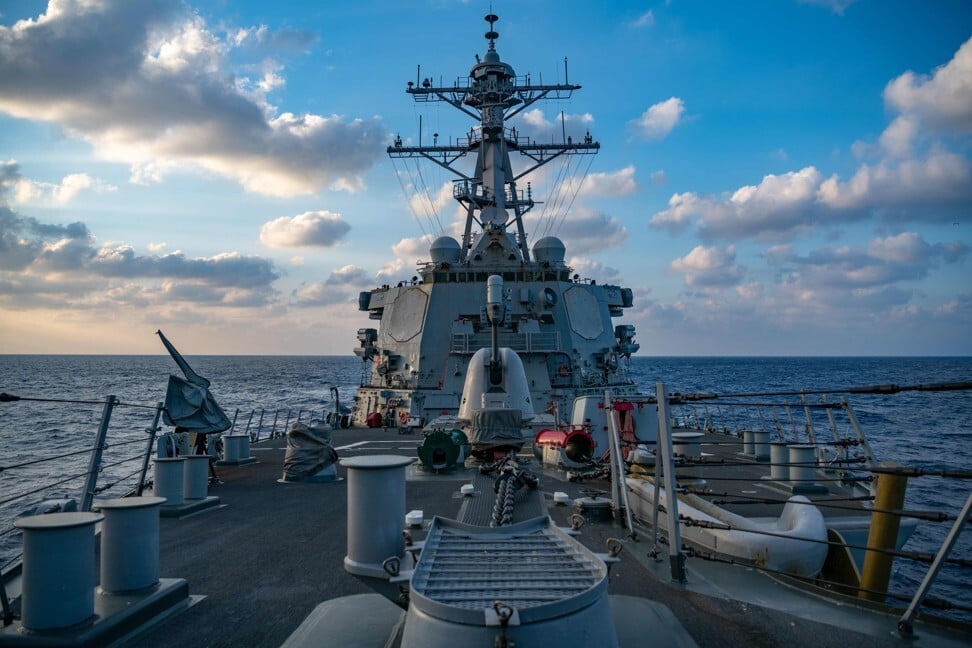
The most likely collision scenario, he said, would be in the South China Sea.
“I still worry most about military close encounters associated with American freedom of navigation operations, which could rapidly escalate in unintended but dangerous directions, for example, in the direction of a serious naval conflict.”
Guided-missile destroyer the USS Barry sails in the South China Sea last month. Photo: AFP
He said an international incident would put Trump and Xi on a reputational collision course, with each leader facing pressure to stand up to the other and not back down, given the mistrust and heated rhetoric.
“The danger, then, is an unforeseen spark, which could set off a frightening movement up the escalation ladder,” he added.
Zhao Tong, a senior fellow at the Carnegie-Tsinghua Centre for Global Policy in Beijing, also expressed concern that military incidents and conflicts with the US had become “less unimaginable given how quickly mutual animosity is building”.
Nationalist sentiment
In recent months, many senior Chinese diplomats have risen to Xi’s hardline, nationalist call and displayed their “fighting spirit”, often at the expense of the country’s global image.
“In future crises, if People’s Liberation Army officers, like some Chinese diplomats, calculate that it is in their personal interests to act extra tough, even if they know their aggression could cause war and cost China dearly, they might still feel incentivised to do so,” Zhao said.
To make things worse, according to Zhang Tuosheng, a security analyst from the China Foundation for International and Strategic Studies, Beijing and Washington had yet to set up an operational crisis management mechanism.

The Chinese leadership surely understands the massive costs of military action against TaiwanShelley Rigger, Davidson College

“One of the major lessons is that we’ve paid scant attention to the establishment of a series of mechanisms that have proven necessary during the Cold War era in preventing tensions spiralling out of control in the event of emergencies or a real crisis,” he said.
Beijing made clear its resentment over the warming ties between Washington and Taipei ahead of and during Taiwanese President Tsai Ing-wen’s inauguration on Wednesday, but a military confrontation over the self-ruled island in the near term was not likely, according to Rigger.
“The Chinese leadership surely understands the massive costs – in blood, treasure and reputation – of military action against Taiwan. They are way too smart to count on the US not intervening,” she said.
Rigger noted several retired PLA officers, including 
air force Major General Qiao Liang

, had unusually toned down their hawkish stance on seeking reunification with Taiwan by force.

“That is a frustrating message for many Chinese to hear, but war is very costly and very unpredictable – something the US has learned through painful experience,” she said.

While experts called for efforts to lower tensions in the lead-up to the US presidential election in November, most said that would largely hinge on Trump.

“Anything is possible with Trump,” Rigger said. “If he thinks better relations with China will help him win re-election, he will do whatever it takes to turn the relationship around. I’d be really surprised if the Chinese leadership didn’t respond positively to such an opportunity.”

But Zhu said it would be naive to pin hopes on Trump, who was desperate to play the China card in his re-election campaign.

“Beijing should be particularly cautious on Taiwan and the South China Sea disputes and should not engage in rhetorical tit-for-tat with Washington,” he said. “We need to look beyond the Trump presidency and prioritise the steady development of bilateral relations over the need to outcompete Trump.”

Source: SCMP
07/05/2020

Riyaz Naikoo: Hizbul Mujahideen Kashmir militant killed by Indian forces

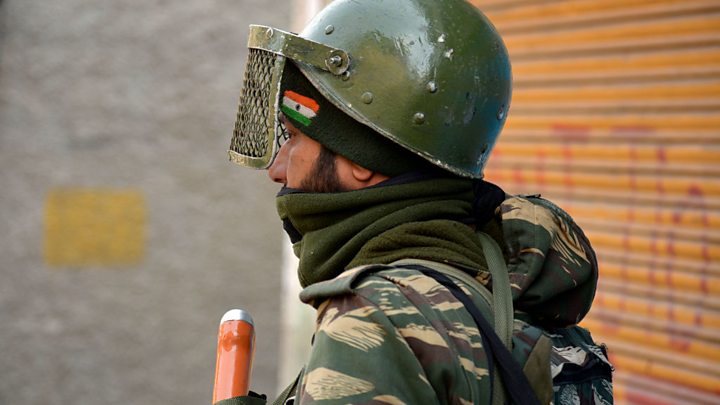
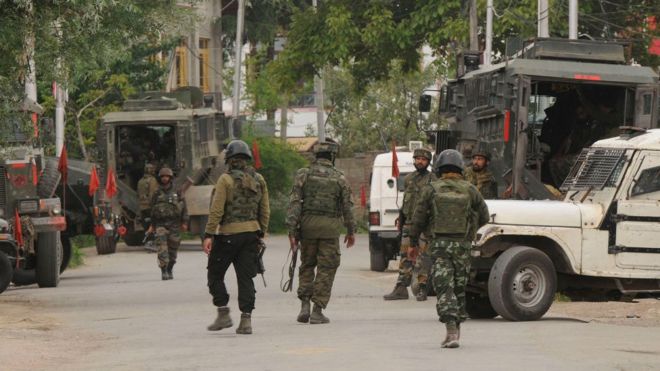
Kashmir security forcesImage copyright GETTY IMAGES

Indian security forces have killed a prominent militant leader in disputed Kashmir, officials say.

Riyaz Naikoo had taken over command of the banned Hizbul Mujahideen group, succeeding Burhan Wani who was killed by security forces in 2016.

Wani’s death triggered massive protests in the region, which is claimed in its entirety by both India and Pakistan.

The region has seen an armed insurgency against Indian rule since 1989, which has flared following Wani’s killing.

Naikoo was shot dead in his home village of Beigh Pora in Pulwama district after militants killed eight security personnel in two separate attacks, part of a recent surge of violence in Indian-administered Kashmir.

Locals said the militant leader had been trapped in a joint siege laid by army, paramilitary and police forces. He had been on the run for eight years.

“At least 76 militants including Naikoo have been killed since January this year. But we also lost 20 soldiers including senior army and police officers,” a security official told BBC Urdu on condition of anonymity.

Under a new policy, militants who are killed are not identified and their bodies are not handed over to their families.

Officials had accused Riyaz Naikoo of plotting attacks against the security establishment in the valley.

Disputed Kashmir has been a flashpoint for more than 60 years, sparking two wars between India and Pakistan.

In August 2019, the Indian government stripped the region of its semi-autonomous status and split it into two federally-run territories.

Thousands of people were detained and the region remains under severe security restrictions.

Source: The BBC

09/04/2020

India and Pakistan locked in border fighting amid coronavirus crisis

NEW DELHI (Reuters) – Indian and Pakistani troops in disputed Kashmir are engaged in their most frequent cross-border fighting of at least two years, official data shows, even as both nuclear-armed rivals battle surging coronavirus outbreaks.

Kashmir has long been a flashpoint between the neighbours but tension was renewed after New Delhi withdrew the autonomy of the Himalayan region last August and split it into federally-administered territories.

Both countries claim the region in full, but rule only parts, and often accuse each other of breaching a 2003 ceasefire pact by shelling and firing across the Line of Control (LoC), an informal border in Kashmir, and of killing dozens every year.

Indian Army data reviewed by Reuters shows 411 ceasefire violations by Pakistan’s military in March, the highest number in a single month since at least 2018. That compares with 267 violations in March last year recorded by the Indian Army.

“(The) Pakistan Army never initiates ceasefire violations along LoC, but it has always responded befittingly to Indian Army’s unprovoked firing,” said Major-General Babar Iftikhar, of the public relations wing of the Pakistan Army.

Iftikhar said Pakistan’s military had recorded 705 ceasefire violations by the Indian Army since the beginning of the year.

The Indian Army data showed 1,197 Pakistani violations during the same period.

Reuters is not in a position to independently verify the competing claims.

Four Indian army officials said the heightened border activity was a cover to help militants from Pakistan-backed groups infiltrate into Indian Kashmir, as some troops help to run health camps and hand out food in the battle on the virus.

“The increase in ceasefire violations is an indication that Pakistan is trying to push militants into the Kashmir valley,” said one of the officials, who all sought anonymity because they were not authorised to speak to media.

India has 5,734 infections, including 166 deaths, while Pakistan has reported 4,072 cases and 58 deaths, with the military of each helping its government’s efforts against the virus.

As summer approaches, infiltration into Kashmir typically picks up. An Indian security official said between 250 and 300 militants were estimated to be ready to cross over from Pakistan, citing intelligence reports.

“This is the time when our (border) fence is the weakest,” with damage caused by winter snows, said the official, who sought anonymity.

On Monday, the Indian Army said in a statement it killed five Pakistan-backed militants at the LoC during a firefight in heavy snow, with five of its special forces soldiers also killed.

Pakistan denies giving material support to militants in Kashmir but says it provides moral and diplomatic backing for the self-determination of Kashmiri people.

Source: Reuters

31/10/2019

Jammu and Kashmir: India formally divides flashpoint state

India has formally divided the state of Jammu and Kashmir into two new federally-administered territories.

In the new arrangement, Jammu and Kashmir is one territory, and Ladakh, which borders China, is separate.

The two new union territories are now ruled directly from the capital Delhi.

It’s part of a controversial move announced in August to tighten the Indian government’s control over the part of Kashmir it administers.

R K Mathur and Girish Chandra Murmu were sworn in as lieutenant governors of Ladakh and Jammu and Kashmir respectively on Thursday.

“Now the real participation of co-operative federalism will be seen. New highways, new railway lines, new schools, new hospitals will take the development of the people of Jammu and Kashmir to new heights,” Prime Minister Narendra Modi said at a public rally in the western state of Gujarat.

Union territories have far less autonomy from the federal government than states do.

The former state has long been one of the world’s most dangerous flashpoints and is a highly militarised area.

India and Pakistan both claim Kashmir in full, but control only parts of it.

How does this affect the people there?

Almost 98% of the state’s population will be in the union territory of Jammu and Kashmir, comprising two regions – the Muslim-majority Kashmir valley, which has about eight million people, and the Hindu-majority Jammu, which has about six million.

The third region, the newly created union territory of Ladakh, is a high-altitude desert inhabited by 300,000 people, with almost equal numbers of Muslims and Buddhists.

Workers from the previous state government will continue to retain their jobs in the new territories, the government said.

What’s the background?

On 5 August, the government revoked Kashmir’s special status, sparking protests in the Muslim-majority valley.

Article 370, as the constitutional provision guaranteeing special status was known, allowed the region a certain amount of autonomy, including special privileges in property ownership, education and jobs. This provision had underpinned India’s often fraught relationship with Kashmir.

Before the Bharatiya Janata Party-led government announced its decision to scrap the special status, it put the region under lockdown – mobile phone networks, landlines and the internet were cut off; and regional political leaders were placed under house arrest.

Media caption The children being ‘tortured’ in Kashmir

The region also witnessed protests where security forces often clashed with civilians. Thousands of activists and others were believed to have been picked up from their homes in the days that followed the surprise move.

Almost three months later, the situation is still far from normal.

On Tuesday, militants killed five migrant labourers in Kulgam district. Just a day before, a truck driver from outside the region was killed in Anantnag district.

In total, 11 such migrant workers have been killed by militants in the past two weeks.

Earlier this month, the Indian government restored mobile services 72 days after they were suspended.

But internet services continue to be suspended and most businesses remain closed – some in protest against the government, and others for fear of reprisals from militants opposed to Indian rule.

Source: The BBC

04/09/2019

PM Khan: Pakistan would not use nuclear weapons first, amid tensions with India

ISLAMABAD (Reuters) – Pakistan would not use nuclear weapons first, Prime Minister Imran Khan said on Monday, amid tensions with arch-rival India after New Delhi revoked the special status of its part of the disputed Kashmir region.

“We both are nuclear-armed countries. If these tensions increase, the world could be in danger,” Khan said, addressing members of the Sikh religious community in the eastern city of Lahore. “There will be no first from our side ever,” he said.

The foreign ministry’s spokesman subsequently said on Twitter that the comments were being taken out of context and did not represent a change in Pakistan’s nuclear policy.

“PM was simply reiterating Pakistan’s commitment to peace and the need for both nuclear states to demonstrate responsible behaviour,” spokesman Mohammad Faisal said on his official Twitter account.

Tension remains high in Kashmir, where security forces have used tear gas against stone-throwing protesters and the valley remains under lockdown after Indian Prime Minister Narendra Modi’s decision to withdraw special rights for the Muslim-majority state on Aug. 5.

By stripping Indian-controlled Kashmir of its special status, New Delhi blocked the region’s right to frame its own laws and allowed non-residents to buy property there. Delhi said the change would help Kashmir’s development, to the benefit of all, but its move angered many residents of the region and was strongly condemned by Pakistan.

Khan has so far focused on a global diplomatic campaign condemning India’s actions, accusing Modi of committing human rights violations and atrocities in the valley.

He has also said frequently that any misadventure between two nuclear-armed nations could endanger the world.

Muslim-majority Kashmir has long been a flashpoint between India and Pakistan. Both countries rule parts of Kashmir while claiming it in full. Two of the three wars they have fought have been over it.

Also on Monday, Islamabad gave a consular access to an Indian who was given a death sentence for spying by a Pakistani military court, which the International Court of Justice asked Pakistan to review in mid-July.

“Pursuant to the decision of the International Court of Justice, Pakistan provided consular access on 02 September, 2019 to India for Commander Kulbhushan Jadhav, Indian spy, serving Indian Naval officer,” a Pakistani foreign office statement said.

The statement said that at India’s request, there was no restriction on the language of communication and the access was recorded, which continued for two hours.

An Indian external affairs ministry statement said “Jadhav appeared to be under extreme pressure to parrot a false narrative to bolster Pakistan’s untenable claims.” It said Delhi would wait for a detailed report to determine the extent of conformity to the ICJ directives.

Source: Reuters

Law of Unintended Consequences

continuously updated blog about China & India

ChiaHou's Book Reviews

continuously updated blog about China & India

What's wrong with the world; and its economy

continuously updated blog about China & India