Chindia Alert: You’ll be Living in their World Very Soon
aims to alert you to the threats and opportunities that China and India present. China and India require serious attention; case of ‘hidden dragon and crouching tiger’.
Without this attention, governments, businesses and, indeed, individuals may find themselves at a great disadvantage sooner rather than later.
The POSTs (front webpages) are mainly 'cuttings' from reliable sources, updated continuously.
The PAGEs (see Tabs, above) attempt to make the information more meaningful by putting some structure to the information we have researched and assembled since 2006.
Image copyright AFPImage caption Embankments have been washed away in Bangladesh
Millions of people across Bangladesh and eastern India are taking stock of the devastation left by Cyclone Amphan.
A massive clean-up operation has begun after the storm left 84 dead and flattened homes, uprooted trees and left cities without power.
India’s Prime Minister Narendra Modi has arrived in West Bengal state to conduct an aerial survey.
Authorities in both countries had evacuated millions of people before the storm struck.
Covid-19 and social-distancing measures made mass evacuations more difficult, with shelters unable to be used to full capacity.
Officials also said people were afraid and reluctant to move to shelters for fear of contracting the virus.
The cyclone arrived with winds gusting up to 185km/h (115mph) and waves as high as 15ft.
Image copyright REUTERSImage caption Roads have been blocked by falling trees in BangladeshImage copyright AFPImage caption Many people have been injured in wall collapses in Bengal
It is the first super cyclone to form in the Bay of Bengal since 1999. Though its winds had weakened by the time it struck, it was still classified as a very severe cyclone.
Three districts in India’s West Bengal – South and North 24 Parganas and East Midnapore – were very badly hit.
In Bangladesh, there are reports of tens of thousands of homes damaged or destroyed and many villages submerged by storm surges in low-lying coastal areas like Khulna and Satkhira.
The affected areas include the Sunderbans, mangroves spread over an area of more than 10,000 square kilometres that spans both India and Bangladesh – the swampy islands are home to more than four million of the world’s poorest people.
Image copyright MUKTIImage caption Many homes, built of brick and mud, have been washed away
Those in the Sunderbans say it is too early to estimate casualties in the area, which is now cut-off from the mainland by the storm.
“There are houses which have collapsed and people could be trapped in them but we don’t know yet,” Debabrat Halder, who runs an NGO in one of the villages, told the BBC.
He recalls cyclone Bulbul in November 2019, which was followed by a huge incidence of fever, diarrhoea and flu, and is afraid that that the same may happen again.
And worse, he adds, is that the flooding from contaminated sea water, has likely destroyed the soil.
“Nothing will grow in this soil,” he says, adding that it will likely take years to convert it into fertile land again.
Image copyright MUKTIImage caption The Sunderbans delta is frequently hit by severe stormsImage copyright MUKTIImage caption Crops have all been destroyed by the flooding
Kolkata, the capital of West Bengal, and one of India’s biggest cities has been devastated. Its roads are flooded and the city was without power for more than 14 hours.
The state’s chief minister, Mamata Banerjee, said the devastation in Kolkata was “a bigger disaster than Covid-19”.
But assessment of the damage is being hampered by blocked roads and flooding in all these areas.
– The last nine poverty-stricken county-level regions in east China’s Anhui Province have been removed from the country’s list of impoverished counties.
– This marks that all county-level regions in the Yangtze River Delta, consisting of Shanghai and the provinces of Jiangsu, Zhejiang and Anhui, have been officially lifted out of poverty for the first time in history.
HEFEI, April 29 (Xinhua) — Sitting in front of his smartphone, Zhang Chuanfeng touts dried sweet potatoes to viewers on China’s popular video-sharing app Douyin, also known as TikTok.
“These are made from sweet potatoes I grew myself. They are sweet and have an excellent texture,” said Zhang while livestreaming in Tangjiahui Township of Jinzhai County in east China’s Anhui Province. Tucked away in the boundless Dabie Mountains, the township used to have the biggest poor population in the county.
Aerial photo taken on April 16, 2020 shows residential buildings in Dawan Village of Jinzhai County, east China’s Anhui Province. (Xinhua/Liu Junxi)
Jinzhai County is among the last nine county-level regions in Anhui that have been removed from the country’s list of impoverished counties, according to an announcement issued by the provincial government Wednesday. They are also the last group of county-level regions that bid farewell to poverty in the Yangtze River Delta.
E-COMMERCE
Zhang might seem like a typical e-commerce businessman reaping success in China’s booming livestreaming industry. But his road to success has been a lot bumpier: he suffers from dwarfism.
A little more than 1.4 meters tall, Zhang has a babyface, making him “look like a junior school student,” he said. But the man, 38, is the father of a nine-year-old boy.
For Zhang, life was tough before 2014. “Nobody wanted me because of my ‘disabilities’ when I went out to look for jobs,” he said. “I was turned down again and again.”
Zhang was put on the government’s poverty list in 2014 as China implemented targeted poverty-relief measures. With the help of local officials, he got a bank loan of 10,000 yuan (about 1,400 U.S. dollars) and bought 22 lambs. He tended the animals whole-heartedly and seized every opportunity to learn how to raise them more professionally.
Zhang Chuanfeng feeds his lambs in Zhufan Village of Jinzhai County, east China’s Anhui Province, April 26, 2017. (Xinhua/Zhang Duan)
Within a year, the number of his lambs expanded to hundreds. In 2016, Zhang’s earnings exceeded 100,000 yuan, more than enough for him to cast off poverty.
Riding on this success, Zhang began to seek new opportunities. He rented a shop and started selling products online to embrace an e-commerce strategy the local government introduced in 2017.
More than 100 online shops, including Zhang’s, in the county have helped more than 7,000 poverty-stricken households sell about 73 million yuan worth of local specialties since 2018. Zhang alone earned 500,000 yuan from a sales revenue of 5 million yuan last year.
A villager arranges local specialties for sale at Dawan Village of Jinzhai County, east China’s Anhui Province, April 17, 2020. (Xinhua/Liu Junxi)
WICKERWORK SUCCESS
About 100 km north of Jinzhai lies Funan, a place that used to be vulnerable to constant floods.
Zhang Chaoling, who lives by the Huaihe River in Funan County, had to flee her hometown at a young age due to floods, but has flourished on a willow plantation along the river later.
“The land is largely covered by silt following continual flooding in the past. It is an ideal place to plant willows and make wickerwork,” Zhang said.
Zhang left her hometown for Guangzhou in 1993 and found a job in a garment factory. A few years later, she founded a trading company with her husband in Guangzhou, selling wickerwork products from her hometown to other countries.
Zhang returned to her hometown and set up a wickerwork production base in 2011. Funan is famous for its delicate wickerwork. Skilled craftsmen traditionally use local willow as a raw material to weave products such as baskets, furniture and home decorations.
A villager arranges wickerwork products in Funan County, east China’s Anhui Province, April 15, 2020. (Photo by Zhou Mu/Xinhua)
“The flood is well controlled now. I remember the last huge flood came in 2007,” Zhang said.
Taking advantage of the fertile land along the Huaihe River, she plants over 130 hectares of willow trees and employs hundreds of locals mostly in their 50s and 60s.
“I can process 100 to 150 kg of willow twigs per day, from which I make around 80 yuan,” said Geng Shifen, who peels willow twigs with a clamp next to the plantation.
A total of 130,000 people are engaged in the wickerwork industry in Funan, creating an output of nearly 9 billion yuan in 2019, and helping 15,000 locals shake off poverty, local statistics showed.
POVERTY REDUCTION FEAT
The Anhui provincial government Wednesday announced that its last nine county-level regions including Jinzhai and Funan are removed from the country’s list of impoverished counties.
This marks that all 31 impoverished county-level regions in Anhui have shaken off poverty, echoing China’s efforts to eradicate absolute poverty by the end of 2020.
With the announcement, all county-level regions in the Yangtze River Delta have been officially lifted out of poverty for the first time in history.
A bus runs on a rural road in Jinzhai County, east China’s Anhui Province, April 17, 2020. (Xinhua/Liu Junxi)
Covering a 358,000-square-km expanse, the Yangtze River Delta, consisting of Shanghai and the provinces of Jiangsu, Zhejiang and Anhui, is one of the most populated and economically dynamic areas in China, contributing one-fourth of the country’s GDP.
Anhui had a population of 63.65 million as of 2019, official data showed. The poor population in the province had decreased from 4.84 million in 2014 to 87,000 in 2019, and the poverty headcount ratio had been reduced from 9.1 percent to 0.16 percent during the period, according to the provincial poverty relief office.
A county can be removed from the list if its impoverished population drops to less than 2 percent, according to a national mechanism established in April 2016 to eliminate poverty in affected regions. The ratio can be loosened to 3 percent in the western region.
By the end of 2019, 5.51 million people in China were still living in poverty.
“We will continue our work to prevent people from returning to poverty, and help the remaining poor population shake off poverty by all means,” said Jiang Hong, director of the Anhui provincial poverty relief office.
Sinkhole suddenly opened up near subway station in city of Xiamen but no one is killed or injured
Taxi driver whose vehicle was swallowed up says he and his passenger were able to pull themselves free unaided
The hole opened up at a site in Xiamen. Photo: Weibo
Two cars have been swallowed by a hole that opened up in the ground near a subway station in southeast China.
It is the latest of a string of ground collapses involving subway projects in mainland cities this year.
The 500 square metre hole opened up just before 10pm on Thursday near Lucuo station in Xiamen, a city in Fujian province.
The city’s subway operator said no one had died or been injured in the accident and the people in the two cars had been able to get out on their own.
The accident also caused water pipes to burst, flooding the station.
No injuries were reported after the incident. Photo: Weibo
The road and station were temporarily closed after the accident, but normal services resumed on Friday morning.
One of the cars swallowed was a taxi, and the driver told Beijing News he had been driving along the road when he suddenly found the vehicle falling into the hole.
The man, surnamed Chang, dragged his passenger free and they were able to climb out of the pit unaided. He said the car had not been seriously damaged.
Three people are still missing after a similar accident in the southern city of Guangzhou earlier this month that swallowed a truck and electric bike.
Five workers were also killed in the eastern port city of Qingdao in May in an accident at a subway construction site.
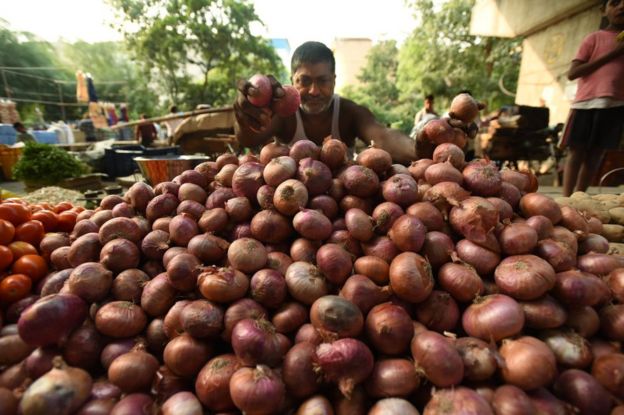
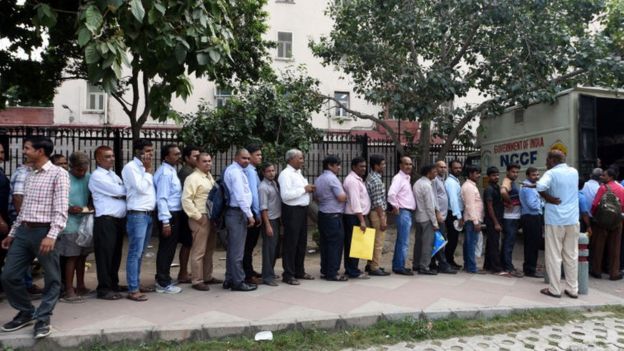
Image copyright GETTY IMAGESImage caption The onion is India’s most “political” vegetable
Onion prices have yet again dominated the headlines in India over the past week. BBC Marathi’s Janhavee Moole explains what makes this sweet and pungent vegetable so political.
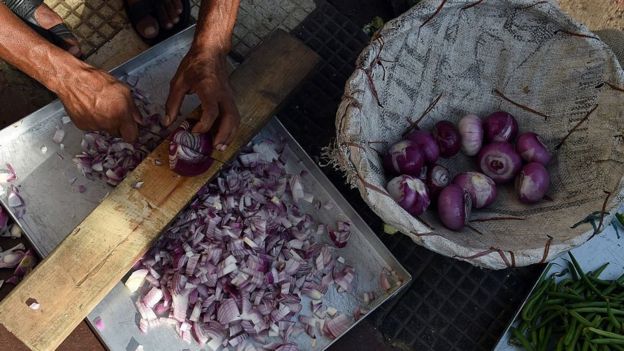
The onion – ubiquitous in Indian cooking – is widely seen as the poor man’s vegetable.
But it also has the power to tempt thieves, destroy livelihoods and – with its fluctuating price a measure of inflation – end the careers of some of India’s most powerful politicians.
With that in mind, it’s perhaps unsurprising those politicians might be feeling a little concerned this week.
So, what exactly is happening with India’s onions?
In short: its price has skyrocketed.
Onion prices had been on the rise in India since August, when 25 rupees ($0.35; £0.29) would have got you a kilo. At the start of October, that price was 80 rupees ($1.13; £0.91).
Fearing a backlash, the Bharatiya Janata Party (BJP)-led government banned onion exports, hoping it would bring down the domestic price. And it did.
Image copyright GETTY IMAGESImage caption Onion prices peaked by the end of September
A kilo was selling for less than 30 rupees on Thursday at Lasalgaon, Asia’s largest onion wholesale market, located in the western state of Maharashtra.
However, not everyone is happy.
While high prices had angered consumers in a sluggish Indian economy, the fall in prices sparked protests by exporters and farmers in Maharashtra, where state elections are due in weeks.
And it is not just at home where hackles have been raised: the export ban has also strained trade relations between India and its neighbour, Bangladesh, which is among the top importers of the vegetable.
But why does the onion matter so much?
The onion is a staple vegetable for the poor, indispensable to many Indian cuisines and recipes, from spicy curries to tangy relishes.
“In Maharashtra, if there are no vegetables or you can’t afford to buy vegetables, people eat ‘kanda bhakari’ [onion with bread],” explains food historian Dr Mohseena Mukadam.
True, onions are not widely used in certain parts of the country, such as the south and the east – and some religious communities don’t eat them at all.
But they are especially popular in the more populous northern states which – notably – send a higher number of MPs to India’s parliament.
“Consumers in northern India wield more power over the federal government. So although consumers in other parts of India don’t complain as much about higher prices, if those in northern India do, the government feels the pressure,” says Milind Murugkar, a policy researcher.
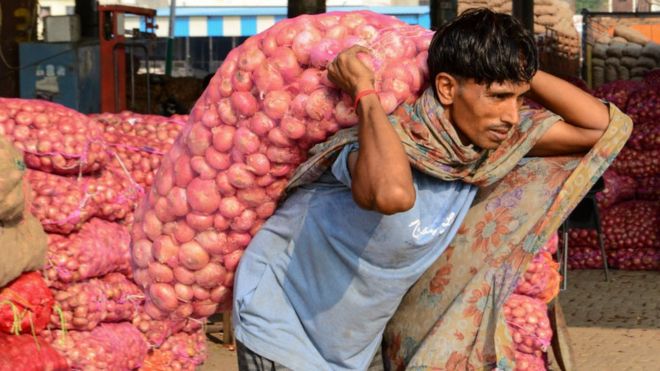
Image copyright GETTY IMAGESImage caption Onions are so ubiquitous that the government has been selling them at subsided rates
A drop in prices also affects the income of onion farmers, mainly in Maharashtra, Karnataka in the south and Gujarat in the west.
“Farmers see the onion as a cash crop that grows in the short term, and grows well in dry areas with less water,” says Dipti Raut, a journalist, who has been on the “onion beat” for years.
“It’s like an ATM machine that guarantees income to farmers and sometimes, their household budget depends on the onion produce,” she said.
Onions have even attracted robbers: when prices skyrocketed in 2013, thieves tried to steal a truck loaded with onions, but were caught by the police.
Why do politicians care about the onion?
Put simply, because the price moving too far one way or another is likely to anger a large block of voters, be they everyday households, or the country’s farmers.
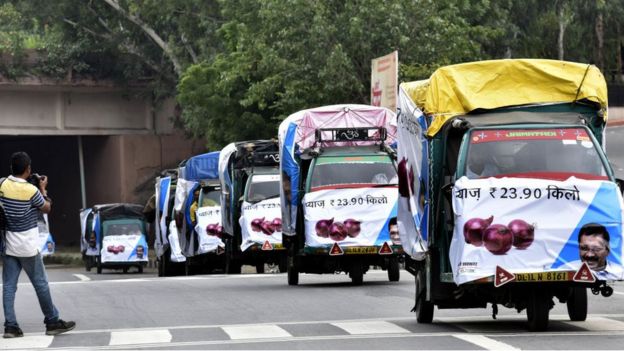
Image copyright GETTY IMAGESImage caption The Delhi government transported 70 vans full of subsidised onions
Onions are so crucial they have even featured in election campaigns. The Delhi state government bought and sold them at subsidised rates in September when prices were at their peak: chief minister Arvind Kejriwal, it should be noted, is up for re-election next year.
Meanwhile, Indira Gandhi swept to power in 1980 on slogans that used soaring onion prices as a metaphor for the economic failures of the previous government.
But why did onion prices rise this year?
A drop in supply, due to heavy rains and flooding destroying the crop in large parts of India, and damaging some 35% of the onions stocks in storage, according to Nanasaheb Patil, director of the National Agricultural Co-operative Marketing Federation.
He said the flooding had also delayed the next round of produce, which was due in September.
Image copyright GETTY IMAGES
“This has become a fairly regular phenomenon in recent decades,” Mr Murugkar said. “Onion prices swing heavily with a small drop or increase in production.”
In fact, the shortage – and subsequent rise in prices – happens almost every year around this time, according to Ms Raut.
“It’s a vicious cycle and the trader lobby and middlemen benefit from even the slightest price fluctuations,” she added.
What’s the solution?
Ms Raut says more grass-root planning and better storage facilities and food processing services will ease the problem – and making a variety of cash crops and vegetables available across the country would also ease the pressure on onions.
“The government is quick to act when onion prices rise. Why don’t they act as swiftly when prices fall?” asked Vikas Darekar, an onion farmer in Maharashtra. He said the government should buy onions from farmers at a “fair price”.
Mr Murugkar, however, feels that the government should never interfere in “onion matters”.
“If you are interested in raising purchasing power of the people, they should not curtail exports. Do we have such a ban on software exports? It’s really absurd. A government which has won such a huge majority should be able to withstand the pressures from a few consumers.”
GUWAHATI, India (Reuters) – Rescue workers were trying on Friday to reach 13 miners trapped underground in a coal mine in India’s remote northeastern Meghalaya state since the previous day, authorities said.
The mine is an old, illegal so-called rat-hole mine, they said. Rat-hole mines are common in Meghalaya as they are dug by villagers but are very dangerous as the coal is pulled out from narrow, horizontal seams.
Meghalaya Chief Minister Conrad Sangma said authorities had no information on the condition of the miners.
“We are praying that they come out alive,” he told Reuters by telephone from the state capital Shillong.
A flash flood from a nearby river on Thursday raced through the mine, which is located near a dense forest, said Sylvester Nongtngr, police chief of the East Jaintia Hills district of Meghalaya.
Nearly all mines in Meghalaya, which borders Bangladesh, use the rat-hole mining method, even though they are not legal and authorities try to crack down on them.
Workers, often children, descend hundreds of feet on bamboo ladders to dig out the coal from small holes, often leading to accidents.


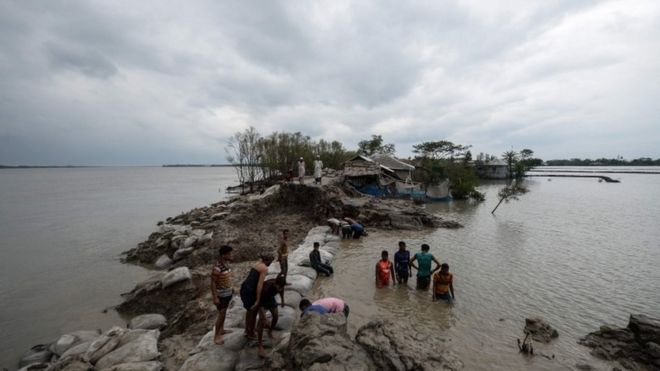 Image copyright AFP
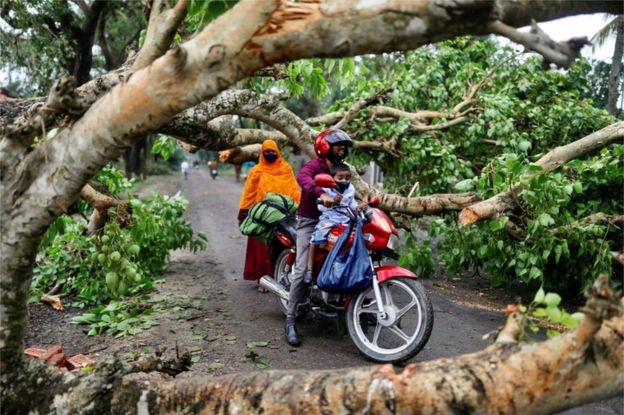 Image copyright REUTERS
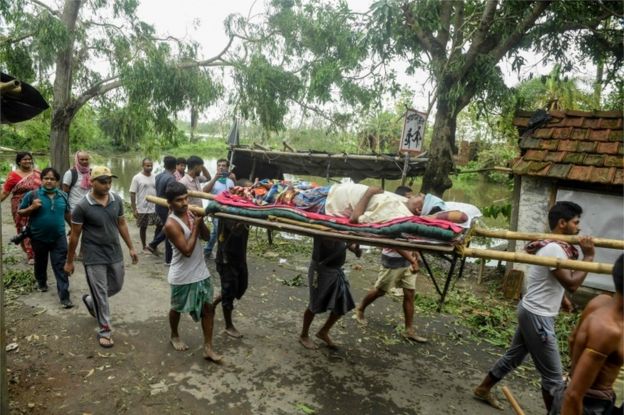 Image copyright AFP
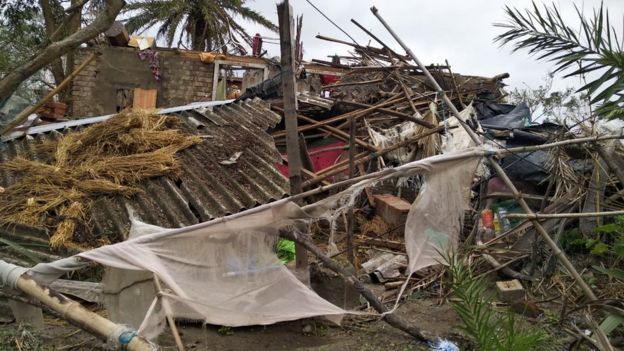 Image copyright MUKTI
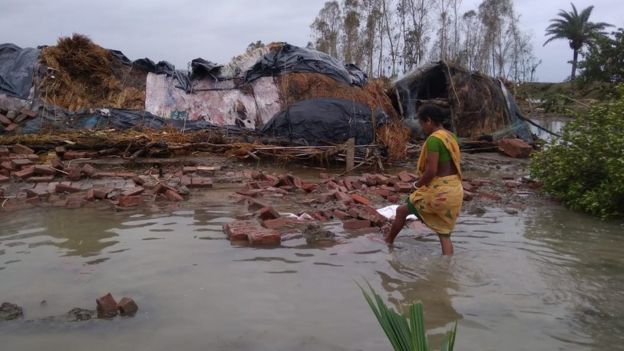 Image copyright MUKTI
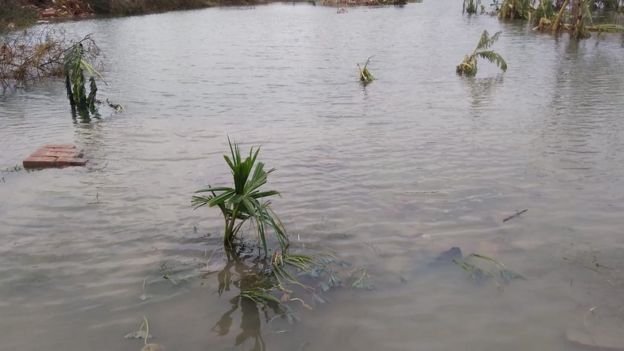 Image copyright MUKTI





 CHINDIA ALERT: You'll be living in their world, very soon