Chindia Alert: You’ll be Living in their World Very Soon
aims to alert you to the threats and opportunities that China and India present. China and India require serious attention; case of ‘hidden dragon and crouching tiger’.
Without this attention, governments, businesses and, indeed, individuals may find themselves at a great disadvantage sooner rather than later.
The POSTs (front webpages) are mainly 'cuttings' from reliable sources, updated continuously.
The PAGEs (see Tabs, above) attempt to make the information more meaningful by putting some structure to the information we have researched and assembled since 2006.
TAIPEI (Reuters) – Only Taiwan’s democratically-elected government can represent its people on the world stage, not China, its foreign ministry said on Tuesday, calling on the World Health Organization (WHO) to “cast off” China’s control during the coronavirus pandemic.
Taiwan’s exclusion from WHO, due to China’s objections which considers the island one of its provinces, has infuriated Taipei, which says this has created a dangerous gap in the global fight against the coronavirus.
Taiwan has been lobbying to attend, as an observer, this month’s meeting of the WHO’s decision-making body, the World Health Assembly (WHA), although government and diplomatic sources say China will block the move.
Steven Solomon, the WHO’s principal legal officer, said on Monday that the WHO recognised the People’s Republic of China as the “one legitimate representative of China”, in keeping with U.N. policy since 1971, and that the question of Taiwan’s attendance was one for the WHO’s 194 member states.
Speaking in Taipei, Taiwan Foreign Ministry spokeswoman Joanne Ou said the 1971 decision, under which Beijing assumed the U.N. China seat from Taipei, only resolved the issue of who represented China, not the issue of Taiwan, and did not grant China the power to represent Taiwan internationally.
“Only the democratically-elected Taiwanese government can represent Taiwan’s 23 million people in the international community,” she told reporters.
The WHO should “cast off the Chinese government’s control”, and let Taiwan fully participate in fighting the virus, Ou said.
“Do not let China’s improper political interference become an obstacle to impeding the world’s united fight against the virus.”
Taiwan attended the World Health Assembly as an observer from 2009-2016 when Taipei-Beijing relations warmed.
But China blocked further participation after the election of Taiwan President Tsai Ing-wen, who China views as a separatist, charges she rejects.
The United States has strongly supported Taiwan’s participation at the WHA as an observer, another fault line in Washington-Beijing ties that have been already overshadowed by the Trump administration’s criticism of how China and the WHO have handled the outbreak.
China says Taiwan is adequately represented by Beijing and that Taiwan can only take part in the WHO under Beijing’s “one China” policy, in which Taiwan would have to accept that it is part of China, something Tsai’s government will not do.
Taiwan has reported far fewer cases of the new coronavirus than many of its neighbours, due to early and effective detection and prevention work.
SEOUL/BEIJING (Reuters) – China has allowed 200 employees from South Korea’s Samsung Electronics Co Ltd (005930.KS) to enter the country to work on an expansion of the firm’s NAND memory chip factory, the company said on Wednesday.
The move came after China said on Tuesday that it was in talks with some countries to establish fast-track procedures to allow travel by business and technical personnel to ensure the smooth operation of global supply chains.
China said it has reached a consensus on such an arrangement with South Korea, without elaborating on the terms, including whether individuals entering China will be subject to quarantine.
China, where the virus first emerged late last year, blocked entry last month for nearly all foreigners in an effort to curb risks of coronavirus infections posed by travellers from overseas. After bringing the local spread under control with tough containment measures, it is trying to restart its economic engines after weeks of near paralysis.
A chartered China Air Ltd (601111.SS) plane flew in the Samsung Electronics employees on Wednesday, a company spokeswoman said.
Samsung said its employees will follow the local government’s policy upon arrival, without elaborating.
Shaanxi province, where Samsung’s NAND memory chip plant is located, requires people travelling from overseas to undergo a 14-day quarantine, according to South Korea’s foreign ministry.
“Samsung employees will not be exempted from the 14-day quarantine rule imposed by the Shaanxi province. They will get coronavirus tests at the airport upon arrival and will be transported to a local hotel designated by Chinese authorities,” an official at the Consulate General of South Korea in Xi’an told Reuters.
Samsung Electronics in December increased investment at its chip factory in China by $8 billion to boost production of NAND flash memory chips.
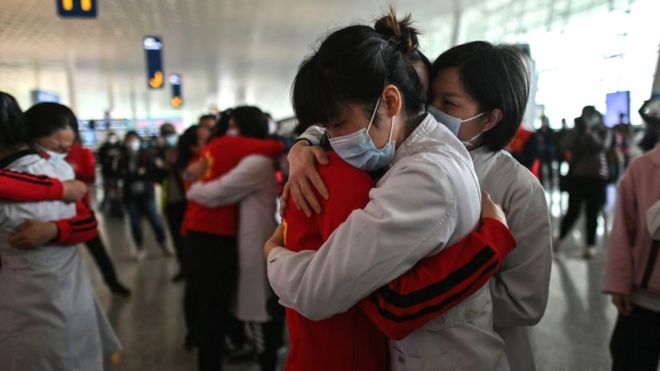
Image copyright GETTY IMAGESImage caption The Chinese city of Wuhan recently lifted its strict quarantine measures
The Chinese city of Wuhan, where the coronavirus originated last year, has raised its official Covid-19 death toll by 50%, adding 1,290 fatalities.
Wuhan officials attributed the new figure to updated reporting and deaths outside hospitals. China has insisted there was no cover-up.
It has been accused of downplaying the severity of its virus outbreak.
Wuhan’s 11 million residents spent months in strict lockdown conditions, which have only recently been eased.
The latest official figures bring the death toll in the city in China’s central Hubei province to 3,869, increasing the national total to more than 4,600.
China has confirmed nearly 84,000 coronavirus infections, the seventh-highest globally, according to Johns Hopkins University data.
What’s China’s explanation for the rise in deaths?
In a statement released on Friday, officials in Wuhan said the revised figures were the result of new data received from multiple sources, including records kept by funeral homes and prisons.
Deaths linked to the virus outside hospitals, such as people who died at home, had not previously been recorded.
Media caption Learn how Wuhan dealt with the lockdown
The “statistical verification” followed efforts by authorities to “ensure that information on the city’s Covid-19 epidemic is open, transparent and the data [is] accurate”, the statement said.
It added that health systems were initially overwhelmed and cases were “mistakenly reported” – in some instances counted more than once and in others missed entirely.
A shortage of testing capacity in the early stages meant that many infected patients were not accounted for, it said.
A spokesman for China’s National Health Commission, Mi Feng, said the new death count came from a “comprehensive review” of epidemic data.
In its daily news conference, the foreign ministry said accusations of a cover-up, which have been made most stridently on the world stage by US President Donald Trump, were unsubstantiated. “We’ll never allow any concealment,” a spokesman said.
Why are there concerns over China’s figures?
Friday’s revised figures come amid growing international concern that deaths in China have been under-reported. Questions have also been raised about Beijing’s handling of the epidemic, particularly in its early stages.
In December 2019, Chinese authorities launched an investigation into a mysterious viral pneumonia after cases began circulating in Wuhan.
China reported the cases to the World Health Organization (WHO), the UN’s global health agency, on 31 December.
But WHO experts were only allowed to visit China and investigate the outbreak on 10 February, by which time the country had more than 40,000 cases.
The mayor of Wuhan has previously admitted there was a lack of action between the start of January – when about 100 cases had been confirmed – and 23 January, when city-wide restrictions were enacted.
Around that time, a doctor who tried to warn his colleagues about an outbreak of a Sars-like virus was silenced by the authorities. Dr Li Wenliang later died from Covid-19.
Wuhan’s death toll increase of almost exactly 50% has left some analysts wondering if this is all a bit too neat.
For months questions have been asked about the veracity of China’s official coronavirus statistics.
The inference has been that some Chinese officials may have deliberately under-reported deaths and infections to give the impression that cities and towns were successfully managing the emergency.
If that was the case, Chinese officials were not to know just how bad this crisis would get in other countries, making its own figures now seem implausibly small.
The authorities in Wuhan, where the first cluster of this disease was reported, said there had been no deliberate misrepresentation of data, rather that a stabilisation in the emergency had allowed them time to revisit the reported cases and to add any previously missed.
That the new death toll was released at the same time as a press conference announcing a total collapse in China’s economic growth figures has led some to wonder whether this was a deliberate attempt to bury one or other of these stories.
Then again, it could also be a complete coincidence.
China has been pushing back against US suggestions that the coronavirus came from a laboratory studying infectious diseases in Wuhan, the BBC’s Barbara Plett Usher in Washington DC reports.
US President Donald Trump and some of his officials have been flirting with the outlier theory in the midst of a propaganda war with China over the origin and handling of the pandemic, our correspondent says.
Mr Trump this week halted funding for the World Health Organization (WHO), accusing it of making deadly mistakes and overly trusting China.
“Do you really believe those numbers in this vast country called China, and that they have a certain number of cases and a certain number of deaths; does anybody really believe that?” Mr Trump said at the White House on Wednesday.
On Thursday, UK Foreign Secretary Dominic Raab said: “We’ll have to ask the hard questions about how [coronavirus] came about and how it couldn’t have been stopped earlier.”
But China has also been praised for its handling of the crisis and the unprecedented restrictions that it instituted to slow the spread of the virus.
Image copyright GETTY IMAGESImage caption The Chinese city of Wuhan recently lifted its strict quarantine measures
The Chinese city of Wuhan, where the coronavirus originated last year, has raised its official Covid-19 death toll by 50%, adding 1,290 fatalities.
Wuhan officials attributed the new figure to updated reporting and deaths outside hospitals. China has insisted there was no cover-up.
It has been accused of downplaying the severity of its virus outbreak.
Wuhan’s 11 million residents spent months in strict lockdown conditions, which have only recently been eased.
The latest official figures bring the death toll in the city in China’s central Hubei province to 3,869, increasing the national total to more than 4,600.
China has confirmed nearly 84,000 coronavirus infections, the seventh-highest globally, according to Johns Hopkins University data.
What’s China’s explanation for the rise in deaths?
In a statement released on Friday, officials in Wuhan said the revised figures were the result of new data received from multiple sources, including records kept by funeral homes and prisons.
Deaths linked to the virus outside hospitals, such as people who died at home, had not previously been recorded.
Media caption Learn how Wuhan dealt with the lockdown
The “statistical verification” followed efforts by authorities to “ensure that information on the city’s Covid-19 epidemic is open, transparent and the data [is] accurate”, the statement said.
It added that health systems were initially overwhelmed and cases were “mistakenly reported” – in some instances counted more than once and in others missed entirely.
A shortage of testing capacity in the early stages meant that many infected patients were not accounted for, it said.
A spokesman for China’s National Health Commission, Mi Feng, said the new death count came from a “comprehensive review” of epidemic data.
In its daily news conference, the foreign ministry said accusations of a cover-up, which have been made most stridently on the world stage by US President Donald Trump, were unsubstantiated. “We’ll never allow any concealment,” a spokesman said.
Why are there concerns over China’s figures?
Friday’s revised figures come amid growing international concern that deaths in China have been under-reported. Questions have also been raised about Beijing’s handling of the epidemic, particularly in its early stages.
In December 2019, Chinese authorities launched an investigation into a mysterious viral pneumonia after cases began circulating in Wuhan.
China reported the cases to the World Health Organization (WHO), the UN’s global health agency, on 31 December.
But WHO experts were only allowed to visit China and investigate the outbreak on 10 February, by which time the country had more than 40,000 cases.
The mayor of Wuhan has previously admitted there was a lack of action between the start of January – when about 100 cases had been confirmed – and 23 January, when city-wide restrictions were enacted.
Around that time, a doctor who tried to warn his colleagues about an outbreak of a Sars-like virus was silenced by the authorities. Dr Li Wenliang later died from Covid-19.
Wuhan’s death toll increase of almost exactly 50% has left some analysts wondering if this is all a bit too neat.
For months questions have been asked about the veracity of China’s official coronavirus statistics.
The inference has been that some Chinese officials may have deliberately under-reported deaths and infections to give the impression that cities and towns were successfully managing the emergency.
If that was the case, Chinese officials were not to know just how bad this crisis would get in other countries, making its own figures now seem implausibly small.
The authorities in Wuhan, where the first cluster of this disease was reported, said there had been no deliberate misrepresentation of data, rather that a stabilisation in the emergency had allowed them time to revisit the reported cases and to add any previously missed.
That the new death toll was released at the same time as a press conference announcing a total collapse in China’s economic growth figures has led some to wonder whether this was a deliberate attempt to bury one or other of these stories.
Then again, it could also be a complete coincidence.
But China has also been praised for its handling of the crisis and the unprecedented restrictions that it instituted to slow the spread of the virus. WHO Director General Dr Tedros Adhanom Ghebreyesus has hailed China for the “speed with which [it] detected the outbreak” and its “commitment to transparency”.
US President Donald Trump this week halted funding for the WHO, accusing it of making deadly mistakes and overly trusting China.
“Do you really believe those numbers in this vast country called China, and that they have a certain number of cases and a certain number of deaths; does anybody really believe that?” Mr Trump said at the White House on Wednesday.
On Thursday, UK Foreign Secretary Dominic Raab said: “We’ll have to ask the hard questions about how [coronavirus] came about and how it couldn’t have been stopped earlier.”
TAIPEI/BEIJING (Reuters) – Taiwan and the United States this week discussed how to get “closer coordination” between the island and the World Health Organization (WHO) during the coronavirus outbreak, drawing a rebuke from China for “political manipulation” of the epidemic.
Taiwan’s is excluded from the WHO due to diplomatic pressure from China, which considers it merely a wayward province with no right to the trappings of state.
Its omission has become a major source of anger for the Taiwan, which says it has been unable to get first hand information from the WHO, putting lives on the island in danger for the sake of politics. Both the WHO and China say Taiwan has been given the help it needs.
The U.S. State Department said on Thursday senior officials from the United States and Taiwan on Tuesday held a “virtual forum on expanding Taiwan’s participation on the global stage”, with particular focus on the WHO and how to share Taiwan’s successful model of fighting the coronavirus.
“Participants also discussed ongoing efforts to reinstate Taiwan’s observer status at the World Health Assembly, as well as other avenues for closer coordination between Taiwan and the World Health Organization,” it said.
The World Health Assembly is the WHO’s decision-making body.
Taiwan attended it as an observer from 2009-2016 when Taipei-Beijing relations warmed, but China blocked further participation after the election of Taiwan President Tsai Ing-wen, who China views as a separatist, charges she denies.
Taiwan’s Foreign Ministry expressed thanks to the United States on Friday for its “continued taking of concrete actions to support Taiwan’s participation in the WHO and other international organisations”.
In Beijing, Chinese Foreign Ministry spokeswoman Hua Chunying said the United States and Taiwan were both well aware that members of the WHO must be sovereign states, and accused Taiwan of seeking political capital from the outbreak.
“We hope they will not attempt to use this epidemic to engage in political manipulation,” she told a daily news briefing.
U.S. President Donald Trump signed a new law last month requiring increased support for Taiwan’s international role. China threatened unspecified retaliation in response.
Like most countries the United States has only unofficial ties with the island, but is its strongest backer on the world stage.
Taiwan has been far more successful than many of its neighbours keeping the virus in check thanks to early and stringent steps to control its spread. It has reported 348 cases and five deaths to date.
In its latest measure, Health Minister Chen Shih-chung said on Friday people who don’t wear face masks on public transport would face fines of up to T$15,000 (nearly $500).
TAIPEI (Reuters) – Anger at being confused with China amid the coronavirus outbreak and Beijing’s stepped-up efforts to assert sovereignty is stirring heated debate in Taiwan about how to further distance itself from its giant and often threatening neighbour
At its core is a debate about whether to drop “China” from the island’s official name, the Republic of China.
During the virus crisis, the World Health Organization (WHO), which considers the island part of China, has listed Taiwan’s far lower case number under China’s, and China has repeatedly insisted only it has the right to speak for Taiwan on the global stage, including about health issues.
Taipei says this has confused countries and led them to impose the same restrictions on Taiwanese travellers as on Chinese, and has minimised Taiwan’s own successful efforts to control the virus.
Taiwan has been debating for years who it is and what exactly its relationship should be with China – including the island’s name. But the pandemic has shot the issue back into the spotlight.
Lin I-chin, a legislator for the ruling Democratic Progressive Party (DPP), said in parliament last month that Taiwan should change its English name to “Republic of Chunghwa”, an English rendering of the word Taiwan uses for China in its name.
“Taiwan has been brought to grief by China,” she said.
On Sunday, the New Power Party, one of Taiwan’s smaller opposition groups, released the results of a survey in which almost three-quarters of respondents said Taiwan passports should only have the word “Taiwan” on them, removing any reference to China.
“During this epidemic period, our people have been misunderstood by other countries, highlighting the urgency of changing the English name,” it said in a statement.
Taiwan’s Foreign Ministry has given a cautious response to the passport idea, noting that according to the constitution, the official name is Republic of China and that the word Taiwan was already added to passport covers in 2003.
“In the future, if there is consensus between the ruling and opposition parties on this new name, the Foreign Ministry shall cooperate in handling it,” spokeswoman Joanne Ou said.
But the government is wary of a name change for Taiwan, saying there is no consensus for such a radical move.
Although the DPP supports the island’s independence – theoretically meaning the official formation of a Republic of Taiwan – President Tsai Ing-wen says there is no need to do so, as the island is already an independent country called the Republic of China. She often refers to the island as the Republic of China, Taiwan.
‘REPUBLIC OF TAIWAN’
Premier Su Tseng-chang has said changing the island’s name isn’t the most urgent issue facing Taiwan.
“If we want to change then it might as well be to ‘Republic of Taiwan’. Taiwan is more well known,” Su said in parliament. “But if there’s no national consensus, a name change isn’t the most important thing for now.”
Taiwan’s official name is a throwback to when the Kuomintang party fled to the island after losing the Chinese civil war to the Communists in 1949, and continued to claim to be China’s legitimate government.
“The Republic of China is a country, Taiwan is not,” Chen Yu-jen, a Kuomintang legislator from the island of Kinmen, which sits just offshore from the Chinese city of Xiamen, told parliament on Monday.
The statement drew a sharp rebuke from Su, who told reporters it meant Chen had no right to be a member of the legislature. Chen said she was simply stating the facts, and that Taiwan is a geographic name, not a national name.
China’s pressure on Taiwan diplomatically and militarily during the virus crisis has also reduced Beijing’s already low standing in the eyes of many Taiwanese.
A March poll commissioned by Taiwan’s China-policy making Mainland Affairs Council and carried out by Taipei’s National Chengchi University showed more than three-quarters of respondents believed China’s government was unfriendly to Taiwan’s, the highest level in a decade.
Any name change would infuriate China, which has a law mandating the use of force to stop Taiwan independence.
Anyone caught breaking Singapore’s social distancing rules could be jailed from Friday, as the city state ramped up its coronavirus defence and announced the introduction of distance learning for schools.
Under updates to its powerful infectious diseases law, anyone who intentionally sits less than 1 metre away from another person in a public place or on a fixed seat demarcated as not to be occupied, or who stands in a queue less than a metre away from another, will be guilty of an offence.
Offenders can be fined up to S$10,000 (US$6,990), jailed for up to six months, or both. The rules, in place until April 30, can be applied to individuals and businesses.
The news was followed later by an announcement from the education ministry that starting from April, schools will start conducting one day of home-based learning for students per week.
Singapore’s new social distancing laws send needed signal, experts say
27 Mar 2020
“The recent spike in imported cases signals a new phase in our nation’s fight against Covid-19. To support further safe distancing, schools will progressively transit to a blended learning model, starting with one day of home-based learning a week,” the ministry said in a statement.
It added schools will remain open for students whose parents are not able to secure alternative childcare arrangements.
Hundreds of thousands of students in Singapore returned to class on Monday after a week of school holidays, despite growing calls for schools to be closed.
Singapore is one of the few jurisdictions in the region that has yet to suspend schools, unlike Hong Kong, Thailand, Indonesia, and Malaysia.
Education Minister Ong Ye Kung had earlier cited scientific evidence, saying that the pneumonia-like Covid-19 illness does not affect the young as much as adults.
Authorities in the city state, however, have said that suspending schools and closing workplaces are among the next steps to be taken should the situation worsen. Singapore has confirmed 683 cases so far, of which 172 have recovered and two died.
Global condom shortage looms amid virus lockdowns
A global shortage of condoms is looming, the world’s biggest producer said, after a coronavirus lockdown forced it to shut down production.
Malaysia’s Karex makes one in every five condoms globally. It has not produced a single condom from its three Malaysian factories in the past 10 days because of the lockdown imposed by the government to halt the spread of the virus.
That’s already a shortfall of 100 million condoms, normally marketed internationally by brands such as Durex, supplied to state health care systems such as Britain’s NHS or distributed by aid programmes such as the UN Population Fund.
“We are going to see a global shortage of condoms everywhere, which is going to be scary,” Karex Chief Executive Goh Miah Kiat said this week.
“My concern is that for a lot of humanitarian programmes deep down in Africa, the shortage will not just be two weeks or a month. That shortage can run into months.”
The other major condom-producing countries are China, where the coronavirus led to widespread factory shutdowns, and India and Thailand, which are seeing infections spiking only now.
Goh said Karex was in the process of appealing to the government for an exemption to operate under specific conditions. Malaysia is approving other essential goods producers to operate with half of their workforce.
“The good thing is that the demand for condoms is still very strong because like it or not, it’s still an essential to have,” Goh said. “Given that at this point in time people are probably not planning to have children. It’s not the time, with so much uncertainty.”
China to ban most foreign arrivals
China has banned most foreigners from entering the country in an effort to block the spread of the coronavirus through imported cases.
With several exceptions, including transit visas and foreigners arriving via Hong Kong and Macau with short-term entry permits, entry visas issued to foreigners will be suspended as an “interim measure”, according to a statement late on Thursday by the country’s foreign ministry.
“In view of the rapid spread of the new coronavirus epidemic worldwide, China has decided to temporarily suspend entry of foreigners with currently valid visas and residence permits in China,” the ministry said.
“This is an interim measure that China has to take in order to respond to the current epidemic situation, with reference to the practice of many countries,” it added. “The Chinese side will adjust the above measures according to the epidemic situation through separate announcements.”
Pakistan aid workers lack basic kit
Pakistan’s biggest charity, famous for its emergency services for the poor, is kitting staff out in raincoats and rubber boots in the battle against the coronavirus as it can’t get hold of proper personal protective equipment, the organisation says.
Pakistan has reported the highest number of coronavirus infections in South Asia, with 1,179 cases and nine deaths, but health experts say there is a lack of public awareness about the virus and the cash-strapped government is ill-prepared to tackle it.
The Edhi Foundation has for decades stepped in to help when government services fail communities and it runs the country’s largest ambulance service.
Now it has had to train dozens of staff on how to handle suspected coronavirus patients. But providing them with proper protection is a problem given a nationwide shortage of the equipment.
“We’ve compromised on certain things and use alternatives,” Facial Edhi, head of the Edhi Foundation, said at his office in Karachi, Pakistan’s biggest city, on Thursday.
“Full aprons are in short supply in the market.”
He said he was confident the raincoats would work just as well.
South Korea pleads with residents to stay indoors
Authorities in South Korea pleaded with residents on Friday to stay indoors and avoid large gatherings as new coronavirus cases hovered close to 100 per day.
South Korea reported 91 new infections on Friday, taking the national tally to 9,332, the Korea Centres for Disease Control and Prevention said. The country has reported similar daily numbers for the past two weeks, down from a high of over 900 in late February.
The government has sought to convince a restless public that several more weeks of social distancing and self-isolation may be needed to allow health authorities to tamp down the smaller but still steady stream of new cases.
“As the weather is getting nicer, I know many of you may have plans to go outside,” said Yoon Tae-ho, director general for public health policy at the health ministry. “But social distancing cannot be successful when it’s only an individual, it needs to be the whole community.”
Coronavirus: California officials alarmed by rate of infection
27 Mar 2020
Italy reports 662 new deaths, with uptick in new cases
Italy is reporting an uptick in new novel coronavirus infections, after four consecutive days in which new cases had decreased.
The country now has 62,013 active cases, a daily increase of 4,492, the Italian Civil Protection Agency said in its bulletin.
On Wednesday the daily variation was 3,491, on Tuesday 3,612, on Monday 3,780, on Sunday 3,957, and on Saturday a record 4,821.
There are also 662 new fatalities, bringing the total death toll to 8,165, while overall infections, including deaths and recoveries, have risen to 80,539, a daily increase of 8.3 per cent.
Recoveries are up by around 11 per cent to 10,361, while the number of intensive care patients – a closely watched figure given the shortage of hospital beds – has risen by 3.5 per cent, to 3,612.
Russia closes all restaurants nationwide
Russia is temporarily closing restaurants nationwide for a nine-day period starting on Saturday to prevent the spread of the coronavirus.
Restaurants will still be able to provide delivery services during that time, according to the decree by Prime Minister Mikhail Mishustin, published on his website on Friday.
Russia has reported more than 800 cases of coronavirus, predominantly in Moscow, which has seen at least two virus-related deaths. Mayor Sergei Sobyanin has warned that the actual number of cases is probably “significantly more”.
The country has already prohibited regular international flights, and imposed strict quarantine measures for anyone entering the country and anyone who could have been exposed to someone infected with the virus – though has not yet opted to impose lockdown measures like those seen elsewhere.
Coronavirus containment measures spark prison protests across Italy as nation goes into lockdown
First casualty in Kenya
Kenya has recorded its first coronavirus death as a rapid rise in confirmed cases puts Africa’s fragile health systems to the test.
Kenyan Health Cabinet Secretary Mutahi Kagwe said a 66-year-old Kenyan man died on Thursday afternoon despite treatment in an intensive care unit.
Kagwe said the man, who arrived into the country on March 13 from South Africa via Swaziland, was a diabetic. Also on Thursday, three women aged between 30 and 61 tested positive for Covid-19, the disease caused by the coronavirus, taking the country’s total to 31.
Kenya is the second country in East Africa and the 15th on the continent to confirm a coronavirus-related death. Algeria has the highest death toll in Africa with 25 fatalities, while Egypt has reported 24 and Morocco 11.
About a week ago, the continent of 54 countries had reported fewer than 300 cases. But by Friday Africa had 3,221 confirmed cases and 87 deaths. WHO regional director for Africa Matshidiso Moeti said on Thursday that the situation in Africa was “evolving very quickly in terms of geographic spread and the increasing number of cases”.
Australian military to enforce quarantine
The Australian military will help enforce the quarantine of travellers returning to the country, with the prime minister unveiling strict new measures and door-to-door checks on Friday to rein in the spread of Covid-19.
With some two-thirds of Australia’s 3,000 Covid-19 cases still linked to overseas travel, Scott Morrison said 14-day home quarantines would now be actively policed with the help of the military.
Thousands of citizens and residents are still arriving in Australia every day and there have been instances of return travellers repeatedly breaking a promise to stay at home.
Morrison said all returnees arriving after midnight Saturday would now be kept in hotels in the city of arrival for the duration of their quarantine.
Those already on Australian soil and under orders to self-quarantine for two weeks will face active checks, he said.
Quarantine measures will be getting “a lot tougher and a lot stricter,” Morrison said, adding the Australian Defence Force would “assist in the compliance with these arrangements.”
Afghanistan to release 10,000 prisoners
Afghanistan will release at least 10,000 prisoners over the age of 55 in an attempt to prevent the spread of the coronavirus, officials said on Thursday.
“The president has issued a decree that several thousand prisoners will be released soon due to coronavirus,” an official in President Ashraf Ghani’s office said.
Those released will not include members of Islamist militant groups the Taliban or Islamic State, and the process will be completed within 10 days, said two government officials.
Afghanistan has reported 91 cases of coronavirus and three deaths. The country’s western Herat province has recorded at least 54 of the 75 total cases reported in the last week.
International aid groups in recent weeks have raised concerns about the possibility of the coronavirus spreading in prisons across Afghanistan.
BEIJING, March 28 (Xinhua) — China has sent a team of medical experts to Pakistan to help the country fight the COVID-19 pandemic, Foreign Ministry spokesperson Geng Shuang announced Saturday.
The team, organized by the National Health Commission, consists of experts selected by the health commission of Xinjiang Uygur Autonomous Region, Geng said in a press statement.
The team left for Pakistan on Saturday afternoon, he said.
Legislation ‘blatantly obstructs other sovereignties from developing legitimate diplomatic relations with China’, foreign ministry says
US president’s decision could damage efforts by Beijing and Washington to work together in the fight against Covid-19, observers say
The United States’ new Taipei Act aims to discourage Taiwan’s allies from cutting diplomatic ties with the island due to pressure from Beijing. Photo: EPA-EFE
Beijing has condemned US President Donald Trump’s decision to sign into law an act designed to bolster Taiwan’s diplomatic standing in the world, describing it as an act of hegemony.
“China expresses its strong indignation and firmly opposes the bill,” foreign ministry spokesman Geng Shuang told a press conference on Friday.
The legislation, he said, “blatantly obstructs other sovereignties from developing legitimate diplomatic relations with China, which is an act of hegemony” adding that it also “seriously violated the one-China principle … [and] brutally interferes in Chinese domestic affairs”.
Trump signed the Taiwan Allies International Protection and Enhancement Initiative (Taipei) Act of 2019 on Thursday, just hours before speaking to Chinese President Xi Jinping over the telephone to discuss how the two countries can work together to tackle the coronavirus pandemic.
China calls for ‘concrete steps’ from US to cooperate on fighting Covid-19
27 Mar 2020
The legislation aims to discourage Taiwan’s diplomatic allies from cutting ties with the island due to pressure from Beijing. It also requires the US to supplement its own diplomatic presence in countries that support Taiwan and reduce its diplomatic footprint if they side with Beijing.
The bill was written by Republican senator for Colorado Cory Gardner and Democrat senator for Delaware Chris Coons, who said the US should support Taiwan in strengthening its alliances around the world amid increased pressure and “bullying tactics” from Beijing.
It was passed unanimously by the House of Representatives on March 4 after being reconciled with the Senate’s version that was approved in October.
Relations between Beijing and Taipei have been at a low ebb since Tsai Ing-wen, from the independence-leaning Democratic Progressive Party, was elected president in 2016, and re-elected for a further four-year term in January.
Taiwan’s foreign ministry welcomed the legislation, thanking the United States for its support for the island’s “diplomatic space” and right to participate in world affairs.
In the coronavirus fog, tussling over Taiwan goes under the radar
27 Mar 2020
Observers said that while the new act would benefit Taipei on the world stage, it would also be detrimental to its relationship with Beijing, and could be damaging to the commitments made between Xi and Trump to work together to fight Covid-19.
“Given it has been suppressed by Beijing in recent years, the new act will help Taiwan to gain more support from the international community,” said Zheng Zhengqing, an expert on Taiwan affairs at Tsinghua University in Beijing.
He said that Xi believed Taipei’s international role should be decided by Beijing, not Washington.
“What Trump has done comes from the opposite direction … and could hinder engagement and cooperation between [mainland] China and the US amid the coronavirus outbreak and make matters worse,” he said.
Zhu Songling, a professor at the Institute of Taiwan Studies at Beijing Union University, said the Taipei Act had crossed a red line for Beijing and would bring further uncertainty to China-US relations, as well as relations across the Taiwan Strait.
Beijing considers Taiwan part of its sovereign territory awaiting reunification with the mainland, by force if necessary.
Taipei-based political and military commentator Chi Le-yi said that while the new legislation was significant, it remained to be seen how it would affect Taiwan’s global standing or the stability of the Taiwan Strait amid the ongoing strategic gamesmanship between mainland China and the US.
“The bill itself is very meaningful, it has turned the US’s concerns about Taiwan issue into a legal issue,” he said.
“But its impact will depend on how it is implemented by America’s executive units.”
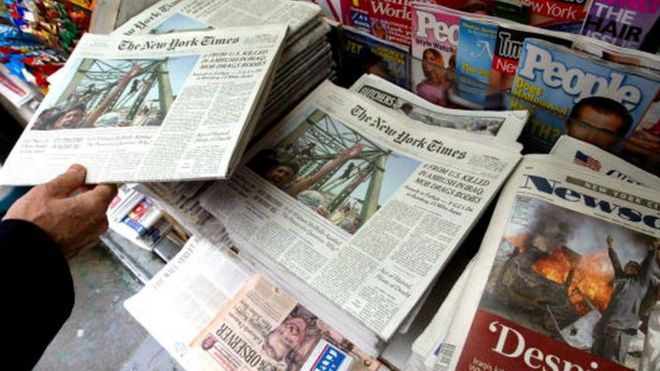
China has effectively expelled journalists from three US newspapers in retaliation for restrictions on its news outlets in the US.
Its foreign ministry ordered reporters from the New York Times, the Washington Post and the Wall Street Journal to return media passes within 10 days.
The ministry also demanded information about their operations in China.
The measures were in response to “unwarranted restrictions on Chinese media agencies” in the US, it said.
China’s action also prohibits the newspapers’ journalists from working in the semi-autonomous regions of Hong Kong and Macau, where there is greater press freedom than on the mainland.
Earlier this month, the Trump administration imposed limits on the number of Chinese citizens who could work as journalists in the US – the latest move in a tit-for-tat row over press freedoms.
“What the US has done is exclusively targeting Chinese media organisations, and hence driven by a Cold War mentality and ideological bias,” China’s foreign ministry said in a statement on Tuesday.
US Secretary of State Mike Pompeo urged Beijing to reconsider its decision, calling the move “unfortunate”.
“I regret China’s decision today to further foreclose the world’s ability to conduct the free press operations that, frankly, would be really good for the Chinese people in these incredibly challenging global times, where more information, more transparency are what will save lives,” Mr Pompeo said.
Great loss for Chinese journalism
Zhaoyin Feng, BBC Chinese
All foreign correspondents in China are required to renew their press credentials annually, which usually happens at the year end.
This means most American reporters of the three US major publications have an expiring visa and will need to leave China under the new rules. We don’t know the exact number of affected journalists yet, but it’s believed to be close to a dozen.
The expulsions will lead to a major personnel loss in these three media organisations’ China operation, especially for the Wall Street Journal, which had already seen three reporters expelled from China last month.
Critics say it’s an even greater loss for China, as the draconian measures come at a time when the country and the rest of the world need high-quality journalism on China more than ever.
It’s still unclear whether the US publications can send new correspondents, American citizens or not, to fill in the positions in China.
In the midst of a dangerous pandemic, the world’s two superpowers are locked in an escalating war with multiple fronts. By fighting over media, the origin of the coronavirus, and technology and trade, the US and China are competing to prove the superiority of their own political model.
At the beginning of March, the US state department said five media outlets, including China’s official news agency Xinhua, would be required to reduce their total number of staff to 100 from 160.
The move was seen as retaliation for China’s expulsion of two US journalists for the Wall Street Journal over a coronavirus editorial in February.
The row over media access is the latest episode in an increasingly acrimonious dispute between China and the US.
Disagreements over trade, intellectual property rights and 5G networks have damaged relations in recent years.
The coronavirus pandemic has been a source of tension too, with Washington and Beijing both accusing each other of spreading misinformation.
On Tuesday, US President Donald Trump angered China by referring to the coronavirus as “Chinese”.
A foreign ministry spokesman accused the US of stigmatising China, where the first cases of Covid-19 were recorded in the city of Wuhan in late 2019.
However, last week a Chinese foreign ministry spokesman shared a conspiracy theory, alleging the US Army had brought it to the region.
The unfounded accusation led Mr Pompeo to demand China stop spreading “disinformation” as it tried “to shift blame” for the outbreak.










 CHINDIA ALERT: You'll be living in their world, very soon