Chindia Alert: You’ll be Living in their World Very Soon
aims to alert you to the threats and opportunities that China and India present. China and India require serious attention; case of ‘hidden dragon and crouching tiger’.
Without this attention, governments, businesses and, indeed, individuals may find themselves at a great disadvantage sooner rather than later.
The POSTs (front webpages) are mainly 'cuttings' from reliable sources, updated continuously.
The PAGEs (see Tabs, above) attempt to make the information more meaningful by putting some structure to the information we have researched and assembled since 2006.
Xie Haifeng’s story is one of luck and resilience and he has made it his mission to help others through adversity
Professional dancer owes part of his success to the city of Hong Kong and one of its doctors who helped survivors through recovery
Xie Haifeng was 15 when he lost his leg in one of modern China’s most devastating disasters. Photo: Handout
When the rumbling began, Xie Haifeng thought someone was shaking his bed. Perhaps one of the other 800 children in the school dormitory was being naughty. Or maybe it was a small quake. Then came the unmistakable sound of screams.
Xie, then a 15-year-old pupil at Muyi Town Middle School in the southwestern Chinese province of Sichuan, started running. He fell as the dorm building collapsed around him. When he tried to stand up, he realised something was missing. His left leg was gone.
What Xie thought was a small quake turned out to be one of the most devastating disasters in modern Chinese history.
The Sichuan earthquake of May 2008 left at least 87,000 people dead and shook the country to its core. It was less than three month before Beijing would host its first Olympic Games, an opportunity to show the world its strength and ambition.
Instead, 7,444 schools had crumbled like tofu in an area known to be seismically active. Their rubble was a stark demonstration of the weak foundation of China’s progress and its tragic consequences. At Xie’s school, the shoddily built walls and ceilings crushed 600 children. Only 300 survived.
It still frightens me to recall the earthquake.Xie Haifeng, dancer
Xie considers himself lucky. “If I had run just one second more slowly, I would have been dead. If I had run one second faster, I would have been completely fine. But anyway, I am lucky to be alive,” he said. A dozen years later, his story is also one of resilience. Defying all the odds, Xie is now a professional dancer for a troupe in Sichuan and has made it his mission to help others through adversity.
The journey from his hospital bed to the stage was long and difficult and even though many years have passed, “it still frightens me to recall the earthquake”. But, he said: “I have forgiven fate and accepted the reality that I have only one leg.”
Xie’s trauma was a particularly difficult blow to his family. His older sister was already handicapped, after injuring her arm in an accident. When his mother, a migrant worker in the northwestern province of Gansu, arrived at the hospital a few days after the earthquake, she had no idea of the extent of Xie’s condition.
“When I woke up in the evening, I saw my mother weeping beside my bed. I told myself I should be strong,” Xie said, adding that his mother initially thought he had suffered only bruises. He was sent for treatment to a hospital in the prosperous southern city of Shenzhen, along with other survivors who had been left with disabilities by the earthquake.
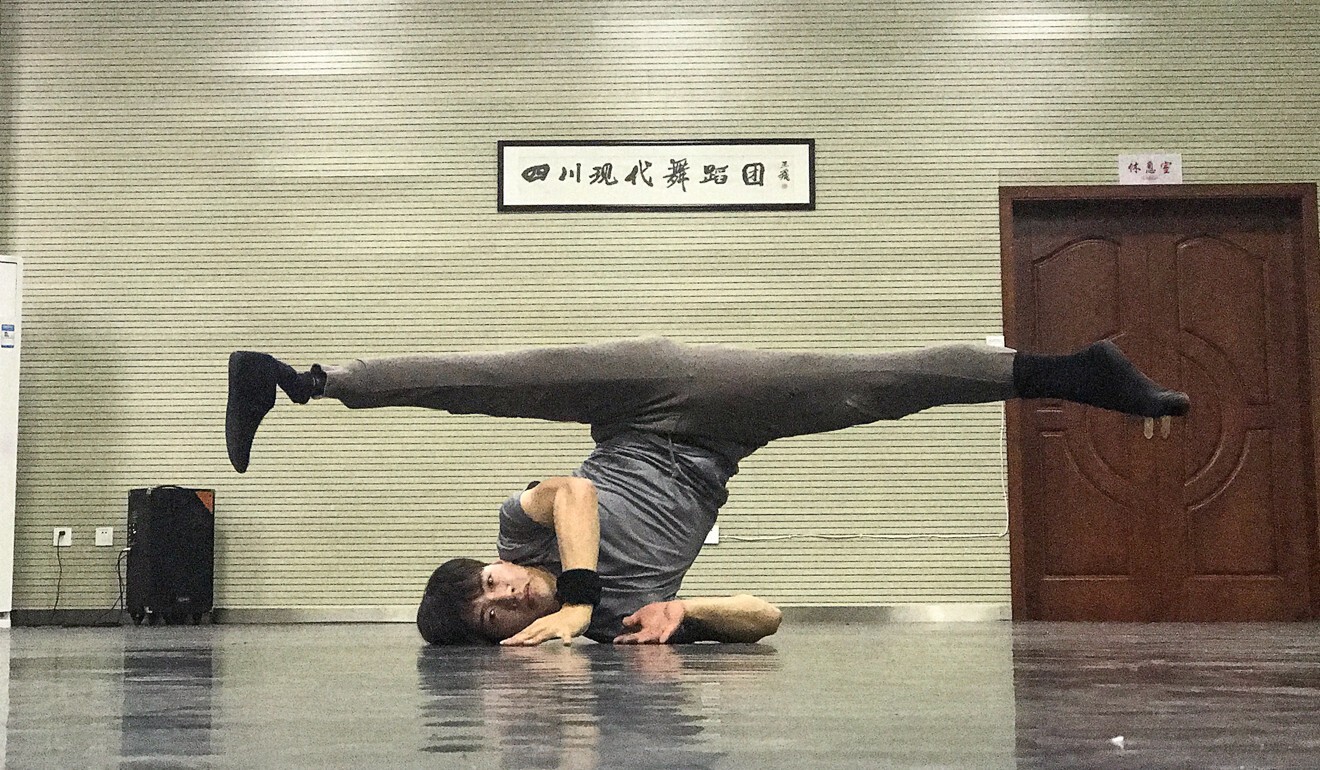
Defying all the odds, Xie Haifeng is now a professional dancer. Photo: Handout
It was there that Xie was inspired to make the most of his life. A team of athletes visited the hospital and he was shocked to see one of them, a volleyball player, walking on a prosthetic leg.
Xie began to wear a prosthesis and after rehabilitation training returned to his hometown in 2009 where he was admitted to Qingchuan High School. At first, he was self-conscious and felt inferior to his peers. He did not dare to wear shorts in summer and said he seldom talked to the other students.
The following year he was introduced to members of the Chengdu Disabled People’s Art Troupe, where he found a new and welcoming home. Xie quit school and joined the troupe, despite his parents’ opposition. They were convinced study was the only way for rural students like their son to get out of poverty.
Xie learned Sichuan opera and was soon performing its art of bian lian, or
– a skill that requires rapid mask changes in a dazzling sleight of hand – on stage until the troupe was disbanded in 2011, leaving him unemployed for six months.
China marks 10-year anniversary of Sichuan earthquake
But the misfortune led to an improbable opportunity when he was hired by the Sichuan Provincial Disabled People’s Art Troupe and trained to dance. At 19, and with no experience, Xie found the training far more difficult than those who had started at the more usual age of five or six.
His body was too stiff, he said, and in the first months he spent 10 hours each day just stretching and building flexibility. It was just the beginning of a long and often arduous process.
“That agony is too much to be described,” Xie said about the pain of dancing on a prosthetic leg. “During the first six months’ training, I broke three artificial legs.”
More than once, he wondered whether he had chosen the right path. But, ultimately, his gruelling effort paid off and Xie has performed in Singapore, Hong Kong and Macau. In 2013, he won a gold medal at a national dancing competition for people with disabilities.
“My dances won me applause and recognition from the audience. I feel relieved and I think my heart belongs to the stage,” he said.
Xie broke three artificial legs during his first six months of dance training. Photo: Handout
Xie said he owed part of his success to Hong Kong which in 2008 donated HK$20 billion (US$2.5 billion) in aid to Sichuan and sent doctors to treat the injured. Among the volunteers was Poon Tak-lun, a Hong Kong orthopaedist who flew to Sichuan every two weeks from 2008 to 2013 to treat patients.
At a gala show in 2013 to express gratitude from the people of Sichuan to Hong Kong, Xie met Poon and the two became good friends, thanks to their common interest in the arts.
“Dr Poon promised to pay for all the costs of installing and repairing my artificial leg in the future. He told me to focus on dancing without worrying about the leg’s costs,” Xie said.
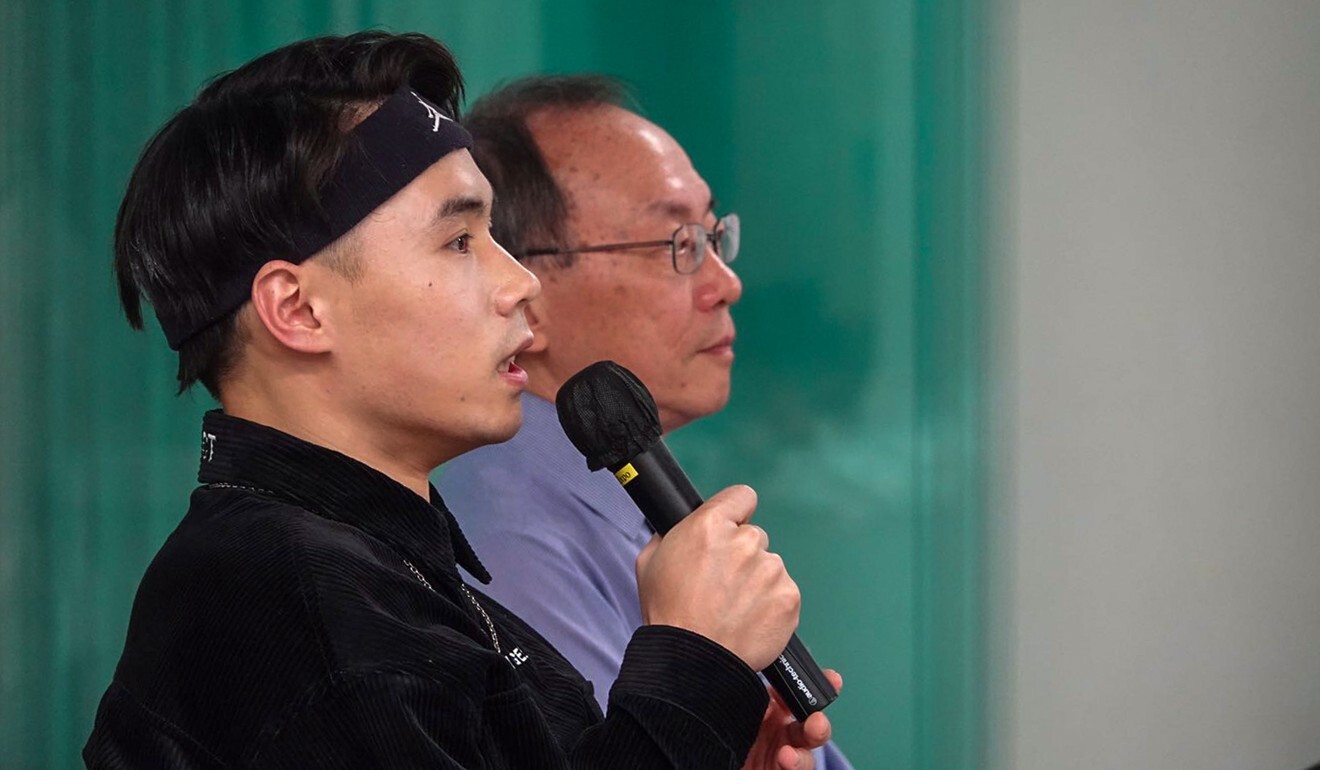
Xie Haifeng (pictured left with friend Poon Tak-lun) gives a speech to students in Hong Kong. Photo: Handout
Grateful for the help he received from Poon and Hong Kong, Xie has sought to return the favour by doing what he does best.
“I have no other skills except dancing and performing. So I thought of sharing my experience to encourage young students in Hong Kong,” he said.
Xie travels to Hong Kong about twice a year to perform and visit schools. In 2019, he visited the city four times, performing dances and Sichuan opera, and giving speeches at more than 10 primary and secondary schools.
“I encourage them to study hard. I said there are many people in this world who have more difficulties than them but still insist on pursuing their dreams, so they should not give up their dreams,” Xie said.
When he is not dancing and giving inspirational speeches, Xie said he lived a life like everyone else – climbing mountains, swimming and proudly walking on the leg he gained after almost losing everything in Sichuan’s deadly earthquake.
BEIJING (Reuters) – China’s Hubei province where the coronavirus pandemic originated will lift travel restrictions on people leaving the region as the epidemic there eases, but other regions will tighten controls as new cases double due to imported infections.
The Hubei Health Commission announced it would lift curbs on outgoing travellers starting March 25, provided they had a health clearance code.
The provincial capital Wuhan, where the virus first appeared and which has been in total lockdown since since Jan. 23, will see its travel restrictions lifted on April 8.
RELATED COVERAGE
China health commission says virus transmission risks remain
China’s Hubei province to remove travel bans starting March 25
However, the risk from overseas infections appears to be on the rise, prompting tougher screening and quarantine measures in major cities such as the capital Beijing.
China had 78 new cases on Monday, the National Health Commission said, a two-fold increase from Sunday. Of the new cases, 74 were imported infections, up from 39 imported cases a day earlier.
The Chinese capital Beijing was the hardest-hit, with a record 31 new imported cases, followed by southern Guangdong province with 14 and the financial hub of Shanghai with nine. The total number of imported cases stood at 427 as of Monday.
Only four new cases were local transmissions. One was in Wuhan which had not reported a new infection in five days.
Wuhan residents will soon be allowed to leave with a health tracking code, a QR code, which will have an individual’s health status linked to it.
In other parts of the country, authorities have continued to impose tougher screening and quarantine and have diverted international flights from Beijing to other Chinese cities, but that has not stemmed the influx of Chinese nationals, many of whom are students returning home from virus-hit countries.
Beijing’s city government tightened quarantine rules for individuals arriving from overseas, saying on Tuesday that everyone entering the city will be subject to centralised quarantine and health checks.
The southern city of Shenzhen said on Tuesday it will test all arrivals and the Chinese territory of Macau will ban visitors from the mainland, Hong Kong and Taiwan.
The number of local infections from overseas arrivals – the first of which was reported in the southern travel hub of Guangzhou on Saturday – remains very small.
On Monday, Beijing saw its first case of a local person being infected by an international traveller arriving in China. Shanghai reported a similar case, bringing the total number of such infections to three so far.
CONCERNS ABOUT NEW WAVE OF INFECTIONS
The rise in imported cases and the lifting of restrictions in some cities to allow people to return to work and kickstart the battered Chinese economy has raised concerns of a second wave of infections.
A private survey on Tuesday suggested that a 10-11% contraction in first-quarter gross domestic product in the world’s second largest economy “is not unreasonable”.
The epidemic has hammered all sectors of the economy – from manufacturing to tourism. To persuade businesses to reopen, policymakers have promised loans, aids and subsidies.
In the impoverished province of Gansu, government officials are each required to spend at least 200 yuan (24.31 pounds) a week to spur the recovery of the local catering industry.
The official China Daily warned in an editorial on Tuesday that maintaining stringent restrictions on people’s movements would “now do more harm than good”.
BEIJING, April 5 (Xinhua) — “The air and environment in the cemetery have been notably improved, with less people burning joss paper,” said Wang Fang, a tomb sweeper from Yinchuan, Ningxia Hui Autonomous Region.
This year’s Tomb Sweeping Day, which falls on Friday, witnesses more changes, as China has made various efforts to reform funeral traditions in recent years, and ecological burial and environmentally friendly tomb sweeping practices are increasingly popular.
GREENER BURIAL
In a tea garden in Hangzhou in east China’s Zhejiang Province, there stands a hidden cemetery where burial plots are built under tea trees in a bid to enlarge its green area as well as conserve land.
“It would be good to return to nature here after I pass away,” said a local resident surnamed Wu.
China has seen progress in ecological burials in recent years, especially in developed cities. The first model ecological cemetery of Beijing has been built in Babaoshan Revolutionary Cemetery, with a green coverage rate of nearly 90 percent.
Currently, ecological burials in first-tier cities, including Beijing, Shanghai and Guangzhou, takes up more than 20 percent of the total. It is expected that by 2020, the share of ecological burial across the country reach over 50 percent.
In addition, tomb sweeping practices have become greener. Most tomb sweepers would rather present flowers at tombstones than burn joss paper to pay tribute to their deceased families and friends.
On Tomb Sweeping Day, some cemeteries hold cultural activities, such as calligraphy and painting exhibitions as well as poetry recitals as an alternative to tomb sweeping.
LAND CONSERVATIVE
Besides the “tea garden burial,” other ecological burial methods in China include tree, flower, wall and sea burials.
Replacing traditional tombstones with trees and flower beds, putting urns on shelves in walls or just dropping ashes into the sea requires less or even no land.
“At first people said it was for those in financial difficulties to save money, but as time changes, the popularity of ecological burials have increased,” said Zhao Quansheng, manager of a Yinchuan-based cemetery.
“A customer told us that his father voluntarily asked for an ecological burial to conserve land,” Zhao said.
Non-profit cemeteries are also thriving in places of separate burial traditions. In Yishui County, east China’s Shandong Province, 110 non-profit cemeteries have been built, leading to conservation of large areas of land that otherwise would be utilized for burial sites.
Xue Feng, Party secretary of Yishui, said it used to take about 20 to 27 hectares of land to accommodate all the private tombs in the county, but now it only needs 10 percent of that.
LESS MONEY
China has beefed up funeral infrastructure and public services, with the number of funeral parlours and cemeteries reaching 1,760 and 1,420, respectively.
Since 2009, the Ministry of Civil Affairs has pushed forward fee reduction in basic public funeral services as well as other preferential policies, benefiting low-income groups. For example, commercial cemeteries in Chongqing, Gansu and Ningxia were required to set aside part of their burial sites as non-profits for those with financial difficulties.
“Now the whole funeral is free, including the urn and burial site, which is a great help for households with low incomes like us,” said Yuan Li, a rural resident from Yishui, where funeral services have been free of charge since 2017.
Xue said the fee-reduction policy could save the public nearly 200 million yuan (about 30 million U.S. dollars) annually.
The Ministry of Civil Affairs issued a pilot plan for funeral reform in 2017, and released guidelines with another 14 authorities on further reform in 2018.
“The funeral reforms help encourage fine and up-to-date practices and trends, and make contributions to land and ecological conservation,” said Ma Guanghai, sociology professor of Shandong University. “It is an important aspect of social progress.”
BEIJING, Feb. 24 (Xinhua) — China’s national observatory on Sunday forecast that some northern and eastern parts of the country would be shrouded in smog in the coming days while snow will hit western regions.
Thick smog will envelop northern and eastern areas including Hebei and Shandong provinces until Thursday, according to the National Meteorological Center (NMC).
From Sunday night to Monday morning, thick fog will be seen in the provinces of Henan, Anhui, Jiangsu, Shanghai and Hubei, reducing visibility in some areas to less than 200 meters, the NMC said.
From Sunday night to Tuesday, snow will hit west China’s Tibet, Qinghai and Gansu, while rain will soak the south from Tuesday to Wednesday.
Bad weather could disrupt traffic after the Spring Festival holiday when many people are returning to work after the break.
China’s Spring Festival travel rush started from Jan. 21 and will last till March 1.





 CHINDIA ALERT: You'll be living in their world, very soon