Archive for ‘gender’

12/04/2020

African ambassadors in China complain to government over ‘discrimination’

JOHANNESBURG (Reuters) – African ambassadors in China have written to the country’s foreign minister over what they call discrimination against Africans as the country seeks to prevent a resurgence of the coronavirus.

Several African countries have separately also demanded that China address their concerns that Africans, in particular in the southern city of Guangzhou, are being mistreated and harassed.

Having brought under control the original outbreak centred on the city of Wuhan, China is now concerned about imported cases and is stepping up scrutiny of foreigners coming into the country and tightening border controls. It has denied any discrimination.

In recent days Africans in Guangzhou have reported being ejected from their apartments by their landlords, being tested for coronavirus several times without being given results and being shunned and discriminated against in public. Such complaints have been made in local media, and on social media.

The ambassadors’ note said such “stigmatisation and discrimination” created the false impression that the virus was being spread by Africans.

“The Group of African Ambassadors in Beijing immediately demands the cessation of forceful testing, quarantine and other inhuman treatments meted out to Africans,” it said.

The note was sent to China’s top diplomat, Wang Yi, copying the chair of the African Union, South African President Cyril Ramaphosa and all African foreign ministers.

The Chinese foreign ministry’s International Press Centre did not immediately respond to a request for comment on the note, sent outside of business hours.

The Chinese embassy in South Africa also did not respond.

Foreign affairs official Liu Baochun told a news conference on Sunday that Guangzhou is enforcing anti-virus measures on anyone who enters the city from across the national border, regardless of nationality, race or gender.

The Chinese embassy in Zimbabwe on Saturday dismissed the accusation that Africans were being deliberately targeted.

“It is harmful to sensationalize isolated incidents,” it said in a tweeted statement. “China treats all individuals in the country, Chinese and foreign alike, as equals.”

DISAPPOINTMENT

The ambassadors’ note highlighted a number of reported incidents, including that Africans were being ejected from hotels in the middle of the night, the seizure of passports, and threats of visa revocation, arrest or deportation.

On Saturday, Ghana’s foreign minister of affairs Shirley Ayorkor Botchwey said she had summoned the Chinese ambassador to express her disappointment and demand action.

Kenya’s foreign ministry has also “officially expressed concern”, adding the government is working with Chinese authorities to address the matter.

On Friday, Nigerian legislator Akinola Alabi tweeted a video of a meeting between the leader of Nigeria’s lower house of parliament, Femi Gbajabiamila, and Chinese Ambassador Zhou Pingjian. In it, Gbajabiamila demanded an explanation from the diplomat after showing Zhou a video of a Nigerian complaining about mistreatment in China.

The ambassador said in response to the questions from the house leader that he took the complaints “very seriously” and promised to convey them to the authorities back home.

Source: Reuters

25/11/2019

Priya: India’s female comic superhero returns to rescue ‘stolen girls’

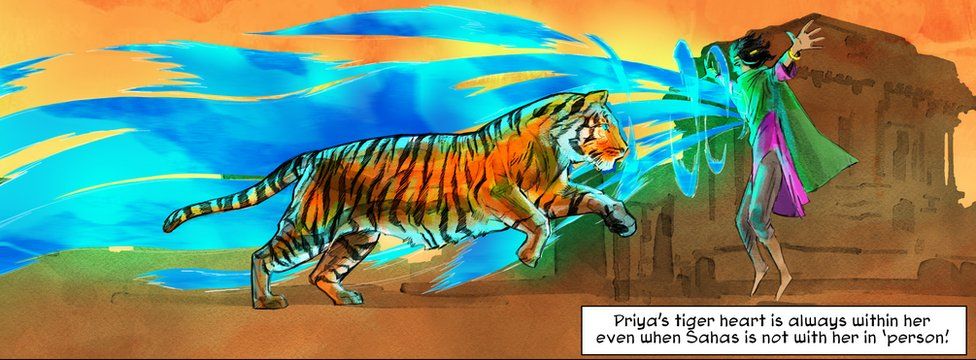
Priya Shakti riding her pet tiger SahasImage copyright PRIYASHAKTI

Comic crusader Priya, a gang-rape survivor who earlier campaigned against rape and acid attack, is back in a new avatar. This time she is fighting the trafficking of girls and women for sex.

The “modern-day female superhero” was first launched in December 2014, exactly two years after the horrific gang rape of a young woman on a bus in Delhi, to focus attention on the problems of gender and sexual violence in India.

In the first edition, Priya Shakti, the tiger-riding heroine challenges the stigma surrounding rape while in Priya’s Mirror, the second edition, she returns to fight acid attacks.

In the latest edition – Priya and the Lost Girls – she takes on the powerful sex-trafficker Rahu, the evil demon who runs an underworld brothel city where he has entrapped many women, including Priya’s sister Lakshmi.

Indian-American actor and writer Dipti Mehta, who wrote the script of the comic, draws on ancient Indian mythology to create larger-than-life fantastical characters and delivers a powerful feminist statement.

The story of Lost Girls begins when the protagonist returns home to find that there are no girls in her village.

She then mounts her flying tiger Sahas (Hindi for courage) and arrives in Rahu’s den. It’s a city ruled by greed, jealousy and lust, where women exist only to serve and please men – and those who resist are turned into stone.

Priya with her tiger SahasImage copyright PRIYASHAKTI

Priya is threatened and attacked, a woman who works for Rahu tries to lure her into the sex trade saying: “If you work for us, you’d serve only five to six men and not 20”, but in the end, good wins over evil and she manages to vanquish Rahu and liberate her sister and all the other trafficked girls.

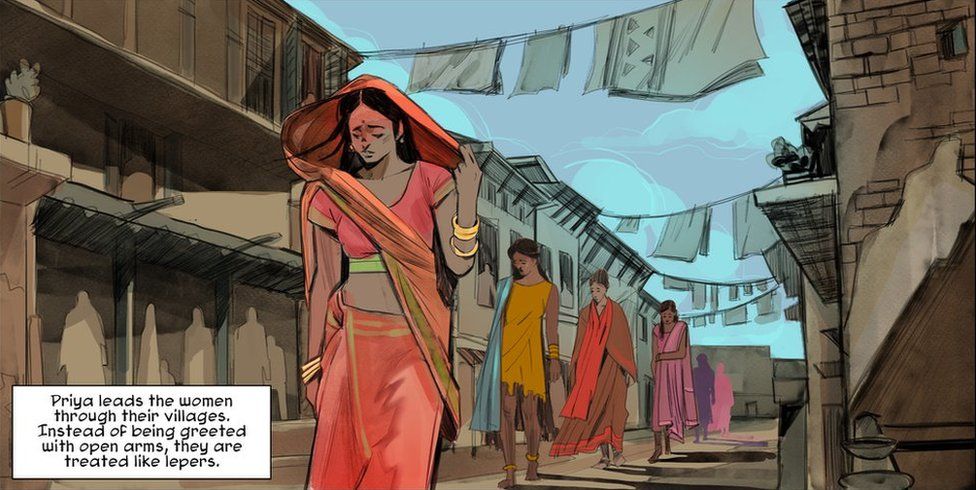
But victory still eludes her. The families of rescued girls refuse to take them back. The survivors are treated like “lepers”, facing stigma, scorn and ridicule.

But Priya and the other girls stand up to confront patriarchy, says Ms Mehta, “just as women have broken their silence to talk about MeToo”, the campaign against sexual harassment and abuse that started in Hollywood in October 2107 and later spread to many other parts of the world.

“I was very clear from the start that Lost Girls can’t be just another comic book where good guy wins and evil dies, it had to be much more than that,” Ms Mehta says.

Presentational grey line
Priya Shakti in the comicImage copyright PRIYASHAKTI
Presentational grey line

Ram Devineni, the Indian-American creator of the comic series, told the BBC that he had decided to focus on sex trafficking in this edition after visiting Sonagachi, India’s largest red-light area in the eastern city of Kolkata, where he met several women engaged in sex work.

“Half of them told me they had been tricked into coming there and, once there, they were forced into the sex trade. The other half said they’d agreed to do this for a living because they were dirt poor and they had no alternative.

“Often there were two to three women sharing a small dingy room, many of them had young children who lived with them, and some of them said their children slept in the same bed where they serviced clients.

“I found that really disheartening.”

Presentational grey line
Cover of Priya and The Lost GirlsImage copyright PRIYASHAKTIPresentational grey lineAccording to the United Nations Office on Drugs and Crime, human trafficking is the second largest organised criminal business in the world after the arms trade. It is even ahead of the drugs trade.

“It’s a multi-billion-dollar industry,” anti-trafficking activist Ruchira Gupta told the BBC on the phone from New York.

Ms Gupta, who supports trafficked girls and women in India through her charity Apne Aap Women Worldwide, says there are 100 million people trapped in human trafficking globally, of which 27 million are in India alone, and most of the trafficking is in girls and young women.

India, Bangladesh and Nepal, she says, make up “the epicentre” of global sex trafficking.

Ms Gupta, who collaborated on Priya and the Lost Girls, says she plans to take the comic to schools and colleges in India and the US to use it as a talking tool, “as a conversation starter on what is a very difficult topic”.

The only way to fight trafficking, she believes, is to “de-normalise” sex trade – and cinema, art and pop culture are tools that can help do that.

The comic is made to appeal to young people. After its launch, it can be downloaded for free anywhere in the world; it also has “augmented reality features”, which means people can see special animation and movies by scanning the artwork with their smartphones.

The families of rescued girls refuse to take them back, the survivors facing stigma, scorn and ridiculeImage copyright PRIYASHAKTI

“People often make flippant comments to say that prostitution is the oldest occupation in the world, but they don’t realise that trafficking is not some poor woman getting money in exchange for having sex with a man. It is the extreme exploitation of most vulnerable girls,” Ms Gupta says.

To stop this “commodification” of girls, she adds, we need to create revulsion in men’s minds about sex trade – and it’s best to catch them young.

“We must work with young boys and teenagers, 13 to 14 year olds, through storytelling and pop culture. They learn about sex from porn sites which portray sex workers as happy hookers, and no-one sees the girl behind her.

“I want to demolish that myth of the happy hooker. I want to ensure that people see the girl behind her.”

Artwork by Syd Fini and Neda KazemifarPresentational grey line

You may also be interested in…

Media caption Freida Pinto: Why I made a film about sex slaves

Source: The BBC

30/05/2019

Chinese driver gets ticket for scratching his face

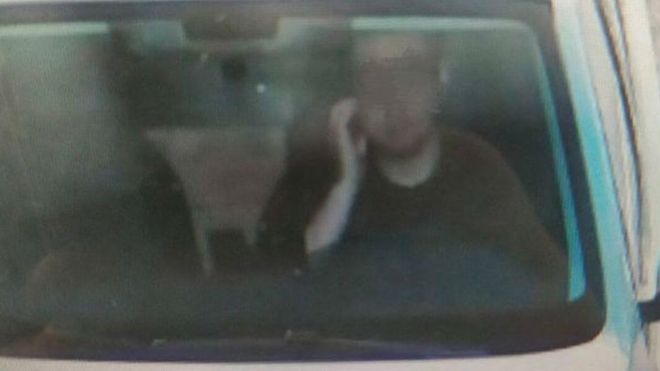
Mr Liu scratching his faceImage copyright SINA WEIBO
Image caption A Chinese man’s face scratch landed him a traffic fine and two points on his licence

A man in eastern China received a fine after a traffic camera using artificial intelligence captured him scratching his face, it’s reported.

According to the Jilu Evening Post, the male motorist surnamed Liu was driving on Monday in Jinan, eastern Shandong province, and had raised his hand to scratch his face while passing a traffic camera.

The next thing he knew, he’d received a notification instructing him that he had violated the laws of the road for “driving while holding a phone”. A surveillance picture of his “offence” was attached.

He was told that he would receive two points on his licence and was also ordered to pay a 50 yuan (£5.70; $7.25) fine.

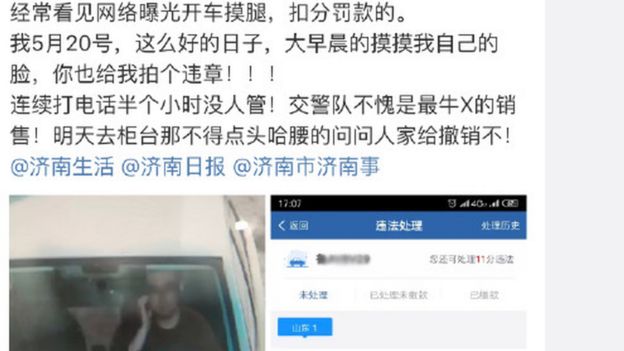
“I often see people online exposed for driving and touching [others’] legs,” he said on the popular Sina Weibo microblog,” “but this morning, for touching my face, I was also snapped ‘breaking the rules’!”

He shared the surveillance picture of himself that he had been sent, and said that he was going to go the authorities to try to sort the situation, after “no one would help him” over the phone.

Mr Liu's traffic offenceImage copyright SINA WEIBO
Image caption Mr Liu shared his surveillance photograph on social media

You might also like:

The Global Times newspaper says that the city’s traffic authority have now cancelled his ticket, and told him that “the traffic surveillance system automatically identifies a driver’s motion and then takes a photo”, which is why his face-scratching had been mistaken for him taking a phone call.

While many online are amused by his case joking that the positioning of his hand signalled he certainly appeared to be on an “invisible” phone, some are also voicing their concerns about the level of surveillance placed on them.

“This is quite embarrassing,” says one, “that monitored people have no privacy.”

“Chinese people’s privacy – is that not an important issue?” another asks.

There are more than 170 million surveillance cameras and the country has plans to install a further 400 million by 2020.

Many are fitted with artificial intelligence including facial recognition technology, and whereas some can read simple faces, others can estimate age, ethnicity and gender.

Source: The BBC

Law of Unintended Consequences

continuously updated blog about China & India

ChiaHou's Book Reviews

continuously updated blog about China & India

What's wrong with the world; and its economy

continuously updated blog about China & India