Archive for ‘Guangzhou’

23/10/2019

Have scientists discovered why China is so rich in rare earth elements the world’s smartphones need?

  • Chinese geologists think they have formula that could help to increase control of market in the elements hi-tech industries depend upon
  • Simple combination of clay mined for porcelain production, granite bedrock and acid rain could point to lucrative sources of rare earths
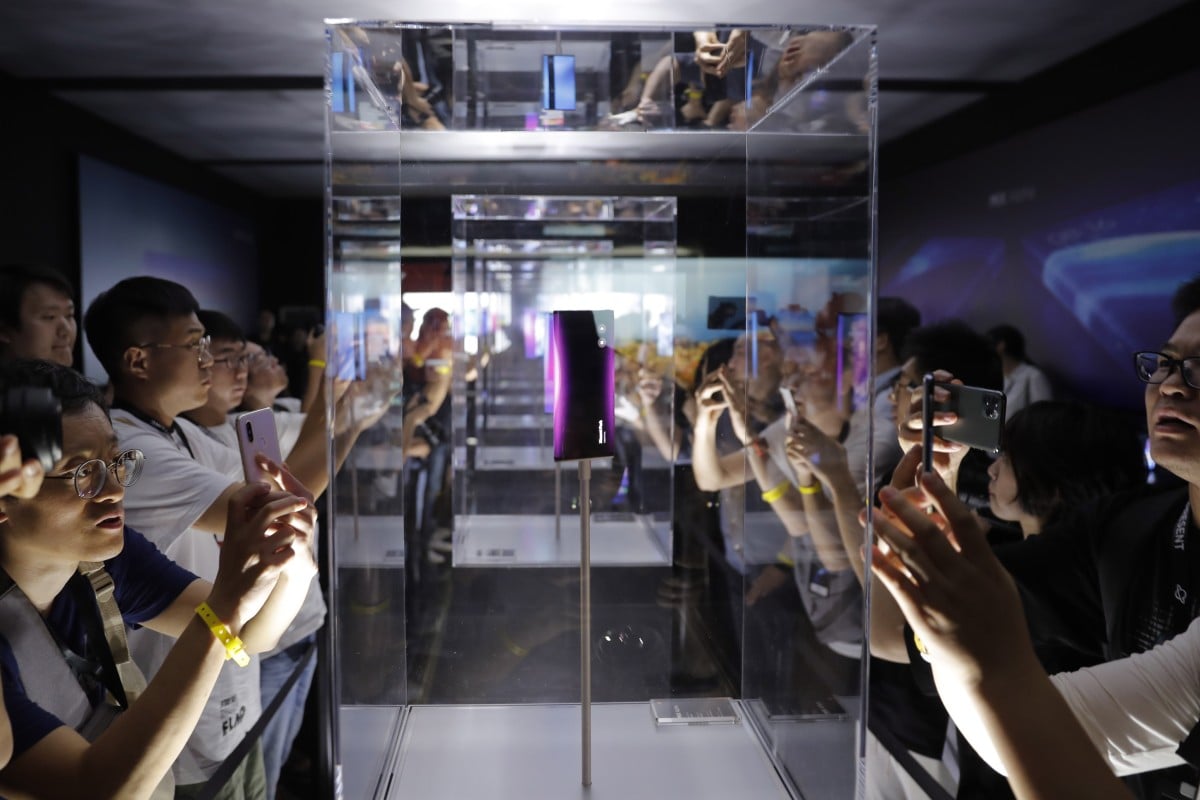
China has 80 per cent of the reserves of rare earth elements the world needs to keep talking on its smartphones, and geologists in Guangzhou think they know why. Photo: EPA
Geologists in southern China say they have isolated a series of critical factors that could make it easier to find rare earth elements used in hi-tech consumer goods such as smartphones.
China has more than 80 per cent of the world’s reserves of heavy rare earths such as terbium, dysprosium and holmium concentrated in a few provinces to the south of the country.
The reason for the concentration is one of the biggest puzzles in geology, but researchers at the Guangzhou Institute of Geochemistry in Guangdong province say the answer may be found in a combination of clay deposits, acid rain and granite that is distinctive to southern China.

Professor He Hongping and his colleagues came to the conclusion by testing the interaction between rare earths and different types of clay. Through their research they found that kaolinite – or china clay – was the best at absorbing rare earths from water.

The clay, named after Gaoling village near Jingdezhen, a centuries-old ceramic production centre in east China’s Jiangxi province, is a raw material for porcelain production.

While kaolinite is found in many countries, those places do not have rare earth deposits – probably because of the lack of acid rain, He said.

“You need the right environment.”

He said that rocks that contained tiny amounts of rare earth elements weathered faster in an acid environment, but the acidity could not be too high or the rare earth might run off before it could be captured by the clay.

Why Beijing cut tax rate on rare earths amid trade war

Rainwater with the right natural acidity often occurred in areas around 20 degrees latitude, such as southern China, he said.

The last step was to locate the source rock. Granite formed in volcanic eruptions between 100 million and 200 million years ago is considered to be the main source of rare earths.

He said that part of the Pacific tectonic plate containing rare elements might have been forced under the Eurasian Plate and was pushed to the surface as magma that formed rocks.

Other countries could learn from the Chinese experience, said He, whose team submitted their findings to the research journal Chemical Geology.

Recent discoveries in Vietnam, Australia and North Carolina in the United States conformed to the Guangzhou team’s theory, but there was still more research to do, he said.

“Rare earth deposits are quite unlike minerals such as copper. Sometimes they occur in this mountain but not in another nearby with almost the same geological features. Sometimes they occur in one half of the mountain but not in the other.”

With China and the US engaged in a trade war, and Beijing cutting taxes on mining companies looking for these elements, the pressure was on to unlock the secrets of China’s abundant rare earth deposits, he said.

Does China’s dominance in rare earths hold leverage in trade war?

Dr Huang Fan, associate researcher with the China Geological Survey, said the Guangzhou discovery would help geologists to find more rare earths.

Most rare earth mines were located along the borders between provinces such as Guangdong and Jiangxi, but recently there were discoveries on a plateau in Yunnan province, where few geologists believed rare earths could be found, he said.

“There are many more rare earth deposits out there waiting for us.”

Source: SCMP

06/10/2019

Xinhua Headlines: China’s Greater Bay Area busy laying foundation for innovation

As China aims to develop its Greater Bay Area into an international innovation and technology hub, innovation and entrepreneurship resources are shared in the area to provide more opportunities for young Hong Kong and Macao entrepreneurs.

The provincial government of Guangdong has stepped up efforts to improve basic research capability, considered the backbone of an international innovation and technology hub, by building large scientific installations and launching provincial labs.

by Xinhua writers Liu Yiwei, Quan Xiaoshu, Wang Pan, Jing Huaiqiao

GUANGZHOU, Oct. 5 (Xinhua) — Hong Kong man Andy Ng was surprised his shared workspace Timetable was rented out completely only six months after it had started operation in Guangzhou, capital of south China’s Guangdong Province.

While studying economics at City University of Hong Kong, Ng set up his first business, developing an online education platform, but soon realized the Hong Kong market was too small. After earning a master’s degree in the UK in 2017, Ng returned to China and chose Guangzhou as his new base.

Timetable is now accumulating popularity and even fans in Dianping.com, China’s major online consumer guide. Ng feels lucky that his business caught the implementation of the Guangdong-Hong Kong-Macao Greater Bay Area (GBA) development plan.

The bay area, covering 56,000 square km, comprises Hong Kong and Macao, as well as nine cities in Guangdong. It had a combined population of about 70 million at the end of 2017, and is one of the most open and dynamic regions in China.

Aerial photo taken on July 11, 2018 shows the Hong Kong-Zhuhai-Macao Bridge in south China. (Xinhua/Liang Xu)

In July 2017, a framework agreement on the development of the bay area was signed. On February 18 this year, China issued the more specific Outline Development Plan for the Guangdong-Hong Kong-Macao Greater Bay Area. One of its major aims is to develop the area into an international innovation and technology hub.

OPPORTUNITIES FOR YOUTH

The plan proposes that innovation and entrepreneurship resources be shared in the bay area to provide more opportunities for young Hong Kong and Macao entrepreneurs.

An incubator for entrepreneurship, Timetable is home to 52 companies, including 15 from Hong Kong and Macao, such as Redspots, a virtual reality company that won the Hong Kong Information and Communications Technology (ICT) Awards 2019.

“I persuaded them one by one to come here,” Ng said. “I told them of my own experience that the GBA is a great stage for starting a business with ever-upgrading technologies, ever-changing consumer tastes and a population 10 times that of Hong Kong.”

Timetable is a startup base of the Guangzhou Tianhe Hong Kong and Macao Youth Association, which has assisted 65 enterprises founded by Hong Kong and Macao young people since its establishment in October 2017.

The association and its four bases provide a package of services from training and registering to policy and legal consultation, said Chen Jingzhan, one of the association founders.

Tong Yat, a young Macao man who teaches children programming, is grateful the association encouraged him to come to Guangdong, where young people enjoy more preferential policies to start their own businesses.

“The GBA development not only benefits us, but paves the way for the next generation,” Tong said. “If one of my students were to become a tech tycoon in the future and tell others that his first science and technology teacher was me, I would think it all worthwhile.”

In the first quarter of this year, there were more than 980 science and technology business incubators in Guangdong, including more than 50 for young people from Hong Kong and Macao, said Wu Hanrong, an official with the Department of Science and Technology of Guangdong Province.

INNOVATION HIGHLAND

As the young entrepreneurs create a bustling innovative atmosphere, the Guangdong government has stepped up efforts to improve basic research capability, considered the backbone of an international innovation and technology hub, by building large scientific installations and launching provincial labs.

Several large scientific facilities have settled in Guangdong. China Spallation Neutron Source (CSNS) operates in Dongguan City; a neutrino observatory is under construction in Jiangmen City; a high intensity heavy-ion accelerator is being built in Huizhou City.

Aerial photo taken on June 23, 2019 shows the construction site of the Jiangmen Underground Neutrino Observatory (JUNO) in Jiangmen, south China’s Guangdong Province. (Xinhua/Liu Dawei)

Guangdong also plans to build about 10 provincial labs, covering regenerative medicine, materials, advanced manufacturing, next-generation network communications, chemical and fine chemicals, marine research and other areas, said Zhang Yan, of the provincial department of science and technology.

Unlike traditional universities or research institutions, the provincial labs enjoy a high degree of autonomy in policy and spending. A market-oriented salary system allows them to recruit talent from all over the world, and researchers from other domestic organizations can work for the laboratories without giving up their original jobs, Zhang said.

The labs are also open to professionals from Hong Kong and Macao. Research teams from the universities of the two special administrative regions have been involved in many of the key programs, Zhang said.

For example, the provincial lab of regenerative medicine and health has jointly established a regenerative medicine research institute with the Chinese University of Hong Kong, a heart research center with the University of Hong Kong, and a neuroscience research center with the Hong Kong University of Science and Technology (HKUST).

Photo taken on July 24, 2019 shows a rapid cycling synchrotron at the China Spallation Neutron Source (CSNS) in Dongguan, south China’s Guangdong Province. (Xinhua/Liu Dawei)

Guangdong has been trying to break down institutional barriers to help cooperation, encouraging Hong Kong and Macao research institutions to participate in provincial research programs, exploring the cross-border use of provincial government-sponsored research funds, and shielding Hong Kong researchers in Guangdong from higher mainland taxes.

NANSHA FOCUS

Located at the center of the bay area, Guangzhou’s Nansha District is designed as the national economic and technological development zone and national free trade zone, and is an important pivot in building the area into an international innovation and technology hub.

The construction of a science park covering about 200 hectares started on Sept. 26. Gong Shangyun, an official with the Nansha government, said the park will be completed in 2022.

Jointly built by the Guangzhou government and the Chinese Academy of Sciences (CAS), the science park will accommodate CAS research institutes from around Guangzhou, including the South China Sea Institute of Oceanology, the South China Botanical Garden (SCBG) and the Guangzhou Institute of Energy Conversion.

Ren Hai, director of the SCBG, is looking forward to expanding the research platforms in Nansha. “We will build a new economic plant platform serving the green development of the Pearl River Delta, a new botanical garden open to the public, and promote the establishment of the GBA botanical garden union.”

Wang Ying, a researcher with the SCBG, said the union will help deepen the long cooperation among its members and improve scientific research, science popularization and ecological protection. “Predecessors of our botanical garden have helped the Hong Kong and Macao counterparts gradually establish their regional flora since the 1950s and 1960s.”

HKUST also started to build a new campus in Nansha the same day as the science park broke ground. “Located next to the high-speed rail station, the Guangzhou campus is only a 30-minute journey from the Hong Kong campus. A delegation from the HKUST once paid a visit to the site and found it very convenient to work here,” Gong said.

Chief Executive of the Hong Kong Special Administrative Region (HKSAR) Carrie Lam hoped the new campus would help create a new chapter for the exchanges and cooperation on higher education between Guangzhou and Hong Kong, and cultivate more talents with innovative capabilities.

Nansha’s layout is a miniature of the provincial blueprint for an emerging international innovation and technology hub.

“We are seeking partnership with other leading domestic research institutions and encouraging universities from Hong Kong and Macao to set up R&D institutions in Guangdong,” said Zhang Kaisheng, an official with the provincial department of science and technology.

“We are much busier now, because research institutes at home and abroad come to talk about collaboration every week. The GBA is a rising attraction to global scientific researchers,” Zhang said.

Source: Xinhua

04/10/2019

Have scientists discovered why China is so rich in rare earth elements the world’s smartphones need?

Chinese geologists think they have formula that could help to increase control of market in the elements hi-tech industries depend upon

  • Simple combination of clay mined for porcelain production, granite bedrock and acid rain could point to lucrative sources of rare earths
China has 80 per cent of the reserves of rare earth elements the world needs to keep talking on its smartphones, and geologists in Guangzhou think they know why. Photo: EPA
Geologists in southern China say they have isolated a series of critical factors that could make it easier to find rare earth elements used in hi-tech consumer goods such as smartphones.
China has more than 80 per cent of the world’s reserves of heavy rare earths such as terbium, dysprosium and holmium concentrated in a few provinces to the south of the country.
The reason for the concentration is one of the biggest puzzles in geology, but researchers at the Guangzhou Institute of Geochemistry in Guangdong province say the answer may be found in a combination of clay deposits, acid rain and granite that is distinctive to southern China.

Professor He Hongping and his colleagues came to the conclusion by testing the interaction between rare earths and different types of clay. Through their research they found that kaolinite – or china clay – was the best at absorbing rare earths from water.

The clay, named after Gaoling village near Jingdezhen, a centuries-old ceramic production centre in east China’s Jiangxi province, is a raw material for porcelain production.

While kaolinite is found in many countries, those places do not have rare earth deposits – probably because of the lack of acid rain, He said.

“You need the right environment.”

He said that rocks that contained tiny amounts of rare earth elements weathered faster in an acid environment, but the acidity could not be too high or the rare earth might run off before it could be captured by the clay.

Why Beijing cut tax rate on rare earths amid trade war

Rainwater with the right natural acidity often occurred in areas around 20 degrees latitude, such as southern China, he said.

The last step was to locate the source rock. Granite formed in volcanic eruptions between 100 million and 200 million years ago is considered to be the main source of rare earths.

He said that part of the Pacific tectonic plate containing rare elements might have been forced under the Eurasian Plate and was pushed to the surface as magma that formed rocks.

Other countries could learn from the Chinese experience, said He, whose team submitted their findings to the research journal Chemical Geology.

Recent discoveries in Vietnam, Australia and North Carolina in the United States conformed to the Guangzhou team’s theory, but there was still more research to do, he said.

“Rare earth deposits are quite unlike minerals such as copper. Sometimes they occur in this mountain but not in another nearby with almost the same geological features.

Sometimes they occur in one half of the mountain but not in the other.”

With China and the US engaged in a trade war, and Beijing cutting taxes on mining companies looking for these elements, the pressure was on to unlock the secrets of China’s abundant rare earth deposits, he said.

Does China’s dominance in rare earths hold leverage in trade war?

Dr Huang Fan, associate researcher with the China Geological Survey, said the Guangzhou discovery would help geologists to find more rare earths.

Most rare earth mines were located along the borders between provinces such as Guangdong and Jiangxi, but recently there were discoveries on a plateau in Yunnan province, where few geologists believed rare earths could be found, he said.

“There are many more rare earth deposits out there waiting for us.”

Source: SCMP

03/10/2019

Across China: Visually impaired enjoy China’s National Day celebrations

GUANGZHOU, Oct. 2 (Xinhua) — With the help of audio description given by volunteers, visually impaired people in south China’s Guangzhou “watched” live broadcasting of China’s National Day celebrations on Tuesday.

“The aircrafts are flying through the sky in a shape of triangle, with seven lines of colored clouds behind,” the volunteers described the formation in detail.

On Tuesday, a grand military parade and a 100,000-people mass pageantry were held in Beijing to celebrate the 70th founding anniversary of the People’s Republic of China.

A total of 100 visually-impaired people “watched” the broadcast in Guangzhou Library. Wearing earphones, they got a full account of the celebrations from two volunteers.

For Lu Haixia, one of the volunteers, narrating a live broadcasting put her under great pressure.

“It takes me 100 hours to prepare the oral scripts for a movie, and much more hours for preparing for such a long live broadcasting in order to provide informative accounts of the event to the audience,” she said.

“With the detailed narration, I feel like seeing formations parading on the Chang’an Avenue, and that I can get more involved in the cheering,” said Wang Zeyu, one of the “viewers.”

This was the first time for Guangzhou to introduce a live broadcast of major celebrations with audio description to the visually impaired. Organizers of the event hope to carry the effort forward to give the visually impaired more confidence to get integrated into the society.

Source: Xinhua

30/09/2019

Next stop: Croatia. Chinese travellers skip Hong Kong for niche destinations over National Day break

  • Train trips, Xinjiang and chartered flights among the growing holiday trends, travel agents say
Destinations such as Dubrovnik, Croatia, are becoming more popular among mainland Chinese tourists, according to one of China’ s biggest travel services. Photo: AFP

Chartered flights and niche destinations such as Croatia and Malta are growing in popularity as Hong Kong falls out of favour for mainland Chinese holidaymakers over the National Day “golden week” break.

Japan has overtaken Thailand as the most searched overseas destination on the website of travel agency Ctrip, followed by Malaysia, the United States, Singapore, Australia, Macau, France, Italy and Russia.

Within the mainland places such as Beijing and Shanghai continued to be among the most popular searches but Urumqi, capital of Xinjiang Uygur autonomous region, is a fast-growing term, especially among people in Shanghai and Guangzhou.

“It could be that tourists want to see autumn leaves,” a Ctrip spokesman told the South China Morning Post.

October 1 marks the start of a week-long break on the mainland when millions of Chinese take the chance to travel. This year, an estimated 800 million people are expected to go on trips in China or overseas, about 10 per cent more than last year.
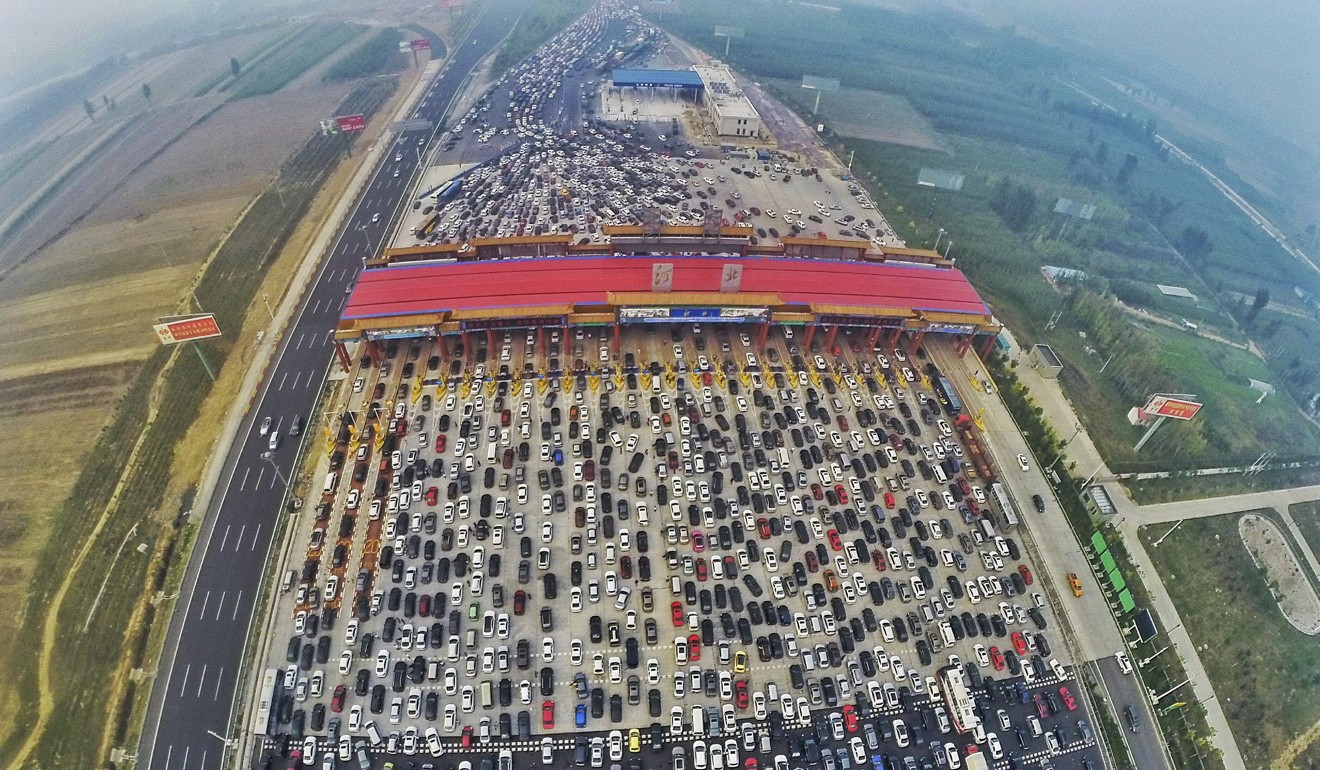
The country’s motorways are expected to be jammed from about 2pm on Monday, reaching a peak at around midnight, and again from 10am Tuesday, according to web mapping service Tencent Map.
China’s highways can expect heavy traffic as travellers head out for the holiday. Photo: Reuters

Ctrip said people heading overseas were increasingly seeking out new destinations, with bookings to places such as the Czech Republic, Austria, Croatia, Malta and Cambodia growing by 45 per cent this year.

“As Chinese people travel outside the country more and their experience of travel grows, many are more willing to go to smaller eastern European countries, such as the Czech Republic,” the spokesman said.

“Popular movies also have a strong influence. Many young people are willing to travel to see where films are shot, such as Croatia, one of the locations for Game of Thrones.”

Other noticeable trends this year include more people travelling with pets, by train and on chartered flights. The site said it sold 60 per cent more European train tickets and 10 times the number of train tickets for Japan for this golden week compared to last year.

The most popular routes in Asia were Tokyo to Kyoto in Japan, and Seoul to Busan in South Korea.

Hong Kong protests leave ‘golden week’ tourist boom in tatters as visitor arrivals during Chinese holiday period are set to be slashed by a third

Thousands of users also chose chartered flights, a service Ctrip introduced in September.

Ji Yu, head of chartered flights for Ctrip said most people thought chartered flights or helicopters were something only millionaires could afford, but in the internet age, they had become cheaper and more accessible.

“In the internet era, consumer needs vary from person to person, especially in terms of travel. There are products on the market to satisfy each customer’s personal needs.”

Among the more popular chartered routes were from Beijing or Shanghai to Tokyo, Bangkok, the Maldives and London.

More people are also going away for longer. Digital travel services giant Qunar said that 80 per cent of the travellers booking flights or hotels through its services were heading off for more than five days. And of those 41 per cent were travelling for more than a week.

Meanwhile, trips to Hong Kong have fallen substantially, with just 15 group tours expected to enter the city each day, down from 110 last year, according to the Travel Industry Council of Hong Kong.

Efforts to promote Hong Kong attractions have also increased in Shenzhen in recent weeks, with advertising videos scenic spots, popular restaurants and malls in Hong Kong playing on cross-border buses. Passengers can also get discounts to some stores and services with their tickets.

Source: SCMP

26/09/2019

Beijing Daxing airport – world’s largest terminal – takes flight

  • Visually spectacular and with the latest technology, the Chinese capital’s second international airport is open for business
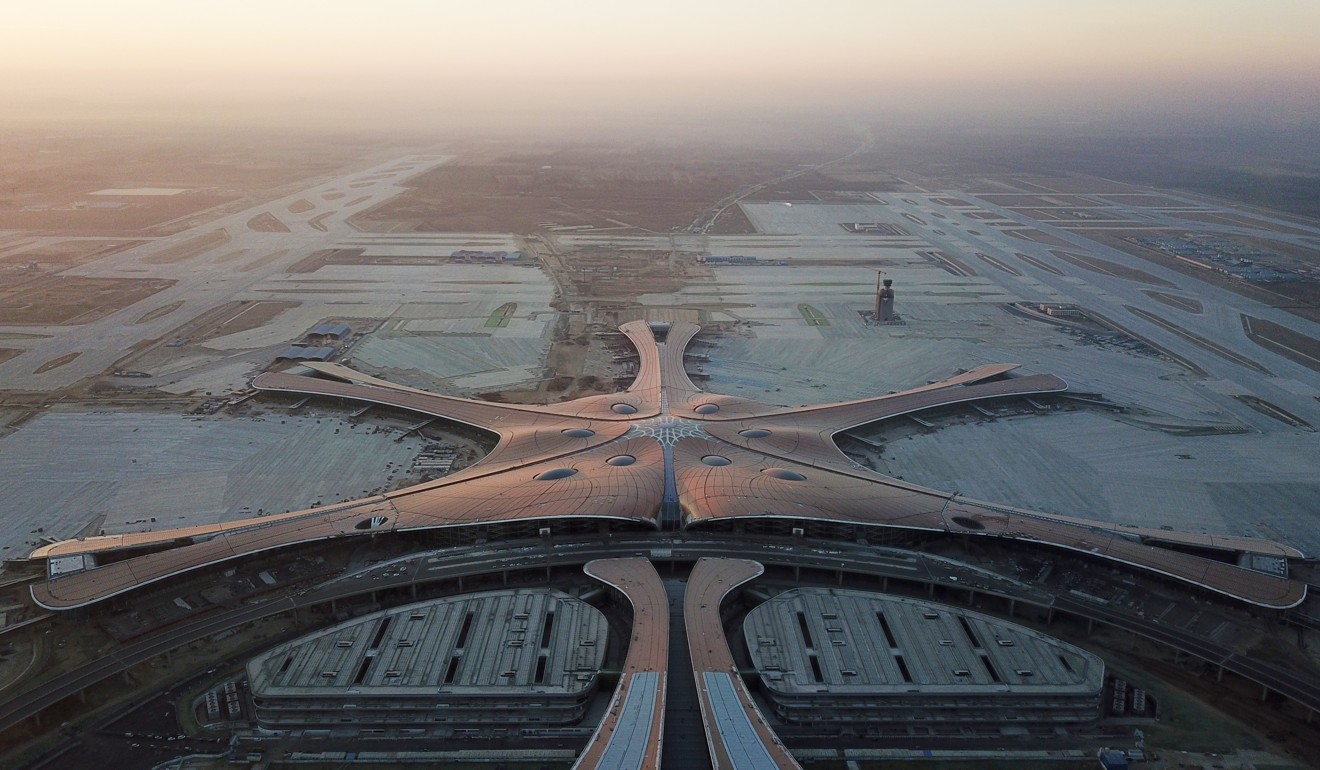
The terminal building at Beijing Daxing International Airport, which has officially opened. Photo: Xinhua

At 4.23pm on Wednesday a China Southern Airlines A380 left Beijing for Guangzhou – on the first commercial flight out of the world’s latest and largest airport terminal at Daxing, five years after construction began on the ambitious project.

The 80 billion yuan (US$11 billion) Beijing Daxing International Airport was officially opened by Chinese President Xi Jinping on Wednesday morning.

China Southern Airlines, the mainland’s largest carrier, has 40 per cent of the flight slots at the new airport. It is one of 16 airlines which will be operating out of Beijing Daxing International Airport, the visually spectacular new facility at the southern end of the Chinese capital.

Six other flights, including China Eastern Airlines for Shanghai and Air China for Chengdu, took off before 5pm in the afternoon. These domestic airlines will have part of their operations moving to Daxing for the upcoming winter-spring season, according to the mainland’s aviation authority. No Hong Kong airlines were listed.

British Airways has announced its whole operation will be moved to Daxing, while some foreign airlines, such as Ethiopian Airlines, Polish Airlines, Malaysia Airlines, Royal Air Maroc and Finnair, will operate at both airports.

Spanning 47 sq km (18 square miles) – almost 50 per cent larger than the city of Macau – Daxing, with its 700,000 square metre (7.5 million sq ft) terminal is a spectacular sight. Its futuristic shape, resembling a giant hexagonal starfish or – as some internet users have dubbed it – an alien base, not only handles more aircraft, it also keeps passengers’ walks

From the centre of the security check to the furthest end gate in each wing is about 600 metres (1,970 feet), or less than an eight-minute walk.

Beijing’s new 7-runway, star-shaped Daxing airport opened by Xi Jinping
According to Xinhua, more than 70 restaurants, tea shops and coffee houses will operate in the airport, along with 36 international brands, including Louis Vuitton, Gucci and Bottega Veneta.

Daxing is designed to take pressure off the overcrowded Beijing Capital International Airport (BCIA) and, by 2021, is expected to handle 45 million passengers a year, rising to 72 million by 2025.

Located at the south of the capital, 46km (28.5 miles) from the central Tiananmen Square, the airport was once frowned upon for its less than optimal location, with its southern end at the border with Hebei province. But it may not be as time-consuming for travellers as originally thought.

The design of the airport means passengers will walk a much shorter distance to the check-in and security check.Hu Haiqing, China Southern Airlines

Hu Haiqing, deputy general manager of China Southern Airlines’ operation control centre, told Global Times that “although Daxing is further away from downtown Beijing than the Capital airport, there are still some advantages, especially for our airline”.
With most of its bases in the south of the country, China Southern Airlines flights to Daxing will be 10 to 15 minutes shorter than to the Capital airport. A further 15 to 20 minutes taxiing time will also be saved, thanks to its position in the new airport.
“The design of the airport also means passengers, once they leave their car or train, will walk a much shorter distance to the check-in and security check,” Hu said.
According to Xinhua, Daxing’s design also makes transit much quicker, with transfers between international and domestic flights up to 90 minutes shorter than from the Capital airport.
The futuristic shape of Daxing airport not only handles more aircraft, it also keeps passengers’ walks to a minimum. Photo: Xinhua

Public transport will be the quickest way to reach the new airport from downtown Beijing – 20 minutes from West Beijing railway station once the Beijing-Xiongan high-speed rail officially opens. The airport express service will also take passengers from Caoqiao station to the airport in 19 minutes.

There is no underground rail service or airport express connecting the Capital airport in the north with Daxing, but passengers can change trains at Caoqiao for downtown Beijing or other stations which connect with BCIA’s airport express service.

Waiting times at the new airport will be greatly reduced by the use of facial recognition technology for self-service check-in and smart security checks, according to Wang Hui, manager of Daxing’s terminal management department.

The technology does away with the need for a paper boarding pass and passengers can check-in, with or without luggage, and go through the security check by themselves.

Beijing is the window for China to go global … Daxing airport makes it possible to open more global routes.China Eastern Airlines pilot

“The airport has more than 400 self-service check-in kiosks, which means more than 80 per cent of check-ins will be self-service. That shortens each passenger’s queuing time to no more than 10 minutes,” Wang told Global Times.
“The smart security check channels are able to handle 260 passengers per hour, 40 per cent faster than using traditional means,” he said.
The opening of Daxing Airport could be a great boost for the mainland – and even the global – aviation industry by easing pressure on the Capital airport and making new routes possible, said a veteran China Eastern Airlines pilot who declined to be named.
5 things we know about Beijing’s new Daxing International Airport
Opening new flight routes from BCIA was almost impossible, he pointed out, because the centre of Beijing was a no-fly zone for security reasons. Daxing airport’s location at the southern end of the city, however, avoided the problem of planes having to bypass the restricted space, leaving room to open more routes for domestic and international flights.
“Beijing is the window for China to go global but the Capital airport’s schedule is saturated and unable to open new routes. Daxing airport makes it possible to open more global routes,” the pilot said.
He said the runway design at Daxing also meant fewer delays, because the four runways of phase one – more than any other airport in China – included one which was perpendicular to the other three, allowing flights to land and take off regardless of wind direction.
Source: SCMP
20/09/2019

Across China: Guangzhou incubator gives HK and Macao entrepreneurs a leg-up

GUANGZHOU, Sept. 19 (Xinhua) — After exploring registering a company in Shenzhen and Zhuhai in 2013 and 2015, ChiMan Chan, a Hong Kong entrepreneur, finally made the plunge and launched a business on the Chinese mainland in 2017 when he came across the Tianhe District Service Center for Hong Kong and Macao Youth Entrepreneurship.

The service center, a non-profit organization which acts as an incubator for emerging enterprises, is located in the heart of Guangzhou’s bustling CBD, Zhujiang New Town.

Since it was established in 2017, the center has embraced more than 2,200 young entrepreneurs from the two Special Administrative Regions, and 45 Hong Kong and Macao enterprises have settled down at the center.

Thanks to the assistance from the center, Chan is now the founder and chief executive officer of Deming ProDevelop, an engineering consultant agency with four offices scattered across the Guangdong-Hong Kong-Macao Greater Bay Area.

In Chan’s view, the service center played an instrumental role in his company’s current success. “Without the help of the service center, there is no way we could have thrived to such an extent on the Chinese mainland,” Chan said.

Establishing a business is tough in itself, but for newcomers to the mainland, the application and registration process can especially present a massive initial hurdle, according to Chan. Luckily, the service center reduced some of that pressure for him.

Chen Jingzhan, director of the center’s entrepreneurship and innovation department, said many Hong Kong and Macao entrepreneurs that have set their eyes on development on the mainland often face similar headaches.

“It’s not just a matter of investing enough time to complete the registration process. Without professional guidance, many Hong Kong and Macao newcomers to the mainland simply do not know where to start,” said Chen, adding that is where the service center comes in.

Not only does the center help entrepreneurs get started, but it also offers support as they continue to develop through free registration, entrepreneurship, policy, intellectual property rights, law, and market resource consulting services.

To enterprises that meet specific requirements, the center even provides office space for two to three people free of charge, with aims of “reducing the operational costs associated with startups, and offering more development opportunities to Hong Kong and Macao enterprises,” said Chen.

Since the Outline Development Plan for the Guangdong-Hong Kong-Macao Greater Bay Area was released in February, more and more youths from Hong Kong and Macao have set their sights on Guangdong.

Ye Zhengqiao, a young entrepreneur from Hong Kong, is one of them. Drawn to the Greater Bay Area after graduating from university in the U.S., Ye now is the founder of Geometry Technology Co., Ltd., a company that has launched an online intelligent pet platform. Ye’s platform lists pet-related service providers and product sellers in a one-stop online solution for pet owners in China.

Ye said the construction of the Guangdong-Hong Kong-Macao Greater Bay Area has given young people like him “more confidence and opportunity.” He said he believes “the rate of success in Guangdong is higher than in Hong Kong,” and that the Greater Bay Area gives young people “more room to try new things with lower capital requirements.”

The concept behind the Greater Bay Area also provided the inspiration for ChiMan Chan’s business. While working on a project related to the construction of the Hong Kong-Zhuhai-Macao Bridge, the Greater Bay Area’s most iconic feat of engineering, Chan saw the potential for deepened cooperation and wanted to build a bridge of his own: a platform to connect Chinese mainland engineers and their Hong Kong, Macao and overseas counterparts.

Chen hopes more services like those on offer at the Tianhe District Service Center for Hong Kong and Macao youth entrepreneurship will be offered to young Hong Kong entrepreneurs, both in the mainland and in Hong Kong itself.

Ye Zhengqiao agrees that the mainland offers new pathways to Hong Kong and Macao youths, adding that he hopes more young people from the two SARs can latch on to the new possibilities provided by the Greater Bay Area, and “come to the mainland more often to appreciate the opportunities available.”

Source: Xinhua

17/09/2019

China’s women still waiting for an end to getting groped on public transport

  • Priority carriages on underground trains have not solved the problem of sexual harassment for female passengers
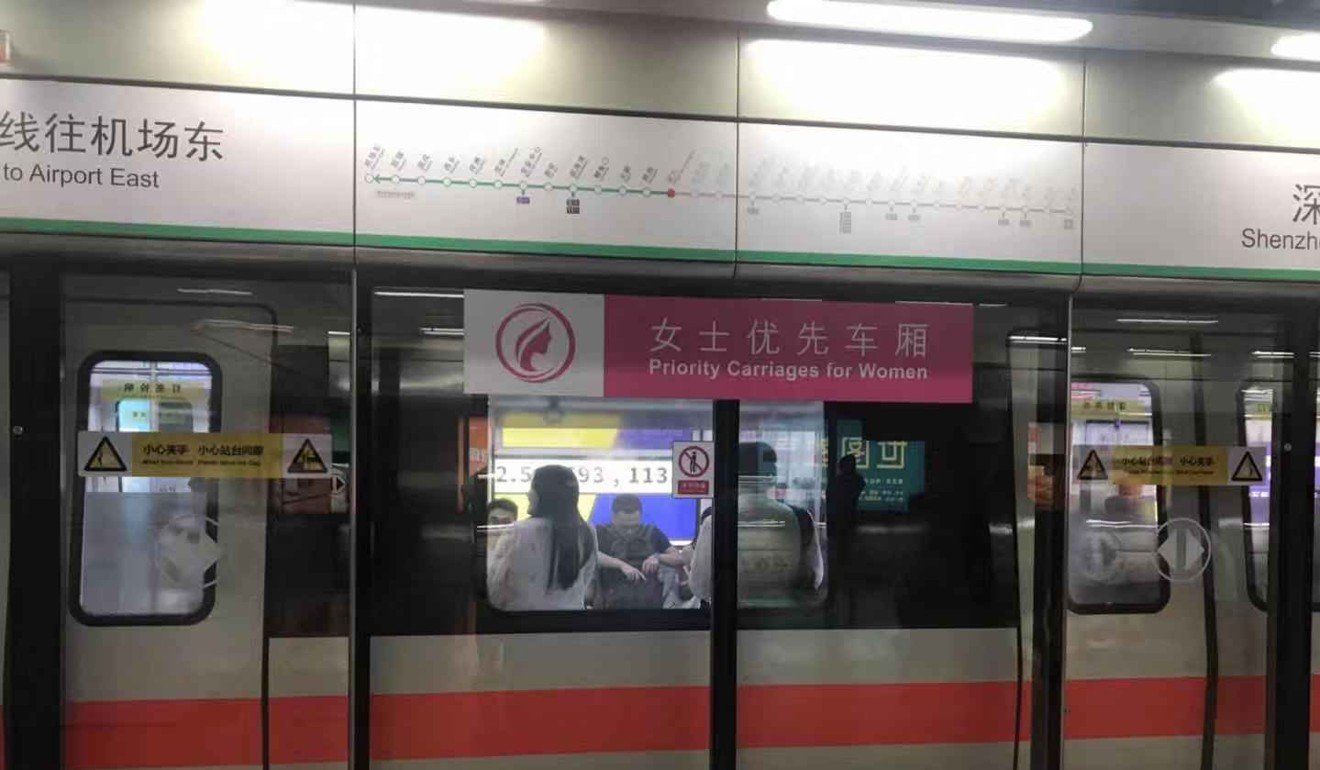
A woman is surrounded by men in a priority carriage on the Shenzhen metro. Photo: Sam Tsang

The first time Wanda was groped by a man on a Beijing bus she was a college student, travelling to school in her gym uniform on a summer’s day. Ten years – and numerous examples of sexual harassment on public transport – later, she is still haunted by the memory.

Now 31, Wanda – who asked to be identified only by her first name – remembers every detail of the incident. The bus was not crowded but the man, who appeared to be in his 40s, went straight over to stand uncomfortably close to her.

Then he pressed himself tightly against her and began making a thrusting motion with his lower body. Wanda said she froze, terrified by the encounter and unsure how to act. Just then, the bus took a sharp turn, the man was thrown aside and she quickly moved away.

“Afterwards, for a period, I looked at every adult man I saw as if he was aggressive,” she said.

Since then, Wanda said she had been flashed at in public and just last year was forced to block a man with her purse when he tried to touch her leg on a train.
118 Chinese men detained for groping women on subway trains

Wanda’s experience is not unusual but attempts to address the problem of sexual harassment on public transport in China have met with mixed results, as well as claims by feminists that they are restrictive to women.

Two major cities in southern China, for example, introduced priority carriages for women on their underground trains in 2017.

Shenzhen

and Guangzhou, both in Guangdong province, established two designated carriages – one at each end of the train – during peak times.

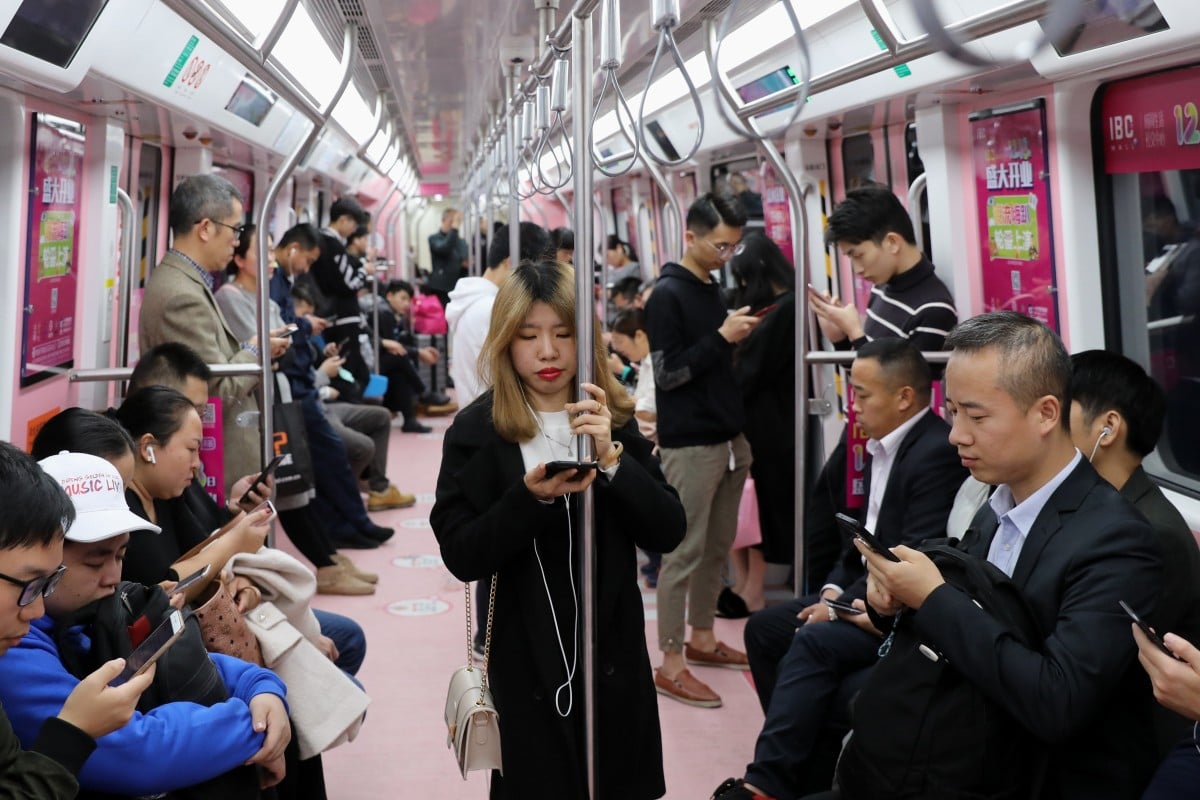
The carriages are decorated with pink stickers which say, in Chinese and English, “priority carriages for women” and while men are not barred from using them
they are encouraged to leave them to women passengers.
While the authorities did not specifically say they were intended to prevent sexual harassment – saying only that the scheme was meant to “give more care and respect to women” – the carriages followed a precedent set by Japan and Europe for that reason.

Shenzhen is currently considering an update to its priority carriages with an amended law designating them for people with disabilities and minors, as well as women, and only during rush hour. Other passengers who do not meet these criteria can be asked to leave by rail staff.

A priority carriage for women on the Shenzhen underground system. Photo: Phoebe Zhang

But in reality the restrictions on the priority carriages are seldom enforced and they have been used by men since their launch. Furthermore, feminists say the scheme is a form of segregation, rather than an attempt to solve the cause of the issue.

One reason the priority carriages have failed in their purpose could be the size of the crowds using public transport each day. According to government data, there are roughly 5 million passenger trips on the Shenzhen underground every day and 8 million in Guangzhou.

It is also hard for staff to enforce the regulation.

“When it first came out, subway staff vehemently advocated for women to use it, so many people did,” said Zhang Ying, a piano teacher in Guangzhou. Staff would hold loud speakers and gesture for women to get on the priority carriages. But now, everybody just treats it like an ordinary carriage, she said.

Zhang said she rarely uses the priority carriages because of the inconvenience of having to walk all the way to the end of the train.

Women call for convenience in all areas, but [the government] only wants to draw you a little corner to play in.Xiao Meili, Guangzhou-based feminist

Feminists have opposed the scheme from the start.
“The logic behind the scheme is wrong to begin with,” said Xiao Meili, a Guangzhou-based feminist. “When noticing the dangers women face in public spaces, women call for convenience in all areas, but [the government] only wants to draw you a little corner to play in, signalling they still will neglect you in most places.”
Although it may appear well-intentioned, Xiao said the scheme was restricting women’s space.
“Most of the sexual harassers and rapists are men, so wouldn’t it be more effective to put these offenders in a limited space?” she asked.
In a survey of 443 people conducted by a group of feminists in Shenzhen in 2017, 42 per cent of women said they had been harassed on public transport, compared with just 6 per cent of men.
Most of the interviewees said they were dissatisfied with the police response and 65 per cent said they thought police should be most responsible for handling sexual harassment in public.
Six ways Japanese women can deter gropers on trains
Xiao and others have repeatedly written to government representatives about sexual harassment on public transport. In 2016, Xiao’s feminist group received 40,000 yuan (US$5,650) in public donations – just enough to buy an advertisement slot.
For two years, the group tried to put up anti-harassment billboards in the Guangzhou and Shenzhen underground systems, but they were repeatedly blocked by the authorities who said the advertisements would cause panic.
But in 2018 Xiao’s group spotted advertisements in the subways in Beijing, Shanghai and Chengdu, some placed by news organisations and others by local governments. One advertisement in Chengdu, put up by rail officials, said: “There’s no groping hand here.”
Another, in Beijing, said: “Prevent sexual harassment, be vocal.”
Xiao said she was happy to see the changes, but described the current policy of updating the carriages in Shenzhen as an example of “lazy politics”.
There needed to be more than a pink bumper sticker on carriage windows, she said.
Instead, policymakers needed to think about the actual mechanisms of stopping harassment and how to handle culprits once they were caught.
“Women do not demand special care as if they are a soft and weak group,” Xiao said.
“They demand the safety they deserve and the right to travel conveniently.”
Source: SCMP
13/09/2019

1.93 mln daily entry, exit trips expected for Mid-Autumn Festival holiday

BEIJING, Sept. 12 (Xinhua) — China’s border check agencies are expected to see an average of 1.93 million inbound and outbound trips made by Chinese and foreign tourists per day during the three-day Mid-Autumn Festival holiday, the National Immigration Administration said Thursday.

The figure indicated a year-on-year increase of 1.6 percent, according to the administration.

It said the average daily trips at major airports in the cities of Beijing, Shanghai, Guangzhou and Chengdu are expected to reach 85,000, 109,000, 54,000 and 21,000 respectively.

The administration asked border check agencies nationwide to ensure sufficient personnel and disclose passenger flow information in a timely manner to properly handle the holiday travel surges.

It also advised passengers to avoid traveling during peak hours.

The Mid-Autumn Festival falls on Sept. 13 this year.

Source: Xinhua

09/09/2019

China’s Guangdong to release another 3,150 tonnes of pork from reserves to secure supplies

BEIJING (Reuters) – China’s Guangdong province said it will release 3,150 tonnes of frozen pork from reserves during the upcoming holidays, part of a campaign to secure supplies of the country’s favorite meat, local media reported on Monday, after a devastating disease ravaged the hog herd.
The pig herd in the major pork consuming region has fallen 34% from the previous year in the first half of 2019, while the sow herd dropped 43%, the Nanfang Daily reported, citing government statistics.
“Hog supplies will face an unprecedented, grave test,” the newspaper said, quoting an unnamed official with the provincial agriculture bureau, as it will be increasingly difficult to transport pigs into Guangdong from outside provinces due to falling production nationwide.
Various factors, including the environmental crackdown on illegal pig farming and outbreaks of African swine fever, are behind the fall, the official said.
Guangdong relies on supplies from other provinces. Authorities in Guangzhou, the capital city of the province, have said they will release 1,600 tonnes of frozen pork from reserves in September.
Major pig producers in the region including the Guangdong branch of agribusiness giant New Hope Liuhe, said they will further expand hog production in the area to help with supplies.
Liuhe, which currently supplies about 300,000 hogs a year in Guangdong, will add another 50,000 pigs to the market in the second half of the year, and expand pig production by 700,000 heads next year, according to Li Weifeng, general manager in charge of the Guangdong new district at the firm, the newspaper reported.
Local authorities are also promoting modern and large scale pig farms, to secure pork supplies in the region in the long run, the paper said.
China’s state planner said on Monday it will issue subsidies of up to 5 million yuan ($700,000) to support the construction of large-scale pig farms.
Source: Reuters
Law of Unintended Consequences

continuously updated blog about China & India

ChiaHou's Book Reviews

continuously updated blog about China & India

What's wrong with the world; and its economy

continuously updated blog about China & India