Archive for ‘Guiyang’

01/11/2019

Help pours in for Chinese student who lived on 30 cents a day

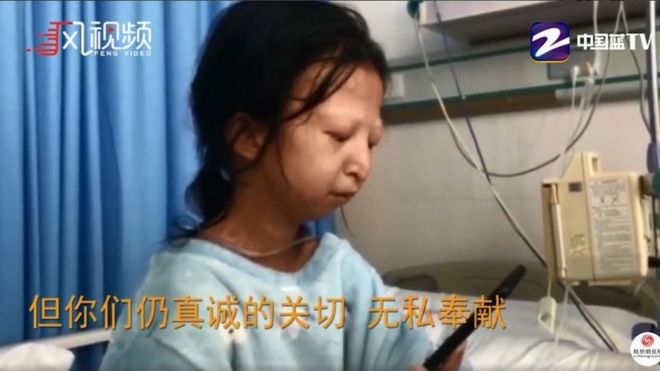
Wu Huayan on her hospital bedImage copyright FENG VIDEO
Image caption Wu Huayan ate only rice and chillies in order to save money to help her ill brother

Well-wishers have donated almost a million yuan to a Chinese student who was hospitalised after living on 2 yuan ($0.30, £0.20) a day for five years.

The case of Wu Huayan shocked Chinese people after it hit the headlines earlier this week.

The 24-year old woman became seriously malnourished while struggling to study and support her sick brother.

Ms Wu’s story also sparked anger at authorities for failing to recognise her plight and help her much earlier.

After the story was reported, donations began pouring in for the college student in the city of Guiyang – reportedly totalling some 800,000 yuan ($114,000, £88,000).

What is Wu Huayan’s story?

Earlier, this month, the young woman went into hospital after having difficulty breathing, according to Chinese media.

She was only 135cm (4ft 5ins) tall, weighing barely more than 20kg (43 pounds; three stones).

The doctors found she was suffering from heart and kidney problems due to five years spent eating minimal amounts of food. She said she needed to save money to support her sick brother.

Wu Huayan lost her mother when she was four and her father died when she was in school.

She and her brother were then supported by their grandmother, and later by an uncle and aunt who could only support them with 300 yuan ($42, £32) each month.

Most of that money went on the medical bills of her younger brother, who had mental health problems.

This meant Ms Wu spent only 2 yuan a day on herself, surviving largely off chillies and rice.

The siblings are from Guizhou, one of the poorest provinces in China.
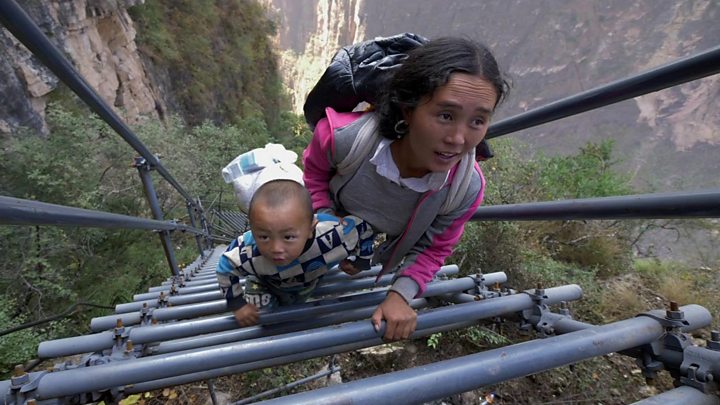
Media caption China’s uphill struggle fighting extreme poverty

What has the reaction been?

The case sparked an outpouring of concern – and anger at authorities.

Many people on social media said they wanted to help with donations, and many voiced concern about her college not helping her.

One user called her situation “worse than that of refugees in Afghanistan”, while another pointed to the extravagant cost of China’s 70th anniversary celebrations, saying the money could have been better spent.

Others expressed their admiration at her efforts to help her brother, while also persevering with her studies in college.

Aside from the donations on crowd funding platforms, her teachers and classmates donated 40,000 yuan ($5,700; £4,400), while local villagers collected 30,000 yuan to help her.

Officials released a statement saying Ms Wu had been receiving the minimum government subsidy – thought to be between 300 and 700 yuan a month – and was now getting an emergency relief fund of 20,000 yuan.

“We will keep following the case of this strong-minded and kind girl,” the Tongren City Civil Affairs Bureau said.

“We will actively co-operate with other relevant departments to solve the problem according to the minimum living standard and temporary assistance responsibility that the civil affairs department bears.”

How bad is poverty in China?

The case of Wu Huayan has echoes of a story from 2018 when a Chinese boy arrived at school with his hair full of frozen ice.

Dubbed “Little Wang”, his story also went viral, leading to international donations from people impressed by his resilience, and shocked at his poverty.
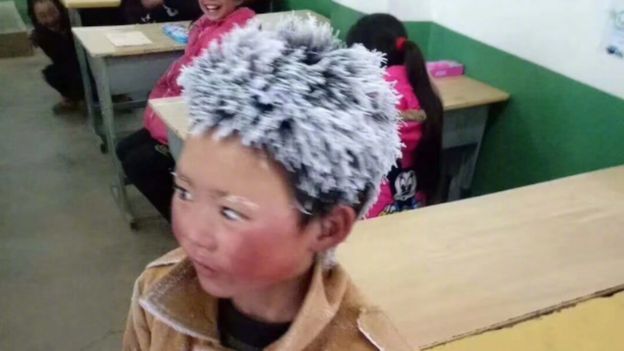
Wang, a left-behind migrant childImage copyright PEOPLE’S DAILY

While China’s economy has skyrocketed over the past decades, poverty has not disappeared, and inequality has grown.

One major reason cited is the huge divide between rural and urban areas.

According to the bureau, the per capita disposable income of a household in the capital Beijing was 57,229 yuan ($8,090; £6,300) in 2017.

As a point of comparison, in rural region of Guizhou where Ms Wu lives, that figure is around 16,703 yuan.

China has moved from being “moderately unequal in 1990 to being one of the world’s most unequal countries,” according to a 2018 report by the International Monetary Fund.

According to the National Bureau of Statistics in 2017, 30.46 million rural people were still living below the national poverty line of $1.90 a day.

China has previously pledged to “eliminate” poverty by 2020.

Source: The BBC

22/07/2019

Chinese, Vietnamese parties hold 15th theory seminar

CHINA-GUIYANG-HUANG KUNMING-VIETNAM-THEORY SEMINAR (CN)

Huang Kunming (R), a member of the Political Bureau of the Communist Party of China (CPC) Central Committee, a member of the Secretariat of the CPC Central Committee and head of the Publicity Department of the CPC Central Committee, holds talks with Vo Van Thuong, head of the Communist Party of Vietnam (CPV) Central Committee’s Communication and Education Commission, before the fifteenth theory seminar between the CPC and the CPV in Guiyang, capital of southwest China’s Guizhou Province, on July 21, 2019. (Xinhua/Xie Huanchi)

GUIYANG, July 21 (Xinhua) — The Communist Party of China (CPC) and the Communist Party of Vietnam (CPV) held their fifteenth theory seminar on Sunday in Guiyang, southwest China’s Guizhou Province.

The seminar focused on exploring laws of socialist modernization in China and Vietnam.

The opening ceremony of the seminar was attended by Huang Kunming, a member of the Political Bureau of the CPC Central Committee and also a member of the Secretariat of the CPC Central Committee, and Vo Van Thuong, head of the CPV Central Committee’s Communication and Education Commission.

Huang said in his keynote speech that the CPC has led the Chinese people in successfully creating the road of modernization construction with Chinese characteristics that has promoted the fast development of the country, based on the national conditions and by adhering to putting the people first, taking the economic construction as the central task and adhering to the reform and opening up.

Prior to the seminar, Huang, who is also head of the Publicity Department of the CPC Central Committee, held talks with Thuong. They exchanged views on deepening relations between the two parties and two countries and on enhancing media exchanges and cooperation.

Source: Xinhua

30/05/2019

Chinese education officials sacked for investigating four-year-olds in anti-mafia crackdown

  • Parents in Jiangsu province were shocked by a form that said a kindergarten class had been investigated and ‘no pupils were found to be involved in organised crime’
  • Officials fired or disciplined for ‘causing serious negative publicity’
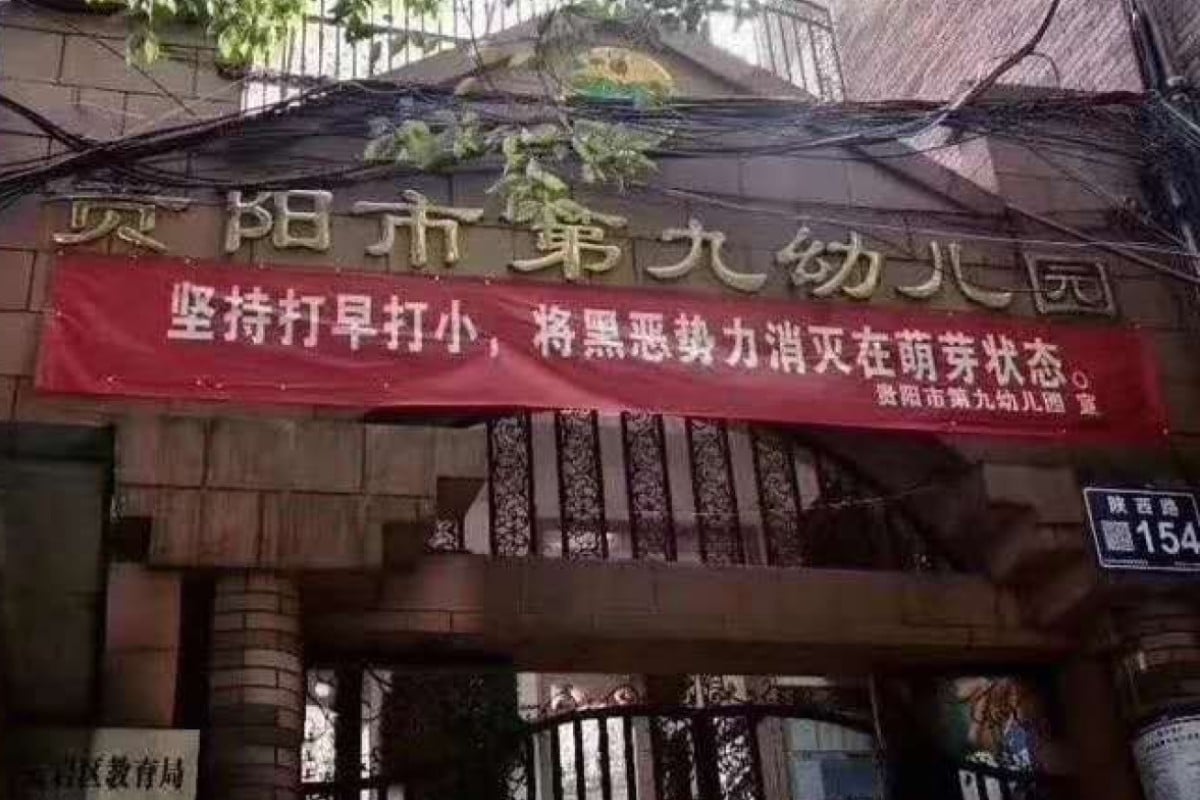
A kindergarten in Guiyang put up a banner on its entrance that read: “Crack down early and crack down young. Eliminate the dark and evil forces when they are still budding”. It was later removed. Photo: Weibo
Education officials in eastern China have been sacked or disciplined after targeting kindergarten pupils in a crackdown on organised crime.
Residents in Wuxi, a city in Jiangsu province, were shocked when a note saying that 35 pupils aged four and five at Xinguang Kindergarten had been investigated as part of the wider crackdown on mafia-style gangs was leaked online.
The form, signed by two teachers, concluded: “No pupils were found to be involved in organised crime”.
Copies of the document started circulating on social media, triggering a widespread backlash and ridicule.
Some social media users accused the kindergarten of box-ticking and questioned whether staff would have been capable of discovering whether any parents were involved in organised crime.
China’s war on organised crime, corrupt officials sees 79,000 people detained

One said that if officials really wanted to nip criminal tendencies in the bud, they were starting too late, adding: “Why not start when they are in the womb and crack down in the maternity hospital?”

An unidentified staff member from the Wuxi Education Bureau confirmed that schools were being targeted in the crackdown on organised crime, telling Chengdu Economic Daily: “Banners are hung everywhere inside and outside the school premises”.However, they insisted: “There was no wrongdoing by the kindergarten. We are mainly targeting teachers and parents for the publicity.”

But on Thursday the Wuxi government backed down and criticised education officials in Xishan district for misinterpreting the crackdown on organised crime and “putting on an unrealistic show”.

Three senior officials from the Xishan district authority were disciplined for their roles in “causing serious negative publicity”.

China’s fentanyl firms back crackdown on opioid

Feng Dongyan, the chief and party secretary of Xishan district education bureau, was given a party warning.

Wang Zhaoyu, director of the bureau’s general office, and Lu Zhongxian, the director in charge of education inspection of the bureau, lost their jobs and were given a serious party disciplinary warning.

Beijing started the campaign targeting grass-roots criminal organisations and their “protective umbrellas” last year.

More than 3,000 people have been punished so far, but the campaign has also been ridiculed for taking aim at the wrong targets.

Last month a kindergarten in Guiyang in Guizhou province put up a banner at its entrance reading: “Crack down early and crack down young. Eliminate the dark and evil forces when they are still budding”.

The kindergarten said the banner was “meant for the public” but took it down after an online backlash.

Source: SCMP

Law of Unintended Consequences

continuously updated blog about China & India

ChiaHou's Book Reviews

continuously updated blog about China & India

What's wrong with the world; and its economy

continuously updated blog about China & India