
People walk beside the terraced lands of paddy fields in Gaoniang Town, Tianzhu County of southwest China’s Guizhou Province, Sept. 3, 2019. (Xinhua/Yang Wenbin)
Source: Xinhua
continuously updated blog about China & India

You will be living in their world, very soon

Beware the Waking Dragon
People walk beside the terraced lands of paddy fields in Gaoniang Town, Tianzhu County of southwest China’s Guizhou Province, Sept. 3, 2019. (Xinhua/Yang Wenbin)
Source: Xinhua
BEIJING, Aug. 25 (Xinhua) — The water quality of China’s major rivers, lakes and coastal waters is improving, while in general, the water ecology is not optimistic, an official report showed.
The report was made by an inspection team tasked with examining the enforcement of the water pollution prevention and control law, under the Standing Committee of the National People’s Congress, China’s top legislature.
From April to June, the law enforcement inspection team was divided into four groups and went to eight provinces, including Sichuan, Jiangsu, Hunan, Hebei, Guangdong, Anhui, Yunnan and Guizhou, to carry out law enforcement inspections.
The inspection groups visited 31 cities and carried out on-site inspections of 201 organizations, villages and projects.
At the same time, 23 other provincial-level regions were entrusted to carry out similar investigations to achieve full coverage of law enforcement inspections.
According to the report, in 2018, 71 percent of the national surface water sections were of good quality and the water quality of major rivers, lakes and coastal waters was stable and good.
However, the report also points out that inadequate law implementation is still prominent, and the overall situation of China’s water environment is not optimistic.
Source: Xinhua

China says it has successfully tested new fins on its Long March rockets to help guide spent boosters away from populated areas, possibly paving the way for development of reusable technology like SpaceX’s Falcon 9.
China successfully launched a Long March 2C rocket on Friday using grid-fin technology to guide its spent booster to a landing spot in Guizhou province in the country’s southwest, state-run Science and Technology Daily reported on Sunday, citing China Aerospace Science and Technology Corporation (CASC), a key contractor for the Chinese space programme.
The report said China was the second country to master the technology, after the United States.

Shanghai-based online news outlet The Paper reported that the 2C’s grid fins were developed by a team of about a dozen engineers, all under the age of 35.
The team also designed a new companion electrical control system to control the fins, taking about six months to complete the task.
China has conducted frequent satellite launches in recent years, including 38 last year, the highest total for any country in 2018. But landing safety has become an issue as traditional zones grow more populated.
And Shaanxi Television reported in May this year that debris was found on a motorway in northwestern China’s Shaanxi province, with residents saying they heard a loud noise and saw an object fall to the ground.
Under existing arrangements, authorities in projected landing zones have to evacuate the areas each time, not only inconveniencing residents but adding to the economic cost and difficulty of the work, according to the The Paper. The grid fins are expected to help ease some of those problems.
“The successful test of the [grid-fin] technology is of great significance to solving the landing issue,” the report quoted CASC assistant director He Wei as saying.
“It also lays a solid foundation for recoverable and reusable technologies.”
Long Lehao, chief commander and designer of Long March 3A rocket series, said the development of reusable technologies could support large-scale development and use of space in the future, as well as make the space programmes more commercially competitive, The Beijing News reported.
Beijing sees space as an important driver for growth and an opportunity to promote hi-tech industries.
became the first private firm in China to successfully launch a rocket into space.
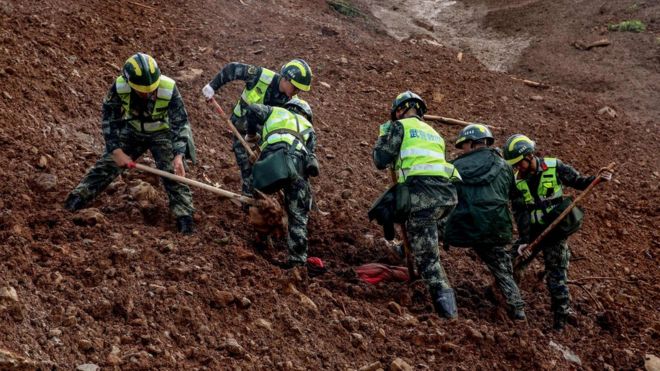 Image copyright AFP
At least 36 people are now known to have died in a landslide that struck a village in southern China on Tuesday.
State-run local media also report that 15 people have been missing since a wave of mud buried more than 20 houses in the province of Guizhou.
Chinese authorities told Xinhua news agency that another 40 people had been rescued from the landslide in Shuicheng county.
It comes as heavy rains continue to batter parts of the country.
Two children and a mother with a baby are reportedly among the dead, but details are still unclear.
Footage from state broadcaster CCTV show rescue workers using diggers to unearth survivors from a huge mound in the village.
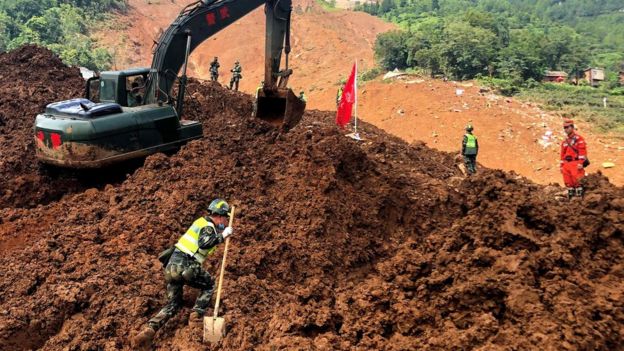 Image copyright AFP
A local school has also been commandeered as a emergency medical and rescue centre for victims.
According to Xinhua, the government has reportedly set aside 30 million yuan ($4.4m; £3.5m) for rescue efforts and the relocation of victims.
Landslides are common in rural and mountainous areas of China, especially after heavy rain.
Last month, footage emerged of a landslide in Fujian province in the country’s southeast.
Several other people have also been killed and thousands have been evacuated from their homes this year as a result of rain and flooding.

Huang Kunming (R), a member of the Political Bureau of the Communist Party of China (CPC) Central Committee, a member of the Secretariat of the CPC Central Committee and head of the Publicity Department of the CPC Central Committee, holds talks with Vo Van Thuong, head of the Communist Party of Vietnam (CPV) Central Committee’s Communication and Education Commission, before the fifteenth theory seminar between the CPC and the CPV in Guiyang, capital of southwest China’s Guizhou Province, on July 21, 2019. (Xinhua/Xie Huanchi)
GUIYANG, July 21 (Xinhua) — The Communist Party of China (CPC) and the Communist Party of Vietnam (CPV) held their fifteenth theory seminar on Sunday in Guiyang, southwest China’s Guizhou Province.
The seminar focused on exploring laws of socialist modernization in China and Vietnam.
The opening ceremony of the seminar was attended by Huang Kunming, a member of the Political Bureau of the CPC Central Committee and also a member of the Secretariat of the CPC Central Committee, and Vo Van Thuong, head of the CPV Central Committee’s Communication and Education Commission.
Huang said in his keynote speech that the CPC has led the Chinese people in successfully creating the road of modernization construction with Chinese characteristics that has promoted the fast development of the country, based on the national conditions and by adhering to putting the people first, taking the economic construction as the central task and adhering to the reform and opening up.
Prior to the seminar, Huang, who is also head of the Publicity Department of the CPC Central Committee, held talks with Thuong. They exchanged views on deepening relations between the two parties and two countries and on enhancing media exchanges and cooperation.
Source: Xinhua

Villagers clean a house damaged by floods at Jiangbei Village of Banlan Township, Rongan County, south China’s Guangxi Zhuang Autonomous Region,July 14, 2019. A series of reconstructing and rescuing works have been done since Rong’an was hit by heavy rains recently. (Xinhua/Huang Xiaobang)
BEIJING, July 14 (Xinhua) — At least 17 people were killed or missing and thousands evacuated as torrential downpours unleashed floods and toppled houses in central, eastern and southern China.
The National Meteorological Center on Sunday renewed a blue alert for rainstorms, predicting heavy rain in Zhejiang, Fujian, Jiangxi, Hunan, Guangdong, Yunnan, Sichuan provinces, as well as Guangxi Zhuang Autonomous Region and Tibet Autonomous Region.
Some of those regions will see up to 120 mm of torrential rainfall, it said.
China has a color-coded weather warning system, with red representing the most severe, followed by orange, yellow and blue.
As of 8 a.m. Sunday, at least 17 people died or were reported missing following rain-triggered floods in central Hunan Province, which also forced more than 470,000 people to be relocated and 179,000 were in urgent need of aid.
Four hydrometric stations along the Yangtze River in Xianning city, central Hubei Province, have reported the river water reaching or surpassing a level that can activate local anti-flood work.
In eastern Anhui Province, rain-triggered floods have affected more than 51,000 people and damaged over 2,700 hectares of crops.
The floods have forced the evacuation of 926 people, and caused a direct economic loss of more than 59.6 million yuan (8.66 million U.S. dollars) in the province.
As of Saturday noon, 330,000 people in 18 counties of Jiangxi Province have been affected by rainstorm-triggered floods, with over 10,500 residents relocated.
Poyang Lake, China’s largest freshwater lake in the lower reaches of the Yangtze, is swelling above the alarming level, according to the hydrographic department in Jiangxi.
The water level of the lake reached 20.08 meters as of 8 a.m. Saturday, 1.08 m above the warning level, as recorded by Xingzi Hydrometric Station on the lake.
In south China’s Guangxi Zhuang Autonomous Region, rainstorm has affected more than 360,000 people as of 5 p.m. Sunday, damaging over 35,000 hectares of crops, according to the region’s emergency management department.
The disastrous weather in Guangxi has prompted the region to activate a level-II emergency response and send special work teams and relief materials to the ravaged areas.
In some of the disaster-hit towns, flood water from subterranean rivers has inundated roads.
“After torrential downpours, waters on mountains and underground rivers converge into low-lying lands, which may lead to waterlogging. In affected villages, the water depth in some people’s houses can exceed two meters,” said Liao Bin, an official with Jiuwei Town, Hechi City.
Local authorities have dispatched boats and wooden rafts to transfer the stranded people, set up temporary relocation sites, and deliver living supplies to blocked villages.
Since June, the southwestern province of Guizhou has allocated a total of 16.5 million yuan for its hardest-hit 16 counties.
Source: Xinhua
GUIYANG, July 14 (Xinhua) — A completion ceremony for a new “Red Army Bridge” was hosted this week amid a cheerful tutti of gongs and drums in a small village in Liping County of southwest China’s Guizhou Province.
Shangshaozhai Village, with hundreds of years of history, was once separated from the outside world by a raging river. The only way leading outward was by boat.
Everything changed however in December 1934, when the passing-by Red Army built a wooden bridge together with local villagers.
From October 1934 to October 1936, the Red Army, the forerunner of the People’s Liberation Army (PLA), carried out a daring military maneuver that laid the foundation for the eventual victory of the Communist Party of China.
The Red Army marched through raging rivers, snowy mountains and arid grasslands to break the Kuomintang regime’s grip on the country and to continue their fight against Japanese invaders. Some of them marched as far as 12,500 km, enduring hunger, thirst and cold.
Wu Xiyan, 68, said his uncle was among the villagers who cooperated with the Red Army in building the bridge.
“They brought out all the available timber at home, and many of the villagers even volunteered to provide their bed and door boards,” said Wu. “The village truly needed a bridge.”
The bridge deck, one meter wide, is comprised of over 90 pieces of wooden boards. To commemorate the close relations between the Red Army and the local people, it was named “Red Army Bridge.”
Over 80 years on, the bridge remained the solitary channel for more than 600 villagers to exit and enter the village. Despite careful maintenance, it struggled to deal with the strain of local traffic.
Having learned the stories behind the bridge, in September 2017, Sinopec, a major Chinese state-owned enterprise, donated 1.8 million yuan (261,400 U.S. dollars) to build a new bridge for the village.
The new bridge, 4.5 meters wide, enables cars to drive across, with a weight capacity up to 20 tons.
Also named “Red Army Bridge,” the new bridge echoes its predecessor at a distance of 85 years and 50 meters.
The Red Army spirit is a treasure that the village has valued over all these years, said Wu, adding the village has done its best to preserve the old bridge over the years.
In 2012, a former Red Army member, over 90 years old, came to visit the bridge from eastern Zhejiang Province, Wu recalled.
He said the bridge looked exactly the same as what he saw in 1935, according to Wu.
“My uncle once told me the Red Army, passing by Shangshaozhai, promised that a better village would be built for us in the future,” Wu said.
“Over the course of my lifetime, I have been a constant witness to the fulfillment of this serious promise,” Wu said.
Source: Xinhua
BEIJING, July 7 (Xinhua) — Four work teams have been dispatched to four provincial-level regions in southern China, including Jiangxi, Hunan, Guangxi and Guizhou, to assist with local flood control efforts, according to the Ministry of Water Resources Sunday.
The National Meteorological Center earlier issued a yellow alert for heavy rains in the country’s southern regions. Characterized by wide coverage and long duration, the rainstorm would hit the regions with precipitation up to 180 mm in some areas.
Water levels of major rivers in southern China would be above the warning line, according to the weather forecast.
The ministry stresses that local governments should take targeted measures to prevent mountain torrents, ensure dam safety during floods and strengthen patrols on the levee system.
The ministry also asks local water resources departments to pay close attention to the weather conditions and raining and flood situation, issue alerts timely and move the people out of the dangerous areas in time.
China has a four-tier color-coded weather warning system, with red representing the most severe, followed by orange, yellow and blue.
The China Meteorological Administration on Sunday also issued a grade-IV response for the upcoming rains. The grade-IV response, the lowest in China’s emergency response system, means a 24-hour alert, daily damage reports, and the allocation of money and relief materials within 48 hours.
Source: Xinhua
WUHAN, July 6 (Xinhua) — The middle and lower reaches of the Yangtze River, China’s longest river, is likely to see flooding as a new round of sustained strong rainfall is forecast to lash the region from Sunday to next Wednesday, the Changjiang Water Resources Commission said Saturday.
Hydrometeorological forecasts show heavy rain with a precipitation ranging between 120 mm and 210 mm will hit the Yangtze’s middle and lower reaches in the following four days, causing the water levels of the mighty river’s many tributaries to reach alarming levels.
Some small and medium-sized rivers in Chongqing Municipality and the provinces of Hunan, Hubei, Jiangxi, Anhui, Jiangsu and Guizhou are also likely to see relatively serious flooding, according to the commission.
The commission activated an emergency response for flooding Saturday noon and advised local governments in affected areas to take precautions against possible disasters.
Source: Xinhua
BEIJING, July 6 (Xinhua) — Valuable tea plants are flourishing on around 67 hectares of tea farms in Qingchuan County of southwest China’s Sichuan Province, bringing new hope to impoverished locals.
“Tea plants are growing so well that I believe our lives will be better and better in the future,” said Jiao Yuan’en, a 66-year-old local villager, in the upbeat mood.
Jiao’s tea plants are grown from seedlings donated by tea farmers, thousands of miles away in Anji of eastern Zhejiang Province, as a gift to help alleviate poverty.
In April 2018, 20 tea farmers from Huangdu village of Anji, a well-known tea planting area, wrote a letter to Xi Jinping, general secretary of the Communist Party of China Central Committee, proposing to donate 15 million tea seedlings to poor areas.
Responding to their letter, Xi praised their move and called on Party members to share the Party’s burdens and encourage those who get rich first to help latecomers in the battle against poverty.
With Xi paying close attention to this project, the State Council Leading Group Office of Poverty Alleviation and Development chose 34 impoverished villages in provinces of Guizhou, Hunan and Sichuan to receive the seedlings.
By the end of March this year, a total of 16.65 million seedlings from Huangdu village were planted in around 358 hectares of land, involving 1,862 needy households, and more than 95 percent of the seedlings have survived.
In Guizhou, the donated tea seedlings helped inspire other locals to engage in tea planting, and in Hunan, tea farms were incorporated into local tourism.
The kind-hearted action from Anji farmers is expected to help 5,839 villagers improve their livelihood and lift them out of poverty when the tea plants are ripe for harvest in the spring of 2020.
China aims to lift all rural residents living below the current poverty line out of poverty by the year 2020.
Source: Xinhua

continuously updated blog about China & India
continuously updated blog about China & India
continuously updated blog about China & India
 CHINDIA ALERT: You'll be living in their world, very soon