Archive for ‘hospitalised’

07/05/2020

Gas leak at S.Korea-owned factory in India kills 11, hundreds hospitalised

CHENNAI (Reuters) – At least 11 people were killed in India in a gas leak at a South Korean-owned factory making polystyrene products that made hundreds of people sick and led to the evacuation of villagers living nearby, officials said.

The accident occurred some 14 km (9 miles) inland from the east coast city of Visakhapatnam, in Andhra Pradesh state, at a plant operated by LG Polymers, a unit of South Korea’s biggest petrochemical maker, LG Chem Ltd.

Srijana Gummalla, commissioner of the Greater Visakhapatnam Municipal Corporation, said gas from styrene, a principal raw materials at the plant, leaked during the early hours of the morning, when families in the surrounding villages were asleep.

Yashwanth Saikumar Ambati, 23, who lives about 300 metres away from the plant, said he woke up around 4.30 a.m. because of a strong smell.

“I went back to sleep and I woke up around 6 because the smell got stronger. My eyes were itchy, and I was feeling drowsy, light-headed and slightly breathless,” he told Reuters, adding that neighbours also complained of eye irritation and stomach aches.

In a statement issued from Seoul, LG Chem said that the gas emitted in the leak can cause nausea and dizziness when inhaled, adding that it was seeking to ensure casualties received treatment quickly.

Video from Reuters partner ANI shot later on Thursday showed emergency workers in the area rushing to help victims, some of whom appeared to be listless and disoriented.

A number of victims lay unconscious on the streetside, as volunteers fanned them and others carried them to ambulances.

A spokesman for LG Chem in Seoul said the leak was discovered by a night shift maintenance worker and has been brought under control.

According to both the company spokesman and Gummalla, the plant was being reopened after India relaxed a nationwide lockdown that had been imposed on March 25 to contain the spread of the new coronavirus.

Thursday’s incident brought back bad memories of a gas leak at an factory of U.S. chemical firm Union Carbide that killed thousands in the central Indian city of Bhopal in 1984, but thankfully it was on a far smaller scale.

“I pray for everyone’s safety and well-being in Visakhapatnam,” Prime Minister Narendra Modi said in a tweet.

S.N. Pradhan, director general of the National Disaster Response Force, said that at least 11 had died after around 1,000 people living near the plant were exposed to the gas.

FALLING, RUNNING AWAY

B.V. Rani, a revenue official in the district, said she received a call at around 4 a.m. from a police officer near the facility, who sounded panicky. “He asked me to come to the spot immediately,” Rani told Reuters.

When Rani went there, she saw that people had collapsed unconscious in the village adjoining the 60-acre site of the plant.

“I personally helped more than 15 people get to an ambulance who had tried to run away from the village but dropped down within a few metres,” she said.

At least one child was among the dead, a policeman at the site told ANI, whose video showed at least two other children being lifted into an ambulance.

Between 300-400 people were hospitalised, Swarupa Rani, an Assistant Commissioner of Police in Visakhapatnam told Reuters. Another 1,500 people had been evacuated, mostly from a neighbouring village.

Areas within approximately 3-kilometre (nearly 2-mile) radius of the plant were evacuated, he said, with emergency services going from door-to-door to find anyone left behind.

TOP PETROCHEMICAL MAKER

Andhra Pradesh Chief Minister Jagan Mohan Reddy said in a televised address that the gas leak occurred because raw material was stored for a long period of time.

The state government will give 10 million rupees ($131,900) compensation to the families to those who died, and it will also form a panel to investigate the cause of the accident, said P.V. Ramesh, a senior aide to the chief minister.

“Obviously something has gone wrong,” Ramesh told Reuters. “Nobody will be spared.”

LG Chem’s share priced closed nearly 2% weaker on Thursday, in a Seoul market that was broadly flat.

South Korea’s top petrochemical maker by capacity, LG Chem acquired the plant in 1997 and established LG Polymers India Private Limited (LGPI), according to a company website.

The LG Polymers plant makes polystyrene products which are used in manufacturing electric fan blades, cups and cutlery and containers for cosmetic products such as make up.

“LG Polymers is a multi national, reputed company, and it is sad that the incident has happened in their plant,” Chief Minister Reddy said in a televised media address.

($1 = 75.8140 Indian rupees)

Source: Reuters

31/03/2020

Coronavirus latest: New York begs for help; Indonesia bans foreigners entry; Italy extends lockdown

  • US death toll passes 3,000 as New York’s hospitals are pushed to breaking point
  • Italy extends lockdown as cases exceed 100,000; UN Security Council votes by email for first time
The USNS Comfort passes the Statue of Liberty as it enters New York Harbour on Monday. Photo: Reuters

Harsh lockdowns aimed at halting the march of the coronavirus pandemic extended worldwide Monday as the death toll soared toward 37,000 amid new waves of US outbreaks.

The tough measures that have confined some two-fifths of the globe’s population to their homes were broadened. Moscow and Lagos joined the roll call of cities around the globe with eerily empty streets, while Virginia and Maryland became the latest US states to announce emergency stay-at-home orders, followed quickly by the capital city Washington.

In a symbol of the scale of the challenge facing humanity, a US military medical ship sailed into New York to relieve the pressure on overwhelmed hospitals bracing for the peak of the pandemic.

France reported its highest daily number of deaths since the outbreak began, saying 418 more people had succumbed in hospital.

Spain, which announced another 812 virus deaths in 24 hours, joined the United States and Italy in surpassing the number of cases in China, where the disease was first detected in December.

On Tuesday, mainland China reported a rise in new confirmed coronavirus cases, reversing four days of declines, due to an uptick in infections involving travellers arriving from overseas.

Mainland China had 48 new cases on Monday, the National Health Commission said, up from 31 new infections a day earlier.

All of the 48 cases were imported, bringing the total number of imported cases in China to 771 as of Monday.

There was no reported new case of local infection on Monday, according to the National Health Commission. The total number of infections reported in mainland China stood at 81,518 and the death toll at 3,305. Globally, more than 760,000 have been infected, according to official figures.

Here are the developments:

Hospital ship arrives in New York

New York’s governor issued an urgent appeal for medical volunteers Monday amid a “staggering” number of deaths from the coronavirus, saying: “Please come help us in New York, now.”

The plea from Governor Andrew Cuomo came as the death toll in New York State climbed past 1,200 – with most of the victims in the big city – and authorities warned that the crisis pushing New York’s hospitals to the breaking point is just a preview of what other cities across the US could soon face.

Cuomo said the city needs 1 million additional health care workers.

“We’ve lost over 1,000 New Yorkers,” he said. “To me, we’re beyond staggering already. We’ve reached staggering.”

The governor’s plea came as a 1,000-bed US Navy hospital ship docked in Manhattan on Monday and a field hospital was going up in Central Park for coronavirus patients.

New York City reported 914 deaths from the virus as of 4:30pm local time Monday, a 16 per cent increase from an update six hours earlier. The city, the epicentre of the US outbreak, has 38,087 confirmed cases, up by more than 1,800 from earlier in the day.

Coronavirus field hospital set up in New York’s Central Park as city’s health crisis deepens

Gloom for 24 million people in Asia

The economic fallout from the coronavirus pandemic will prevent almost 24 million people from escaping poverty in East Asia and the Pacific this year, according to the World Bank.

In a report released on Monday, the Washington-based lender also warned of “substantially higher risk” among households that depend on industries particularly vulnerable to the impact of Covid-19. These include tourism in Thailand and the Pacific islands; manufacturing in Vietnam and Cambodia; and among people dependent on “informal labour” in all countries.

The World Bank urged the region to invest in expanding conventional health care and medical equipment factories, as well as taking innovative measures like converting ordinary hospital beds for ICU use and rapidly trining people to work in basic care.

Billionaire blasted for his Instagram-perfect isolation on luxury yacht

31 Mar 2020

Indonesia bans entry of foreigners

Indonesia barred foreign nationals from entering the country as the world’s fourth-most populous country stepped up efforts to contain the spread of the coronavirus pandemic.

The travel ban, to be effective soon, will also cover foreigners transiting through the country, Foreign Minister Retno Marsudi said after a cabinet meeting in Jakarta Tuesday. The curbs will not apply to holders of work permits, diplomats and other official visitors, she said.

The curbs on foreign citizens is the latest in a raft of measures taken by Indonesia to combat the deadly virus that’s sickened more than 1,400 people and killed 122. President Joko Widodo’s administration previously banned flights to and from mainland China and some of the virus-hit regions in Italy, South Korea and Iran. The president on Monday ordered stricter implementation of social distancing and health quarantine amid calls for a lockdown to contain the pandemic.

Indonesia has highest coronavirus mortality rate in Southeast Asia

First US service member dies

The first US military service member has died from the coronavirus, the Pentagon said on Monday, as it reported another sharp hike in the number of infected troops.

The Pentagon said it was a New Jersey Army National Guardsman who had tested positive for Covid-19 and had been hospitalised since March 21. He died on Saturday, it said.

Earlier on Monday, the Pentagon said that 568 troops had tested positive for the coronavirus, up from 280 on Thursday. More than 450 Defence Department civilians, contractors and dependents have also tested positive, it said.

US military has decided to stop providing more granular data about coronavirus infections within its ranks, citing concern that the information might be used by adversaries as the virus spreads.

The new policy, which the Pentagon detailed in a statement on Monday, appears to underscore US military concerns about the potential trajectory of the virus over the coming months – both at home and abroad.

School to resume in South Korea … online

South Korean children will start the new school year on April 9 with only online classes, after repeated delays due to the outbreak of the new coronavirus, the government said Tuesday.

Prime Minister Chung Sye Kyun said that despite the nation’s utmost efforts to contain the virus and lower the risk of infection, there is consensus among teachers and others that it is too early to let children go back to school.

The nation’s elementary schools, and junior and senior high schools were supposed to start the new academic year in early March, but the government has repeatedly postponed it to keep the virus from spreading among children.

The start was last postponed until April 6, but has now been delayed three more days to allow preparations to be made for online classes.

The nation now has 9,786 confirmed cases in total, with 162 deaths.

Italy extends lockdown as cases exceed 100,000

Italy’s government on Monday said it would extend its nationwide lockdown measures
against a coronavirus outbreak, due to end on Friday, at least until the Easter season in April.
The Health Ministry did not give a date for the new end of the lockdown, but said it would be in a law the government would propose. Easter Sunday is April 12 this year. Italy is predominantly Roman Catholic and contains the Vatican, the heart of the church.

Italians have been under lockdown for three weeks, with most shops, bars and restaurants shut and people forbidden from leaving their homes for all but non-essential needs.

Italy, which is the world’s hardest hit country in terms of number of deaths and accounts for more than a third of all global fatalities, saw its total death tally rise to 11,591 since the outbreak emerged in northern regions on February 21.

The death toll has risen by 812 in the last 24 hours, the Civil Protection Agency said, reversing two days of declines, although the number of new cases rose by just 4,050, the lowest increase since March 17, reaching a total of 101,739.

Deadliest day in Italy and Spain shows worst not over yet

28 Mar 2020
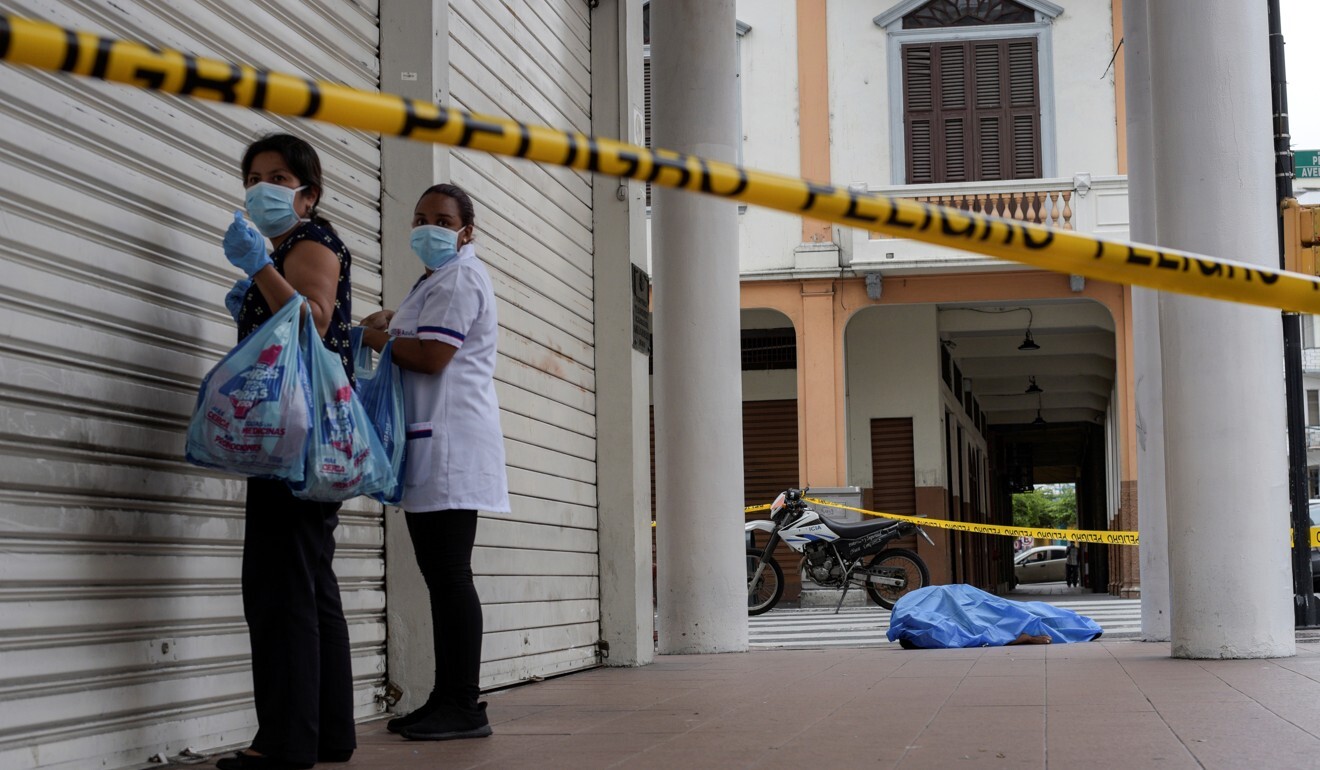
Women stand near the body of a man who died on the sidewalk in Guayaquil, Ecuador. Photo: Reuters

Ecuador struggles to collect the dead

Ecuadorean authorities said they would improve the collection of corpses, as delays related to the rapid spread of the new coronavirus has left families keeping their loved ones’ bodies in their homes for days in some cases.

Residents of Guayaquil, Ecuador’s largest city, have complained they have no way to dispose of relatives’ remains due to strict quarantine and curfew measures designed to prevent spread of the disease. Last week, authorities said they had removed 100 corpses from homes in Guayaquil.

But delays in collecting bodies in the Andean country, which has reported 1,966 cases of the virus and 62 deaths, were evident midday on Monday in downtown Guayaquil, where a man’s dead body lay on a sidewalk under a blue plastic sheet. Police said the man had collapsed while waiting in line to enter a store. Hours later, the body had been removed.

More than 70 per cent of the country’s coronavirus cases, which is among the highest tallies in Latin America, are in the southern province of Guayas, where Guayaquil is located.

Panama to restrict movement by gender

The government of Panama announced strict quarantine measures that separate citizens by gender in an effort to slow the spread of the novel coronavirus.

From Wednesday, men and women will only be able to leave their homes for two hours at a time, and on different days. Until now, quarantine regulations were not based on gender.

Men will be able to go to the supermarket or the pharmacy on Tuesdays, Thursdays and Saturdays, and women will be allowed out on Mondays, Wednesdays and Fridays.

No one will be allowed to go out on Sundays. The new measures will last for 15 days.

Police in Kenya use tear gas to enforce coronavirus curfew

Remote vote first for UN Security Council

The UN Security Council on Monday for the first time approved resolutions remotely after painstaking negotiations among diplomats who are teleworking due to the coronavirus pandemic.

The Security Council unanimously voted by email for four resolutions, including one that extended through April 2021 the expiring mandate of UN experts who are monitoring sanctions on North Korea, diplomats said.

The UN mission in Somalia was also prolonged, until the end of June, and the mission in Darfur until the end of May – two short periods decided due to uncertainty over the spread of the pandemic.

The Council also endorsed a fourth resolution aimed at improving the protection for peacekeepers.

The resolutions are the first approved by the Security Council since it began teleworking on March 12 and comes as Covid-19 rapidly spreads in New York, which has become the epicenter of the disease in the United States.

Congo ex-president dies in France

Former Republic of Congo president Jacques Joaquim Yhombi Opango died in France on Monday of the new coronavirus, his family said. He was 81.

Yhombi Opango, who led Congo-Brazzaville from 1977 until he was toppled in 1979, died at a Paris hospital of Covid-19, his son Jean-Jacques said. He had been ill before he contracted the virus.

Yhombi Opango was an army officer who rose to power after the assassination of president Marien Ngouabi.

Yhombi Opango was ousted by long-time ruler Denis Sassou Nguesso. Accused of taking part in a coup plot against Sassou Nguesso, Yhombi Opango was jailed from 1987 to 1990. He was released a few months before a 1991 national conference that introduced multiparty politics in the central African country.

When civil war broke out in Congo in 1997, Yhombi Opango fled into exile in France. He was finally able to return home in 2007, but then divided his time between France and Congo because of his health problems.

‘When I wake I cry’: France’s nurses face hell on coronavirus front line

31 Mar 2020

EU asks Britain to extend Brexit talks

The European Union expects Britain to seek an extension of its post-Brexit transition period beyond the end of the year, diplomats and officials said on Monday, as negotiations on trade have ground to a halt due to the coronavirus pandemic.

Europe has gone into a deep lockdown in a bid to curb the spread of the disease, with more than 330,000 infections reported on the continent and nearly 21,000 deaths.

In Britain, Prime Minister Boris Johnson and his health minister have both tested positive for the virus and the prime minister’s senior adviser Dominic Cummings – one of the masterminds behind Britain’s departure from the EU earlier this year – was self-isolating with symptoms.

London and the EU have been seeking to agree a new trade pact by the end of the year to kick in from 2021, even though the bloc has long said that such a time frame was extremely short to agree rules on everything from trade to security to fisheries.

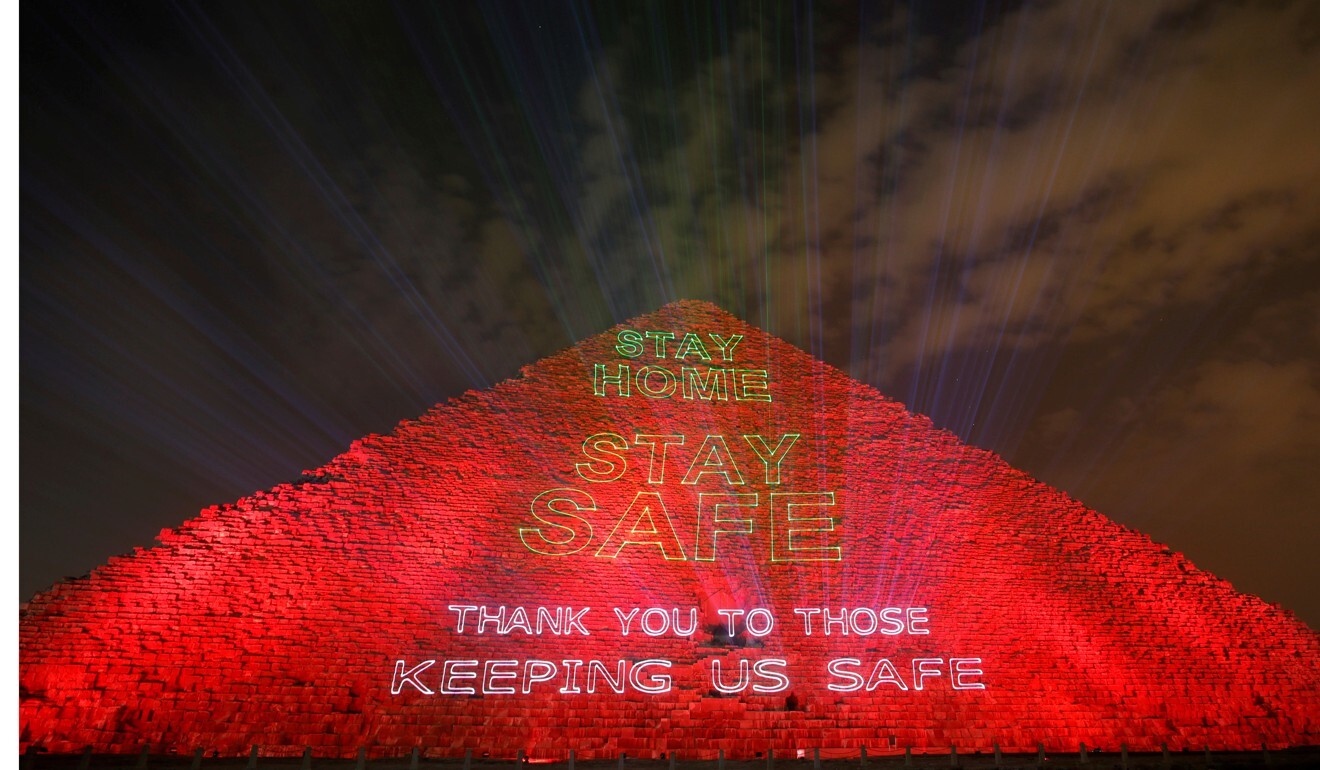
The pyramid of Khufu, the largest of the Giza pyramid complex. Photo: Reuters

Great Pyramid in Egypt lights up in solidarity

Egypt’s famed Great Pyramid was emblazoned Monday evening with messages of unity and solidarity with those battling the novel coronavirus the world over.

“Stay safe”, “Stay at home” and “Thank you to those keeping us safe,” flashed in blue and green lights across the towering structure at the Giza plateau, southwest of the capital Cairo.

Egypt has so far registered 656 Covid-19 cases, including 41 deaths. Of the total infected, 150 reportedly recovered.

Egypt has carried out sweeping disinfection operations at archaeological sites, museums and other sites across the country.

In tandem, strict social distancing measures were imposed to reduce the risk of contagion among the country’s 100 million inhabitants.

Tourist and religious sites are shuttered, schools are closed and air traffic halted.

Myanmar braces for ‘big outbreak’ after migrant worker exodus from Thailand
30 Mar 2020

Saudi king to pay for all patients’ treatment

Saudi Arabia will finance treatment for anyone infected with the coronavirus in the country, the health minister said on Monday.

The kingdom has registered eight deaths among 1,453 infections, the highest among the six Gulf Arab states.

Health Minister Tawfiq Al Rabiah said King Salman would cover treatment for citizens and residents diagnosed with the virus, urging people with symptoms to get tested.

“We are all in the same boat,” he told a news conference, adding that Crown Prince Mohammed bin Salman was overseeing containment efforts “night and day”.

Denmark eyes gradual reopening after Easter

Denmark may gradually lift a lockdown after Easter if the numbers of coronavirus cases and deaths remain stable, Prime Minister Mette Frederiksen said on Monday.

The Nordic country, which has reported 77 coronavirus-related deaths, last week extended until after Easter a two-week lockdown to limit physical contact between its citizens that began on March 11.

The number of daily deaths slowed to five on Sunday from eight and 11 on Saturday and Friday respectively. Denmark has reported a total of 2,577 coronavirus infections.

“If we over the next two weeks across Easter keep standing together by staying apart, and if the numbers remain stable for the next two weeks, then the government will begin a gradual, quiet and controlled opening of our society again, at the other side of Easter,” Frederiksen said.

Source: SCMP

01/11/2019

Help pours in for Chinese student who lived on 30 cents a day

Wu Huayan on her hospital bedImage copyright FENG VIDEO
Image caption Wu Huayan ate only rice and chillies in order to save money to help her ill brother

Well-wishers have donated almost a million yuan to a Chinese student who was hospitalised after living on 2 yuan ($0.30, £0.20) a day for five years.

The case of Wu Huayan shocked Chinese people after it hit the headlines earlier this week.

The 24-year old woman became seriously malnourished while struggling to study and support her sick brother.

Ms Wu’s story also sparked anger at authorities for failing to recognise her plight and help her much earlier.

After the story was reported, donations began pouring in for the college student in the city of Guiyang – reportedly totalling some 800,000 yuan ($114,000, £88,000).

What is Wu Huayan’s story?

Earlier, this month, the young woman went into hospital after having difficulty breathing, according to Chinese media.

She was only 135cm (4ft 5ins) tall, weighing barely more than 20kg (43 pounds; three stones).

The doctors found she was suffering from heart and kidney problems due to five years spent eating minimal amounts of food. She said she needed to save money to support her sick brother.

Wu Huayan lost her mother when she was four and her father died when she was in school.

She and her brother were then supported by their grandmother, and later by an uncle and aunt who could only support them with 300 yuan ($42, £32) each month.

Most of that money went on the medical bills of her younger brother, who had mental health problems.

This meant Ms Wu spent only 2 yuan a day on herself, surviving largely off chillies and rice.

The siblings are from Guizhou, one of the poorest provinces in China.

Media caption China’s uphill struggle fighting extreme poverty

What has the reaction been?

The case sparked an outpouring of concern – and anger at authorities.

Many people on social media said they wanted to help with donations, and many voiced concern about her college not helping her.

One user called her situation “worse than that of refugees in Afghanistan”, while another pointed to the extravagant cost of China’s 70th anniversary celebrations, saying the money could have been better spent.

Others expressed their admiration at her efforts to help her brother, while also persevering with her studies in college.

Aside from the donations on crowd funding platforms, her teachers and classmates donated 40,000 yuan ($5,700; £4,400), while local villagers collected 30,000 yuan to help her.

Officials released a statement saying Ms Wu had been receiving the minimum government subsidy – thought to be between 300 and 700 yuan a month – and was now getting an emergency relief fund of 20,000 yuan.

“We will keep following the case of this strong-minded and kind girl,” the Tongren City Civil Affairs Bureau said.

“We will actively co-operate with other relevant departments to solve the problem according to the minimum living standard and temporary assistance responsibility that the civil affairs department bears.”

How bad is poverty in China?

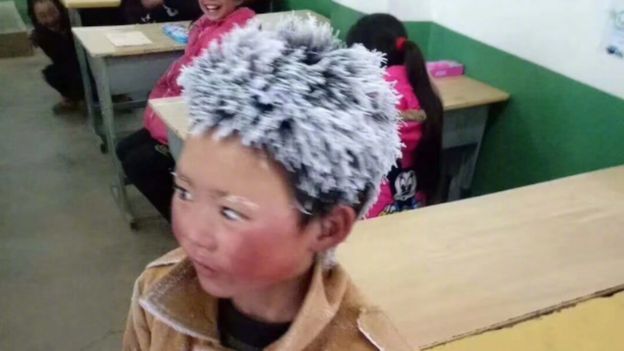
The case of Wu Huayan has echoes of a story from 2018 when a Chinese boy arrived at school with his hair full of frozen ice.

Dubbed “Little Wang”, his story also went viral, leading to international donations from people impressed by his resilience, and shocked at his poverty.

Wang, a left-behind migrant childImage copyright PEOPLE’S DAILY

While China’s economy has skyrocketed over the past decades, poverty has not disappeared, and inequality has grown.

One major reason cited is the huge divide between rural and urban areas.

According to the bureau, the per capita disposable income of a household in the capital Beijing was 57,229 yuan ($8,090; £6,300) in 2017.

As a point of comparison, in rural region of Guizhou where Ms Wu lives, that figure is around 16,703 yuan.

China has moved from being “moderately unequal in 1990 to being one of the world’s most unequal countries,” according to a 2018 report by the International Monetary Fund.

According to the National Bureau of Statistics in 2017, 30.46 million rural people were still living below the national poverty line of $1.90 a day.

China has previously pledged to “eliminate” poverty by 2020.

Source: The BBC

28/08/2019

Chinese man prevented from visiting Indian family

Wang Qi
Image caption Wang Qi has been waiting for months to see his family in India

In 1963, a former Chinese army surveyor crossed into India and was captured weeks after a war between the two countries. Wang Qi was then left in a central Indian town for more than five decades before he was allowed to travel back home to China in 2017.

The BBC reported his story at the time and videos of the emotional family reunion in China were watched by millions.

But now, more than 30 months later, his story has taken an unexpected turn – Mr Wang is stuck in China and unable to return to India.

He has been waiting for more than four months for officials to renew his Indian visa so that he can travel back to India where his children and grandchildren live.

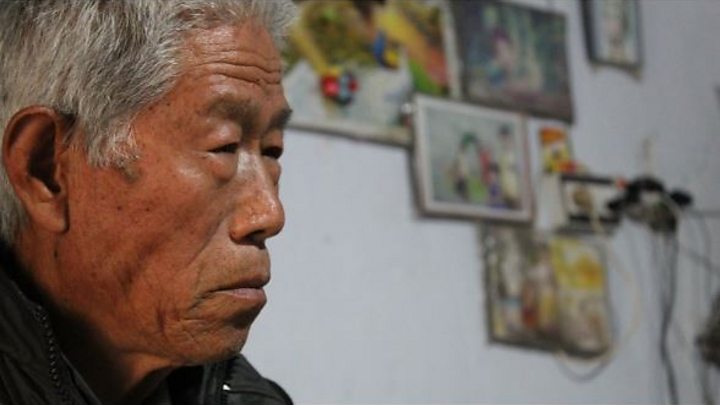
“Why are they doing this? I’ve been fighting for such a long time. How much longer can I fight?” Mr Wang told me over the phone from his home city of Xianyang.

The BBC has emailed the Indian embassy in Beijing and is yet to receive a response.

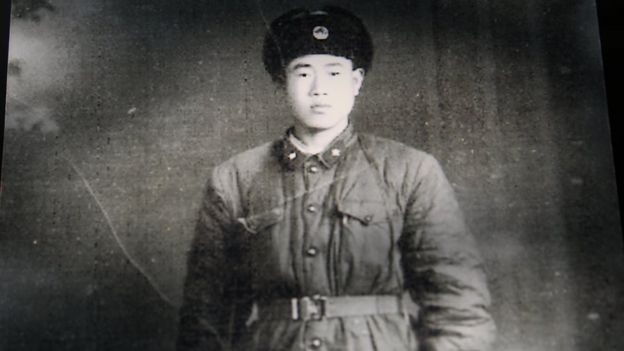
Born to a farmer family in Shaanxi with four brothers and two sisters, he studied surveying and joined China’s People’s Liberation Army in 1960.

Mr Wang says he was “tasked with building roads for the Chinese army” and was captured when he “strayed erroneously” into Indian territory in January 1963.

Wang Qi in Chinese army uniform
Image caption He joined China’s People’s Liberation Army in 1960

“I had gone out of my camp for a stroll but lost my way. I was tired and hungry. I saw a Red Cross vehicle and asked them to help me. They handed me over to the Indian army,” he said.

After he was captured, he spent the next seven years in multiple prisons before he was released by a court order in 1969.

Police took him to Tirodi, a far-flung village in the central state of Madhya Pradesh, where he ended up living for most of his life.

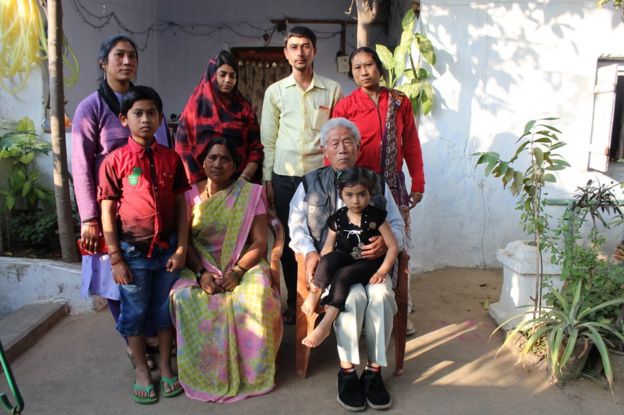
Instead he worked at a flour mill, eventually marrying a local woman and raising a family with her. Neighbours said they lived in “utter poverty”.

It was never clear whether Mr Wang was actually a prisoner of war. But he was denied official Indian documents or citizenship, and he was also denied permission to return to China. Officials told the BBC in 2017 that there were “deficiencies” and a “lack of interest” in the case over the years.

A Chinese passport holder, Mr Wang was reunited with his family in China in 2017. After the BBC reported his story, he received a one-year multiple entry Indian visa.

Media caption Wang Qi did not see his family in China for decades

He kept coming back to India to meet his wife, children and grandchildren who continued to live here.

When Mr Wang first arrived in China, he received a rapturous welcome. Crowds met him with banners reading, “Welcome home, soldier, it’s been a rough journey”.

But according to Mr Wang’s son, Vishnu, his father’s request to local officials to clear his salary for the period of his stay in India, remains unanswered.

Vishnu also adds that it’s unclear if his father still has any claim to ancestral property in China after being away for so many years.

“He was ecstatic to have met his family after decades. He didn’t want anything else.”

In 2017, Mr Wang rushed back to India to take care of his wife, who was hospitalised due to “liver complications”.

“Getting funds for the expensive treatment was very difficult. We tried everywhere, begged for money but didn’t receive any response,” Vishnu says.

She died within a fortnight.

Mr Wang with his family
Image caption Mr Wang married an Indian woman and raised a family with her

“My father’s visa was renewed in 2018. He applied again in April 2019 but he is still waiting,” Vishnu adds.

Xianyang and Beijing, where the Indian embassy is located, are more than 1,000 kilometres (621 miles) apart – and travelling between the two cities isn’t easy for Mr Wang, who is nearly 80 years old, Vishnu says.

“My father is fed up. He doesn’t understand why this is taking so long.”

Source: The BBC

23/02/2019

Bootleg liquor kills at least 84 in northeast India, 200 hospitalised

GUWAHATI, India (Reuters) – At least 84 people have died from drinking toxic bootleg liquor in the northeastern Indian state of C, and around 200 others have been hospitalised, a state government minister said on Saturday.

The deaths come less than two weeks after more than 100 people died from drinking tainted alcohol in two northern Indian states, Uttarkhand and Uttar Pradesh.

Police have arrested twelve people in connection with making bootleg alcohol in Assam, a practice local politicians say is rampant in the area’s tea estates, where its is drunk by poorly-paid labourers after a tough day’s work in the plantations.

“Every 10 minutes we are getting reports of casualties from different places. So far about 200 people are in hospital with many of them critical,” Assam Health Minister Himanta Biswa Sarma told Reuters via telephone.

“Doctors from nearby districts and other medical colleges have been rushed in to deal with the crisis,” said Sarma, after visiting patients at Jorhat, located some 300 kilometres east of the state’s financial hub, Guwahati.

Deaths from illegally produced alcohol, known locally as hooch or country liquor, are common in India, where many cannot afford branded spirits.

The death tolls from the two recent incidents, however, are believed to be the deadliest since a similar case killed 172 in West Bengal in 2011.

Dilip Rajbnonshi, a doctor at the government hospital in Golaghat, located some 40 kilometres southwest of Jorhat said the deaths were due to “spurious country liquor”.

A number of women are among the casualties. Many of those that drank the liquor were tea plantation workers who had just received their weekly wages, according to another state government official.

“I asked some of the patients why they consume liquor almost everyday and they said after a hard day’s work in the plantations they drink to relieve stress and tiredness,” health minister Sarma said.

Mrinal Saikia, a local lawmaker from the Bharatiya Janata Party – which is in control of the federal and Assam state governments – said alcohol, often laced with cattle feed and battery acid, is being supplied “in gallons” to tea plantation workers.

“This is a big business in areas surrounding tea gardens where people set up illegal distilleries to make country liquor,” he said.

Source: Reuters
Law of Unintended Consequences

continuously updated blog about China & India

ChiaHou's Book Reviews

continuously updated blog about China & India

What's wrong with the world; and its economy

continuously updated blog about China & India