01/10/2019
- 70th anniversary of the founding of the People’s Republic of China marked by its biggest ever military parade and huge civilian parade
- Xi says no force can stop China ‘marching forward’ and vows to protect the long-term stability of Hong Kong
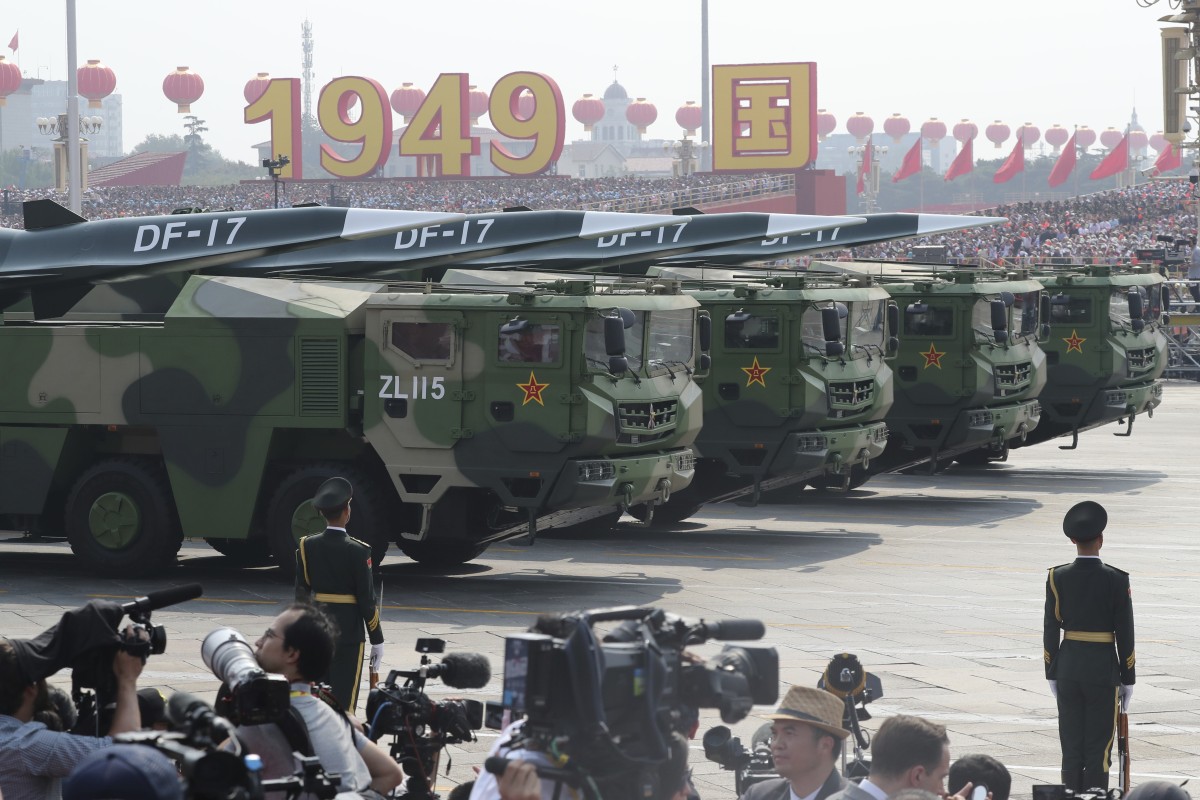
Military vehicles carry DF-17 missiles capable of reaching the US mainland during the parade to mark 70 years of the People’s Republic. Photo: AP
China staged a massive military parade in Beijing on Tuesday to mark the
70th anniversary of the founding of the People’s Republic, with much of the smog-shrouded capital city under a security lockdown.
President Xi Jinping inspected over 15,000 troops, more than 160 aircraft and 580 weapon systems in a show of the country’s growing military might and his drive to modernise the People’s Liberation Army.
He also delivered a bullish eight-minute speech hailing the accomplishments of seven decades of Communist rule and pledging to achieve his vision of a “Chinese dream” of national rejuvenation and global prominence.
Here are some of the key takeaways from a day of celebration in Beijing:
Xi presided over the ceremony in Tiananmen Square flanked by his predecessors Jiang Zemin and Hu Jintao, along with other retired and present party elders.
The rare appearance of Jiang and Hu – on the rostrum of the Gate of Heavenly Peace, where the country’s founding father Mao Zedong declared Communist rule on October 1, 1949 – was clearly aimed at projecting unity and solidarity in the face of daunting domestic and international challenges.
China’s National Day parade, as it happened
Hu had been absent from the funeral of former premier Li Peng in late July, although the ailing Jiang attended.
Former vice-president Zeng Qinghong and Song Ping, the oldest party elder in attendance, also appeared on the rostrum.
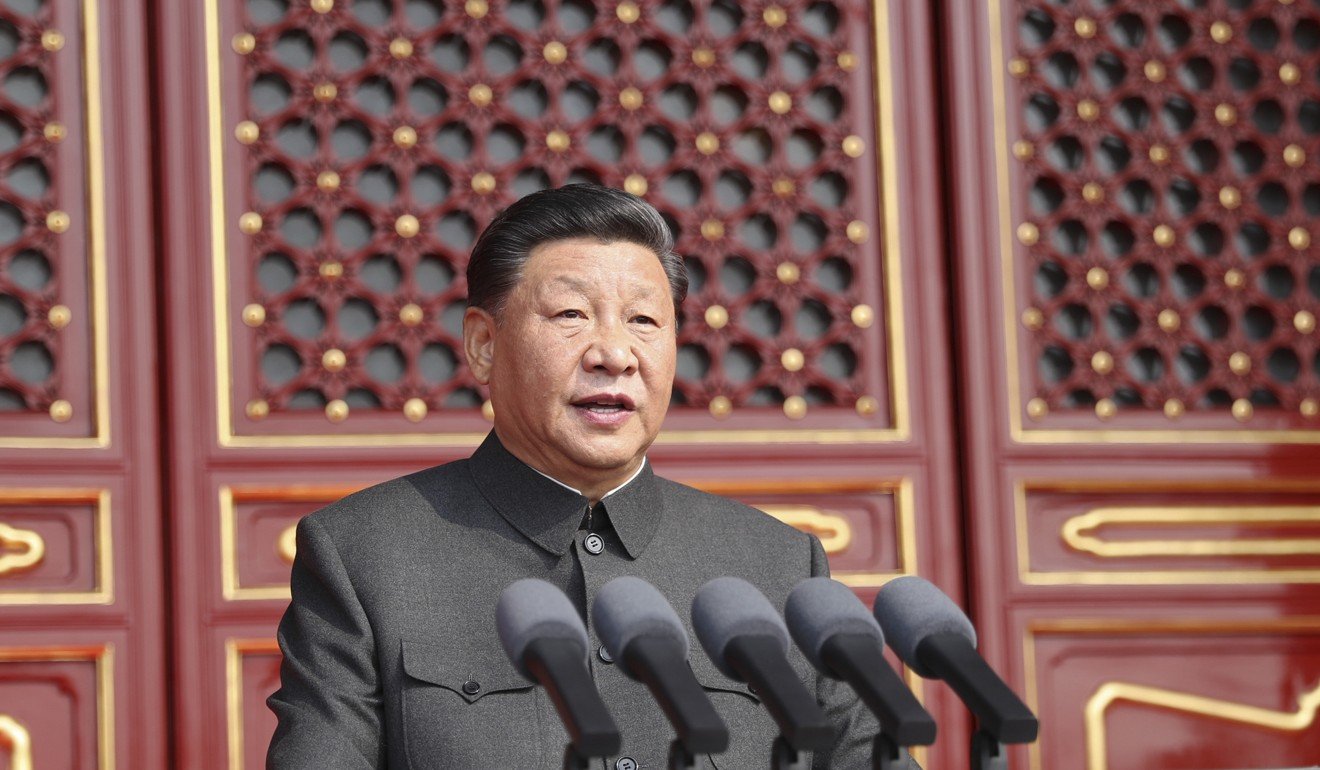
President Xi Jinping speaks in Tiananmen Square during Tuesday’s celebrations. Photo: Xinhua
But notably, while former premier Wen Jiabao was present, his predecessor Zhu Rongji was not.
‘No force can shake China’
Dressed in a Mao suit, Xi’s nationally televised speech invoked China’s “century of humiliation” and praised the achievements of its people, saying there was no force that could stop it forging ahead.
“No force can shake the status of our great motherland, and no force can stop the Chinese people and the Chinese nation from marching forward,” he said.
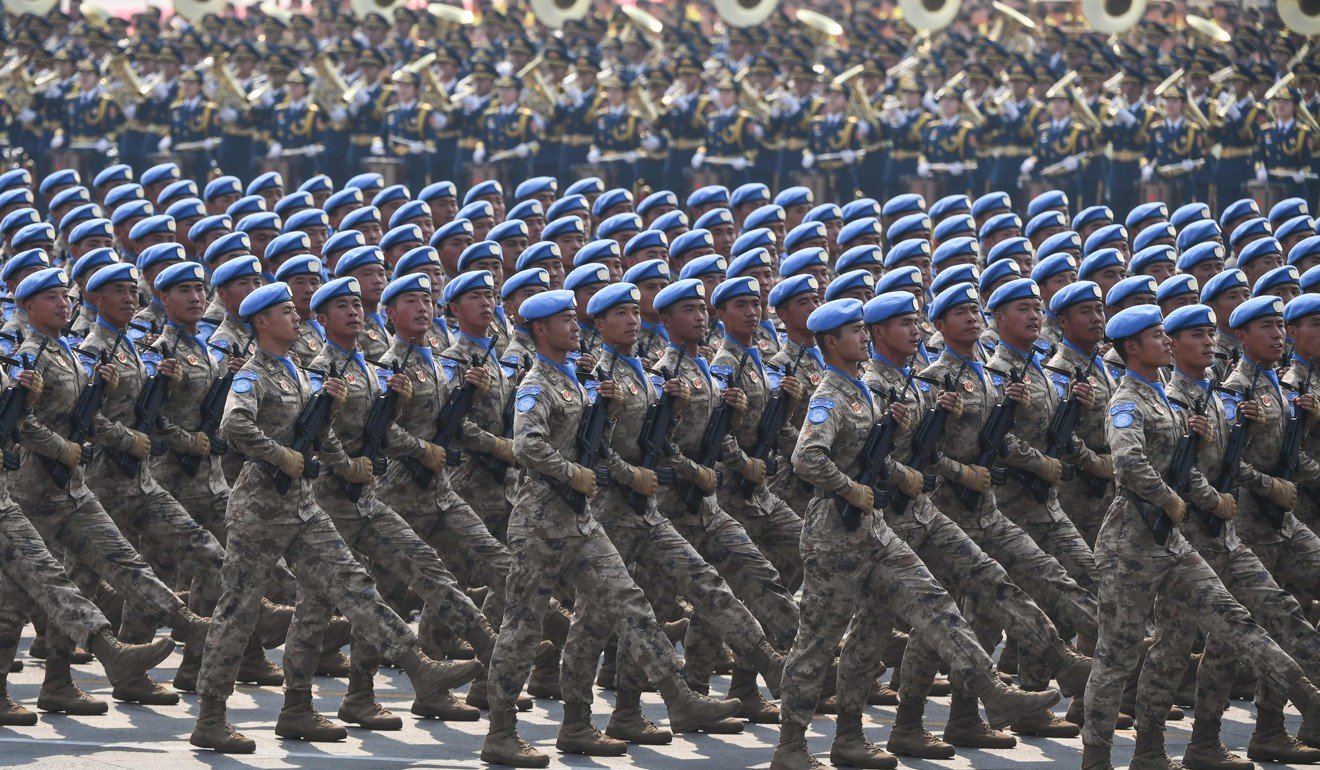
Chinese troops take part in the Republic’s largest ever military parade. Photo: AFP
“The People’s Liberation Army [PLA] will serve its purpose in safeguarding the sovereignty, security and development interests of the country, and world peace,” he said, at a time when Beijing has expanded its military footprint globally, including with its
first overseas military base in Djibouti.
Xi called on the Communist Party and the country to unite and continue to fight for the realisation of what he called the “Chinese dream” – the nation’s rejuvenation.
One country, two systems
Amid escalating unrest in Hong Kong, which has plunged the city into a deepening crisis and threatened to overshadow the National Day celebrations, Xi vowed that the central government would uphold “one country, two systems”.
He said the central government would protect the long-term stability of Hong Kong and Macau, and stressed the goal of “peaceful reunification” with the self-ruling Taiwan, repeating a message frequently used by his predecessors, including Deng Xiaoping, Jiang and Hu.
The theme of one country, two systems later appeared in a National Day parade for the first time, with placards forming the words: “Hong Kong’s tomorrow will be better.”
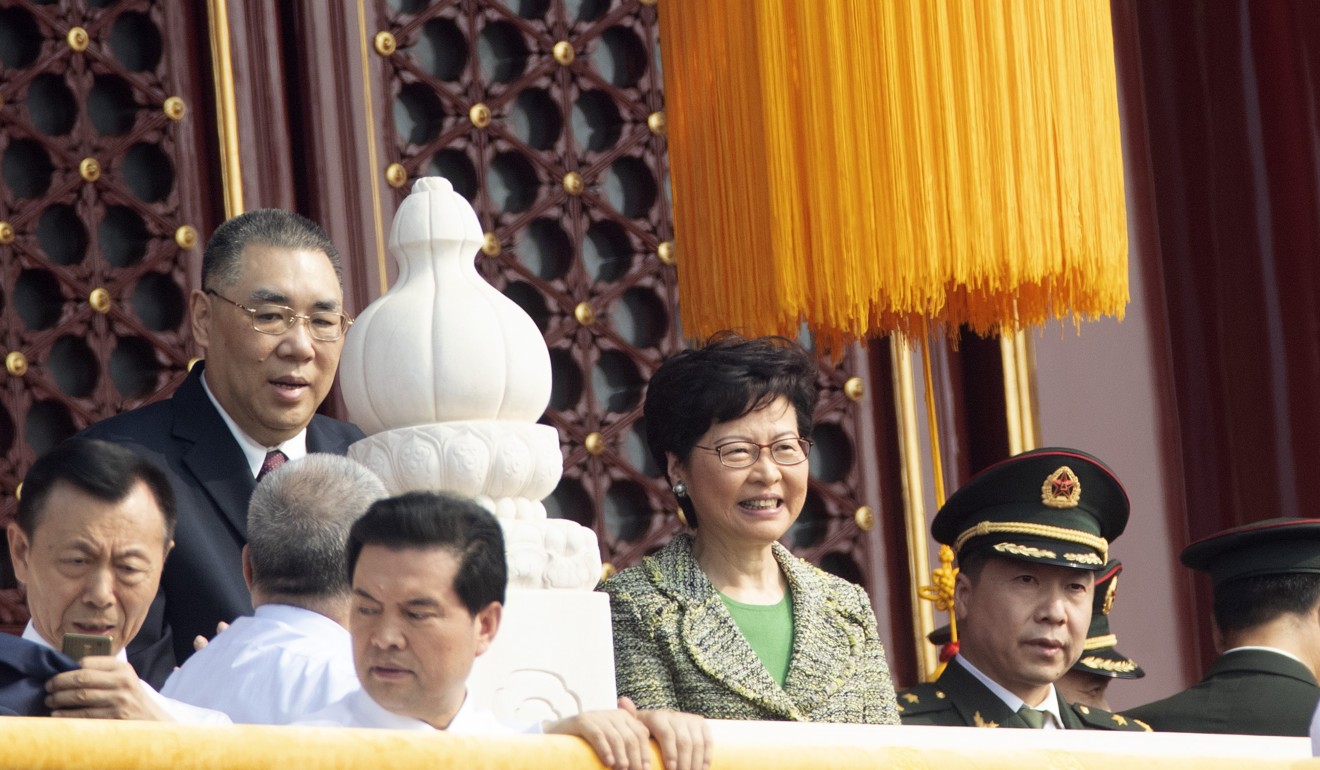
Hong Kong Chief Executive Cheng Yuet-ngor attended the ceremony, as did 10 Hong Kong police officers involved in suppressing
anti-government protests in the city.
Showing off new weapons
China’s advancement in military weaponry was on full display, with almost half of the items featured being shown to the public for the first time.
Hong Kong leader Carrie Lam was among the guests in Beijing on Tuesday. Photo: AP
The morning’s celebrations included an 80-minute military parade – the biggest since the founding of the People’s Republic – in an apparent effort to showcase the prowess of the PLA, the world’s biggest military with 2 million personnel.
Among the weapons shown were DF series missiles, including the DF-17, a nuclear-capable glider that has the capacity to strike the US mainland, and the DF-41, which has a range of up to 15,000km, making it the world’s longest-range military missile.
Signalling Xi’s status
A 100,000-strong civilian parade featuring huge portraits of Xi and predecessors including Mao, Deng, Jiang and Hu wrapped up the morning celebration.
The procession was divided into three parts, representing three eras of the People’s Republic: the Mao era, Deng’s reform and opening up, and Xi’s era, which seeks global prominence on a par with that of the United States.
Xi appeared keen to project his supreme status in the party, reinforced since he abolished the constitutional term limit a year ago, allowing him potentially to remain leader for life.
He waved at his own portrait, unveiled alongside a sign reading “Carry out Xi Jinping Thought on Socialism with Chinese Characteristics for a New Era”.
Source: SCMP
Posted in "one country, two systems", 70th anniversary, Aircraft, Beijing, Carrie Lam Cheng Yuet-ngor, Carry out Xi Jinping Thought on Socialism with Chinese Characteristics for a New Era, celebrates, Central government, century of humiliation, civilian parade, Communist rule, Country, development interests, DF-17 missiles, Djibouti, escalating unrest, founding father, founding of the People’s Republic of China, Gate of Heavenly Peace, global prominence, Hong Kong, Hong Kong Chief Executive, Hu Jintao, inspected, leader for life, Li Peng, long-term stability, Macau, Mao suit, Mao Zedong, marching forward, Military advances, military footprint globally, military parade, Military vehicles, National Day, National Day celebrations, national rejuvenation, October 1 1949, overseas military base, peaceful reunification, People's Liberation Army (PLA), People’s Liberation Army, People’s Liberation Army (PLA), president jiang zemin, President Xi Jinping, security, Song Ping, sovereignty, supreme status, Taiwan, The Chinese Dream, themes, Tiananmen Square, troops, Uncategorized, US mainland, weapon systems, Wen Jiabao, world peace, Xi JinPing, Zeng Qinghong, Zhu Rongji |
Leave a Comment »
22/09/2019
- October 1 event is intended to be a showcase for military’s progress under Xi Jinping, with J-20 stealth fighters set to take pride of place
- Domestically developed weapons are main focus of event despite long-standing problems in building aircraft engines
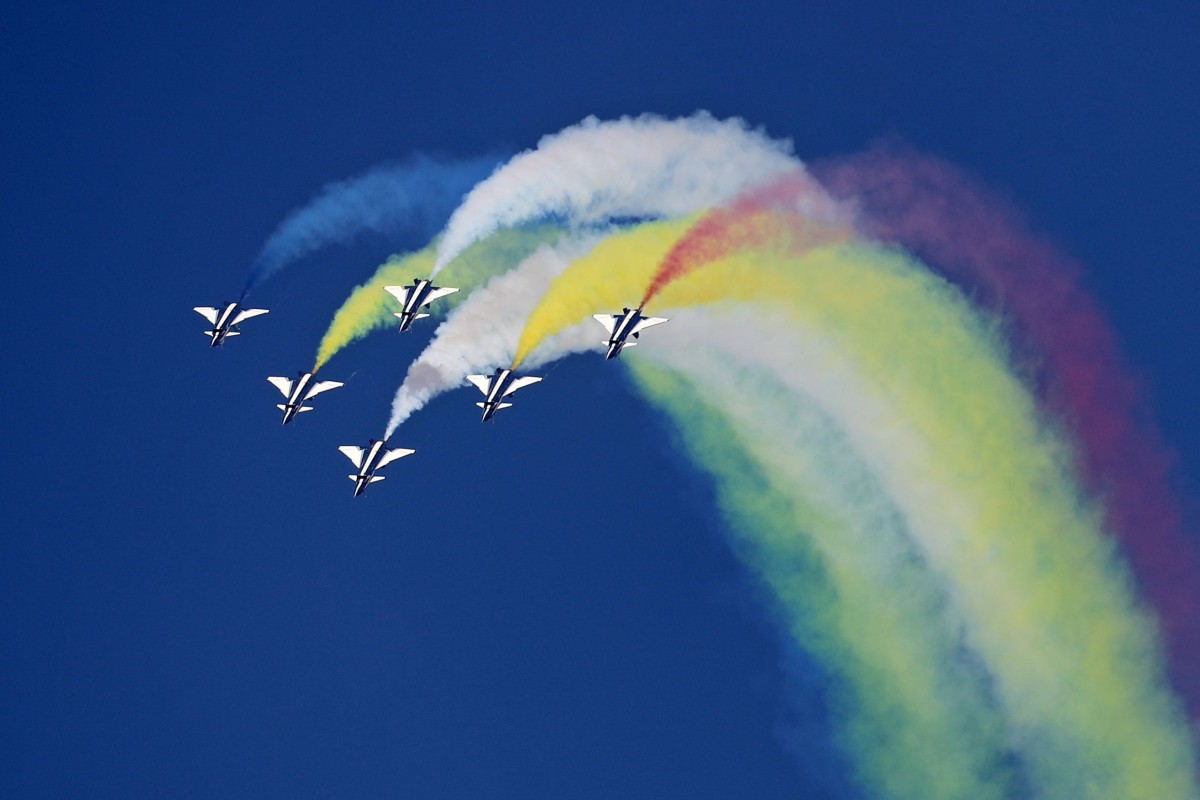
Chinese J-10 jets perform at the Dubai air show in 2017. Photo: AFP
China has stepped up intensive rehearsals for the upcoming National Day parade, which military insiders say is designed to showcase the achievements of Chinese President Xi Jinping’s modernisation drive.
The parade on October 1 will mark the 70th anniversary of the founding of the People’s Republic and will focus on weapons developed since Xi came to power in late 2012, despite long-standing problems in aircraft engine development.
Video clips circulating on mainland social media in recent days have shown at least seven types of aircraft – including the KJ-2000 airborne early warning and control aircraft and J-10 and J-11B fighter jets – taking part in rehearsals over the countryside around Beijing.
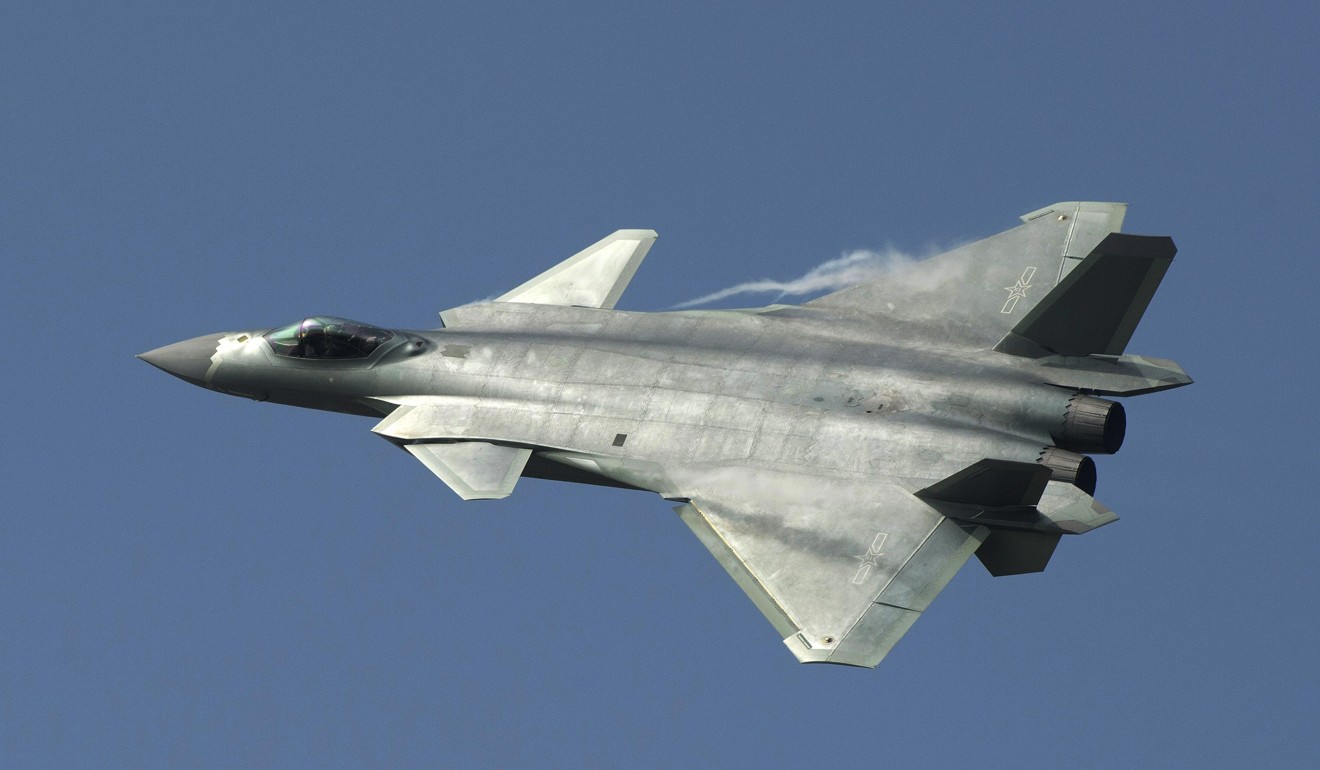
A military insider said the country’s first stealth fighter jet, the J-20, had been rehearsing over the western suburbs of the capital since April.
“There will be up to seven J-20 displayed in the military parade, which is the largest formation since its formal deployment to the Chinese air force in 2017,” the military insider said.
“The J-20 has entered mass production. So far at least 70 J-20s have been made, even though all of them are still equipped with Russian AL-31 engines.”
Earlier this month, the People’s Liberation Army Air Force released a video of a flight of seven J-20s, the largest formation seen so far, suggesting that the fifth-generation warplane has gone into mass production as an arms race with the United States mounts in the region.
The second-largest J-20 formation was shown in an air force video for PLA Day on August 1, when five of the jets were shown.
China has been forced to deploy the J-20 ahead of its schedule since the US has increased the deployment of its fifth-generation stealth fighter jets like the F-22 and F-35s in the Asia-Pacific region.
The US and its allies, including Japan and South Korea, will have more than 200 F-35s by 2025, which means China also needs a similar number of stealth fighters.
To meet demand, China has been working on the development of a purpose-built thrust engine for its stealth fighter since the early 2000s, but has yet to achieve international quality control standards due to problems that include single-crystal turbine blade technology.
China’s air force spreads its wings in 70th anniversary video
Hong Kong-based military commentator Song Zhongping said aircraft engine development had been a long-standing shortcoming but it would not affect the practical fighting capacity of the J-20, which currently uses Russian engines.
“The J-20 hasn’t used the domestic engines so far because it wants a better one, and it still has time,” Song said.
“Other [Chinese-developed] warplanes like the J-10, J-11 and multipurpose attack helicopters are all modified and advanced types, indicating comprehensive achievements amid China’s military modernisation over the past years.”
A Chinese J-20 stealth fighter has entered mass production. Photo: EPA-EFE
Besides the domestically developed aircraft, Beijing is going to display its strategic nuclear missiles, such as the DF-41 intercontinental ballistic missile and the JL-2 submarine-launched ballistic missile, as centrepieces of its National Day military parade, according to a Beijing-based military source.
Xi, who also chairs the powerful Central Military Commission, inspected the country’s biggest military parade at the Zhurihe Combined Tactics Training Base in Inner Mongolia in 2017 to celebrate the 90th anniversary of the PLA, but the source said the weapons displayed in Zhurihe had been developed under the leadership of Xi’s predecessor, Hu Jintao.
“Xi needs to highlight his personal achievements in his era, that’s why this year’s parade has political aims more than military significance,” the source said.
The source also highlighted the significance of the People’s Republic marking its 70th anniversary because the Soviet Union did not survive for that length of time.
“Xi is attempting to tell the outside world that Chinese communist regime has been consolidated under his leadership.”
Source: SCMP
Posted in 70th anniversary, 90th anniversary, Air show, aircraft engines, AL-31 engines, allies, Asia-Pacific region, Beijing, Central Military Commission, Central Military Commission (CMC), China’s air force, Chinese communist regime, Chinese fighter jet, countryside, domestically developed aircraft, Dubai, event, F-22, F-35, founding of the People’s Republic, Hong Kong, Hu Jintao, Inner Mongolia, J-11B fighter jets, J-20 stealth fighter, J-20 stealth fighters, Japan, KJ-2000 airborne early warning and control aircraft, Korea, military parade, multipurpose attack helicopters, National Day, National Day parade, October 1, People’s Liberation Army Air Force, PLA, preparations, pride of place, Russian, seen, single-crystal turbine blade technology, skies, Soviet Union, step up, strategic nuclear missiles, submarine-launched ballistic missile, Uncategorized, US, Xi JinPing, Zhurihe, Zhurihe Combined Tactics Training Base |
Leave a Comment »
23/06/2019
- Stalled denuclearisation talks also expected to be on the agenda when Chinese president meets Kim Jong-un this week
- Analysts say Korean peninsula has become intense diplomatic battleground between Beijing and Washington
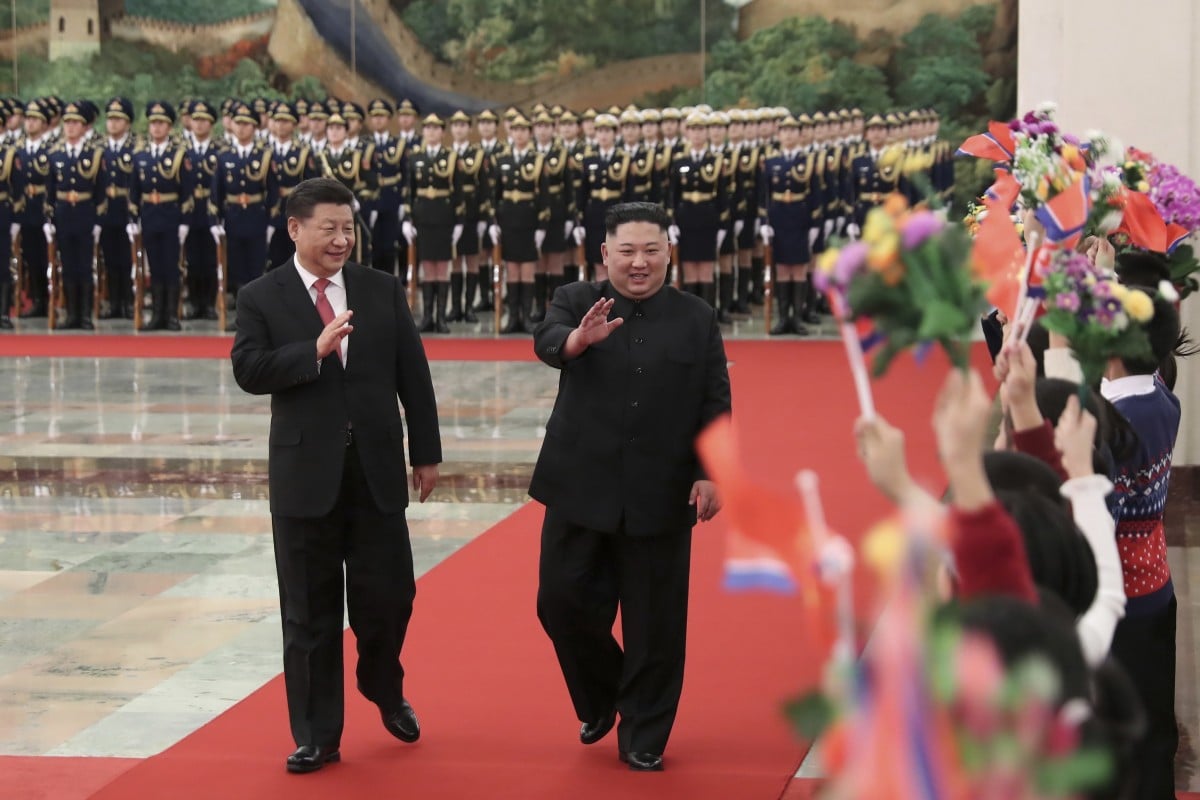
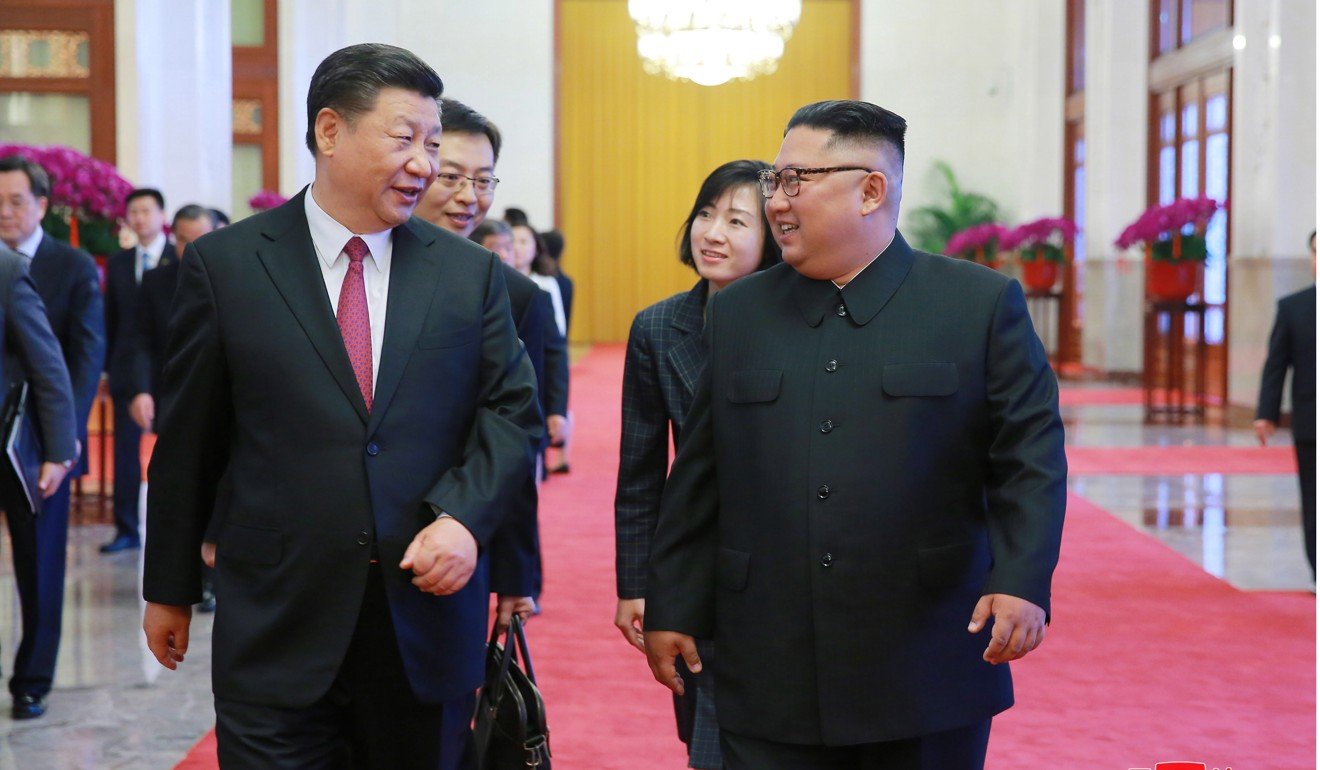
North Korean leader Kim Jong-un (right) attends a welcome ceremony in Beijing with Chinese President Xi Jinping in January. Xi will begin a visit to Pyongyang on Thursday. Photo: AP
Xi Jinping’s upcoming trip to
will be a state visit – a higher status than the last trip to the hermit kingdom by a Chinese president, highlighting the close bilateral ties between Beijing and Pyongyang.
Xi’s two-day trip, which
, is the first by a Chinese president to North Korea in 14 years and comes just a week before he is due to meet US President Donald Trump for talks on the sidelines of the Group of 20 summit in Japan.
“Leaders of the two countries will review the development of the bilateral relationship and carry out an in-depth exchange of opinions on the development of Sino-North Korean relations in the new era, and chart the future course of development,” state news agency Xinhua reported on Tuesday.
Xi’s predecessor, Hu Jintao, went to North Korea in October 2005 on a three-day trip described as an “official goodwill” visit.
Speaking at a regular press briefing in Beijing on Tuesday, foreign ministry spokesman Lu Kang said Xi’s visit aimed to “inject new impetus” into relations in the year the two countries marked the 70th anniversary of establishing diplomatic ties, and to give stalled denuclearisation talks a much needed push.
“Regarding the progress on denuclearisation, as I said, the result of the Hanoi leaders’ meeting in February was indeed a little unexpected. But after that, everyone actually looks forward to the resumption of dialogue in a good direction,” Lu said, referring to the failed talks between Trump and North Korean leader Kim Jong-un in the Vietnamese capital four months ago.
Trump hinted at the possibility of another meeting with Kim after receiving what he called “a beautiful letter” from the North Korean leader last week. On Tuesday, South Korea’s chief nuclear negotiator, Lee Do-hoon, said the US had been in contact with the North.
Life in North Korea the ‘admiration and envy’ of others, state media says
Washington will also send US Special Representative for North Korea Stephen Biegun to South Korea next week, days after Xi’s visit to Pyongyang, to fully align its position on North Korea with its ally.
Meanwhile, Trump confirmed he would meet Xi for talks in Osaka next week, saying in a tweet on Tuesday they had “a very good telephone conversation” and would hold “an extended meeting” at the G20 summit, where they are
over an almost year-long trade war.
Pyongyang has demanded the lifting of sanctions imposed on the regime following its nuclear and missile tests, while Beijing has said the livelihoods of North Koreans should not be affected. But Washington insists full sanctions should remain in place.
The US has also voiced scepticism about Chinese compliance with the sanctions. At a security summit in Singapore earlier this month, US acting Pentagon chief Patrick Shanahan – who on Wednesday stepped down from his role
– presented his Chinese counterpart Wei Fenghe with photographs and satellite images of North Korean ships transferring oil near China’s coast.
Analysts said Xi would seek to use the visit to boost China’s diplomatic leverage on the North Korean nuclear front, strengthening its hand in dealing with the US.
Exports from North Korea to China, which account for the bulk of its trade, plunged 87 per cent last year from 2017, and the country has faced other economic problems at a time when Kim has vowed to deliver on the economy.
A diplomatic source said China was expected to offer a large amount of humanitarian assistance, such as food and fertiliser, to North Korea, which could weaken the impact of sanctions.
China’s goal of denuclearisation on the Korean peninsula is unwavering and will not changeLu Chao, North Korean affairs expert at Liaoning Academy of Social Sciences
Communist Party mouthpiece People’s Daily on Tuesday said via its social media account that Xi would discuss economic and trade cooperation with Kim during the visit.
Quoting Zheng Jiyong, director of the Centre for Korean Studies at Fudan University in Shanghai, the newspaper said Pyongyang had taken steps to reform its economy and introduced China’s industrial manufacturing blueprint.
In September, Beijing proposed building a rail link from the city of Dandong, in China’s northeastern Liaoning province, to Pyongyang and then on to Seoul and Busan in the South, as well as a new road between Dandong and Pyongyang through Sinuiju.
Lu Chao, a North Korean affairs expert at the Liaoning Academy of Social Sciences, said large-scale economic cooperation between China and North Korea was unlikely because of the sanctions, but smaller moves were possible.
Chinese tourists flood North Korea as Beijing remains Pyongyang’s key ally
“For example, China may export daily necessities to North Korea. And if it’s needed, China is very likely to provide [food] assistance to North Korea,” Lu said. “I believe the UN sanctions on North Korea should change, because it has shown a more substantive approach to [achieving] denuclearisation.”
But analysts said Beijing remained firm on the need for Pyongyang to honour its pledges so that denuclearisation could be achieved.
“China’s goal of denuclearisation on the Korean peninsula is unwavering and will not change … China supports [North Korea] and the US continuing to hold talks,” Lu said.
Beijing also had an important part to play in the peace process, according to Boo Seung-chan, an adjunct professor at the Yonsei Institute for North Korean Studies in Seoul.
“China can have a positive role as a mediator to facilitate the peace process on the Korean peninsula,” Boo said.
Source: SCMP
Posted in aims, Asan Institute for Policy Studies, Beijing, Busan, Centre for Korean Studies, chinese tourists, Dandong, denuclearisation, diplomatic battleground, Fudan University, hermit kingdom, Hu Jintao, Kim Jong-un, Korean peninsula, Liaoning Academy of Social Sciences, Liaoning province, new impetus, North Korea, Patrick Shanahan, People’s Daily, President Donald Trump, President Xi Jinping, Pyongyang, Seoul, Shanghai, Singapore, Sino-North Korean relations, South Korea, State visit, ties, Uncategorized, US acting Pentagon chief, US Special Representative for North Korea, Washington, Wei Fenghe, Xinhua, Yonsei Institute for North Korean Studies |
Leave a Comment »
19/06/2019
- ‘Traditional friendship’ between two nations will continue whatever the future brings, Xi says ahead of two-day trip to Pyongyang
- Visit comes amid rising tensions between Beijing and Washington, and stalled negotiations on the denuclearisation of the Korean peninsula
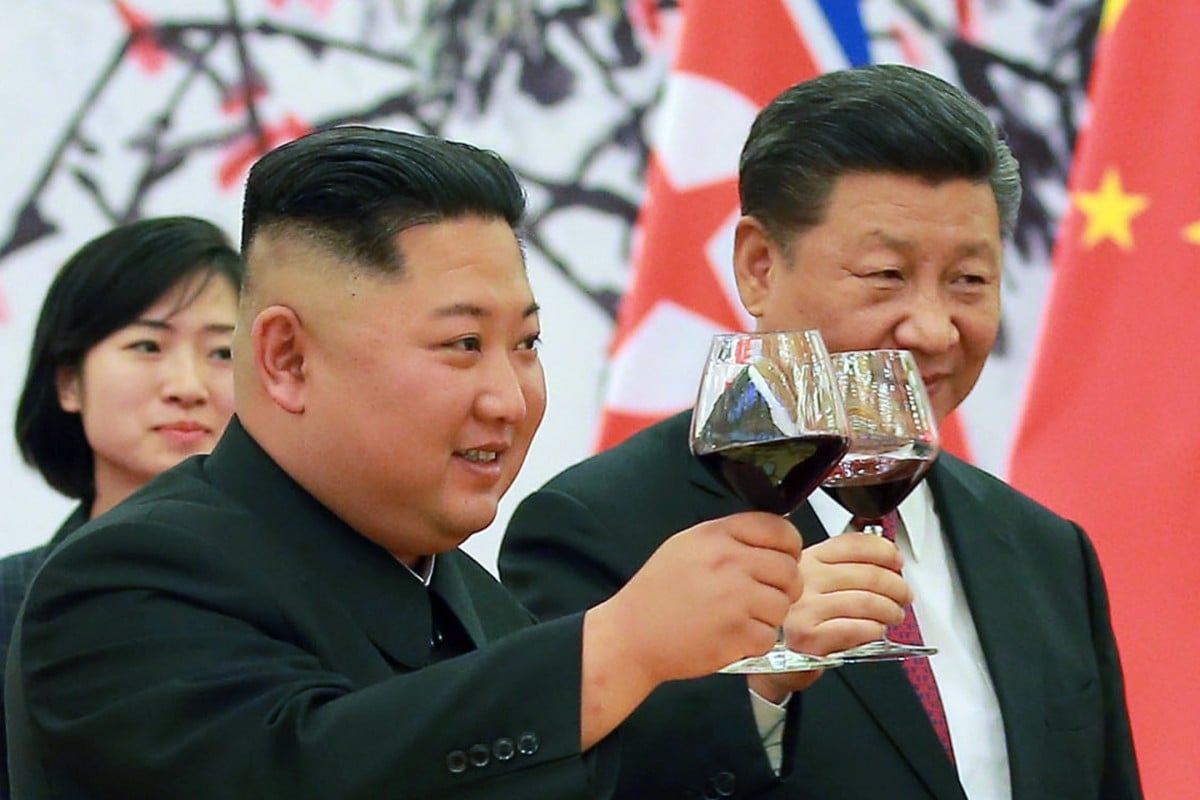
Chinese President Xi Jinping says China will continue to “firmly support” North Korean leader Kim Jong-un. Photo: AP
Chinese President Xi Jinping has pledged his full support for North Korean leader Kim Jong-un and promised to play an active role in efforts to bring peace and stability to the region, a day ahead of his
Xi’s comments, in an editorial published by North Korean newspaper Rodong Sinmunon Wednesday, come as China remains locked in a trade and technology war with the United States, and after a second summit between US President Donald Trump and Kim in Hanoi in February failed to achieve any progress on the denuclearisation of the Korean peninsula.
“No matter how the international situation changes”, China would “firmly support Chairman Kim Jong-un to lead the North Korean party and people to implement the new strategic line”, the article said.
As well as expressing the two sides’ desire to strengthen “strategic communication and exchanges”, Xi said Beijing would continue to support Pyongyang in its negotiations with other countries.
Xi Jinping (left) says China will “contribute to peace, stability, development and prosperity in the region”. Photo: EPA-EFE
“We will actively contribute to peace, stability, development and prosperity in the region by strengthening communication and coordination with the Democratic People’s Republic of Korea,” he said, referring to the country by its official name.
China would also engage with other stakeholders “by jointly expediting progress on dialogue and negotiations on the issues of the Korean peninsula”, he said.
Xi’s state visit to North Korea aims for ‘new impetus’ in ties
Speaking ahead of Xi’s two-day trip to Pyongyang, which starts on Thursday, Chinese foreign ministry spokesman Lu Kang said on Tuesday that the outcome of the Trump-Kim summit in Hanoi was “a little unexpected” and that China was encouraging both sides to continue their dialogue.
Trump said last week that he had received a “
” from Kim that had “reset” the tone between the two countries. In May, he said Pyongyang was “not ready to negotiate”.
One of the major stumbling blocks in the negotiation process has been the United Nations sanctions. Pyongyang has stipulated that they should be lifted as a precondition of the denuclearisation process while Washington has insisted they should remain in place until North Korea provides clear evidence the process is under way.
China, meanwhile, has been accused of providing large amounts of humanitarian aid to its neighbour to help offset the impact of the sanctions.
Xi said China would continue to support North Korea in raising “legitimate concerns through dialogue”.
“No matter how the wind and clouds of the international situation change, our two parties and two peoples inherit and carry forward the traditional friendship between China and the DPRK,” he said.
Zhao Tong, a fellow at the Carnegie-Tsinghua Centre for Global Policy, said that while the main aim of Xi’s visit was to reaffirm ties, its timing, amid the US-China dispute, was designed to show Beijing still had a role to play in the negotiations.
“As China-US strategic rivalry grows, China wants to maintain its geopolitical influence on the Korean peninsula. By demonstrating its unique relations with the DPRK at a time when neither Washington nor Seoul is able to resume high-level engagements with Pyongyang, Beijing is signalling to Washington that it is still a helpful, constructive and indispensable partner to resolve important regional problems,” he said.
Xi’s visit to North Korea will be the first by a Chinese leader since Hu Jintao in 2005.
Source: SCMP
Posted in Beijing, Carnegie-Tsinghua Centre for Global Policy, Chinese President Xi Jinping, Democratic People’s Republic of Korea, denuclearisation, full support, Hu Jintao, Kim Jong-un, Korean peninsula, North Korean leader, Pyongyang, Rodong Sinmunon, Seoul, Uncategorized, Washington |
Leave a Comment »




 CHINDIA ALERT: You'll be living in their world, very soon