Chindia Alert: You’ll be Living in their World Very Soon
aims to alert you to the threats and opportunities that China and India present. China and India require serious attention; case of ‘hidden dragon and crouching tiger’.
Without this attention, governments, businesses and, indeed, individuals may find themselves at a great disadvantage sooner rather than later.
The POSTs (front webpages) are mainly 'cuttings' from reliable sources, updated continuously.
The PAGEs (see Tabs, above) attempt to make the information more meaningful by putting some structure to the information we have researched and assembled since 2006.
The tech investment push is part of a fiscal package waiting to be signed off by the National People’s Congress, which convenes this week
This initiative will reduce China’s dependence on foreign technology, echoing objectives set forth previously in the ‘Made in China 2025’ programme
A conductor rehearses the military band on the sidelines of the National People’s Congress in Beijing’s Great Hall of the People in March of last year. China’s legislature is expected to sign off on a massive tech-led stimulus plan. Photo: AP
Beijing is accelerating its bid for global leadership in key technologies, planning to pump more than a trillion dollars into the economy through the roll-out of everything from next-generation wireless networks to artificial intelligence (AI).
In the master plan backed by President Xi Jinping himself, China will invest an estimated 10 trillion yuan (US$1.4 trillion) over six years to 2025, calling on urban governments and private hi-tech giants like Huawei Technologies to help lay 5G wireless networks, install cameras and sensors, and develop AI software that will underpin
and Huawei to SenseTime Group at the expense of US companies.
As tech nationalism mounts, the investment drive will reduce China’s dependence on foreign technology, echoing objectives set forth previously in the “Made in China 2025”
programme. Such initiatives have already drawn fierce criticism from the Trump administration, resulting in moves to block the rise of Chinese tech companies such as Huawei.
How will China’s annual legislative meetings affect the stock investor? Five key industries to watch
18 May 2020
“Nothing like this has happened before, this is China’s gambit to win the global tech race,” said Digital China Holdings chief operating officer Maria Kwok, as she sat in a Hong Kong office surrounded by facial recognition cameras and sensors. “Starting this year, we are really beginning to see the money flow through.”
The tech investment push is part of a fiscal package waiting to be signed off by China’s legislature, the National People’s Congress, which convenes this week. The government is expected to announce infrastructure funding of as much as US$563 billion this year, against the backdrop of the country’s worst economic performance since the Mao era.
The nation’s biggest purveyors of cloud computing and data analysis Alibaba, the parent company of the South China Morning Post, and Tencent Holding will be linchpins of the upcoming endeavour. China has already entrusted Huawei, the world’s largest telecommunications equipment supplier, to help galvanise 5G. Tech leaders including Pony Ma Huateng and Jack Ma are espousing the programme.
Maria Kwok’s company is a government-backed information technology systems integration provider, among many that are jumping at the chance. In the southern city of Guangzhou, Digital China is bringing half a million units of project housing online, including a complex three quarters the size of Central Park in New York City. To find a home, a user just has to log on to an app, scan their face and verify their identity. Leases can be signed digitally via smartphone and the renting authority is automatically flagged if a tenant’s payment is late.
China is no stranger to far-reaching plans with massive price tags that appear to achieve little. There is no guarantee this programme will deliver the economic rejuvenation its proponents promise. Unlike previous efforts to resuscitate the economy with “dumb” bridges and highways, this newly laid digital infrastructure will help national champions develop cutting-edge technologies.
“China’s new stimulus plan will likely lead to a consolidation of industrial internet
providers, and could lead to the emergence of some larger companies able to compete with global leaders, such as GE and Siemens,” said Nannan Kou, head of research at BloombergNEF, in a report. “One bet is on industrial internet-of-things (IoT) platforms, as China aims to cultivate three world leading companies in this area by 2025.”
China is not alone in pumping money into the technology sector as a way to get out of the post-coronavirus economic slump. Earlier this month, South Korea said AI and wireless communications would be at the core of it its “New Deal” to create jobs and boost growth.
Nothing like this has happened before, this is China’s gambit to win the global tech raceMaria Kwok, COO at Digital China Holdings
The 10 trillion yuan that China is estimated to spend from now until 2025 encompasses areas typically considered leading edge, such as AI and IoT, as well as items such as ultra-high voltage lines and high-speed rail, according to the government-backed China Centre for Information Industry Development. More than 20 of mainland China’s 31 provinces and regions have announced projects totaling over 1 trillion yuan with active participation from private capital, a state-backed newspaper reported on Wednesday.
Separate estimates by Morgan Stanley put new infrastructure at around US$180 billion each year for the next 11 years – or US$1.98 trillion in total. Those calculations also include power and rail lines. That annual figure would be almost double the past three-year average, the investment bank said in a March report that listed key stock beneficiaries including companies such as China Tower Corp, Alibaba, GDS Holdings, Quanta Computer and Advantech Co.
Beijing’s half-formed vision is already stirring a plethora of stocks, a big reason why five of China’s 10 best-performing stocks this year are tech plays like networking gear maker Dawning Information Industry and Apple supplier GoerTek. The bare outlines of the master plan were enough to drive pundits toward everything from satellite operators to broadband providers.
China’s telecoms carriers push to complete ‘political task’ of 5G network roll-out amid coronavirus crisis
6 Mar 2020
It is unlikely that US companies will benefit much from the tech-led stimulus and in some cases they stand to lose existing business. Earlier this year, when the country’s largest telecoms carrier China Mobile awarded contracts worth 37 billion yuan for 5G base stations, the lion’s share went to Huawei and other Chinese companies. Sweden’s Ericsson got only a little over 10 per cent of the business in the first four months. In one of its projects, Digital China will help the northeastern city of Changchun swap out American cloud computing staples IBM, Oracle and EMC with home-grown technology.
It is in data centres that a considerable chunk of the new infrastructure development will take place. Over 20 provinces have launched policies to support enterprises using cloud computing services, according to a March research note from UBS Group.
Tony Yu, chief executive of Chinese server maker H3C, said that his company was seeing a significant increase in demand for data centre services from some of the country’s top internet companies. “Rapid growth in up-and-coming sectors will bring a new force to China’s economy after the pandemic passes,” he told Bloomberg News.
From there, more investment should flow. Bain Capital-backed data centre operator ChinData Group estimated that for every one dollar spent on data centres another US$5 to US$10 in investment in related sectors would take place, including in networking, power grid and advanced equipment manufacturing. “A whole host of supply chain companies will benefit,” the company said in a statement.
There is concern about whether this long-term strategy provides much in the way of stimulus now, and where the money will come from. “It’s impossible to prop up China’s economy with new infrastructure alone,” said Zhu Tian, professor of economics at China Europe International Business School in Shanghai. “If you are worried about the government’s added debt levels and their debt servicing abilities right now, of course you wouldn’t do it. But it’s a necessary thing to do at a time of crisis.”
Digital China is confident that follow-up projects from its housing initiative in Guangzhou could generate 30 million yuan in revenue for the company. It is also hoping to replicate those efforts with local governments in the northeastern province of Jilin, where it has 3.3 billion yuan worth of projects approved. These include building a so-called city brain that will for the first time connect databases including traffic, schools and civil matters such as marriage registry. “The concept of smart cities has been touted for years but now we are finally seeing the investment,” said Kwok.
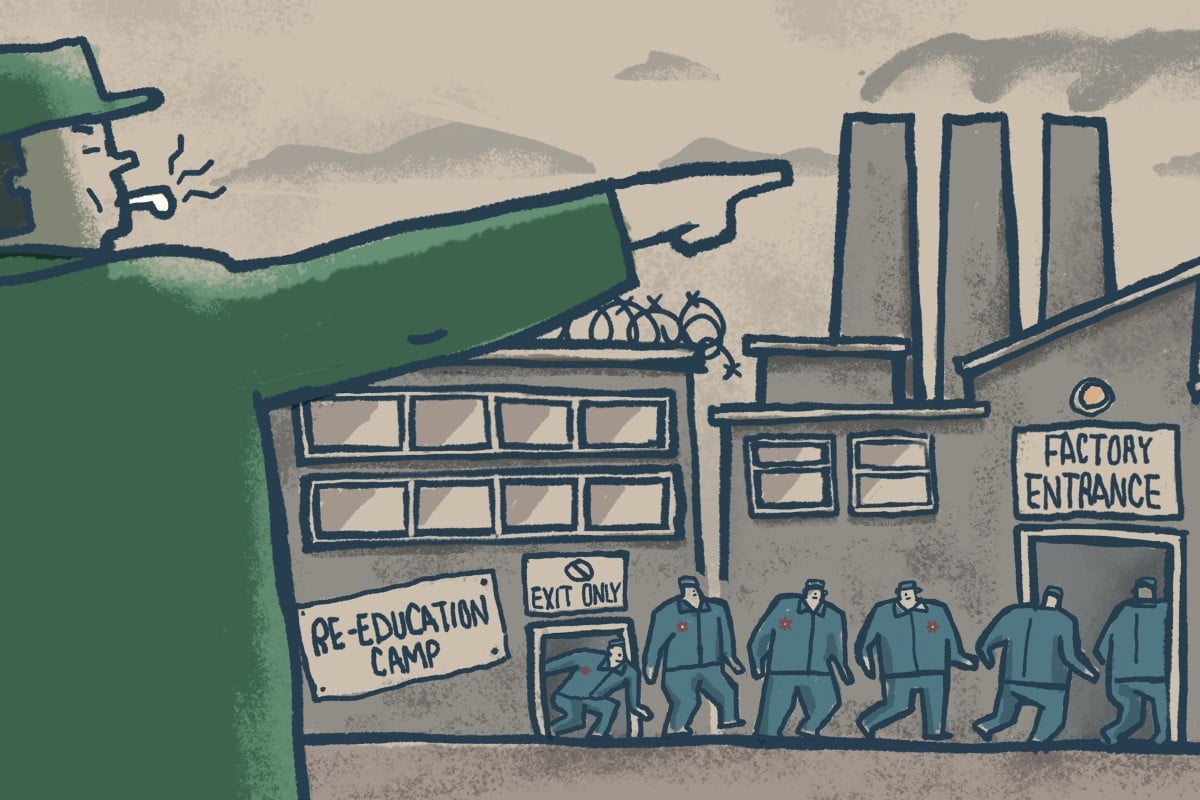
Inmates who have undergone compulsory re-education programme to be moved to other parts of China under job placement scheme delayed by Covid-19 outbreak
Critics have said the camps are a move to eradicate cultural and religious identity but Beijing has defended them as way of boosting job opportunities and combating Islamic radicalisation
Illustration by Perry Tse
The Chinese government has resumed a job placement scheme for tens of thousands of Uygur Muslims who have completed compulsory programmes at the “re-education” camps in the far-western region of Xinjiang, sources said.
The plan, which includes a quota for the numbers provinces must take, was finalised last year but disrupted by the outbreak of Covid-19.
The delay threatens to undermine the Chinese government’s efforts to justify its use of internment camps in Xinjiang.
Critics have said these camps were part of the measures designed to eradicate the ethnic and cultural identity of Uygurs and other Muslim minorities and that participants had no choice but to undertake the re-education programme.
Beijing has repeatedly dismissed these criticisms and said the camps are to give Uygurs the training they need to find better jobs and stay away from the influence of radical fundamentalism.
First Xinjiang, now Tibet passes rules to promote ‘ethnic unity’
17 Feb 2020
Now with the disease under control, the Chinese government has resumed the job placement deal for other provinces to absorb Xinjiang labourers, sources said.
Despite the devastating impact of the disease on its economy and job markets, the Chinese authorities are determined to go ahead with the plan, which they believe would
“Excellent graduates were to be taken on as labourers by various inland governments, in particular, 19 provinces and municipalities,” said the source. It is unclear what constitutes “excellent graduates”.
Some sources earlier said that the programme may be scaled back in light of the new economic reality and uncertainties.
But a Beijing-based source said the overall targets would remain unchanged.
“The unemployment problem in Xinjiang must be resolved at all costs, despite the outbreak,” the source said.
The South China Morning Post has learned that at least 19 provinces and cities have been given quotas to hire Muslim minorities, mostly Uygurs, who have “graduated” from re-education camps.
As early as February, when the daily number of infections started to come down outside Hubei province, China already begun to send Uygur workers to their new jobs.
A photo taken in February showed thousands of young Uygurs, all wearing face masks and with huge red silk flowers pinned to their chests, being dispatched to work in factories outside their hometowns.
By the end of February, Xinjiang alone has created jobs for more than 60,000 Uygur graduates from the camps. A few thousand were also sent to work in other provinces.
Many have been employed in factories making toys and clothes.
Xinjiang’s new rules against domestic violence expand China’s ‘extremism’ front to the home
7 Apr 2020
Sources told the Post that the southern city of Shenzhen – China’s hi-tech manufacturing centre – was given a target last year to eventually resettle 50,000 Uygurs. The city is allowed to do this in several batches, with 15,000 to 20,000 planned for the first stage.
In Fujian province, a government source also said they had been told to hire “tens of thousands of Xinjiang workers”.
“I heard the first batch of several thousands would arrive soon. We have already received official directives asking us to handle their settlement with care,” said the source.
He said the preparation work includes providing halal food to the workers as well as putting in place stronger security measures to “minimise the risks of mass incidents”. It is not known whether they will be given access to prayer rooms.
There are no official statistics of how many Uygurs will be resettled to other provinces and the matter is rarely reported by the mainland media.
But in March, Anhui Daily, the province’s official newspaper, reported that it had received 1,560 “organised labourers from Xinjiang”.
The Uygur workers on average could earn between 1,200 yuan (US$170) to 4,000 yuan (US$565) a month, with accommodation and meals provided by the local authorities, according to Chinese media reports.
However, they are not allowed to leave their dormitories without permission.
The UN has estimated that up to a million Muslims were being held in the camps. Photo: AP
Xinjiang’s per capita disposable income in 2018 was 1,791 yuan a month, according to state news agency Xinhua. But the salary level outside the region’s biggest cities such as Urumqi may be much lower.
The official unemployment rate for the region is between 3 and 4 per cent, but the statistics do not include those living in remote rural areas.
Mindful of the potential risks of the resettlement, Beijing has taken painstaking efforts to carefully manage everything – from recruitment to setting contract terms to managing the workers’ day-to-day lives.
Local officials will go to each Uygur workers’ home to personally take them to prearranged flights and trains. On arrival, they will be immediately picked up and sent to their assigned factories.
US bill would bar goods from Xinjiang, classifying them the product of forced labour by Uygurs
12 Mar 2020
Such arrangements are not unique to Uygurs and local governments have made similar arrangements for ethnic Han workers in other parts of China.
After screening them for Covid-19, local governments have arranged for workers to be sent to their workplaces in batches. They are checked again on arrival, before being sent to work.
China is accelerating such placement deals on a massive scale to offset the impact of the economic slowdown after the outbreak.
Sources told the South China Morning Post that the job placement deal was first finalised by governments in Xinjiang and other provinces last year.
The aim is to guarantee jobs for Uygur Muslim who have “completed vocational training” at the re-education camps and meet poverty alleviation deals in the region, one of the poorest parts of China.
The training they receive in the camps includes vocational training for various job types such as factory work, mechanical maintenance and hotel room servicing. They also have to study Mandarin, Chinese law, core party values and patriotic education.
Xinjiang’s massive internment camps have drawn widespread international condemnation.
The United Nations has estimated that up to 1 million Uygur and other Muslim minority citizens are being arbitrarily detained in the camps, which Beijing insists are necessary to combat terrorism and Islamic radicalisation.
Late last year, Xinjiang’s officials announced that all the inmates of these so-called vocational training centres had “graduated” and taken up employment.
Before this labour placement scheme was introduced, it was extremely difficult for Uygurs to find jobs or live and work in inland regions.
Muslim ethnic minorities, Uygurs in particular, have been subjected to blatant discrimination in China and the situation worsened after the 2009 clashes.
Earlier this month, the Australian Strategic Policy Institute released a report saying more than 80,000 Uygurs had been moved from Xinjiang to work in factories in nine Chinese regions and provinces.
It identified a total of 27 factories that supplied 83 brands, including household names such as Google, Apple, Microsoft, Mitsubishi, Siemens, Sony, Huawei, Samsung, Nike, Abercrombie and Fitch, Uniqlo, Adidas and Lacoste.
‘Psychological torture’: Uygurs abroad face mental health crisis over plight of relatives who remain in Xinjiang
11 Mar 2020
The security think tank concluded that the Chinese government had transferred Uygur workers “under conditions that strongly suggest forced labour” between 2017 and 2019, sometimes drawing labourers directly from re-education camps.
The report also said the work programme represents a “new phase in China’s social re-engineering campaign targeting minority citizens”.
Workers were typically sent to live in segregated dormitories, underwent organised Mandarin lessons and ideological training outside working hours and were subject to constant surveillance, the researcher found.
They were also forbidden from taking part in religious observances, according to the report that is based on open-source documents, satellite pictures, academic research and on-the-ground reporting.
Chinese foreign ministry spokesman Zhao Lijian criticised the report saying it had “no factual basis”.
This marks the latest mobile network upgrade on Mount Everest, where Chinese carriers had previously installed 2G, 3G and 4G equipment
China Mobile plans to deploy Huawei 5G gear at an altitude of 6,500 metres, providing network coverage to the mountain’s summit
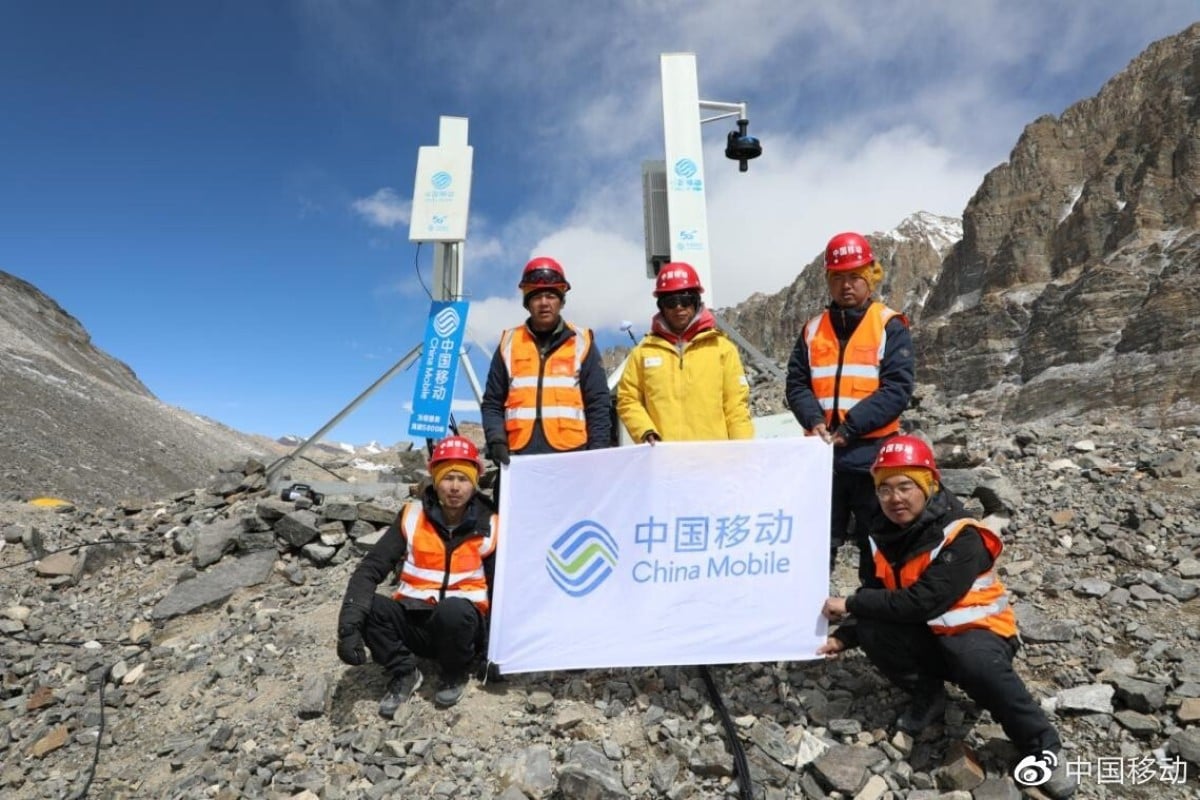
A team from China Mobile shows off the initial 5G base stations, supplied by Huawei Technologies, that the telecoms carrier deployed on Mount Everest this April. Photo: Weibo
Huawei Technologies has teamed up with wireless network operators China Mobile, China Unicom and China Telecom to roll out advanced 5G infrastructure on
The deployment of 5G base stations on the famous Himalayan mountain, with an elevation of 8,848 metres, has extended the reach of the next-generation mobile technology, which has been held up as “the connective tissue” for the Internet of Things, autonomous cars, smart cities and other new applications – providing the backbone for the industrial internet. The new 5G infrastructure roll-outs were announced by Huawei in a post on Chinese microblogging site Weibo on Monday and confirmed by its spokeswoman on Tuesday.
China Mobile, the world’s largest wireless network operator, said its 5G project on Mount Everest marked “not only another extreme challenge in a human life exclusion zone, but also laid a solid foundation for the later development of 5G smart tourism and 5G communications for scientific research”, according to the company’s post on Weibo on Monday.
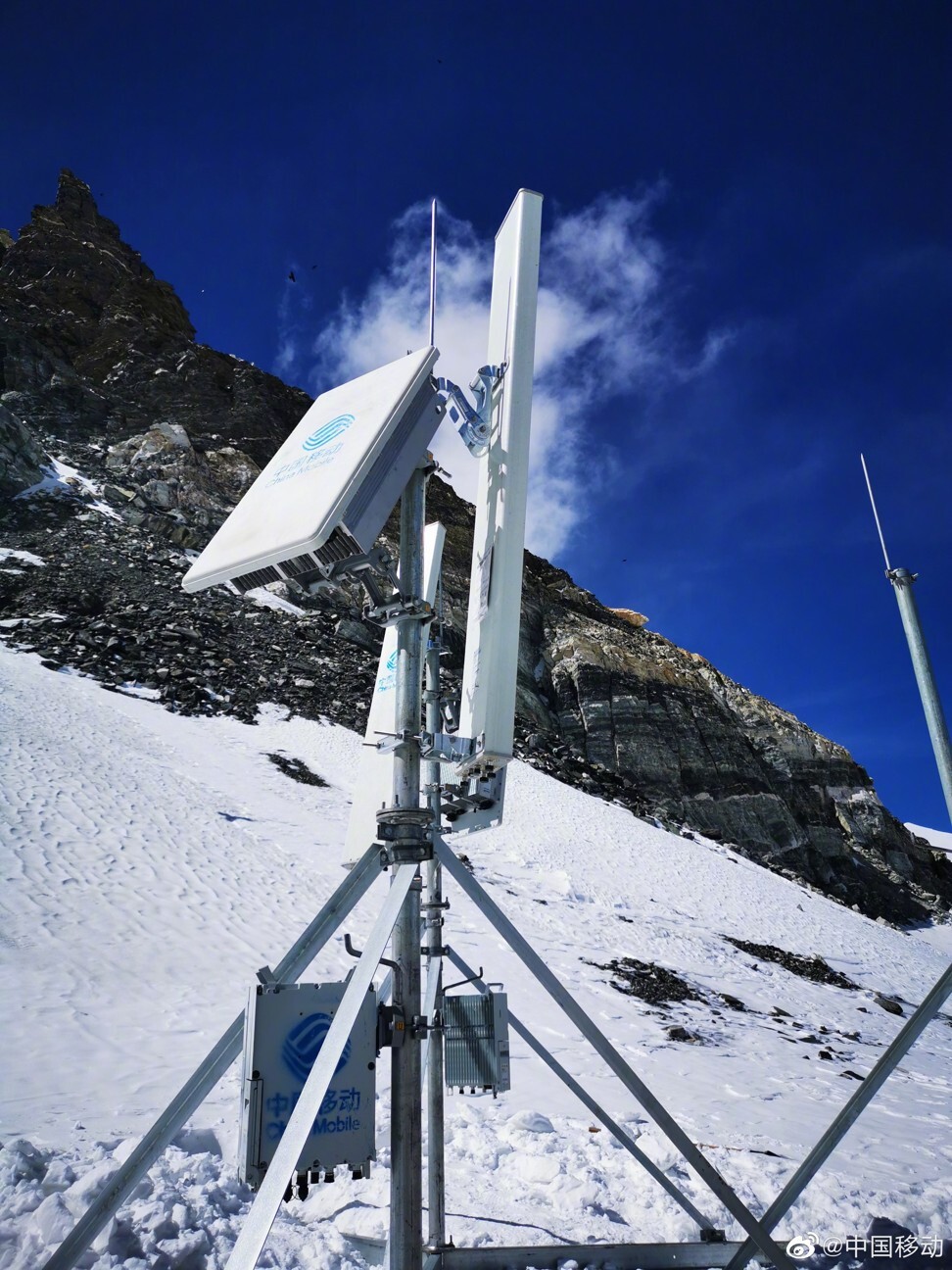
The Hong Kong and New York-listed carrier set up three 5G base stations – radio access gear that connects mobile devices to the broader telecommunications network – on April 19 in two camps at altitudes of 5,300 metres and 5,800 metres, which provide online download speed of about 1 gigabit per second.
China Mobile plans to install two more 5G base stations, supplied by telecommunications gear maker Huawei Technologies, on Mount Everest before April 25. Photo: Weibo
Installation of two more base stations are expected to be completed by China Mobile before April 25 in another camp at an altitude of 6,500 metres, providing 5G network coverage to the summit of Mount Everest. The international border between China and Nepal is 1,414 kilometres in length and runs across that summit.
More than 150 China Mobile employees are taking part on the construction and maintenance of the new 5G base stations as well as upgrading existing infrastructure on the surrounding areas, according to the company. It said 25 kms of new optical cables have also been laid out to support this project.
China Telecom confirmed its Mount Everest project on Tuesday in a statement, which said its 5G base stations were installed on April 13 at an altitude of 5,145 metres. It partnered with state-run China Central Television to broadcast a 24-hour live-streamed programme on April 14 from Mount Everest, which had an audience of more than six million people.
China Mobile did not immediately respond to a request for comment. China Unicom did not immediately reply to a separate request for comment.
Mobile network operators in China launched initial commercial 5G services last year. The country has already deployed more than 160,000 5G base stations, covering more than 50 cities, according to a report published last month by the GSMA, the trade body which represents mobile operators worldwide.
While initial commercial 5G mobile services were launched in countries like South Korea, the US, and Australia, the scale of China’s market is likely to dwarf the combined size of those economies, negating any first-mover advantage.
The steady annual deployment of new 5G base stations is critical to meet future demand in the world’s second largest economy and biggest smartphone market. China is expected to have 600 million 5G mobile users by 2025, which would make up 40 per cent of total global 5G subscribers, according to the GSMA.
Project will examine whether earthquake and changing wind speeds have affected peak’s snowcap
Survey team hoping the BeiDou satellite navigation system and other Chinese technology can help them find the answer
A Chinese team is preparing to determine the exact height of Mount Everest. Photo: AFP
China is sending a surveying and mapping team to the summit of Mount Everest this month in a bid to end the long-running debate over the precise height of the world’s tallest mountain.
The mission was announced on Wednesday at one of the mountain’s base camps in Tibet, where a team of 53 surveyors has been making technical preparations since March 2. The team will use China’s BeiDou navigation satellite system and Chinese surveying instruments for the project.
Mount Everest – known as Sagarmatha in Nepal and Qomolangma in Tibet – lies in the Himalayas on the border between China and Nepal. The two countries have long disputed whether measurements of the mountain should include its snowcap or be limited to the rock base.
Nepal suspends Everest permits over coronavirus
In 2005, a Chinese expedition assessed the peak and measured the height from both the rock base and from the top of the snowfall. The result, a rock height of 8,844.43 metres (29,017.2 feet), was declared by China to be the most accurate and precise measurement to date.
Nepal has long held that Everest’s snowcap should be included, putting the iconic peak at 8,848 metres, a height which is widely accepted. However, geologists believe the snowcap may have shrunk by several centimetres after the magnitude 8.1 earthquake in 2015. Changing wind speeds are also believed to have affected it.
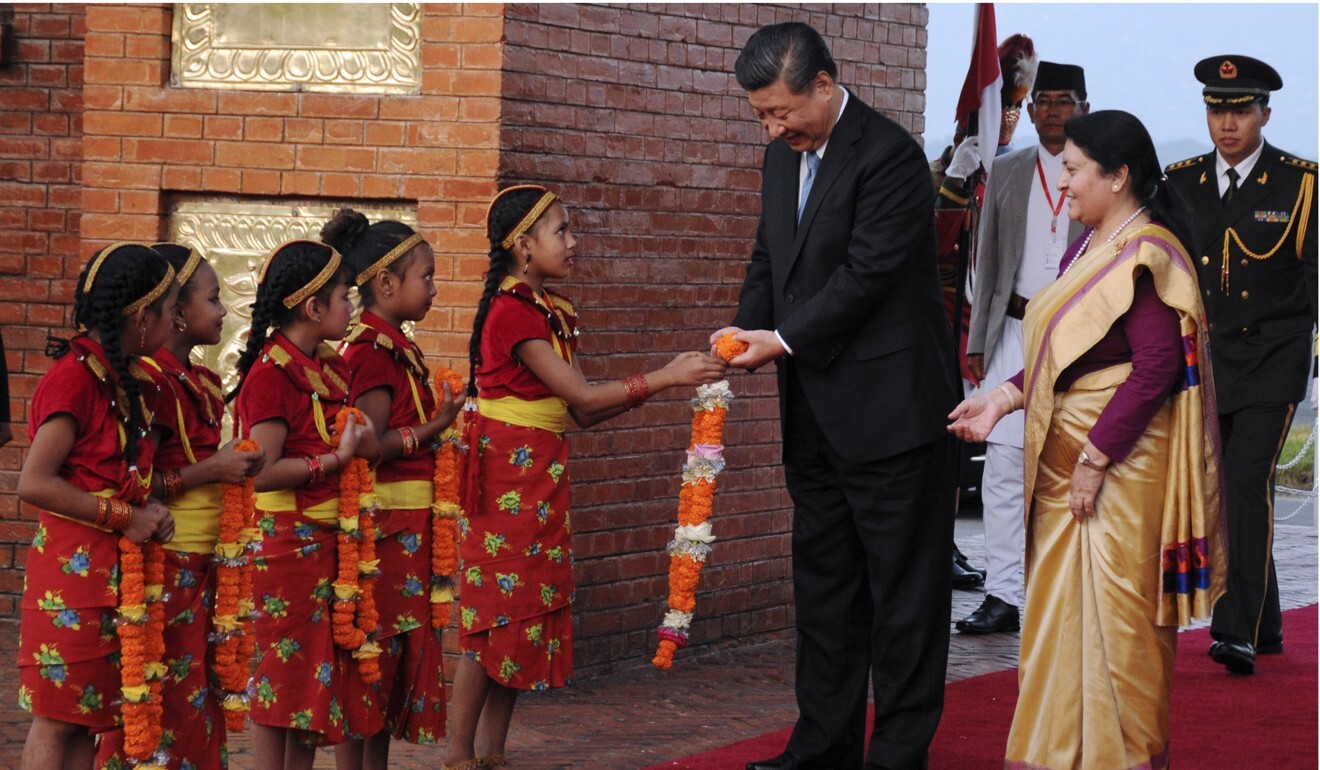
Chinese President Xi Jinping visited Nepal in October. Photo: EPA-EFE
Following a state visit to Nepal by Chinese President Xi Jinping in October, the two countries agreed to jointly launch a scientific research project to determine the exact height of Everest, recognising the peak as “an eternal symbol of the friendship between the two countries”.
China’s natural resources ministry said the project indicated a new step in the friendship and highlighted the historical significance of the mission, which coincides with the 60th anniversary of the first Chinese ascent of the mountain’s north side as well as the 45th anniversary of China’s first precise measurement of the peak.
The results of the survey will be used for geodynamics research and the precise depth of the summit’s snowcap, meteorological and wind speed data will offer first-hand materials for glacier monitoring and biological environment protection.
In a separate development, China Mobile said on Thursday that the entire peak now had 5G coverage.
In a joint project with Huawei, 5G antennas were installed at the mountain’s advance base camp, at a height of 6,500 metres. Antennas were installed earlier in April at the lower base camp, at 5,300 metres and at 5,800 metres.
The government has defeated the first rebellion from its own MPs over plans to allow Huawei to be used in the UK’s 5G mobile network.
Thirty-eight Conservative rebels backed an amendment to end the Chinese firm’s participation in the project by the start of 2023.
Despite promises from the government of a new bill to address their concerns, rebel MPs pushed their plan to a vote.
But with a large Commons majority, the government defeated it by 24 votes.
Culture Minister Matt Warman said the government had heard the points “loud and clear”.
He added: “We will now engage intensively with colleagues across the House to make sure that we will make our case at every possible level…and we will underline that we will always put national security at the very top of our agenda.”
The use of Huawei technology in the 5G network was signed off by No 10 and security experts earlier this year, with the caveats of keeping the kit out of the most sensitive areas and capping its market share at 35%.
But Tory critics say the firm is an arm of the Chinese state and a risk to UK security – claims the firm rejects.
Other countries, including the US and Australia, have banned Huawei from their own networks and criticised the UK’s decision.
After the Commons vote, Huawei vice president Victor Zhang, said: “An evidence-based approach is needed, so we were disappointed to hear some groundless accusations asserted.
“The industry and experts agree that banning Huawei equipment would leave Britain less secure, less productive and less innovative.”
Today’s revolt on Huawei leaves Boris Johnson with one king-sized political headache.
It will likely prompt a bout of teeth gnashing in Downing Street that so many Tories should be ready to defy the PM so soon after he delivered them a whopping election victory.
But it will also sting that their ranks were made up of some of the most senior Tory MPs, including a solid block of former cabinet ministers.
In other words, these are not the sort of MPs who No 10 might expect to be able to bully back into line.
And this matters because the rebellion could pave the way for an even bigger one in the summer that could yet overturn the Huawei decision, with several Tory MPs making clear they are ready to join the rebels once the key 5G legislation comes back to the Commons.
A defeat for Mr Johnson over such a high profile issue would be a deeply wounding blow – all the more so since he went out on a limb to give his personal go-ahead to Huawei despite the fury of the White House and other allies.
Time perhaps for the PM to root out the paracetamol.
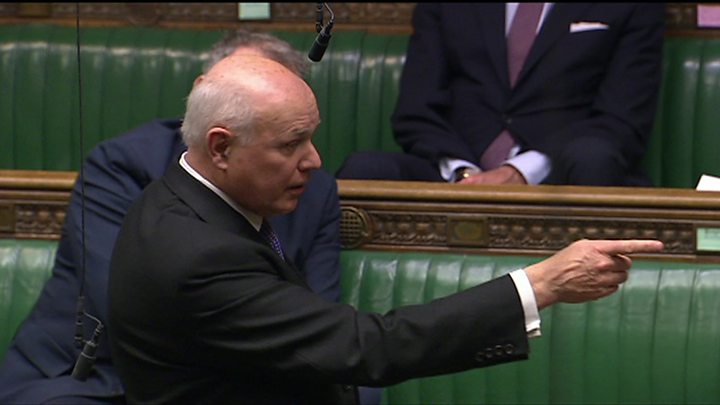
A group of Tory MPs, led by the party’s former leader Sir Iain Duncan Smith, put forward an amendment to the Telecommunications Infrastructure Bill to try and stop Huawei’s involvement.
The amendment would have seen firms classified as “high-risk vendors” by the National Cyber Security Centre be banned entirely from the UK’s 5G project by 31 December 2022.
Sir Iain said he and his colleagues were “genuinely concerned that this country has got itself far too bound in to a process in which we are reliant on untrusted vendors”.
Speaking in the Commons, the backbencher accused the Chinese government of spending 20 years “underbidding” other technology firms until Huawei dominated the market, and the outcome was a risk to the UK’s security.
He said using Huawei’s technology was a “statement of absence of thought by any government”, adding: “If defence of the realm is our number one priority, then this becomes demi-defence of the realm, and I am simply not prepared to put up with that.”
Media caption IDS warns UK “in thrall” to untrusted telecoms providers
Culture Secretary Oliver Dowden tried to reassure the group of backbenchers with the promise of bringing forward a Telecoms Security Bill before the summer recess “so all honourable members will be able to debate these points extensively”.
He also said the government wanted to work with its Five Eyes security partners – including the US – on alternative solutions so the UK could “get to a position where we do not have to use high-risk vendors at all”.
But Mr Dowden could not give a timetable for the exclusion of such companies, except to say it would be “in this Parliament” – meaning within the next five years.
As a result, Sir Iain pushed his amendment to a vote, marking the first Tory rebellion against the government since Boris Johnson won the election in December.
However, while 282 MPs from across the House voted in favour of the amendment, 306 MPs voted against, defeating it.
There were 38 Conservative MPs who rebelled against their government by voting for the amendment – including former international trade secretary Liam Fox, ex-Brexit secretary David Davis and former housing minister Esther McVey.
Conservative MP and Foreign Affairs Committee chairman, Tom Tugendhat, also voted in favour of the amendment, saying he did “not get the commitments” he wanted from the government.
“I am sorry that I could not support the government. I hope the policy will change before we come to the main Telecoms Security Bill before the summer.”
The Telecommunications Infrastructure Bill later passed without needing a vote.
BEIJING (Reuters) – Tens of thousands of ethnic Uighurs were moved to work in conditions suggestive of “forced labor” in factories across China supplying 83 global brands, and Australian think tank said in a report released on Sunday.
The Australian Strategic Policy Institute (ASPI) report, which cited government documents and local media reports, identified a network of at least 27 factories in nine Chinese provinces where more than 80,000 Uighurs from the western region of Xinjiang have been transferred.
“Under conditions that strongly suggest forced labor, Uighurs are working in factories that are in the supply chains of at least 83 well-known global brands in the technology, clothing and automotive sectors, including Apple, BMW, Gap, Huawei, Nike, Samsung, Sony and Volkswagen,” the think-tank said in the introduction to its report.
The ASPI report said the transfers of labor were part of a state-sponsored program.
It says the workers “lead a harsh, segregated life,” are forbidden to practice religion, and are required to participate in mandarin language classes.
It also says the Uighurs are tracked electronically and restricted from returning to Xinjiang.
China’s Foreign Ministry on Monday said reports the government had violated the Uighurs’ rights were untrue.
“This report is just following along with the U.S. anti-China forces that try to smear China’s anti-terrorism measures in Xinjiang,” spokesman Zhao Lijian at a regular press briefing on Monday.
The United Nations estimates over a million Muslim Uighurs have been detained in camps in Xinjiang over recent years as part of a wide-reaching campaign by Chinese officials to stamp out terrorism.
The mass detentions have provoked a backlash from rights groups and foreign governments, which say the arbitrary nature of the detentions violates human rights.
China has denied the camps violate the rights of Uighurs and say they are designed to stamp out terrorism and provide vocational skills.
“Those studying in vocational centers have all graduated and are employed with the help of our government,” said the Foreign Ministry’s Zhao, “They now live a happy life.”
The 83 global brands mentioned in ASPI’s report either work directly with the factories or source materials from the factories, it said, citing public supplier lists and the factories’ own information.
One of the factories, O-Film Technology Co Ltd, which has manufactured cameras for Apple Inc’s (AAPL.O) iPhones, received 700 Uighur laborers as part of the program in 2017, a local media article cited by the report said.
Apple referred Reuters to an earlier statement that said “Apple is dedicated to ensuring that everyone in our supply chain is treated with the dignity and respect they deserve. We have not seen this report but we work closely with all our suppliers to ensure our high standards are upheld.”
The other companies mentioned in the introduction to ASPI’s report – BMW (BMWG.DE), Gap Inc (GPS.N) , Huawei Technologies Co Ltd, Nike Inc (NKE.N), Samsung and Sony Corp (6758.T) did not respond to requests for comment on Monday.
O-Film Technology did not respond to a request for a comment either.
Volkswagen told Reuters in a statement that none of the listed companies is a direct supplier. It said the company holds “direct authority” in all parts of its business and “respects minorities, employee representation and social and labor standards.”
The report said a small number of the brands, including Abercrombie & Fitch Co [ANF.N], advised vendors to terminate their relationships with these companies in 2020, and others denied direct contractual relationships with the suppliers.
ASPI describes itself as an independent think-tank whose core aim is to provide insight for the Australian government on matters of defense, security and strategic policy.
NEW DELHI (Reuters) – U.S. President Donald Trump said on Tuesday that India will buy $3 billion worth of military equipment, including attack helicopters, as the two countries deepen defence and commercial ties in an attempt to balance the weight of China in the region.
India and the United States were also making progress on a big trade deal, Trump said. Negotiators from the two sides have wrangled for months to narrow differences on farm goods, medical devices, digital trade and new tariffs.
Trump was accorded a massive reception in Indian Prime Minister Narendra Modi’s home state on Monday, with more than 100,000 people filling into a cricket stadium for a “Namaste Trump” rally.
On Tuesday, Trump sat down for one-on-one talks with Modi followed by delegation-level meetings to try and move forward on issues that have divided them, mainly the festering trade dispute.
RELATED COVERAGE
U.S. first lady Melania Trump visits ‘happiness’ class at Delhi school
After those meetings, Trump said his visit had been productive with the conclusion of deals to buy helicopters for the Indian military. India is buying 24 SeaHawk helicopters from Lockheed Martin equipped with Hellfire missiles worth $2.6 billion and also plans a follow-on order for six Apache helicopters.
India is modernising its military to narrow the gap with China and has increasingly turned to the United States over traditional supplier, Russia.
Trump said the two countries were also making progress on a trade deal, which had been an area of growing friction between them.
“Our teams have made tremendous progress on a comprehensive trade agreement and I’m optimistic we can reach a deal that will be of great importance to both countries,” said Trump in remarks made alongside Modi.
The two countries had initially planned to produce a “mini deal”, but that proved elusive.
Instead both sides are now aiming for a bigger package, including possibly a free trade agreement.
Trump said he also discussed with Modi, whom he called his “dear friend”, the importance of a secure 5G telecoms network in India, ahead of a planned airwaves auction by the country.
The United States has banned Huawei, arguing the use of its kit creates the potential for espionage by China – a claim denied by Huawei and Beijing – but India, where telecoms companies have long used network gear from the Chinese firm, is yet to make a call.
Trump described Monday’s rally in Ahmedabad and again praised Modi and spoke of the size of the crowd, claiming there were “thousands of people outside trying to get in..
“I would even imagine they were there more for you than for me, I would hope so,” he told Modi. “The people love you…every time I mentioned your name, they would cheer.”
In New Delhi, Trump was given a formal state welcome on Tuesday at the red sandstone presidential palace with a 21-cannon gun salute and a red coated honour guard on horseback on a smoggy day.
HUG GETS TIGHTER
India is one of the few big countries in the world where Trump’s personal approval rating is above 50% and Trump’s trip has got wall-to-wall coverage with commentators saying he had hit all the right notes on his first official visit to the world’s biggest democracy.
They were also effusive in their praise for Modi for pulling off a spectacular reception for Trump.
“Modi-Trump hug gets tighter,” ran a headline in the Times of India.
But in a sign of the underlying political tensions in India, violent protests broke out in Delhi on Monday over a new citizenship law that critics say discriminates against Muslims and is a further attempt to undermine the secular foundations of India’s democracy. They say the law is part of a pattern of divisiveness being followed by Modi’s Hindu nationalist Bharatiya Janata Party.
At least 7 people were killed and about 150 injured in the clashes that took place in another part of the capital, away from the centre of the city where Modi is hosting Trump.
In his speech on Monday, Trump extolled India’s rise as a stable and prosperous democracy as one of the achievements of the century. “You have done it as a tolerant country. And you have done it as a great, free country,” he said.
Delhi has also been struggling with high air pollution and on Tuesday the air quality was moderately poor at 193 on a government index that measures pollution up to a scale of 500. The WHO considers anything above 60 as unhealthy.
(Reuters) – Beijing threatened to retaliate against Czech companies with operations in China if a senior Czech lawmaker went ahead with a planned visit to Taiwan, according to a diplomatic letter seen by Reuters.
The Jan. 10 letter, which was sent by China’s embassy in Prague to the Czech president’s office, suggested that Czech companies operating in mainland China, such as Volkswagen (VOWG_p.DE) subsidiary Skoda Auto or lender Home Credit Group, would suffer if Senate speaker Jaroslav Kubera visited the self-ruled island.
Kubera died unexpectedly on Jan. 20, before his trip had been due to take place, but the letter, written in Czech, reveals how explicit Beijing was about the possible consequences if the visit had gone ahead.
“Czech companies whose representatives visit Taiwan with Chairman Kubera will not be welcome in China or with the Chinese people,” the letter said.
“Czech companies who have economic interests in China will have to pay for the visit to Taiwan by Chairman Kubera,” the letter added, noting that “China is the largest foreign market for many Czech companies like Skoda Auto, Home Credit Group, Klaviry Petrof and others”.
Chinese officials in Beijing did not immediately respond to a request for comment. The Czech president’s spokesman confirmed the office had received the letter but did not comment on its content.
The Foreign Ministry in Taiwan, which Beijing considers a breakaway province, criticised China’s warning to Prague.
“China’s business pressure on the Czech Republic proves that ‘one belt one road’ is a predatory policy tool, bringing only counter-effects to the global business order,” Foreign Ministry spokeswoman Joanne Ou said.
‘SERIOUS BREACH’
As speaker of the Czech Republic’s Senate, Kubera was the country’s second-most senior official after President Milos Zeman.
Zeman and Prime Minister Andrej Babis had expressed concern that Kubera’s plans to visit Taiwan would lead China to retaliate against the Central European country’s business community.
The Senate’s office said Kubera had been aware of the letter and its content after receiving a copy at a regular meeting of top Czech foreign policy officials.
The Chinese letter warns that Kubera’s trip would be seen as a “serious breach” of the so-called one China policy on Taiwan, under which Beijing insists it is the sole representative of China.
Babis’s government, which has the main say on foreign policy, has said repeatedly it adheres to the one China policy.
However, diplomatic ties cooled last year when city authorities in Prague showed support for Tibet and demanded changes to an intercity partnership agreement with Beijing over a reference to China’s policy on Taiwan.
The agreement was eventually cancelled, and Prague instead signed a cooperation deal with Taiwan’s Taipei, further infuriating Beijing.
Another upset to bilateral relations took place in December 2018 when the Czech cyber-security watchdog warned about the risks of using network technology provided by Chinese telecoms equipment makers Huawei and ZTE.
A Home Credit spokesman said he had not been aware of the letter, while Skoda could not be reached immediately for comment.
Czech senators elected a replacement for Kubera as speaker on Wednesday.
MUNICH (Reuters) – U.S. Secretary of State Mike Pompeo defended on Saturday his nation’s global role despite misgivings in Europe, vowing that Western values would prevail over China’s desire for “empire”.
Pompeo was seeking to reassure Europeans troubled by U.S. President Donald Trump’s “America first” rhetoric, ambivalence over the transatlantic NATO military alliance and tariffs on European goods.
“I’m happy to report that the death of the transatlantic alliance is grossly exaggerated. The West is winning, and we’re winning together,” he said in a speech at the Munich Security Conference, listing U.S. steps to protect liberal democracies.
RELATED COVERAGE
U.S., allied firms testing alternatives to Chinese 5G technology – Esper
Pompeo was, in part, responding to German President Frank-Walter Steinmeier, who on Friday accused the United States, Russia and China of stoking global mistrust.
Trump’s decision to pull out of the 2015 Iran nuclear deal, as well as the Paris climate accord, have undermined European priorities, while moves such as recognition of Jerusalem as Israel’s capital have weakened European diplomacy, envoys say.
Pompeo defended the U.S. strategy, saying Europe, Japan and other American allies were united on China, Iran and Russia, despite “tactical differences.”
He reiterated Washington’s opposition to the Nord Stream 2 gas pipeline under construction between Russia and Germany under the Baltic Sea, a project backed by the government of German Chancellor Angela Merkel.
Citing Russia’s 2014 annexation of Crimea, cyber threats in Iran and economic coercion by China, Pompeo said those countries were still “desiring empires” and destabilising the rules-based international system.
U.S. Secretary of Defense Mark Esper, speaking immediately after Pompeo, focused his remarks solely on China, accusing Beijing of a “nefarious strategy” through telecommunications firm Huawei [HWT.UL].
“It is essential that we as an international community wake up to the challenges presented by Chinese manipulation of the long-standing international rules-based order,” Esper said.
He said it was not too late for Britain, which last month said it would allow Huawei a limited role in building its 5G networks, to take “two steps back,” but added he still needed to asses London’s decision.
“We could have a win-win strategy if we just abide by the international rules that have been set in place for decades … that respect human rights, that respect sovereignty,” he said.
Those accused Huawei of violating US sanctions and stealing technology from T-Mobile. Huawei has denied the claims.
The firm, one of the world’s biggest smartphone makers, said the US is targeting it because its expansion is a threat to American business interests.
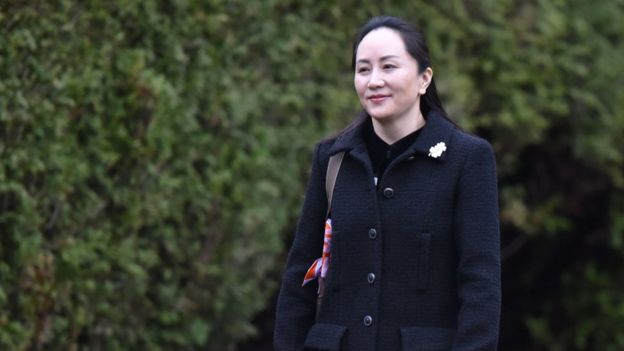
Meng Wanzhou, its chief financial officer and the daughter of the company’s founder, is still being held in Canada where she is fighting extradition to the US.
She is wanted there on charges of fraud and sanctions violations – claims she denies.
Image copyright AFPImage caption Meng Wanzhou was arrested during a layover in Vancouver in 2018
“This new indictment is part of the Justice Department’s attempt to irrevocably damage Huawei’s reputation and its business for reasons related to competition rather than law enforcement,” the company said.
In the updated indictment, the US accuses Huawei of racketeering and trade secret theft, and gives more detail about the firm’s efforts to evade US rules on doing business with Iran and North Korea.
Prosecutors also said Huawei offered bonuses to staff who obtained “confidential information” from its competitors.
“As a consequence of its campaign to steal this technology and intellectual property, Huawei was able to drastically cut its research and development costs and associated delays, giving the company a significant and unfair competitive advantage,” prosecutors said.
Huawei said the new charges are a “contrived repackaging” of claims that have already been litigated in civil court.
“The government will not prevail on these charges which we will prove to be both unfounded and unfair,” the company said.
The new charges, filed in federal court in Brooklyn on Thursday, suggest the US is not backing away from its fight over Huawei, which has added to tensions between the US and China, and complicated American relationships with allies.
The US has pushed partners such as the UK to ban Huawei technology from their networks, maintaining the company’s equipment could be used for spying by China.












 CHINDIA ALERT: You'll be living in their world, very soon