18/04/2020
SHANGHAI (Reuters) – China ordered on Saturday that anyone in Wuhan working in certain service-related jobs must take a coronavirus test if they want to leave the city.
The order comes after the central city, where the coronavirus emerged late last year, lifted a 70-day lockdown that all but ended the epidemic there.
People in Wuhan work in nursing, education, security and other sectors with high exposure to the public must take a nucleic acid test before leaving, the National Health Commission said in an order.
The government of Hubei province, of which Wuhan is capital, will pay for the tests, the commission said.
Since the city relaxed its lockdown restrictions people who arrived in there before Chinese New Year, when the virus was peaking in China, are allowed to go back to their homes.
People working in other sectors aiming to leave Wuhan are encouraged to take voluntary tests before going.
Within seven days of arrival at their destinations, people who can present test results showing they do not carry the virus, as well as a clean bill of health on a health app, can go back to work.
Everyone else will have to spend 14 days in quarantine before returning to work.
Authorities have worked with the China’s tech giants to devise a colour-based health code system, retrieved via mobile app, that uses geolocation data and self-reported information to indicate one’s health status.
Wuhan will speed up its efforts to investigate asymptomatic coronavirus cases and confirm the presence of antibodies in people, which might suggest immunity, the commission said.
Wuhan, which accounts for 60% of infections in China and 84% of the death toll as of Saturday, has been testing inhabitants aggressively throughout the virus’ breakout and many companies had already been asking workers from the city to undergo tests before resuming work.
Wuhan revised up its death toll from the coronavirus by 1,290 on Friday, taking the city’s toll to 3,869, because of incorrect reporting, delays and omissions, especially in the chaotic early stages of the outbreak, authorities said.
China national death toll is 4,632 from 82,719 cases.
Source: Reuters
Posted in 'when', 14 days, 60, 70-day, 84%, after, aggressively, aiming, allowed, antibodies, Anyone, arrived, asking, asymptomatic, authorities, before, breakout, capital, carry, central, certain, chaotic, China, China’s, chinese new year, City, clean bill of health, colour-based, comes, commission, companies, confirm, coronavirus cases, Data, days, death toll, delays, destinations, devise, early stages, education, efforts, else, emerged, encouraged, ended, epidemic, especially, Everyone, Friday, geolocation, go back, Government, health app, health code system, health status, high exposure, homes, hubei province, immunity, incorrect reporting, indicate, infections, information, inhabitants, investigate, key, late last year, leave, leaving, lifted, lockdown, mandates, mobile app, must, National, National Health Commission, nursing, omissions, one’s, order, other, outbreak, pay, peaking, People, presence, present, public, public workers, quarantine, relaxed, restrictions, results, resuming, retrieved, returning, said, Saturday, sectors, security, self-reported, service-related jobs, seven, Shanghai, showing, speed up, spend, suggest, take, tech giants, test, tests, their, there, throughout, Uncategorized, undergo, uses, via, Virus, voluntary, want, work, workers, working, Wuhan |
Leave a Comment »
15/04/2020
- Residents of nine regions, including Wuhan, Beijing and Shanghai, to be sampled using both nucleic acid and antibody tests, state media reports
- Research ‘very important as it will help us to direct our countermeasures in the future’, molecular virologist says
China is using dual testing to determine how many people have been infected with Covid-19 but recovered without showing symptoms. Photo: AP
China has begun a major survey to determine how many people might have been infected with the
coronavirus and then recovered
without ever showing symptoms, while also assessing immunity levels within different communities, state media reported.
The research will be conducted in six provinces, including Hubei which was the focus of the initial outbreak, as well as Beijing, Shanghai and Chongqing.
, the capital of Hubei and home to about 60 per cent of all infections reported in mainland China, is taking the lead in the study, which involves giving both nucleic acid and antibody tests to 11,000 of its 11 million residents, state news agency Xinhua reported on Wednesday.
Health workers collected throat swabs and blood samples from about 900 people randomly selected from eight subdistricts of the city on Tuesday, Ding Gangqiang, head of the Wuhan epidemiological survey team, was quoted as saying.
“The purpose is to learn about the immunity level in communities and provide scientific support on how we should adjust our disease control strategies,” he said.
Professor Lu Hongzhou, a specialist in infectious diseases who heads the Shanghai Public Health Clinical Centre where Covid-19 patients are being treated, said he supported the research though the collection of samples had yet to start in the city.
“We haven’t received notification from the top [to start],” he said. “The number of infections [in Shanghai] is not very big, but I think we’d better do this so as to have an idea of the scale of asymptomatic carriers.”
Professor Jin Dong-yan, a molecular virologist at the Li Ka Shing Faculty of Medicine at the University of Hong Kong, said that the use of both nucleic acid and antibody tests would enable scientists to determine those people who had been infected but recovered without medical aid and without showing symptoms.
The study into asymptomatic infections got under way in Wuhan in Tuesday. Photo: Simon Song
If a person tested positive in a nucleic acid test, it meant they were carrying the virus, and if positive in an antibodies test, it meant that they had contracted the virus and had recovered, he told the South China Morning Post.
“This is very important as it will help us to direct our countermeasures in the future,” Jin said.
“If we find, say 60 per cent, of the population has acquired immunity, then lockdowns will no longer be meaningful. If it turns out that there are many people with a high viral load but without symptoms, then we should be on high alert and take stricter measures.
“For people in Hubei, the tests can also save them from discrimination when they get back to work – those who prove to have developed immunity are very unlikely to get infected [again] for at least a year,” he said.
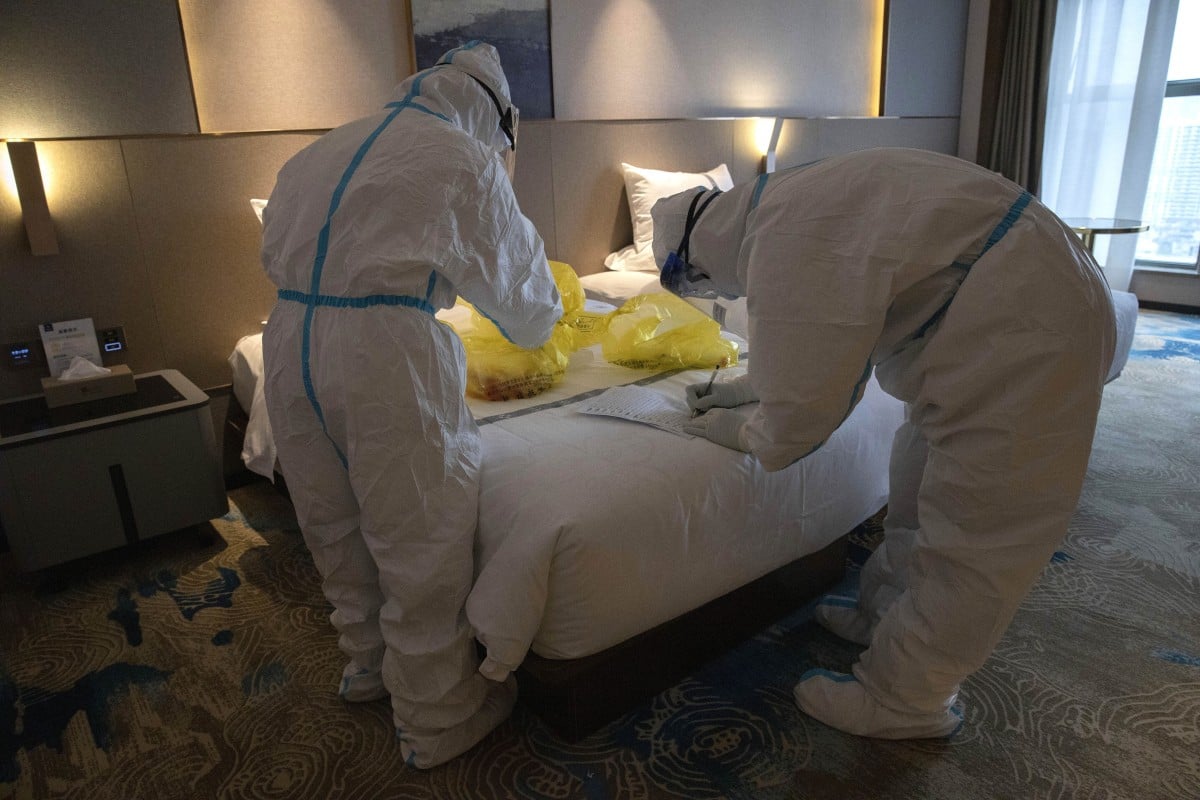
Wuhan hotel owners say they’re on the brink of going bust
to the nation’s daily infections tally at the start of April amid concerns that such people could trigger a second outbreak once the widespread lockdowns in cities like Wuhan and elsewhere were lifted.
China reported 103 new coronavirus infections on Wednesday, of which 39 were imported. Of the total, 57 people had no symptoms, including three of the imported cases.
Since the outbreak began, China has reported 82,295 cases, of which 95 per cent have recovered and been discharged from hospital.
Source: SCMP
Posted in antibody tests, ASYMPTOMATIC CASES, asymptomatic infections, Beijing, blood samples, China, collected, coronavirus, countermeasures, COVID-19, health workers, Hubei, immunity, infected, infectious diseases, launches, Li Ka Shing Faculty of Medicine, lockdowns, Mainland China, meaningful, molecular virologist, nine, nucleic acid, patients, People, Population, recovered, regions, research, residents, sampled, Shanghai, Shanghai Public Health Clinical Centre, shared, showing, south china morning post, state news agency, study, symptoms, throat swabs, Tuesday, Uncategorized, University of Hong Kong, without, Wuhan, Wuhan epidemiological survey team, Xinhua |
Leave a Comment »




 CHINDIA ALERT: You'll be living in their world, very soon