Chindia Alert: You’ll be Living in their World Very Soon
aims to alert you to the threats and opportunities that China and India present. China and India require serious attention; case of ‘hidden dragon and crouching tiger’.
Without this attention, governments, businesses and, indeed, individuals may find themselves at a great disadvantage sooner rather than later.
The POSTs (front webpages) are mainly 'cuttings' from reliable sources, updated continuously.
The PAGEs (see Tabs, above) attempt to make the information more meaningful by putting some structure to the information we have researched and assembled since 2006.
NEW DELHI (Reuters) – India and Pakistan are set to sign an agreement on Indian pilgrims visiting a Sikh shrine in Pakistan, rare cooperation between the nuclear-armed neighbours at a time of tension that has brought exchanges of fire on their disputed border.
The pact will introduce visa-free access from India to the Pakistani town of Kartarpur, home to a temple that marks the site where the founder of Sikhism, Guru Nanak, died.
India’s foreign ministry said in a statement late on Monday an understanding had been reached on most issues and India was prepared to sign the agreement on Wednesday.
Pakistani officials were not immediately available for comment but Pakistan’s Dawn newspaper cited a foreign ministry spokesman as saying agreement had been reached and the two sides would sign the pact soon.
The Sikh minority in India has long sought easier access to the temple in Kartarpur, which is just over the border in Muslim-majority Pakistan.
The collaboration comes at a time of tension between the rivals, with Pakistan particularly aggrieved over recent Indian government measures in its part of the divided Muslim-majority region of Kashmir.
Both countries claim the Himalayan region in full but rule it in part.
India in August revoked special autonomy in Indian-controlled Kashmir, which was accompanied by a crackdown on dissent by India’s security forces there, angering Pakistan.
The dispute over Kashmir has bedevilled relations since their independence in 1947 and sparked two of their three wars.
India said on Sunday two soldiers and a civilian were killed in cross-border shelling in Kashmir while Pakistan said one of its soldiers and three civilians had been killed.
In February, they came close to war following a suicide bombing in Indian Kashmir that killed 40 paramilitary soldiers. In response, India launched an air strike on the Pakistani side and Pakistan shot down an Indian aircraft.
The new crossing will be inaugurated in early November, just before the 550th birthday of Sikhism’s founder on Nov. 12, officials from both sides have said.
The shrine is about 4 km (2-1/2 miles) from the border. The crossing and corridor, including a road, bridge over the Ravi River and immigration office, will replace a drawn-out visa process and circuitous journey through Pakistan.
But there is still disagreement over a $20 fee that Pakistan wants to charge each visitor.
India “has consistently urged Pakistan that in deference to the wishes of the pilgrims, it should not levy such a fee”, India’s foreign ministry said.
SRINAGAR/NEW DELHI (Reuters) – Authorities in Indian Kashmir have arrested nearly 4,000 people since the scrapping of its special status last month, government data shows, the most clear evidence yet of the scale of one of the disputed region’s biggest crackdowns.
Muslim-majority Kashmir, claimed by both India and Pakistan, has been in turmoil since India stripped its portion of the region of its autonomy and statehood on Aug. 5, leading to clashes between security forces and residents and inflaming tension with Pakistan.
India said the removal of the status that its part of Kashmir has held since independence from Britain in 1947 would help integrate it into the Indian economy, to the benefit of all.
In an attempt to stifle the protests that the reform sparked in Kashmir, India cut internet and mobile services and imposed curfew-like restrictions in many areas.
It has also arrested more than 3,800 people, according to a government report dated Sept. 6 and seen by Reuters, though about 2,600 have since been released.
A spokeswoman for India’s interior ministry did not respond to a request for comment. Neither did Jammu and Kashmir police.
It was not clear on what basis most of the people were being held but an Indian official said some were held under the Public Safety Act, a law in Jammu and Kashmir state that allows for detention for up to two years without charge.
The data for the first time shows the extent of the detentions, as well as indicating who was picked up and where.
More than 200 politicians, including two former chief ministers of the state were arrested, along with more than 100 leaders and activists from an umbrella organisation of pro-separatist political groups.
The bulk of those arrested – more than 3,000 – were listed as “stone pelters and other miscreants”. On Sunday, 85 detainees were shifted to a prison in Agra in northern India, a police source said.
Rights group Amnesty International said the crackdown was “distinct and unprecedented” in the recent history of the region and the detentions had contributed to “widespread fear and alienation”.
“The communication blackout, security clampdown and detention of the political leaders in the region has made it worse,” said Aakar Patel, head of Amnesty International India.
‘RIGHT TO LIFE’
India says the detentions are necessary to maintain order and prevent violence, and points to the relatively limited number of casualties compared with previous bouts of unrest.
The government says only one person is confirmed to have died compared with dozens in 2016, when the killing of a militant leader sparked widespread violence.
“The right to life is the most important human right,” India’s national security adviser Ajit Doval told reporters recently.
The report contains data from the 13 police districts that make up the Kashmir Valley, the most populous part of the Himalayan region where the main city of Srinagar is located.
The largest number of arrests have been in Srinagar, the data shows, at nearly 1,000. Earlier unrest often centred in rural areas.
Of the detained political leaders, more than 80 were from the People’s Democratic Party, formerly in coalition in Jammu and Kashmir state with the ruling Bharatiya Janata Party.
About 70 are from the National Conference, which has for years dominated politics in Indian Kashmir, and more than a dozen from India’s main opposition Congress party.
Police also arrested more than 150 people accused of association with militant groups fighting Indian rule.
An Indian official said it was likely that more than 1,200 people were still held, including all the high-profile politicians and separatists mentioned in the report, while dozens more are being arrested every day.
In the 24 hours before the report was compiled, more than two dozen people were arrested, mainly on suspicion of throwing stones at troops, the data showed.
The data did not include those under informal house arrest, nor people detained in a round-up of separatists that began in February after a bomb attack by a Pakistan-based militant group on Indian troops.
Days before India’s move to strip Kashmir of special status, one prominent separatist leader told Reuters that more than 250 people with links to the movement were already in detention.
Image copyright GETTY IMAGESImage caption Four million people were stripped of their citizenship in the draft list last July
India has published the final version of a list which effectively strips about 1.9 million people in the north-eastern state of Assam of their citizenship.
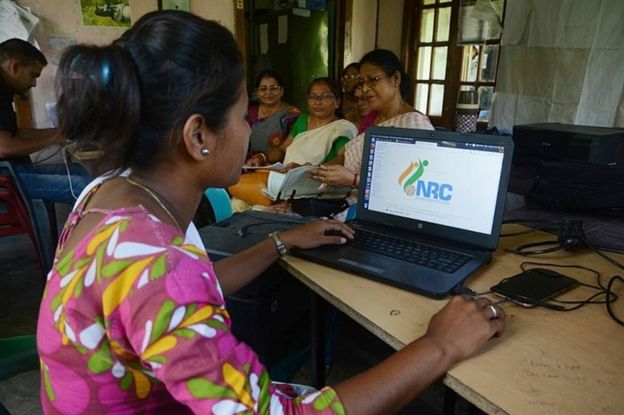
The National Register of Citizens (NRC) is a list of people who can prove they came to the state by 24 March 1971, the day before neighbouring Bangladesh declared independence from Pakistan.
People left off the list will have 120 days to appeal against their exclusion.
It is unclear what happens next.
India says the process is needed to identify illegal Bangladeshi migrants.
It has already detained thousands of people suspected of being foreigners in temporary camps which are housed in the state’s prisons, but deportation is currently not an option for the country.
The process has also sparked criticism of “witch hunts” against Assam’s ethnic minorities.
A draft version of the list published last year had four million people excluded.
What is the registry of citizens?
The NRC was created in 1951 to determine who was born in Assam and is therefore Indian, and who might be a migrant from neighbouring Bangladesh.
The register has been updated for the first time.
Image copyright EPAImage caption The NRC was created in 1951 to determine who was born in the state and is Indian
Families in the state have been required to provide documentation to show their lineage, with those who cannot prove their citizenship deemed illegal foreigners.
Prime Minister Narendra Modi’s Hindu nationalist Bharatiya Janata Party (BJP) has long railed against illegal immigration in India but has made the NRC a priority in recent years.
An anxious wait
By Rajini Vaidyanathan, BBC News, Assam
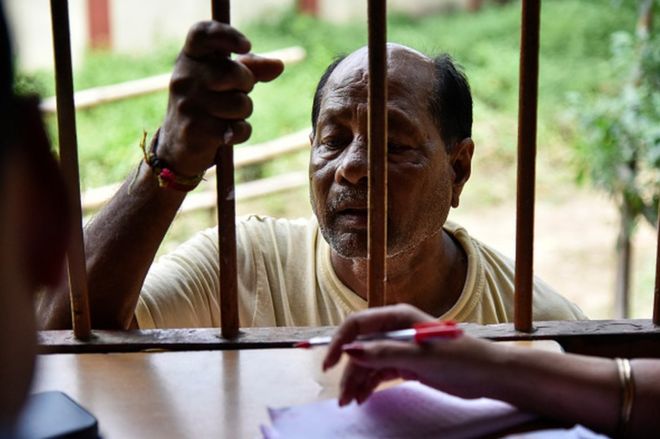
A small community centre in the village of Katajhar is being guarded by two members of the Indian army. Outside, a line of people wait. Some are clutching plastic bags containing documents.
As they enter one of two rooms, an official runs his eyes down a print-out to see if their names or photos are on it. This list – the National Register of Citizens – is one with huge consequences. And so there’s fear and trepidation as people here find out whether they’ve been included.
Many here who haven’t made it tell me it’s a mistake as they show me paperwork they say proves they belong in this country.
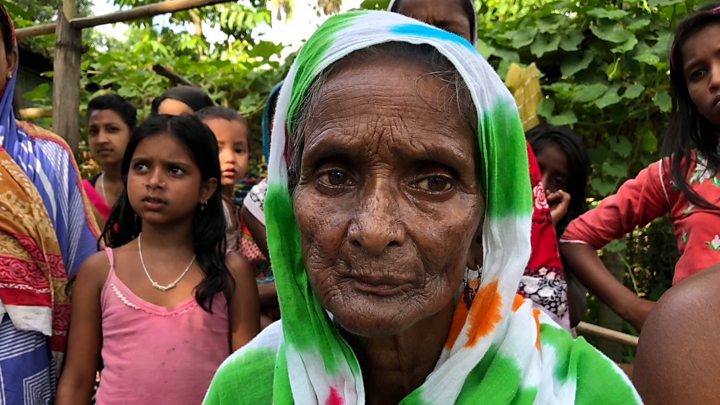
None of Asia Khatun’s family of nine made the list. They now have the chance to appeal but there’s real fear about what might come next. “I’d rather die than go to a detention centre,” she tells me. People here are angry but they’re also scared.
Why is the registry happening in Assam?
Assam is one India’s most multi-ethnic states. Questions of identity and citizenship have long vexed a vast number of people living there.
Among its residents are Bengali and Assamese-speaking Hindus, as well as a medley of tribespeople.
A third of the state’s 32 million residents are Muslims, the second-highest number after Indian-administered Kashmir. Many of them are descendants of immigrants who settled there under British rule.
But illegal migration from neighbouring Bangladesh, which shares a 4,000-km long border with India, has been a concern there for decades now. The government said in 2016 that an estimated 20 million illegal immigrants were living in India.
So have 1.9 million people effectively become stateless?
Not quite. Residents excluded from the list can appeal to the specially formed courts called Foreigners Tribunals, as well as the high court and Supreme Court.
However, a potentially long and exhaustive appeals process will mean that India’s already overburdened courts will be further clogged, and poor people left off the list will struggle to raise money to fight their cases.
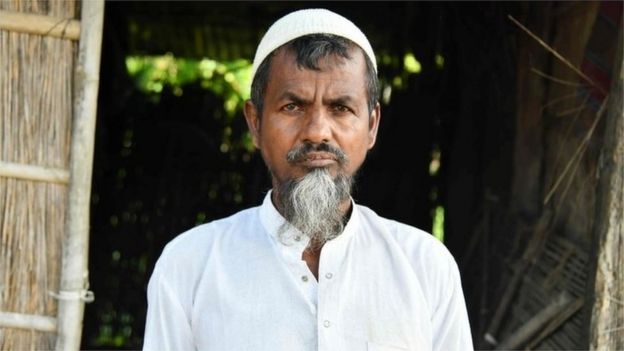
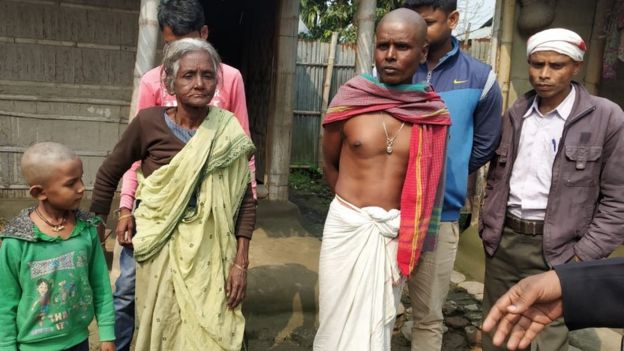
Image copyright AFPImage caption Saheb Ali, 55, from Goalpara district, has not been included in the list
If people lose their appeals in higher courts, they could be detained indefinitely.
Some 1,000 people declared as foreigners earlier are already lodged in six detention centres located in prisons. Mr Modi’s government is also building an exclusive detention centre, which can hold 3,000 detainees.
“People whose names are not on the final list are really anxious about what lies ahead. One of the reasons is that the Foreigners Tribunal does not have a good reputation, and many people are worried that they will have to go through this process,” Sangeeta Barooah Pisharoty, author of Assam: The Accord, The Discord, told the BBC.
Why have been the courts so controversial?
The special courts were first set up in 1964, and since then they have declared more than 100,000 people foreigners. They regularly identify “doubtful voters” or “illegal infiltrators” as foreigners to be deported.
But the workings of the specially formed Foreigners Tribunals, which have been hearing the contested cases, have been mired in controversy.
There are more than 200 such courts in Assam today, and their numbers are expected to go up to 1,000 by October. The majority of these tribunals were set up after the BJP came to power in 2014.
The courts have been accused of bias and their workings have often been opaque and riddled with inconsistencies.
Media caption Living in limbo: Assam’s four million unwanted
For one thing, the burden of proof is on the accused or the alleged foreigner.
For another, many families are unable to produce documents due to poor record-keeping, illiteracy or because they lack the money to file a legal claim.
People have been declared foreigners by the courts because of differences in spellings of names or ages in voter rolls, and problems in getting identity documents certified by authorities. Amnesty International has described the work by the special courts as “shoddy and lackadaisical”.
Journalist Rohini Mohan analysed more than 500 judgements by these courtsin one district and found 82% of the people on trial had been declared foreigners. She also found more Muslims had been declared foreigners, and 78% of the orders were delivered without the accused being ever heard – the police said they were “absconding”, but Mohan found many of them living in their villages and unaware they had been declared foreigners.
“The Foreigners Tribunal,” she says, “must be made more transparent and accountable.”
Both the citizen’s register and the tribunals have also sparked fears of a witch hunt against Assam’s ethnic minorities.
Have the minorities been targeted?
Many say the list has nothing to do with religion, but activists see it as targeting the state’s Bengali community, a large portion of whom are Muslims.
They also point to the plight of Rohingya Muslims in neighbouring Bangladesh.
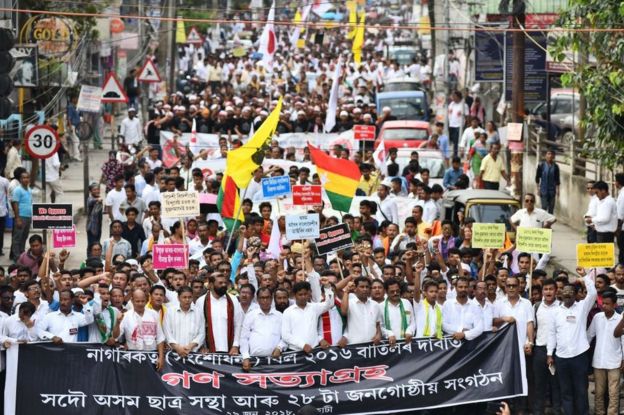
Image copyright GETTY IMAGESImage caption The move to make millions of people stateless will probably spark protests
However significant numbers of Bengali-speaking Hindus have also been left off the citizenship list, underscoring the communal and ethnic tensions in the state
“One of the communities worst affected by the list are the Bengali Hindus. There are as many of them in detention camps as Muslims. This is also the reason just days before NRC is to be published the BJP has changed tack, from taking credit for it to calling it error-ridden. That is because the Bengali Hindus are a strong voter base of the BJP,” says Barooah Pisharoty.
And in an echo of US President Donald Trump’s policy to separate undocumented parents and children, families have been similarly broken up in Assam.
Detainees have complained of poor living conditions and overcrowding in the detention centres.
Image copyright CITIZENS FOR JUSTICE AND PEACEImage caption A father and son killed themselves 30 years apart because of citizenship doubts (photo shows funeral)
One detainee told a rights group after his release he had been taken to a room which had a capacity for 40 people, but was filled with around 120 people. People who have been declared foreigners as well as many inmates have been suffering from depression. Children have also been detained with their parents.
Human rights activist Harsh Mander, who visited two detention centres, has spoken about a situation of “grave and extensive human distress and suffering”.
What happens to people who are declared foreigners?
The BJP which rules the state, has insisted in the past that illegal Muslim immigrants will be deported. But neighbouring Bangladesh will definitely not accede to such a request.
Many believe that India will end up creating the newest cohort of stateless people, raising the spectre of a homegrown crisis that will echo that of the Rohingya people who fled Myanmar for Bangladesh.
It is not clear whether the people stripped of their Indian citizenship will be able to access welfare or own property.
One possibility is that once they are released, they will be given work permits with some basic rights, but will not be allowed to vote.
SRINAGAR, India (Reuters) – Schools reopened in Indian Kashmir’s main city on Monday but most classrooms were empty as parents kept their children home, fearing unrest over the government’s decision two weeks ago to revoke the region’s autonomy.
Some 190 primary schools were set open in Srinagar as a sign of normalcy returning to Muslim majority Jammu and Kashmir as authorities ease a clampdown aimed at preventing mass protests.
Parents said their children would stay home until cellular networks are restored and they can be in contact with them.
“How can we risk the lives of our children?” said Gulzar Ahmad, a father of two who are enrolled in a school in the city’s Batamallo district where protests have occurred.
“Troops have arrested minor children in the last two weeks and several children were injured in clashes,” he said. “Our children are safe inside their homes. If they go to school who can guarantee their safety?”
Authorities were not immediately available for comment, but have previously denied reports of mass arrests.
Protests began after the Aug. 5 decision by Prime Minister Narendra Modi’s government to withdraw Kashmir’s special status and integrate it fully into India, with equal rights for all Indians to buy property there and compete for government jobs.
Critics said the decision will alienate many Kashmiris and add fuel to a 30-year armed revolt in the Himalayan territory that Pakistan also lays claim to.
On the weekend, residents of Srinagar – the hotbed of the separatist revolt – threw stones and clashed with police. Dozens of people were injured, two senior officials and witnesses said.
Reuters journalists visited two dozen schools in Srinagar on Monday. Some schools were lightly staffed and classrooms deserted. Gates at other schools were locked.
Only one student showed up at Presentation Convent Higher Secondary School, which has an enrolment of 1,000 pupils, and went home, said a school official.
A handful of teachers but no students turned up at the barricaded Burn Hall school in one of the city’s high security zones.
“How can students come to classes in such a volatile situation? The government is turning these little children into cannon fodder,” a teacher said, adding that schools should stay closed until the situation is normal.
CROSS BORDER FIRING
New Delhi’s decision on Kashmir has heightened tensions with its neighbour and rival nuclear power, Pakistan, and triggered cross-border exchanges of fire.
In the latest incident, two civilians were killed in Pakistan-controlled Kashmir by Indian soldiers firing across the disputed border, Pakistan’s foreign ministry said, adding that it had summoned India’s deputy commissioner in Islamabad to protest.
“The ceasefire violations by India are a threat to regional peace and security and may lead to a strategic miscalculation,” the foreign ministry said.
There was no immediate comment from India which has previously accused Pakistan of trying to whip up tensions to draw global attention.
More than 50,000 people have died in the revolt that erupted against Indian rule in Kashmir in 1989. India blames Pakistan for giving material support to the militants and helping them cross into its part of the mountainous region.
Pakistan denies the allegation and says it only gives moral and diplomatic support to the Kashmiri people in their struggle for self determination.
SRINAGAR (Reuters) – Police arrested the publisher of one of the most widely read newspapers in Indian-controlled Kashmir in a midnight raid over a decades-old case, the police and his brother said on Tuesday, highlighting the difficulties facing media in the region.
Tension has run high in the Himalayan region since more than 40 Indian police were killed in a February suicide car bomb attack by a militant group based in Pakistan.
Muslim-majority Kashmir is at the heart of more than seven decades of hostility between nuclear archrivals India and Pakistan. Each claims it in full but rules only a part.
Ghulam Jeelani Qadri, 62, a journalist and the publisher of the Urdu-language newspaper Daily Afaaq, was arrested at his home in the region’s main city of Srinagar, half an hour before midnight on Monday.
“It is harassment,” his brother, Mohammad Morifat Qadri, told Reuters. “Why is a 1993 arrest warrant executed today? And why against him only?”
Qadri was released on bail after a court appearance on Tuesday.
The case dates from 1990, when Qadri was one of nine journalists to publish a statement by a militant group fighting against Indian rule in Kashmir. An arrest warrant for Qadri was issued in 1993, but it was never served.
Qadri had visited the police station involved in the arrest multiple times since the warrant was issued, most recently in 2017 to apply for a passport, his brother added.
Asked why Qadri was arrested at night, Srinagar police chief Haseeb Mughal told Reuters, “Police were busy during the day.”
The Kashmir Union of Working Journalists condemned the arrest, saying it seemed to be aimed at muzzling the press.
“Qadri was attending the office on a daily basis and there was absolutely no need for carrying out a midnight raid at his residence,” it said in a statement.
Journalists in Kashmir find themselves caught in the crossfire between the Indian government and militant groups battling for independence.
Both sides are stepping up efforts to control the flow of information, with the situation at its worst in decades, dozens of journalists have told Reuters.
India is one of the world’s worst places to be a journalist, ranked 138th among 180 countries on the press freedom index of international monitor Reporters Without Borders, with conditions in Kashmir cited as a key reason.




 CHINDIA ALERT: You'll be living in their world, very soon