Chindia Alert: You’ll be Living in their World Very Soon
aims to alert you to the threats and opportunities that China and India present. China and India require serious attention; case of ‘hidden dragon and crouching tiger’.
Without this attention, governments, businesses and, indeed, individuals may find themselves at a great disadvantage sooner rather than later.
The POSTs (front webpages) are mainly 'cuttings' from reliable sources, updated continuously.
The PAGEs (see Tabs, above) attempt to make the information more meaningful by putting some structure to the information we have researched and assembled since 2006.
SRINAGAR (Reuters) – Police arrested the publisher of one of the most widely read newspapers in Indian-controlled Kashmir in a midnight raid over a decades-old case, the police and his brother said on Tuesday, highlighting the difficulties facing media in the region.
Tension has run high in the Himalayan region since more than 40 Indian police were killed in a February suicide car bomb attack by a militant group based in Pakistan.
Muslim-majority Kashmir is at the heart of more than seven decades of hostility between nuclear archrivals India and Pakistan. Each claims it in full but rules only a part.
Ghulam Jeelani Qadri, 62, a journalist and the publisher of the Urdu-language newspaper Daily Afaaq, was arrested at his home in the region’s main city of Srinagar, half an hour before midnight on Monday.
“It is harassment,” his brother, Mohammad Morifat Qadri, told Reuters. “Why is a 1993 arrest warrant executed today? And why against him only?”
Qadri was released on bail after a court appearance on Tuesday.
The case dates from 1990, when Qadri was one of nine journalists to publish a statement by a militant group fighting against Indian rule in Kashmir. An arrest warrant for Qadri was issued in 1993, but it was never served.
Qadri had visited the police station involved in the arrest multiple times since the warrant was issued, most recently in 2017 to apply for a passport, his brother added.
Asked why Qadri was arrested at night, Srinagar police chief Haseeb Mughal told Reuters, “Police were busy during the day.”
The Kashmir Union of Working Journalists condemned the arrest, saying it seemed to be aimed at muzzling the press.
“Qadri was attending the office on a daily basis and there was absolutely no need for carrying out a midnight raid at his residence,” it said in a statement.
Journalists in Kashmir find themselves caught in the crossfire between the Indian government and militant groups battling for independence.
Both sides are stepping up efforts to control the flow of information, with the situation at its worst in decades, dozens of journalists have told Reuters.
India is one of the world’s worst places to be a journalist, ranked 138th among 180 countries on the press freedom index of international monitor Reporters Without Borders, with conditions in Kashmir cited as a key reason.
MUMBAI/NEW DELHI (Reuters) – Police broke up clashes between rival groups of voters in West Bengal on Monday as some of India’s richest families and Bollywood stars also cast their ballots in Mumbai during the fourth phase of a massive, staggered general election.
In West Bengal, a populous eastern state crucial for Prime Minister Narendra Modi’s re-election bid, supporters of his Hindu nationalist Bharatiya Janata Party (BJP) clashed with others from the regional Trinamool Congress, police said.
TV footage showed armed security forces chasing away people wielding sticks, although it was initially difficult to determine the scale of the clashes.
There were no immediate reports of any poll-related injuries in West Bengal, where at least one person was killed and three injured during the third phase of voting last week.
The BJP is in a direct, and sometimes bloody, fight in West Bengal with Trinamool, whose chief Mamata Banerjee is one of Modi’s biggest critics and a potential prime ministerial candidate.
More than 127 million people are eligible to vote in this round of the seven-phase election held across 71 seats in nine states. Modi’s coalition won more than 75 percent of the seats in the previous election in 2014.
Many of the constituencies are in Uttar Pradesh in the north and western India’s Maharashtra, where the financial capital Mumbai is located. Uttar Pradesh elects the most lawmakers, with Maharashtra next. Both states are ruled by the BJP and its allies.
However, political analysts say the BJP may struggle to repeat its strong showing this time due mainly to a jobs shortage and weak farm prices, issues upon which the main opposition Congress party has seized.
‘SOME PROGRESS’
First-time voter Ankita Bhavke, a college student in Mumbai, said she voted for economic development.
“I want the country to be at par with the best in the world,” she said. “There’s been some progress in the last five years.”
India’s financial markets were closed on Monday for the election.
Mumbai is home to the massive Hindi film industry, as well as Asia’s wealthiest man, Mukesh Ambani, and India’s richest banker, Uday Kotak.
Ambani, who heads Reliance Industries, and Kotak, managing director of Kotak Mahindra Bank, created a stir this month by publicly endorsing an opposition Congress party candidate from their upscale South Mumbai constituency.
Mumbai, which has six seats, is India’s wealthiest city but ageing and insufficient infrastructure is a major concern. Six people were killed last month when part of a pedestrian bridge collapsed, recalling memories of a 2017 rush-hour stampede that killed at least 22 people on a narrow pedestrian bridge.
The election, the world’s biggest democratic exercise with about 900 million voters, started on April 11 with Modi in the lead amid heightened tension with long-time enemy Pakistan.
The last phase of voting is on May 19, with results released four days later.
There are a total of 545 seats in the Lok Sabha.
Modi sent warplanes into Pakistan in late February in response to a suicide attack by an Islamist militant group based there that killed 40 Indian police in the disputed Kashmir region.
Modi has sought votes on his tough response towards militancy and in recent days has evoked the deadly Easter Sunday bombings in nearby Sri Lanka.
Maidul Islam, a professor of political science at Kolkata’s Centre for Studies in Social Sciences, said long queues outside polling stations would indicate whether Modi’s national security pitch was working.
“Whenever there is a BJP kind of a wave, you see a higher voter turnout,” he said.
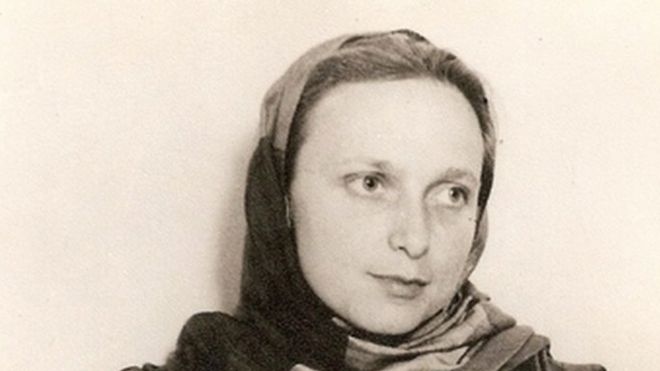
Freda Bedi lived an unusual life. Born in a small town in England, she moved to India for love and ended up joining the independence movement. Her biographer, Andrew Whitehead, writes about her remarkable story.
“There are things deeper than labels and colour and prejudice, and love is one of them.”
These were the words of Freda Bedi, an English woman who overcame prejudice to marry an Indian Sikh and went on to challenge Indian notions about the role of a woman and a wife.
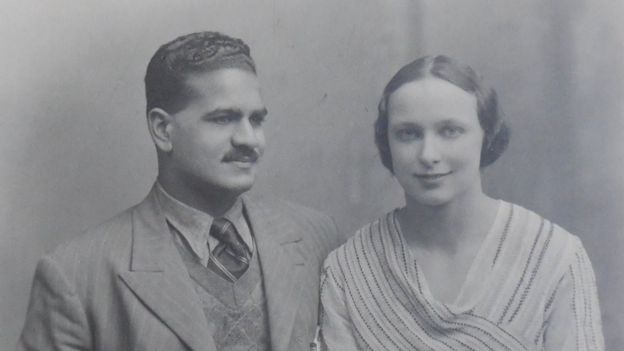
Freda and her boyfriend, Baba Pyare Lal Bedi (his friends called him BPL), met at Oxford where both were students.
This was the early 1930s and romances across the racial divide were rare – almost as rare as a girl from Freda’s background securing a spot at a top university. She was born, quite literally, above the shop in the city of Derby in England’s East Midlands, where her father ran a jewellery and watch repair business.
Freda could barely remember her father. He enlisted during the First World War and served in the Machine Gun Corps, where casualties were so high it was known as the “suicide club”. He died in northern France when his daughter was just seven years old. “This death shadowed my whole childhood,” she recalled – it shaped her political loyalties and prompted her lifelong spiritual quest.
Her years at Oxford were “the opening of the gates of the world”, as Freda once put it. She was part of “the Depression generation” – those who were students at a time of global crisis, mass unemployment and the rise of fascism.
She made firm friends at her college with young women who were rebellious by nature, and went with them to meetings of the Labour Club and the communist October Club.
Image captionFreda and BPL met as students at Oxford University
Driven by curiosity and by sympathy with those struggling against the Empire, she also went along to the weekly meetings of the Oxford Majlis, where radicals among the university’s small number of Indian students asserted their country’s case for nationhood. BPL Bedi, a handsome and cheerful Punjabi, was a regular there. A friendship developed into intellectual collaboration and, within months, Freda and BPL were a couple.
In the early 1930s, women’s colleges at Oxford were obsessed with sex or rather with preventing it. If a male student came to have tea in a female student’s room, a chaperone had to be present, the door left wide open and the bed had to be taken into the corridor. Freda’s college did its best to derail her relationship – she was disciplined for visiting BPL without a chaperone in what she was convinced was a case of racial discrimination.
But she was fortunate in her student friends. Barbara Castle, who later became a commanding British woman politician of her era, was thrilled when Freda confided that she intended to marry her boyfriend. “Well, thank goodness”, Barbara exclaimed. “Now at least you won’t become a suburban housewife!” Freda’s mother didn’t see things that way though. Her family were sternly disapproving, until BPL made a visit to Derby and managed to charm them.
Freda commented that the engagement caused “a minor sensation” in Oxford. That was an understatement. She believed she was the first Oxford woman undergraduate to marry an Indian fellow student. Some didn’t hide their disapproval. The registrar who conducted the marriage ceremony pointedly refused to shake hands with the couple.
From the moment she married, Freda regarded herself as Indian and often wore Indian-style clothes. A year later, husband and wife and their four-month old baby, Ranga, set off by boat from Trieste, Italy, on the two-week journey to the western Indian city of Bombay (now Mumbai). “The nightmare was to get milk for myself to drink because I was feeding the baby”, Freda recalled. “And I remember the millions of cockroaches that used to come out at night in the ship’s kitchens – I used to go in and attempt to get milk.”
The couple had already been marked out by the British authorities as revolutionaries and potential trouble makers because of their student activism. When they disembarked in Bombay, their bags and cases were inspected for seven hours to check for left-wing propaganda. “Even Ranga’s little napkin was taken off and searched,” recalled Freda, “because they thought I might be carrying messages in it”.
The key test of Freda’s marriage was still to come – the first meeting with her Indian mother-in-law, a widow and matriarch known in the family as Bhabooji. From Bombay, the Bedis travelled non-stop for a couple of days to reach the small Punjabi city of Kapurthala, arriving at the family home close to midnight. Freda was wearing a white cotton sari – “not the ideal travelling dress, and nursing Ranga had not improved it”.
BPL bowed to touch his mother’s feet in the traditional expression of respect. “I copied him, feeling a little awkward,” Freda said, “but all my shyness disappeared when she smiled at us both with tears in her eyes, and embraced us and the child as if she could not hold us close enough.”
Although Freda was determined to fit in with her Indian extended family, her lifestyle was anything but conventional. BPL’s political stand extended to rejecting any share in his family’s wealth. They made their home in Lahore, one of the largest cities in Punjab, in a cluster of thatched huts without power or running water, keeping hens and a buffalo. It can’t have been the sort of life Freda had expected – nor would she have been used to the idea of sharing the household with her mother-in-law.
“Nowhere had I seen a white woman trying to be a typical Indian daughter-in-law”, commented Som Anand, a frequent visitor to the Bedis’ huts. “It surprised me to see Mrs Bedi coming to Bhabooji’s hut in the morning to touch her feet. In household matters she respected the old mother’s inhibitions. Her mother-in-law was an equally large hearted person; despite all her conservatism she had accepted a Christian into the family without a murmur.”
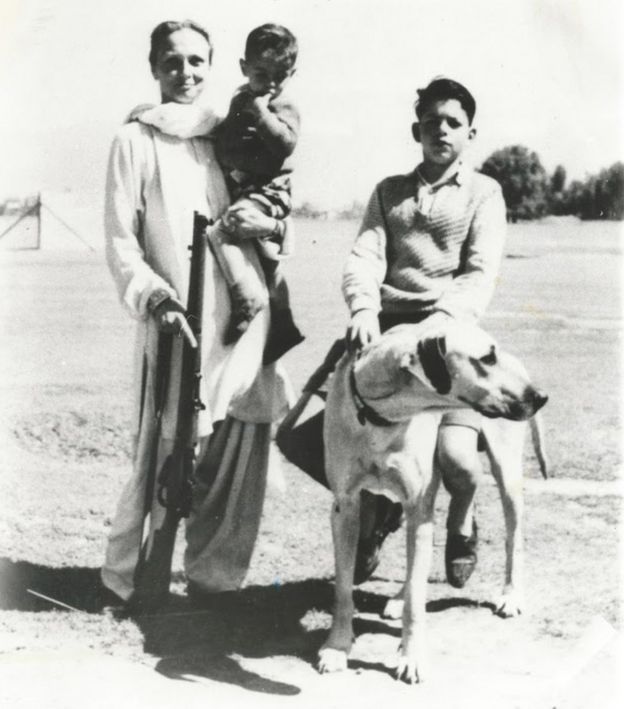
Image captionFreda and BPL moved to Kashmir after 1947 and remained politically active
When World War Two broke out, both BPL and Freda were outraged that India was being dragged into supporting the British war effort. BPL was detained in a desert prison camp to stop him sabotaging military recruitment in Punjab. Freda decided to make her own stand against her motherland.
She volunteered as a satyagrahi, a seeker of truth, and was among those chosen by Indian independence leader Mahatma Gandhi to defy emergency wartime powers. She travelled to her husband’s home village of Dera Baba Nanak and announced that she would “break the law by asking the people not to support the military effort until India became democratic”. The authorities didn’t know how to respond to a white woman staging such a protest – they hurriedly sent an English police inspector to the village, deeming it inappropriate for an Indian policeman to arrest an Englishwoman.
Freda was brought before a visiting magistrate that same morning – she has left her own account of the trial:
It was finished in 15 minutes. The man on the other side of the table was quite young still, and looked as though he had been to Oxford. His face was red.
“I find this as unpleasant as you do,” he murmured.
“Don’t worry. I don’t find it unpleasant at all.”
“Do you want the privileges granted to an Englishwoman?”
“Treat me as an Indian woman and I shall be quite content.”
She was sentenced to six months in jail, which was fairly standard, and also to hard labour, which she regarded as vindictive.
That turned out to be no more onerous than supervising the prison gardens, where women imprisoned for criminal rather than political offences – many were locked up for killing their abusive husbands – did most of the work.
“It was my destiny to go to India,” Freda asserted. It was her destiny too to make history as an English woman who went willingly to jail in support of India’s demand for freedom.
The Bedis’ political prominence persisted after independence, when they moved to Kashmir – Freda joined a left-wing women’s militia and worked with the radical nationalists who gained power there. In the 1950s, her life changed utterly when, during a UN assignment in Burma, she encountered Buddhism for the first time and became an enthusiastic convert.
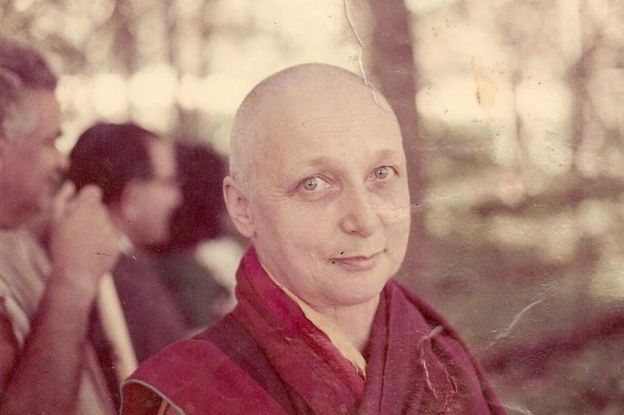
Image captionFreda became a Buddhist nun in the 1950s
When thousands of Tibetans fled across the Himalayas in 1959 to escape Chinese oppression, Freda devoted herself to helping these “brave and wonderful” refugees. She became steeped in Tibetan spirituality. And once she felt that she had fulfilled her role as a mother (the film star Kabir Bedi is one of her three surviving children), she broke convention again by taking vows as a Tibetan Buddhist nun. In her sixties, she travelled relentlessly to spread the word about Buddhist teachings but never returned to live in the West.
“India is my womanhood and my wife-hood,” she once declared. “I too am ‘dust that England bore, shaped and made aware’. Yet I am living in an Indian way, with Indian clothes, with an Indian husband and child on Indian soil, and I cannot feel even the least barrier or difference in essentials between myself and the new country I have adopted.”
Throughout her life, Freda was determined not to be constrained by barriers of race, religion, nation or gender. She delighted in challenging convention and confounding expectations – that is what makes her story so beguiling.




 CHINDIA ALERT: You'll be living in their world, very soon