Chindia Alert: You’ll be Living in their World Very Soon
aims to alert you to the threats and opportunities that China and India present. China and India require serious attention; case of ‘hidden dragon and crouching tiger’.
Without this attention, governments, businesses and, indeed, individuals may find themselves at a great disadvantage sooner rather than later.
The POSTs (front webpages) are mainly 'cuttings' from reliable sources, updated continuously.
The PAGEs (see Tabs, above) attempt to make the information more meaningful by putting some structure to the information we have researched and assembled since 2006.
Image copyright SIPA/SHUTTERSTOCKImage caption The photographs of the Tiananmen Tank Man became some of the world’s most famous
Charlie Cole, one of the photographers who captured the famous Tank Man on film during the Tiananmen Square protests, has died.
The image of one man standing in the way of a column of tanks, a day after hundreds possibly thousands of people died, has become a defining image of the 1989 pro-democracy protests.
Cole later described how he had expected the man would be killed, and felt it was his responsibility to record what was happening.
But the unidentified protester was eventually pulled away from the scene by two men. What happened to him remains unknown.
A symbol of peaceful resistance
Cole knew he would be searched later by Chinese security so hid the undeveloped film roll in the bathroom.
Shortly after he took it, officials broke through the door and searched the hotel room, but they did not discover the film.
The scene as shot by him and the other three photographers went on to become an iconic symbol of peaceful resistance across the world.
Media caption Tiananmen’s tank man: The image that China forgot
Thirty years ago, Beijing’s Tiananmen Square became the focus for large-scale protests, calling for reform and democracy.
Demonstrators had been camped for weeks in the square, but late on 3 June, the military moved in and troops opened fire.
China has only ever said that 200 civilians and security personnel died, but there has been no publicly released record of deaths. Witnesses and foreign journalists have said the figure could be up to 3,000.
Tiananmen is still a heavily censored topic in modern China, and the Tank Man pictures are banned.
YINCHUAN, Aug. 15 (Xinhua) — The China-Arab States Tour Operators Conference 2019 will be held from Sept. 4 to 7 in Yinchuan, capital of northwest China’s Ningxia Hui Autonomous Region, local authorities said Thursday.
According to the region’s department of culture and tourism, the four-day event will include a series of activities such as tourism resources promotion, tourism cooperation and exchange between China and Arab countries, and investment project negotiation.
Tourism officials from Indonesia, Morocco and Chad, as well as some 120 traders from China and 15 countries along the Belt and Road including Singapore, the Republic of Korea and Egypt, will participate.
Tourism resources and products such as the starry sky, the Great Wall, intangible cultural heritage and wine in Ningxia will be presented in the form of a stage drama at the fair.
Foreign participants will also introduce their tourism resources to further integrate Ningxia into regional tourism along the Belt and Road.
Traditional handicrafts such as papercutting, embroidery, wood carving and clay sculptures will be displayed to propel the development of the cultural tourism industry in the region, according to Zhao Mingxia, deputy director of the culture and tourism department.
China suggests good progress made in Regional Comprehensive Economic Partnership talks after marathon 10-day negotiations in Zhengzhou
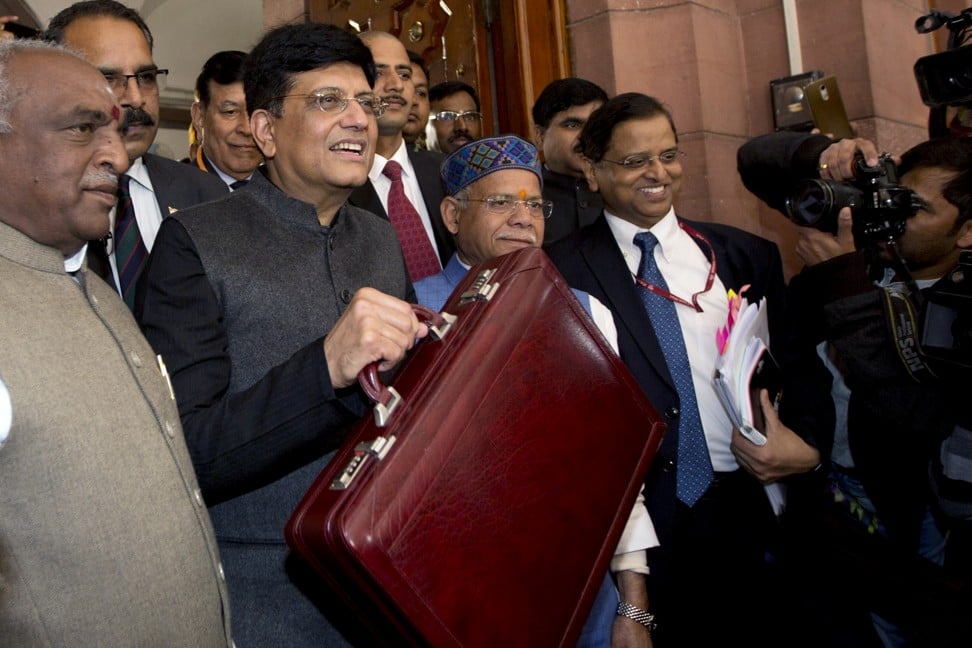
Indian Commerce Minister Piyush Goyal has opted to skip the upcoming high-level meetings, adding fuel to rumours that the country could be removed
The Association of Southeast Asian Nations (Asean) has overtaken the US to become China’s second-largest trading partner in the first half of 2019. Photo: AP
China has claimed “positive progress” towards finalising the world’s largest free-trade agreement by the end of 2019 after hosting 10 days of talks, but insiders have suggested there was “never a chance” of concluding the deal in Zhengzhou.
The 27th round of the Regional Comprehensive Economic Partnership (RCEP) negotiations closed on Wednesday in the central Chinese city.
working level conference brought over 700 negotiators from all 16 member countries to Henan province, with China keen to push through a deal which has proven extremely difficult to close.
If finalised, the agreement, which involves the 10 Asean nations, as well as China, Japan, South Korea, Australia, New Zealand, and India, would cover around one-third of the global gross domestic product, about 40 per cent of world trade and almost half the world’s population.
“This round of talks has made positive progress in various fields,” said assistant minister of commerce Li Chenggang, adding that all parties had reaffirmed the goal of concluding the deal this year. “China will work together with the RCEP countries to proactively push forward the negotiation, strive to resolve the remaining issues as soon as possible, and to end the negotiations as soon as possible.”
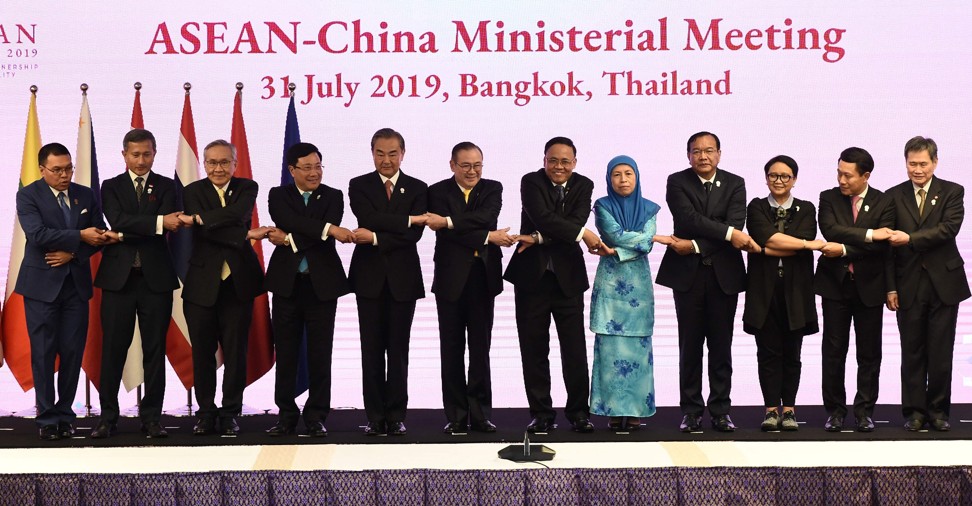
China’s Foreign Minister Wang Yi (fifth left) poses with foreign ministers from the Association of Southeast Asian Nations (Asean) countries during the ASEAN-China Ministerial Meeting in Bangkok. Photo: AFP
China is keen to complete a deal which would offer it a buffer against the United States in Asia, and which would allow it to champion its free trade position, while the US pursues protectionist trade policy.
The RCEP talks took place as Chinese and American trade negotiators resumed face-to-face discussions in Shanghai, which also ended on Wednesday, although there was little sign of similar progress.
As the rivalry between Beijing and Washington has intensified and bilateral trade waned, the Association of Southeast Asian Nations (Asean) overtook the US to become China’s second-largest trading partner in the first half of 2019. From January to June, the trade volume between China and the 10-member bloc reached US$291.85 billion, up by 4.2 per cent from a year ago, according to government data.
The Asean bloc is made up of Indonesia, Thailand, Malaysia, Singapore, Philippines, Vietnam, Myanmar, Cambodia, Brunei and Laos.
China will work together with the RCEP countries to proactively push forward the negotiation, strive to resolve the remaining issues as soon as possible, and to end the negotiations as soon as possible. Li Chenggang
RCEP talks will now move to a higher level ministerial meeting in Beijing on Friday and Saturday, but trade experts have warned that if material progress is not made, it is likely that the RCEP talks will continue into 2020, prolonging a saga which has already dragged on longer than many expected. It is the first time China has hosted the ministerial level talks.
But complicating matters is the fact that India’s Commerce Minister, Piyush Goyal, will not attend the ministerial level talks, with an Indian government official saying that he has to participate in an extended parliamentary session.
India is widely viewed as the biggest roadblock to concluding RCEP, the first negotiations for which were held in May 2013 in Brunei. Delhi has allegedly opposed opening its domestic markets to tariff-free goods and services, particularly from China, and has also had issues with the rules of origin chapter of RCEP.
China is understood to be “egging on” other members to move forward without India, but this could be politically explosive, particularly for smaller Asean nations, a source familiar with talks said.
Deborah Elms, executive director of the Asian Trade Centre, a Singapore-based lobby group, said that after the last round of negotiations in Melbourne between June 22 to July 3 – which she attended – there was “frustration” at India’s reluctance to move forward.
She suggested that in India’s absence, ministers in China could decide to move forward through a “pathfinder” agreement, which would remove India, but also potentially Australia and New Zealand.
India’s Commerce Minister, Piyush Goyal, will not attend the ministerial level talks this week in Beijing. Photo: Bloomberg
This “Asean-plus three” deal would be designed to encourage India to come on board, Elms said, but would surely not go down well in Australia and New Zealand, which have been two of the agreement’s biggest supporters.
New Zealand has had objections to the investor protections sections of RCEP, and both countries have historically been pushing for a more comprehensive deal than many members are comfortable with, since both already have free trade agreements with many of the other member nations.
However, their exclusion would be due to “an unfortunate geographical problem, which is if you’re going to kick out India, there has always been an Asean-plus three concept to start with”. Therefore it is easier to exclude Australia and New Zealand, rather than India alone, which would politically difficult.
A source close to the negotiating teams described the prospect of being cut out of the deal at this late stage as a “frustrating rumour”, adding that “as far as I know [it] has no real basis other than a scare tactic against India”.
There was “never a chance of concluding [the deal during] this round, but good progress is being made is what I understand. The key issues remain India and China”, said the source, who wished to remain anonymous.
Replacing bilateral cooperation with regional collaborations is a means of resolving the disputesTong Jiadong
However, Tong Jiadong, a professor of international trade at the Nankai University of Tianjin, said Washington’s refusal to recognise India as a developing country at the World Trade Organisation could nudge the world’s second most populous nation closer to signing RCEP.
“That might push India to the RCEP, accelerating the pace of RCEP,” Tong said, adding that ongoing trade tensions between Japan and South Korea could also be soothed by RCEP’s passage.
“Replacing bilateral cooperation with regional collaborations is a means of resolving the disputes between the two countries,” Tong said.
Although the plan was first proposed by the Southeast Asian countries, China has been playing an increasingly active role, first as a response to the now defunct US-backed Trans-Pacific Partnership (TPP), and more recently as a means of containing the impact of the trade war.
China’s vice-commerce Minister, Wang Shouwen, told delegates last week that RCEP was “the most important free trade deal in East Asia”. He called on all participants to “take full advantage of the good momentum and accelerating progress at the moment” to conclude a deal by the end of the year.
China’s Wang Yi and US’ Mike Pompeo at summit in Thailand to sell their visions of future for Southeast Asia
Analysts expect pragmatism from Asean as world’s two biggest economic powers play diplomatic game
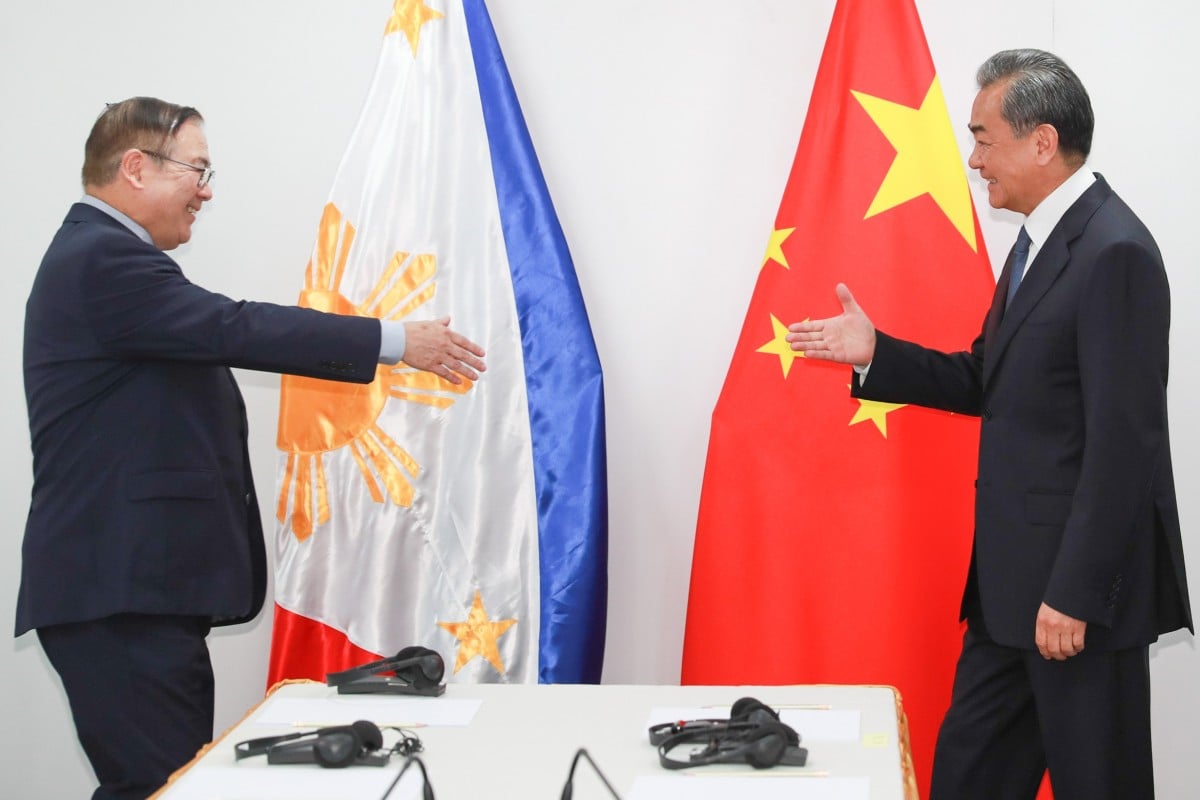
Chinese Foreign Minister Wang Yi (right) greets his Philippine counterpart Teodoro Locsin at the Asean meeting in Bangkok, Thailand. Photo: Xinhua
China and the United States are on a mission to strengthen ties with allies and expand their influence in Southeast Asia this week as their trade war enters a second year.
US Secretary of State Mike Pompeo arrived for a meeting of the Association of Southeast Asian Nations (Asean) in Bangkok on Wednesday to promote the US-led Indo-Pacific strategy, while Chinese Foreign Minister Wang Yi touched down a day earlier to advance Beijing’s Belt and Road Initiative.
The US Department of State said Pompeo’s trip was aimed at deepening Washington’s “long-standing alliances and vibrant bilateral relations with these countries, and [to] reaffirm our commitment to Asean, which is central to our vision for the Indo-Pacific region”.
In Beijing on Wednesday, Chinese foreign ministry spokeswoman Hua Chunying said that while their meeting was yet to be set, Wang and Pompeo were expected to meet and talk “frankly” about bilateral relations.
“I think that it is indeed necessary for China and the United States to maintain communication, as the two countries face many situations,” Hua said. “The issues would be communicated frankly”.
The Indo-Pacific strategy is a military and economic framework to contain China’s expansion into the Pacific and Indian oceans, and give an alternative to Beijing’s flagship belt and road development programme.
En route to Thailand, Pompeo said that after a stalled start to US Indo-Pacific policy during the Barack Obama administration, Washington’s strategy was well on its way to bearing fruit for the US and its allies.
South China Sea tensions, US-China trade war loom over Asean summit
“We have watched these coalitions build out,” he said.
Pompeo dismissed claims that China’s sphere of influence among Asean members was growing, saying such speculation was “not factually accurate”.
“[Asean countries] are looking for partners that are going to help them build out their economies and to take good care of their people,” he said, pledging greater engagement from President Donald Trump’s administration.
Pompeo was expected to sit down on Friday with his South Korean and Japanese counterparts to consolidate their trilateral alliance in the region.
He was also expected to hold talks with Thai Foreign Minister Don Pramudwinai that day.
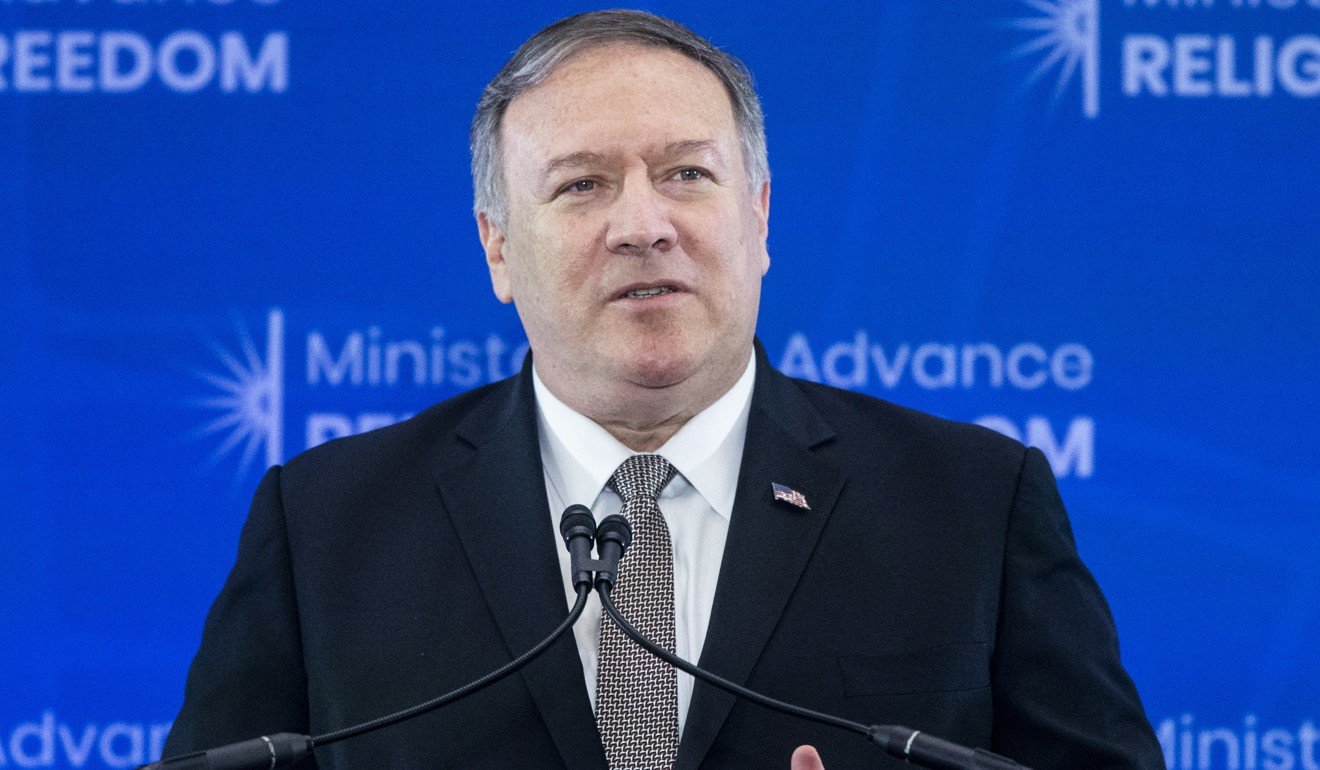
US Secretary of State Mike Pompeo is expected to meet Chinese Foreign Minister Wang Yi at Asean in Thailand. Photo: EPA-EFE
Meanwhile, Wang launched his belt and road pitch to his Cambodian, Philippine and Indonesian counterparts after he arrived in Thailand for the gathering, which ends on Saturday.
The belt and road projects are largely commercial and aimed at strengthening land and sea infrastructure linking Asia, Europe and Africa. But they raised suspicion in the West that they are aimed at eroding the US-led world order.
During his meeting with Philippine Foreign Affairs Secretary Teodoro Locsin, Wang said: “China is willing to have high-level exchanges with the Philippines, to deepen the mutual trust, and promote the Belt and Road Initiative [in the Philippines] … to accelerate the development of regional infrastructure.”
Can China’s trade boost with Asean help get the Regional Comprehensive Economic Partnership over the line?
This year’s Asean forum was taking place as countries were more receptive to Chinese initiatives, in part due to the unpredictability of the US administration, according to Rajeev Ranjan Charturvedy, a visiting fellow at the S. Rajaratnam School of International Studies at Nanyang Technological University in Singapore.
“Policy uncertainties under the Trump administration have already pushed some Asean countries towards China in ways that would have seemed unlikely a few years ago,” Charturvedy said.
Analysts said Trump’s “America first” approach shaped his Asean policy. The president had vowed to apply “punishments” to countries – including Asean member states – for contributing to the US trade deficit.
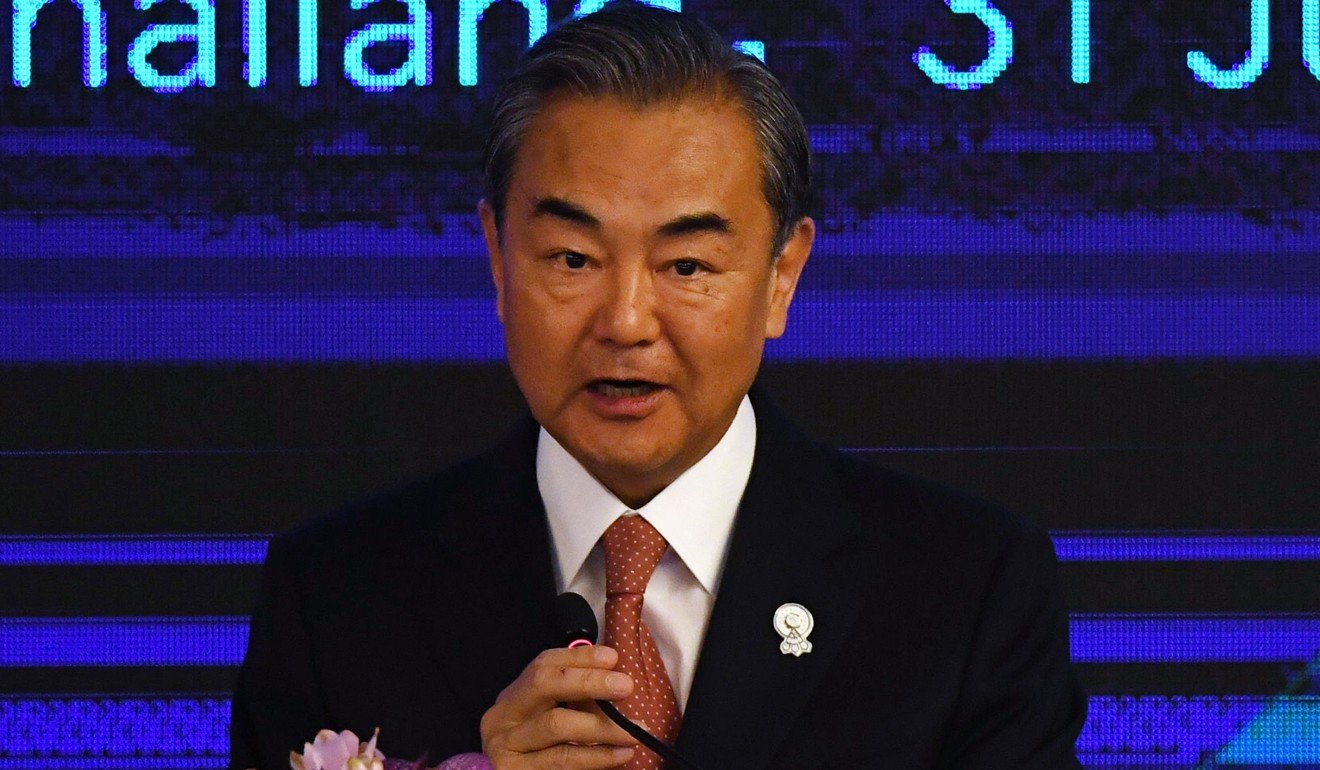
Chinese Foreign Minister Wang Yi is talking to Asean counterparts at a time when they are receptive to China’s proposals, an analyst says. Photo: AFP
Trump was absent at the Asean summit in Singapore last year, leading to concerns that Washington’s commitment to Asia was declining.
Charturvedy said the Asean forum’s focus was about building constructive regionalism, but China’s attitudes to security could pose a challenge.
“[However] Asean countries clearly hope not to be forced to choose between the US and Chinese offers. Rather, they would like more freedom of choice while accommodating for a larger role for China in the region,” he said.
Clarita Carlos, a professor of political science at the University of the Philippines, suggested that Asean members would be pragmatic during the forum.
Robert Lighthizer warns Vietnam over trade deficit with US
They would try to find their own balance between the two major powers – as countries rather than a bloc – to try to maximise each state’s interests and advantages, Carlos said.
“Vietnam has a love-hate relationship with China, especially as a winner in the ongoing US-China trade war,” she said. “Singapore has close relations with China. There are also ups and downs in the relationship with China for Brunei, Malaysia and Indonesia.”
Indonesian finance minister working on loan structure and criteria
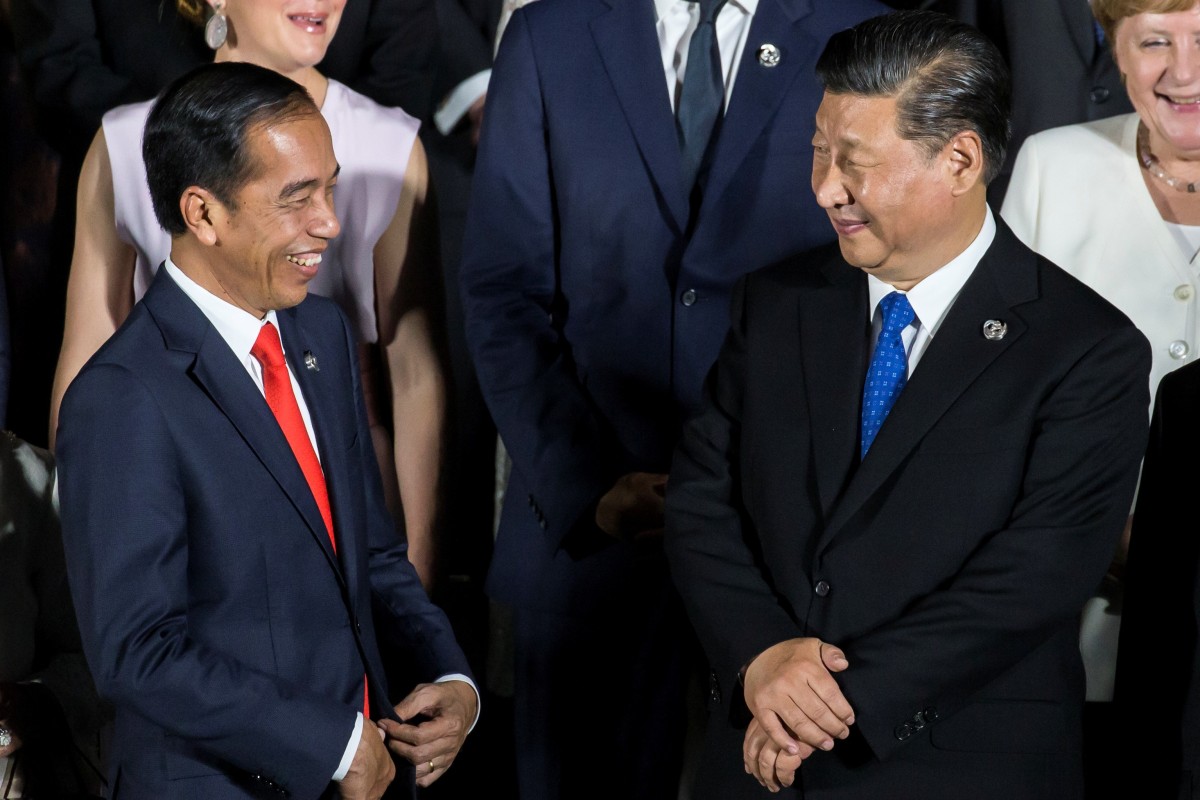
Indonesian President Joko Widodo asked Chinese President Xi Jinping for a special belt and road fund at the G20 summit in Osaka last week. Photo: Reuters
Indonesia has asked China to set up a special fund within its Belt and Road Initiative for investment in Southeast Asia’s biggest economy, after offering China projects worth US$91 billion, Indonesian government officials said on Wednesday.
Indonesia has not been among the biggest beneficiaries of China’s trillion-dollar push to create a modern-day Silk Road.
Indonesia says this is because it has insisted that any loan within the initiative’s framework is done on a business-to-business basis to avoid exposing the government in case of default.
Indonesian President Joko Widodo made the request for a special fund during a meeting with Chinese President Xi Jinping on the sideline of the Group of 20 summit in Japan last week, Indonesia’s Finance Minister Sri Mulyani Indrawati said.
Japan still leads in Southeast Asia infrastructure race, even as China ramps up belt and road investments: report
Indrawati said she had been given the responsibility of coming up with the fund’s structure, including a proposal to China on the size of the fund and the criteria for loans from it.
“I am currently doing a study about its form, its mechanism, the size of it and of course the consequences of its costs,” she said.
Luhut Pandjaitan, coordinating minister for maritime affairs, said separately the fund should provide loans “with low interest in regards to investment in Indonesia, in partnership with Indonesian companies”.
Pandjaitan, who oversees belt and road projects in Indonesia, previously said the Indonesian government had offered China involvement in about 30 projects, worth US$91 billion, during the second Belt and Road Forum in April.
The most high-profile belt and road venture in Indonesia is a US$6 billion high-speed rail project connecting the capital, Jakarta, to the textile hub of Bandung, awarded to a consortium of Chinese and Indonesian state firms in 2015.
China expert lays out trillion yuan nuclear path for belt and road plan
The project has faced land ownership issues.
Another controversial project is a US$1.5 billion hydropower plant, funded by Chinese banks and being built by the Chinese state firm Sinohydro, in the heart of the Batang Toru rainforest on the island of Sumatra, which is home to the endangered Tapanuli orangutans.
Agus Djoko Ismanto, an executive of the power plant developer PT North Sumatra Hydro Energy, on Wednesday denied disrupting the orangutan habitat. He said 11 per cent of the construction had been completed and it was due to begin operation by 2022.
BANGKOK (Reuters) – Southeast Asian leaders agreed on Sunday to work together on regional economy and security to strengthen their positions amid growing U.S.-China tensions, as they wrapped up this year’s first summit in Bangkok.
The 10-member Association of Southeast Asian Nations (ASEAN) will need its collective economic strength for bargaining power globally, especially amid the trade tensions between the world’s top two economies, Thai Prime MinisterPrayuth Chan-ocha told a news conference, as chairman of the 34th ASEAN Summit.
Prayuth urged ASEAN nations to complete negotiations this year for the China-initiated Regional Comprehensive Economic Partnership (RCEP) pact that includes 16 countries.
“This will help ASEAN handle the changes and uncertainty that will happen in the region going forward, particularly the impacts of trade tension between ASEAN’s important trade partners.”
Negotiations began in 2012 on RCEP, which envisions the creation of a free trade zone encompassing 45% of the world’s population and more than a third of its GDP, but does not involve the United States.
First proposed by China, RCEP’s 16 signatories include the 10 ASEAN member states and six Asia-Pacific countries, including major economies China, India, Japan and South Korea. ASEAN has existing free-trade agreements with all six countries.
“If we can do this, we will have the bargaining power and base for negotiation. Because when combined, we are 650 million people, the largest regional bloc in the world,” the Thai prime minister said.
Four ASEAN countries – Thailand, Indonesia, Singapore and Vietnam – will discuss the trade war in next week’s G20 summit, which assembles 20 major economies, in Tokyo, Prayuth said.
ASEAN countries also agreed on a common approach on a U.S.-led Indo-Pacific initiative, at a time when U.S.-China tensions were rising and forcing ASEAN countries to take sides.
Prayuth hailed the bloc’s agreement on the ASEAN Outlook on the Indo-Pacific as a “significant step” for the region.
The endorsed outlook document, seen by Reuters, acknowledges “maritime issues such as unresolved maritime disputes that have the potential for open conflict” as existing and emerging geopolitical challenges.
It outlines maritime cooperation “for peaceful settlement of disputes”. It also aims for connectivity in the Indo-Pacific region.
BANGKOK (Reuters) – Southeast Asian leaders opened a two-day summit in Bangkok on Saturday, though it was unclear what progress their 10-country group could make on disputes in the South China Sea and the plight of ethnic Rohingya fleeing Myanmar.
Formed more than half a century ago, the Association of Southeast Asian Nations (ASEAN) has historically struggled with challenges facing the region because it works only by consensus and is reluctant to become involved in any matter regarded as internal to a member state.
Thai Prime Minister Prayuth Chan-ocha was making his debut as a civilian leader representing current chair Thailand, after a general election in March that opposition parties say was designed to ensure his victory five years after the former army chief seized power in a 2014 coup.
Officials are expected to discuss a Code of Conduct (COC) for negotiations over the South China Sea, one of the world’s busiest waterways and a potential flashpoint, as it is claimed by several ASEAN members as well as China.
However, it was unlikely much progress would be made, though member nations might discuss the June 9 collision of a Philippine boat and a Chinese fishing vessel.
“It is encouraging to see that the ASEAN-China talks on the COC have continued,” said Marty Natalegawa, former foreign minister of Indonesia.
“However, there is real risk that developments on the ground – or more precisely at sea – are far outpacing the COC’s progress thereby possibly rendering it irrelevant.”
Philippine President Rodrigo Duterte has accepted China’s proposal to jointly investigate allegations that a Chinese fishing vessel abandoned 22 Filipinos after it sank their boat in the South China Sea, his spokesman said on Saturday.
Rights groups have also called on ASEAN leaders to rethink support for plans to repatriate Rohingya Muslims who have fled member state Myanmar, where activists say returnees could face discrimination and persecution.
More than 700,000 Rohingya crossed into Bangladesh in 2017, according to U.N. agencies, after a crackdown by Myanmar’s military sparked by Rohingya insurgent attacks on the security forces.
However, it is unlikely that there will be any criticism of Myanmar at the summit over the Rohingya, said Prapat Thepchatree, a political science professor at Thailand’s Thammasat University said.
“This issue has been a very sensitive one for ASEAN,” he said.
Host country Thailand deployed about 10,000 security forces around Bangkok for the summit, mindful of a decade ago when Thailand last hosted an ASEAN summit and dozens of protesters loyal to military-ousted former premier Thaksin Shinawatra forced their way into the meeting venue.
But on Saturday morning, only a small group of people had planned to stage a protest to call Prayuth’s election the product of a rigged system.
The group, called Citizens Wanting Elections, was stopped by police before it could reach a meeting point near the summit venue. The group later released a statement welcoming visiting leaders but criticising Prayuth.
“The individual who serves as President of ASEAN, who welcomes everyone today, did not come from a clean and fair election,” the letter said.
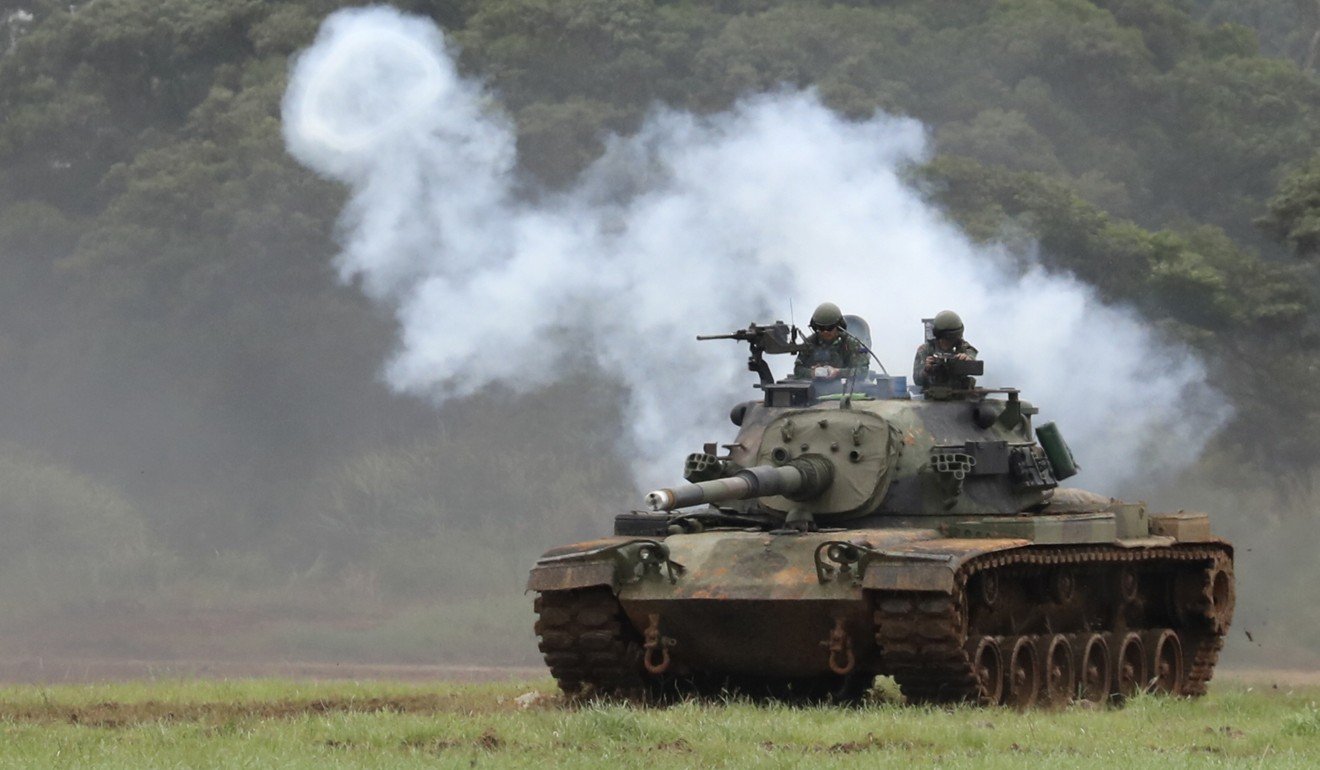
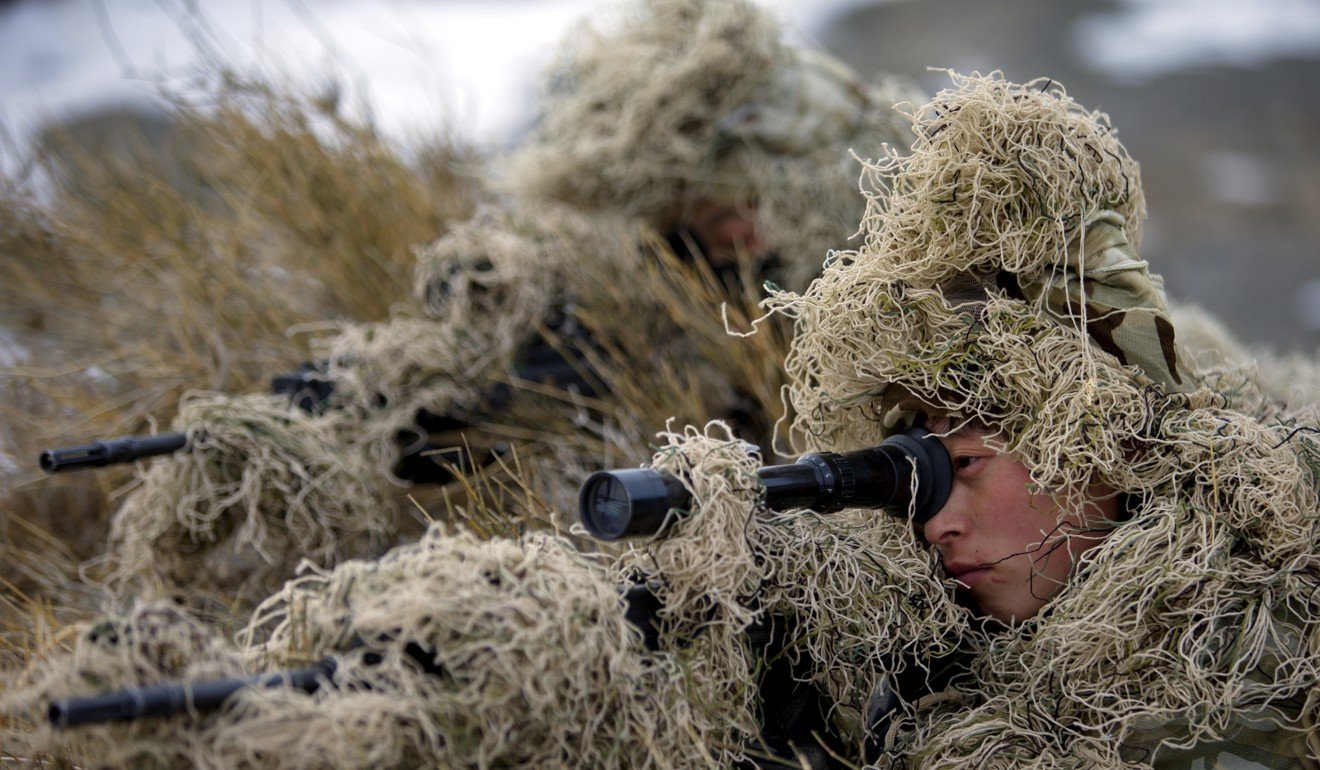
With a defence budget second only to the US, China is amassing a navy that can circle the globe and developing state-of-the-art autonomous drones
The build-up is motivating surrounding countries to bolster their own armed forces, even if some big-ticket military equipment is of dubious necessity
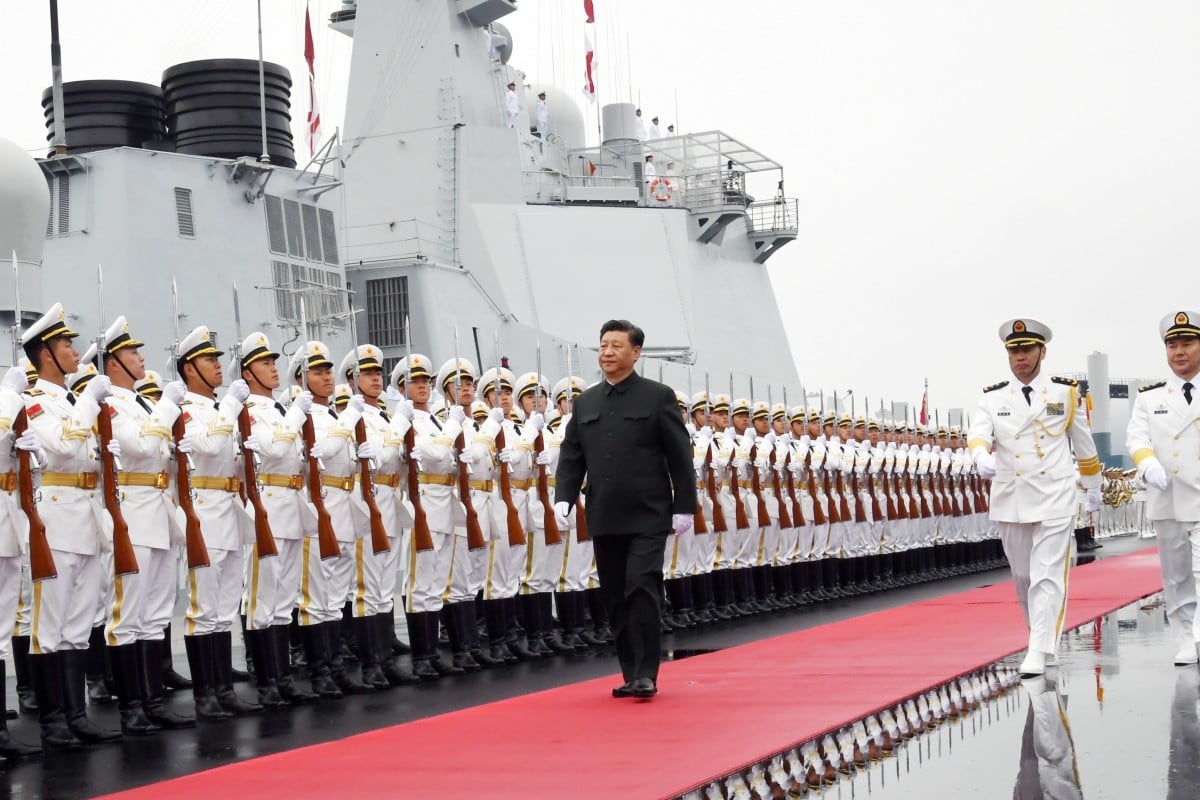
Chinese President Xi Jinping reviews an honour guards before a naval parade in Qingdao. Photo: Xinhua
The Asia-Pacific region is one of the fastest-growing markets for arms dealers, with economic growth, territorial disputes and long-sought military modernisation propelling a 52 per cent increase in defence spending over the last decade to US$392 billion in 2018, according to the Stockholm International Peace Research Institute.
The region accounts for more than one-fifth of the global defence budget and is expected to grow. That was underscored last week by news of
, China is amassing a navy that can circle the globe and developing state-of-the-art autonomous drones. The build-up is motivating surrounding countries to bolster their armed forces too – good news for purveyors of submarines, unmanned vehicles and warplanes.
Opinion: How the Shangri-La Dialogue turned into a diplomatic coup for China
Kelvin Wong, a Singapore-based analyst for Jane’s, a trade publication that has been covering the defence industry for 121 years, has developed a niche in infiltrating China’s opaque defence industry by attending obscure trade shows that are rarely advertised outside the country.
He said the US is eager to train allies in Asia and sell them arms, while also stepping up its “freedom of navigation” naval operations in contested waters in the
In his speech at the Shangri-La Dialogue, acting US Defence Secretary Patrick Shanahan touted American advancements in technology “critical to deterring and defeating the threats of the future” and said any partner could choose to win access to that technology by joining the US defence network.
Wong said the message was clear: “Buy American.”
Analysts say Chinese soldiers have less training, motivation and lower morale than their Western counterparts. Photo: Reuters
The analyst said there is a growing admission among the Chinese leadership that the
He said one executive at a Chinese defence firm told him: “The individual Chinese soldier, in terms of morale, training, education and motivation, (cannot match) Western counterparts. So the only way to level up is through the use of unmanned platforms and
To that end, China has developed one of the world’s most sophisticated drone programmes, complete with custom-built weapon systems. By comparison, Wong said,
US drones rely on weapons originally developed for helicopters.
Wong got to see one of the Chinese drones in action two years ago after cultivating a relationship with its builder, the state-owned China Aerospace Science & Technology Corporation. He viewed a demonstration of a 28-foot-long CH-4 drone launching missiles at a target with uncanny ease and precision.
“Everyone knew they had this,” Wong said. “But how effective it was, nobody knew. I could personally vouch they got it down pat.”
China unveils its answer to US Reaper drone – how does it compare?
That is what Bernard Loo Fook Weng, a military expert at Singapore’s S. Rajaratnam School of International Studies, told the author Robert Kaplan for his 2014 book, Asia’s Cauldron, about simmering tensions in the South China Sea.
He was describing the competition for big-ticket military equipment of dubious necessity.
submarines it could not figure out how to submerge.
“It’s keeping up with the Joneses,” Wong said. “There’s an element of prestige to having these systems.”
Submarines remain one of the more debatable purchases, Wong said. The vessels aren’t ideal for the South China Sea, with its narrow shipping lanes hemmed in by shallow waters and coral reefs. Yet they provide smaller countries with a powerful deterrence by enabling sneak attacks on large ships.
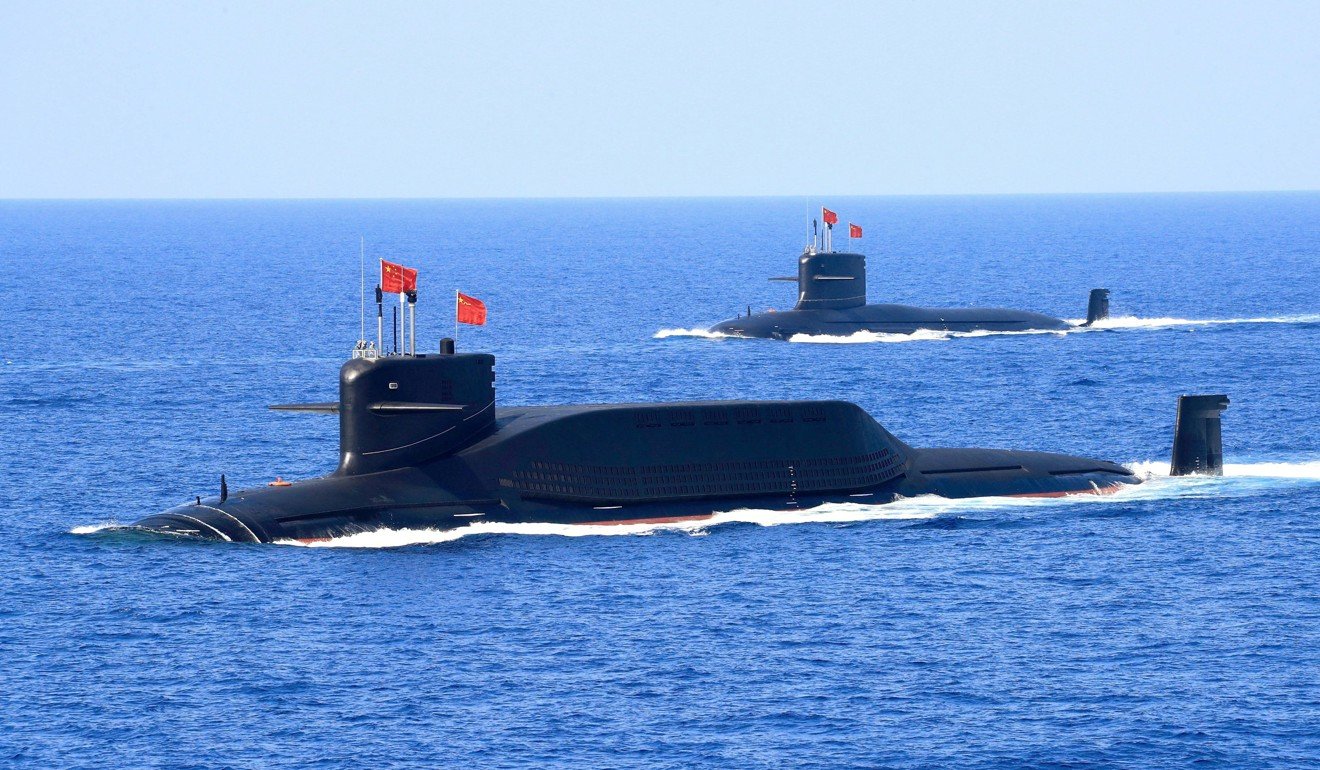
Nuclear-powered PLA Navy ballistic missile submarines in the South China Sea. Photo: Reuters
Type 218 submarines with propulsion systems that negate the need to surface more frequently. If the crew did not need to eat, the submarine could stay under water for prolonged periods. Wong said the craft were specially built for Asian crews.
“The older subs were designed for larger Europeans so the ergonomics were totally off,” he said.
Singapore, China deepen defence ties, plan larger military exercises
Tiny Singapore plays a crucial role securing the vital sea lanes linking the Strait of Malacca with the South China Sea. According to the
the country dedicates 3.3 per cent of its gross domestic product to defence, a rate higher than that of the United States.
State-of-the-art equipment defines the Singapore Armed Forces. Automation is now at the centre of the country’s military strategy, as available manpower is shrinking because of a rapidly ageing population.
Wong said Singapore is investing in autonomous systems and can operate frigates with 100 crew members – 50 fewer than they were originally designed for.
“We always have to punch above our weight,” he said.
legalisation of same-sex marriage
would get the impression this was Asia’s first taste of marriage equality. They would be quite wrong.
While Taiwan may be the first jurisdiction in Asia to legalise the modern form of same-sex marriage, such unions have been recognised across the region in various guises for centuries.
It may be true that Asia does not have a great reputation among the
community, but it does have a rich history of acceptance of sexual and gender diversity – one that has largely been forgotten.
When Europeans first encountered Chinese society, they praised many aspects of it, from its efficient government to the sophisticated lifestyles of the upper-class. But they were shocked and repulsed about one aspect of Chinese society: the “abominable vice of sodomy”.
Opinion: Three lessons for Hong Kong from Taiwan’s LGBT journey
One Portuguese Dominican friar, Gaspar da Cruz, even wrote an apocalyptic tract which portrayed China as the new Sodom – beset by earthquakes, floods, and other natural disasters due to their acceptance of that “filthy abomination, which is that they are so given to the accursed sin of unnatural vice”, that is, sodomy.
Southern China, in particular, was known for a widespread acceptance of homosexual relationships. Shen Defu, a Chinese writer during the Ming dynasty, wrote that it was common for men of all social classes in Fujian province to take male lovers. While men generally took on these lovers while maintaining respectable marriages to women, there were some men who took their lover-relationships to a quasi-marriage level. The older man would be considered qixiong (adoptive older brother) and the younger qidi(adoptive younger brother).
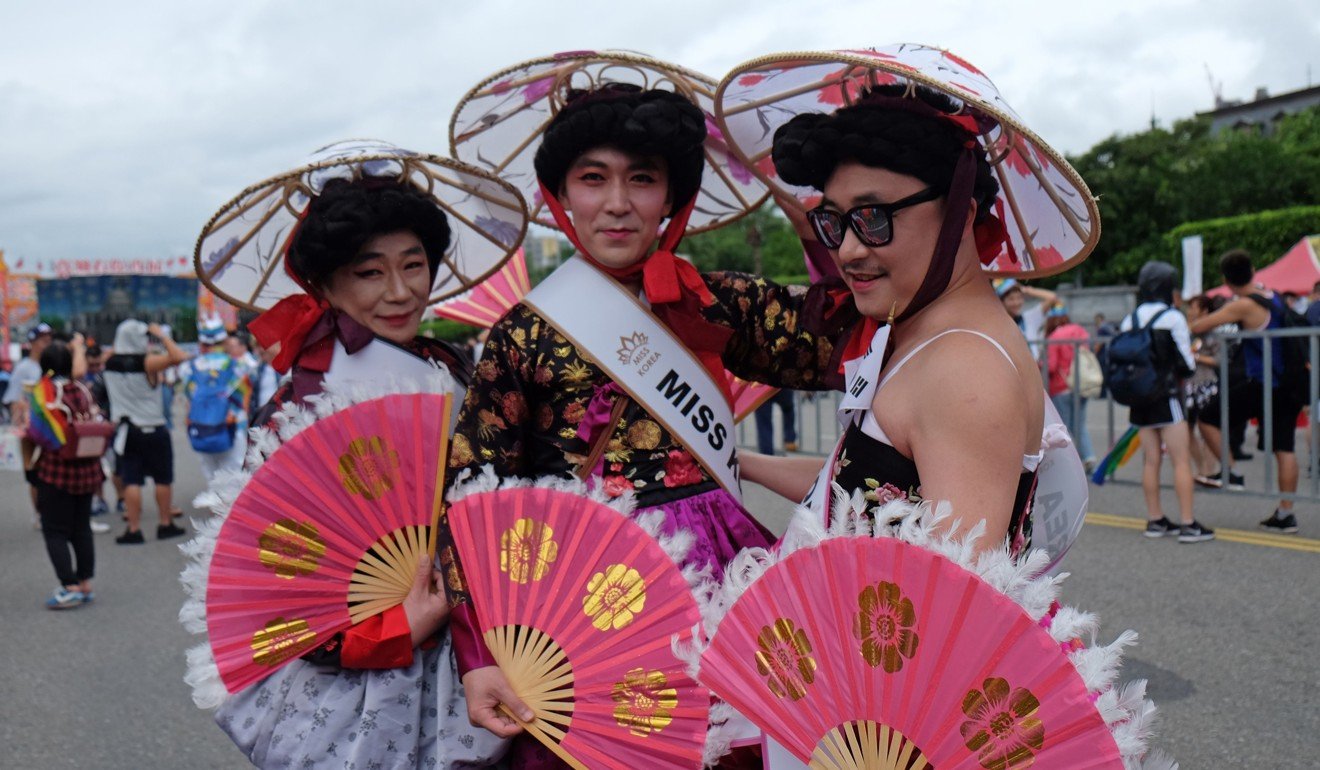
South Korean men take part in Taiwan’s annual LGBT pride parade in Taipei. Photo: AFP
Bret Hinsch, a professor of history in Taiwan, describes the ceremony based on the narration of a Chinese playwright, Li Yu (1610-1680): “Two men sacrifice a carp, a rooster, and a duck. They then exchange their exact times of birth, smear each other’s mothers with the blood of their sacrifices, and then swear eternal loyalty to one another.
The ceremony concludes with feasting on the sacrificial victims …. The younger qidi would move into the qixiong’s household. There he would be treated as a son-in-law by his husband’s parents. Throughout the marriage, many of which lasted for 20 years, the qixiong would be completely responsible for his younger husband’s upkeep.
The marriage would typically dissolve after a number of years so that the younger man could find a bride to marry to procreate and further the family lineage. The elder man was expected to pay the bride a price for the younger man.
These forms of gay “marriage” were prevalent enough in Fujian that there was even a patron deity of homosexuality, the rabbit. Many Han people from Fujian migrated to Taiwan starting in the 17th century; they now make up 80 per cent of the population.
Explained: gay rights, LGBTQ and same-sex marriage in Asia
Most literary accounts of homosexual relationships in China involve men, and there is a lively debate among scholars as to whether women enjoyed the same freedom.
Nevertheless, the most documented of female “quasi-marriages” are the “Golden Orchid Associations” in Guangdong. (Around 15 per cent of Taiwan’s population is Hakka, which historians trace specifically to Han migrants from Guangdong and surrounding areas.) The Golden Orchid Society was a movement based in Guangdong that lasted from the late Qing dynasty until the early 1900s. It provided a “sisterhood” alternative to women who did not want to get married for various reasons.
To announce her intentions, one woman would offer another gifts of peanut candy, dates and other goods. If the recipient accepted the gift, it was a signal she had accepted the proposal. They would swear an oath to one another, where sometimes one woman was designated “husband” and the other “wife”.
A couple kiss as they celebrate Taiwan’s legalisation of same-sex marriage. Photo: Reuters
Hinsch describes the ceremony in this way: “After an exchange of ritual gifts, the foundation of the Chinese marriage ceremony, a feast attended by female companions served to witness the marriage. These married lesbian couples could even adopt female children, who in turn could inherit family property from the couple’s parents.”
While these “marriages” are not equivalent to the same-sex marriages of today, they nevertheless are historical precedents for what is now happening in Taiwan.
And China is far from being the only country in Asia with a queer history – Southeast Asia’s LGBTQ history is even richer.
Why some members of Singapore’s LGBT community prefer life in the shadows
In the early modern period, marriages between two people of the same assigned sex but who identified as different genders, were fairly normal in many parts of Southeast Asia. We know this primarily from the records Europeans kept when they landed on Asian shores.
For instance, here is a letter by a Portuguese missionary, Antonio de Paiva, to his Catholic bishop in 1544 about his observations of the Bugis people in what is now
: “Your lordship will know that the priests of these kings are generally called bissus. They grow no hair on their beards, dress in a womanly fashion, and grow their hair long and braided; they imitate [women’s] speech because they adopt all of the female gestures and inclinations. They marry and are received, according to the custom of the land, with other common men, and they live indoors, uniting carnally in their secret places with the men whom they have for husbands …”
After this scandalised description, the author concludes with amazement that the Christian god, who had destroyed “three cities of Sodom for the same sin”, had not yet destroyed such “wanton people” who were “encircled by evil”.
Drag queens at a gay nightclub in Beijing. Despite its reputation, Asia has a long history of accepting diversity. Photo: EPA
Dating as far back as the 13th century, bissu have traditionally served as council to kings and guarded sacred manuscripts. They are considered a fifth gender within the Bugis’ gender-system: oroané (male men), makkunrai (female women), calabai (male women), calalai (female men), and bissu, who were neither male nor female (or both).
Brunei’s LGBT residents face up to new death by stoning law against gay sex
Today, their ranks have thinned – in one area, the population has dwindled to just six people – but the tradition remains, and they still perform important blessings. Contemporary bissu are typically male-bodied individuals who adopt feminine and masculine elements in their appearance. Although in the past bissu were married men, today they are required to be celibate.
In pre-Islamic Bugis culture, bissu were accorded priestly honours and tasked with mediating between the gods and people precisely because of, not in spite of, their gender. According to professor Halilintar Lathier, an Indonesian anthropologist, Bugis culture “perceived the upper world as male and this world as female, and therefore only a meta-gender would be able to become an intermediary”.
This pattern of a “gender-expansive” priest able to marry others of the same sex recurs throughout Southeast Asia.
A transgender beauty contest in Pattaya, Thailand. Despite its reputation, Asia has a long history of accepting diversity. Photo: Handout
To the west of South Sulawesi is Borneo, a large island that contains all of Brunei and parts of Indonesia and
. Borneo is home to many indigenous communities, including the Iban. The Iban historically respected manang bali, who were typically male-bodied shamans who adopted feminine dress and demeanour, and who took men as their husbands. Manang bali were mediators and held roles of great ritual importance; they were typically wealthy village chiefs known for their healing arts.
West of Borneo is the Malay Peninsula, where there are records from the Malay Annals and Misa Melayu dating as far back as the 15th century about priests, called sida-sida, who served in the palaces of the Malay sultans. They were responsible for safeguarding women in the palace as well as the food and clothing of royalty, and overseeing ritual protocol. The sida-sida undertook “androgynous behaviour” such as wearing women’s clothing and doing women’s tasks. A Malay anthropologist in the 1950s, Shamsul A.B., recalls seeing male-bodied sida-sida in the royal palace in his childhood, who were believed by the population to either be celibate and asexual, or attracted to men. Michael Peletz, an anthropologist and author of Gender Pluralism in Southeast Asia, notes that based on the evidence, it is “highly likely” that sida-sida involved both male- and female-bodied people who were involved in transgender practices, and who engaged in sexual relationships with people of the same and opposite sex.
How a gay student’s suicide is helping Japan’s LGBT community speak up
, where pre-colonial communities were religiously led by babylan: women healers and shamans who were responsible for mediating between the gods and people. Male-bodied people (asog, bayog), sometimes considered a third sex, could also hold these roles so long as they comported themselves like women. A 16th century Spanish Catholic manuscript records asog in the following manner:
“Ordinarily they dress as women, act like prudes and are so effeminate that one who does not know them would believe they are women … they marry other males and sleep with them as man and wife and have carnal knowledge.”
Dancers perform at the Shanghai PRIDE opening party. Despite its reputation, Asia has a long history of accepting diversity. Photo: AFP
The Spanish priests saw these asog as “devil-possessed”, particularly because they habitually practised “sodomy” among one another. Due to the Chinese reputation for homosexuality and various Sinophobic attitudes, some even attributed the prevalence of sodomy to the Chinese, whom they said had “infected the natives” and introduced the curse to the “Indians”, although there is no evidence of this.
COLONIAL CURVEBALL
Although these examples relate to the religious arena, anthropologists believe the respect accorded to these ritual specialists were an indicator of a wider societal acceptance of gender and sexual diversity in Southeast Asia – an acceptance that began to be eroded through the introduction of world religions (particularly Christianity), modernity, and colonialism. For example, in Malaysia, Brunei,
, Myanmar and throughout the commonwealth, the British enforced a penal code that legislated against sodomy. More than half of the countries that currently legally prohibit sodomy do so based on laws created by the British.
On gay sex, India has assumed an ancient position. Read the kama sutra
Similarly, after the Chinese were defeated by Western and Japanese imperialists, many Chinese progressives in the early 20th century sought to modernise China, which meant adopting “modern” Western ideas of dress, relationships, science and sexuality.
Concubinage was outlawed, prostitution was frowned upon, and women’s feet were unbound. It also meant importing European scientific understandings of homosexuality as an inverted or perverted pathology. These “scientific ideas” were debunked in the 1960s in the West, but lived on in China, frozen in time, and have only recently begun to thaw with the rise of LGBTQ activists in Asia.
A recent headline on the news from Taiwan read: “First in Asia: marriage equality comes to Taiwan”, as if the recent bill was an unprecedented “first” for Asia and that marriage equality – which, presumably, the headline writer associates with the West – has finally reached Asian shores.
But when we zoom out historically, it is evident that what happened in Taiwan is not so much a novel “breakthrough” for Asia. It is more a reconnection to its queer Chinese and Asian heritage, as well as a rejection of outdated Western ideas that it once adopted.
There is still much more work to be done to advance LGBT rights in Taiwan and the rest of Asia, but perhaps looking backwards in time can help us move forward.
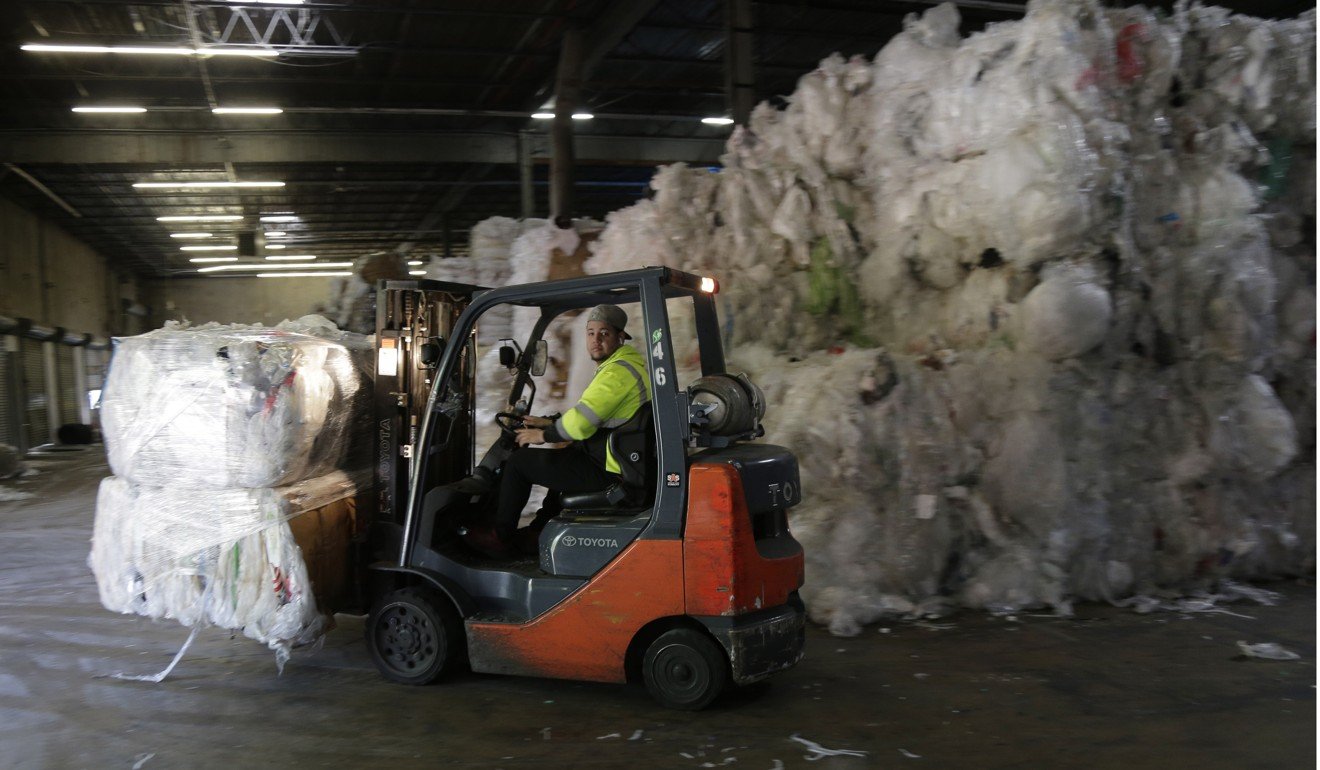
US paper mills are expanding capacity to take advantage of a glut of cheap waste materials
Some facilities that previously exported plastic or metal to China have retooled so they can process it themselves
China phased in import restrictions on scrap paper and plastics in January last year. Photo: AP
The halt on China’s imports of waste paper and plastic that has disrupted US recycling programmes has also spurred investment in American plants that process recyclables.
US paper mills are expanding capacity to take advantage of a glut of cheap scrap. Some facilities that previously exported plastic or metal to China have retooled so they can process it themselves.
And in a twist, the investors include Chinese companies that are still interested in having access to waste paper or flattened bottles as raw material for manufacturing.
“It’s a very good moment for recycling in the United States,” said Neil Seldman, co-founder of the Institute for Local Self-Reliance, a Washington-based organisation that helps cities improve recycling programmes.
Global scrap prices plummeted in the wake of China’s ban. Photo: AP
China, which had long been the world’s largest destination for paper, plastic and other recyclables, phased in import restrictions in January last year.
Global scrap prices plummeted, prompting waste-hauling companies to pass the cost of sorting and baling recyclables on to municipalities. With no market for the waste paper and plastic in their blue bins, some communities scaled back or suspended kerbside recycling programmes. But new domestic markets offer a glimmer of hope.
How China’s ban on plastic waste imports became an ‘earthquake’
About US$1 billion in investment in US paper processing plants has been announced in the past six months, according to Dylan de Thomas, a vice-president at The Recycling Partnership, a non-profit organisation that tracks and works with the industry.
Hong Kong-based Nine Dragons, one of the world’s largest producers of cardboard boxes, has invested US$500 million over the past year to buy and expand or restart production at paper mills in Maine, Wisconsin and West Virginia.
Brian Boland, vice-president of government affairs and corporate initiatives for ND Paper, Nine Dragons’ US affiliate, said that as well as making paper from wood fibre, the mills would add production lines turning more than a million tonnes of scrap into pulp to make boxes.
“The paper industry has been in contraction since the early 2000s,” he said. “To see this kind of change is frankly amazing. Even though it’s a Chinese-owned company, it’s creating US jobs and revitalising communities like Old Town, Maine, where the old mill was shuttered.”
Hong Kong-based Nine Dragons has invested US$500 million in paper mills in Maine, Wisconsin and West Virginia. Photo: Handout
:
The Northeast Recycling Council said in a report last autumn that 17 North American paper mills had announced increased capacity to handle recyclable paper since the Chinese cut-off.
Another Chinese company, Global Win Wickliffe, is reopening a closed paper mill in Kentucky. Georgia-based Pratt Industries is constructing a mill in Wapakoneta, Ohio that will turn 425,000 tonnes of recycled paper per year into shipping boxes.
Plastics also had a lot of capacity coming online, de Thomas said, noting new or expanded plants in Texas, Pennsylvania, California and North Carolina that turned recycled plastic bottles into new bottles.
Chinese companies were investing in plastic and scrap metal recycling plants in Georgia, Indiana and North Carolina to make feedstocks for manufacturers in China, he said.
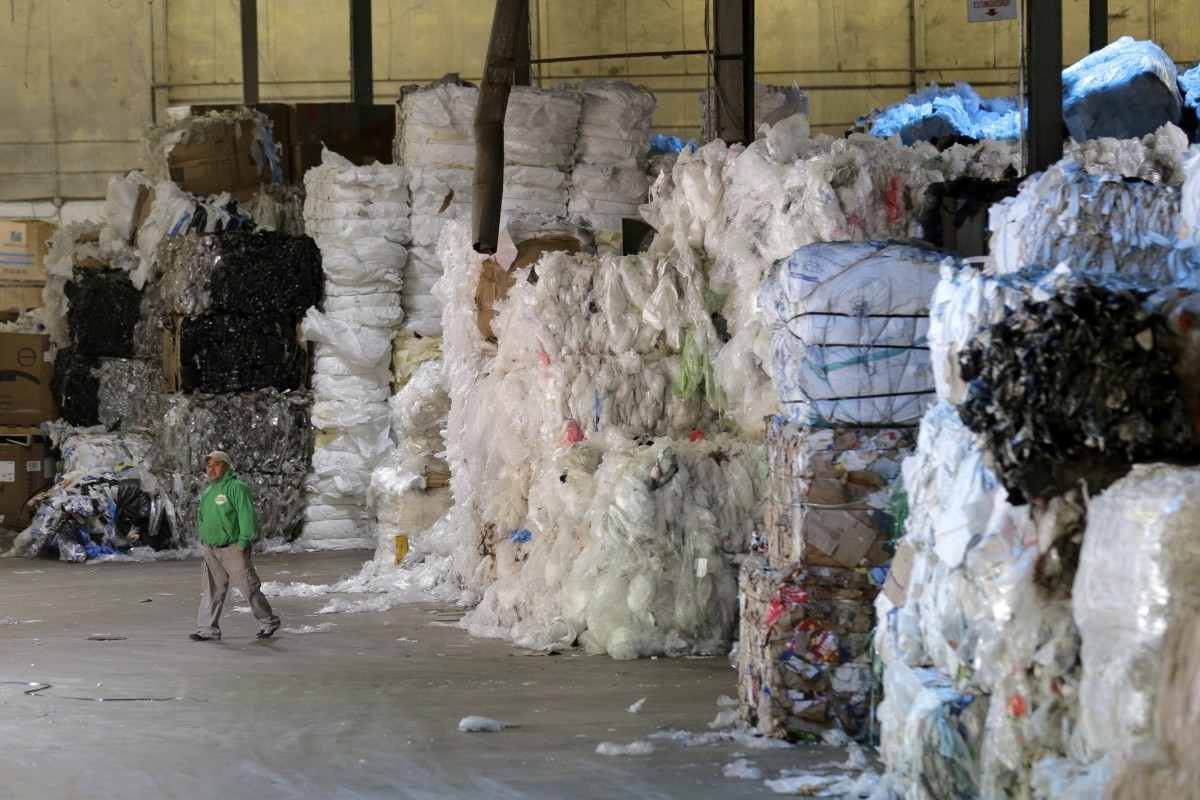
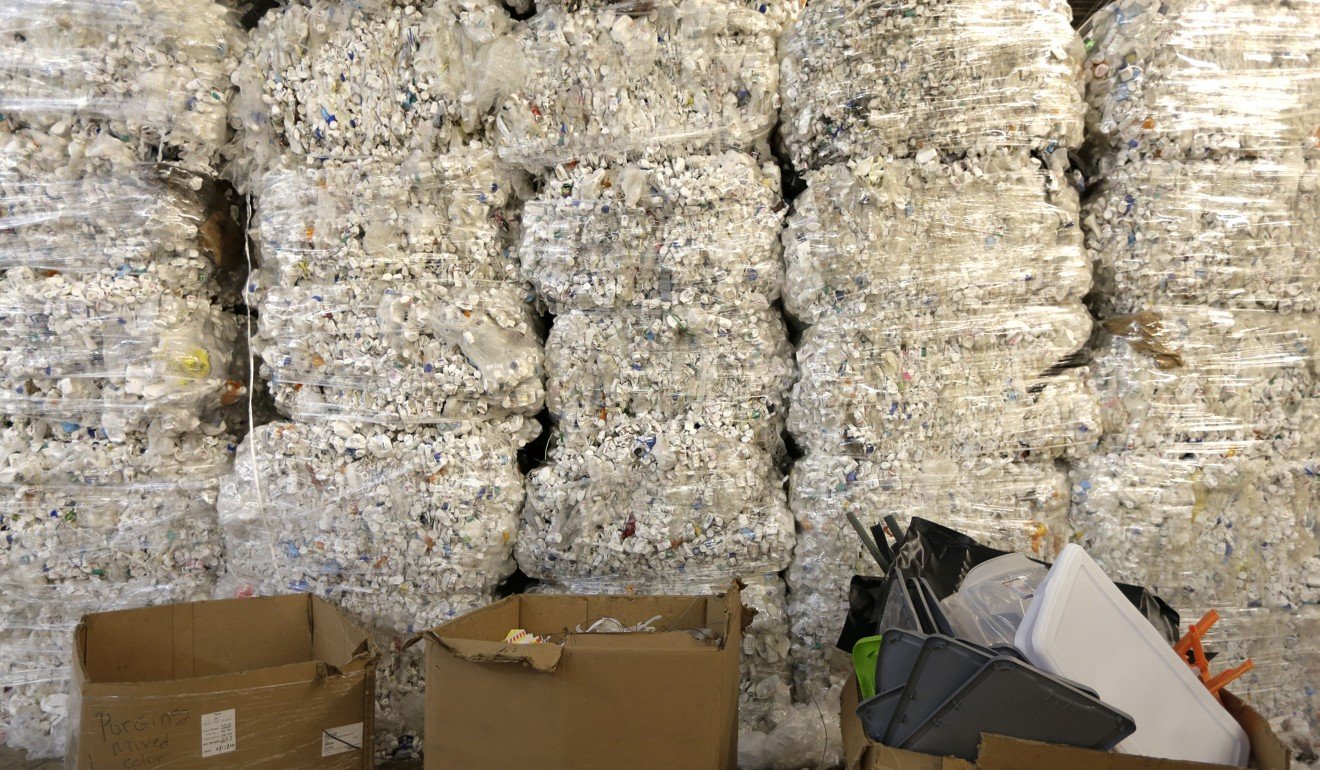
GDB International processes bales of scrap plastic film into pellets to make garbage bags and plastic pipe. Photo: AP
In New Brunswick, New Jersey, the recycling company GDB International exported bales of scrap plastic film such as pallet wrap and grocery bags for years. But when China started restricting imports, company president Sunil Bagaria installed new machinery to process it into pellets he sells profitably to manufacturers of garbage bags and plastic pipe.
The imports cut-off that China called “National Sword” was a much-needed wake-up call to his industry, he said.
“The export of plastic scrap played a big role in easing recycling in our country,” Bagaria said. “The downside is that infrastructure to do our own domestic recycling didn’t develop.”
China to suspend checks on US scrap metal shipments, halting imports
That was now changing, but he said far more domestic processing capacity would be needed as a growing number of countries restricted scrap imports.
“Ultimately, sooner or later, the society that produces plastic scrap will become responsible for recycling it,” he said.
It has also yet to be seen whether the new plants coming on line can quickly fix the problems for municipal recycling programmes that relied heavily on sales to China to get rid of piles of scrap.
About US$1 billion in investment in US paper processing plants has been announced in the past six months, according to a non-profit group that tracks the industry. Photo: AP
“Chinese companies are investing in mills, but until we see what the demand is going to be at those mills, we’re stuck in this rut,” said Ben Harvey, whose company in Westborough, Massachusetts, collects trash and recyclables for about 30 communities.
He had a car park filled with stockpiled paper a year ago after China closed its doors, but eventually found buyers in India, Korea and Indonesia.
China to collect applications for scrap metal import licences from May
Keith Ristau, chief executive of Far West Recycling in Portland, Oregon, said most of the recyclable plastic his company collected used to go to China but now most of it went to processors in Canada or California.
To meet their standards, Far West invested in better equipment and more workers at its material recovery facility to reduce contamination.
In Sarepta, Louisiana, IntegriCo Composites is turning bales of hard-to-recycle mixed plastics into railroad ties. It expanded operations in 2017 with funding from New York-based Closed Loop Partners.
“As investors in domestic recycling and circular economy infrastructure in the US, we see what China has decided to do as very positive,” said Closed Loop founder Ron Gonen.


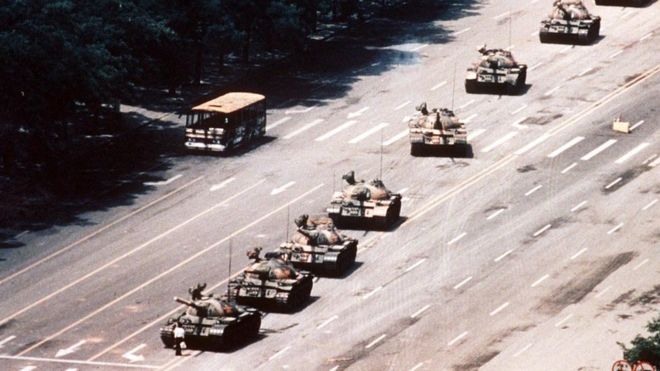 Image copyright SIPA/SHUTTERSTOCK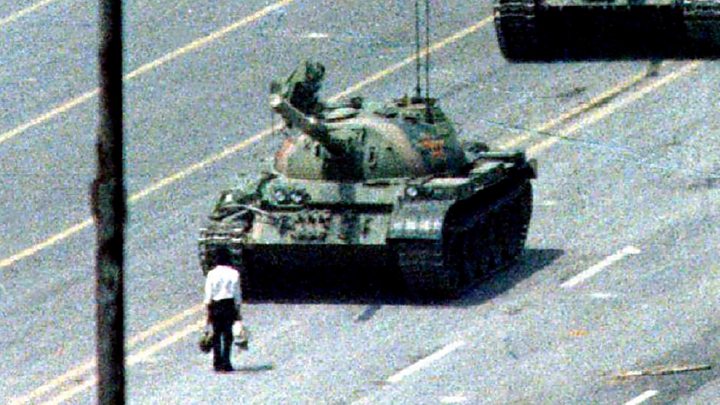








 CHINDIA ALERT: You'll be living in their world, very soon