Archive for ‘inspected’

11/05/2020

Xi inspects north China’s Shanxi Province

TAIYUAN, May 11 (Xinhua) — Xi Jinping, general secretary of the Communist Party of China Central Committee, on Monday inspected north China’s Shanxi Province.

On Monday afternoon, Xi visited an organic daylily farm in Yunzhou District of Datong City, and a village in the city’s Xiping Township to learn about poverty alleviation efforts.

He then went to the Yungang Grottoes to learn about historical and cultural heritage protection efforts.

(Xinhua/Li Xueren, Xie Huanchi, Liu Bin)

Source: Xinhua
22/04/2020

Xi inspects poverty alleviation in northwest China’s Shaanxi Province

CHINA-SHAANXI-XI JINPING-INSPECTION (CN)

Chinese President Xi Jinping, also general secretary of the Communist Party of China Central Committee and chairman of the Central Military Commission, inspects the local poverty alleviation work in Jinping Community of Laoxian Township, Pingli County of the city of Ankang, northwest China’s Shaanxi Province, April 21, 2020. (Xinhua/Zhai Jianlan)

XI’AN, April 21 (Xinhua) — Xi Jinping, general secretary of the Communist Party of China Central Committee, on Tuesday inspected the local poverty alleviation work in northwest China’s Shaanxi Province.

Xi visited a community, a township hospital, a primary school and a tea farm in Laoxian Township, Pingli County of the city of Ankang.

Source: Xinhua

31/03/2020

Xi inspects wetland conservation, urban management in Hangzhou

CHINA-ZHEJIANG-HANGZHOU-XI JINPING-INSPECTION (CN)

Chinese President Xi Jinping, also general secretary of the Communist Party of China Central Committee and chairman of the Central Military Commission, visits the Xixi National Wetland Park during an inspection in Hangzhou, east China’s Zhejiang Province, March 31, 2020. (Xinhua/Yan Yan)

HANGZHOU, March 31 (Xinhua) — Xi Jinping, general secretary of the Communist Party of China Central Committee, on Tuesday inspected wetland conservation and technology-based urban management in the city of Hangzhou, east China’s Zhejiang Province.

During the inspection, Xi visited the Xixi National Wetland Park and the City Brain, a smart city platform aiming to improve urban management.

Hangzhou’s City Brain project was launched in 2016 to help the city make plans in areas including public security, transport and healthcare with the use of big data, cloud computing and artificial intelligence, among other cutting-edge technologies.

With a total area of 11.5 square kilometers, the Xixi National Wetland Park is the first national wetland park in the country.

Source: Xinhua

19/11/2019

Chinese top political advisor inspects construction of China-Laos railway

VIENTIANE, Nov. 18 (Xinhua) — Chinese top political advisor Wang Yang on Monday inspected the construction of the China-Laos Railway at ancient Lao capital Luang Prabang, some 220 km north of Vientiane.

Wang, chairman of the National Committee of the Chinese People’s Political Consultative Conference, inspected the construction of a major bridge crossing the Mekong River, which is an important node of the 414.3-km railway.

He was also briefed on the construction of the China-Laos Railway, met with representatives from the company that constructs the railway and delivered a speech.

On behalf of the Central Committee of the Communist Party of China (CPC) and the Chinese people, Wang expressed warm greetings to the staff participating in the construction of the China-Laos Railway and sent his heartfelt thanks to those who cared and supported the construction of the railway.

Wang said the railway is a major project of the China-Laos Economic Corridor and an important platform and carrier of the implementation on building a community with a shared future for China and Laos.

Hailing the railway’s important significance in improving Laos’ infrastructure and boosting local economic and social development, Wang said top leaders of the two countries have attached great importance to the railway and have made explicit requirements of the construction on different occasions.

Wang called on builders of the railway to note the importance of the railway from the overall and strategic height, uphold the principle of quality and safety first, enhance project management, fulfill social responsibilities and work on to build a model, competitive and clean project, so as to contribute to the China-Laos friendship.

The China-Laos Railway is a strategic docking project between the China-proposed Belt and Road Initiative and Laos’ strategy to convert from a landlocked country to a land-linked hub.

The railway, with 198-km tunnels and 62-km bridges, will run from Boten border gate in northern Laos, bordering China, to Vientiane with an operating speed of 160 km per hour.

The project started in December 2016 and is scheduled to be completed and opened to traffic in December 2021.

Source: Xinhua

01/10/2019

Military advances and Xi Jinping’s supreme status among the themes as Beijing celebrates National Day

  • 70th anniversary of the founding of the People’s Republic of China marked by its biggest ever military parade and huge civilian parade
  • Xi says no force can stop China ‘marching forward’ and vows to protect the long-term stability of Hong Kong
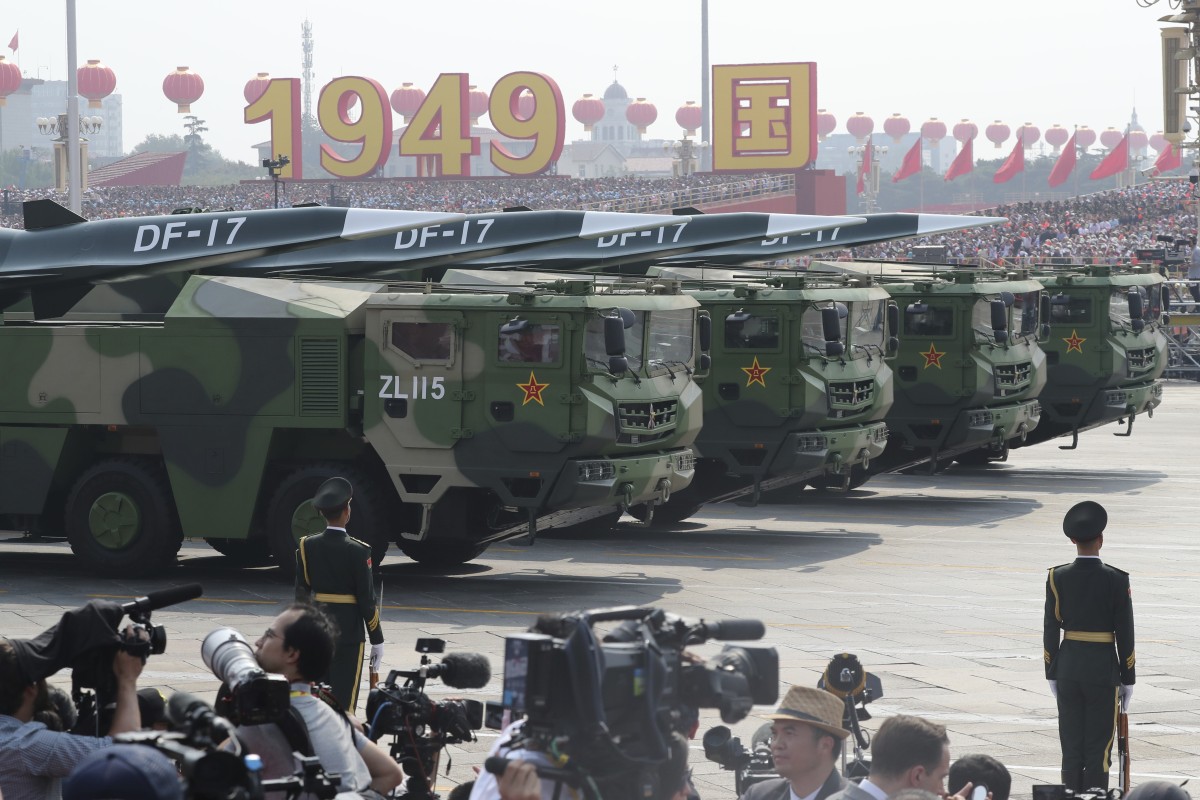
Military vehicles carry DF-17 missiles capable of reaching the US mainland during the parade to mark 70 years of the People’s Republic. Photo: AP
China staged a massive military parade in Beijing on Tuesday to mark the 70th anniversary of the founding of the People’s Republic, with much of the smog-shrouded capital city under a security lockdown.
President Xi Jinping inspected over 15,000 troops, more than 160 aircraft and 580 weapon systems in a show of the country’s growing military might and his drive to modernise the People’s Liberation Army.
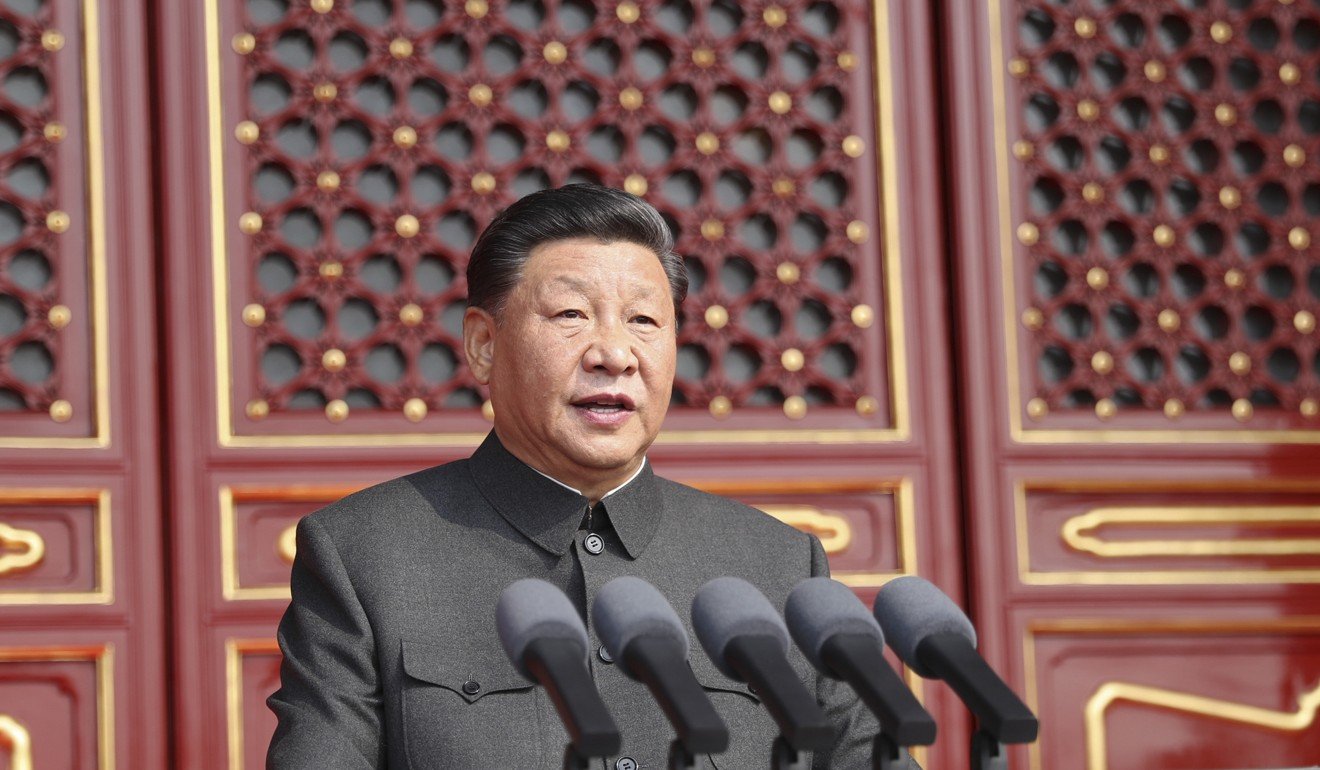
He also delivered a bullish eight-minute speech hailing the accomplishments of seven decades of Communist rule and pledging to achieve his vision of a “Chinese dream” of national rejuvenation and global prominence.

Here are some of the key takeaways from a day of celebration in Beijing:

A show of unity

Xi presided over the ceremony in Tiananmen Square flanked by his predecessors Jiang Zemin and Hu Jintao, along with other retired and present party elders.

The rare appearance of Jiang and Hu – on the rostrum of the Gate of Heavenly Peace, where the country’s founding father Mao Zedong declared Communist rule on October 1, 1949 – was clearly aimed at projecting unity and solidarity in the face of daunting domestic and international challenges.

China’s National Day parade, as it happened
Hu had been absent from the funeral of former premier Li Peng in late July, although the ailing Jiang attended.

Former vice-president Zeng Qinghong and Song Ping, the oldest party elder in attendance, also appeared on the rostrum.

President Xi Jinping speaks in Tiananmen Square during Tuesday’s celebrations. Photo: Xinhua

But notably, while former premier Wen Jiabao was present, his predecessor Zhu Rongji was not.

‘No force can shake China’

Dressed in a Mao suit, Xi’s nationally televised speech invoked China’s “century of humiliation” and praised the achievements of its people, saying there was no force that could stop it forging ahead.

“No force can shake the status of our great motherland, and no force can stop the Chinese people and the Chinese nation from marching forward,” he said.

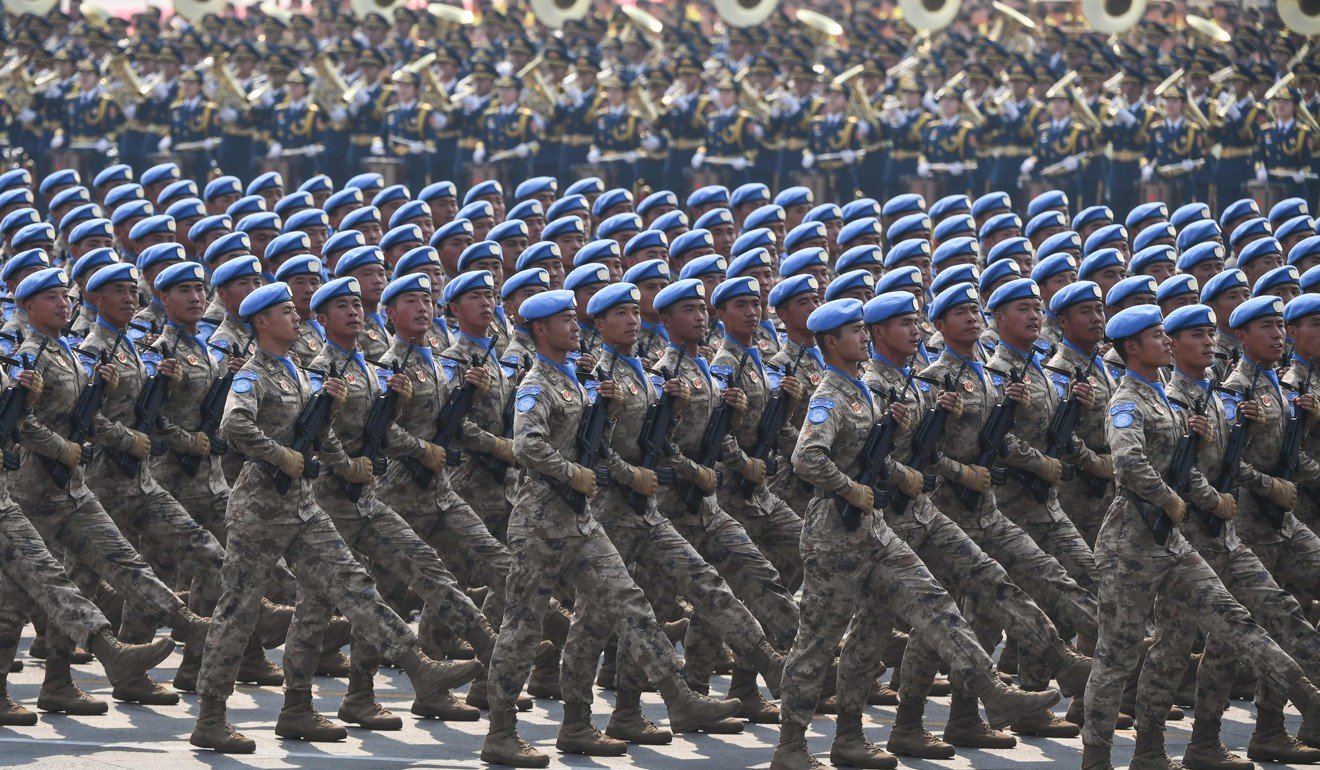
Chinese troops take part in the Republic’s largest ever military parade. Photo: AFP
“The People’s Liberation Army [PLA] will serve its purpose in safeguarding the sovereignty, security and development interests of the country, and world peace,” he said, at a time when Beijing has expanded its military footprint globally, including with its first overseas military base in Djibouti.
Xi called on the Communist Party and the country to unite and continue to fight for the realisation of what he called the “Chinese dream” – the nation’s rejuvenation.
One country, two systems
Amid escalating unrest in Hong Kong, which has plunged the city into a deepening crisis and threatened to overshadow the National Day celebrations, Xi vowed that the central government would uphold “one country, two systems”.
He said the central government would protect the long-term stability of Hong Kong and Macau, and stressed the goal of “peaceful reunification” with the self-ruling Taiwan, repeating a message frequently used by his predecessors, including Deng Xiaoping, Jiang and Hu.

The theme of one country, two systems later appeared in a National Day parade for the first time, with placards forming the words: “Hong Kong’s tomorrow will be better.”

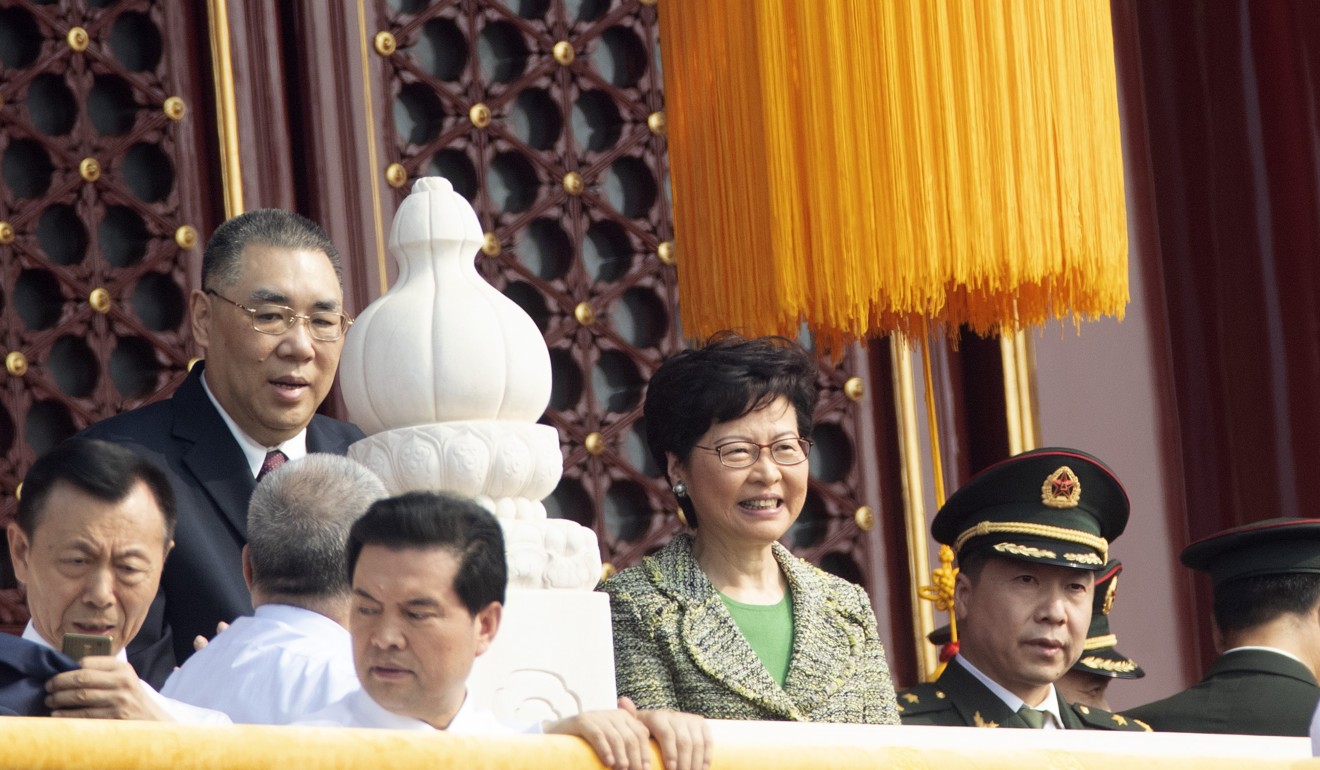
Hong Kong Chief Executive Cheng Yuet-ngor attended the ceremony, as did 10 Hong Kong police officers involved in suppressing anti-government protests in the city.
Showing off new weapons
China’s advancement in military weaponry was on full display, with almost half of the items featured being shown to the public for the first time.
Hong Kong leader Carrie Lam was among the guests in Beijing on Tuesday. Photo: AP

The morning’s celebrations included an 80-minute military parade – the biggest since the founding of the People’s Republic – in an apparent effort to showcase the prowess of the PLA, the world’s biggest military with 2 million personnel.

Among the weapons shown were DF series missiles, including the DF-17, a nuclear-capable glider that has the capacity to strike the US mainland, and the DF-41, which has a range of up to 15,000km, making it the world’s longest-range military missile.

Signalling Xi’s status

A 100,000-strong civilian parade featuring huge portraits of Xi and predecessors including Mao, Deng, Jiang and Hu wrapped up the morning celebration.

The procession was divided into three parts, representing three eras of the People’s Republic: the Mao era, Deng’s reform and opening up, and Xi’s era, which seeks global prominence on a par with that of the United States.

Xi appeared keen to project his supreme status in the party, reinforced since he abolished the constitutional term limit a year ago, allowing him potentially to remain leader for life.

He waved at his own portrait, unveiled alongside a sign reading “Carry out Xi Jinping Thought on Socialism with Chinese Characteristics for a New Era”.

Source: SCMP

29/09/2019

China, Russia pledge to enhance extensive cooperation, legislative coordination

RUSSIA-CHINA-LI ZHANSHU-VISIT

Li Zhanshu, chairman of the Standing Committee of the National People’s Congress of China, meets with Russian President Vladimir Putin in Moscow, Russia, Sept. 25, 2019. Li paid an official goodwill visit to Russia from Sept. 25 to 28. (Xinhua/Pang Xinglei)

MOSCOW, Sept. 28 (Xinhua) — China’s top legislator Li Zhanshu and top Russian officials have agreed to further strengthen bilateral comprehensive cooperation and continue to promote legislative coordination for stronger ties.

Li, chairman of the Standing Committee of the National People’s Congress of China, on Saturday completed an official visit to Russia, during which he held talks with Russian President Vladimir Putin and the heads of both houses of the Russian parliament.

The Russian leaders congratulated China on the 70th anniversary of the founding of the People’s Republic of China and hailed the great achievements China has made in the past seven decades. The two sides also exchanged congratulations on the 70th anniversary of the establishment of diplomatic relations between China and Russia.

When meeting Putin, Li said, under the strategic guidance of the heads of state of the two countries, China-Russia relations have hit an unprecedented high and entered a new era of higher level and greater development.

Under the current international situation, China and Russia should strengthen mutual support, jointly build strategic support and security barriers between the two countries, and promote the construction of a new type of international relations and a community with a shared future for mankind, Li said.

He called on the two sides to bring their political mutual trust and strategic cooperation to a new height, and push economic and trade cooperation to a new level, so as to move forward their comprehensive strategic partnership of coordination for a new era.

For his part, Putin lauded Russia-China ties as a model of relations between the world’s major countries.

He said the comprehensive strategic partnership of coordination for a new era between the two countries, built in compliance with the international law, is in the interests of the two countries and the two peoples.

Noting that the current bilateral cooperation in various areas is steadily advancing towards the established goals, Putin urged the two countries to further strengthen all-round cooperation and develop their ties on the basis of existing achievements.

Li also met with Valentina Matviyenko, speaker of the Russian Federation Council, or the upper house of parliament, and Vyacheslav Volodin, speaker of the Russian State Duma, or the lower house of parliament.

During his talks with the heads of Russian parliament, Li said the cooperation between legislative bodies, as an important part of the China-Russia comprehensive strategic partnership of coordination for a new era, is expected to prioritize the implementation of the consensus reached by the two heads of state.

According to him, the two sides should promote communication and collaboration for the sake of the development of bilateral ties and, in particular, strengthen the exchanges of experience on foreign-related legal construction, so as to effectively deal with unilateralism and protectionism as well as defend the national sovereignty, security and interests of the two countries.

Li also called for better synergy between the China-proposed Belt and Road Initiative and the Russia-led Eurasian Economic Union, further cooperation in high-tech fields as well as sub-national cooperation and people-to-people exchanges.

For her part, Matviyenko said China’s development has proved to the world that a country can follow its own development path in line with its national conditions.

She said the people of the two countries work closely together and respect each other’s national interests, adding that no matter how the international situation changes, the long-term friendly cooperation between the two countries will remain unchanged.

The legislative bodies of the two countries should provide legal support and guarantee for the development of bilateral relations, Matviyenko said.

Volodin also urged the legislative bodies to make good use of existing cooperation mechanisms in a bid to promote cooperation in various fields, resist external interference and safeguard a fair and just international order.

Li and Volodin also attended the fifth meeting of the China-Russia committee for parliamentary cooperation.

In his speech, Li talked about China’s historic achievements in the past 70 years and spoke highly of the contribution of legislative cooperation to the development of bilateral relations.

He expressed hopes that both sides, after thorough studies, will come up with new ideas and new measures for legislative cooperation in a new era, better use the committee for parliamentary cooperation as a platform, and further enrich China-Russia relations.

While in Moscow, the top Chinese legislator also visited the Tomb of the Unknown Soldier and inspected the Moscow metro project of the China Railway Construction Corporation.

He also exchanged views on strengthening local cooperation with Rustam Minnikhanov, president of Russia’s Tatarstan Republic, in its capital of Kazan and visited the Kazan Helicopter Plant and Kazan Federal University.

Source: Xinhua

18/09/2019

Xi inspects manufacturing enterprise, Yellow River ecological protection in central China

CHINA-HENAN-ZHENGZHOU-XI JINPING-INSPECTION (CN)

Chinese President Xi Jinping, also general secretary of the Communist Party of China Central Committee and chairman of the Central Military Commission, communicates with workers while inspecting Zhengzhou Coal Mining Machinery Group Co., Ltd. during his tour in Zhengzhou, central China’s Henan Province, Sept. 17, 2019. (Xinhua/Ju Peng)

ZHENGZHOU, Sept. 17 (Xinhua) — Xi Jinping, general secretary of the Communist Party of China Central Committee, inspected a manufacturing enterprise and ecological protection of the Yellow River during his tour in Zhengzhou, central China’s Henan Province on Tuesday afternoon.

Source: Xinhua

Law of Unintended Consequences

continuously updated blog about China & India

ChiaHou's Book Reviews

continuously updated blog about China & India

What's wrong with the world; and its economy

continuously updated blog about China & India