Archive for ‘Jaish-e-Mohammad’

02/03/2019

Pakistan and India step back from the brink, tensions simmer

MUZAFFARABAD, Pakistan/SRINAGAR, India (Reuters) – A flare up between arch-foes India and Pakistan appeared to be easing on Saturday after Islamabad handed back a captured Indian pilot, but tensions continued to simmer amid efforts by global powers to prevent a war between the nuclear-armed neighbours

Wing Commander Abhinandan Varthaman, who became the face and symbol of the biggest clash between India and Pakistan in many years, walked across the border just before 9 p.m. (1600 GMT) on Friday in a high-profile handover shown on live television.

Shelling across the Line of Control (LoC) that acts as a de facto border in the disputed Kashmir region, a frequent feature in recent weeks, continued on Saturday.

Pakistan’s military said on Saturday its air force and navy “continue to be alert and vigilant”, while two of its soldiers were killed after exchanging fire with Indian troops along the Line of Control. India’s military said on Saturday that Pakistan was firing mortar shells across the LoC.

Pakistan touted Abhinandan’s return as “as a goodwill gesture aimed at de-escalating rising tensions with India” after weeks of unease that threatened to spiral into war after both countries used jets for bombing missions this week.

Global powers, including China and the United States, have urged restraint to prevent another conflict between the neighbours who have fought three wars since independence from Britain in 1947.

Tensions escalated rapidly following a suicide car bombing on Feb. 14 that killed at least 40 Indian paramilitary police in Indian-controlled Kashmir.

India accused Pakistan of harbouring the Jaish-e Mohammad group behind the attack, which Islamabad denied, and Prime Minister Narendra Modi promised a strong response.

Indian warplanes carried out air strikes on Tuesday inside Pakistan on what New Delhi called militant camps. Islamabad denied any such camps existed, as did local villagers in the area, but Pakistan retaliated on Wednesday with its own aerial mission, that led to both sides claiming to have shot down jets.

The stand off came at a critical time for Modi, who faces a general election that must be held by May and who had been expected to benefit from nationalist pride unleashed by the standoff.

Pakistani leaders say the ball is now in India’s court to de-escalate the tensions, though the Pakistani army chief told top military leaders of the United States, Britain and Australia on Friday that his country would “surely respond to any aggression in self-defence”.

“COLLIDE HEAD-ON”

The Indian pilot’s ordeal since being shot down on Wednesday had made him the focal point of the crisis and he returned to his homeland to a hero’s welcome, with crowds thronging the Wagah border crossing and waving Indian flags.

Before his release, Pakistani television stations broadcast video of Abhinandan in which he thanked the Pakistani army for saving him from an angry crowd who chased him after seeing him parachute to safety.

Pakistan frees Indian pilot as crisis thaws
“The Pakistani army is a very professional service,” he said. “I have spent time with the Pakistan army. I am very impressed.”
On Friday, four Indian troops and one civilian were killed in a clash with militants in the Indian-administered Kashmir, where a further three people were killed and one wounded from Pakistani shelling.
Pakistan’s military said two civilians were killed and two wounded since Friday afternoon on Pakistan’s side of Kashmir from a barrage of Indian shelling.

In a sign of the unease, residents say they are afraid another conflagration is likely.

“The way situation is developing along the LoC makes me feel that both sides may collide head-on anytime now,” said Chaudhry Jahangir , a Pakistani resident of the Samahni sector in Kashmir.

Source: Reuters

19/02/2019

Pakistan PM Imran Khan says ready to talk terror, then packs in warning against strikes

Pakistan PM Imran Khan has denied hand behind Pulwama terror attack stating if there is evidence, his government will act against the culprits.

INDIA Updated: Feb 19, 2019 14:50 IST

HT Correspondent
HT Correspondent
Hindustan Times, Islamabad
Imran Khan,Pulwama attack
Pakistan Prime Minister Imran Khan on Tuesday said if there is any evidence of involvement of any Pakistani national in Pulwama terror attack, his government will act against the culprits. (AP)

Pakistan Prime Minister Imran Khan has denied his country’s role behind the Pulwama terror attack, the worst in Jammu and Kashmir in decades. He claimed that India does not have any evidence to prove Pakistan’s role in terror attacks in Kashmir.

“You (India) have blamed the Pakistan government without any evidence…If you have any evidence, we will act,” Imran Khan said.

He said, “It is in our interest that nobody from our soil spreads violence. I want to tell Indian government that we will take action if evidence is found against anyone from Pakistan.”

“What has Pakistan to gain from this? Why will Pakistan do this at a stage when it is moving towards stability,” said Imran Khan adding that “this is a Naya Pakistan with a new mindset.”

Calling for a dialogue with India, he said, “If you thinks you will attack us and we will not think of retaliating…We will retaliate. We all know starting a war is in the hands of humans, where it will lead us only God knows. This issue should be solved through dialogue.”

Also Read | Eliminated Jaish leadership that planned Pulwama attack within 100 hours, says army

Imran Khan’s reaction comes days after at least 40 CRPF jawans were killed in a terror attack in Jammu and Kashmir. Pakistan-backed terror outfit Jaish-e-Mohammad claimed responsibility for the attack.

Earlier, Pakistan sought an urgent intervention of UN Secretary-General in defusing tensions with India and help facilitate dialogue between the two countries.

Following the terror attack, India launched a diplomatic offensive against Pakistan with the ministry of external affairs reaching out to more than two dozen countries including P5 – the US, the UK, France, Russia and China, which has repeatedly blocked India’s bid to get Jaish-e-Mohammad chief Masood Azhar declared as global terrorist by the United Nations.

Also Read | Army major killed in Pulwama encounter made plans for first anniversary

China has used veto to shield Masood Azhar. Pakistan has also denied its support to the terror group. On Monday, in a joint statement Imran Khan and Saudi Arabia’s prince Mohammed bin Sultan “underlined the need for avoiding politicisation of UN listing regime.” This is being viewed as a snub to India’s renewed efforts to isolate Pakistan over its continued support to terror outfits and corner Masood Azhar’s JeM.

India withdrew the most favoured nation (MFN) status accorded to Pakistan in 1996. The MFN status had not been revoked even during the 1999 Kargil War and in the aftermath of 2008 Mumbai terror attack that killed more than 160 people.

Source: Hindustan Times

18/02/2019

Pulwama attack: Four Indian soldiers killed in Kashmir gun battle

Four soldiers have been killed in Indian-administered Kashmir in a gun battle with militants, police say.

The clash occurred in Pulwama district, where more than 40 Indian paramilitary police were killed in a suicide attack on Thursday, raising tensions between nuclear-armed India and Pakistan.

A civilian and two alleged militants were also killed as Indian troops searched for suspects.

Meanwhile Pakistan recalled its ambassador for consultations.

India had already recalled its top diplomat from Pakistan in the wake of Thursday’s attack – in which it said the Pakistani state was complicit.

Pakistan denies any role in the bombing, which was claimed by a group based on its soil – Jaish-e-Mohammad (JeM)

What’s happening in Pulwama?

Police say two militants who were trapped in Pinglena village were killed in Monday’s operation. Both are JeM members and one is a Pakistani national, authorities said.

Heavy gunfire has been heard, and Indian security officials are appealing to villagers to stay indoors.

Police told BBC Urdu that when they fired “warning shots” at the house where the alleged militants were hiding, they fired back. One officer critically injured was taken to hospital.

The owner of the house was killed during the exchange of fire, police added.

Indian security forces have been hunting for militants with suspected links to JeM following Thursday’s bombing, which saw a vehicle packed with explosives ram a convoy of 78 buses carrying Indian security forces.

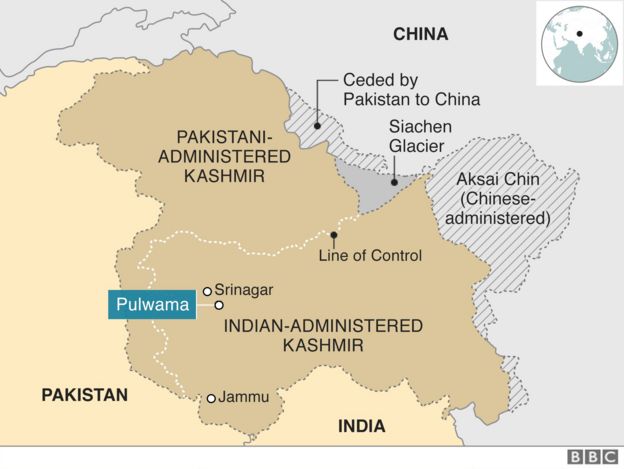
map

The suicide bomber was identified as a local Kashmiri aged between 19 and 21.

More than 20 people were detained on Sunday, according to police.

How high are tensions?

Kashmir has been a flashpoint between India and Pakistan since independence.

Both countries claim all of Muslim-majority Kashmir but control only parts of it. They have fought two wars and a limited conflict in the region.

Thursday’s attack was the deadliest attack against Indian forces since an Islamist-led insurgency began in 1989. It sparked anti-Pakistan protests in some Indian cities and angry mobs targeted Kashmiri students and businessmen.

Mobile internet services in Indian-administered Kashmir were cut over the weekend and the Indian government has pulled security normally provided to at least five Kashmiri separatist leaders.

Isolated incidents of students from Kashmir being beaten up or evicted from their accommodation in northern Indian states have also been reported.

India’s Central Reserve Police Force (CRPF) offered help to students in need, but also warned of false reports.

In broader terms, there has has been a spike in violence in Indian-administered Kashmir since Indian forces killed a popular militant in 2016. Significant numbers of young men have joined the insurgency in recent years and the funerals of well-known militants draw huge crowds who want to pay respects to “martyrs”.

India has been accused of using excessive force to control protests with thousands of people suffering eye injuries or being blinded by pellet guns.

How might India retaliate?

Indian Prime Minister Narendra Modi, who is facing an election later this year, has vowed a strong response and says he will give the military free rein.

The last time an attack on Indian forces close to this magnitude occurred in Kashmir was in 2016, when 19 soldiers were killed at a base. In response to that, India carried out “surgical strikes” which involved Indian soldiers crossing the de facto border to hit Pakistani posts.

This time analysts say heavy snow in the region could make that kind of limited ground response impossible. But there are fears that going further, for example with air strikes, could lead to Pakistani retaliation and a significant escalation.

So far India has focused on retaliation by economic and diplomatic means. It has revoked Pakistan’s Most Favoured Nation trading status, raised customs duties to 200% and vowed to isolate it in the international community.

Presentational grey line

Despite tensions Pakistan is calm

By Secunder Kermani, BBC Pakistan correspondent

The threat of Indian military action has not provoked widespread concern amongst the general public in Pakistan. Previous attacks by militants like JeM, believed to have close links to the intelligence services, have been seen as attempts by the Pakistani military to prevent the civilian government developing too friendly a relationship with India.

However, since Imran Khan was elected as prime minister here, many have begun to believe both the army and his administration were united in wanting to improve cross border ties.

Whether Pakistan was involved in the attack or not, it seems unlikely concerted action will now be taken against JeM. Its leader has been in “protective custody” since another attack in 2016, but still regularly releases audio messages to followers.

The group has in the past been a useful tool for Pakistan’s intelligence services wanting to foment unrest across the border, and authorities may now be reluctant to confront them, in case they turn against the Pakistani state as some of their members have done in the past.

Source: The BBC

17/02/2019

Kashmiri Muslims evicted, threatened after deadly attack on Indian forces

SRINAGAR (Reuters) – India has warned against rising communal tensions across the country as Kashmiris living outside their state faced property evictions, job suspensions and attacks on social media after a suicide bomber killed 44 policemen in the region.

The car bomb attack on a security convoy on Thursday, claimed by Pakistan-based Islamist militant group Jaish-e-Mohammad and carried out by a 20-year-old Kashmiri man, was the worst in decades of insurgency in the disputed area, which is claimed in full by both the nuclear-armed neighbours but ruled in part.

As the bodies of the paramilitary policemen who died in the attack were returned to families across India this weekend, passionate crowds waving the Indian flag gathered in the streets to honour them and shouted demands for revenge. Pakistan has denied any role in the killings.

Kashmiri Muslims, meanwhile, are facing a backlash in Hindu-majority India, mainly in the northern states of Haryana and Uttarakhand, forcing the federal interior ministry to issue an advisory to all states to “ensure their safety and security and maintain communal harmony”.

Aqib Ahmad, a Kashmiri student in Uttarakhand capital Dehradun, said the owner of the house he was staying in had asked him to move out fearing an attack on his property. Rates for air tickets to Kashmir have sky-rocketed as tensions escalate, he said.

Two other students in Dehradun said they also had been asked to vacate their rooms immediately.


Local media reported that some Kashmiri students were assaulted by members of Hindu right-wing groups in Uttarakhand, while a Kashmiri man had been booked by the police in the southern city of Bengaluru under a colonial-era sedition law for a post allegedly backing the militants. Reuters was not able to independently verify the reports.

Police in Jammu and Kashmir (J&K) state said they were providing temporary accommodation to people returning to Kashmir. The police urged Kashmiris to contact their hotline for “speedy assistance in case they face any difficulties/harrasment”.

“TRAITOR”

Fear has engulfed Kashmiri students in Haryana’s Ambala district after a video on social media showed a village headman asking people to evict Kashmiri students in the area.

“In case it is not done, the person in whose residence such students are living will be considered as a traitor,” the man says in the video, whose authenticity Reuters has not been able to independently verify.


Police said they were investigating the matter.

Since the video surfaced on social media on Saturday, at least half a dozen Kashmiri students have been shifted to the hostel of a university campus in Ambala.

A Facebook user named Anshul Saxena, meanwhile, has claimed credit for getting people fired or suspended for posts he calls “anti-national”.

Saxena uploaded a screengrab of a suspension letter handed out to a Kashmiri employee of a pharmaceutical company who had allegedly written in favour of the attack.

The attack on India’s paramilitary police follows the deadliest year in Kashmir for security personnel since Prime Minister Narendra Modi’s Hindu nationalist Bharatiya Janata Party came to power nearly five years ago.

44 killed in worst Kashmir attack in decades
Government data shows 91 officers lost their lives in Kashmir last year, about 14 percent more than 2017. Thousands of people, including militants and civilians, have died since the insurgency began in late 1980s.
Political leaders from Kashmir appealed to the government to ensure security of Kashmiris across India, while many people on Twitter said their homes were open to Kashmiris seeking shelter.
“Understand the pain and anguish,” Mehbooba Mufti, former chief minister of J&K, said in a tweet. “But we must not allow such mischievous elements to use this as an excuse to persecute/harass people from J&K. Why should they suffer for somebody else’s action?”
Source: Reuters
16/02/2019

U.S. backs India’s right to self-defence over Kashmir attack – Indian government

NEW DELHI (Reuters) – The United States supports India’s right to self-defence against cross-border attacks, India’s foreign ministry said on Saturday after a deadly car bombing in disputed Kashmir raised tensions with rival neighbour Pakistan.

Prime Minister Narendra Modi has promised a strong response after a Pakistan-based militant group claimed responsibility for the suicide attack on a military convoy on Thursday that killed 44 paramilitary policemen.

India’s government said it had evidence the group, Jaish-e-Mohammad (JeM), had the backing of Pakistan and demanded Islamabad take action. Pakistan has condemned the attack and rejected India’s allegations.U.S. National Security Adviser John Bolton spoke to his Indian counterpart Ajit Doval on Friday night, promising to help bring those behind the attack to justice, the foreign ministry said in a readout of the phone call.

“The two NSAs vowed to work together to ensure that Pakistan cease to be a safe haven for JeM and terrorist groups that target India, the U.S. and others in the region,” the foreign ministry said.

“They resolved to hold Pakistan to account for its obligations under U.N. resolutions,” it added.

India has for years accused Muslim Pakistan of backing separatist militants in divided Kashmir, which the neighbours both claim in full but rule in part.

Pakistan denies that, saying it only offers political support to the Himalayan region’s suppressed Muslim people.

Modi, who is facing an election in the next few months, has called a meeting of political parties on Saturday to build support for action against Pakistan.

Indians have poured onto social media to vent their fury over the suicide bombing in Kashmir, with many of them calling for swift retribution against Pakistan as TV news shows hosted jingoistic debates.

When he swept to power at the head of a Hindu nationalist-led alliance in 2014, Modi vowed to pursue a tough line with Pakistan. The two countries have gone to war three times since independence from Britain in 1947, twice over Kashmir.

The attack comes at a difficult time for Pakistan, which is struggling to attract foreign investment and avert a payments crisis, with its swiftly diminishing foreign currency reserves at less than $8 billion, equivalent to two months of import payments.

Source: Reuters

15/02/2019

Pulwama attack: India will ‘completely isolate’ Pakistan

India has said it will ensure the “complete isolation” of Pakistan after a suicide bomber killed 46 soldiers in Indian-administered Kashmir.

Federal Minister Arun Jaitley said India would take “all possible diplomatic steps” to cut Pakistan off from the international community.

India accuses Pakistan of failing to act against the militant group which said it carried out the attack.

This is the deadliest attack to hit the disputed region in decades.

Both India and Pakistan claim all of Muslim-majority Kashmir but only control parts of it.

An insurgency has been ongoing in Indian-administered Kashmir since the late 1980s and there has been an uptick in violence in recent years.

How will India ‘punish’ Pakistan?

India says that Jaish-e-Mohammad, the group behind the attack, has long had sanctuary in Pakistan and accuses its neighbour of failing to crack down on it.

It has called for global sanctions against the group and has said it wants its leader, Masood Azhar, to be listed as a terrorist by the UN security council.

Although India has tried to do this several times in the past, its attempts were repeatedly blocked by China, an ally of Pakistan.

Mr Jaitley set out India’s determination to hold Pakistan to account when speaking to reporters after attending a security meeting early on Friday.

He also confirmed that India would revoke Most Favoured Nation status from Pakistan, a special trading privilege granted in 1996.

Pakistan said it was gravely concerned by the bombing but rejected allegations that it was in any way responsible.

But after Prime Minister Narendra Modi said in a speech that those behind the attack would pay a “heavy price”, many analysts expect more action from Delhi.

After a 2016 attack on an Indian army base that killed 19 soldiers, Delhi said it carried out a campaign of “surgical strikes” in Pakistan-administered Kashmir, across the de facto border. But a BBC investigation found little evidence militants had been hit.

However analysts say that even if the Indian government wants to go further this time, at the moment its options appear limited due to heavy snow across the region.

map

How did the attack unfold?

The bomber used a vehicle packed with explosives to ram into a convoy of 78 buses carrying Indian security forces on the heavily guarded Srinagar-Jammu highway about 20km (12 miles) from the capital, Srinagar.

“A car overtook the convoy and rammed into a bus,” a senior police official told BBC Urdu.

It stands as the deadliest militant attack on Indian forces in Kashmir since the insurgency began in 1989.

The bomber is reported to be Adil Dar, a high school dropout who left home in March 2018. He is believed to be between the ages of 19 and 21.

Soon after the attack Jaish-e-Mohammad released a video, which was then aired on the India Today TV channel. In it, a young man identified as Adil Dar spoke about what he described as atrocities against Kashmiri Muslims. He said he joined the banned group in 2018 and was eventually “assigned” the task of carrying out the attack in Pulwama.

He also said that by the time the video was released he would be in jannat (heaven).

Dar is one of many young Kashmiri men who have been radicalised in recent years. On Thursday, main opposition leader Rahul Gandhi said that the number of Kashmiri men joining militancy had risen from 88 in 2016 to 191 in 2018.

India has been accused of using brutal tactics to put down protests in Kashmir – with thousands of people sustaining eye injuries from pellet guns used by security forces.

What’s the reaction?

“We will give a befitting reply, our neighbour will not be allowed to de-stabilise us,” said Prime Minister Modi.

Mr Gandhi and two former Indian chief ministers of Jammu and Kashmir all condemned the attack and expressed their condolences.

The attack has also been widely condemned around the world, including by the US and the UN Secretary General.

The White House called on Pakistan to “end immediately the support and safe haven provided to all terrorist groups operating on its soil”.

Pakistan said it strongly rejected any attempts “to link the attack to Pakistan without investigations”.

What’s the background?

There have been at least 10 suicide attacks since 1989 but this is only the second suicide attack to use a car.

Prior to Thursday’s bombing, the deadliest attack on Indian security forces in Kashmir this century came in 2002, when militants killed at least 31 people at an army base in Kaluchak near Jammu, most of them civilians and relatives of soldiers.

At least 19 Indian soldiers were killed when militants stormed a base in Uri in 2016. Delhi blamed that attack on the Pakistani state, which denied any involvement.

The latest attack also follows a spike in violence in Kashmir that came about after Indian forces killed a popular militant, 22-year-old Burhan Wani, in 2016.

More than 500 people were killed in 2018 – including civilians, security forces and militants – the highest such toll in a decade.

India and Pakistan have fought three wars and a limited conflict since independence from Britain in 1947 – all but one were over Kashmir.

Who are Jaish-e-Mohammad?

Started by cleric Masood Azhar in 2000, the group has been blamed for attacks on Indian soil in the past, including one in 2001 on the parliament in Delhi which took India and Pakistan to the brink of war.

Most recently, the group was blamed for attacking an Indian air force base in 2016 near the border in Punjab state. Seven Indian security personnel and six militants were killed.

It has been designated a “terrorist” organisation by India, the UK, US and UN and has been banned in Pakistan since 2002.

However Masood Azhar remains at large and is reportedly based in the Bahawalpur area in Pakistan’s Punjab province.

India has demanded his extradition from Pakistan but Islamabad has refused, citing a lack of proof.

Source: The BBC

Law of Unintended Consequences

continuously updated blog about China & India

ChiaHou's Book Reviews

continuously updated blog about China & India

What's wrong with the world; and its economy

continuously updated blog about China & India