Archive for ‘Jammu’

17/02/2020

The Kashmir journalist forced into manual labour

Muneeb Ul IslamImage copyright MUKHTAR ZAHOOR
Image caption Muneeb Ul Islam can no longer afford to work as a journalist in Kashmir

Journalists in Indian-administered Kashmir are struggling to make ends meet amid a months-long communications blockade that has only partially been lifted. The BBC’s Priyanka Dubey visited the region to find out more.

Muneeb Ul Islam, 29, had worked as a photo-journalist in Kashmir for five years, his pictures appearing in several publications in India and abroad.

But the young photographer’s dream job vanished almost overnight in August last year, when India’s federal government suspended landline, mobile and internet services in Kashmir.

The government’s move came a day before its announcement that it was revoking the region’s special status – a constitutionally-guaranteed provision, which gave Kashmir partial autonomy in matters related to property ownership, permanent residency and fundamental rights.

The controversial decision catapulted the Muslim-majority valley into global news – but local journalists like Mr Islam had no way to report on what was going on. And worse, they had to find other things to do because journalism could no longer pay the bills.

By January, the region had not had access to the internet for more than 150 days, India’s longest such shutdown.
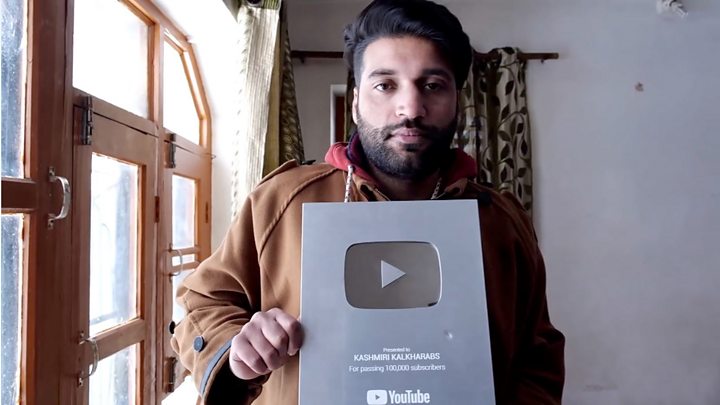
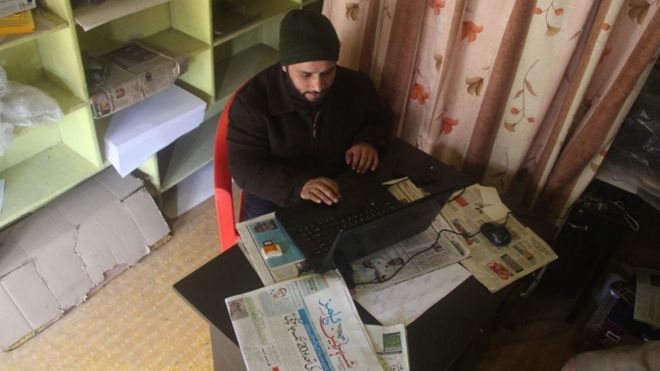
Media caption The silenced YouTube stars of Indian-administered Kashmir

“I chose journalism because I wanted to do something for my people,” Mr Islam explains. “I covered this conflict-ridden region with dedication until the loss of Kashmir’s special status put a full stop on my journey.”

In January, the government eased restrictions and allowed limited broadband service in the Muslim-majority valley, while 2G mobile coverage resumed in parts of the neighbouring Jammu region. But mobile internet and social media are still largely blocked.

India says this is necessary to maintain law and order since the region saw protests in August, and there has also been a long-running insurgency against Indian rule. But opposition leaders and critics of the move say the government cannot leave these restrictions in place indefinitely.

Meanwhile, journalists like Mr Islam are struggling.
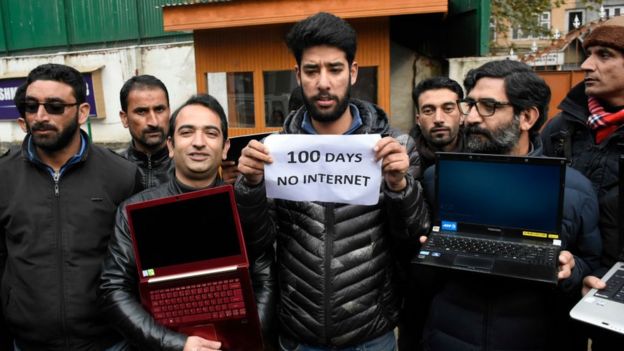
Kashmiri journalists protest against the continuous internet blockade for 100th day out Kashmir press club , Srinagar, Indian Administered Kashmir on 12 November 2019.Image copyright GETTY IMAGES
Image caption Kashmiri journalists protested after 100 days of no internet in the region

For months, Mr Islam says, he kept trying to report and file stories and photos.

In September, he even spent 6,000 rupees ($84; £65) of his own money to make two trips to the capital, Srinagar, for a story. But he soon ran out of funds and had to stop.

He then tried to file his stories on a landline phone: he would call and read them aloud to someone on the other side who could type it out. But, as he found out, his stories didn’t earn him enough money to cover the cost of travelling for hours in search of a working landline.

Presentational grey line

Read more on Kashmir

Presentational grey line

And Mr Islam was desperate for money because his wife was ill. So he eventually asked his brother for help, finding work carrying bricks on a construction site in his neighbourhood in Anantnag city. It pays him 500 rupees a day.

Mr Islam is not the only journalist in Kashmir who has been forced to abandon their career for another job.

Another journalist, who did not want to reveal his name, says he had been working as a reporter for several years, but quit the profession in August. He now plans to work in a dairy farm.
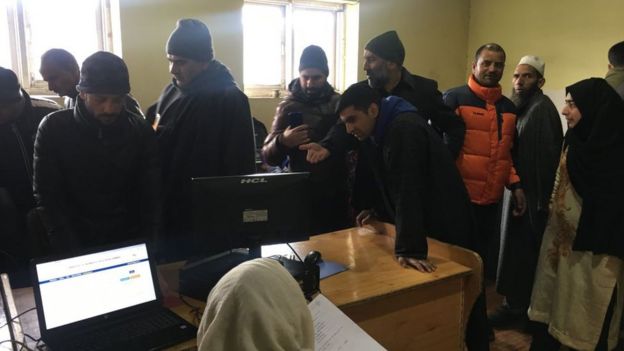
People at the Anantnag information officeImage copyright MUKHTAR ZAHOOR
Image caption Internet is available in some government offices

Yet another reporter, who also also wished to remain anonymous, says he used to earn enough to comfortably provide for his family. Now, he barely has money to buy petrol for his motorcycle.

“I have no money because I have not been able to file any story in the last six months,” a third reporter, who spoke to the BBC on the condition of anonymity, says. “My family keeps telling me to find another job. But what else can I do?”

In December, people were given limited access to the internet at a government office in Anantnag, but this hasn’t helped local journalists. The office, Mr Islam says, is always crowded and there are only four desktops for a scrum of officials, students and youngsters who want to log on to respond to emails, fill exam forms, submit job applications or even check their social media.

“We have access for only for a few minutes and the internet speed is slow,” he explains. “We are barely able to access email, forget reading the news.”

What’s more, Mr Islam says those who work at the office often ask customers to show them the contents of emails. “This makes us uncomfortable, but we don’t have a choice.”
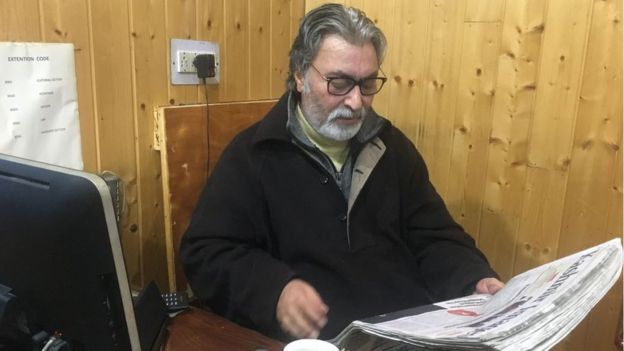
Basheer Manzar, the editor of Kashmir ImagesImage copyright MUKHTAR ZAHOOR
Image caption Basheer Manzar runs Kashmir Images, a local newspaper

Many journalists say that they have been completely cut off from their contacts for months now, making it hard to to maintain their networks or sources.

They also speak of how humiliating it is to beg for wi-fi passwords and hotspots at the cramped media centre in Srinagar, which has less than two dozen computers for hundreds of journalists.

This has left publishers in the lurch too. “My reporters and writers are not able to file,” says Basheer Manzar, the editor of Kashmir Images.

He still publishes a print edition, he says, because if he doesn’t do so for a certain number of days in the month, he will lose the license.

But the website continues to struggle, he adds, because most of the readers in Indian-administered Kashmir have no access to the internet.

“I know what is happening in New York through news on the TV, but I don’t know what’s happening in my hometown.”

Source: The BBC
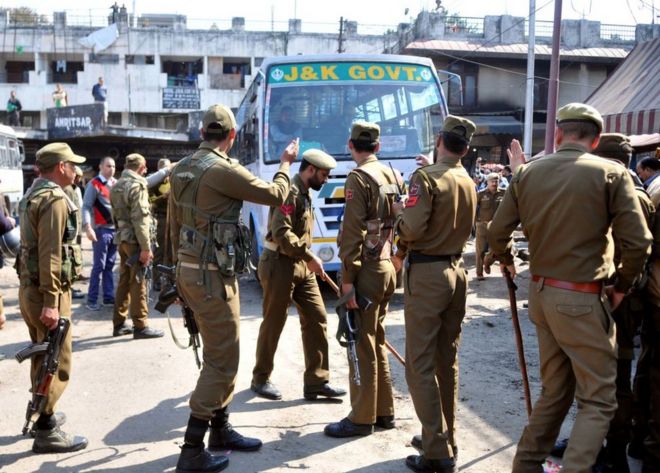
09/03/2019

Man arrested over Kashmir grenade attack

Police at the site of the blast in Jammu city on 7 March 2019.Image copyrightGETTY IMAGES
Image captionThe blast occurred at a busy bus station in Jammu city

Indian police have arrested an alleged member of the Hizbul Mujahideen militant group after a grenade attack killed at least two people and injured more than 30 others.

The attack took place on Thursday in a bus station in the Indian-administered state of Jammu and Kashmir.

Last month a suicide attack against security forces triggered cross-border air strikes between India and Pakistan.

Hizbul Mujahideen has said it was not behind Thursday’s attack.

But police told BBC Urdu that the accused, Yasir Javed Bhat, had confessed. He is a Kashmiri and reported to be in his 20s.

“He revealed that he was tasked with throwing the grenade by Farooq Ahmed Bhat, a district commander of Hizbul Mujahideen in Kulgam district,” inspector general Manish Kumar Sinha said.

Mr Sinha added that they were gathering more intelligence on Yasir.

Hizbul Mujahideen was formed in 1989 when an armed insurgency against Indian rule first broke out in the valley. It was the largest Kashmiri militant group through the 1990s and is considered to be pro-Pakistani.

India has blamed Pakistan for supporting militancy in the region – a charge Islamabad denies.

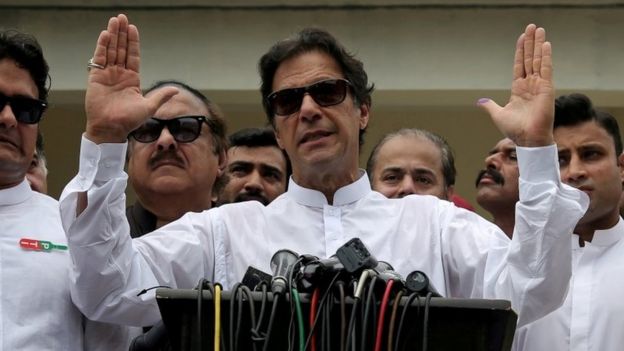
Cricket star-turned-politician Imran Khan, chairman of Pakistan Tehreek-e-Insaf (PTI), speaks after voting in the general election in Islamabad, July 25, 2018Image copyrightREUTERS
Image captionPakistan PM Imran Khan said Pakistan was not behind the suicide attack in February

This has long been a source of tension between the nuclear-armed neighbours as groups based in Pakistan have carried out deadly attacks on Indian soil. The suicide attack last month killed more than 40 central reserve policemen in Indian-administered Kashmir.

Tensions between the two sides escalated quickly. India carried out air strikes against what it said was a militant camp based in Pakistan and the latter retaliated with air raids of its own.

An Indian fighter jet was shot down in Pakistan-administered Kashmir and the pilot was captured. Two days later, Pakistan handed over the pilot to Indian officials establishing a fragile truce.

Source: The BBC

07/03/2019

Days after Pulwama, 1 killed, 29 injured in grenade blast inside bus in Jammu

The incident comes less than a month after over 44 CRPF personnel were killed and many injured on February 14 in Jammu and Kashmir’s Pulwama.

SNS Web | New Delhi | 

One person was killed and 29, including a woman injured in a blast after a grenade was tossed at a bus in the general bus stand in the heart of Jammu on Thursday. The condition of five injured is said to be serious.
The killed youth has been identified as a 17-year-old Mohammad Sharik of Haridwar in Uttrakhand.
Minister of State for Defence Subhash Bhamre said a local investigation has been initiated into the incident. He further said the government has given complete liberty to the forces to take all necessary steps.
The Jammu and Kashmir Police has been rushed to the site of the blast.
The Chinese grenade exploded in the bus at about 12 noon. The driver and conductor were among the injured rushed to the Government Medical College, Jammu. The injured include passengers belonging to Bihar, Punjab, Haryana, Uttrakhand, Jammu and the Kashmir valley.
Visuals from the blast site showed the damaged bus of the J&K Road Transport Corporation (JKSRTC) in which the grenade exploded.
The area has been cordoned off by the security personnel. Nature and the cause is being ascertained, police said.
Fifteen suspects have been rounded up for interrogation.
The grenade attack has coincided with the shifting of detained separatist Yasin Malik to the Jammu’s Kot-Bhalwal jail.
Police suspected the JeM outfit behind the attack. Some radicals had threatened of revenge during the recent communal tension here when about six cars were burnt.
K Vijay Kumar and KK Sharma,  both advisors to the Governor, visited the spot to take stock of the situation. The divisional commissioner, deputy commissioner and senior police and civil officers also visited the spot.
This is the third grenade attack in the bus stand during the past few months.
The blast comes at a time when Jammu and Kashmir is on a high alert following the heightened tensions between India and Pakistan in the wake of the Pulwama terror attack.
Former chief minister Mehbooba Mufti condemned the incident and called for unity to defeat terror elements in the state.
“I condemn this act of terror in the strongest possible terms. My prayers for speedy recovery of those injured. The perpetrators are out there to inflict pain and divide us. Our unity has to be our tool to defeat them,” Mufti tweeted.
The provincial president of National Conference, Devender Rana, visited the hospital to inquire about the wellbeing of injured persons.
The incident comes less than a month after over 44 CRPF personnel were killed and many injured on February 14 in one of the deadliest terror strikes in Jammu-Kashmir when a Jaish-e-Mohammad (JeM) suicide bomber blew up an explosive-laden vehicle near their bus in Pulwama district.
The bus was part of a convoy of 78 vehicles carrying around 2500 CRPF personnel from Jammu to Srinagar.
Source; The Statesman
25/02/2019

‘Give peace a chance’: After PM Modi’s ‘Pathan’ dare, Imran Khan says he ‘stands by’ his words on Pulwama

PM Modi said that he told him ‘let us fight against poverty and illiteracy’ and Khan gave his word saying he is a Pathan’s son, ‘but went back on it’.

SNS Web | New Delhi | 

Pakistan Prime Minister Imran Khan on Sunday asked his Indian counterpart Narendra Modi to “give peace a chance” and assured him that he “stands by” his words and will “immediately act” if New Delhi provides Islamabad with “actionable intelligence” on the Pulwama attack.


Khan’s remarks came a day after PM Modi in a rally in Rajasthan, recalled his conversation with the Pakistan PM during a congratulatory call after he became the country’s premier.

PM Modi had told him “let us fight against poverty and illiteracy” and Khan gave his word saying he is a Pathan’s son “but went back on it”.

“There is consensus in the entire world against terrorism. We are moving ahead with strength to punish the perpetrators of terrorism…The scores will be settled this time, settled for good…This is a changed India, this pain will not be tolerated…We know how to crush terrorism,” PM Modi further said.

A statement released by the Pakistan Prime Minister’s Office said, “PM Imran Khan stand by his words that if India gives us actionable intelligence, we will immediately act.”

PM Modi should “give peace a chance”, Khan said in the statement.

In his first statement issued since the February 14 attack, Pakistani Prime Minister Imran Khan had on Tuesday accused India of blaming his country “without evidence” and warned of retaliation against any military action by India.

However, he assured India that he would act against the perpetrators of the deadly Pulwama terror attack, carried out by Pakistan-based Jaish-e-Mohammad (JeM) terror group and said that the issue between the two countries can be solved through dialogue.

India had called Khan’s offer to investigate the attack if provided proof as a “lame excuse”.

The already sour relations between India and Pakistan have worsened over the past few weeks as New Delhi accused Islamabad of the Pulwama attack.

India has accused Islamabad’s spy agency ISI of being involved in the attack and has maintained that the terror group JeM is a “child of the Pakistan Army”.

Following the attack, India immediately withdrew the ‘Most Favoured Nation’ status granted to Pakistan and initiated steps to isolate the neighbouring country from the international community.

Earlier, India had also announced its decision to stop the flow of its share of water from the Beas, Ravi and Sutlej to Pakistan.

Prime Minister Narendra Modi had in many of his public speeches after the attack, said that the security forces have been given full freedom to decide the future course of action regarding the terrorist attack in Pulwama.

India’s neighbours, including Sri Lanka, Maldives, Nepal, Bangladesh, Afghanistan and Bhutan—and other countries like Saudi Arabia, UAE, Iran, Russia, Germany, Canada, UK, Australia and Canada came out in strong support of New Delhi following the terror attack.

Over 44 CRPF personnel were killed and many injured on February 14 in one of the deadliest terror strikes in Jammu-Kashmir when a Jaish-e-Mohammad (JeM) suicide bomber blew up an explosive-laden vehicle near their bus in Pulwama district.

The bus was part of a convoy of 78 vehicles carrying around 2500 CRPF personnel from Jammu to Srinagar.

Source: The Statesman
14/02/2019

20 CRPF jawans killed, over 45 injured in suicide blast in J-K’s Pulwama; JeM claims attack

This is the worst terror attack on security personnel since the Uri incident in September 2016 which left 18 soldiers dead.

SNS Web | New Delhi | 


CRPF DG RR Bhatnagar said the convoy carrying the soldiers was travelling from Jammu to Srinagar when the attack occurred. Terrorists continued to fire at the convoy even after the bus was completely charred. The convoy consisted of 70 vehicles carrying about 2500 soldiers. Two CRPF vehicles were damaged in the attack.

The attack has reportedly happened on a heavily guarded highway.

The attack is being taken seriously as the highway particularly in South Kashmir is properly sanitised before movement of convoys of security forces. The Road Opening Parties (ROPs) also conduct thorough checking of the road for possible IEDs.

The DGP of J-K Police, Dilbag Singh, confirmed that it was a suicide attack in which an explosive-laden car was rammed into the CRPF bus.

The bus was completely destroyed and mutilated bodies of the jawans lay scattered on the road that also bore blood stains.

At least 13 jawans were killed on the spot and others succumbed in the hospital.

The injured jawans have been rushed to the 92 Base hospital of the Military and CRPF hospital.

Pakistan backed Jaish-e-Mohammed has claimed responsibility for the Pulwama terror attack, in a text message to Kashmiri News Agency GNS.

A spokesman of JeM claimed that the attack was carried out by their activist Aadil Ahmad of Gundi Bagh in Pulwama.

Former chief minister Mehbooba Mufti condemned the gruesome attack.Former chief minister Omar Abdullah also condemned the attack and extended his condolences to the families of the bereaved.


The convoy was held up in Jammu for the past six days due to the closure of the Jammu-Srinagar highway because of snow and landslides and proceeded to Srinagar this morning only after the highway was opened for one way traffic.

The National Investigation Agency (NIA) is likely to be assigned the investigation of the attack.

This is the worst terror attack on security personnel since the Uri incident in September 2016.

Eighteen soldiers were killed and several others injured when heavily-armed militants stormed a battalion headquarters of the Indian Army in North Kashmir’s Uri town.

Source: The Statesman
Law of Unintended Consequences

continuously updated blog about China & India

ChiaHou's Book Reviews

continuously updated blog about China & India

What's wrong with the world; and its economy

continuously updated blog about China & India