Chindia Alert: You’ll be Living in their World Very Soon
aims to alert you to the threats and opportunities that China and India present. China and India require serious attention; case of ‘hidden dragon and crouching tiger’.
Without this attention, governments, businesses and, indeed, individuals may find themselves at a great disadvantage sooner rather than later.
The POSTs (front webpages) are mainly 'cuttings' from reliable sources, updated continuously.
The PAGEs (see Tabs, above) attempt to make the information more meaningful by putting some structure to the information we have researched and assembled since 2006.
BEIJING (Reuters) – China announced on Wednesday that its parliament will open a key annual session on May 22, signalling that Beijing sees the country returning to normal after being reduced to a near-standstill for months by the COVID-19 epidemic.
During the gathering of the National People’s Congress in the capital, delegates will ratify major legislation, and the government will unveil economic targets, set defence spending projections and make personnel changes. The ruling Communist Party also typically announces signature policy initiatives.
The session was initially scheduled to start on March 5 but was postponed due to COVID-19, which has infected nearly 83,000 people and killed more than 4,600 on the mainland after emerging late last year in the central city of Wuhan.
As the epidemic has subsided, economic and social life gradually returned to normal, making it possible for the congress to convene, the official Xinhua news agency quoted the standing committee of the NPC, the legislature’s top decision-making body, as saying.
The committee also appointed Huang Runqiu as the new minister for ecology and environment, a post vacated when predecessor Li Ganjie became deputy Communist Party chief for Shandong province earlier this month, Xinhua reported.
Tang Yijun was also named as the new justice minister to replace Fu Zhenghua, who has reached the retirement age of 65 for ministers.
The Chinese People’s Political Consultative Conference (CPPCC), an advisory body to parliament, has proposed starting its annual session a day before the parliamentary session opens.
Analysts expect China to roll out additional fiscal stimulus in order to cushion the blow from COVID-19, which has developed in to a worldwide pandemic that some fear will trigger a severe global recession.
China’s economy contracted for the first time on record during the January-March period, when the government imposed severe travel and transport restriction to curb the spread of the epidemic.
Parliament is also expected to discuss the anti-government protests in Hong Kong, amid growing speculation that Beijing take steps to strengthen its grip on the city.
It is unclear how long parliament and its advisory body will meet for this time, and people familiar with the matter have told Reuters that this year’s annual sessions could be the shortest in decades due to COVID-19 concerns. Usually more than 5,000 delegates descend on Beijing from all over China for at least 10 days.
Beijing city plans to ease quarantine rules as early as Thursday, two sources familiar with the situation told Reuters, ahead of the key political meetings.
People arriving in the capital from other parts of China will no long have to be quarantined for two weeks unless they come from high-risk areas such as Heilongjiang in the north and some parts of Guangdong in the southeast, the sources said.
China has attacked Ms Meng’s arrest and the extradition process as a “political incident”. She denies all the charges against her.
What does Ms Meng’s lawsuit say?
Ms Meng’s claim – filed in British Columbia’s Supreme Court on Friday – seeks damages against the Royal Canadian Mounted Police (RCMP), Canadian Border Services Agency (CBSA) and the federal government for allegedly breaching her civil rights under Canada’s Charter of Rights and Freedoms.
She says CBSA officers held, searched and questioned her at the airport under false pretences before she was arrested by the RCMP.
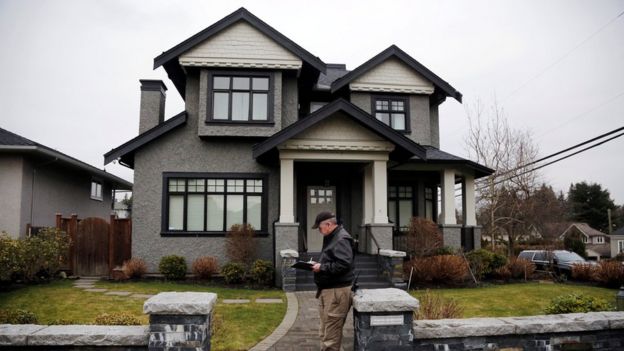
Image copyrightREUTERSImage caption Ms Meng has a property in Vancouver and is currently out on bail
Her detention was “unlawful” and “arbitrary”, the suit says, and officers “intentionally failed to advise her of the true reasons for her detention, her right to counsel, and her right to silence”.
Where are we in the extradition process?
Ms Meng, 47, will next appear in court on Wednesday, when it will be confirmed that Canada has issued a legal writ over her extradition to the US. A date for an extradition hearing will be set.
But this is still the early stages. A judge must authorise her committal for extradition and the justice minister would then decide whether to surrender her to the US.
There will be chances for appeal and some cases have dragged on for years.
The Meng Wanzhou case – how did we get here?
1 December: Ms Meng, the daughter of Huawei’s founder, is arrested while changing planes at Vancouver airport
7 December: Ms Meng first appears in court in Vancouver, where it is revealed she is accused of breaking US sanctions on Iran. China demands her release
10 December: Canadian citizens Michael Kovrig and Michael Spavor are arrested in China
11 December: Ms Meng is released on bail
28 January: US formally charges Ms Meng with fraud and Huawei with circumventing US sanctions on Iran and stealing technology from T Mobile
2 March: Canada says Ms Meng’s extradition can move forward but the process is expected to be long
What is Huawei accused of?
The US alleges Huawei misled the US and a global bank about its relationship with two subsidiaries, Huawei Device USA and Skycom Tech, to conduct business with Iran.
US President Donald Trump’s administration has reinstated all sanctions on Iran removed under a 2015 nuclear deal and recently imposed even stricter measures, hitting oil exports, shipping and banks.
It also alleges Huawei stole technology from T Mobile used to test smartphone durability, as well as obstructing justice and committing wire fraud.
In all, the US has laid 23 charges against the company.
Some Western nations are reviewing business with the firm over spying concerns, although Huawei has always maintained it acts independently.
How has China reacted?
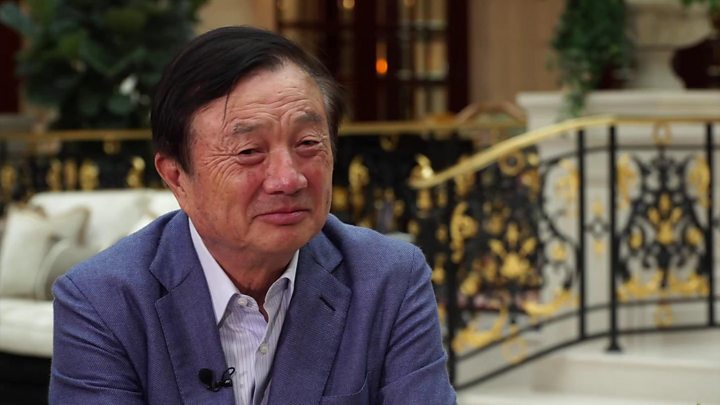
Media caption – Huawei founder Ren Zhengfei on the arrest of his daughter
The arrest has seriously strained relations between China, and the US and Canada.
Beijing says it is an “abuse of the bilateral extradition treaty” between Canada and the US, and has expressed its “resolute opposition” and “strong dissatisfaction” with the proceedings.
China also says the accusations against Huawei, the world’s second biggest smartphone maker by volume, are a “witch-hunt”.
Two Canadian citizens are thought to have been detained in China in retaliation for the arrest.
China and the US are also engaged in tough trade negotiations to end a major tariff dispute.




 CHINDIA ALERT: You'll be living in their world, very soon