Chindia Alert: You’ll be Living in their World Very Soon
aims to alert you to the threats and opportunities that China and India present. China and India require serious attention; case of ‘hidden dragon and crouching tiger’.
Without this attention, governments, businesses and, indeed, individuals may find themselves at a great disadvantage sooner rather than later.
The POSTs (front webpages) are mainly 'cuttings' from reliable sources, updated continuously.
The PAGEs (see Tabs, above) attempt to make the information more meaningful by putting some structure to the information we have researched and assembled since 2006.
GUBEI WATER TOWN, China (Reuters) – The mock Qing dynasty village nestled below the Great Wall would normally be teeming with tourists on Labour Day, but the thin crowds on Friday showed that while China’s coronavirus epidemic has subsided, people’s fears could take longer to fade.
During holidays, some 100,000 visitors a day would traipse round the quaint stone-paved streets of Gubei Water Town, 110 kilometres (68 miles) northeast of Beijing. Its marketing manager reckoned on getting just a tenth of that number this year.
“People have concerns about the virus and are unwilling to travel long distances,” said Guo Baorong. For a start, there will be no international tourists this time, he said, noting foreigners would normally make up around 15% of visitors.
About 70% of China’s tourist attractions had reopened as of Thursday, according to China’s Ministry of Culture and Tourism, but all sites have had to cap visitors to 30% of designed capacity.
More sites, including the Forbidden City in Beijing, were set to reopen Friday.
Staff at the entrance to Gubei Water Town checked visitors’ temperatures and health tracking codes. And inside, lines on the ground directed tourists to stand one meter apart and stores used ropes to keep crowds from forming. Like everywhere in China since the lockdowns were imposed to stem the epidemic, everyone wore masks.
Still, in places where tourists squeezed together as the streets narrowed, staff shouted at them to spread out.
Some tourists enjoyed the smaller crowds.
Xiao Chen, a 24-year-old student wearing traditional Chinese garb known as “Hanfu” came to Gubei to take pictures around ancient architecture.
“It’s good to come out of the city. There was barely anyone in Gubei Water Town yesterday, and even today, it’s not crowded,” she said.
The tranquility may not last. Room bookings jumped on Thursday after Beijing and nearby areas began easing coronavirus restrictions, with about 90% of accommodation now reserved.
“We were not expecting that many people to come in,” said Guo.
Patten says to watch out for any future attempts by Beijing to ‘undermine the rule of law and to corrupt the electoral process in the months ahead’
The plea comes as the ruling Conservative Party in Britain toughens up China policies
Chris Patten is an outspoken critic of the Chinese government’s handling of Hong Kong affairs. Photo: AFP
Britain’s last colonial governor of Hong Kong, Chris Patten, has asked the British government to watch out for Chinese attempts to interfere with the city’s affairs while the world grapples with the coronavirus pandemic.
He made the plea to Foreign Secretary Dominic Raab as the ruling Conservative Party toughens up China policies, amid what many party members see as Beijing’s deliberate failures to be transparent about the initial Covid-19 outbreaks.
The call also comes amid growing worry among Hong Kong’s pro-democracy activists, as police have rounded up dissidents and Beijing authorities have stepped up the rhetoric of national security concerns.
Patten, an outspoken critic of the Chinese government’s handling of Hong Kong affairs, said: “I hope we can … count on the British government to call out China for its breaches of the [Sino-British] Joint Declaration and to watch carefully for future attempts by Beijing to undermine the rule of law and to corrupt the electoral process in the months ahead.”
Wave of arrests of Hong Kong pro-democracy figures draws global criticism
The declaration provided for Hong Kong’s status quo until 2047.
The Foreign Office has not responded to an inquiry by the Post on Patten’s letter.
Citing their roles in unlawful protests, Hong Kong police rounded up at least 15 opposition camp activists earlier this month, including media tycoon Jimmy Lai Chee-ying and prominent barrister Martin Lee Chu-ming, known as the city’s “father of democracy”.
On Tuesday, a bipartisan group of US lawmakers wrote Secretary of State Mike Pompeo requesting that his department’s upcoming assessment of Hong Kong’s autonomy reflect a recent wave of arrests by the city’s authorities of pro-democracy activists.
Hong Kong police to respond with force to any Labour Day protests
30 Apr 2020
Patten also asked the British government to investigate the origin of the coronavirus.
“I would be grateful for your assurance that the British government will press for an expert mission to Wuhan and will encourage other countries to do the same,” he wrote, underscoring the need to “make sure that we know everything about the nature of the virus in order to fight it effectively. We also need to prevent anything similar happening in the future.”
On Wednesday, Britain’s ambassador to the US Karen Pierce backed calls for an investigation into the origins of the novel coronavirus and the response of the World Health Organisation.
“We need to learn after all these crises, just as we did after Ebola in 2014. We need to learn how we can always do things better,” she said.
The comments came after Britain’s foreign affairs parliamentary committee asked the government whether it plans to use international bodies to hold China to account over the Covid-19 pandemic.
Outbound flights from Beijing were 15 times higher on one travel site within half an hour of Beijing relaxing quarantine requirements on the city
The rebound in bookings spells some hope for online travel providers in China as the country emerges from a pandemic which saw widespread travel restrictions
Passengers arrive from a domestic flight at Beijing Capital Airport on March 27, 2020. Photo: AFP
Within an hour of Beijing downgrading its emergency response level, relaxing quarantine requirements for some arrivals to the Chinese capital city, travel bookings on some sites surged up to 15 times.
Thirty minutes after the announcement on Wednesday, bookings for outbound flights from Beijing were 15 times higher than before the announcement on Qunar, one of the biggest online travel service providers in China. Searches for travel packages and hotel bookings on the platform also increased three-fold, according to a Qunar report.
On Alibaba Group Holding‘s Fliggy travel platform, bookings for flight and trains heading in and out of Beijing increased 500 per cent and 300 per cent respectively one hour after the announcement, compared to the same time a day ago, according to a Fliggy report. Alibaba owns the South China Morning Post.
Bookings for flight and train tickets in Beijing for the upcoming Labour Day long weekend also increased more than 300 per cent and 160 per cent respectively on Chinese group buying site Meituan Dianping on Wednesday after the announcement compared to the day before, while searches for the attractions in the Beijing area on the platform increased almost three times from a week ago, according to Meituan.
“The surge in searches for travel in Beijing was because the lockdown measures in the city were the strictest in the country after work resumed,” said Jiang Xinwei, senior analyst with Analysys. “Consumption among residents was suppressed [during the lockdowns], so there is now a rebound in bookings.”
China’s online travel sites prepare for surge in domestic tourism
21 Mar 2020
The rebound in bookings spells some hope for online travel providers in China as the country gradually emerges from a pandemic which the Chinese government responded to by implementing strict quarantine measures, shutting down tourist attractions and suspending group tours.
Beijing-based consultancy Analysys estimates that China’s national tourism economy lost at least 10 billion yuan (US$1.4 billion) a day on average during the outbreak, with travel service providers like Qunar and Ctrip overloaded with millions of booking changes as well as cancellation and refund requests.
The relaxation of travel restrictions in and out of Beijing also comes ahead of a
, which starts on Friday and is the first extended public holiday after Lunar New Year in late January.
In November, the Chinese government lengthened the holiday from the original three days to five to stimulate consumption and encourage travelling amid a slowing economy weighed down by the US-China trade war.
Some cities, such as Huzhou in eastern China’s Zhejiang province and Kunming in southwestern province Yunnan, have issued travel vouchers to stimulate consumption for the tourist industry, according to the Ministry of Culture and Tourism.
Ctrip estimated that there would be more than 86 million domestic tourists during the long weekend – more than double the number of travellers seen during the Ching Ming Festival in April, which recorded 43 million tourists, according to the China Tourism Academy.
However, Jiang said the rebound this week does not mean the Chinese travel industry is out of the red. “The travel industry will recover partially during the public holiday, but this will not be more than 60 per cent [of levels before the pandemic],” he said. “The government needs to do more to signal that travelling is safe and encourage residents to do so.”
Beijing’s Chaoyang district remains the last high-risk area in China, with virus preventive measures continuing to impact on travel and shopping plans
China faces the dilemma of preventing a re-emerge of the pandemic, while also pushing to get its economy back to normal
China’s continued pandemic prevention measures, coupled with still hesitant consumer demand, will inevitably lead to persistent limitations on the nation’s economic recovery, analysts said. Photo: Bloomberg
After nearly three months of being quarantined by herself in Beijing, Mary Zhao was looking forward to the upcoming long weekend at the start of May to be able to finally reunite with her parents.
But Zhao was forced to abandon her plan for the Labour Day holidays as Beijing’s upmarket Chaoyang district, where she lives, remains the only high-risk zone for coronavirus in the entire country.
If she travelled the five hours by car, or two hours via bullet train, to the neighbouring Hebei province, she would first have to undergo a 14-day quarantine before seeing her parents. Her parents would also have the same two week quarantine to look forward to once they returned home if they came to visit their daughter in Beijing.
These strict controls to prevent a re-emergence of the coronavirus outbreak are making a return to normal life impossible for many, and mean the final economic and social cost
from China’s draconian preventive measures could be much larger than expected.
Wuhan declares ‘victory’ as central Chinese city’s last Covid-19 patients leave hospital
It underscores the dilemma facing China’s leaders on how to balance the need to
and to avoid a fresh outbreak. On the surface, China may be able to declare victory as even Wuhan, the city where the virus was first detected, announced that the last Covid-19 patient had left hospital on Sunday. But fears of a renewed outbreak have kept the country’s cinemas and most schools closed, with travel between provinces discouraged.
China’s national borders also remain largely closed, with flights being cut to a minimum, and a mandatory 14-day quarantine for every arrival. In the number of places where new cases have been reported, quarantine requirements have been tightened, including Harbin and a few other cities near the border with Russia.
Chaoyang, the home to one of Beijing’s main business districts and most foreign embassies, changed its risk rating to high from low in the middle of April after three new cases were reported, dealing a fresh blow to the district’s
and forcing many of the 3.5 million residents to cancel their travel plans.
On the outskirts of Beijing, near Beijing Capital International Airport, returning migrant workers to Picun village were ordered to stop at entrance and could only be escorted inside by their landlord, with many villages and residential compounds remaining closed to outsiders.
In the high-end shopping district of Guomao, some shops also remain closed as there are few potential customers, while over in the popular Sanlitun area, metal barriers restrict access and temperature checkpoints are still required.
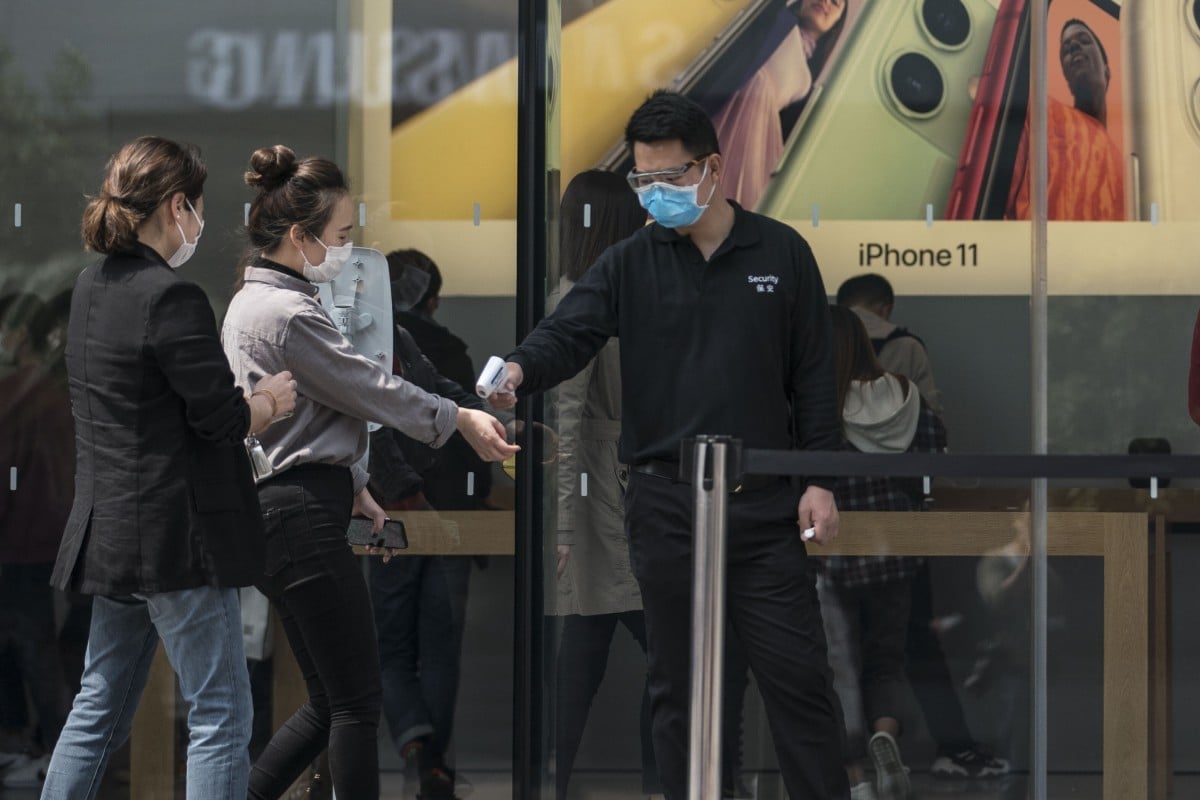
The landmark Apple Store in the popular Taikoo shopping centre is open, but with limited customers allowed inside, there are long queues outside. Customers are required to scan a QR code to check their movements over the last few days before entering.
Coronavirus: More schools reopen in China for students preparing for university entrance exams
“Why do I have to spend 20 minutes just to get into the Apple Store? The sun has almost melted me down,” one visitor complained to the security guards at the front of the shop.
China’s continued pandemic prevention measures, coupled with still hesitant consumer demand, will inevitably lead to persistent limitations on the nation’s economic recovery, analysts said.
Ernai Cui, an economist at research firm Gavekal Dragonomics, said on Monday that China’s cautious approach to lifting restrictions “points to a weak second quarter for consumer services”, adding additional pressure to the economic recovery.Mao Zhenhua, a researcher at the China Institute of Economics at Renmin University, said China’s preventive measures will inevitably be a drag on production, employment and exports.



 CHINDIA ALERT: You'll be living in their world, very soon