Archive for ‘launches’

05/05/2020

China launches manned spacecraft prototype with new Long March 5B rocket

  • Modified version of country’s most powerful rocket carries next-generation capsule designed to take astronauts to its planned space station
  • It will be able to launch and land with three crew members and up to 500kg of cargo, according to state media
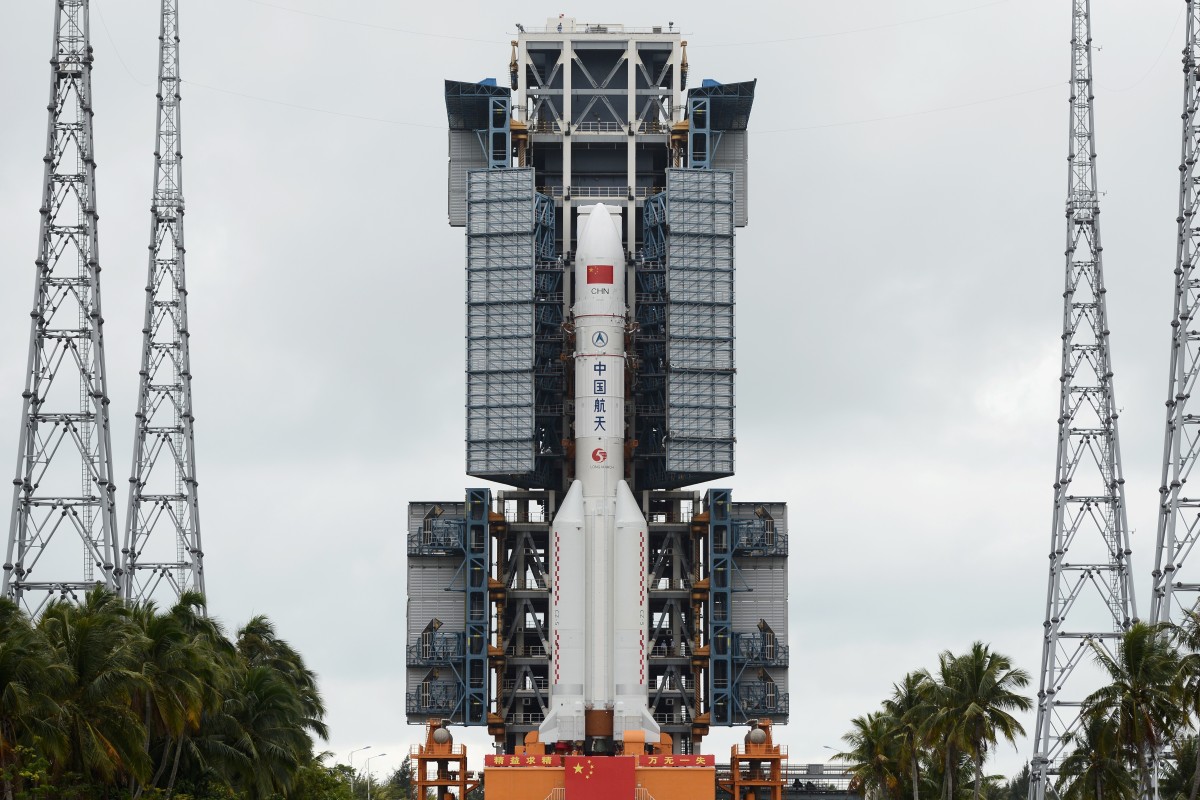
China launched a new version of its heavy-lift Long March 5 rocket on Tuesday. Photo: Reuters

China successfully launched a prototype of its next-generation manned spacecraft – without astronauts – along with a new version of its heavy-lift Long March 5 rocket on Tuesday, its space agency said.

The Long March 5B rocket was launched into low-Earth orbit from the Wenchang Satellite Launch Centre on Hainan Island in the country’s south.

The launch marks a significant step forward for China’s two big space exploration ambitions – building a space station and a mission to Mars.

A modified version of China’s most powerful rocket, the Long March 5B is 53.7 metres (176 feet) tall. It will carry the next-generation crew capsule prototype designed to replace the Shenzhou spacecraft, to transport astronauts to its planned space station in low-Earth orbit.

China aims to launch the core module of that space station designed for three crew members, the Tianhe, in 2021. Beijing has been planning to build its own space station for decades as an alternative to the International Space Station, from which China has been excluded by the United States over security concerns.
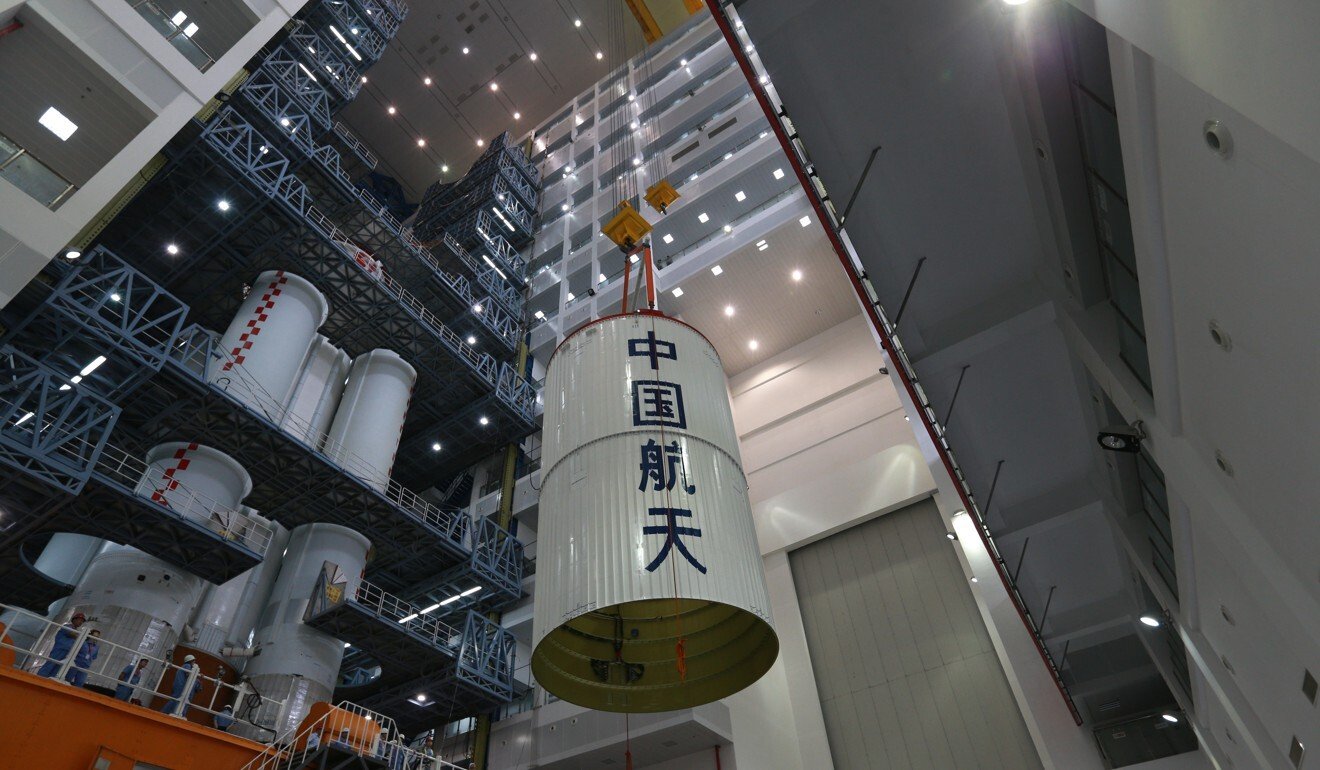
China’s space station project has been delayed by problems with its heavy-lift rockets. Photo: Xinhua
The prototype capsule has a different configuration to Shenzhou’s and it will be able to launch and land with three astronauts on board as well as up to 500kg of cargo, according to state news agency Xinhua. That will mean it can be used to transport research specimens and hardware from the space station back to Earth.

While the Shenzhou can ferry three astronauts, the new capsule design will be able to accommodate up to six crew members and, unlike the Shenzhou, it will be capable of carrying them to the moon, according to Chinese media reports.

Its systems, performance in orbit and parachute deployment are among the areas that will be put to the test during the launch.

Why China’s next Long March 5 rocket mission will be about restoring national pride

14 Dec 2019

The long-anticipated space station project has been delayed by problems in the development of heavy-lift rockets to carry the modules. In 2017, an oxygen supply problem caused the failure of the second Long March 5 launch, and it plunged into the Pacific Ocean shortly after take-off. But in December it successfully carried a Shijian-20 satellite into orbit, while the liquid oxygen-liquid hydrogen engines used in both the Long March 5 and 5B rockets passed testing in January.

China’s other space ambitions include a Mars probe, and landing astronauts on the moon within the next decade. For the Mars mission, the unmanned orbiter and rover Tianwen-1 will be launched by the Long March 5 and it is expected to take up to seven months for the probe to reach the red planet. China would be the third country to do so – after the United States and the Soviet Union.

Zhang Kejian, head of the China National Space Administration, said China was on track to launch the mission this year, with July the likely launch date.

Source: SCMP

01/05/2020

China launches mission to determine height of Mount Everest once and for all

  • Project will examine whether earthquake and changing wind speeds have affected peak’s snowcap
  • Survey team hoping the BeiDou satellite navigation system and other Chinese technology can help them find the answer
A Chinese team is preparing to determine the exact height of Mount Everest. Photo: AFP
China is sending a surveying and mapping team to the summit of Mount Everest this month in a bid to end the long-running debate over the precise height of the world’s tallest mountain.
The mission was announced on Wednesday at one of the mountain’s base camps in Tibet, where a team of 53 surveyors has been making technical preparations since March 2. The team will use China’s BeiDou navigation satellite system and Chinese surveying instruments for the project.
Mount Everest – known as Sagarmatha in Nepal and Qomolangma in Tibet – lies in the Himalayas on the border between China and Nepal. The two countries have long disputed whether measurements of the mountain should include its snowcap or be limited to the rock base.
Nepal suspends Everest permits over coronavirus
In 2005, a Chinese expedition assessed the peak and measured the height from both the rock base and from the top of the snowfall. The result, a rock height of 8,844.43 metres (29,017.2 feet), was declared by China to be the most accurate and precise measurement to date.

Nepal has long held that Everest’s snowcap should be included, putting the iconic peak at 8,848 metres, a height which is widely accepted. However, geologists believe the snowcap may have shrunk by several centimetres after the magnitude 8.1 earthquake in 2015. Changing wind speeds are also believed to have affected it.

Chinese President Xi Jinping visited Nepal in October. Photo: EPA-EFE
Following a state visit to Nepal by Chinese President Xi Jinping in October, the two countries agreed to jointly launch a scientific research project to determine the exact height of Everest, recognising the peak as “an eternal symbol of the friendship between the two countries”.

China’s natural resources ministry said the project indicated a new step in the friendship and highlighted the historical significance of the mission, which coincides with the 60th anniversary of the first Chinese ascent of the mountain’s north side as well as the 45th anniversary of China’s first precise measurement of the peak.

The results of the survey will be used for geodynamics research and the precise depth of the summit’s snowcap, meteorological and wind speed data will offer first-hand materials for glacier monitoring and biological environment protection.

In a separate development, China Mobile said on Thursday that the entire peak now had 5G coverage.
In a joint project with Huawei, 5G antennas were installed at the mountain’s advance base camp, at a height of 6,500 metres. Antennas were installed earlier in April at the lower base camp, at 5,300 metres and at 5,800 metres.
Source: SCMP
15/04/2020

Coronavirus: China launches study into asymptomatic cases and shared immunity

  • Residents of nine regions, including Wuhan, Beijing and Shanghai, to be sampled using both nucleic acid and antibody tests, state media reports
  • Research ‘very important as it will help us to direct our countermeasures in the future’, molecular virologist says
China is using dual testing to determine how many people have been infected with Covid-19 but recovered without showing symptoms. Photo: AP
China has begun a major survey to determine how many people might have been infected with the coronavirus and then recovered without ever showing symptoms, while also assessing immunity levels within different communities, state media reported.

The research will be conducted in six provinces, including Hubei which was the focus of the initial outbreak, as well as Beijing, Shanghai and Chongqing.

Wuhan

, the capital of Hubei and home to about 60 per cent of all infections reported in mainland China, is taking the lead in the study, which involves giving both nucleic acid and antibody tests to 11,000 of its 11 million residents, state news agency Xinhua reported on Wednesday.

Health workers collected throat swabs and blood samples from about 900 people randomly selected from eight subdistricts of the city on Tuesday, Ding Gangqiang, head of the Wuhan epidemiological survey team, was quoted as saying.

“The purpose is to learn about the immunity level in communities and provide scientific support on how we should adjust our disease control strategies,” he said.

Professor Lu Hongzhou, a specialist in infectious diseases who heads the Shanghai Public Health Clinical Centre where Covid-19 patients are being treated, said he supported the research though the collection of samples had yet to start in the city.

“We haven’t received notification from the top [to start],” he said. “The number of infections [in Shanghai] is not very big, but I think we’d better do this so as to have an idea of the scale of asymptomatic carriers.”

Professor Jin Dong-yan, a molecular virologist at the Li Ka Shing Faculty of Medicine at the University of Hong Kong, said that the use of both nucleic acid and antibody tests would enable scientists to determine those people who had been infected but recovered without medical aid and without showing symptoms.

The study into asymptomatic infections got under way in Wuhan in Tuesday. Photo: Simon Song
If a person tested positive in a nucleic acid test, it meant they were carrying the virus, and if positive in an antibodies test, it meant that they had contracted the virus and had recovered, he told the South China Morning Post.

“This is very important as it will help us to direct our countermeasures in the future,” Jin said.

“If we find, say 60 per cent, of the population has acquired immunity, then lockdowns will no longer be meaningful. If it turns out that there are many people with a high viral load but without symptoms, then we should be on high alert and take stricter measures.

“For people in Hubei, the tests can also save them from discrimination when they get back to work – those who prove to have developed immunity are very unlikely to get infected [again] for at least a year,” he said.

Wuhan hotel owners say they’re on the brink of going bust

15 Apr 2020
Beijing began adding asymptomatic cases

to the nation’s daily infections tally at the start of April amid concerns that such people could trigger a second outbreak once the widespread lockdowns in cities like Wuhan and elsewhere were lifted.

China reported 103 new coronavirus infections on Wednesday, of which 39 were imported. Of the total, 57 people had no symptoms, including three of the imported cases.

Since the outbreak began, China has reported 82,295 cases, of which 95 per cent have recovered and been discharged from hospital.

Source: SCMP

10/03/2020

China launches new BeiDou navigation satellite

(EyesonSci)CHINA-XICHANG-SATELLITE-LAUNCH (CN)

China launches a new satellite of the BeiDou Navigation Satellite System (BDS) from the Xichang Satellite Launch Center in southwest China’s Sichuan Province, March 9, 2020, only one step away from completing the whole global system. The satellite, the 54th of the BeiDou family, was sent into a geostationary orbit as planned by a Long March-3B carrier rocket. The newly launched satellite is the second geostationary earth orbit satellite of the BDS-3 system, and the last one is expected to be launched in May. (Photo by Guo Wenbin/Xinhua)

XICHANG, March 9 (Xinhua) — China launched a new satellite of the BeiDou Navigation Satellite System (BDS) from the Xichang Satellite Launch Center in southwest China’s Sichuan Province at 7:55 p.m. Monday (Beijing Time), only one step away from completing the whole global system.

The satellite, the 54th of the BeiDou family, was sent into a geostationary orbit as planned by a Long March-3B carrier rocket.

China began to construct its navigation system, named after the Chinese term for the Big Dipper constellation, in the 1990s and started serving the Asia-Pacific Region in 2012. At present, all the first generation BDS-1 satellites have ended operations, and a total of 54 BDS-2 and BDS-3 satellites have been sent into space.

Compared with other navigation systems in the world, the design of the BDS constellation is unique, including medium earth orbit, inclined geosynchronous earth orbit and geostationary earth orbit satellites.

The BDS-3 system will consist of a total of 30 satellites, including 24 medium earth orbit satellites, three geostationary earth orbit satellites and three inclined geosynchronous earth orbit satellites.

The newly launched satellite is the second geostationary earth orbit satellite of the BDS-3 system, and the last one is expected to be launched in May.

The satellite and the carrier rocket were developed by the China Academy of Space Technology (CAST) and the China Academy of Launch Vehicle Technology, respectively.

Space engineers have overcome difficulties during the novel coronavirus epidemic to ensure the success of the mission.

Monday’s launch was the 327th mission of the Long March rocket series.

The new satellite has the most functions and signals, the largest size and the longest designed life span among all the BDS-3 satellites, said Chen Zhonggui, chief designer of BDS-3 satellites from CAST.

The satellite is based on the Dongfanghong-3B platform, currently one of the largest satellite platforms being used in China, and can carry more fuels to ensure its long life, said Chen.

The satellite has integrated the functions of navigation and communication. The accuracy of dynamic positioning can reach the decimeter level, according to Liu Tianxiong, deputy chief designer of BDS-3 satellites.

It can provide services for the driverless vehicles, accurate berthing of ships, as well as takeoff and landing of airplanes. It will be widely used in the fields of communication, electric power, finance, mapping, transportation, fishery, agriculture and forestry.

The ability of short message communication has been improved 10 times on this satellite. Users can send a message of over 1,000 Chinese characters at one time as well as pictures via the satellite, quite useful in emergencies.

The satellite’s ability to receive signals has also been greatly improved, which could help miniaturize users’ terminals, said Pan Yuqian, one of the satellite’s designers.

China aims to complete the construction of the BDS constellation in May and provide high-precision, reliable positioning, navigation and timing services anywhere in the world.

Source: Xinhua

27/12/2019

China launches heaviest satellite to test key technologies

CHINA-HAINAN-LONG MARCH-5-LAUNCH (CN)


Long March-5 Y3 blasts off from Wenchang Space Launch Center in south China’s Hainan Province, Dec. 27, 2019. The rocket, coded as Long March-5 Y3, blasted off from the coastal launch center at 8:45 p.m. (Beijing time), carrying the Shijian-20 technological experiment satellite weighing over eight tonnes, the heaviest and most advanced communications satellite of the country. About 2,220 seconds later, the satellite was sent into its planned orbit. (Xinhua/Yang Guanyu)

by Xinhua writers Quan Xiaoshu, Yu Fei

WENCHANG, Hainan, Dec. 27 (Xinhua) — Aboard the third Long March-5 rocket, China’s largest carrier rocket, Shijian-20, a new technology test and verification satellite, successfully entered its orbit Friday night.

The rocket, coded as Long March-5 Y3, blasted off from the Wenchang Space Launch Center in south China’s Hainan Province at 8:45 p.m. (Beijing time).

Shijian-20, weighing more than eight tonnes, is the country’s heaviest and most advanced communications satellite in geosynchronous orbit, according to its maker, the China Academy of Space Technology (CAST) under the China Aerospace Science and Technology Corporation (CASC).

It will carry out orbit experiments for a series of key technologies, the CAST said in a press release.

It will demonstrate in orbit its heat transfer technology based on cryogenic loop heat pipes, an efficient thermal control device for space applications, to lay the foundation for the development of highly sensitive space probes.

The satellite will test the controllable deformation of shape memory polymers, a type of smart material that can switch between temporary shapes, to pave the way for the development of large variable space structures.

It will also carry out satellite-ground communication tests using Q/V bands, which lie between 33-75 GHz, within the extremely high frequency (EHF) area of the radio spectrum. These frequencies are used mainly for satellite communications.

“The major way to improve the satellite communication capacity is to expand the bandwidth of available frequency bands. If we liken the geostationary orbit to an expressway, which is now the most crowded in space, the use of Q/V bands will help to widen the expressway by four to five times,” said Li Feng, chief designer of the satellite with the CAST.

The test is key to the development of the next generation of high throughput satellites capable of delivering 1Tbps bandwidth for ultrafast speeds, he said.

Shijian-20 has the largest solar wings among all China’s satellites, with the total wingspan 10 meters wider than that of a Boeing 737 aircraft.

The solar wings will unfold twice, the first time after the satellite enters its orbit and the second after it flies around the orbit for about a week. The increase of the solar wing area will supply the satellite with abundant power.

The satellite adopts a hybrid propulsion system. Chemical propulsion is powerful but inefficient, and is used in rapid orbit change or satellite attitude adjustment to send it to the planned orbit as soon as possible. Electric propulsion is more precise and efficient but less powerful, which is suitable for long-term delicate adjustments in orbit.

Electric propulsion is also a preferred technology for future deep space exploration. Missions to explore Mars, Jupiter and asteroids are all too far away from Earth to be fulfilled by chemical propulsion alone, as it is impossible to bring the amount of fuel needed.

Shijian-20 will also test the adaptability of the DFH-5 satellite platform, which may serve the needs of high-capacity satellites for high orbit communications, microwave remote sensing, optical remote sensing, space scientific exploration, in-orbit service and other purposes in the next 20 years.

“With the government’s consistent support for the communications satellite industry in the past decades, we have developed the DFH-3 and DFH-4 satellite platforms, making China one of the few countries in the world that can independently develop large communications satellites and provide in-orbit commercial services,” said Hao Yanyan, product assurance manager of Shijian-20 with the CAST.

So far, there are more than 20 communications satellites based on the DFH-4 platforms running stably in orbit.

To meet the pressing needs of economic development, the research and development of the DFH-5 platform started in 2010.

According to the design, the takeoff weight of a satellite based on the DFH-5 platform can reach eight to nine tonnes, and its payload capacity 1,500 to 1,800 kg. The power for the whole satellite is more than 28 kilowatts, while the power for its payload above 18 kilowatts.

“According to these technical indicators, a satellite based on the DFH-5 platform in orbit can provide services equivalent to that of two or three satellites on the DFH-4 platform,” Hao said.

The new technologies verified by Shijian-20 will further promote the development of new satellites, especially the high throughput communications satellite and high resolution remote sensing satellite, which is of great significance to the progress of China’s space technology, Li said.

Source: Xinhua

20/09/2019

China launches new remote-sensing satellites

(SCI-TECH)CHINA-JIUQUAN-SATELLITES-LAUNCH (CN)

A Long March-11 carrier rocket carrying five new remote-sensing satellites blasts off from the Jiuquan Satellite Launch Center in northwest China’s Gansu Province, Sept, 19, 2019. Five new remote-sensing satellites were sent into planned orbit on Thursday. The satellites belong to a commercial remote-sensing satellite constellation project “Zhuhai-1,” which will comprise 34 micro-nano satellites. (Photo by Wang Jiangbo/Xinhua)

JIUQUAN, Sept. 19 (Xinhua) — Five new remote-sensing satellites were sent into planned orbit from the Jiuquan Satellite Launch Center in northwest China’s Gobi Desert Thursday.

The five satellites were launched by a Long March-11 carrier rocket at 2:42 p.m. (Beijing Time).

The satellites belong to a commercial remote-sensing satellite constellation project “Zhuhai-1,” which will comprise 34 micro-nano satellites, including video, hyperspectral, and high-resolution optical satellites, as well as radar and infrared satellites.

The carrier rocket was developed by the China Academy of Launch Vehicle Technology, and the satellites were produced by the Harbin Institute of Technology and operated by the Zhuhai Orbita Aerospace Science and Technology Co. Ltd.

Thursday’s launch was the 311th mission for the Long March series carrier rockets.

The newly launched satellites comprise four hyperspectral satellites with 256 wave-bands and a coverage width of 150 km, and a video satellite with a resolution of 90 centimeters.

The Zhuhai-1 hyperspectral satellites have the highest spatial resolution and the largest coverage width of their type in China.

The data will be used for precise quantitative analysis of vegetation, water and crops, and will provide services for building smart cities, said Orbita, the largest private operator of hyperspectral satellites in orbit.

The company aims to cooperate with government organizations and enterprises to expand the big data satellite services.

Source: Xinhua

30/07/2019

Punjab: India state launches ‘gun for plants’ scheme


A man poses with plant saplings before applying for a gun licenseImage copyright COURTESY: CHANDER GAIND
Image caption Applicants for gun licenses must plant at least 10 saplings and submit ‘selfies’ as proof

Guns and plant saplings are an odd combination – but in India’s northern Punjab state, the two are now linked.

For a month now, applicants in the state’s Ferozepur district have had to plant at least 10 saplings before applying for gun licences.

“Punjabis are mad about cars, weapons and mobiles. Let them be mad about plantations too,” District Commissioner Chander Gaind told the BBC.

Mr Gaind said applicants would have to submit selfies with the saplings.

“With roads being widened at a [fast] rate, trees are being cut in very large numbers, so this was the need of the hour,” he added.

With 360,000 licensed gun holders, Punjab has the third largest number of licenses in India, government data shows.

But a selfie with a sapling does not guarantee one of the much sought after licences. It merely means the application will be “considered” for processing.

The order was issued on 5 June to coincide with world environment day, but has only now picked up traction in local media as more people have started complying.

Mr Gaind says they have received at least 100 applications – along with selfies – since the order was passed.

But simply planting saplings and taking selfies with them is not enough – applicants also have to submit follow-up selfies a month later, proving that they are nurturing the plants.


Source: The BBC
07/07/2019

Lhasa launches 80 new energy buses to protect environment

LHASA, July 6 (Xinhua) — Eighty buses using new energy have been put into use Saturday morning in Lhasa, the capital city of China’s southwest Tibet Autonomous Region, which will help reduce vehicle exhaust emissions and further improve the local air quality.

The new buses are all plug-in hybrid electric vehicles, equipped with Tibetan-Mandarin bilingual station announcements, driving monitoring and management systems, and auto-alarms, according to the city’s bus operation company.

The company purchased 110 new energy buses after the city’s 104 old buses reached their service lives. The other 30 buses are scheduled to be put into operation by the end of this month. By then, Lhasa will have 422 new energy buses, accounting for more than 80 percent of the city’s total buses.

“Our goal of vigorously promoting new energy vehicles is to implement the low-carbon and green way of traveling, to reduce greenhouse gas emissions, and to protect the clear water and blue sky of the snowy plateau,” said Gogyi, general manager of the company.

Lhasa plans to replace its old buses with new energy ones by batches, and all of the city’s buses are expected to be powered by new energy by 2021, said Gogyi.

Currently, Lhasa has 522 buses and 41 bus routes, covering the main urban areas, suburbs and surrounding counties, making it more and more convenient for locals to travel by public transportation.

Source: Xinhua

25/06/2019

China launches new BeiDou satellite

BEIJING, June 25 (Xinhua) — China sent a new satellite of the BeiDou Navigation Satellite System (BDS) into space from the Xichang Satellite Launch Center in Sichuan Province at 2:09 a.m. Tuesday.

Launched on a Long March-3B carrier rocket, the satellite was sent to the inclined geosynchronous earth orbit. It is the 46th satellite of the BDS satellite family and the 21st satellite of the BDS-3 system.

The design of the BDS constellation is unique, including medium earth orbit (MEO), geostationary earth orbit (GEO) and inclined geosynchronous earth orbit (IGEO) satellites.

So far, there are already 18 MEO BDS-3 satellites, one GEO BDS-3 satellite, and two IGEO BDS-3 satellites sent into space.

After in-orbit tests, the new satellite will work with those BDS satellites already in orbits to improve the coverage and positioning accuracy of the system.

The new satellite and the carrier rocket were developed by the China Academy of Space Technology and the China Academy of Launch Vehicle Technology under the China Aerospace Science and Technology Corporation.

The launch was the 307th mission for the Long March series of carrier rockets.

Source: Xinhua

01/04/2019

China launches new data relay satellite

CHINA-XICHANG-NEW DATA RELAY SATELLITE-LAUNCH (CN)

The Tianlian II-01 satellite is launched by a Long March-3B carrier rocket at the Xichang Satellite Launch Center in southwest China’s Sichuan Province, on March 31, 2019. China sent the new data relay satellite into orbit from the Xichang Satellite Launch Center late Sunday night. The Tianlian II-01 satellite was launched at 11:51 p.m. Beijing Time by a Long March-3B carrier rocket. As the first satellite to constitute China’s second-generation data relay satellite network, the Tianlian II-01 will provide data relay, measurement and control, transmission services for manned spacecraft, satellites, carrier rockets and other non-spacecraft users. (Xinhua/Guo Wenbin)

BEIJING, April 1 (Xinhua) — China sent a new data relay satellite into orbit from the Xichang Satellite Launch Center in southwest China’s Sichuan Province late Sunday night.

The Tianlian II-01 satellite was launched at 11:51 p.m. Beijing Time by a Long March-3B carrier rocket.

As the first satellite to constitute China’s second-generation data relay satellite network, the Tianlian II-01 will provide data relay, measurement and control, transmission services for manned spacecraft, satellites, carrier rockets and other non-spacecraft users.

The Tianlian II network will be markedly more advanced in mission planning, system management and operations than the first-generation network composed of Tianlian I satellites.

The new network, with faster data transfer and higher multi-objective service capability, will play an important role in improving the transmission promptness, in-orbit security and mission flexibility for medium- and low-Earth orbiting satellites and manned spacecraft.

The satellite is developed by the China Academy of Space Technology under the China Aerospace Science and Technology Corporation.

The launch marks the 301st mission of the Long March carrier rocket series.

Source: Xinhua

Law of Unintended Consequences

continuously updated blog about China & India

ChiaHou's Book Reviews

continuously updated blog about China & India

What's wrong with the world; and its economy

continuously updated blog about China & India