Chindia Alert: You’ll be Living in their World Very Soon
aims to alert you to the threats and opportunities that China and India present. China and India require serious attention; case of ‘hidden dragon and crouching tiger’.
Without this attention, governments, businesses and, indeed, individuals may find themselves at a great disadvantage sooner rather than later.
The POSTs (front webpages) are mainly 'cuttings' from reliable sources, updated continuously.
The PAGEs (see Tabs, above) attempt to make the information more meaningful by putting some structure to the information we have researched and assembled since 2006.
Supreme Court dismisses new petition on verifying all votes with VVPAT, says ‘let country elect its government’
INDIAUpdated: May 21, 2019 14:54 IST
HT Correspondent
Hindustan times, New Delhi
Calling the petition a “nuisance”, the court said, “We won’t entertain such a plea over and over again.(HT Photo)
The Supreme Court on Tuesday dismissed a new petition that sought matching of all voter verifiable paper audit trail (VVPAT) slips with electronic voting machines (EVMs) during the counting of votes on May 23.
Calling the petition a “nuisance”, the court said, “We won’t entertain such a plea over and over again. Can’t come in the way of people electing their representatives. Let country elect its government.”
A vacation bench headed by Justice Arun Mishra refused to entertain the plea filed by a Chennai-based organisation ‘Tech for All’ saying that a larger bench headed by Chief Justice Ranjan Gogoi had already dealt with the matter and passed an order, news agency PTI reported.
The apex court had on May 7 dismissed a review plea filed by 21 Opposition leaders led by Andhra Pradesh Chief Minister N Chandrababu Naidu seeking that random matching of VVPAT slips with EVMs be increased to 50 per cent.
The top court had on April 8 directed the Election Commission to increase random matching of VVPAT slips with EVMs from one to five polling booths per assembly segment in Lok Sabha polls, saying it would provide greater satisfaction not just to political parties but also to the entire electorate.
MUMBAI/NEW DELHI (Reuters) – Police broke up clashes between rival groups of voters in West Bengal on Monday as some of India’s richest families and Bollywood stars also cast their ballots in Mumbai during the fourth phase of a massive, staggered general election.
In West Bengal, a populous eastern state crucial for Prime Minister Narendra Modi’s re-election bid, supporters of his Hindu nationalist Bharatiya Janata Party (BJP) clashed with others from the regional Trinamool Congress, police said.
TV footage showed armed security forces chasing away people wielding sticks, although it was initially difficult to determine the scale of the clashes.
There were no immediate reports of any poll-related injuries in West Bengal, where at least one person was killed and three injured during the third phase of voting last week.
The BJP is in a direct, and sometimes bloody, fight in West Bengal with Trinamool, whose chief Mamata Banerjee is one of Modi’s biggest critics and a potential prime ministerial candidate.
More than 127 million people are eligible to vote in this round of the seven-phase election held across 71 seats in nine states. Modi’s coalition won more than 75 percent of the seats in the previous election in 2014.
Many of the constituencies are in Uttar Pradesh in the north and western India’s Maharashtra, where the financial capital Mumbai is located. Uttar Pradesh elects the most lawmakers, with Maharashtra next. Both states are ruled by the BJP and its allies.
However, political analysts say the BJP may struggle to repeat its strong showing this time due mainly to a jobs shortage and weak farm prices, issues upon which the main opposition Congress party has seized.
‘SOME PROGRESS’
First-time voter Ankita Bhavke, a college student in Mumbai, said she voted for economic development.
“I want the country to be at par with the best in the world,” she said. “There’s been some progress in the last five years.”
India’s financial markets were closed on Monday for the election.
Mumbai is home to the massive Hindi film industry, as well as Asia’s wealthiest man, Mukesh Ambani, and India’s richest banker, Uday Kotak.
Ambani, who heads Reliance Industries, and Kotak, managing director of Kotak Mahindra Bank, created a stir this month by publicly endorsing an opposition Congress party candidate from their upscale South Mumbai constituency.
Mumbai, which has six seats, is India’s wealthiest city but ageing and insufficient infrastructure is a major concern. Six people were killed last month when part of a pedestrian bridge collapsed, recalling memories of a 2017 rush-hour stampede that killed at least 22 people on a narrow pedestrian bridge.
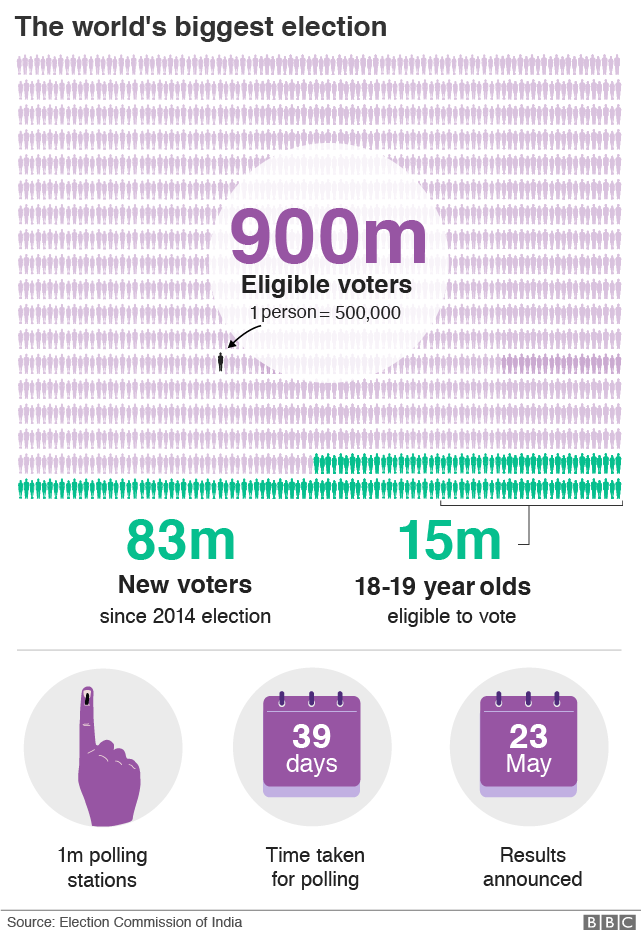
The election, the world’s biggest democratic exercise with about 900 million voters, started on April 11 with Modi in the lead amid heightened tension with long-time enemy Pakistan.
The last phase of voting is on May 19, with results released four days later.
There are a total of 545 seats in the Lok Sabha.
Modi sent warplanes into Pakistan in late February in response to a suicide attack by an Islamist militant group based there that killed 40 Indian police in the disputed Kashmir region.
Modi has sought votes on his tough response towards militancy and in recent days has evoked the deadly Easter Sunday bombings in nearby Sri Lanka.
Maidul Islam, a professor of political science at Kolkata’s Centre for Studies in Social Sciences, said long queues outside polling stations would indicate whether Modi’s national security pitch was working.
“Whenever there is a BJP kind of a wave, you see a higher voter turnout,” he said.
It is an election like no other. Those eligible to vote in India’s upcoming polls represent more than 10% of the world’s population and they will take part in the largest democratic exercise in history.
Voters will choose representatives for the Indian parliament, and in turn decide if Hindu nationalist Prime Minister Narendra Modi will run the country for another five years.
What is at stake?
Whoever wins these elections and forms a government will control the destiny of the world’s largest democracy.
While they are in charge, India’s economy is likely to overtake the UK’s and become the world’s fifth-largest.
Its population meanwhile – at more than 1.34bn people – is predicted to soon surpass China’s 1.39bn.
Hundreds of millions of Indians have escaped poverty since the turn of the millennium but huge challenges remain.
Unemployment is a major concern and is especially high among young people.
Millions of farmers are angry about low crop prices.
How the nuclear-armed country engages with the outside world – and manages a tricky relationship with its neighbour Pakistan – is also of immense importance to international security.
Who is being elected?
Indians are voting for members of parliament and the job of prime minister tends to go to the leader of the party or coalition with most seats. The current PM is Narendra Modi.
His main rival is opposition leader Rahul Gandhi.
Parliament has two houses: the Lok Sabha and the Rajya Sabha.
The lower house – Lok Sabha – is the one to watch.
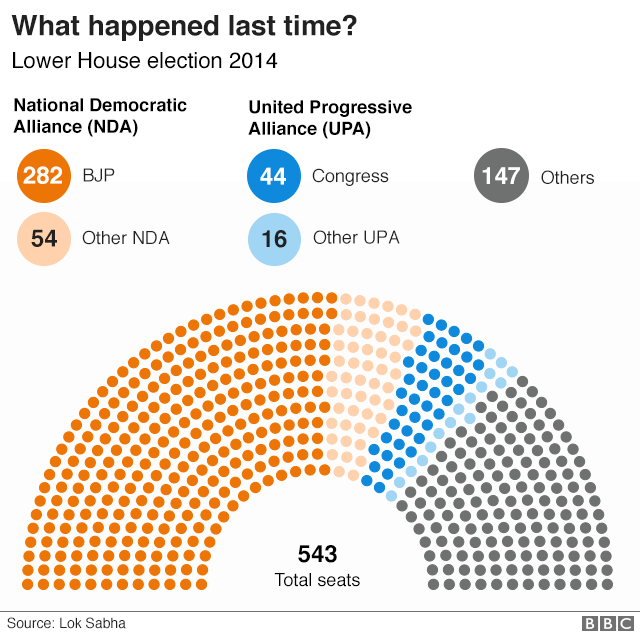
It has 543 elected seats and any party or coalition needs a minimum of 272 MPs to form a government.
At the last election in 2014, Mr Modi’s BJP won 282 seats.
Mr Gandhi’s Congress Party only took 44 seats in 2014 – down from 206 in 2009.
Why does voting take so long?
Because of the enormous number of election officials and security personnel involved, voting will take place in seven stages between 11 April and 19 May.
Different states will vote at different times.
Votes will be counted on 23 May and results are expected on the same day.
Who will win?
This election is being seen as a referendum on Mr Modi, a polarising figure adored by many but also accused of stoking divisions between India’s Hindu majority and the country’s 200 million Muslims.
Until a few months ago, Mr Modi and his BJP party were seen as the overwhelming favourites. But the loss of key states in December’s regional elections injected a sense of serious competition into the national vote.
Analysts are divided on whether Mr Modi will be able to win a simple majority again.
A recent escalation of tensions with Pakistan has given the BJP a new and popular issue to campaign on.
It will be hoping that a focus on patriotism will help the party to get past the serious challenge mounted by powerful regional parties and Congress.
Some observers have billed this as the most important election in decades and the tone of the campaign has been acrimonious.
Mr Modi’s Hindu nationalist Bharatiya Janata Party (BJP) won a historic landslide in the last elections in 2014. He stakes his claim to lead India on a tough image and remains the governing BJP’s main vote-getter.
But critics say his promises of economic growth and job creation haven’t met expectations and India has become more religiously polarised under his leadership.
The BJP faces challenges from strong regional parties and a resurgent Congress party, led by Rahul Gandhi. Mr Gandhi’s father, grandmother and great-grandfather are all former Indian prime ministers. His sister, Priyanka Gandhi, formally joined politics in January.
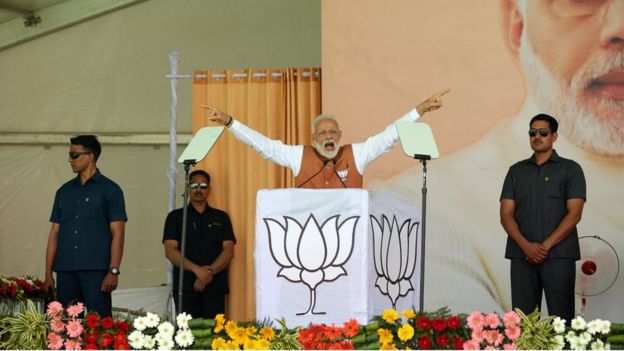
Image captionMr Modi has made national security a key election issue
How has voting gone so far?
The Lok Sabha, or lower house of parliament has 543 elected seats and any party or coalition needs a minimum of 272 MPs to form a government.
Hundreds of voters began to queue up outside polling centres early Thursday morning. In the north-eastern state of Assam, lines of voters began forming almost an hour before voting officially began.
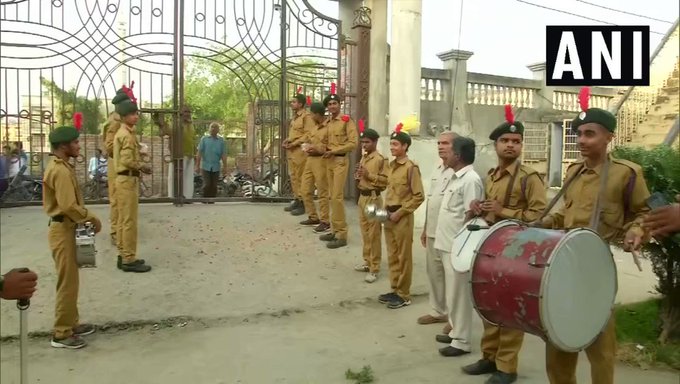
Voters at one polling booth in Baraut – in the northern state of Uttar Pradesh – got a royal welcome with people greeted by drums and a shower of flower petals.
But violence has flared in several places already. One person has died after clashes erupted at a polling station in Anantpur, in southern Andhra Pradesh state. Four others were critically injured in the fight that broke out between workers from two parties, BBC Telugu reports.
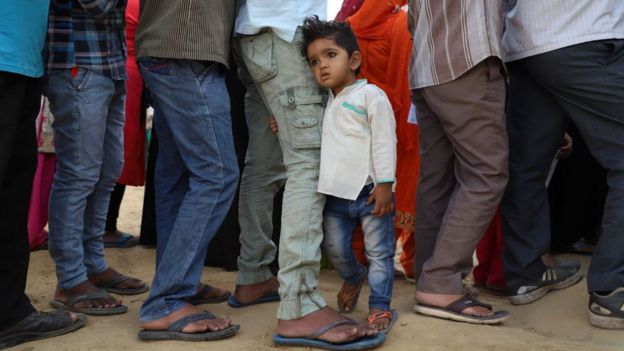
Image copyrightGETTY IMAGESImage caption A little boy clutches his father outside a polling booth in Ghaziabad in Uttar Pradesh state
In central Chhattisgarh state, suspected Maoists detonated an IED device near a polling booth at around 04:00 local time (23:30 BST) – no injuries were reported.
The mineral-rich state has witnessed an armed conflict for more than three decades and attacks by Maoist rebels on security forces are common. On Tuesday a state lawmaker was killed in a suspected rebel attack.
How big is this election?
It is mind-bogglingly vast – about 900 million people above the age of 18 will be eligible to cast their ballots at one million polling stations. At the last election, vote turn-out was around 66%.
More than 100 million people are eligible to vote in the first phase of the election on Thursday.
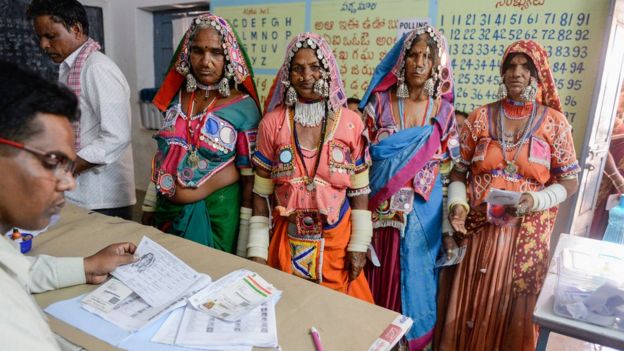
Image copyrightGETTY IMAGESImage caption Indian lambadi tribeswomen at a polling station in southern India
No voter is meant to have to travel more than 2km to reach a polling station. Because of the enormous number of election officials and security personnel involved, voting will take place in seven stages between 11 April and 19 May.
India’s historic first election in 1951-52 took three months to complete. Between 1962 and 1989, elections were completed in four to 10 days. The four-day elections in 1980 were the country’s shortest ever.
The two parties kept three of the six Lok Sabha seats in Jammu-Kashmir for “friendly contest” between them.
Statesman News Service | Jammu | March 20, 2019 4:34 pm
The Congress and National Conference (NC) on Wednesday sealed a partial pre-poll alliance for the upcoming Lok Sabha elections wherein the two parties kept three of the six Lok Sabha seats in Jammu-Kashmir for a “friendly contest” between them.
Both parties will contest the Jammu, Udhampur and Srinagar seats in alliance, while there will be “friendly contest” for Anantnag, Baramulla and Ladakh seats.
The NC has left both seats of Jammu division – Jammu and Udhampur – for the Congress.
NC chief, Farooq Abdullah, will re-contest from the Srinagar Lok Sabha seat and the Congress will not field any candidate against him.
The two parties reached the alliance only after Congress leaders Ghulam Nabi Azad and Ambika Soni dashed to Srinagar early this morning from New Delhi to hold deliberations with Abdullah.
The NC had earlier announced candidature of BR Kundal, a former chief secretary of the state, who recently deserted the Congress and joined the NC.
The two parties failed to reach any understanding for the Anantnag seat in South Kashmir where the PCC chief GA Mir was seeking the Congress ticket.
The NC had spared the seat for Mir during the by-polls but the election did not take place due to security reasons. Farooq Abdullah had won the Srinagar seat during the by-election.
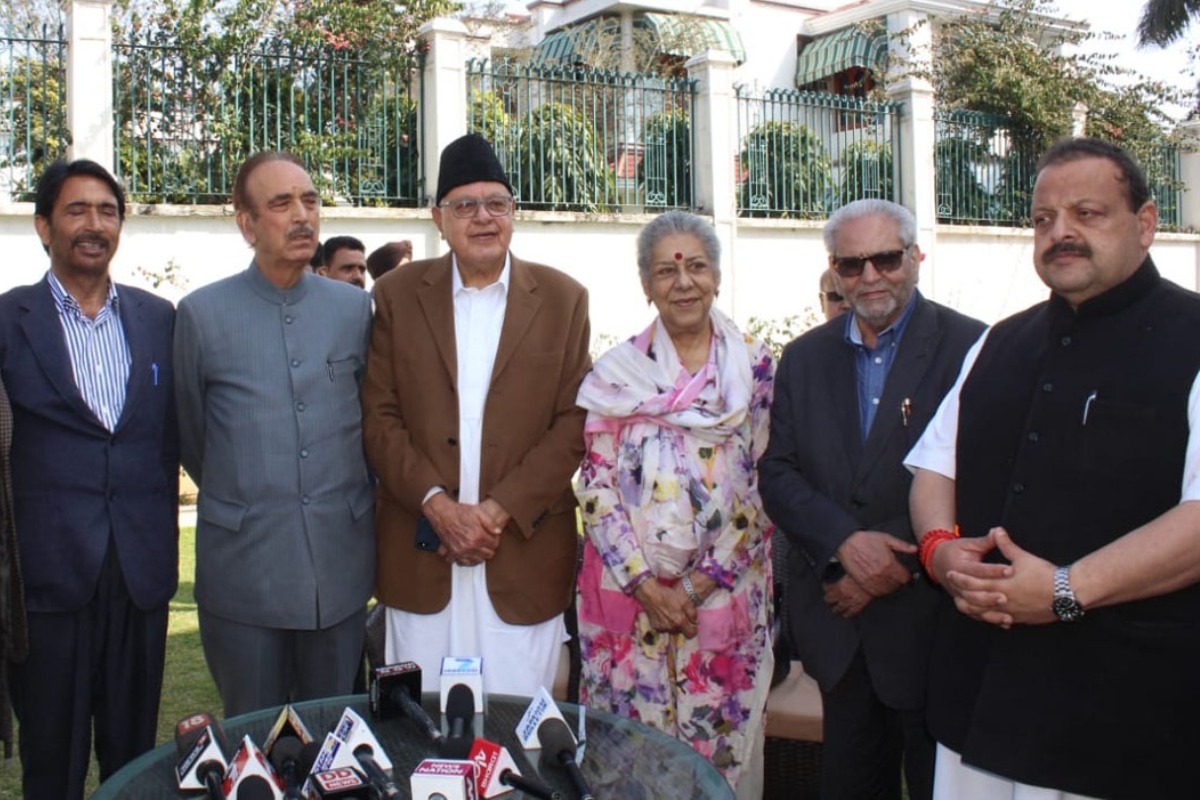
The announcement about the alliance was made jointly by Farooq Abdullah, Ghulam Nabi Azad and Ambika Soni after a closed door meeting at Abdullah’s residence.
Azad said that the alliance has been reached in the national interest, to strengthen secular forces in Jammu and Kashmir as the state faces threat from Pakistan.
Abdullah said the Congress will contest from Jammu and Udhampur Lok Sabha seats.
“I will contest from Srinagar and there will be a friendly contest between National Conference and Congress in Anantnag and Baramulla parliamentary constituencies. We are also discussing the Ladakh seat,” said Farooq Abdullah.
Azad said that friendly contest means that there will be no cut-throat contest between the parties on Anantnag and Baramulla seats.
“Live and let live. This is the best decision taken in national interest. If either the Congress or National Conference wins, it is a win-win situation for both,” he said.
Azad said the Congress-NC alliance will ensure there is no division of secular votes and the BJP doesn’t get to benefit. He added that all Congress leaders will also campaign for Abdullah, who will be contesting from the Srinagar Parliamentary seat.
The NC has already announced Mohammad Akbar Lone, a former Speaker, as the party’s candidate for the Baramulla seat.
Earlier, there were speculations that the pre-poll alliance between NC and Congress had hit a dead-end after former announced its candidate for the Anantnag Parliamentary constituency. Anantnag Lok Sabha seat has been a bone of contention between the NC and Congress.
Omar Abdullah, National Conference vice-president, had set a precondition to contest on all three seats in Kashmir for any alliance to take place.
In exchange, NC was willing to support Congress in the two seats in Jammu and one in Ladakh. However, Congress had insisted on contesting from four seats – two from the Jammu region and one each from Ladakh and Anantnag.
On Tuesday, Peoples Democratic Party (PDP) chief and former Chief Minister Mehbooba Mufti dismissed reports of an alliance with the Congress stating that the party is preparing to contest all the six Lok Sabha seats in Jammu and Kashmir. Mehbooba Mufti is expected to finalise the party’s candidates for the Lok Sabha seats within a day or two.
The BSP leader’s statement came a day after the Congress said it was leaving seven of the 80 Lok Sabha seats in Uttar Pradesh for the SP-BSP combine
LOK SABHA ELECTIONSUpdated: Mar 18, 2019 14:38 IST
HT Correspondent
Hindustan Times, New Delhi
Bahujan Samaj Party president Mayawati has said that the SP-BSP combine was strong enough to defeat the Bharatiya Janata Party in Uttar Pradesh and that they did not need the support of the Congress.(PTI file photo)
Bahujan Samaj Party president Mayawati, in a strong snub for the Congress, said on Monday that the SP-BSP combine was strong enough to defeat the BJP in politically important Uttar Pradesh in the upcoming Lok Sabha elections.
The BSP leader’s statement came a day after the Congress said it was leaving seven of the 80 Lok Sabha seats in Uttar Pradesh for the SP-BSP combine, which recently formed an alliance and had left two seats – Rae Bareli and Amethi – for the Congress.
“The Congress is free to put up candidates in all Uttar Pradesh seats, our alliance is strong enough to defeat the BJP. The Congress should not create confusion about any alliance with us,” Mayawati tweeted.
She made it clear that the SP-BSP combine had no poll understanding with the Congress anywhere in the country. “Our supporters should not fall for doubts being created by the Congress,” the former chief minister of Uttar Pradesh said.
Watch: Congress leaves 7 seats for SP, BSP and RLD in UP for Lok Sabha polls
LS polls: Congress leaves 7 seats for SP, BSP and RLD in UP
Uttar Pradesh Congress Committee chief Raj Babbar announced that Congress will not be contesting on 7 seats in UP. Congress will leave those seats for the SP-BSP-RLD alliance in the state.
Minutes later, Samajwadi Party leader Akhilesh Yadav tweeted a similar message saying the SP-BSP- RLD alliance in Uttar Pradesh was capable of defeating BJP. “Congress should not create any confusion,” he added.
The Congress had on Sunday announced that it would not be contesting Mainpuri, Kannauj and the seats from where BSP chief Mayawati and RLD leaders Ajit Singh and Jayant Chaudhary will contest the upcoming Lok Sabha elections.
At the press conference UPCC chief Raj Babbar said, “We are leaving 7 seats vacant for SP, BSP and RLD. These include Mainpuri, Kannauj, Firozabad and whatever seats Mayawati ji & RLD’s Jayant ji and Ajit Singh contest from. We will also give two seats to Apna Dal – Gonda & Pilibhit.”
Mayawati has time and again made it clear that her alliance has nothing to do with the Congress. A week back she had said: “It is being made clear again that the Bahujan Samaj Party will not have any electoral alliance with the Congress in any state.”
This drew a sharp retort from the Congress with its Uttar Pradesh unit spokesperson saying, “We don’t need her.”
Uttar Pradesh will go to polls in all seven phases starting April 11 and ending on May 19. Counting of votes will take place on May 23.
NEW DELHI (Reuters) – India’s main opposition Congress party will reserve a third of federal government jobs for women if it comes into power, its chief Rahul Gandhi said on Wednesday, in a sign women’s rights are rising up the political agenda for next month’s election.
Over the last week, two powerful parties from eastern India said they would field women in a third of parliamentary races, putting pressure on Prime Minister Narendra Modi’s ruling Bharatiya Janata Party (BJP) and other big parties to follow suit.
India ranks at 149 out of 193 countries – worse than neighbouring Afghanistan, Bhutan, Bangladesh and Pakistan – for the percentage of women in national parliaments, according to the Inter-Parliamentary Union, an independent organisation promoting democracy.
“…Frankly, I don’t see enough women in leadership positions. I don’t see them leading enough companies, I don’t see them leading enough states, I don’t see enough of them in the Lok Sabha and the Vidhan Sabhas,” Gandhi said in the southern city of Chennai, referring to India’s lower house of parliament and state legislatures.
Federal government jobs in India are already subject to numerous quotas, including one passed in January that reserves 10 percent of openings for people outside high income brackets.
Gandhi also said that Congress would pass the Women’s Reservation Bill this year if it came to power. The bill, which reserves 33 percent of the seats in national and state assemblies for women, has been on hold for two decades despite being championed by Congress and the BJP at different points.
The BJP, which says it has empowered women through nationwide schemes including clean fuel and sanitation, questioned how the Congress jobs plan would be implemented.
“For how many generations have people talked about reservation in party positions, reservation for elections, reservation in jobs? But it doesn’t seem to happen,” BJP spokesperson Shaina N.C. said.
There are currently 66 women out of a total 543 elected members in India’s lower house of parliament. At 12 percent, this is the highest ever proportion of women in the Lok Sabha.
Women make up nearly half of all voters in the country of 1.3 billion people, according to the Election Commission of India. Based on recent state polls, women will likely head to voting stations in droves for the elections due by May, surpassing male turnout, analysts predict.
On Tuesday, Mamata Banerjee, chief minister of West Bengal state, said her All India Trinamool Congress party would field 17 women candidates across 42 seats.
Earlier, on Sunday, the Biju Janata Dal, which rules Odisha state in eastern India, said it would reserve seven of 21 seats it is contesting for women candidates.
“33% reservation in parliament will give them bigger role in highest policy making body,” Naveen Patnaik, leader of the BJD and Odisha’s chief minister, said in a tweet.
“Women of our nation rightfully deserve this from all of us.”
CWC meeting LIVE: Congress is launching its Lok Sabha election campaign from Ahmedabad in Gujarat, the home state of PM Narendra Modi and BJP president Amit Shah with a meeting of its top leaders, including Rahul Gandhi, Sonia Gandhi, Manmohan Singh.
The Congress is launching its Lok Sabha election campaign from Ahmedabad in Gujarat, the home state of Prime Minister Narendra Modi and BJP president Amit Shah with a meeting of its Congress Working Committee (CWC) and a public rally by its top leaders.
Congress president Rahul Gandhi, UPA chairperson Sonia Gandhi, former Prime Minister Manmohan Singh and party general secretaries, including Priyanka Gandhi, will be among the senior leaders of the party attending the meeting.
The Congress Working Committee, the highest decision-making arm of the party, would seek answers to failures and unfulfilled promises of the Modi government on governance, agrarian distress, economic issues, unemployment, national security and women’s safety, according to party leaders.
Hardik Patel, a prominent young leader of Patidars, who is leading a movement for reservation in jobs and education for their community, is likely to join Congress and contest the Lok Sabha elections on a party ticket, according to sources.
Rahul Gandhi renewed his attack on PM Modi over Rafale deal controversy during his public rally in Jharkhand
INDIAUpdated: Mar 02, 2019 15:58 IST
HT Correspondent
Hindustan Times, Ranchi
Congress president Rahul Gandhi addressing a public rally in Jharkhand on Saturday.(Photo: Twitter/INCIndia)
Congress president Rahul Gandhi on Saturday renewed his attack on Prime Minister Narendra Modi reiterating his charge that he misled the people on the issues of providing corruption-free government, job creation and addressing farm distress. Gandhi said PM Modi’s image has changed from a leader who promised to bring “achchhe din” (better time) to “chowkidar chor hai” (the watchman is a thief).
Speaking at the Congress’s Parivartan Ulgulan Maha Rally at the Morahbad in Jharkhand, Gandhi said, “One chowkidar has defamed all chowkidars of India…All the chowkidars of India are honest…Everyone knows that when someone says chowkidar chor hai, it refers to Narendra Modi.”
The Congress president alleged that PM Modi “snatched” Rs 30,000 crore from the Indian Air Force (IAF), which protects the country, and the Hindustan Aeronautics Limited (HAL) and gave it to industrialist Anil Ambani in Rafale deal.
Gandhi has been targeting PM Modi over Rs 58,000-crore Rafale deal with France that India signed in 2016 for the purchase of 36 fighter planes. A similar deal was being negotiated when the Congress-led United Progressive Alliance (UPA) was in power before 0214 for the purchase of 126 Rafale jets.
The Modi government renegotiated the deal with France terming the previous one unworkable. The Congress and other opposition parties have alleged that commercial favouritism was done in Rafale deal.
Gandhi on several occasions has alleged that PM Modi personally ensured that Ambani’s firm, Reliance Defence gets contract in Rafale deal. Both the government and the Reliance Defence have rejected the allegation as baseless. Reliance Defence is an off-set partner of the Dassault Aviation, the manufacturer of Rafale fighter jets.
Addressing his first rally in Jharkhand since 2014, the Congress president repeated his charge against PM Modi saying, “It is a matter of shame that Indian Air Force protects the country, air force pilots sacrifice their lives but the prime minister steals money from the air force and puts it in Anil Ambani’s pockets.”
He claimed that in the upcoming Lok Sabha elections, the “chowkidar” will be defeated. He promised that if voted to power the Congress government will implement a minimum income guarantee programme for the poor.
Mamata Banerjee claimed that her party Trinamool Congress(TMC) will win all the 42 Lok Sabha seats in West Bengal in the polls.
INDIAUpdated: Feb 25, 2019 16:35 IST
Press Trust of India
Kolkata
Chief Minister of West Bengal Mamata Banerjee during a press conference at Press Club of India, in New Delhi, on Thursday, Feb. 14, 2019. (HT Photot)
West Bengal chief minister Mamata Banerjee Monday alleged that though the Modi government had intelligence inputs about the Pulwama attack, it did not take any step as it was more keen on “playing politics over the dead bodies of jawans”.
Banerjee, while addressing the Trinamool Congress’s extended core committee meeting in Kolkata, vowed to oust the “dictatorial Narendra Modi government” from power in the upcoming general election.
She claimed that her party Trinamool Congress(TMC) will win all the 42 Lok Sabha seats in West Bengal in the polls.
“The central government was aware that such an attack can take place, there were intelligence inputs. Then why didn’t the government take action to protect our jawans. The government allowed them to die so that they can do politics over the dead body of jawans in the elections,” Banerjee said.
They want to create a “war hysteria” ahead of the Lok Sabha polls, the TMC president alleged.
The central government is functioning in a peculiar way and union ministers are not aware of important decisions, Banerjee claimed.
“This government is being run by two brothers (Prime Minister Narendra Modi and BJP president Amit Shah), who have blood of innocents on their hands,” she said.
“Our party workers and cadre should be cautious as efforts are on to tamper EVMs (electronic voting machines) during the Lok Sabha polls. You all have to thwart those efforts,” she said. On February 14, 40 Central Reserve Police Force (CRPF) personnel were killed in Jammu and Kashmir after a Jaish-e-Mohammed terrorist rammed an explosive-laden vehicle into their bus in Pulwama district.




 CHINDIA ALERT: You'll be living in their world, very soon