Chindia Alert: You’ll be Living in their World Very Soon
aims to alert you to the threats and opportunities that China and India present. China and India require serious attention; case of ‘hidden dragon and crouching tiger’.
Without this attention, governments, businesses and, indeed, individuals may find themselves at a great disadvantage sooner rather than later.
The POSTs (front webpages) are mainly 'cuttings' from reliable sources, updated continuously.
The PAGEs (see Tabs, above) attempt to make the information more meaningful by putting some structure to the information we have researched and assembled since 2006.
People’s Liberation Army has officially recorded no infections but disease fears have delayed recruitment, training and operations
Analysts say Sars experience guided military’s prompt response, but combat effectiveness has been affected
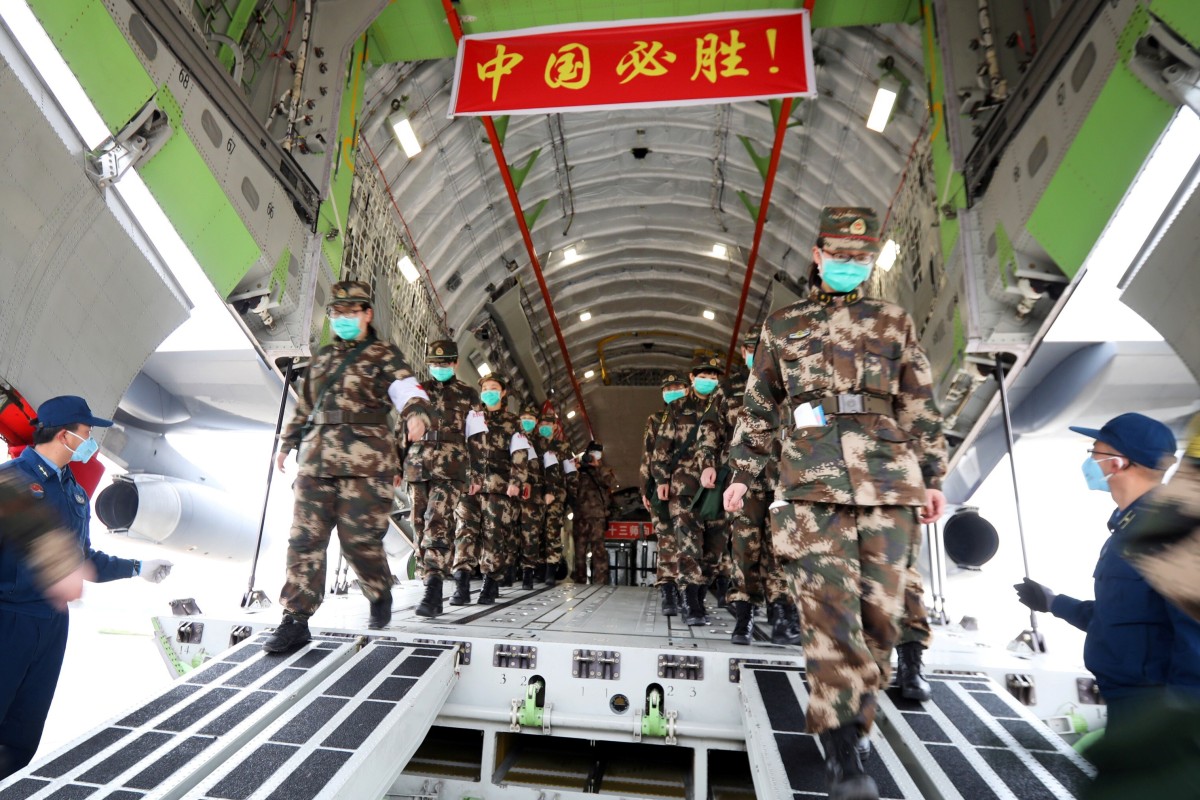
Chinese military medical personnel arriving in Wuhan in February to assist with the coronavirus outbreak response to the February. Photo: Reuters
China’s military may have been spared any coronavirus infections, but the global health crisis has slowed the progress of Chinese President Xi Jinping’s plan to transform the People’s Liberation Army into a modern fighting force capable of long-range power-projecting operations, experts say.
According to China’s defence ministry, the world’s largest armed force – with about 2.3 million personnel – has had zero confirmed cases of Covid-19. In contrast, the US and Russian militaries, ranked second- and third-largest in the world, have reported more than 4,000 and 1,000 respectively.
But the PLA has been affected in other ways by the disease, which was first reported in Wuhan in December before going on to infect 3.9 million people around the world to date.
Safety concerns delayed its annual spring recruitment programme – it has been rescheduled for August – while the PLA Navy was forced to change its training arrangements, switching to classroom study of military theory and tactics, according to Xinhua.
“The PLA is still a conscription army and, given its large turnover of soldiers every year and the late recruitment and training plan this year, the coronavirus pandemic has already affected combat effectiveness,” said Adam Ni, director of the China Policy Centre, an independent, non-profit research organisation based in Canberra, Australia.
China’s military budget will still rise despite coronavirus, experts predict
3 May 2020
The navy’s operations, in particular, would have been affected, according to Charlie Lyons Jones, a researcher from the Australian Strategic Policy Institute’s defence and strategy programme.
“The Chinese navy, short of highly effective disease control measures, is unlikely to avoid similar outbreaks of the novel coronavirus on board its warships,” he said.
“Therefore, even if the PLA Navy currently has zero personnel infected by the novel coronavirus, its position as a navy that can operate effectively in a period of higher-than-normal tension remains precarious at best,” Jones said. He also questioned Beijing’s claims that the military was virus-free.
“The PLA played an important role in China’s response to the coronavirus outbreak in Wuhan … The idea that none of these personnel working on the front lines in Wuhan became infected by the novel coronavirus would be inconsistent with the experiences of countries from around the world,” he said.
More than 4,000 military medical workers were sent to Wuhan as part of China’s effort to contain the outbreak at ground zero – which included the rapid-built emergency field facility, the Huoshenshan hospital – and their efforts were highlighted in a documentary screened recently by state broadcaster CCTV.
China opens coronavirus hospital built in 10 days
At the time, rumours were rampant that the Chinese military had been affected by the coronavirus, fuelled by a report on February 17 by the official PLA Daily that some soldiers had been placed in quarantine and Yu Qiusong, captain of the Changzhou type 054A frigate, was isolating in a guest house. The news report did not mention why the personnel were in quarantine.
But analysts said that whether the official numbers were accurate, the PLA’s closed management, fast response and past experience with severe acute respiratory syndrome (Sars) gave China’s military an advantage in keeping the coronavirus at bay.
Zhou Chenming, a Beijing-based military observer, said a key reason for the less serious hit to the PLA compared to other forces was its speed in recognising the severity of the situation.
“What’s more, the PLA has its own logistic support system that can help minimise its contact with the outside world, thus reducing the possibility of contracting the virus,” he said.
China’s long-range stealth bomber could make its debut this year
4 May 2020
According to Xinhua, the PLA’s Centre for Disease Control and Prevention drew up an emergency response plan and mobilisation arrangements on January 20, the same day Xi issued an instruction to the public that the virus must be “resolutely contained”.
Timothy Heath, a senior international defence research analyst with the Rand Corporation, a US think tank, said China’s military had benefited from its less international role, compared to US forces.
“The US is a globally distributed force while the Chinese military largely operates on the mainland. The US thus faces challenges in containing the disease that the Chinese military does not have to face … and the US military has a large range of missions and tasks it carries out to counter threats to its allies and partners, as well as to US security. This complicates efforts by the US military to carry out disease control measures,” he said.
Beijing ‘carefully considering’ unveiling the plane at the Zhuhai Airshow in November at a time of heightened regional tension
H-20 will give China the nuclear triad of submarines, ballistic missiles and bombers
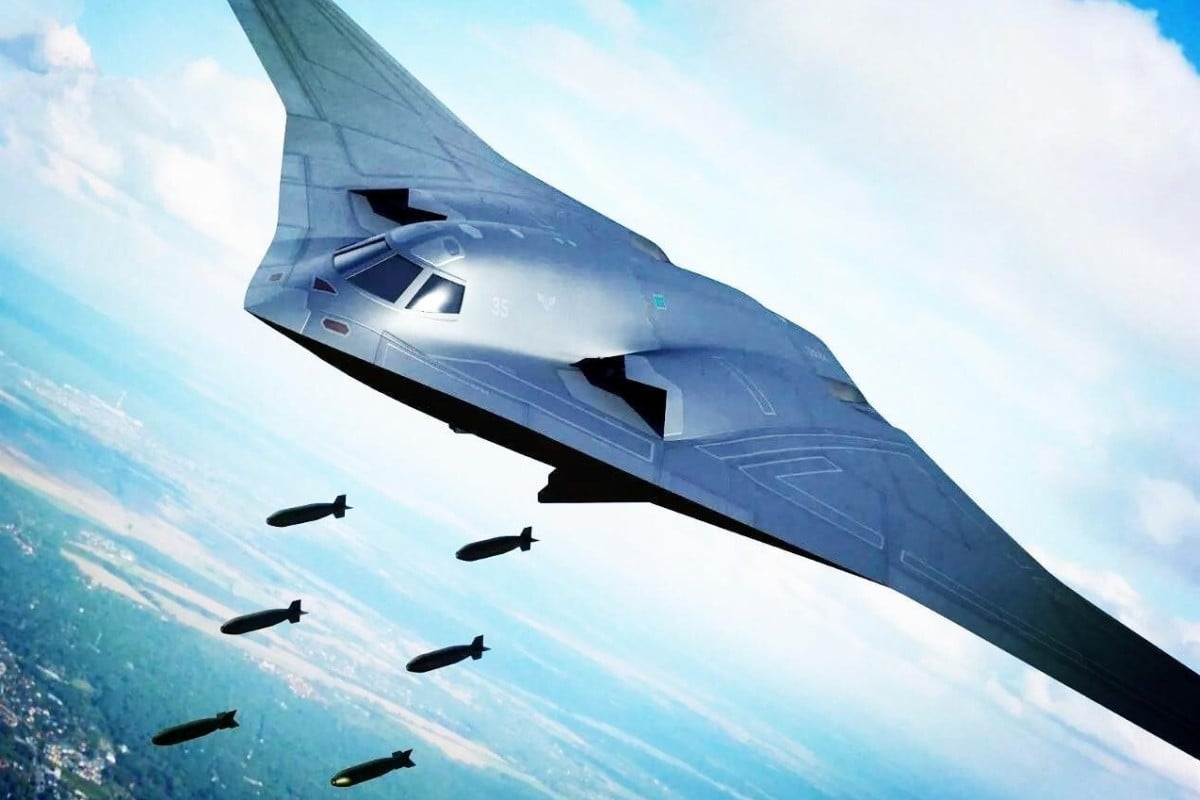
An artist’s impression of what the H-20 may look like. Photo: Weibo
China’s new generation strategic bomber is likely to be ready for delivery this year, but Beijing is said to be weighing the impact of its unveiling at a complex time in regional relations due to the coronavirus pandemic.
Military sources said the Xian H-20 supersonic stealth bomber – expected to double the country’s strike range – could make its first public appearance at this year’s Zhuhai Airshow in November, if the pandemic was sufficiently under control.
“The Zhuhai Airshow is expected to become a platform to promote China’s image and its success in pandemic control – telling the outside world that the contagion did not have any big impacts on Chinese defence industry enterprises,” a source said.
But the appearance of the bomber at this year’s air show could heighten tensions by directly threatening countries within its strike range, especially Australia, Japan and the Korean peninsula.
Thrilling aerobatics fill the skies to open air show in central China
“The Beijing leadership is still carefully considering whether its commission will affect regional balance, especially as regional tensions have been escalating over the Covid-19 pandemic,” another source said.
“Like intercontinental ballistic missiles, all strategic bombers can be used for delivering nuclear weapons … if China claimed it had pursued a national defence policy which is purely defensive in nature, why would it need such an offensive weapon?”
Tensions in the region have worsened in the past month with a war of words between Beijing and Washington over the pandemic, and both sides increasing naval patrols.
The US defence department has estimated a cruising distance of more than 8,500km (5,300 miles) for the H-20, the last in China’s 20 series of new generation warplanes, which includes the J-20 stealth fighter jet, the Y-20 giant transporter and the Z-20 medium-lift utility helicopter.
The arrival of the H-20 would mark the completion of China’s “nuclear triad” of ground-based intercontinental ballistic missiles, submarine-launched missiles and air-launched weapons.
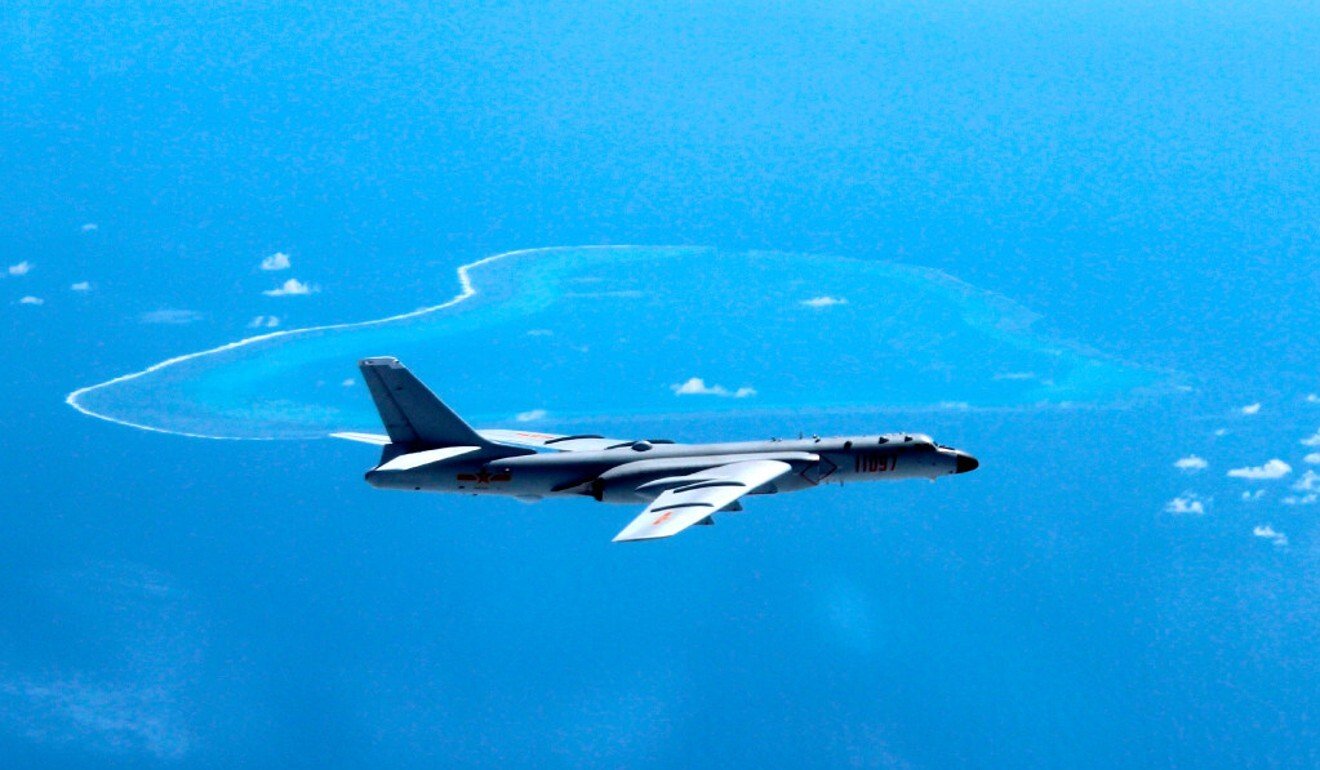
An H-6K bomber, or China’s B-52, flies over the South China Sea. Photo: AP
Chinese state television has said the H-20 could alter the strategic calculus between the US and China by doubling the strike range of its current H-6K, dubbed the country’s B-52.
The H-20 has reportedly been designed to strike targets beyond the second island ring – which includes US bases in Japan, Guam, the Philippines and other countries – from bases in mainland China. The third island chain extends to Hawaii and coastal Australia.
It will be equipped with nuclear and conventional missiles with a maximum take-off weight of at least 200 tonnes and a payload of up to 45 tonnes. The bomber is expected to fly at subsonic speeds and could potentially unleash four powerful hypersonic stealth cruise missiles.
However, like China’s first active stealth fighter jet, the J-20, engine development of the H-20 bomber has fallen behind schedule, according to sources.
For the J-20, engineers were developing high-thrust turbofan WS-15 engines, but the jet is understood to be using either Chinese WS-10B or Russian-built AL-31FM2/3 engines, which compromise its manoeuvrability and stealth capabilities at subsonic speeds.
Military enthusiasts have speculated the H-20 might use the NK-321 Russian engine but two independent military sources said it would be equipped with an upgraded WS-10 engine.
“The WS-10 is still a transitional engine for the H-20 because it is not powerful enough. The eligible replacement may take two to three years for development,” one of the sources said.
China must meet air force demand for J-20 stealth jets, say analysts
17 Feb 2020
The second said the speed of the H-20 would be slower than its original design, with some of its original combat capability being reduced.
“That’s why the American air force doesn’t care about the H-20, because it is not strong and powerful enough to cause any challenge to their B-2 and B-21 bombers.”
If the US decided to deploy more F-35 supersonic fighter jets – it has already sold about 200 to Japan and South Korea – it could push China to bring forward the unveiling of the new bomber, the second source said.
“For example, if some US decision makers decided to deploy up to 500 F-35s to Japan, South Korea, and even Singapore, India and Taiwan – making almost all of China’s neighbours in the Indo-Pacific region use F-35s to contain China – that would pushBeijing to launch the H-20 as soon as possible.”
The H-20 is believed to have been in development since the early 2000s. The project to develop a strategic bomber was first announced by the People’s Liberation Army in 2016.



 CHINDIA ALERT: You'll be living in their world, very soon