28/09/2019
- Military experts say PLA modernisation brought about during Xi Jinping’s presidency will be the main focus of October 1 celebration in Beijing
- It’s necessary for China to ‘show some of its muscle’ amid the trade dispute with the US, observer says
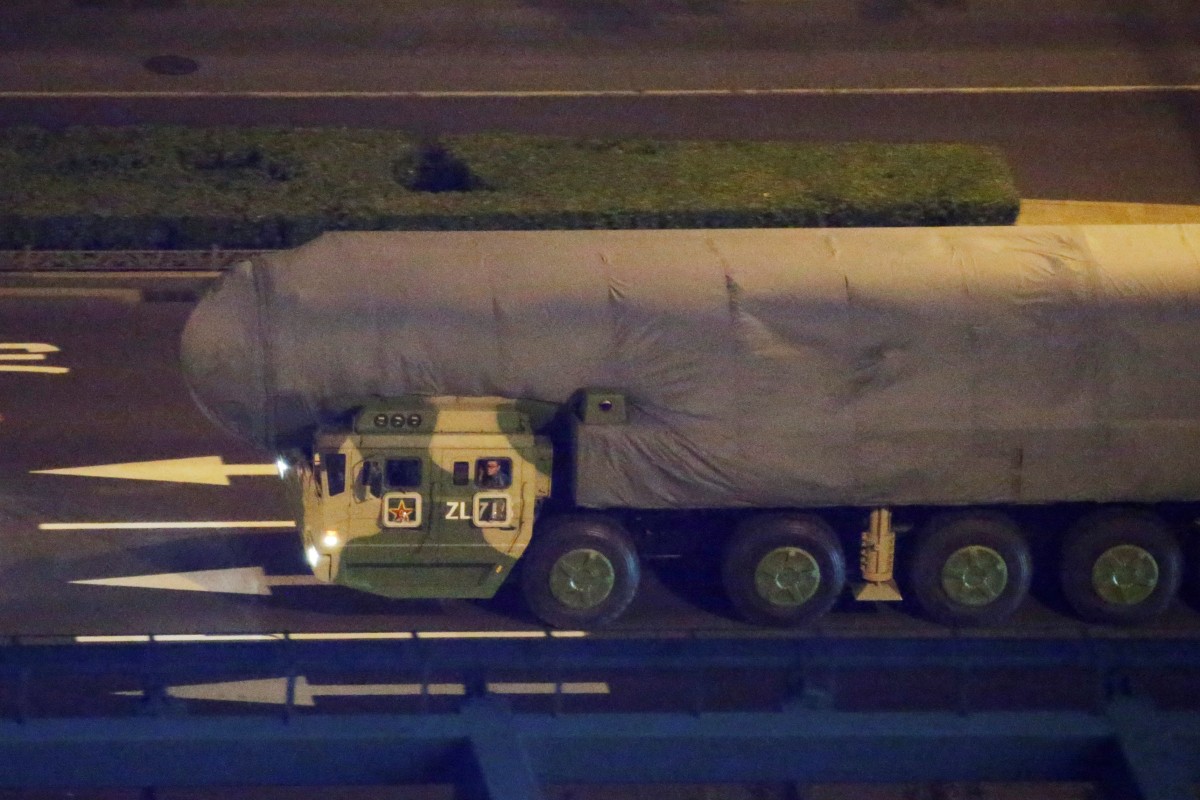
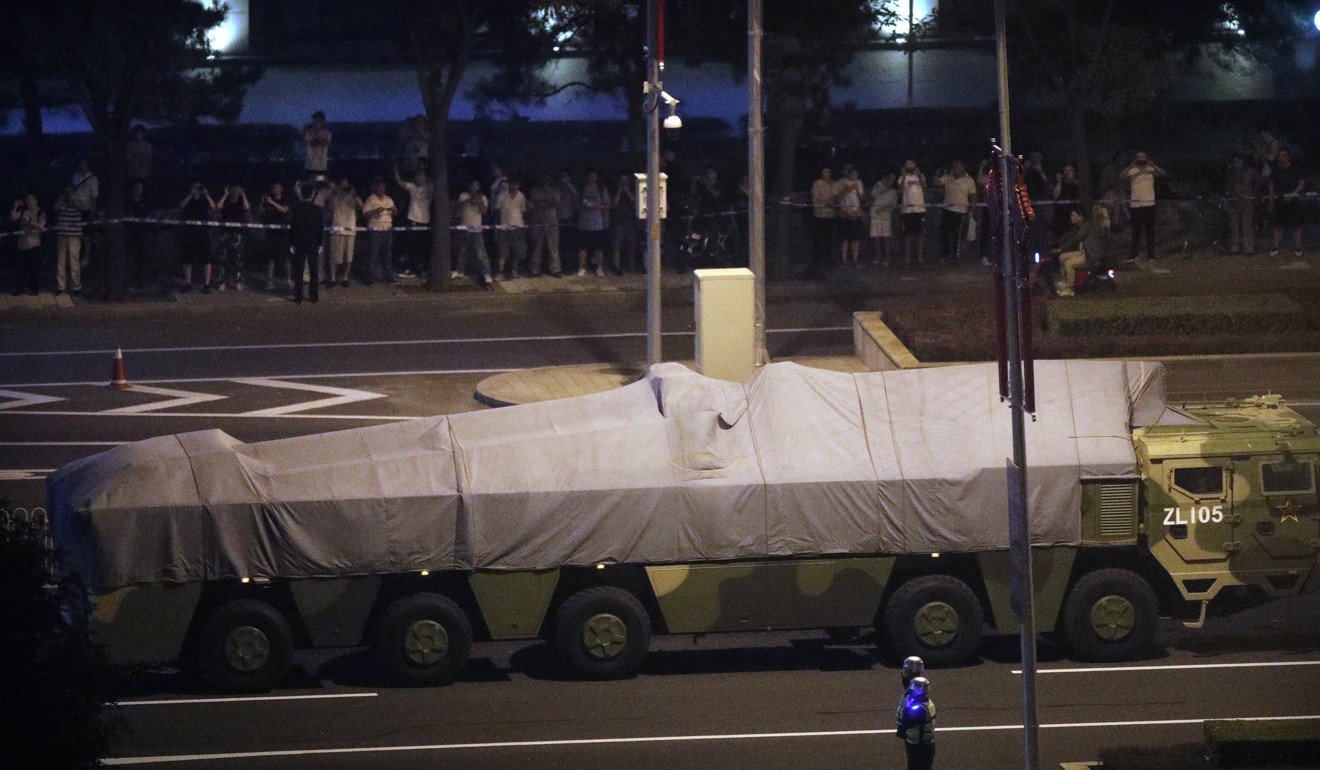
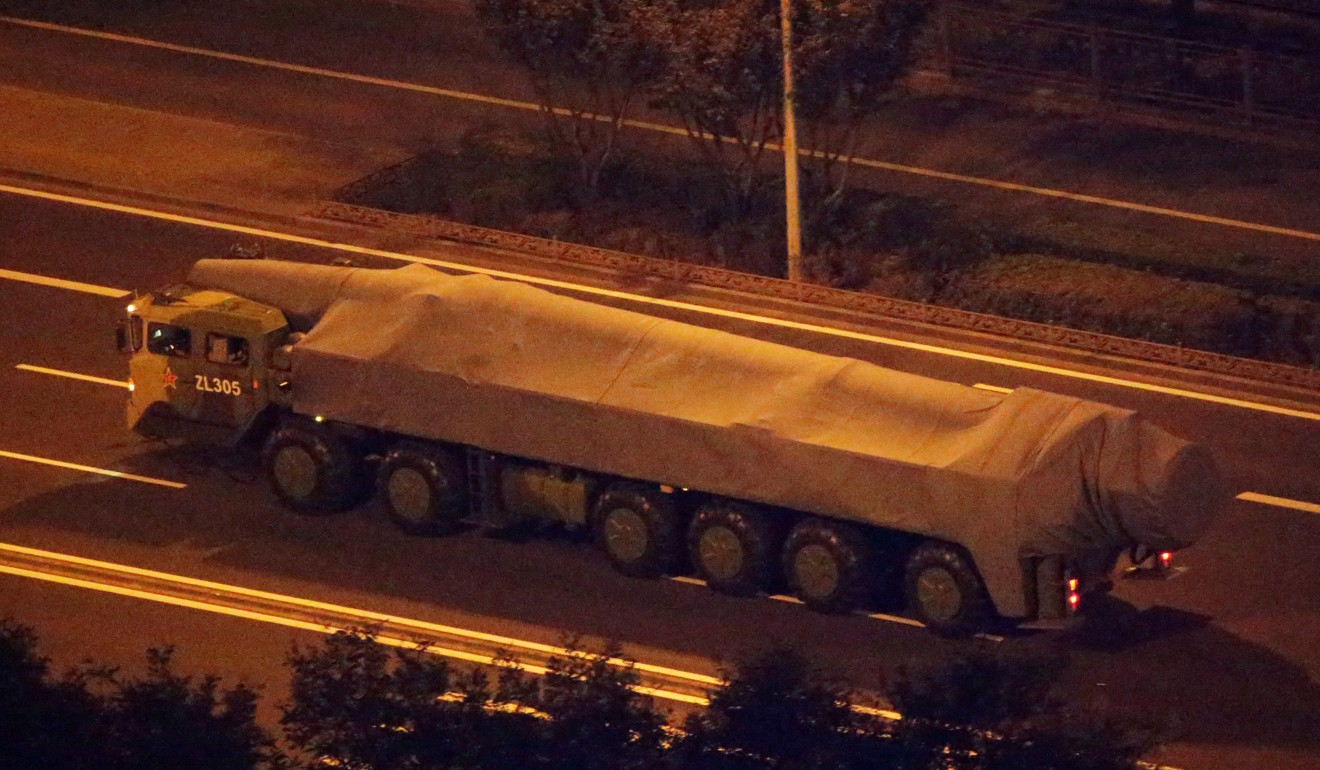
China’s land-based DF-41 intercontinental ballistic missile will be among the military hardware on show on October 1. Photo: Reuters
China plans to show off its most advanced active weapon systems at the upcoming National Day parade, which will be the biggest of the 14 such events it has held over the past seven decades.
The parade, to be held on October 1 to mark the 70th anniversary of the founding of the People’s Republic, will highlight the military modernisation – particularly in nuclear deterrence – that has taken place since President Xi Jinping came to power in late 2012, according to military experts.
The People’s Liberation Army (PLA) offered a glimpse of those weapons during rehearsals for the parade in downtown Beijing from September 14.
As part of the celebrations, Xi, who also chairs the Central Military Commission, will inspect 48 squads on the ground and more than a dozen airborne squadrons, according to a military insider involved in support services for the parade.
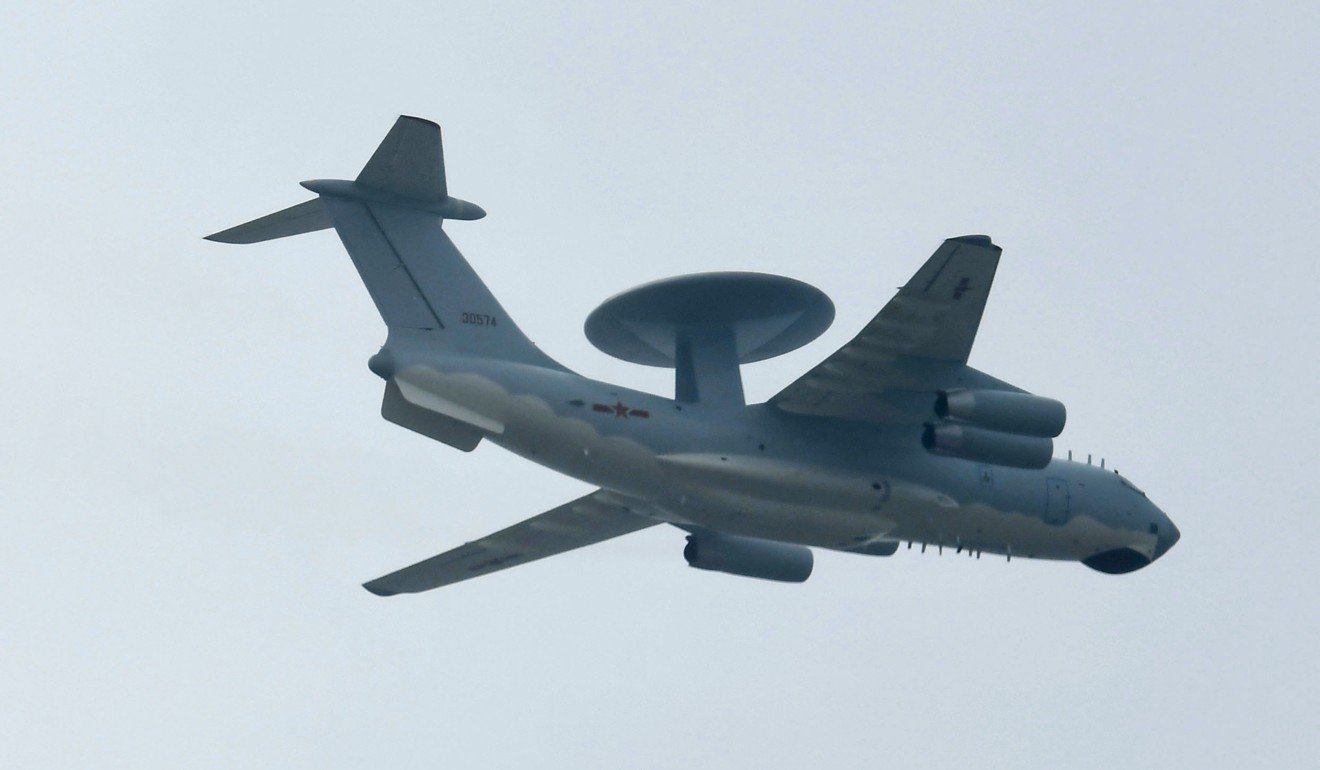
More than a dozen airborne squadrons will take part in the National Day parade. Photo: Kyodo
The squadrons will include the air force’s first stealth fighter, the J-20; the main active warplanes such as the J-10 and J-11B; and armed helicopters like the Z-20. However, the J-8 fighter jet would not appear this year, the source said, confirming that the first interceptor built in China has been formally retired.
“The ground march will be led by several hero forces from the five theatre commands, which is different from previous squads selected from the ground forces, air force and navy,” said the insider, who requested anonymity because of the sensitivity of the matter.
“The main goal of this year’s parade is to promote the military modernisation of the PLA under President Xi’s leadership over the past seven years, with the military overhaul being one of the key achievements.”
Thirty-three of the 48 squads would be “weapon squads”, while the 13 others would be made up of infantry troops from the five theatre commands, the source said.
National Day fireworks in Hong Kong cancelled over safety fears
As part of the PLA’s sweeping military reforms, the army’s previous seven military commands were reshaped into five theatre commands, while the four former general headquarters were dissolved and replaced by 15 small functional departments.
In September 2015, Xi announced the PLA would shed 300,000 troops, cutting its size to 2 million, a move aimed at turning the PLA into a more nimble and combat-ready fighting force on a par with international standards.
Xi also split the former Second Artillery Corps into the Rocket Force and the Strategic Support Force, with the latter backing up the military’s electronic warfare units in cyberspace and outer space.
Among the 33 weapon squads, the highlights are expected to be the PLA’s strategic nuclear missiles such as the Rocket Force’s land-based DF-41 intercontinental ballistic missile (ICBM), the DF-21D anti-ship ballistic missile, the DF-17 hypersonic missile and the sea-launched JL-2, or Big Wave-2.
Adam Ni, a researcher at Macquarie University in Australia, said that showing off different types of missiles on land and sea indicated that the PLA was improving its nuclear deterrence capabilities by perfecting a three-pronged military force structure, or the so-called nuclear triad.
The DF-17 hypersonic ballistic missile will be one of the highlights of the parade. Photo: AP
The DF-41 is capable of carrying multiple warheads and many decoys, making it harder to detect than silo-based systems and better able to survive a first strike.
Ni said the DF-41 was China’s next-generation cutting-edge weapon.
“It’s actually an advanced ICBM and has a range to hit practically anywhere in the world, including the continental United States,” Ni said.
“The DF-41 is the ultimate symbol of the destructive potential of Chinese armed forces, just as nuclear weapons are similar symbols of the US and Russia.”
The JL-2 – which has a shorter range of 7,000km (4,350 miles) and can be launched by the PLA Navy’s Type 094 submarines – is unable to hit anywhere on the American continent when launched from submarines in the South China Sea and coastal areas of China.
China tests new warships in live-fire drills near Vietnam
However, China is developing the JL-3, which has a range of about 9,000km; the upgraded version of the JL-2, with a flight test conducted in June, though it is still less than the 12,000km range of the American Trident II.
“China is stepping up its military modernisation, which includes a number of aspects; the land-based aspect is introducing more mobile and survivable missile systems,” Ni said.
“The game change will happen when China is able to hit the whole US continent with its missile submarines in Chinese coastal waters.”
In military terms, survivable refers to the ability to remain mission capable after a single engagement.
The DF-17 is a land-to-land short-range strategic missile capable of delivering both nuclear and conventional payloads. The US intelligence community has estimated that it will reach initial operational capability by 2020. But if the missile is displayed in the parade, that means it is active already.
China conducted two tests of the DF-17 in November 2017, with the first launched from the Jiuquan Space Launch Centre in Inner Mongolia.
An insider said the main goal of this year’s parade is to promote the military modernisation of the PLA. Photo: Reuters
Hong Kong-based military commentator Song Zhongping said the nuclear weapons that would go on show in the parade would all be strategic missiles designed to improve China’s deterrent capabilities.
The show comes after the PLA delivered a national defence white paper in July stressing its goal to “maintain national strategic security by deterring other countries from using or threatening to use nuclear weapons against China”.
Unlike in the past, this year’s report stated that the US and China were now competing superpowers, and that the PLA’s growing forces were developing to the point that they could challenge the US.
Zhou Chenming, a Beijing-based military observer, said it was also necessary for the PLA to “show some of its muscle” amid the ongoing trade dispute between Beijing and Washington.
“To prevent misunderstanding, most of the weapons are just strategic equipment, not tactical arms, because Beijing still doesn’t want to irritate Washington,” he said.
About 280,000 people were involved in the rehearsals for the parade and related support services, according to Xinhua.
Source: SCMP
Posted in 70th anniversary, accuse teacher, advances, air force, airborne squadrons, American Trident II, armed helicopters, Australia, Beijing, celebration, Central Military Commission, Central Military Commission (CMC), China’s National Day, continental United States, cyberspace, decoys, DF-41 intercontinental ballistic missile, DF-41 intercontinental ballistic missile (ICBM), first strike, founding of the People’s Republic, ground forces, Inner Mongolia, J-20 stealth fighter, J-8 fighter jet, Jiuquan Space Launch Centre, Macquarie University, Military experts, military hardware, multiple warheads, navy, nuclear deterrence, nuclear triad, October 1, outer space, parade, People’s Liberation Army (PLA), pla navy, Rocket Force, Russia, Second Artillery Corps, showcase, silo-based systems, South China Sea, stealth fighter, strategic nuclear missiles, Strategic Support Force, survive, Type 094 submarines, Uncategorized, US, Vietnam, weapon squads, Xi JinPing |
Leave a Comment »
28/09/2019
- Legal process under way, Beijing says after Foreign Minister Wang Yi tells United Nations China is committed to defending multilateralism
- Any unilateral move to leave weapons control pact will have a ‘negative impact in various areas’, minister says in thinly veiled swipe at United States
China, the world’s fifth-largest weapons supplier, has signed up to a global arms control treaty. Photo: Simon Song
China said it has begun preparations to join an international arms control treaty that the United States has threatened to abandon, while also warning Washington against deploying missiles in the Asia-Pacific region.
Speaking at the United Nations General Assembly in New York on Friday, Chinese Foreign Minister Wang Yi said that signing up to the Arms Trade Treaty (ATT) was further evidence of Beijing’s commitment to defending multilateralism.
said in April that he intended to withdraw from the pact, which regulates the US$70 billion global trade in conventional arms.
The White House said at the time that the ATT “will only constrain responsible countries while allowing the irresponsible arms trade to continue”, as major arms exporters like Russia and China were not part of it.
Wang said on Friday that any unilateral move to leave the treaty would have a “negative impact in various areas”. He stopped short of naming the United States or its president.
China’s foreign ministry said in a statement on Saturday that it had begun the legal process of joining the treaty, adding that it attached great importance to the issues caused by the illegal sale and misuse of arms, and supported the aims of the ATT in seeking to regulate the international weapons trade.
Wang also spoke out against the possible deployment of ground-launched missiles in the Asia-Pacific region.
After withdrawing from the
Intermediate-Range Nuclear Forces Treaty in August, the US said it was planning to deploy such weapons in Asia to counter any possible threat from China or Russia.
“[We] urge the country with the largest nuclear weapons to fulfil its special and prior responsibilities on nuclear disarmament,” Wang said, adding that “China will continue to participate in the international arms control process”.
Wang Yi spoke out against the possible deployment of ground-launched missiles in the Asia-Pacific region at the UN General Assembly in New York on Friday. Photo: AFP
According to figures released in May by the Stockholm International Peace Research Institute, the United States is the world’s largest arms exporter, supplying weapons worth 58 per cent more than those of its nearest competitor, Russia.
Together with France, Germany and China, the five nations accounted for 75 per cent of all weapons sold around the world between 2014 and last year, the institute said.
Although China is among the world’s big five arms suppliers, its sales – most of which go to Asia and Oceania – are dwarfed by those of the US, accounting for just 5.2 per cent of the 2014-18 total, compared to America’s 36 per cent.
Several major arms importers, including India, Australia, South Korea and Vietnam, refuse to buy arms from China for political reasons.
Beijing’s decision to join the ATT is in keeping with the image it has sought to present of China as a defender of multilateralism. The stance is also in sharp contrast to the US’ position under Trump, who has repeatedly scrapped multilateral trade agreements in favour of bilateral deals.
Since taking office in 2016, he has withdrawn the US from the Paris climate accord, the Iran nuclear deal and the Trans-Pacific Partnership.
Military observers said Beijing might seek to pressure on Washington to stay in the deal to try to maintain the strategic and military balance in the region.
Song Zhongping, a Hong Kong-based military affairs commentator, said Beijing might be trying to avoid misuse of conventional weapons.
“Beijing may want to press big exporters, such as the US and Russia, to join the deal because without proper regulations, the risk of illegal trade and misuse of conventional weapons could be running high,” he said.
“This could also threaten regional stability or even trigger unnecessary arms races.”
Adam Ni, a China specialist at Sydney’s Macquarie University, said the treaty would put some limits on the arms trade “but it would not mean that China would not be able to do deals. It will still be able to do [most deals]”.
Retired PLA colonel Yue Gang said the strategy could also improve China’s international reputation.
Source: SCMP
Posted in abandon, arms importers, Arms Trade Treaty, Asia, Asia-Pacific region, Australia, Beijing, China alert, deploying, dwarfed, Foreign Minister Wang Yi, France, General Assembly, Germany, global arms control treaty, India alert, Intermediate-Range Nuclear Forces Treaty, Iran nuclear deal, join, largest nuclear weapons, Macquarie University, military affairs commentator, Military observers, missiles, New York, Paris climate accord, political reasons, President Donald Trump, Russia, South Korea, Sydney, threatened, Trans-Pacific Partnership (TPP), Uncategorized, United Nations, United States, Vietnam, Washington, White House |
Leave a Comment »
22/09/2019
- Military experts say PLA modernisation brought about during Xi Jinping’s presidency will be the main focus of October 1 celebration in Beijing
- It’s necessary for China to ‘show some of its muscle’ amid the trade dispute with the US, observer says
China’s land-based DF-41 intercontinental ballistic missile will be among the military hardware on show on October 1. Photo: Reuters
China plans to show off its most advanced active weapon systems at the upcoming National Day parade, which will be the biggest of the 14 such events it has held over the past seven decades.
The parade, to be held on October 1 to mark the 70th anniversary of the founding of the People’s Republic, will highlight the military modernisation – particularly in nuclear deterrence – that has taken place since President Xi Jinping came to power in late 2012, according to military experts.
The People’s Liberation Army (PLA) offered a glimpse of those weapons during rehearsals for the parade in downtown Beijing from September 14.
As part of the celebrations, Xi, who also chairs the Central Military Commission, will inspect 48 squads on the ground and more than a dozen airborne squadrons, according to a military insider involved in support services for the parade.
More than a dozen airborne squadrons will take part in the National Day parade. Photo: Kyodo
The squadrons will include the air force’s first stealth fighter, the J-20; the main active warplanes such as the J-10 and J-11B; and armed helicopters like the Z-20. However, the J-8 fighter jet would not appear this year, the source said, confirming that the first interceptor built in China has been formally retired.
“The ground march will be led by several hero forces from the five theatre commands, which is different from previous squads selected from the ground forces, air force and navy,” said the insider, who requested anonymity because of the sensitivity of the matter.
“The main goal of this year’s parade is to promote the military modernisation of the PLA under President Xi’s leadership over the past seven years, with the military overhaul being one of the key achievements.”
Thirty-three of the 48 squads would be “weapon squads”, while the 13 others would be made up of infantry troops from the five theatre commands, the source said.
National Day fireworks in Hong Kong cancelled over safety fears
As part of the PLA’s sweeping military reforms, the army’s previous seven military commands were reshaped into five theatre commands, while the four former general headquarters were dissolved and replaced by 15 small functional departments.
In September 2015, Xi announced the PLA would shed 300,000 troops, cutting its size to 2 million, a move aimed at turning the PLA into a more nimble and combat-ready fighting force on a par with international standards.
Xi also split the former Second Artillery Corps into the Rocket Force and the Strategic Support Force, with the latter backing up the military’s electronic warfare units in cyberspace and outer space.
Among the 33 weapon squads, the highlights are expected to be the PLA’s strategic nuclear missiles such as the Rocket Force’s land-based DF-41 intercontinental ballistic missile (ICBM), the DF-21D anti-ship ballistic missile, the DF-17 hypersonic missile and the sea-launched JL-2, or Big Wave-2.
Adam Ni, a researcher at Macquarie University in Australia, said that showing off different types of missiles on land and sea indicated that the PLA was improving its nuclear deterrence capabilities by perfecting a three-pronged military force structure, or the so-called nuclear triad.
The DF-17 hypersonic ballistic missile will be one of the highlights of the parade. Photo: AP
The DF-41 is capable of carrying multiple warheads and many decoys, making it harder to detect than silo-based systems and better able to survive a first strike.
Ni said the DF-41 was China’s next-generation cutting-edge weapon.
“It’s actually an advanced ICBM and has a range to hit practically anywhere in the world, including the continental United States,” Ni said.
“The DF-41 is the ultimate symbol of the destructive potential of Chinese armed forces, just as nuclear weapons are similar symbols of the US and Russia.”
The JL-2 – which has a shorter range of 7,000km (4,350 miles) and can be launched by the PLA Navy’s Type 094 submarines – is unable to hit anywhere on the American continent when launched from submarines in the South China Sea and coastal areas of China.
China tests new warships in live-fire drills near Vietnam
However, China is developing the JL-3, which has a range of about 9,000km; the upgraded version of the JL-2, with a flight test conducted in June, though it is still less than the 12,000km range of the American Trident II.
“China is stepping up its military modernisation, which includes a number of aspects; the land-based aspect is introducing more mobile and survivable missile systems,” Ni said.
“The game change will happen when China is able to hit the whole US continent with its missile submarines in Chinese coastal waters.”
In military terms, survivable refers to the ability to remain mission capable after a single engagement.
The DF-17 is a land-to-land short-range strategic missile capable of delivering both nuclear and conventional payloads. The US intelligence community has estimated that it will reach initial operational capability by 2020. But if the missile is displayed in the parade, that means it is active already.
China conducted two tests of the DF-17 in November 2017, with the first launched from the Jiuquan Space Launch Centre in Inner Mongolia.
An insider said the main goal of this year’s parade is to promote the military modernisation of the PLA. Photo: Reuters
Hong Kong-based military commentator Song Zhongping said the nuclear weapons that would go on show in the parade would all be strategic missiles designed to improve China’s deterrent capabilities.
The show comes after the PLA delivered a national defence white paper in July stressing its goal to “maintain national strategic security by deterring other countries from using or threatening to use nuclear weapons against China”.
Unlike in the past, this year’s report stated that the US and China were now competing superpowers, and that the PLA’s growing forces were developing to the point that they could challenge the US.
Zhou Chenming, a Beijing-based military observer, said it was also necessary for the PLA to “show some of its muscle” amid the ongoing trade dispute between Beijing and Washington.
“To prevent misunderstanding, most of the weapons are just strategic equipment, not tactical arms, because Beijing still doesn’t want to irritate Washington,” he said.
About 280,000 people were involved in the rehearsals for the parade and related support services, according to Xinhua.
Source: SCMP
Posted in 70th anniversary, advances, airborne squadrons, Australia, Beijing, Big Wave-2, celebration, Central Military Commission, Central Military Commission (CMC), China’s National Day, continental United States, cyberspace, decoys, DF-17 hypersonic missile, DF-21D anti-ship ballistic missile, DF-41 intercontinental ballistic missile, DF-41 intercontinental ballistic missile (ICBM), electronic warfare units, first strike, founding of the People’s Republic, ICBM, Inner Mongolia, J-20 stealth fighter, Jiuquan Space Launch Centre, live-fire drills, Macquarie University, Military experts, military hardware, military modernisation, missile submarines, multiple warheads, National Day, nuclear deterrence, nuclear triad, nuclear weapons, October 1, outer space, parade, People’s Liberation Army (PLA), PLA modernisation, pla navy, President Xi Jinping, Rocket Force, Russia, sea-launched JL-2, showcase, silo-based systems, South China Sea, stealth fighter, Strategic Support Force, submarines, superpowers, survive, Trident II, Uncategorized, US, Vietnam, warships, Washington, Xinhua |
Leave a Comment »
13/09/2019
- Operations aimed to caution Beijing that US forces can carry out amphibious campaigns far from home
- Washington has power to intervene directly in territorial disputes between its allies and China
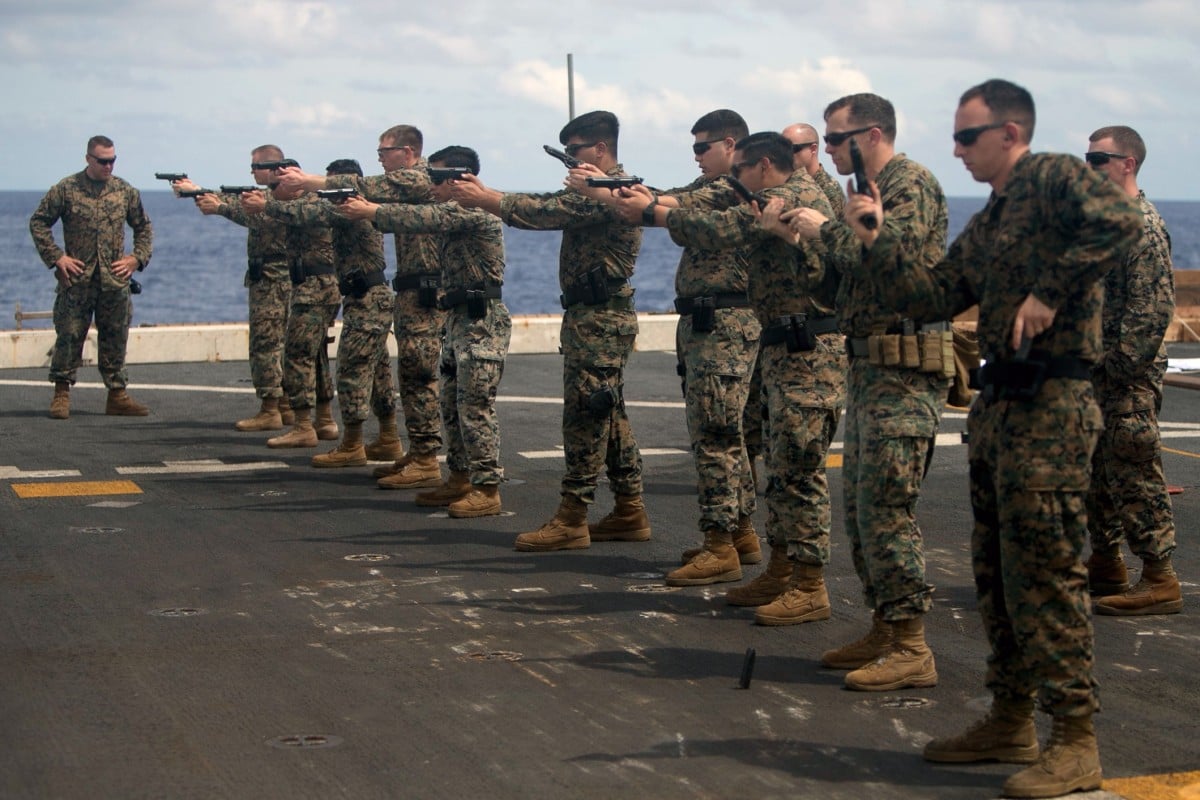
US Marines practise speed reloads on August 9 aboard the USS Green Bay, part of the Wasp Amphibious Ready Group, in the Indo-Pacific region. Photo: Handout
US Marines have conducted airfield- and island-seizure drills in the East and South China seas in what observers say is meant to remind Beijing of US military supremacy in the Asia-Pacific.
The 11-day naval drills were conducted near the Philippines and around the Japanese island of Okinawa by Okinawa-based US marine expeditionary units, the 31st Marine Expeditionary Unit said.
Observers said the operations were meant as a warning to Beijing that the US military could carry out amphibious campaigns far from home if Washington needed to intervene in territorial disputes between China and America’s allies in the region.
The 31st Marine Expeditionary Unit and Amphibious Squadron 11 conducted joint weapons drills from their Wasp Amphibious Ready Group ships from August 9-19, the Okinawa-based marine unit said in a statement.
The activity took place in the Philippine and East China seas and around an American naval base in Japan, it said.
The unit’s Amphibious Reconnaissance Platoon also performed a reconnaissance and surveillance mission through a high-altitude, low-opening parachute jump onto Okinawa.
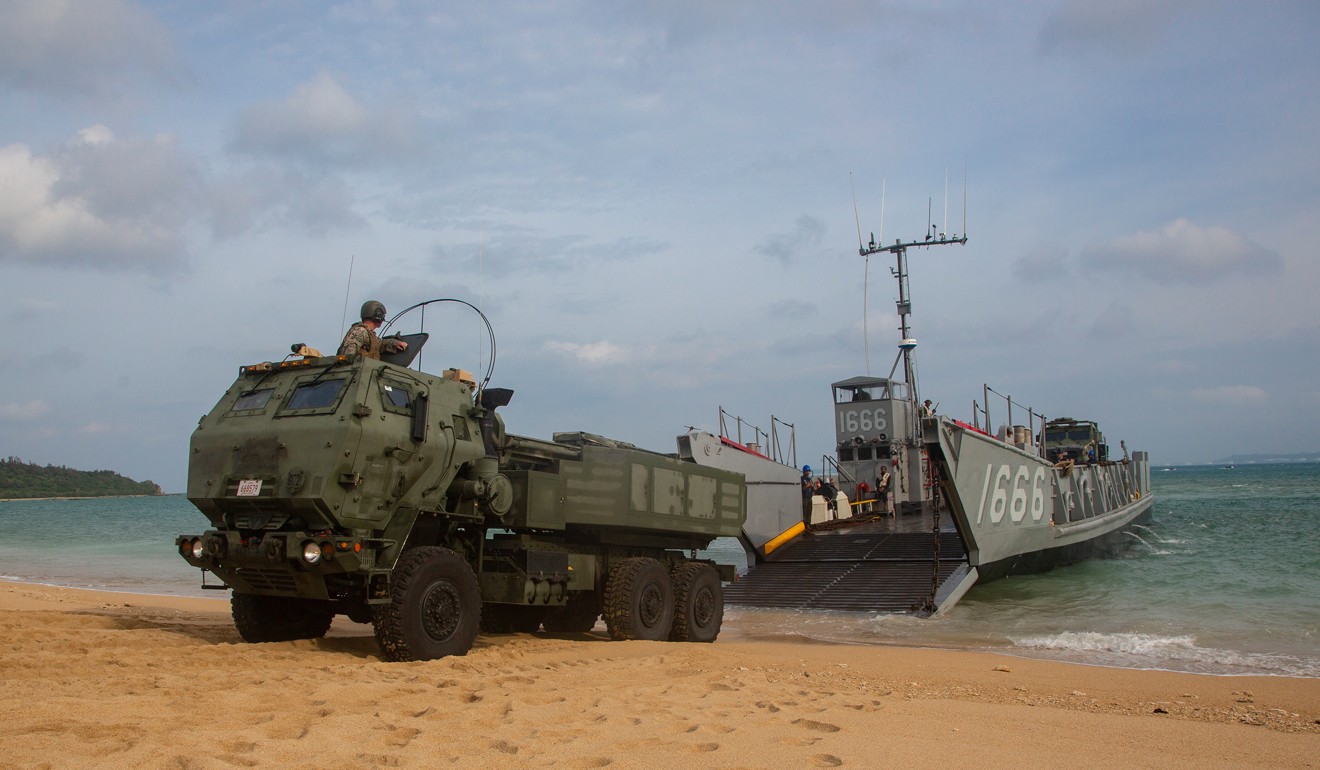
A tilt-rotor aircraft, which hovers like a helicopter but flies like an aeroplane, afterward sent a landing team from a Wasp ship more than 400km (250 miles) away to establish the arming and refuelling point. The team achieved its objective in just over one hour, the statement said.
“The speed with which the Marines were able to establish the forward arming and refuelling point demonstrates a capability that is critical to conducting expeditionary operations in a contested environment,” the statement quoted Lieutenant Guirong Cai, a FARP officer-in-charge from the Marine Air Traffic Control Mobile Team, as saying.
“Their proficiency in swiftly setting up a refuelling point with 5,500 pounds (2.5 tonnes) of fuel demonstrates the 31st MEU’s ability to rapidly refuel and redeploy our air assets as the mission requires.”
A US landing craft lowers its ramp to unload a high mobility artillery rocket system as part of a simulated amphibious raid at Kin Blue on Okinawa on August 14. Photo: Handout
China has a territory dispute with Japan over Diaoyu Islands, known as the Senkakus in Japan, in the East China Sea, while both Beijing and Manila have put in claims on the Scarborough Shoal – also known in China as Huangyan Dao – in the South China Sea.
Adam Ni, a China specialist at Sydney’s Macquarie University, said the drills near the Philippines and Okinawa showed that such a campaign would encompass a wide area, including the South and East China seas, where the US has joined other countries in the region to conduct freedom of navigation operations since 2015.
Maritime drills between US, Asean coincide with rising tensions
“It is a clear reminder to China of US military supremacy despite the narrowing of gaps in military capability in recent years,” Ni said. “The message is that the US military can still take China-controlled South China Sea features in high-intensity conflict.”
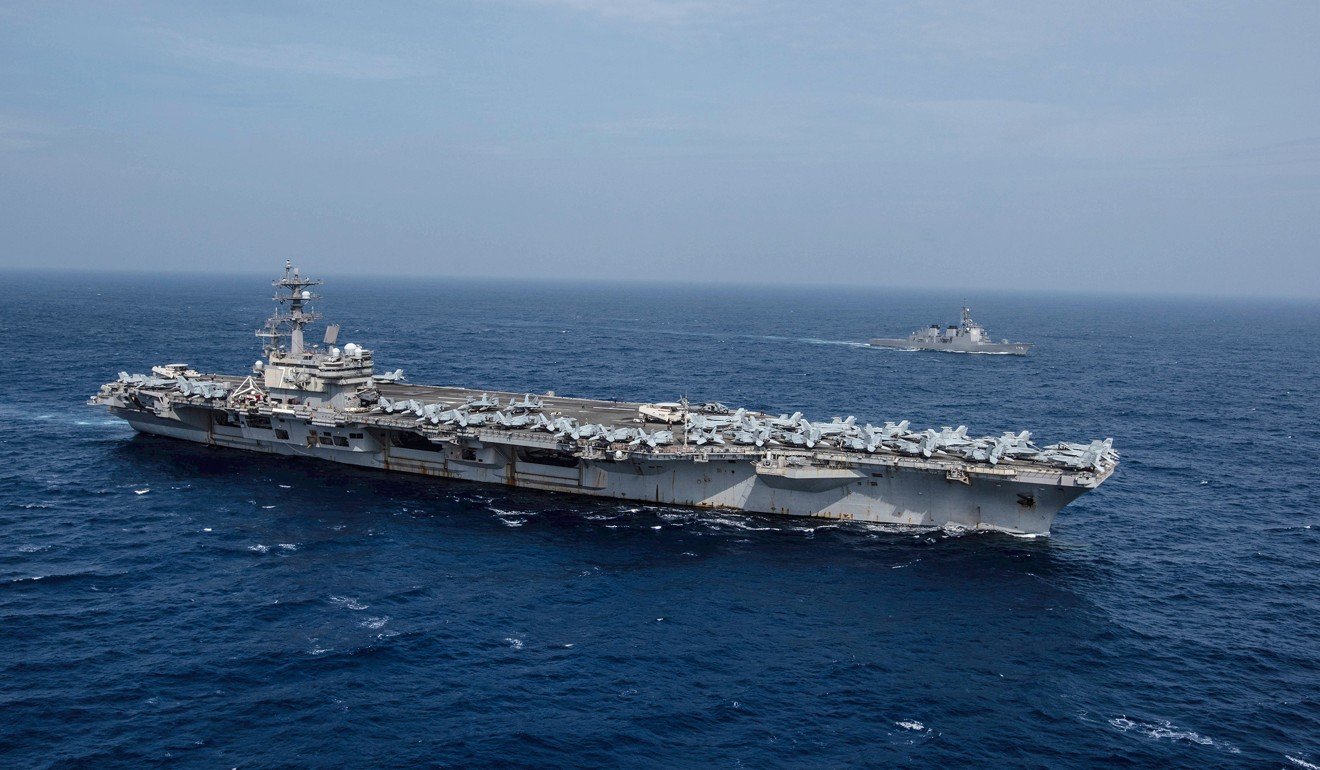
The USS Ronald Reagan aircraft carrier sails alongside a Japan Maritime Self-Defence Force guided-missile destroyer during drills. Photo: Handout
The statement did not say whether the Philippine navy and Japanese maritime self-defence force took part in the drills. But Hong Kong-based military commentator Song Zhongping said the US government would call on its two allies to observe the exercises.
“Whether Washington will intervene in territorial disputes between China and the Philippines as well as China and Japan, the American [military] has used [these drills] to strengthen its island-capture and airfield seizure capabilities in unfamiliar waters and areas,” Song said.
“To show its close relationship with and commitments to Manila and Tokyo, the Americans would invite the two allies to watch the drills. That could also be a good time to sell their amphibious warships and new model aircraft to Japan.”
During the drills, 10 simulated casualties were treated by three medical technicians from the US Air Force’s special operations group and given blood transfusions before being loaded onto a KC-130 transport aircraft for in-flight medical treatment en route to Marine Corps Air Station Futenma on Okinawa, the US Marines said.
Source: SCMP
Posted in 31st Marine Expeditionary Unit, Aircraft carrier, airfield- and island-seizure drills, America’s military edge, American naval base, amphibious campaigns, amphibious raid, Amphibious Reconnaissance Platoon, ASEAN, Asia-Pacific, Asia-Pacific drills, Beijing, China alert, Diaoyu Islands dispute, East China Sea, East China seas, guided missile destroyer, high mobility artillery rocket system, high-altitude, Huangyan Dao, Indo-Pacific region, Japan, Japan Maritime Self-Defence Force, Japanese island, Kin Blue, low-opening parachute jump, Macquarie University, Manila, Marine Air Traffic Control Mobile Team, Marine Corps Air Station Futenma, Marines, Maritime drills, Okinawa, Philippine Navy, Philippines, reconnaissance, remind, Scarborough Shoal, Senkakus, South China Sea, surveillance mission, Sydney, Uncategorized, US, US landing craft, US Marines, US military supremacy, USS Green Bay, USS Ronald Reagan, Washington, Wasp Amphibious Ready Group |
Leave a Comment »



 CHINDIA ALERT: You'll be living in their world, very soon
China set to join Arms Trade Treaty that Donald Trump threatened to abandon
China said it has begun preparations to join an international arms control treaty that the United States has threatened to abandon, while also warning Washington against deploying missiles in the Asia-Pacific region.
Speaking at the United Nations General Assembly in New York on Friday, Chinese Foreign Minister Wang Yi said that signing up to the Arms Trade Treaty (ATT) was further evidence of Beijing’s commitment to defending multilateralism.
said in April that he intended to withdraw from the pact, which regulates the US$70 billion global trade in conventional arms.
The White House said at the time that the ATT “will only constrain responsible countries while allowing the irresponsible arms trade to continue”, as major arms exporters like Russia and China were not part of it.
Wang said on Friday that any unilateral move to leave the treaty would have a “negative impact in various areas”. He stopped short of naming the United States or its president.
China’s foreign ministry said in a statement on Saturday that it had begun the legal process of joining the treaty, adding that it attached great importance to the issues caused by the illegal sale and misuse of arms, and supported the aims of the ATT in seeking to regulate the international weapons trade.
Wang also spoke out against the possible deployment of ground-launched missiles in the Asia-Pacific region.
According to figures released in May by the Stockholm International Peace Research Institute, the United States is the world’s largest arms exporter, supplying weapons worth 58 per cent more than those of its nearest competitor, Russia.
Together with France, Germany and China, the five nations accounted for 75 per cent of all weapons sold around the world between 2014 and last year, the institute said.
Although China is among the world’s big five arms suppliers, its sales – most of which go to Asia and Oceania – are dwarfed by those of the US, accounting for just 5.2 per cent of the 2014-18 total, compared to America’s 36 per cent.
Several major arms importers, including India, Australia, South Korea and Vietnam, refuse to buy arms from China for political reasons.
Beijing’s decision to join the ATT is in keeping with the image it has sought to present of China as a defender of multilateralism. The stance is also in sharp contrast to the US’ position under Trump, who has repeatedly scrapped multilateral trade agreements in favour of bilateral deals.
Since taking office in 2016, he has withdrawn the US from the Paris climate accord, the Iran nuclear deal and the Trans-Pacific Partnership.
Military observers said Beijing might seek to pressure on Washington to stay in the deal to try to maintain the strategic and military balance in the region.
Song Zhongping, a Hong Kong-based military affairs commentator, said Beijing might be trying to avoid misuse of conventional weapons.
“Beijing may want to press big exporters, such as the US and Russia, to join the deal because without proper regulations, the risk of illegal trade and misuse of conventional weapons could be running high,” he said.
“This could also threaten regional stability or even trigger unnecessary arms races.”
Adam Ni, a China specialist at Sydney’s Macquarie University, said the treaty would put some limits on the arms trade “but it would not mean that China would not be able to do deals. It will still be able to do [most deals]”.
Retired PLA colonel Yue Gang said the strategy could also improve China’s international reputation.
Source: SCMP
Posted in abandon, arms importers, Arms Trade Treaty, Asia, Asia-Pacific region, Australia, Beijing, China alert, deploying, dwarfed, Foreign Minister Wang Yi, France, General Assembly, Germany, global arms control treaty, India alert, Intermediate-Range Nuclear Forces Treaty, Iran nuclear deal, join, largest nuclear weapons, Macquarie University, military affairs commentator, Military observers, missiles, New York, Paris climate accord, political reasons, President Donald Trump, Russia, South Korea, Sydney, threatened, Trans-Pacific Partnership (TPP), Uncategorized, United Nations, United States, Vietnam, Washington, White House | Leave a Comment »